|
-- Weekly Market Update for the Week Commencing 13th August 2012
Big Picture
View
Here is a summary of our big picture
view of the markets. Note that our short-term views may differ from our
big picture view.
In nominal dollar terms, the BULL market in US Treasury Bonds
that began in the early 1980s will end by 2013. In real (gold)
terms, bonds commenced a secular BEAR market in 2001 that will continue
until 2014-2020. (Last
update: 23 January 2012)
The stock market, as represented by the S&P500 Index, commenced
a secular BEAR market during the first quarter of 2000, where "secular
bear market" is defined as a long-term downward trend in valuations
(P/E ratios, etc.) and gold-denominated prices. This secular trend will bottom sometime between 2014 and 2020. (Last update: 22 October 2007)
A secular BEAR market in the Dollar
began during the final quarter of 2000 and ended in July of 2008. This
secular bear market will be followed by a multi-year period of range
trading. (Last
update: 09 February 2009)
Gold commenced a
secular bull market relative to all fiat currencies, the CRB Index,
bonds and most stock market indices during 1999-2001. This secular trend will peak sometime between 2014 and 2020. (Last update: 22 October 2007)
Commodities,
as represented by the Continuous Commodity Index (CCI), commenced a
secular BULL market in 2001 in nominal dollar terms. The first major
upward leg in this bull market ended during the first half of 2008, but
a long-term peak won't occur until 2014-2020. In real (gold) terms,
commodities commenced a secular BEAR market in 2001 that will continue
until 2014-2020. (Last
update: 09 February 2009)
Copyright
Reminder
The commentaries that appear at TSI
may not be distributed, in full or in part, without our written permission.
In particular, please note that the posting of extracts from TSI commentaries
at other web sites or providing links to TSI commentaries at other web
sites (for example, at discussion boards) without our written permission
is prohibited.
We reserve the right to immediately
terminate the subscription of any TSI subscriber who distributes the TSI
commentaries without our written permission.
Outlook Summary
Market
|
Short-Term
(1-3 month)
|
Intermediate-Term
(6-12 month)
|
Long-Term
(2-5 Year)
|
| Gold
|
Bullish
(26-Mar-12)
|
Bullish
(26-Mar-12)
|
Bullish
|
| US$ (Dollar Index)
|
Neutral
(28-May-12)
| Neutral
(09-Jan-12)
|
Neutral
(19-Sep-07)
|
| Bonds (US T-Bond)
|
Bearish
(02-Jul-12)
|
Neutral
(18-Jan-12)
|
Bearish
|
| Stock Market
(DJW)
|
Bearish
(30-Jul-12)
|
Bearish
(28-Nov-11)
|
Bearish
|
| Gold Stocks
(HUI)
|
Bullish
(26-Mar-12)
|
Bullish
(23-Jun-10)
|
Bullish
|
| Oil | Neutral
(30-Jul-12)
| Neutral
(31-Jan-11)
| Bullish
|
| Industrial Metals
(GYX)
| Neutral
(30-Jul-12)
| Neutral
(29-Aug-11)
| Neutral
(11-Jan-10)
|
Notes:
1. In those cases where we have been able to identify the commentary in
which the most recent outlook change occurred we've put the date of the
commentary below the current outlook.
2. "Neutral", in the above table, means that we either don't have a
firm opinion or that we think risk and reward are roughly in balance with respect to the timeframe in question.
3. Long-term views are determined almost completely by fundamentals,
intermediate-term views by
fundamentals, sentiment and technicals, and short-term views by sentiment and
technicals.
The irrelevance of
currency reserves
Last week we wrote: "The reserves held by a central bank have no influence on the associated currency's purchasing power and very little influence on its exchange rate. Today's currencies are not 'backed' by central bank reserves. The reserves are holdovers from a previous monetary system and are anachronistic under today's system." Here's what we meant:
A currency's purchasing power and its value relative to other currencies is determined by supply and demand. These days, the supply of no major currency is limited in any way by the associated central bank's reserves. This means that currency reserves have no effect on the supply side of the equation. But what about demand? Would an increase or decrease in the FX reserves held by a central bank significantly alter the investment demand for the currency 'managed' by that central bank?
We don't see how. The real return that can be earned by making loans or investments denominated in a particular currency isn't affected by changes in the reserves held by the associated central bank. It could be argued that investors focused on safety might gravitate towards the currency of a country with substantial FX reserves, but the fact that investors flee to the US$ in times of trouble negates that argument. After all, the Fed has no currency reserves to speak of apart from 263M ounces of gold with a current market value of about $420B. This is less than 5% of the US True Money Supply.
With central banks having unlimited ability to inflate the money supply and exerting considerable control over interest rates, it is clear that central bank policy can strongly influence both currency supply and currency demand. Central bank policy is therefore an important determinant of a currency's purchasing power and exchange rate. And of particular relevance to the present topic, this policy is not constrained in any way by the quantity of FX reserves unless the central bank is attempting to maintain a fixed exchange rate. Furthermore, even in those rare cases where a central bank attempts to maintain a fixed exchange rate between its currency and another currency, the success of the policy relies more on the manipulation of money supply and interest rates than on FX reserves.
As we stated last week, currency reserves are a holdover from an earlier time and a previous monetary system. Moreover, in the earlier time that we are referring to the reserves constituted the actual money while the pieces of paper that often circulated within the economy were money substitutes. For example, when the US was on something close to a genuine gold standard during the last quarter of the 19th Century, pieces of paper known as dollars circulated within the economy. But the paper dollars weren't money. They were, instead, receipts for money (gold). There were a lot more receipts for gold than actual gold, but that's a separate issue.
Under the current monetary system the reserve concept has no meaning. Money doesn't need to be 'backed' by anything. Only money substitutes need to be backed -- by the actual money. The dollar (or euro or whatever) notes that you have in your wallet are not money substitutes, they are money and therefore do not require any backing in order to have value. Regardless of whether or not they have so-called 'backing' in the form of currency reserves, their value will be determined by changes in supply/demand as well as by the laws that force people to use them. As money they really only have two drawbacks: their supply can be arbitrarily increased by the government-banking partnership and they have no use outside of their role as money. Due to these drawbacks they would not be money in the absence of government coercion.
The Stock
Market
Time for selling, if you bought
In the 25th June Weekly Update, under the heading "Buying opportunities are beginning to crop up", we wrote:
"The gold sector is offering up the best buying opportunities at this time, but the market-wide price declines of the past three months have also created good buying opportunities elsewhere. Consequently, there is no need to put all of your eggs in a single gold-coloured basket.
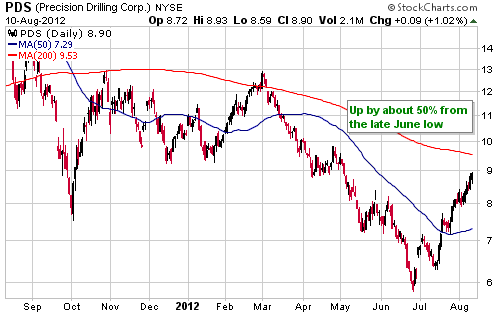
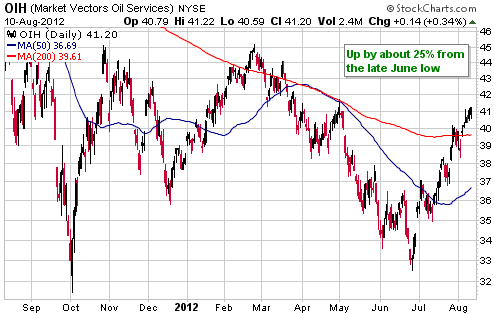
The O&G (oil and gas) service sector is one area of the stock market that offers substantial long-term upside potential and is now sufficiently 'oversold' to establish an attractive short-term reward/risk ratio."
We then singled out Precision Drilling (PDS) and the Oil Services ETF (OIH) as likely candidates for playing a rebound in the beaten-down O&G services sector. Due to the rebounds that have since occurred, the short-term buying opportunities of 6-7 weeks ago have been replaced by short-term selling opportunities.
Current Market Situation
The three senior US stock indices (the SPX, the NDX and the Dow) are testing their March-April highs. They haven't yet done anything to signal that secondary peaks are in place, so some additional upside could be in store. If additional gains are made it will be interesting to see if all three are able to make new highs for the year, as a failure of at least one to make a new high would be a significant non-confirmation.
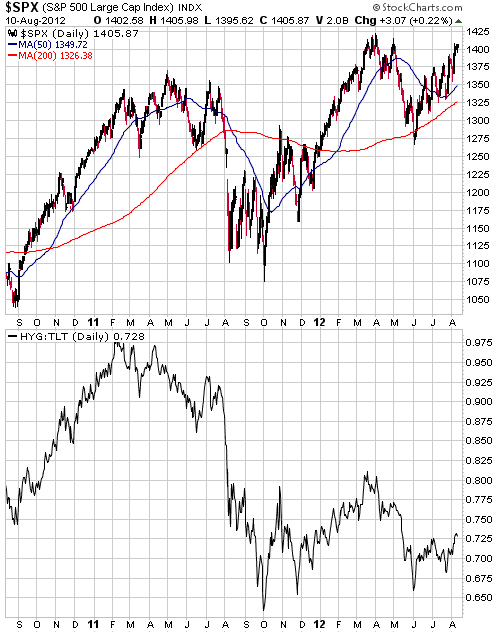
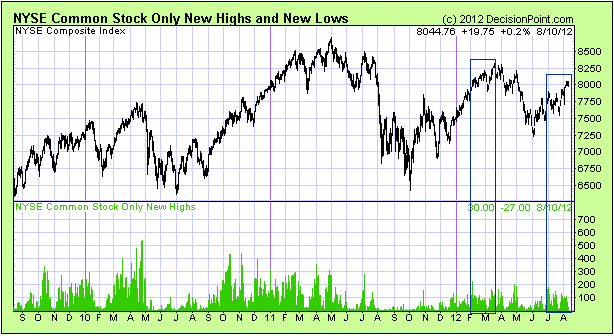
There are already some significant bearish non-confirmations and divergences in place, such as the divergence between the SPX and the RUT/SPX ratio that we've mentioned in previous commentaries. Two others worth noting are illustrated by the charts displayed below.
The first chart shows that while the HYG/TLT ratio (a measure of credit-market risk aversion) has continued to trend up and down with the SPX as it almost always does, it has been much weaker than the SPX over the past year and has struggled to make any headway since bottoming at the beginning of June.
The second chart shows that the number of individual NYSE stocks making new 52-week highs has diverged from the NYSE Composite Index since early July in similar fashion to the way it diverged between early February and mid March of this year. This chart tells us that the recent rally has become increasingly narrow the further it has progressed.
Downside risk is unusually high, but this doesn't necessarily mean that a major decline is about to begin. One plausible outcome is that a major decline will begin this month. Another is that there will soon be a sharp 2-4 week correction followed by another test of the March-April highs in October-November, after which a major decline will begin.
This week's
important US economic events
| Date |
Description |
| Monday Aug 13 | No
important events scheduled
| | Tuesday Aug 14 | PPI
Retail Sales
Business Inventories
| | Wednesday Aug 15 | CPI
Industrial Production
Empire State Mfg Survey
TIC Report | | Thursday
Aug 16 |
Housing Starts
Philadelphia Fed Survey
|
| Friday Aug 17 | Consumer
Sentiment
Leading Economic Indicators
|
Gold and
the Dollar
Gold
Gold Market Sentiment
Market Vane's bullish percentage for gold is around 60, which is up by about 10% from the lows of the past three months but still qualifies as depressed (meaning: supportive). The relatively low proportion of traders that Market Vane's survey identifies as bullish meshes with the Commitment of Traders (COT) numbers, which reveal that the total speculative net-long position in COMEX gold futures remains near a 3-year low.
The sentiment situation doesn't tell us that a rally will soon happen. It does, however, tell us that sentiment is still a tailwind (a supportive factor). The current sentiment backdrop mitigates downside risk and creates upside potential because trend-following speculators are not yet heavily involved on the 'long' side.
Current Market Situation
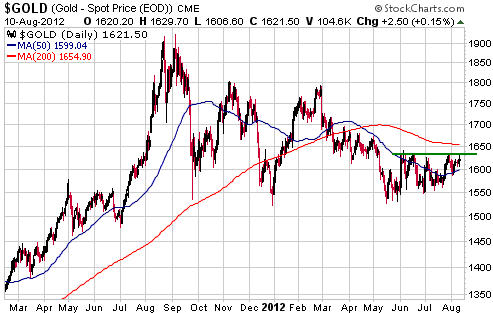
Still not a lot happening to the US$ gold price, although the market appears to be gradually building up strength. Resistance at $1630-$1640 has now been tested numerous times, most recently during last Friday's US trading session. This repeated testing will have weakened the resistance. Consequently, the odds favour an upside breakout in the near future.
The sentiment picture suggests that an upside breakout would come as a surprise to many traders. It would therefore likely prompt a quick reassessment and sufficient reactionary buying to push the price $100-$150 higher over the ensuing weeks.
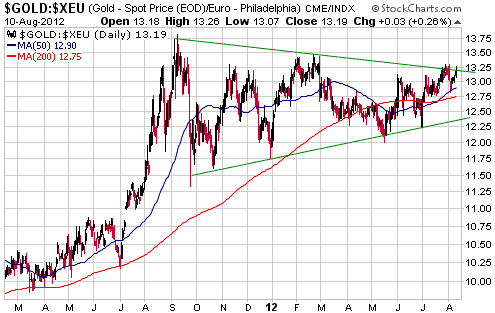
The euro-denominated gold price (gold/euro) is also close to an upside breakout, but on a larger scale. Gold/euro is close to signaling an end to the intermediate-term correction that began almost 12 months ago.
Gold Stocks
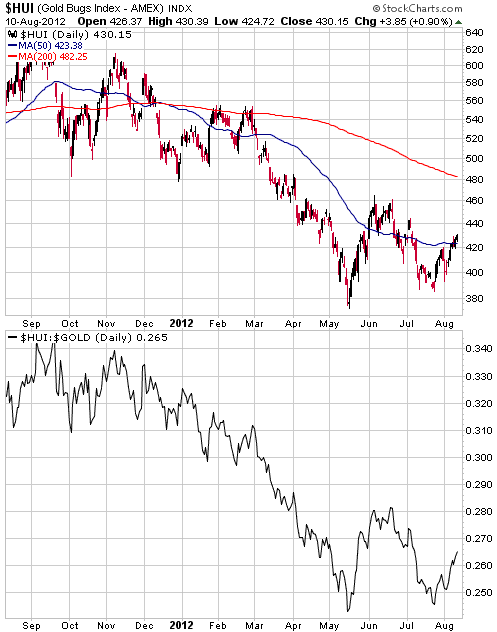
The following daily chart shows that both the HUI and the HUI/gold ratio bottomed in mid May, rebounded into the early part of June, and then pulled back to slightly higher lows in the second half of July. Our view is that this price action is part of a new intermediate-term upward trend, but this view won't be confirmed until the HUI breaks above its early-June peak.
It is a plus that recent short-term trends in the HUI/gold ratio have matched short-term trends in the HUI, because it means that gold stocks are trading like leveraged plays on the gold price. If this keeps up then a rise of, say, 10% in the gold price over the next several weeks will be accompanied by a much greater percentage rise in the HUI.
Substantial strength in the gold mining stocks relative to gold bullion will most likely be necessary for the HUI to reach our target of 550 by October, the reason being that gold probably won't make a new all-time high anytime soon. If gold does no better than rise to around $1800 over the next three months then the HUI/gold ratio will have to rise to around 0.31 in order for our HUI upside target to be achieved. This appears to be a bit of a stretch, but a rise of this magnitude is certainly not out of the question.
Currency Market Update
The Dollar Index has been unusually choppy over the past year. Short-term corrections during a more typical intermediate-term US$ advance would end in the vicinity of the 50-day moving average (MA), but the following daily chart shows that there have several declines to well below the 50-day MA over the course of the current intermediate-term advance. This makes it more difficult than usual to obtain useful information from the Dollar Index's price action. To be more specific, the larger-than-usual price swings make it more difficult to differentiate a routine correction to the upward trend from a trend reversal.
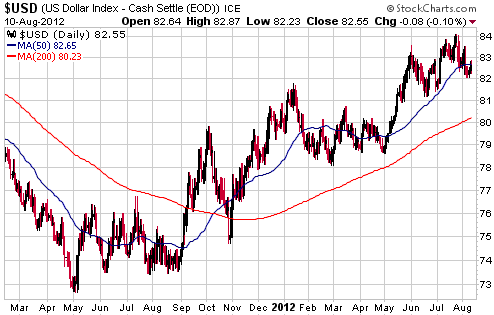
The intermediate-term upward trend in the Dollar Index is related to the intermediate-term downward trend in global equities. That's why the May-2011 multi-year low in the Dollar Index coincided almost to the day with a multi-year high in the Dow Jones World Stock Index (DJW). Consequently, we don't expect the Dollar Index to make a high that will hold for more than a few months until the DJW reaches an intermediate-term bottom. We therefore expect the Dollar Index to make additional gains before it reaches an intermediate-term peak. However, we do not have a strong opinion on what will happen to the dollar over the next several weeks.
One plausible scenario is that the Dollar Index will make a correction low this month and then resume its intermediate-term upward trend. This becomes the most likely scenario if the next major downward leg in global equities begins during August. Another plausible scenario is that the Dollar Index will consolidate for 2-3 months before resuming its intermediate-term upward trend. This becomes the most likely scenario if the stock market's topping process extends into the final quarter of the year.
Update
on Stock Selections
Notes: 1) To review the complete list of current TSI stock selections, logon at
http://www.speculative-investor.com/new/market_logon.asp
and then click on "Stock Selections" in the menu. When at the Stock
Selections page, click on a stock's symbol to bring-up an archive of
our comments on the stock in question. 2) The Small Stock Watch List is
located at http://www.speculative-investor.com/new/smallstockwatch.html
 Company news/developments for the week ended Friday August 10th 2012: Company news/developments for the week ended Friday August 10th 2012:
*Endeavour Mining (EDV.TO, EVR.AX) reported its financial results for the June quarter. Production and costs for the quarter had been reported in mid July, so last week's report didn't contain much in the way of significant new information. That being said, the company generated a lot more cash during the quarter than we were expecting, which is obviously a plus. Also, included with the financial results was a note that the company has been granted the permit it needs to start the construction of its 100K-oz/yr Agbaou mine in Cote d'Ivoire.
We suspect that these results would have boosted EDV's stock price by 5%-10% if not for the AVR acquisition announced at the same time. The AVR acquisition news temporarily trumped all other considerations and caused the stock price to plunge 17% during the ensuing trading day.
*Evolution Mining (EVN.AX) CEO Jake Klein gave a presentation at the Diggers and Dealers conference on 6th August. The presentation, which can be downloaded at
http://www.evolutionmining.com.au/_content/documents/678.pdf, covered the company's recent results and growth forecast. The presentation also a) touched on some of the same reasons for gold stock under-performance that were addressed in detail by the CEO of Gold Fields Ltd. in a speech to the Melbourne Mining Club on 31st July (as discussed in last week's Interim Update), b) emphasised the importance of EVN's low political risk at a time when investors are becoming more concerned about "resource nationalism", and c) cited the fact that it is becoming increasingly difficult and expensive for single-asset mining companies to get financing (EVN has five mines, each with current or expected future gold production of about 100K ounces/year).
*Fairborne Energy (FEL.TO), a natural gas producer, reported a large ($44M) loss for the June quarter. With the natural gas (NG) price near a 10-year low and with FEL's profitability being leveraged to the NG price, the big quarterly loss was neither surprising nor a big deal. At this stage the key measure of FEL's situation is its balance sheet, and here the results were remarkably positive considering the low NG price. Specifically, during the June quarter FEL's net debt (working capital deficit plus long-term debt) fell from $286M to $191M. $80M of this improvement was due to an asset sale, which means that FEL's operations generated about $15M of cash despite the extraordinarily low gas price. We are comfortable with this performance.
FEL's upside potential is linked to the potential for additional gains in the NG price and corporate activity (asset sales or a takeover bid).
*Jaguar Mining (JAG) announced that it has completed the first phase of a three-phase cost-reduction program. This phase included putting the Paciencia mine on care and maintenance and reducing G&A expenses by 40%. The final phase of the cost-reduction program is scheduled to be completed in Q1-2013.
JAG's stock price has rebounded strongly from last month's low. A more meaningful rebound from the perspective of those who are 'long' from much higher levels will probably require strengthening of the company's balance sheet, which, in turn, will probably require the sale of one of its operating mines or its exploration-stage Gurupi project.
*Pinetree Capital (PNP.TO) reported its financial numbers for the June quarter. There was nothing new of significance, because the most important number (the per-share net asset value) was reported a month earlier. The NAV at 30 June was C$1.74/share. It is probably still around this level.
*Pretium Resources (PVG.TO, PVG) announced a small financing: 1M flow-through shares at C$18/share. The $18M raised via this financing will be used to accelerate drilling at the Brucejack project's "Valley of the Kings" zone. Drilling news will be coming thick and fast from PVG through to year-end.
*Ramelius Resources' (RMS.AX) presentation from the Diggers and Dealers conference is posted
HERE.
*Sabina Gold and Silver (SBB.TO) announced exceptional drilling results from the Umwelt deposit at its Back River project, including 51.93-g/t gold over 16.1m. These drilling results and the resultant pop in the stock price to around C$3.00 rewarded those who bought SBB when it traded well below C$2 last month. The market's reaction to the news might also have created a price peak that will hold for a few weeks, although that will depend on the overall market and whether or not SBB announces more good results in the near future.
*UEX (UEX.TO) reported drilling results from its 49%-owned Shea Creek uranium project in the Athabasca Basin of northern Saskatchewan. Areva owns the other 51% of the project and is the project operator. The results were positive, but not significant with respect to UEX's speculative merits.
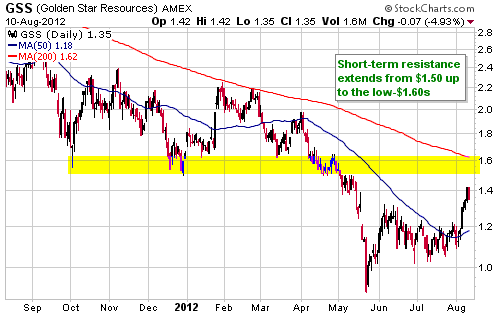
Golden Star Resources (NYSE: GSS, TSX: GSC). Shares: 259M issued, 265M fully diluted. Recent price: US$1.35
GSS reported its production and costs for the recently completed quarter last month. At that time it also issued updated (in this case meaning downgraded) production guidance for the full year. Consequently, there isn't much in the way of important new information in the Q2 financial results issued by GSS last week. There are, however, a few points worthy of comment:
First, the company had operating cash flow of $17.6M and a net profit of $2.5M during the quarter. A $2.5M profit is not much, but any profit is better than a loss.
Second, production costs were a little lower than expected and materially lower than the preceding quarter's costs. Any improvement is obviously welcome and makes a pleasant change.
Third, as a result of the May re-financing and cash generated by operations, the company's balance sheet is now much stronger than it was a few months ago. In particular, GSS has gone from a working capital deficit of $27M to a working capital surplus of $65M. This balance-sheet improvement has reduced the risk at the cost of a higher future share count.
GSS has rebounded strongly from its May low, which reflects the extent to which the stock was under-valued and 'oversold' when it traded below US$1. At that time the market was discounting everything that had gone wrong in the past, everything that had a realistic chance of going wrong in the future, and then some. Last month's disappointing downward revision to full-year production guidance didn't cause the stock price to fall because the worst case had already been factored in, while the improvement in the company's financial position reflected by the quarterly report issued last week indicates that a turnaround has possibly begun.
We are sceptical that a sustainable turnaround has begun. How could we not be, given the record of GSS's management? We remain interested, though, because despite the recent rebound the stock remains extremely under-valued by some measures. For example, Resolute Mining (RSG.AX) is roughly the same size as GSS, operates in the same part of the world (West Africa) and is clearly under-valued at its current price, but GSS's stock price would have to gain about 70% from its current level just for its production and in-ground resources to attain the same low valuations now being assigned to those of RSG.
There is always a legitimate reason for extreme under-valuation and in GSS's case the main reason is the high production cost. The long line of missed growth forecasts is also a factor, but it's the high production cost that creates obvious risk and has the biggest negative effect on both the profitability of the business and the investment demand for the stock. This is especially so when the gold price is directionless and periodically threatening to break out to the downside.
For a gold mining company with a cash cost below $700/oz a decline in the gold price from $1600 to $1300 is an inconvenience, but such a gold price decline could be life-threatening for a company with a cash cost in excess of $1100/oz. The other side of the coin is that a high production cost creates substantial upside leverage to gold, provided that the cost remains at a high plateau and doesn't trend upward with the gold price.
GSS was a better buy a few weeks ago than it is now, but a pullback to the mid-US$1.20s could reasonably be viewed as another buying opportunity. There is short-term resistance at US$1.50-$1.60. Depending on overall exposure, it may be appropriate for buyers of the stock near its lows of the past three months to take partial profits in this resistance range.
Kinross Gold (KGC). Recent price: US$8.24
KGC is not a TSI stock selection, but there are KGC warrants and options in the TSI List so we are going to comment on the quarterly results reported by the company last week.
Production was in line with the company's forecast and is on track to meet the earlier 2012 full-year guidance of 2.5M-2.6M ounces. However, the cost of gold production during 2012 is now expected to be about $20/oz more than the earlier guidance. As an aside, the average gold price received by KGC in Q2-2012 was about 8% higher than the average gold price received in Q2-2011 whereas the cost of the company's gold production rose by 27% over the same period. KGC is therefore a good example of a higher gold price not translating into higher gold-mining profitability.
Nobody who has been paying attention would have been expecting KGC to announce good operating results at this time. We certainly weren't. The low expectations that are now built into the company's stock market valuation explain why KGC was one of the best-performing major gold stocks over the two trading days following last week's announcement of so-so results.
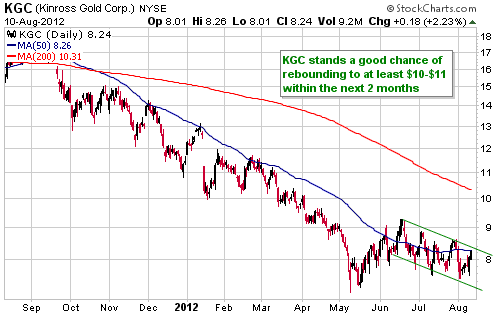
KGC is a very under-valued stock with outsized upside potential (relative to other major gold producers) stemming from one or more of the following possibilities:
1) A future operational turnaround
2) A takeover
3) A breakup of the company (the sum of the market values of KGC's parts is probably much greater than the market value of the company in its current form)
4) A multi-hundred-dollar increase in the gold price
There's a good chance that at least one of these will happen well before our options and warrants expire in 2014.
Our main immediate concern is that the company maintains a healthy balance sheet. The balance sheet included with last week's quarterly report can be described as healthy, in that it showed working capital of $1495M and net cash (working capital minus long-term debt) of $347M. However, it isn't as healthy as it was at the end of 2011. Despite generating $610M of operating cash flow during the first half of 2012 and receiving a cash injection of $220M from the sale of its 50% stake in the Crixas project, net cash on the company's balance sheet declined by $375M over the course of this year's first half. The main reason was the additional $680M invested in "property, plant and equipment". This type of investment is fine, as long as it leads to more profits in the future.
Chart Sources
Charts appearing in today's commentary
are courtesy of:
http://stockcharts.com/index.html
http://www.decisionpoint.com/

|









