|
-- Weekly Market Update for the Week Commencing 14th May 2007
Big Picture
View
Here is a summary of our big picture
view of the markets. Note that our short-term views may differ from our
big picture view.
Bonds commenced a secular BEAR market in
June of 2003. (Last
update: 22 August 2005)
The stock market, as represented by the S&P500 Index, commenced a secular BEAR market during the first quarter of 2000. The rally
that
began in October of 2002 will end during the first half of 2007. The ultimate bottom of
the secular bear market won't occur until the next decade. (Last update: 02 October 2006)
The Dollar commenced a secular BEAR market during the final quarter of 2000. The
first major downward leg in this bear market ended during the first
quarter of 2005, but a long-term bottom won't occur until 2008-2010. (Last update: 28 March 2005)
Gold commenced a
secular bull market relative to all fiat currencies, the CRB Index,
bonds and most stock market indices during 1999-2001. The first major
upward leg in this secular bull market ended in December of 2003, but a
long-term peak won't occur until at least 2008-2010. (Last update: 13
February 2006)
Commodities, as
represented
by the CRB Index, commenced a secular BULL market in 2001. The first
major upward leg in this bull market ended during the second quarter of
2006, but a long-term
peak won't occur until at least 2008-2010. (Last update: 08 January 2007)
Copyright
Reminder
The commentaries that appear at TSI
may not be distributed, in full or in part, without our written permission.
In particular, please note that the posting of extracts from TSI commentaries
at other web sites or providing links to TSI commentaries at other web
sites (for example, at discussion boards) without our written permission
is prohibited.
We reserve the right to immediately
terminate the subscription of any TSI subscriber who distributes the TSI
commentaries without our written permission.
Outlook Summary
Market
|
Short-Term
(0-3 month)
|
Intermediate-Term
(3-12 month)
|
Long-Term
(1-5 Year)
|
Gold
|
Bullish
(02-May-07)
|
Neutral
(23-Apr-07)
|
Bullish
|
US$ (Dollar Index)
|
Bullish
(23-Apr-07)
| Bullish
(31-May-04)
|
Bearish
|
Bonds (US T-Bond)
|
Neutral
(26-Mar-07)
|
Bearish
(26-Mar-07)
|
Bearish
|
Stock Market (S&P500)
|
Neutral
(19-Mar-07)
|
Neutral
(26-Mar-07)
|
Bearish
|
Gold Stocks (HUI)
|
Bullish
(02-May-07)
|
Neutral
(23-Apr-07)
|
Bullish
|
| Oil | Neutral
(12-Mar-07)
| Neutral
(25-Sep-06)
| Bullish
|
Industrial Metals (GYX)
| Neutral
(15-Jan-07)
| Neutral
(26-Mar-07)
| Bullish
|
Notes:
1. In those cases where we have been able to identify the commentary in
which the most recent outlook change occurred we've put the date of the
commentary below the current outlook.
2. "Neutral", in the above table, means that we either don't have a
firm opinion on which way the market will move or that we expect the
market to be trendless during the timeframe in question.
3. Long-term views are determined almost completely by fundamentals,
intermediate-term views by giving an approximately equal weighting to
fundmental and technical factors, and short-term views almost
completely by technicals.
Is the long-term equity bull still alive?
In
a world where money can be created in unlimited quantities 'out of thin
air' it is vital to differentiate between a bull market in an asset and
a bear market in the currency in which the asset is priced, but
differentiating can be a challenge because an upward price trend for
the asset will be the likely result in both cases.
Richard Russell is one of the most astute stock market
observers/commentators around so we hesitate to single him out for
criticism, but the recent dramatic change to his big picture view of
the US stock market provides us with the ideal opportunity to re-visit
what we consider to be the financial world's most important long-term
chart. But first, to make sure everyone is on the same page we've
included, below, an excerpt from Mr Russell's 9th May daily report.
"The first phase of the
bull market occurred during 1982 to probably 1987. This is the phase
where the big money investors took their early positions. The erratic
and complex second phase began around 1987, and may still be in force.
The second phase is the phase in which the public participates -- to
varying degrees. The second phase is usually the longest phase, and
it's characterized by one or more (often more) frightening secondary
reactions which are almost always mistakenly taken to be primary bear
markets.
The 2000 to 2002 collapse
reminds me very much of the frightening decline of 1957-58, which was
widely taken to be a bear market. I turned very bullish at the end of
1957, and that's when I started Dow Theory Letters.
The second phase of the
bull market may still be in force, it's difficult to tell. I suspect
we're now nearing the end of the second phase, and the period ahead may
be ("should be") accompanied by some erratic and confusing action with
very probably a secondary correction.
If we are, in fact, close
to the end of the second phase of this huge bull market, then between
now and the fourth quarter of 2007 we could see a serious correction, a
correction that would serve to turn the public from their current
skepticism to extreme bearishness. This would serve to prepare the
stock market for the final third phase of the bull market.
The third phase of a bull
market is usually the most profitable of the three phases. The third
phase sees the public come into the stock market in full force and with
"both feet." I believe a coming third phase will be international in
character and in speculative intensity it will go beyond anything we've
seen before."
Prior to last week Mr Russell had spent years explaining that US
equities were in the midst of a secular BEAR market, with the 2000-2002
decline being the bear market's first downward leg. However, he now
suspects that the 2000-2002 decline was a sharp correction within the
context of a secular BULL market and that the most lucrative phase of
the long-term bull market lies ahead of us. Furthermore, he now likens
the 2000-2002 decline to the severe bull market correction that
occurred during 1957-1958.
Just to be clear, we have absolutely no problem with someone altering
their opinion in response to evidence that clearly points to an error
in their logic. In fact, we hope to have the good sense to change our
own opinions in situations where new evidence proves us wrong. What we
have a problem with is the REASON given by Mr Russell for his opinion
change.
In a world where money can be created in unlimited quantities 'out of
thin air' it is vital to differentiate between a bull market in an
asset and a bear market in the currency in which the asset is priced,
but differentiating can be a challenge because an upward price trend
will be the likely result in both cases. The doubling of an asset's
price could, for example, be due to a) the asset becoming worth twice
as much in real terms, b) the currency in which the asset is priced
losing half of its purchasing power, or c) some combination of
increased real value on the part of the asset and decreased value on
the part of the currency. The point is that from an investment
perspective there is a big difference between a real price increase and
an inflation-fueled price increase.
Which brings us to the main reason for Mr Russell's change of heart:
last month's simultaneous moves to new nominal price highs by the Dow
Industrials Index, the Utility Index and the Transportation Index.
Mr Russell is taking the concurrent moves to new all-time highs by the
aforementioned indices as confirmation that the bull market of the 80s
and 90s is still alive and that much higher prices lie ahead. Well,
it's true that much higher prices may lie ahead but if the higher
prices are solely the result of inflation (growth in the money supply)
then they will NOT be indicative of an on-going secular bull market in
US equities; they will, instead, be the result of a US$ bear market.
To illustrate our point using an extreme example, the hyperinflation of
the early-1920s caused the German stock market to gain more than one
TRILLION percent in nominal currency terms while it was collapsing in
real terms. During this period German equities were immersed in a major
BEAR market, but had there been the equivalent of the Dow Industrials
Index, the Dow Utility Index and the Dow Transportation Index within
that market at that time then these indices would undoubtedly have been
making new highs almost every day (almost every hour, actually).
So, how do we ever know whether the long-term stock market trend is bullish or bearish?
We can never know for certain because, as discussed in the past, any
market's current trend is always a matter of opinion. However, it is
generally possible to 'see' the real long-term trend by looking at
things in terms of valuations and gold-denominated prices, rather than
dollar-denominated prices. This is where the financial world's most
important long-term chart comes into play.
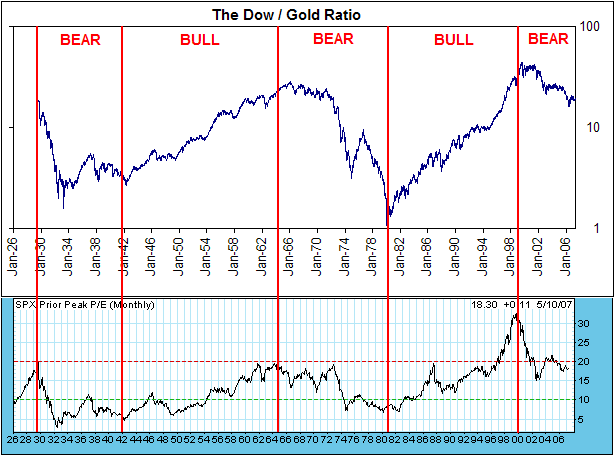
The chart we are referring to is included below. The top part of the
chart shows the Dow/gold ratio and the bottom part of the chart shows
the S&P500's price/peak-earnings ratio. Not coincidentally,
long-term trends in the US stock market's average valuation (as
represented here by the S&P500's P/E ratio) are similar to
long-term trends in the Dow/gold ratio. Note, in particular, that if
investors believe that earnings growth is being fueled more by
inflation than by real/sustainable improvement then they will pay less
for each dollar of earnings (P/E ratios will fall) and there will be
greater investment demand for gold (the gold price will rise relative
to the Dow).
Looking at this chart we are left with little doubt that long-term
downward trends in the Dow/gold ratio and the average stock market
valuation commenced during 1999-2001; that is, we are left with little
doubt that US equities are about 7 years into a secular bear market.
Furthermore, when looked at in valuation and gold terms the situation
during 2000-2002 could hardly be more different to the situation during
1957-1958. In 1958 Mr Russell was right to turn bullish on the stock
market because at that time valuations were relatively low and rising.
Now, however, they are relatively high and falling.
The bottom line is
that if you use the dollar or any other non-redeemable currency as your
measuring stick then you stand a good chance of being hoodwinked by
inflation. In our opinion, Mr Russell has just been hoodwinked.
The Stock
Market
The Euro/Yen Factor
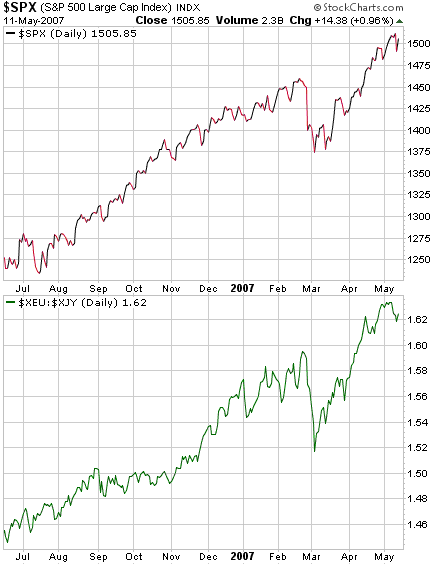
It's worth re-visiting the following chart comparison of the S&P500
Index and the euro/Yen exchange rate because it neatly encapsulates
what's happening in the financial world at this time. Notice the
closeness of the relationship between the US stock market and euro/Yen.
Even the minor twists and turns line up quite well.
Even though our chart shows the US stock market, we could have made the
same point using almost any of the world's stock markets. Clearly,
strength in the euro relative to the Yen is somehow linked to strength
in equities. And during the brief period earlier this year when the Yen
suddenly rallied against the euro, equity prices momentarily became
very weak.
It's reasonable to
expect that the next substantial Yen rally will be associated with a
sharp stock market decline. However, a non-leveraged position in the
Yen probably wouldn't be an effective hedge against the effects of a
Yen rally on an equity portfolio. The reason is that a rally in the
Yen, when it eventually occurs, will likely have an outsized effect on
the markets that have been elevated by low-priced Yen credit. And
someone who takes a leveraged position in the Yen will be putting
himself/herself in the position where a Yen plunge would create a big
problem, so this is also not the way to go.
In our opinion it makes sense for part of an investor's cash position
to be Yen-denominated simply because the Yen is a very under-valued
currency, but we wouldn't specifically buy Yen (or Yen futures or Yen
options) to hedge against the downturns in other markets that will
likely occur when the Yen carry trade eventually begins to unwind.
Current Market Situation
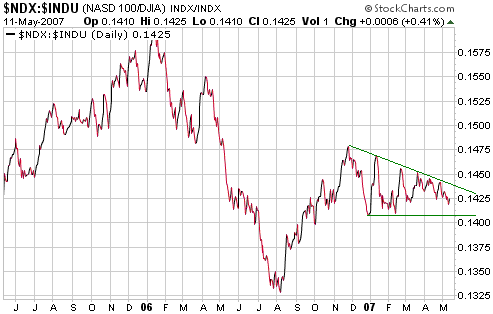
Below is a chart of the NDX/Dow ratio (the NASDAQ100 Index divided by
the Dow Industrials Index), one of the most reliable leading indicators
of the broad US stock market's intermediate-term trend.
The weakness in NDX/Dow from late November through to mid February in
the face of general stock market strength was a warning that things
were not as bullish as they seemed on the surface, while NDX/Dow's
resilience during the February-March decline was a sign that this
decline would not evolve into an intermediate-term correction.
We would describe NDX/Dow's current situation as neutral. It has been
slowly drifting lower over the past several weeks and has therefore
failed to confirm the stock market's rally to new multi-year highs, but
the downward drift does not YET qualify as a bearish divergence.
However, if NDX/Dow were to break below its December and February lows
then we would have a glaring bearish divergence on our hands.
Alternatively, if NDX/Dow were to break above its February-March highs,
and especially if it were to break above its November-2006 high, it
would be a clear signal that the stock market's advance was probably
not close to an end.
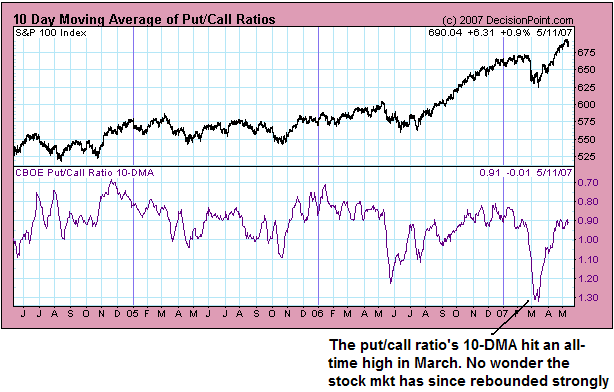
Below is a chart
showing the 10-day moving average of the CBOE put/call ratio. Note that
the chart's scale is inverted (a falling line indicates a rising
put/call ratio).
When the put/call's 10-day MA hit an all-time high during the first
half of March it meant that sentiment had become so bearish so quickly
that it wasn't reasonable to anticipate significant additional downside
in the short-term. We therefore upgraded our short-term stock market
outlook from "bearish" to "neutral", although with the benefit of
hindsight we should obviously have shifted all the way to "bullish".
The extreme fearfulness that was apparent during the first half of
March has since completely evaporated and the put/call's 10-day MA has
moved back to the bottom quartile of its 3-year range (the top quartile
on the chart), which is hardly surprising given the price action.
Sentiment indicators
are generally pointing toward a short-term pullback, but the public
does not appear to be as optimistic about the stock market's prospects
right now as it has been near intermediate-term peaks in the past. We
note, for instance, that small traders as a group have a small
net-SHORT position in S&P500 futures and that the latest AAII
sentiment survey revealed a bullish percentage of only 42.9. Therefore,
in the absence of a breakdown in the NDX/Dow ratio we will assume that
the next pullback will not mark the start of an intermediate-term
correction.
This week's
important US economic events
| Date |
Description |
Monday May 14
| No important events scheduled
|
Tuesday May 15
| CPI
Net Foreign Purchases of US Securities
| | Wednesday May 16
| Housing Starts
Capacity Utilisation
Industrial Production
| | Thursday May 17
| Leading Economic Indicators
| | Friday May 18
| No important events scheduled
|
Gold and
the Dollar
Gold Stocks
In the 2nd May Interim Update and in subsequent commentaries we said it
would be reasonable for short-term traders to 'go long' the gold sector
in anticipation of a rebound over the coming weeks. The idea was that
risk could be managed by placing protective stops just below the 1st
May lows, thus limiting the potential downside to around 3% versus the
potential for a quick gain of around 10%. Due to the favourable
short-term risk/reward we also upgraded our short-term outlook from
"neutral" to "bullish" at that time. Note, though, that the upgrading
of our short-term view did not reflect a significant change to our
assessment of the short-term upside potential as we had already been
anticipating a bit more strength. The key points were the establishment
of a well defined demarcation line (the 1st May low), affording the
ability to limit downside risk, and the likelihood that the late-April
correction had acted to extend the overall advance by at least a couple
of weeks.
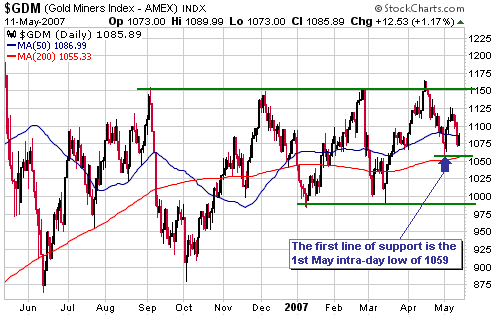
The gold sector thoroughly tested our pre-determined downside limits on
Thursday, but didn't quite do enough to invalidate our modestly bullish
short-term outlook. Specifically, the HUI closed 1 point below its 1st
May low on Thursday while the GDM and the XAU remained above their 1st
May lows. All of these indices then bounced on Friday.
Below is a chart of the GDM (the AMEX Gold Miners Index). With
sentiment toward the major gold stocks seemingly 'in the toilet' it is
difficult for us to imagine that a large decline could soon get
underway, but we don't consider sentiment to be a primary indicator and
so if we had any short-term trading positions we would probably exit
them if the gold stock indices sent a consistent message by closing
below their respective 1st May lows.
On a side note, we
don't alter our investment strategy in response to changes in our -- or
anyone else's, for that matter -- short-term views, and we don't think
you should either. Our investment strategy is always based on long- and
intermediate-term risk/reward considerations. We take shorter-term
positions from time to time and endeavour to use short-term volatility
to improve our longer-term returns, but if the long- and
intermediate-term risk/reward considerations don't change then our
overall exposure generally doesn't change by much. In particular, we
would almost never make a significant alteration to our overall
exposure based on the expectation of a 10% move in either direction in
the short-term.
We know that many traders devote a lot of their time/energy to scalping
moves of a few percent and that some of them are even able to
consistently generate good annual returns by doing so. From our
perspective, however, a 10% move in the gold stock indices in either
direction would be of minor interest only. Assuming our assessment of
the intermediate-term risk/reward remained unchanged then we would
almost certainly do some selling in response to a quick 10% advance and
some buying in response to a quick 10% decline, but our overall market
exposure would not shift by much (our cash reserve is presently around
40% and will probably remain within the 35%-45% range until our
intermediate-term outlook changes).
Further to the above, the following extract from our 30th April commentary remains applicable:
"There is probably some
more upside in store for the gold sector over the coming weeks. But
with the HUI having touched the bottom of our 370-400 target range
earlier this month and with the likely time-window for a turning point
now just around the corner, this is not the time to be cavalier. As we
noted in our 23rd April report, people who are substantially overweight
the gold sector should be looking for opportunities to scale back to a
"core" position (a position from which you could watch a 20-30%
intermediate-term decline with equanimity whilst retaining significant
long-term exposure to the bull market). In other words, people who have
a lot of exposure to gold should consider buying some insurance. This
insurance could take the form of put options, but in general it is much
better to insure yourself against a bull market correction by
increasing your cash reserve than by purchasing put options."
Gold
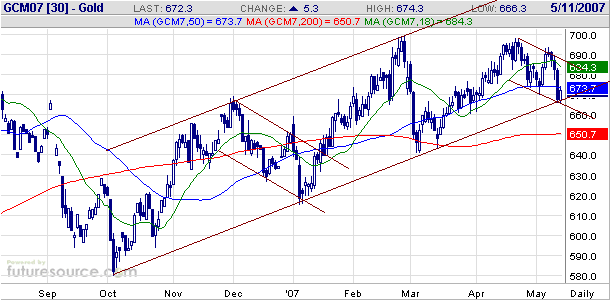
We had previously drawn a line in the sand at $670 for the June gold
futures contract, but the following chart suggests that this is not the
time to downgrade our short-term outlook. For one thing, last week's
decline terminated right at the bottom of a well-defined
intermediate-term channel. For another thing, the correction that began
in mid-April currently looks like a smaller version of the one that
began in early December. We will therefore give our short-term bullish
outlook a bit more rope.
A daily close below $660 (basis the June contract) would decisively breach the channel bottom and project a drop to around $600.
Currency Market Update
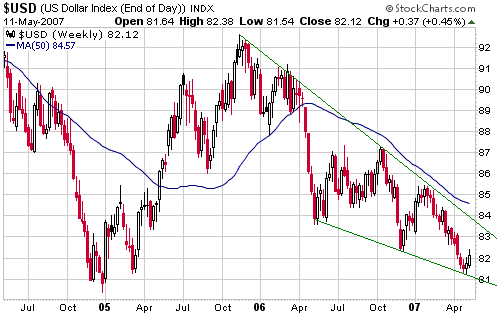
Below is a weekly chart of the Dollar Index.
The momentum low is probably in place for the US dollar, but the modest
rebound of the past two weeks does not have the look of a trend
reversal. Sentiment is mixed, with traders a) frothing-at-the-mouth
bullish on the euro, the British Pound and the Australian Dollar, b)
moderately bullish on the Canadian Dollar, c) moderately bearish on the
Swiss Franc, and d)
frantically-scrambling-to-be-first-to-the-short-selling-window bearish
on the Yen.
An upward reversal in the Dollar Index could occur at any time and the
main risk, as far as the dollar's performance over the next few months
is concerned, is most assuredly to the upside. However, the price
action puts the odds in favour of a drop to (marginal) new lows prior
to the start of a tradable US$ advance.
Update
on Stock Selections
(Note: To review the complete list of current TSI stock selections, logon at http://www.speculative-investor.com/new/market_logon.asp
and then click on "Stock Selections" in the menu. When at the Stock
Selections page, click on a stock's symbol to bring-up an archive of our comments on the stock in question)
 Natural Gas Trusts Natural Gas Trusts
The pace of consolidation is beginning to pick-up within the realm of
Canadian energy trusts. Consolidation is normally bullish for stock
prices, but about three weeks ago the management of Thunder Energy
(TSX: THY.UN) sold the company at ZERO premium to the current market
price and late last week it was announced that Shiningbank Energy (TSX:
SHN.UN) had agreed to sell itself to PrimeWest Energy (TSX: PWI.UN,
NYSE: PWI) at almost no premium to the current market price.
Whereas we were annoyed by the THY takeover, we are satisfied with the
SHN takeover for three main reasons. First, it's a stock-swap deal so
SHN's unit-holders will retain exposure to the upside. Second, at the
time we established the TSI Energy Trust Index (TETI) we almost
included PWI and will have no qualms about replacing SHN with PWI in
the future if/when the merger is approved. Third, PWI has a US listing
in addition to its Canadian listing, which gives it exposure to a
larger group of investors -- the greater exposure will become a
significant advantage when the natural gas bull market heats up again
-- and will potentially make it attractive to a US-based predator
should the consolidation trend continue within the energy trust sector.
In general, the 'gassy' trusts look like they are in the early stages
of upward trends or about to complete lengthy basing patterns. Of the
ones we follow, Daylight Resources (TSX: DAY.UN) looks particularly
interesting at this time; as does Vault Energy (TSX: VNG.UN), although
Vault has already rebounded quite strongly from its lows. Shiningbank
is also suitable for new buying. SHN's price will track the price of
PWI for now, but there's a small chance of a competing (higher) bid;
and in any case, PWI appears to be in reasonable shape.
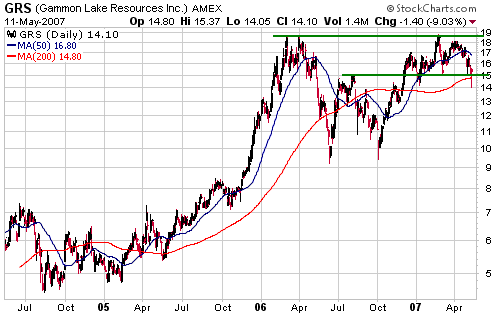
Gammon Lake Resources (AMEX: GRS). Shares: 115M issued, 126M fully diluted. Recent price: US$14.10
GRS reported its Q1 results following the close of trading last
Thursday. The results included lower-than-expected production and
higher-than-expected costs, causing the stock price to take a 9% hit on
Friday.
In our opinion it doesn't make sense to buy or sell a stock such as GRS
in reaction to a single quarter's financial performance, especially
with the company having just recently reached commercial production at
its Mexico-based mining operations. The sailing is rarely smooth during
the first few months of gold mine's life.
But plenty of people obviously have just sold in reaction to the company's latest quarterly results.
The recent price action makes last month's decision by GRS's management
to sell 10M new shares look even smarter than it did at the time
because the price at which the new shares were sold was 28% above
Friday's closing price. Good for GRS, but bad for the people who
participated in the financing.
Friday's sell-off might have created a short-term buying opportunity.
Note, though, that even at US$14/share the stock sports a significant
valuation premium. We think the premium will prove to be justified
because GRS will be an extremely low-cost gold producer once the new
mine is operating smoothly and also because there is huge expansion
potential within the company's existing stable of assets, but it could
take a while to regain the confidence of the market. Furthermore, from
a technical perspective there appears to be more downside in store. In
particular and with reference to the following chart, GRS tested its
2006 peak earlier this year and has just broken decisively below
support at US$15. It would not be surprising to see a bounce back to
$15 (support turned into resistance) over the coming days, but our
guess is that the stock will become available at lower prices within
the next couple of months.
If the market is kind enough to give us the opportunity (there's no
guarantee that it will be so kind) then we will almost certainly be
buyers of GRS in the US$11.50-$12.50 range. This stock will, we think,
be one of the best performers on a risk-adjusted basis during the next
upward leg in the gold sector's long-term bull market.
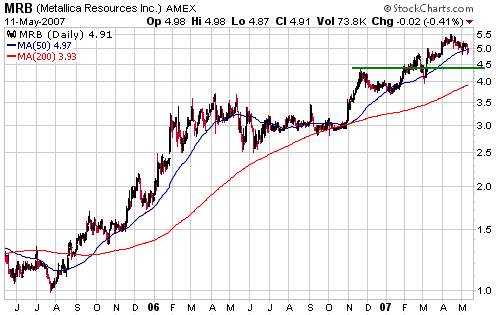
Metallica Resources (AMEX: MRB, TSX: MR). Shares: 92M issued, 118M fully diluted. Recent price: US$4.91
If you are looking for a junior gold producer or soon-to-be producer to
buy at this time then you should look no further than MRB. The stock is
in the process of becoming a market favourite and is not the screaming
bargain it was 11 months ago, but it remains under-valued -- at current
metal prices we can easily justify a valuation of more than US$6/share
-- and looks reasonable from a technical perspective (see chart below).
MRB would be suitable for new buying in the US$4.50-US$5.00 range.
Chart Sources
Charts appearing in today's commentary
are courtesy of:
http://stockcharts.com/index.html
http://www.futuresource.com/
http://www.decisionpoint.com/

|