|
-- Weekly Market Update for the Week Commencing 14th May 2012
Big Picture
View
Here is a summary of our big picture
view of the markets. Note that our short-term views may differ from our
big picture view.
In nominal dollar terms, the BULL market in US Treasury Bonds
that began in the early 1980s will end by 2013. In real (gold)
terms, bonds commenced a secular BEAR market in 2001 that will continue
until 2014-2020. (Last
update: 23 January 2012)
The stock market, as represented by the S&P500 Index, commenced
a secular BEAR market during the first quarter of 2000, where "secular
bear market" is defined as a long-term downward trend in valuations
(P/E ratios, etc.) and gold-denominated prices. This secular trend will bottom sometime between 2014 and 2020. (Last update: 22 October 2007)
A secular BEAR market in the Dollar
began during the final quarter of 2000 and ended in July of 2008. This
secular bear market will be followed by a multi-year period of range
trading. (Last
update: 09 February 2009)
Gold commenced a
secular bull market relative to all fiat currencies, the CRB Index,
bonds and most stock market indices during 1999-2001. This secular trend will peak sometime between 2014 and 2020. (Last update: 22 October 2007)
Commodities,
as represented by the Continuous Commodity Index (CCI), commenced a
secular BULL market in 2001 in nominal dollar terms. The first major
upward leg in this bull market ended during the first half of 2008, but
a long-term peak won't occur until 2014-2020. In real (gold) terms,
commodities commenced a secular BEAR market in 2001 that will continue
until 2014-2020. (Last
update: 09 February 2009)
Copyright
Reminder
The commentaries that appear at TSI
may not be distributed, in full or in part, without our written permission.
In particular, please note that the posting of extracts from TSI commentaries
at other web sites or providing links to TSI commentaries at other web
sites (for example, at discussion boards) without our written permission
is prohibited.
We reserve the right to immediately
terminate the subscription of any TSI subscriber who distributes the TSI
commentaries without our written permission.
Outlook Summary
Market
|
Short-Term
(0-3 month)
|
Intermediate-Term
(3-12 month)
|
Long-Term
(1-5 Year)
|
| Gold
|
Bullish
(26-Mar-12)
|
Bullish
(26-Mar-12)
|
Bullish
|
| US$ (Dollar Index)
|
Neutral
(22-Nov-11)
| Neutral
(09-Jan-12)
|
Neutral
(19-Sep-07)
|
| Bonds (US T-Bond)
|
Neutral
(11-Apr-12)
|
Neutral
(18-Jan-12)
|
Bearish
|
| Stock Market
(DJW)
|
Neutral
(25-Apr-12)
|
Bearish
(28-Nov-11)
|
Bearish
|
| Gold Stocks
(HUI)
|
Bullish
(26-Mar-12)
|
Bullish
(23-Jun-10)
|
Bullish
|
| Oil | Neutral
(31-Jan-11) | Neutral
(31-Jan-11)
| Bullish
|
| Industrial Metals
(GYX)
| Neutral
(22-Nov-11)
| Neutral
(29-Aug-11)
| Neutral
(11-Jan-10)
|
Notes:
1. In those cases where we have been able to identify the commentary in
which the most recent outlook change occurred we've put the date of the
commentary below the current outlook.
2. "Neutral", in the above table, means that we either don't have a
firm opinion or that we think risk and reward are roughly in balance with respect to the timeframe in question.
3. Long-term views are determined almost completely by fundamentals,
intermediate-term views by giving an approximately equal weighting to
fundamental and technical factors, and short-term views almost
completely by technicals.
There are always
alternatives for the past and the future
Our market views can never be proved right by subsequent price action. They can only be proved wrong. Before we explain why, it must be understood that our market views are not based on expected price direction. They are, instead, based on risk relative to reward (upside potential), with a bullish view signifying that we perceive greater upside potential than downside risk over the period in question. For example, over the past two months we've thought that short-term downside risk in the gold market was defined by support at $1550-$1600. When, as a result of a declining price, the distance between the current price and this perceived downside risk became materially less than what we considered to be realistic upside potential over the ensuing three months, we upgraded our short-term gold market outlook to "bullish".
To explain why the correctness of our risk (or reward) assessment cannot be proved by price action, let's again take the example of the gold market. The gold price dropped to the middle of the $1550-$1600 range last week. Even if this turns out to be the bottom of the short-term downward trend that began in February it won't PROVE that our risk assessment was correct, it will only mean that the market didn't disprove our assessment. On the other hand, if the gold price drops well below $1550 in the near future then our earlier risk assessment was wrong.
In general terms, what actually happens in a market is never the only thing that could have happened at that time. The things that could have happened, but didn't, are referred to as "alternative histories" by Nassim Taleb. One of these alternative histories could have had a high probability, but for some reason it didn't happen.
If we accept that what happened in a market over a certain timeframe isn't the only thing that could have happened, then we must also accept that being on the right side of any market move always involves some luck. Of course, it is very rare for someone who ends up on the right side of a market move to credit luck. Luck is often used to explain losses, but almost never used to explain profits.
Here's a case where luck played a big part in a profitable trade: People who were 'long' US subprime debt in 2006 made money. The market didn't prove them wrong. However, the market COULD have proved them wrong in spectacular fashion, because the financial crisis that began in 2007 could easily have begun a year earlier. The fact that this crisis didn't begin a year earlier gave some poor risk assessors an opportunity to look right for a while, although anyone who was silly enough or reckless enough to bet on subprime debt at that late stage of the cycle would eventually have 'come a cropper'.
With regard to short-term price action, the best we can ever reasonably hope for is that the market won't prove us wrong. Unfortunately, the market sometimes (more often than we'd prefer) does prove us wrong, as the market for gold stocks has done over the past few weeks. In late March we thought that the HUI (our gold sector proxy) had short-term downside risk to around 440, but subsequent price action proved that this was an underestimation. However, what if the HUI had done no worse than drop to 440? In that case we wouldn't have been proven right, we would only have not been proven wrong. And the decline to the 390s that we have just experienced would have ended up as one of the alternative histories that could have happened but never did.
Over the long-term, if we perform well in the jobs of assessing risk/reward and managing risk then we should generate good real returns on our investments and speculations. We emphasise that these are separate jobs. Successfully managing risk involves acknowledging that our risk/reward assessment could be wrong in any particular instance, meaning that it takes into account the fact that at any time there are multiple outcomes with realistic possibilities.
Natgas Comment
Here's a quick and dirty summary of a recent article
by Casey Research's Marin Katusa:
1. Due to the extremely low natural gas price, most gas-focused energy producers, including some of the biggest North American energy producers, will be forced to substantially reduce their reserves (since a resource can only be defined as a reserve if it can be economically extracted).
2. Hedges put in place at much higher natgas prices will soon be expiring. This means that natgas producers that were previously protected by relatively high-priced hedges will soon begin to suffer huge losses due to the extremely low natural gas price.
3. The natgas price will probably remain near its recent 10-year low for at least another 12 months.
4. To learn how to profit from the extremely low natgas price and the coming collapse in the share prices of natgas producers, subscribe to my (Marin Katusa's) newsletter.
It occurs to us that with the disappearance of hedge protection and the likelihood of substantial reserve write-downs, a large decline in North American natgas production and a reversal in the major price trend could finally be on the cards. It also occurs to us that when commodity-oriented newsletters that normally concentrate on bullish strategies for their chosen sector begin to tout strategies for profiting from a low commodity price AFTER the price has already fallen to a 10-year low in reaction to well-known bearish fundamentals, it should be viewed as a bullish sign.
Perhaps a major price low was put in place last month.
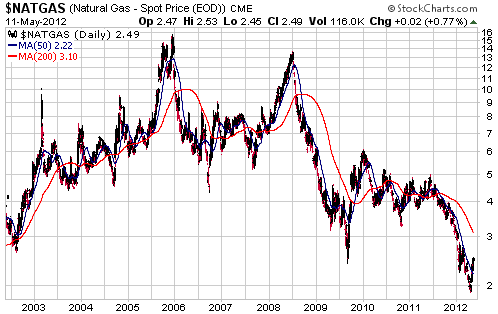
Natgas is an interesting intermediate-term speculation and will be even more so if it pulls back to around $2.00. However, it is not as interesting as the gold sector of the stock market, which is where we'd prefer to focus right now.
The Stock
Market
The Banks
The stock price of JP Morgan (JPM) plunged 9% on Friday in reaction to news that a trading team within the bank had lost about $2B over the past 6 weeks.
Jared Dillian's book "Street
Freak" gives a firsthand account of what it was like being a trader for Lehman Brothers from 2001 through to 2008. If you read this book you will come away with an understanding of how and why banks periodically generate these
big trading losses. Actually, you will probably be left wondering why the
high-profile trading losses don't happen more often than they do, because traders are routinely given a lot of rope and encouraged to take large risks with the firm's capital. Large profits are often the result of this risk taking, but large losses are not uncommon. In normal times the profits usually add up to a bigger number than the losses, but when correlations increase during a system-wide crisis the losses will tend to dwarf the profits.
There is nothing inherently wrong with a bank taking big risks with its capital. If the markets prove the bank's traders wrong then the bank's shareholders will take a hit. If the markets prove the bank's traders wrong in a big way then the bank's shareholders and bondholders could lose 100% of their investments.
The problem isn't the risk-taking in which private banks engage, it's the encouragement and the backstopping of this risk-taking by central banks and governments. By setting the official short-term interest rate at zero and suggesting that it will remain at zero for years to come, by flooding the banking system with reserves, and by attempting to manipulate yield spreads via various programs, the Fed is effectively prodding banks to speculate aggressively. And by their past actions, the Fed and the Treasury are effectively saying to the major banks: "If your speculations lead to company-threatening losses, we will inject enough new money into your coffers -- at the expense of the rest of the economy -- to ensure that you live to speculate another day."
Getting back to the current market action, it was interesting that the stock market viewed JPM's reported trading loss as a JPM-specific problem. JPM's stock tanked on Friday, but the BKX, a proxy for large-cap US bank stocks, suffered only a minor decline.
The first of the following charts shows that the BKX is still in reasonable shape, meaning that there is not yet any evidence in the chart that the upward trend dating back to early October has ended.
The second of the following charts shows that the SX7E, a proxy for European bank stocks, is in anything but reasonable shape. The SX7E's weak rebound from its Q4-2011 low clearly ended in February. It is now close to a multi-year low.
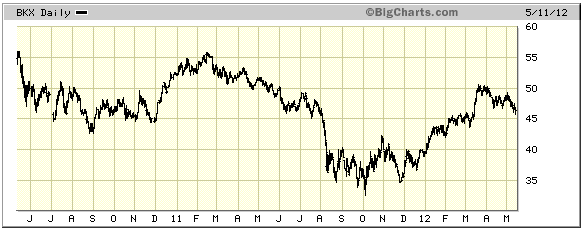
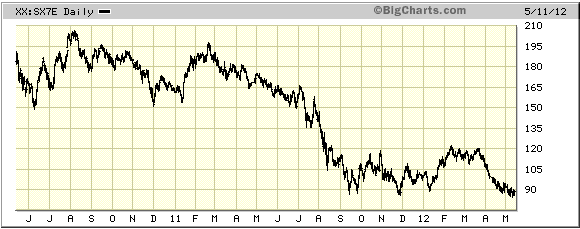
Considering the inter-relatedness of major banks around the world, the ability of the BKX to hold up in the face of JPM's trading loss is much less surprising than its ability to hold up in the face of the on-going bear market in European bank stocks. This rather strange situation probably
stems from the fact that when it comes to supporting commercial banks, the Fed is more willing and more able than the ECB.
Current Market Situation
In the 25th April Interim Update we discussed the bullish divergence that was developing between the NASDAQ Composite Index and the NASDAQ's McClellan Oscillator (MO). The market correction has continued, with the NASDAQ making a marginal new low for the move last week. However, the following chart shows that the bullish divergence is intact.
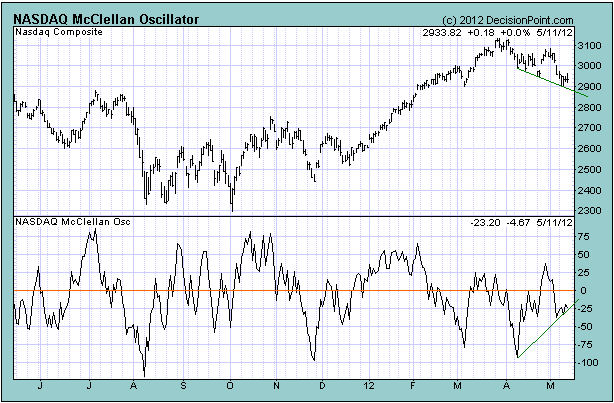
There is no evidence that the correction is complete, but the bullish divergence between the NASDAQ and its MO suggests that it soon will be.
This week's
important US economic events
| Date |
Description |
| Monday May 14 | No
important events scheduled
| | Tuesday May 15 | CPI
Retail Sales
Empire State Manufacturing Survey
TIC Report
Housing Market Index
| | Wednesday May 16 | Housing
Starts
Industrial Production
FOMC Minutes | | Thursday
May 17 |
Philadelphia Fed Survey
Leading Economic Indicators
|
| Friday May 18 | No
important events scheduled
|
Gold and
the Dollar
Gold and Silver
Although there isn't a shred of evidence that gold is experiencing anything more than a routine intermediate-term consolidation, by several measures gold-market sentiment is more bearish now than it has been at any time over the past three years. We note, in particular, that the total speculative net-long position in gold futures just hit its lowest level since April of 2009 (when gold was trading in the $880s), and that Market Vane's bullish consensus for gold is near its lows of the past few years.
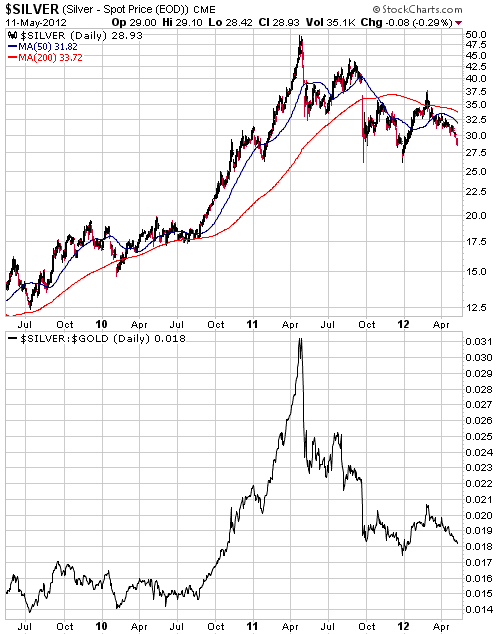
Sentiment towards silver has also become very bearish, as the silver market continues to 'correct' last year's excesses. The correction will probably continue for at least a few more months, but in price terms we suspect that it is complete. In other words, our guess is that there will be at least a few more months of base building above last year's lows.
The following chart compares silver and the silver/gold ratio. The 2010-2011 moon-shot in the silver/gold ratio was driven in part by self-reinforcing reasons that silver should trade at one-sixteenth the price of gold, or higher. The reasons were spurious, but as the price went higher they began to look credible, which prompted new buying, which added credibility to the reasoning, and so on. As the saying goes, the public will believe almost any bullish story as long as the price is rising.
Last year's excesses have been almost completely 'wrung out' of the market, with the silver/gold ratio having almost fallen back to its pre-moon-shot level. Furthermore, the decline from the late-February rebound peak looks more like a normal consolidation than the start of another collapse.
Gold Stocks
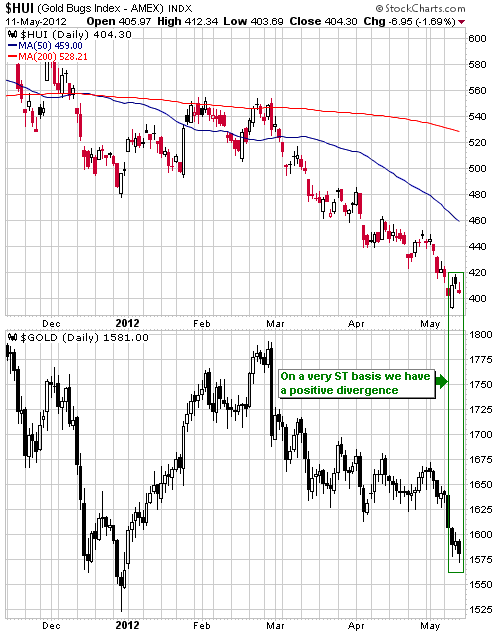
The HUI has been diverging negatively from gold bullion for years, but on a very short-term basis we have a positive divergence on our hands. We are referring to the fact that gold bullion made a new low for the move late last week while the HUI made a higher low.
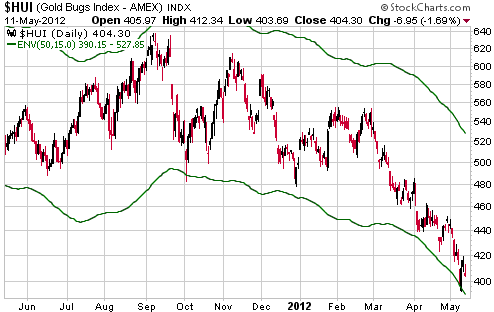
Another short-term plus is that at last week's intra-day low the HUI touched the bottom of its moving-average (MA) envelope. This is a plus in that it points to the HUI being as extended to the downside as it ever gets outside of a system-wide financial crisis. That being said, it should be noted that the bottom of the MA envelope is still declining. It will take a few weeks of rallying to turn the envelope-bottom upward and create the situation where support is rising.
Currency Market Update
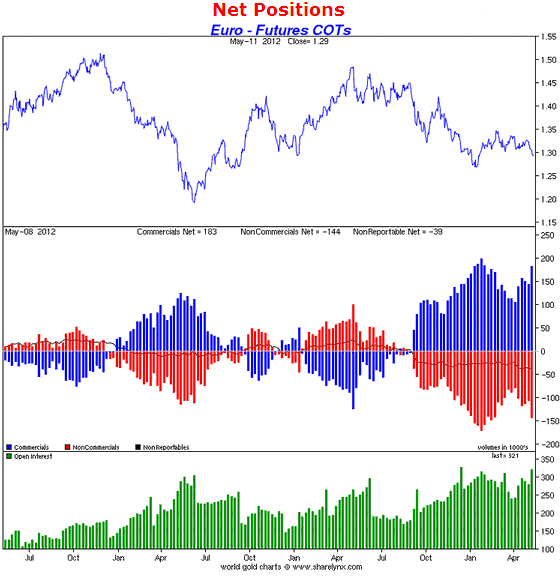
The following chart from Sharelynx.com shows the COT (Commitments of Traders) situation for euro futures. It shows that the speculative net-short position in euro futures has almost returned to the all-time extreme it reached in January of this year.
Although the euro futures market is only a small piece of the overall currency market, the positioning of speculators in euro futures probably reflects the marketwide positioning of speculators. In all likelihood, speculators, as a group, are massively short the euro. This explains why the euro is holding up quite well despite a constant barrage of negative news from Europe.
The euro will probably remain under pressure until the stock market reaches a short-term bottom. After that, it should rally.
Update
on Stock Selections
Notes: 1) To review the complete list of current TSI stock selections, logon at
http://www.speculative-investor.com/new/market_logon.asp
and then click on "Stock Selections" in the menu. When at the Stock
Selections page, click on a stock's symbol to bring-up an archive of
our comments on the stock in question. 2) The Small Stock Watch List is
located at http://www.speculative-investor.com/new/smallstockwatch.html
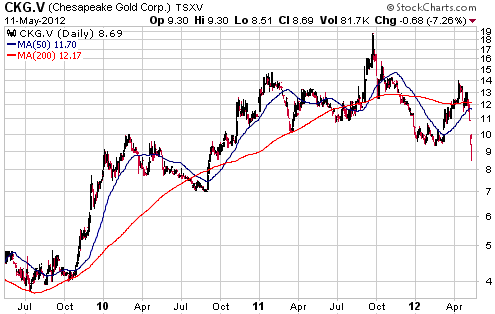
 Chesapeake Gold (TSXV: CKG). Shares: 44M issued, 47M fully diluted. Recent price: C$8.69 Chesapeake Gold (TSXV: CKG). Shares: 44M issued, 47M fully diluted. Recent price: C$8.69
We wrote the following about CKG in the 23rd January 2012 Weekly Update:
"The mid-C$8 area is where the stock's valuation would become irresistible, and is also just above the long-term support indicated on the following chart. We will therefore return CKG to the TSI Stocks List if it trades at C$8.55 within the next two months."
CKG traded as low as C$8.51 on Friday 11th May, but the two-month time limit mentioned in our January report has expired. It therefore wasn't an automatic addition to the TSI Stocks List when it dropped to our suggested C$8.55 entry price on Friday.
At its current price we like CKG a lot, but right now there are dozens of junior gold stocks that offer terrific value. In any case, at this time there isn't room in the TSI List for new stock selections.
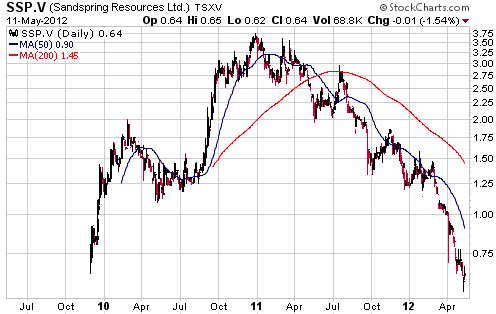
Sandspring Resources (TSXV: SSP). Shares: 131M issued, 143M fully diluted. Recent price: C$0.64
Sandspring's Toroparu project in Guyana has 6M ounces of gold in the M&I category and another 4M ounces of Inferred gold. We consider this to be an 8M-ounce total resource (we calculate the total in-ground resource by adding 50% of the Inferred resource to 100% of the M&I resource).
At its current price of C$0.64/share, SSP has an enterprise value of about $58M ($88M market cap minus $30M cash). This means that its in-ground gold is being valued at only $7/oz. If we are more conservative and only count the 5M ounces of gold that were determined to be mineable in the recently completed Preliminary Economic Assessment (PEA), then the enterprise-value-per-ounce figure rises from $7 to $11. Is $11/oz too much to pay for in-ground gold that, according to a PEA, can be economically mined at a gold price of $1200/oz or higher?
At the current gold price the PEA came up with an after-tax NPV(5%) of around $1,200M for Toroparu. This equates to about $9 per SSP share. The PEA is, by definition, preliminary in nature, so it isn't reasonable to expect SSP to trade anywhere near $9 at this stage. However, it is fair to say that the current discount is extraordinary. This is an example of what Rick Rule was talking about when he said in a recent interview that he was seeing the broadest discrepancy between enterprise value and the valuations established in PEAs/PFSs that he has seen in 35 years in the business.
New short-term trading position: Market Vectors Junior Gold Miners ETF (GDXJ). Recent price: US$20.26
With the HUI having diverged positively from gold bullion and hit the bottom of its MA envelope during the final three days of last week, it is reasonable to take another short-term trading position. We have therefore added GDXJ to the TSI List as a trade with an expected duration of less than three months.
Our price target for this trade is the 200-day moving average. A daily close below 390 by the HUI will be an initial stop.
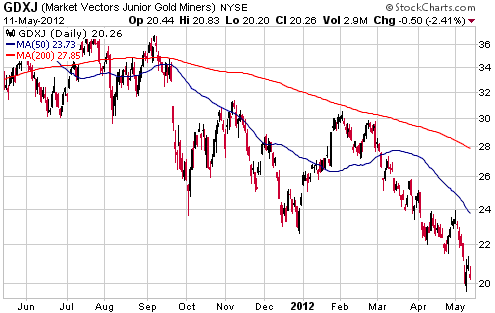
Chart Sources
Charts appearing in today's commentary
are courtesy of:
http://stockcharts.com/index.html
http://www.decisionpoint.com/
http://bigcharts.marketwatch.com/

|









