|
-- Weekly Market Update for the Week Commencing 14th November 2011
Big Picture
View
Here is a summary of our big picture
view of the markets. Note that our short-term views may differ from our
big picture view.
In nominal dollar terms, the BULL market in US Treasury Bonds
that began in the early 1980s ended in December of 2008. In real (gold)
terms, bonds commenced a secular BEAR market in 2001 that will continue
until 2014-2020. (Last
update: 4 April 2011)
The stock market, as represented by the S&P500 Index, commenced
a secular BEAR market during the first quarter of 2000, where "secular
bear market" is defined as a long-term downward trend in valuations
(P/E ratios, etc.) and gold-denominated prices. This secular trend will bottom sometime between 2014 and 2020. (Last update: 22 October 2007)
A secular BEAR market in the Dollar
began during the final quarter of 2000 and ended in July of 2008. This
secular bear market will be followed by a multi-year period of range
trading. (Last
update: 09 February 2009)
Gold commenced a
secular bull market relative to all fiat currencies, the CRB Index,
bonds and most stock market indices during 1999-2001. This secular trend will peak sometime between 2014 and 2020. (Last update: 22 October 2007)
Commodities,
as represented by the Continuous Commodity Index (CCI), commenced a
secular BULL market in 2001 in nominal dollar terms. The first major
upward leg in this bull market ended during the first half of 2008, but
a long-term peak won't occur until 2014-2020. In real (gold) terms,
commodities commenced a secular BEAR market in 2001 that will continue
until 2014-2020. (Last
update: 09 February 2009)
Copyright
Reminder
The commentaries that appear at TSI
may not be distributed, in full or in part, without our written permission.
In particular, please note that the posting of extracts from TSI commentaries
at other web sites or providing links to TSI commentaries at other web
sites (for example, at discussion boards) without our written permission
is prohibited.
We reserve the right to immediately
terminate the subscription of any TSI subscriber who distributes the TSI
commentaries without our written permission.
Outlook Summary
Market
|
Short-Term
(0-3 month)
|
Intermediate-Term
(3-12 month)
|
Long-Term
(1-5 Year)
|
| Gold
|
Neutral
(22-Sep-11)
|
Neutral
(24-Jan-11)
|
Bullish
|
| US$ (Dollar Index)
|
Bullish
(12-Oct-11)
| Bullish
(12-Oct-11)
|
Neutral
(19-Sep-07)
|
| Bonds (US T-Bond)
|
Neutral
(19-Sep-11)
|
Bearish
(24-Aug-11)
|
Bearish
|
| Stock Market (S&P500)
|
Bearish
(17-Oct-11)
|
Neutral
(24-Aug-11)
|
Bearish
|
| Gold Stocks
(HUI)
|
Neutral
(31-Oct-11)
|
Bullish
(23-Jun-10)
|
Bullish
|
| Oil | Neutral
(31-Jan-11) | Neutral
(31-Jan-11)
| Bullish
|
| Industrial Metals
(GYX)
| Bearish
(19-Sep-11)
| Neutral
(29-Aug-11)
| Neutral
(11-Jan-10)
|
Notes:
1. In those cases where we have been able to identify the commentary in
which the most recent outlook change occurred we've put the date of the
commentary below the current outlook.
2. "Neutral", in the above table, means that we either don't have a
firm opinion or that we think risk and reward are roughly in balance with respect to the timeframe in question.
3. Long-term views are determined almost completely by fundamentals,
intermediate-term views by giving an approximately equal weighting to
fundamental and technical factors, and short-term views almost
completely by technicals.
Why the sovereign debt
crisis began in Europe
This is a point we touched on in a couple of earlier commentaries, but it is important enough to reiterate. The point is that the sovereign debt crisis began in Europe because the countries of the euro-zone (EZ) do not have captive central banks. A captive central bank is one that stands ready, willing and able to monetise all government debt should it become difficult or impossible to find other buyers for the debt.
A government with a captive central bank could always CHOOSE to directly default on its debt, but it will never be FORCED to do so because it will always have the option of selling more debt to the central bank in exchange for newly-created money. In other words, it will always have the option of going down the inflation path. The US federal government, for example, will never run short of dollars as long as the Fed exists. Earlier this year there was a brief period when it seemed as if the US government was in danger of running out of money, but this was just for show.
The US government's debt situation is only marginally better than that of Italy's government. Furthermore, Italy's government has a much healthier balance sheet than Japan's government. And yet, the 10-year bonds issued by Italy's government currently yield more than 6%, while the 10-year bonds issued by the governments of the US and Japan yield 2.0% and 1.0%, respectively. The critical difference is that the governments of the US and Japan have their own central banks whereas the government of Italy shares a central bank with 16 other European governments. Of greatest relevance, Italy shares a central bank with inflation-shy Germany.
By way of further explanation we point out that Italy's government could not attempt to inflate its way out of trouble without imposing a cost on German savers, and German savers, strangely enough, aren't keen on donating some of their purchasing power to a bailout of Italy (or, to put it more aptly, to a bailout of the Italian government's bondholders).
So, the buyers of Italian government bonds have to account for the risk that the Italian government will soon have to directly renege on its obligations. The buyers of US and Japanese government bonds do not face such a risk. To put it another way, Italian government bond yields are relatively high due to the realistic possibility of genuine deflation in that country, while US and Japanese government bond yields are relatively low because these governments, via their central banks, have unlimited ability to inflate.
This is contrary to the conventional wisdom that government bond yields in the US and Japan are currently low due to the threat of deflation. If the power to use the 'printing press' were taken away from these governments then deflation really would become probable and bond yields would move much higher as the market discounted the risk of direct default.
Quote of the week /
Speculating on the end of China's boom
"Barreling along one side of an 8-lane highway [in Wuhan, a large industrial city in China] towards the airport with hardly another vehicle in sight, we passed apartment block after apartment block, sitting empty like a construction graveyard.
Eventually we crossed a gigantic new bridge over the Yangtze River. Barely half a mile downstream, another equally vast and expansive bridge was nearing completion... and others further down the river.
I was astounded. There was no traffic. No commercial activity. No people. No tolls. Just empty space, and a lot of ridiculously expensive bridges. It was something out of a bizarre zombie flick.
There are thousands of similar projects all over China, many funded by debt. And, with no direct cash flows earned back and the ongoing maintenance required, these infrastructure projects have become huge liabilities on the Chinese government's balance sheet.
The conventional wisdom is that China's economy will continue to grow 8% or 9% per year indefinitely. And a lot of people are drinking this Kool-Aid. It sounds a lot to me like the other old songs that we've heard over the past few years, like "real estate always goes up in value." Famous last words.
I live by another rule: "All booms bust. The only question is when." And China has had one of the biggest economic booms in history over the past decades. In fact, per capita consumption of cement in China is at the same levels as Taiwan and Japan right before those infrastructure-boom economies hit a brick wall.
One of my favorite speculations right now is to short the stocks of companies whose business model is based on eternal Chinese growth."
- From the article posted HERE
Our comments:
The industrial metals sector of the stock market is leveraged to China's economy and will be hit hard when China's boom turns to bust. However, we don't think that now is the right time to bet against the stocks in this sector, despite the possibility that China's boom is turning to bust as we write. This is because most of the stocks in this sector have recently taken big hits and because a seasonally-positive period will soon begin.
We think that for the risk-reward pendulum to swing back towards risk by enough to justify a bearish speculation, the industrial metals sector will have to rebound for a few more months. In fact, if fear associated with the euro-zone's debt crisis pushes stock prices down to near their October lows at some point over the next few weeks then we will probably 'go long' the industrial metals sector for a multi-month trade. For example, we'd very much appreciate another opportunity to buy Capstone Mining (TSX: CS) in the low-C$2 area.
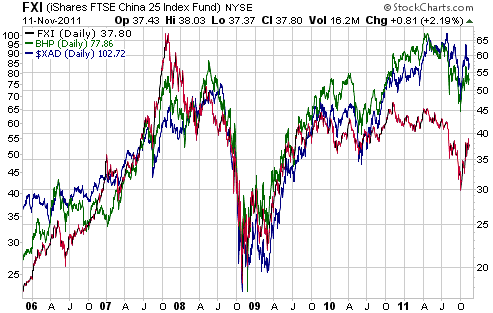
Due to its over-valuation, the Australian Dollar is also acutely vulnerable to being hit hard when China's boom turns to bust. Here's why:
For two inter-related reasons, the A$'s relatively rapid domestic inflation (the cause of its over-valuation) has not YET led to a large decline in its foreign exchange value. The first is the boost to foreign A$ demand provided by China's ravenous consumption of commodities such as iron-ore, coal and copper. The second is Australia's relatively high interest rates, which are largely a function of the economic strength linked to China's demand for commodities produced in Australia. This means that when China's boom turns to bust the investment demand for the A$ will plunge due to the 'double whammy' of falling commodity prices and falling A$ interest rates, enabling the A$ to decline precipitously on the foreign exchange market under the weight of its over-valuation.
We won't be surprised if a large A$ decline begins very soon. We also won't be surprised if a large A$ decline doesn't begin for another 6 months, because the performance of this currency is linked to other markets that could be supported over the next few months by positive seasonal forces. Short-term bets against the A$ therefore don't appeal to us, but we will be looking for opportunities to scale into A$ put options with expiry dates of December next year or later.
The following chart illustrates the connection between China, the A$ and commodity-related equities. On this chart, China is represented by FXI (iShares China 25 Index Fund) and commodity-related equities are represented by BHP (the world's largest mining company).
Some ETNs could become
worthless
In previous commentaries we said we would steer clear of ETNs (Exchange Traded Notes) due to heightened credit risk. Unlike ETFs (Exchange Traded Funds), which are backed by shares or commodities or bonds or futures contracts, ETNs are backed by the credit-worthiness of a financial institution and would likely be worthless if that institution went bankrupt. Rather than try to figure out which ETNs are supported by financially-solid institutions and which ones aren't, we have decided to avoid all ETNs.
A recent article discussing ETN risk can be found HERE.
The oil and stock markets
are one market
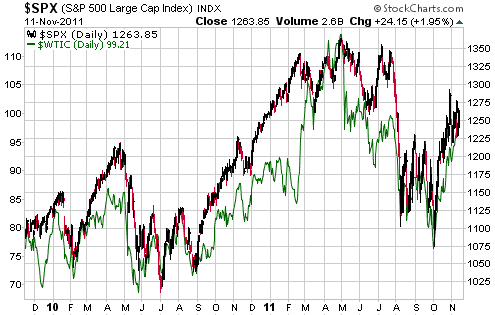
The oil market has been tracking the stock market for a few years now. If anything, the positive correlation between these two markets is becoming stronger. Refer to the following chart for an illustration of what we are talking about.
Unless we get a war or a new round of political upheaval in the Middle East (always a significant risk), the rebounds in the stock and oil markets should end at around the same time.
The Stock
Market
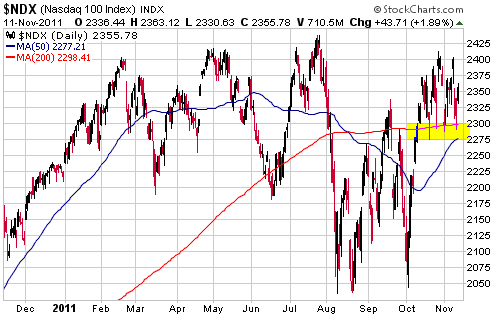
The stock market was hostage to developments in the euro-zone's sovereign debt crisis last week. For example, stock indices fell sharply when the yield on Italian 10-year government bonds surged to around 7.5% mid week and then rebounded strongly when the yield on these bonds dropped back to around 6.5%.
As a result of recent market action, the NASDAQ100 Index (NDX) has important short-term support at 2275-2300. Taking out this support would project a decline to 2150-2175.
This week's
important US economic events
| Date |
Description |
| Monday Nov 14 | No
important events scheduled
| | Tuesday Nov 15 | PPI
Retail Sales
Empire State Manufacturing Survey
Business Inventories
| | Wednesday Nov 16 | CPI
TIC Report
Industrial Production
Housing Market Index | | Thursday
Nov 17 | Housing Starts
Philadelphia Fed Survey
| | Friday Nov 18 | Leading
Economic Indicators
|
Gold and
the Dollar
Gold and Silver
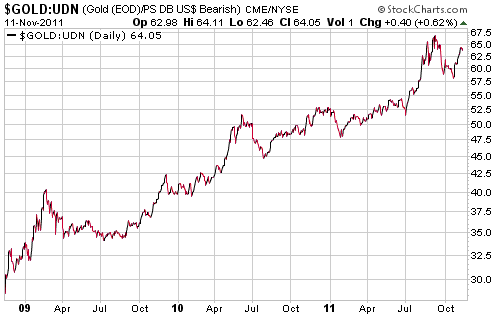
UDN is a fund that is designed to move opposite to the Dollar Index. By dividing the US$ gold price by UDN we therefore get a representation of gold's performance against currencies other than the US$.
The following chart shows that gold/UDN has been in a steady upward trend over the past three years. There is no evidence in this chart of a major upside blow-off, which means that there is no evidence in this chart that a major top is in place. However, past performance suggests that the September peak won't be decisively breached for at least 6 months.
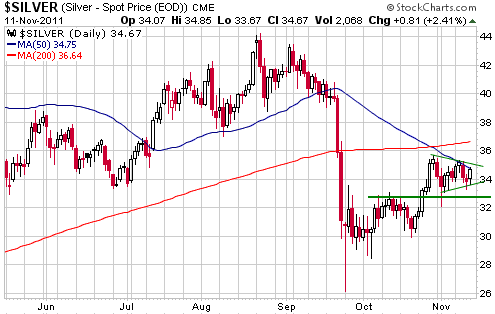
Silver has diverged bearishly from gold on an intermediate-term and a very short-term basis. The short-term bearish divergence is silver's continuing inability to confirm gold's break above its late-October peak.
That being said, the daily silver chart does not look bearish in isolation. As long as silver remains above support at 32.50-33.00 it will be reasonable to interpret the recent price action as a consolidation within a short-term upward trend.
Silver's chart suggests that a rise to $38 is just as likely as a decline to $30.
Gold Stocks
Current Market Situation
The HUI has been rising via a two-steps-forward-one-step-backward process, which has enabled it to make significant upward progress without becoming 'overbought'.
The post-October-low pattern is still being followed, so there is no reason to alter our short-term expectations. Specifically, we continue to expect that a top will be put in place soon after the HUI's daily RSI(14) moves above 70.
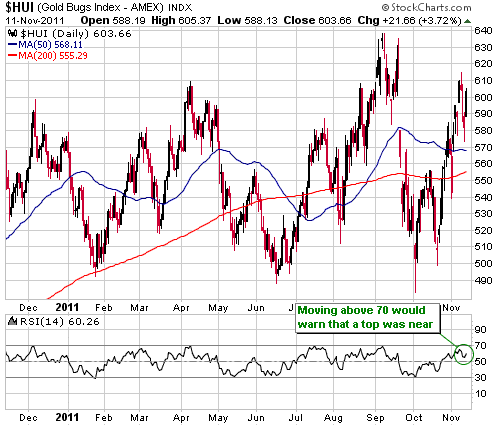
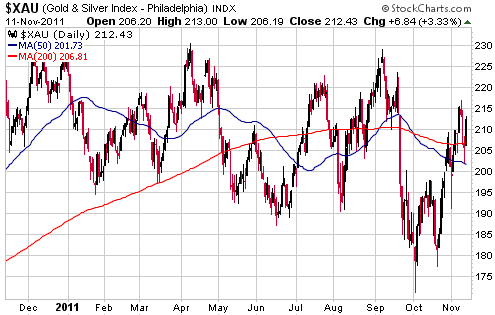
The HUI's next multi-month top will probably be at or below the September top (640), but there is obviously a chance that it could be higher. If it is higher, that is, if the HUI breaks out to the upside, then we will pay closer attention than usual to the XAU.
As we noted in real time, the XAU's failure to confirm the HUI's break to new highs in September was significant. The XAU's failure to confirm the HUI's upside breakout in April of this year was also significant. In fact, it is generally the case that an upside breakout in the HUI will not prove to be sustainable unless it is led by, or quickly confirmed by, an upside breakout in the XAU. Therefore, if the HUI does make a new high we will be very interested to see the position of the XAU at the time.
Strategy Adjustment
It has been a tough year for holders of gold stocks, especially the holders of junior gold stocks. This is largely due to the shift away from risk that began in February and gathered momentum in May, but the fact that many gold producers have performed poorly at the operational level certainly hasn't helped. It seems, to us, that the quantity of companies announcing worse-than-expected results has been much higher than normal this year. In some cases the bad news was solely the result of bad luck. Agnico Eagle's forced closure of a profitable mine due to ground instability, for example. In the majority of cases, however, the cost overruns and/or production shortfalls appear to stem from sub-par management.
Conventional wisdom has it that one of the best times to buy or own the stock of a gold mining company is just after the company goes into production, but the record of the past few years tells the opposite story. The historical record points to the time window around a new mine going into production as being a high-risk period for shareholders, because for every mine that starts up roughly according to plan there are at least two mines that experience major teething problems. Furthermore, sometimes these so-called teething problems continue for years.
Due to the lessons learned from our past experience with junior mining stocks, in the future we will do our best to steer clear of companies that are close to bringing their major asset into production. In the future, we will focus primarily on the stocks of mining companies that are in one of the following two situations:
1) Flagship project in the exploration or development phase, with a long time (at least 1-2 years) to go before production
2) Flagship project in production and performing to plan. (Note: Some mines perform well for a while and then experience major problems, but this is relatively rare. In most cases, a mine that has performed well for at least a few quarters will continue to perform well.)
Fortunately, most of the current TSI stocks are in one of the two situations mentioned above. The ones that aren't are CRK.TO, GSS, JAG and ORV.TO. These four stocks should be de-emphasised when doing new buying, but it doesn't make sense to sell them at current valuations.
Currency Market Update
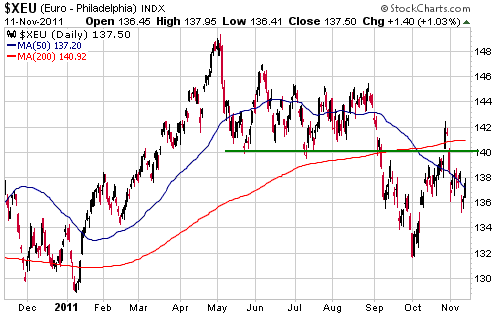
One day the markets are worried that the Italian government is about to default on its debt. The next day these worries dissipate and hope emerges that a default will be avoided. The day after that, fears of debt default again dominate. Then, hope of a meaningful rescue package is rejuvenated. And so on.
The reality is that if Italy remains within the euro zone, Italy's government will have to directly default within the next few months unless the ECB takes a leaf out of the Bernanke playbook. Taking a leaf out of the Bernanke playbook would be very bearish for the euro-zone because it would not only result in the losses that should be taken by bondholders being shared by everyone, it would also get in the way of real economic progress by distorting price signals. However, it could allow direct default to be postponed for 1-2 years.
Last week, the euro plunged when Italian bond yields surged and recouped most of its losses when Italian bond yields pulled back. We have no idea what will happen this week.
We remain bearish on the euro, largely because there is a much greater chance of a substantial euro decline than a substantial euro rally.
Update
on Stock Selections
Notes: 1) To review the complete list of current TSI stock selections, logon at
http://www.speculative-investor.com/new/market_logon.asp
and then click on "Stock Selections" in the menu. When at the Stock
Selections page, click on a stock's symbol to bring-up an archive of
our comments on the stock in question. 2) The Small Stock Watch List is
located at http://www.speculative-investor.com/new/smallstockwatch.html
 Resolute Mining (ASX: RSG). Shares: 607M issued (incl 137M A$0.50 conv notes), 665M fully diluted. Recent price: A$1.95 Resolute Mining (ASX: RSG). Shares: 607M issued (incl 137M A$0.50 conv notes), 665M fully diluted. Recent price: A$1.95
The TSI Stocks List contains Resolute Mining (RSG.AX) and the Resolute Mining company options (RSGO.AX). With the options now only 7 weeks from expiry we are going to remove them from the List. The profit, based on our December 2010 starting point of A$0.67 and last Friday's closing price of A$1.35, was around 100%.
RSG has begun to perform well and stands a good chance of making its way up to A$2.50 over the next few months. The company's management did something right by eliminating the hedge liability in September of last year, thus paving the way for substantial cash generation once the Syama project ramped up to its full capacity. The Syama ramp-up should now be almost complete.
Further to the above, while the recent price run-up creates a profit-taking opportunity it makes sense to retain some exposure to RSG. Therefore, if you own the options and not the stock you should probably either exercise some of your options (the exercise price is A$0.60) or use some of the proceeds from selling the options to purchase the shares.
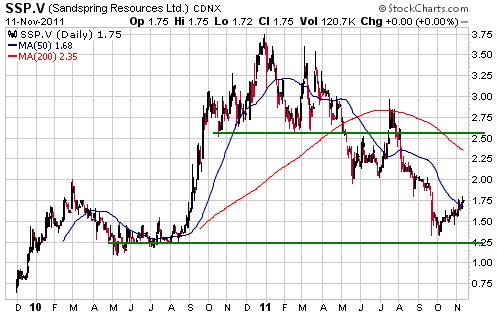
Sandspring Resources (TSXV: SSP). Shares: 108M issued, 120M fully diluted. Recent price: C$1.75
We added SSP, an exploration-stage gold miner, to the TSI Stocks List last month. The company is developing the Toroparu gold-copper project in Guyana.
Last week SSP announced that it had signed a mineral agreement with the government of Guyana. This agreement fixes the royalty and tax rates that SSP will pay if Toroparu is brought into production.
The terms of the agreement aren't particularly attractive (30% tax + 8% royalty to the government), but the fact that a formal agreement has been reached at such an early stage of project development is unusual and shows that the company's management is thinking well ahead. This agreement reduces uncertainty and should enable the economic analysis contained in the project's pre-feasibility study (PFS) to be more complete/accurate than is often the case with such studies. The PFS is due for completion in Q1-2012.
SSP's stock price is a long way below its end-2010 level, which means that it could be weighed down by tax-loss selling over the next few weeks. At the same time, the stock appears to be well supported and offers good value at its current price.
Our simple suggestion is to accumulate on weakness.
Crocodile Gold (TSX: CRK). Shares: 310M issued, 383M fully diluted. Recent price: C$0.41
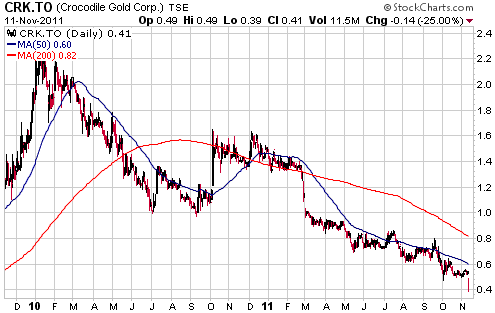
CRK reported its latest quarterly results after the close of trading on Thursday. It was announced that production was less than forecast during the quarter and that the development of the company's most important asset (the Cosmo mine) had been delayed by 1-2 months. This means that 2011 production will be less than expected, which is obviously not good. However, the biggest problem -- and likely the main reason for Friday's plunge in the stock price -- was the extremely high operating cost reported for the latest quarter. Due mostly to lower-than-expected grade, the cash cost for the latest quarter was $1673/oz (about $450/oz higher than the preceding quarter).
CRK should begin to generate much better results after the Cosmo mine is brought into production early next year, but given the confidence-sapping results of the past few quarters we doubt that many people will buy in anticipation of a turnaround. Most people will probably take a 'wait and see' approach.
'Wait and see' will be our approach, because although the stock is cheap there are other junior gold stocks with less problems and less risk that are just as cheap. In fact, there is a glut of ultra-cheap junior gold stocks right now.
Orvana Minerals (TSX: ORV). Shares: 151M issued, 154M fully diluted. Recent price: C$1.59
On 22nd August we wrote:
"A few months ago we thought that ORV stood a good chance of ending this year at a production run-rate of around 120K ounces/year, but a recent press release from the company indicated that it is now expected to take until April of next year to achieve a run rate of only 75K ounces/year. This is due to 'teething problems' at ORV's two new mines. Such problems often occur during the first few quarters after a mine is brought into production, but due to the operational experience of ORV's managers we had hoped that in this case the transition to full production would be smooth. Our hopes have been dashed."
ORV issued an update on its operations last Thursday that didn't contain any surprises. The 'teething problems' are on-going, but the expected rate of improvement is roughly the same now as it was in August. The company did, however, surprise the market (and us) by announcing in the same press release: "In order to lock in downside gold price protection on part of its EVBC production, Orvana executed an additional gold hedge with Credit Suisse of 1,400 ounces per month from January, 2012, to the maturity of the loan in September, 2015."
With this hedge, ORV didn't just lock in downside price protection on a chunk of its expected gold production; it also eliminated upside price participation.
ORV's managers no doubt believe that they are reducing risk via the forward sales commitments they have made, but they have actually done the opposite. In a long-term gold bull market, any mining company that commits to sell all or a portion of its gold at a fixed price over several years is greatly increasing risk. Under conditions that are not farfetched, such a 'hedge' could bankrupt the company.
ORV's managers have only capped the upside on about 25% of expected gold production over the next 4 years, but even a hedge of this magnitude has the potential to create a big problem for the company.
The hedge probably won't hurt over the next 12 months, but sometime within the next 4 years it is quite possible that the gold price will be at least $5000/oz. If this happened there would be a huge negative mark-to-market value associated with the hedge on the company's balance sheet. In addition, the company would be in the risky position whereby a disruption of production could force it to buy gold in the market at thousands of dollars per ounce more than the committed selling price.
In effect, by locking in the upside on about 25% of its production for the next 4 years ORV's managers have voluntarily put the company in the position where hyperinflation would probably lead to bankruptcy. Who wants to own a gold mining company that has positioned itself to 'go under' at the exact time when the protection offered by gold is most needed?
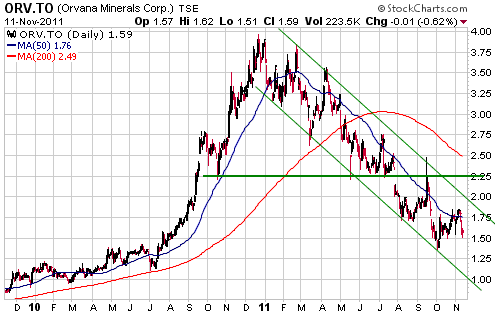
Further to the above, we will look for an opportunity to exit ORV over the next few months. A rebound to near resistance at C$2.25 would create such an opportunity.
Quick note on uranium
The uranium price rose by $4/pound last week, but uranium-mining equities generally didn't react (no pun intended).
Most junior uranium miners are well down on the year and are therefore good candidates for tax-loss selling between now and year-end. Price weakness caused by tax-loss selling or a decline in the broad stock market should be viewed as an opportunity to establish or add to positions in these stocks.
Chart Sources
Charts appearing in today's commentary
are courtesy of:
http://stockcharts.com/index.html

|









