<% 'pass = Request.Form("pass") IF ((Request.Form("pass") = 1) OR (Session("pass") = "pass")) THEN %> The Speculative Investor


   -- Weekly Market Update for the Week Commencing 14th November 2016

Big Picture View

Here is a summary of our big picture view of the markets. Note that our short-term views may differ from our big picture view.

The BULL market in US Treasury Bonds that began in the early 1980s ended in early-2015, but there will be many years of topping action in bond prices and bottoming action in bond yields before major new trends get underway. (Last update: 29 June 2015)

The stock market, as represented by the S&P500 Index, commenced a secular BEAR market during the first quarter of 2000, where "secular bear market" is defined as a long-term downward trend in valuations (P/E ratios, etc.) and gold-denominated prices. This secular trend will bottom sometime between 2018 and 2020. (Last update: 29 June 2015)

A secular BEAR market in the US Dollar began during the final quarter of 2000 and ended in July of 2008. This secular bear market will be followed by a multi-year period of range trading. (Last update: 09 February 2009)

Gold commenced a secular bull market relative to all fiat currencies, the CRB Index, bonds and most stock market indices during 1999-2001. This secular trend will peak sometime between 2018 and 2020. (Last update: 29 June 2015)

Commodities, as represented by the CRB Index, commenced a secular BULL market in 2001 in nominal dollar terms. The first major upward leg in this bull market ended during the first half of 2008, but a long-term peak won't occur until 2018-2020. (Last update: 29 June 2015)

Copyright Reminder

The commentaries that appear at TSI may not be distributed, in full or in part, without our written permission. In particular, please note that the posting of extracts from TSI commentaries at other web sites or providing links to TSI commentaries at other web sites (for example, at discussion boards) without our written permission is prohibited.

We reserve the right to immediately terminate the subscription of any TSI subscriber who distributes the TSI commentaries without our written permission.

Outlook Summary

Market
Short-Term
(1-3 month)
Intermediate-Term
(6-18 month)
Long-Term
(2-5 Year)
Gold N/A Bullish
(10-Oct-16)
Bullish
US$ (Dollar Index) N/A Neutral
(17-Aug-16)
Neutral
(19-Sep-07)
US Treasury Bonds (TLT) N/A Bearish
(19-Oct-15)
Bearish
Stock Market (DJW) N/A Neutral
(14-Nov-16)
Bearish
Gold Stocks (HUI) N/A Bullish
(10-Oct-16)
Bullish
Oil N/A Neutral
(26-Oct-15)
Bullish
Industrial Metals (GYX) N/A Neutral
(10-Oct-16)
Bullish
Notes:
1. Our short-term expectations are discussed in the commentaries, but except in special circumstances we won't attempt to assign a "bullish", "bearish" or "neutral" label to these expectations.
2. The date shown below the current outlook is when the most recent outlook change occurred.
3. "Neutral" means that we think risk and reward are roughly in balance with respect to the timeframe in question.

4. Long-term views are determined almost completely by fundamentals and intermediate-term views are determined by a combination of fundamentals, sentiment and technicals.

Last week's posts at the TSI Blog

Update on the Comex fear-mongering

Summary of current thinking/positioning

1) Thinking that new rebounds for gold and the associated mining indices will soon begin, but continuing to expect that the overall corrections will extend into Q1-2017. Slowly picking away at high-potential gold-mining stocks.

2) Expecting that 2017-2018 will be a very bullish period for commodities. Gradually building up long-term exposure to non-gold commodities while acknowledging that the early-2016 lows could be tested prior to the start of the aforementioned bullish period.

3) Prior to last week was hedged against short-term commodity-price weakness via EEM (emerging market) and USO (oil) put options, but took profits on hedges last week. Looking for new opportunities to establish hedges as still concerned about short-term downside risk.

4) Thinking that government bonds have commenced a long-term bear market, but that the US Treasury Bond is close to a short-term price bottom.

5) Positioned for short-term downside in the US stock market via QID (leveraged NDX bear fund) call options, although the strength of last week's expected rebound has raised some doubts about the appropriateness of this position.

6) Thinking that the Dollar Index is within 1.5 points of a 1-2 month top, but that it will probably move to new multi-year highs during the first quarter of 2017.

7) Maintaining a large cash reserve in recognition of the downside risk in almost all equities (current cash percentage is around 45%), but looking for opportunities to reduce cash and add to gold plus commodity exposure.

Economic Risks of a Trump Presidency

In a 10th May post at the TSI Blog we speculated on the consequences of a Trump presidency. Our conclusion back then was that a Trump presidency would be a significant plus in the area of foreign policy*, but that there wasn't a good reason to expect the US economy and financial markets to fare any better or worse under Trump than they would under Clinton. With it now confirmed that Trump will be the next US president it is time to revisit the topic, although today's discussion will focus on the two main economic risks associated with having Trump, rather than the potential Democratic Party alternative, in the White House.

Before getting into any Trump-specific issues it is worth mentioning that the most potent threat to the US economy comes from the Federal Reserve. By undermining savers, promoting widespread mal-investment and generally distorting price signals throughout the economy, the Fed is an omnipresent obstacle to economic progress -- a relentless force for inefficiency and wealth destruction. This has been the case to some extent for 100 years, but over the past 9 years the Fed has gone to far greater lengths than ever before to 'manage' the economy. In particular, it has implemented by far the most aggressive monetary intervention in its history, leading, predictably, to the weakest post-recession recovery in generations.

Regardless of what actions Trump takes, the actions that have already been taken by the Fed all but guarantee that the next US recession will be devastating. For Trump's sake the next recession better start during the first half of 2017, because if it starts much later than that then he will get a lot of the blame for the Fed's dirty-work.

The first of the two risks we'll highlight is that Trump will follow through on his campaign rhetoric and implement policies that get in the way of international trade, such as placing hefty tariffs on imports from China.

The problems facing the US economy have nothing to do with an inability on the part of previous administrations to negotiate favourable trade deals and cannot possibly be solved or even ameliorated by tariffs. Putting in place tariffs and other restrictions on international trade is akin to imposing economic sanctions on yourself. It is patently stupid.

Some special interest groups will always profit from tariffs, but the economy as a whole cannot benefit because the additional gains of the aforementioned special interests must come at the expense of the broad category called "consumers". When consumers are forced to pay more for some products than they would otherwise be paying, they necessarily spend less on other products. Also, investment ends up getting directed towards businesses that only appear to be economically viable due to price-distorting tariffs, which results in other more-deserving investment opportunities being ignored.

The second Trump-specific risk is the potential for a massive increase in the US fiscal deficit. There would also have been an increase in the government's deficit under a Clinton presidency, but the deficit will be much greater if Trump does what he has promised to do. That's why Trump's widely-unanticipated electoral success was followed by a plunge in the T-Bond market.

As explained in the article posted at http://crfb.org/papers/lame-duck-president-2017, spending increases in excess of revenue increases are already 'baked into the cake' as a result of budgets dictated by previous presidents and Congresses. Specifically, the linked article points out that 150 percent of new revenue a decade from now is pre-committed to spending growth scheduled under current law. Moreover, this should be viewed as an unrealistically-optimistic forecast because it assumes steady inflation-adjusted revenue growth. A more realistic forecast would account for the sizable decline in inflation-adjusted revenue that will be caused by a recession within the next few years.

Trump has not only promised to do nothing to curtail the federal government's growing deficit, he has effectively promised to make it much worse by implementing large tax cuts.

As an aside, tax cuts are unequivocally beneficial to the economy if they are genuine, but a tax cut that isn't funded by reduced government spending is not a genuine tax cut. It is just a type of Keynesian stimulus program, and like all Keynesian stimulus programs it will potentially boost economic activity in the short-term at the cost of slower long-term progress.

The reason is that if a tax cut isn't funded by the government consuming less resources, then one way or another it will have to funded by the private sector. Obviously, the private sector cannot benefit from a tax cut that it will have to pay for. It's the old TANSTAAFL** again. There's no way around it.

In other words, Trump isn't promising to implement genuine tax cuts; he is promising to implement another short-term stimulus program.

A large increase in the federal deficit requires a rapid increase in the supply of government bonds. If the rising supply of government bonds is not monetised by the Fed then it will crowd-out private-sector borrowing, whereas if it is monetised by the Fed it will result in a bigger inflation problem. Furthermore, if interest rates rise and government indebtedness rises, the interest expense on the debt will rise not only in absolute terms but also as a percentage of total government spending. This could lead to a debt spiral, with increasing indebtedness prompting a disproportionately-large rise in interest expense and a further increase in the amount of debt.

In summary, the main Trump-specific economic risks involve protectionism and a rapidly-rising government deficit.

There are also some Trump-specific economic positives and opportunities, at least relative to the alternative. For example, even though Trump's plans will result in higher deficits, the total amount of government spending under Trump will probably be lower than it would have been under Clinton. That is, the government will be consuming/wasting less resources under Trump than would probably have been the case under Clinton. This is because Clinton was planning large tax increases to close the gap between government revenue and government spending. For another example, there is a possibility that a Trump presidency will result in fewer growth-hampering regulations.

Of course, regardless of what Trump does the Fed will be behind the scenes busily wreaking havoc.

    *Due to Trump running a foreign policy that is less concerned about regime change, less eager to intervene militarily in the affairs of other countries, and generally less offensive (in both meanings of the word).

    **There Ain't No Such Thing As A Free Lunch


Commodities

Copper

The industrial-metals markets were incredibly strong last week, with copper leading the way.

In last week's Interim Update we noted that at Wednesday's close the copper price had risen for 13 days in a row and at the time of writing was up an additional 8c during Asian trading on Thursday. It managed to hold that 8c gain during US trading on Thursday, taking the winning streak to an extraordinary 14 days and pushing the daily RSI(14) to the highest level in more than two decades. In other words, going into Friday's trading session the copper market was, by one short-term measure, more 'overbought' than it had been at any time over the preceding 20 years.

That wasn't the end of the surge, though. On Friday there was further acceleration, with CME copper futures momentarily trading as high as US$2.73 (up 0.19 on the day) before reversing course and ending the day with a small loss.

Friday's reversal could obviously have marked a short-term top, but there's no way of knowing for sure.
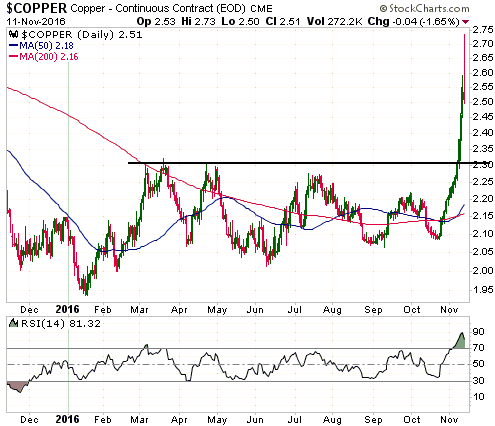


Last week's spectacular price surge cannot be explained by changes in the supply of or the commercial demand for physical copper. Instead, it was almost certainly driven by momentum-following speculation. This creates the risk that the bulk of the gain will be given back.

As an aside, bouts of momentum-following speculation are always supported by fundamental stories that are often only superficially plausible. In this case, we have the story that Trump's plans to boost infra-structure spending will greatly increase the demand for copper. Looking beneath the surface, however, we see that:

1) Considering his plans to cut taxes, increase military spending and leave the most costly entitlement programs alone, Trump's ability to obtain additional funds for infra-structure development will be very limited.

2) Even if Trump were able to follow-through on his infra-structure spending promises, the spending would be spread over several years and would probably not significantly alter global copper consumption.

3) Government infra-structure spending does not constitute a net addition to the economy. It involves the government taking resources that would have been used elsewhere and employing the resources in projects that are politically-motivated rather than economically-motivated.

That being said, we are not trying to imply that copper's recent price surge will turn out to be a 'flash in the pan'. The price action creates significant short-term downside risk, but the weekly close above the March high ($2.33) is evidence of a bullish long-term shift. The fact that last week's price surge happened after the speculative position in copper futures had reached the top of its bear-market range also points to a bullish long-term shift.

To put last week's volatility into perspective and illustrate the bullish long-term shift, here's a weekly chart of the copper price. The blue line on this chart is the 80-week MA. Notice that copper has just achieved the first solid weekly close above its 80-week MA in more than 5 years.
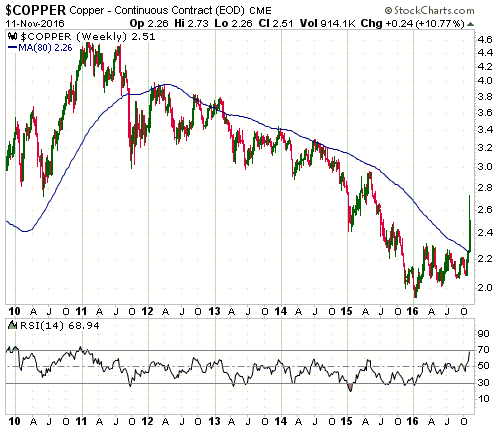


Former resistance in the $2.30s should act as support during the next short-term correction.

Natural Gas (NG)

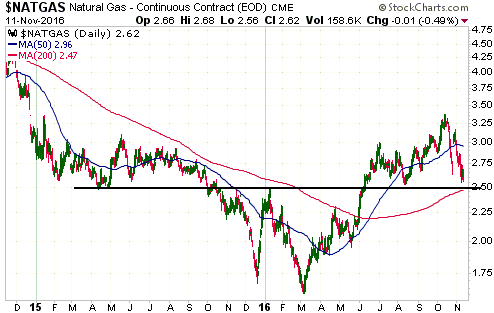
NG trended upward from what we think was a major bottom in March-2016 to a short-term top in October. During this 7-month period it was one of the strongest commodity markets, with the price more than doubling.

The March-October rally was probably the first leg of a new bull market, but bull markets don't progress in straight lines. Instead, they periodically give back a portion of their gains as some speculators take profits, commercial traders put hedges in place and 'weak hands' get shaken out.

Following the sort of gain that the NG price achieved, a decline to the 200-day MA would be a normal occurrence. The 200-day MA happens to be slightly below important lateral support at $2.50, which, in turn, is not far below last Friday's low. Therefore, there's a decent chance that NG's 'retracement' is almost complete.


The Stock Market

A possible 6-12 month bull market extension

The odds have tipped in favour of the US equity bull market continuing for up to another year. Taking into account the high valuation, the equity bull market's advanced age, the lackluster economic/earnings backdrop and the likelihood that interest rates are now trending upward, how is this possible?

It is possible for monetary and technical reasons.

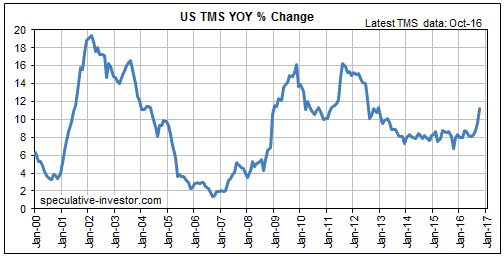
First, the following chart shows that the year-over-year (YOY) growth rate of US True Money Supply (TMS) has begun to accelerate upward from the very narrow horizontal range in which it oscillated for almost three years. This is not happening because the Fed has resumed its money-pumping, but because the commercial banks are responding to rising interest rates by creating new credit at a faster pace.


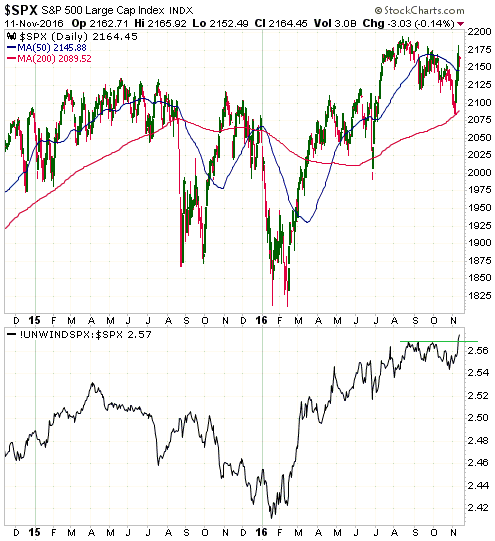
Second, at no time over the past several months has there been a meaningful bearish divergence between the senior US stock indices and the 'market internals'. Furthermore, during last week's rally the 'internals' were stronger than most of the indices. For example, whereas the S&P500 Index (SPX) rebounded to a lower high last week, the UWSPX/SPX ratio (the Unweighted SPX divided by the capitalisation-weighted SPX, a measure of breadth within the S&P500) made a new high. This is a bullish divergence.


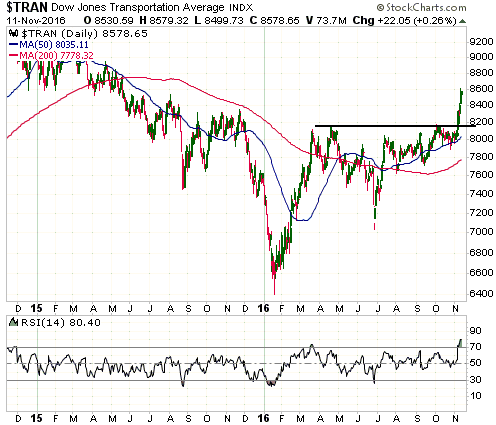
Third, the Dow Transportation Average (TRAN) has decisively broken above intermediate-term resistance.

TRAN is now in a similar position to copper. Both have done enough to signal long-term bullish reversals, but both are now very extended on a short-term basis (TRAN's daily RSI is at a 3-year high).


If there is a significant extension to the bull market it is likely to encompass a change in leadership, with commodity-related equities and other "inflation" plays leading the way.

Current Market Situation

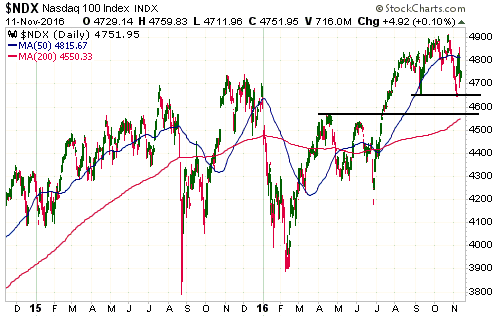
Different US stock indices put in very different performances last week. Among the senior indices, the biggest contrast was between the performances of the Dow Industrials Index and the NASDAQ100 Index (NDX). The following charts show that the Dow rocketed to a new all-time high last week while the NDX remains near support defined by its lows of the past three months.
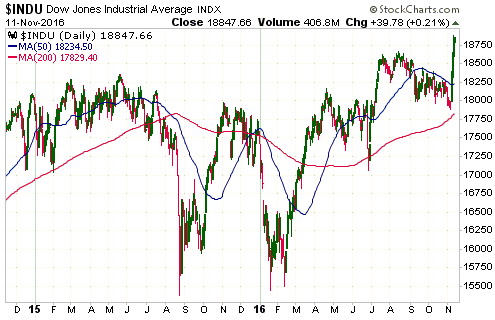


We aren't yet sure what to make of the recent Dow-NDX divergence. More information is required. For example, a decline in the Dow to below its August high combined with a daily close below 4550 by the NDX would indicate that last week's Dow breakout was a 'head fake' and that the market was still immersed in the short-term bearish trend that began in August.

This week's significant US economic events [Notes: 1) The most important events (to the markets) are shown in bold. 2) A list of global economic events can be found HERE]

Date Description
Monday November 14 No important events scheduled
Tuesday November 15 Retail Sales
Import and Export Prices
Business Inventories
Wednesday November 16 PPI
Industrial Production
Housing Market Index
TIC Report
Thursday November 17 CPI
Housing Starts
Friday November 18 Leading Economic Indicators


Gold and the Dollar


Gold

Gold and the US Election

Most people believed that a Trump election victory would be bullish for gold. We believed that it would be neutral for gold beyond a 1-2 day upward reaction. So far, however, the Trump victory has turned out to be gold-bearish and it has done so due to its effect on gold's true fundamental drivers*.

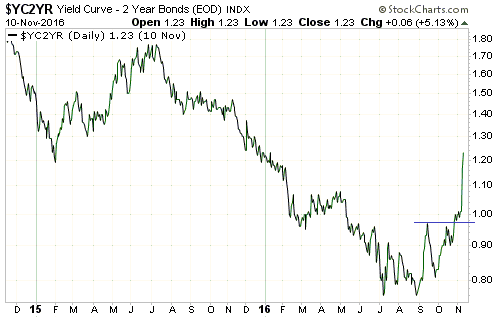
As we mentioned at the time, gold's true fundamentals shifted from slightly bearish to neutral in late-October due to a confirmed reversal in the US yield curve from flattening to steepening. The following chart shows that the yield curve became steeper last week (meaning: long-term interest rates rose relative to short-term interest rates), causing this particular price driver to move further into gold-bullish territory.


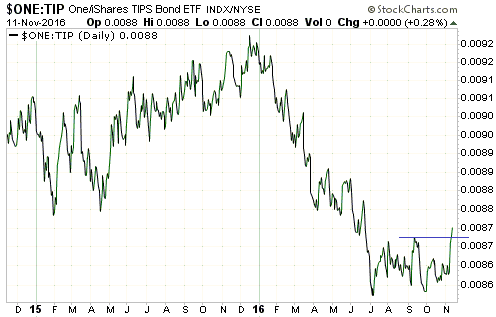
The recent confirmed reversal in the yield curve has, however, been counteracted by an increase in the real interest rate (the TIPS yield). The following chart shows that the reciprocal of the TIPS bond fund (a quantity that closely tracks the 10-year TIPS yield) rose by enough last week to break upward from its 4-month range.

The confirmed upward reversal in the real interest rate has taken gold's true fundamentals back to where they were a few weeks ago: slightly bearish.


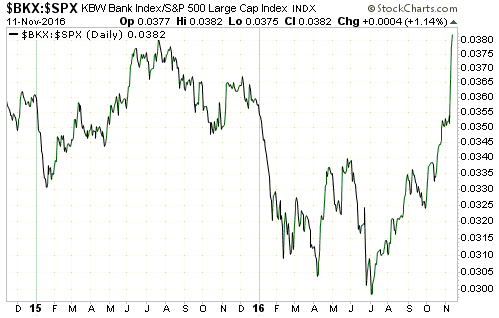
Also, it's worth mentioning that the rise in long-term interest rates that got underway in early-July and that accelerated after Trump's victory has led to substantial relative strength in the banking sector of the stock market. Refer to the following chart of the BKX/SPX ratio for details. The banking sector's relative strength has been a negative influence on gold for a few months.


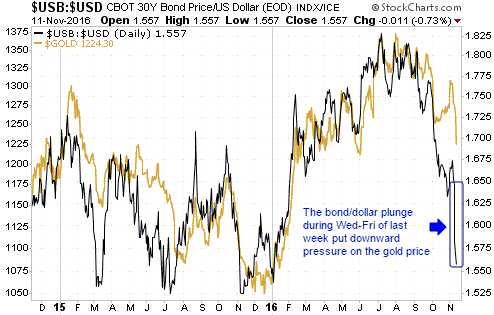
Rather than trying to weigh the fluctuations of several different indicators of financial-system and economic confidence in order to determine whether the fundamental backdrop is bullish, bearish or neutral for gold, a short-cut is to monitor the bond/dollar ratio (the T-Bond divided by the Dollar Index). This simple ratio encompasses, directly or indirectly (mostly indirectly), the main fundamental gold-price drivers.

A rising bond/dollar ratio indicates that the fundamental backdrop is becoming increasingly gold-bullish and a falling bond/dollar ratio indicates the opposite. As illustrated below, the bond/dollar ratio had begun to rebound prior to the election but plunged in the aftermath of the election.

The good news for gold bulls is that the bond/dollar ratio is now very stretched to the downside and will probably soon turn upward due to a pullback in the Dollar Index and/or a rebound in the bond market.


    *The real interest rate (as indicated by the 10-year TIPS yield), the US yield curve (as indicated by the 10yr-2yr yield spread), credit spreads (as indicated by the IEF/HYG ratio), the relative strength of the banking sector (as indicated by the BKX/SPX ratio), the US dollar's exchange rate and the overall trend for commodity prices.

The Price Action

Our view has been that the gold correction would extend into the first quarter of next year and that support in the low-$1200s would potentially be tested before the correction was over, but we certainly didn't expect that the price would come close to testing this support as early as last week. Here, for example, is how we summarised the situation two weeks ago: "The price action leaves open the possibility of a quick decline to support in the low-$1200s prior to a short-term bottom (a bottom that holds for more than a couple of months), but we suspect that such a bottom was put in place when the gold price spiked down to $1243 on 7th October and that the worst that will happen over the weeks immediately ahead is a test of the 7th October low."

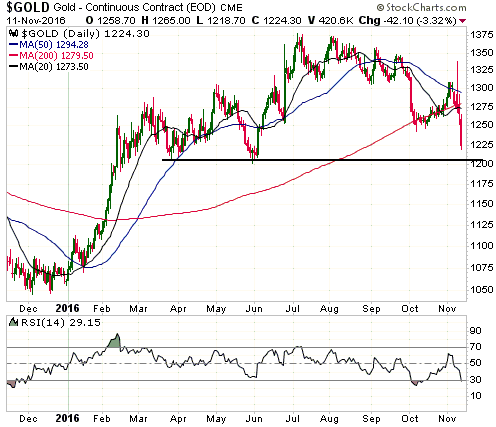
Last week's gold market action was wild. The price traded through a $120 (almost 10%) range, spiking to a 6-week high during Asian trading on Wednesday as part of a brief fear-based reaction to the Trump victory and then plunging to a 5-month low on Friday in response to deteriorating fundamentals. The price is now within striking distance of important lateral support in the low-$1200s.

If support in the low-$1200s is breached on a weekly closing basis it would be a warning that a new cyclical bull market did not get underway last December and that a test of the December-2015 bottom was likely during the first half of 2017. In other words, it's important that support in the low-$1200s holds on a WEEKLY closing basis.


We will be interested to see the Commitments of Traders (COT) report due at the end of this week, as it will reveal the effects on speculative positioning of the post-election price volatility. It will probably (and hopefully) reveal that the total speculative net-long position in COMEX gold futures has dropped to 150K contracts or lower.

Lastly, we expect that a test of support in the low-$1200s will be followed by another multi-week rebound that will take the price back to the $1250-$1300 range.

India's Gold Market

In last week's Interim Update we linked to an article that discussed the recent panic buying of gold in India in reaction to the Indian government's sudden and shocking decision to ban the two most commonly-used bank notes. Further information on this issue is in the article linked HERE.

At this time we only want to make two comments on this topic.

First, last week's actions by the Indian government were NOT about eliminating or even reducing the use of physical cash (the banned notes will be replaced by new notes); they were about increasing government revenue. Under the guise of fighting corruption, the government has come up with a scheme that is expected to uncover hidden cash hoards, some of which will undoubtedly be confiscated by the government.

Second, last week's market action added to the large pile of existing evidence that in terms of effect on the gold price, what's happening in India is trivial compared to what's happening in the US. This is perfectly logical given the true fundamental drivers of the gold price and the relative importance, in determining those drivers, of the US$, the Fed and the US economy.

Other Precious Metals

As stated in earlier commentaries, $16.00 is the most likely target for a correction low in the silver price. In this regard, last week's frenetic market action didn't change anything.

As also stated in earlier commentaries, platinum is the precious metal with the most bullish intermediate-term risk/reward. We were buyers of physical platinum a few weeks ago in the US$930s and will add to our position if given the chance to do so in the $850-$900 range.

Gold Stocks

In last week's Interim Update we wrote:

"Some weakness in the gold-mining indices over the coming 1-2 days could create a good short-term trading opportunity, but at this time the right approach for most investors with sizable cash reserves is to simply pick away at gold-mining stocks that offer reasonable value."

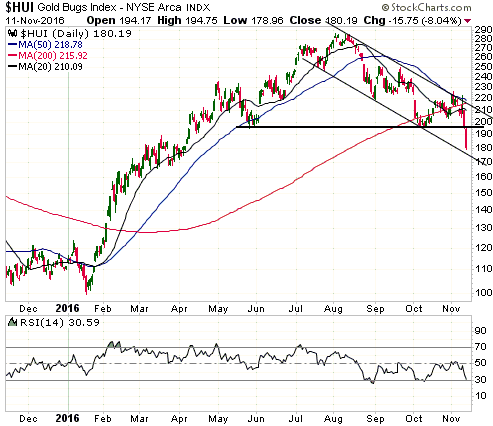
What we got over the ensuing 1-2 days (Thursday and Friday of last week) was a lot more than "some weakness", with the HUI plunging to support at 195 on Thursday and then breaking decisively below support on Friday. There is no longer any nearby lateral support of significance, but there is a channel bottom a few points below Friday's low.


Despite Friday's breach of important lateral support, with the HUI's daily RSI having dropped back to 30 and with the bottom of a well-defined channel not far below the current price it could make sense to buy a gold-mining ETF for a short-term trade. However, the best approach for most people and the approach that we are using is to slowly/methodically add to gold-stock exposure on price weakness. For example, we did a little buying late last week and plan to do a little more buying early this week. This is called sowing the seeds of future profits.

By the way, it will create a more bullish short-term set-up if the gold-mining indices make new lows for the move early this week before turning higher.

The Currency Market

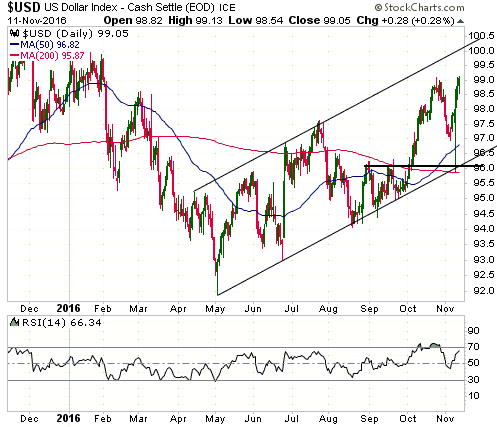
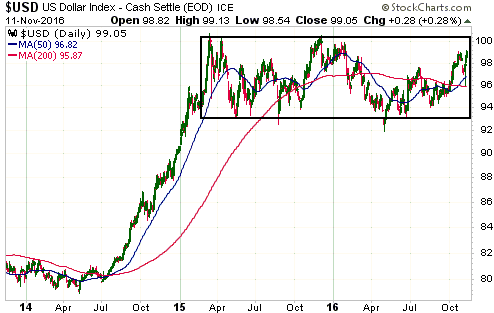
When it became clear that Trump was going to win, the Dollar Index plunged to support at 96. It then quickly changed direction and by the end of the week was back at its October high.

There is major resistance at 100.0-100.5 that will probably be tested within the next two weeks.


As illustrated below, resistance at 100.0-100.5 is the top of a long-term horizontal range. Given that the most important intermediate-term driver of trends in the US$/euro exchange rate (relative equity-market performance) remains US$-bullish and that the US$/euro exchange rate is about 60% of the Dollar Index, the odds favour an eventual upside breakout by the Dollar Index from this horizontal range.

However, our guess is that resistance near 100 will hold over the remainder of this year and that if an upside breakout in the Dollar Index is going to happen it won't do so until the first quarter of next year.


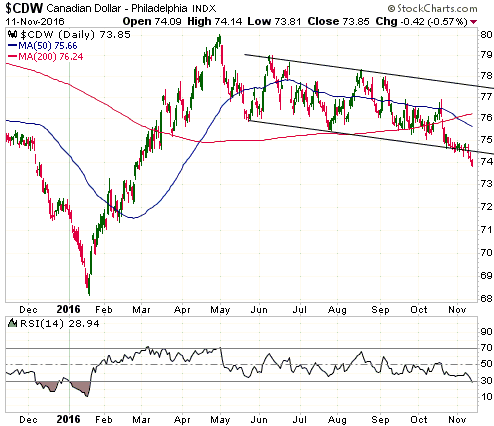
The Canadian dollar (C$) is short-term 'oversold' and could soon rebound, but it is not showing any signs of strength. In fact, it has broken out to the downside and ended last week at an 8-month low.

One implication of the C$'s performance is that we shouldn't expect anything more bullish from the oil price than a 1-3 week counter-trend rebound. In other words, oil's short-term downward trend is probably not complete.


Updates on Stock Selections

Notes: 1) To review the complete list of current TSI stock selections, logon at http://www.speculative-investor.com/new/market_logon.asp and then click on "Stock Selections" in the menu. When at the Stock Selections page, click on a stock's symbol to bring-up an archive of our comments on the stock in question. 2) The Small Stock Watch List is located at http://www.speculative-investor.com/new/smallstockwatch.html

Company news/developments for the week ending Friday 11th November 2016:
[Note: AISC = All-In Sustaining Cost, FS = Feasibility Study, FY = Financial Year, IRR = Internal Rate of Return, ISR = In-Situ Recovery, MD&A = Management Discussion and Analysis, M&I = Measured and Indicated, NAV = Net Asset Value, NPV(X%) = Net Present Value using a discount rate of X%, P&P = Proven and Probable, PEA = Preliminary Economic Assessment, PFS = Pre-Feasibility Study]

  *Almaden Minerals (AAU) published its quarterly report for the September quarter. The company had about C$12.4M of working capital at 30th September, which is about $5M more than at the end of the preceding quarter. The increase was due to the exercising of warrants.

This should mean that AAU is fully-funded for the next 12 months, although we expect that the next equity financing will be done during the first few months of 2017 -- after the results of the Tuligtic project's PFS are reported.

  *Endeavour Mining (EDV.TO) published a maiden resource estimate for the recent Bakatouo and Colline Sud discoveries at its 55%-owned Ity gold mine in Ivory Coast, West Africa. The "Indicated" resource is 515K ounces at a very attractive grade (for an open-pit mine) of almost 3-g/t.

EDV also published the FS results for a proposed CIL (carbon-in-leach) plant at its Ity gold mine. The mine is presently a heap leach operation, but it is envisaged that utilising a CIL processing plant will enable more efficient gold recovery in the future.

According to the FS, the CIL Project would produce an average of 114K ounces of gold per year over a 14-year life at an AISC of only US$603/oz. The initial capex would be about US$300M and at a gold price of $1250/oz the NPV(5%) and IRR would be US$411M and 36%, respectively.

Considering the positive economics and EDV's ability to fund the development using its existing financial resources, it's a good bet that the CIL project will enter the construction phase during the first half of 2017 and be in production by early-2019.

Ity is one of EDV's two operating mines in Ivory Coast. The company also has mines in Ghana, Burkina Faso and Mali.

Ivory Coast appears to contain huge potential, not just for EDV but for gold miners in general. This is due to the geology and the fact that up until now the country has been subject to minimal exploration using modern techniques. There is a lot of relatively high-grade close-to-the-surface ore to be found, but the country risk is also relatively high.

The main problem with country risk is that when it materialises it tends to do so suddenly and without warning. One day everything seems fine, the next day something happens (for example, a military coup) that dramatically reduces the market value of all investments.

Due to the nature of the risk we wouldn't want to invest in a company that had all of its eggs in the Ivory Coast basket, but due to the reward potential it is reasonable for a gold-mining company to have some exposure to this country.

  *Pilot Gold (PLG.TO) published its quarterly report for the September quarter. The balance sheet included in the report revealed that the company had about US$4M of working capital at the end of the quarter, or about $2M less than at the end of the preceding quarter. However, subsequent to quarter end the company arranged an equity financing that will add about US$9M to its balance sheet, so assuming a similar rate of spending in Q4 as in Q3 the company should end the year with about US$11M of working capital. This should be enough to fund the exploration business throughout 2017.

We expect that the next significant news for PLG will be the initial resource estimate for its Goldstrike project in Utah. This is now scheduled for early next year.

  *Petrus Resources (PRQ.TO) announced that Kevin Adair has resigned as CEO and that Neil Korchinski, the company's engineering vice-president and chief operating officer, has been promoted to the CEO role. We view this news as neutral. Personnel-wise, what matters the most is that Don Gray remains as the company's chairman.

Also, PRQ published its quarterly report for the September quarter.

At an operational level, PRQ continues to meet our expectations. In particular, it has been successful at reducing O&G production costs and ramping up production. Production was down to 7100 boe/d (barrels of oil-equivalent per day) during the September quarter due to an asset sale, but it is currently at 8500 boe/d and is expected to end the year at around 9000 boe/d.

Net debt (long-term debt minus working capital) was C$122M at the end of the September quarter, which is roughly the same as it was at the end of the preceding quarter.

On the stock market PRQ continues to perform poorly. Its book value is around C$5.80/share and yet the stock market is valuing the company at only C$1.82/share. The huge discount to book value creates upside potential.

  *Sprott Resource Corp. (SCP.TO) published its financial results for the September quarter.

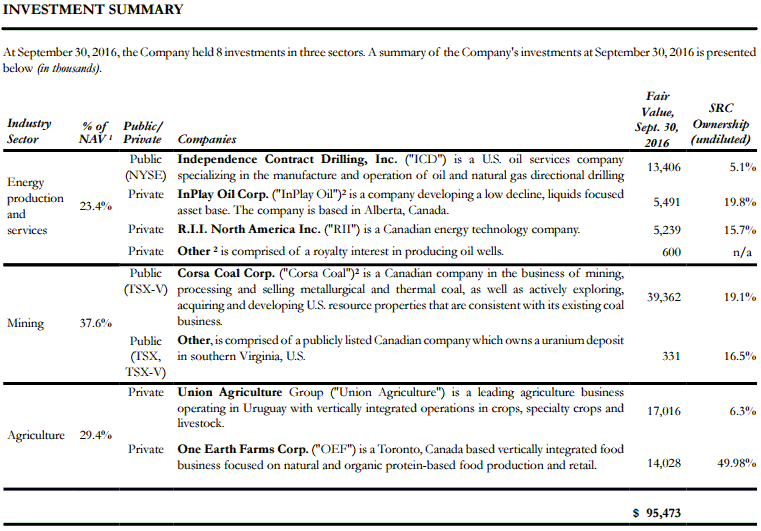
SCP's performance is primarily measured by the change in its net asset value (NAV). Based on this measure, there was good overall performance during the September quarter. Specifically, the NAV increased by C$11M, or C$0.11/share. At 30th September the NAV was C$1.09/share, which means that the stock is presently trading at a discount to NAV of more than 50%. This is the main reason for our continuing interest.

Here is the summary of investments included in the company's latest quarterly MD&A. The most significant changes from the preceding quarter are a large upward revaluation of the publicly-traded Corsa Coal (CSO) position, a large decline in the value of the Independence Contract Drilling (ICD) investment due mostly to the sale of shares, and moderate downward revaluations of the private agricultural investments. Note that proceeds from the sale of ICD shares were used to build up cash and repay about half of the C$18M credit facility, leading to a much stronger balance sheet.


Since the end of the September SCP has acquired ownership of 6.7M shares of the newly-listed InPlay Oil (IPO.TO) as part of a plan of arrangement that involved the merging of Anderson Energy (AND.TO) and the formerly-private InPlay Oil. Putting it more simply, SCP's stake in the privately-held InPlay Oil has been converted into 6.7M publicly-traded shares.

The new shares are trading at C$2.00, which means that SCP's stake is currently worth C$13.4M. This is C$7.9M above the value indicated in SCP's Q3 financial statements, so this is good news for SCP shareholders.

Also since the end of the quarter, SCP has sold most of its remaining ICD shares and used the proceeds to fully repay its credit facility. Consequently, it now has about C$12M of cash and no debt.

We estimate that the company's current NAV is about C$1.14/share.

  *Solitario Exploration (XPL) published its quarterly report for the September quarter. The report revealed that the company's balance sheet is almost the same as it was three months earlier, with no long-term debt and a bit less than US$17M (US$0.43/share) of working capital. This is a very comfortable financial position.

As we've said in the past, XPL is a relatively low-risk long-term play on zinc. It is relatively low-risk due to its strong balance sheet and provides long-term exposure to zinc via its part ownership of the high-grade exploration-stage Bongara project in Peru.

We expect that XPL's management will use part of the company's cash hoard to purchase an advanced-stage mineral exploration project.

  *Timmins Gold (TGD) announced that it is raising C$20M by issuing 36M new shares at C$0.55/share. Each new share will come with half of an 18-month warrant with an exercise price of C$0.70.

TGD was profitable and cash-flow positive over the past two quarters and its balance sheet was in good shape -- with US$22M of working capital -- at the end of the latest quarter. The company therefore didn't need to raise money to fund its operating mine, but it will need additional money to fund the development of the Ana Paula project.

The financing news is negative because it involves issuing new shares at below what we estimate to be fair value at the current gold price. It isn't a big problem, though, because it reduces our per-share value by less than 5% and has the benefit of reducing risk.

List of candidates for new buying

From within the ranks of TSI stock selections the best candidates for new buying at this time, listed in alphabetical order, are:

1) AAU near US$1.10 (last Friday's closing price: US$1.17)

2) BLK.AX (last Friday's closing price: A$0.64)

3) EVN.AX near A$2.00 (last Friday's closing price: A$2.28)

4) PG.TO (last Friday's closing price: C$2.51)

5) PRQ.TO (last Friday's closing price: C$1.82)

Note that the above list is limited to five stocks. It will sometimes contain less than five, but it will never contain more than five regardless of how many stocks are attractively priced for new buying.

Removing Ivanhoe Mines (IVN.TO) from the TSI Stocks List

We have removed IVN from the TSI List. The stock is up by 290% since being added to the List only 9 months ago, so this trade worked well.

IVN's current enterprise value (market cap minus net cash) is still low considering the exceptionality of its assets, so the stock price will probably continue its upward trend as long as DRC (Democratic Republic of the Congo) country risk doesn't bubble to the surface.

Country risk is the sole reason for exiting at this time. This risk was irrelevant when we first began to cover IVN in February because at that time the stock price was well below the value of the company's cash, but it is now relevant due to the much higher stock price.

As well as following the stock at TSI, we have IVN shares in our own account. FYI, we exited about half of our position near the current price of C$2.42 and will look for an opportunity to exit the balance. We will almost certainly exit the balance if given an opportunity in the near future to do so at around C$2.70.

Chart Sources

Charts appearing in today's commentary are courtesy of:

http://stockcharts.com/index.html

<% Session("pass") = "pass" Session.Timeout = 480 ELSE Response.Redirect "market_logon.asp" END IF %>