|
-- Weekly Market Update for the Week Commencing 15th August 2011
Big Picture
View
Here is a summary of our big picture
view of the markets. Note that our short-term views may differ from our
big picture view.
In nominal dollar terms, the BULL market in US Treasury Bonds
that began in the early 1980s ended in December of 2008. In real (gold)
terms, bonds commenced a secular BEAR market in 2001 that will continue
until 2014-2020. (Last
update: 4 April 2011)
The stock market, as represented by the S&P500 Index, commenced
a secular BEAR market during the first quarter of 2000, where "secular
bear market" is defined as a long-term downward trend in valuations
(P/E ratios, etc.) and gold-denominated prices. This secular trend will bottom sometime between 2014 and 2020. (Last update: 22 October 2007)
A secular BEAR market in the Dollar
began during the final quarter of 2000 and ended in July of 2008. This
secular bear market will be followed by a multi-year period of range
trading. (Last
update: 09 February 2009)
Gold commenced a
secular bull market relative to all fiat currencies, the CRB Index,
bonds and most stock market indices during 1999-2001. This secular trend will peak sometime between 2014 and 2020. (Last update: 22 October 2007)
Commodities,
as represented by the Continuous Commodity Index (CCI), commenced a
secular BULL market in 2001 in nominal dollar terms. The first major
upward leg in this bull market ended during the first half of 2008, but
a long-term peak won't occur until 2014-2020. In real (gold) terms,
commodities commenced a secular BEAR market in 2001 that will continue
until 2014-2020. (Last
update: 09 February 2009)
Copyright
Reminder
The commentaries that appear at TSI
may not be distributed, in full or in part, without our written permission.
In particular, please note that the posting of extracts from TSI commentaries
at other web sites or providing links to TSI commentaries at other web
sites (for example, at discussion boards) without our written permission
is prohibited.
We reserve the right to immediately
terminate the subscription of any TSI subscriber who distributes the TSI
commentaries without our written permission.
Outlook Summary
Market
|
Short-Term
(0-3 month)
|
Intermediate-Term
(3-12 month)
|
Long-Term
(1-5 Year)
|
| Gold
|
Neutral
(19-Apr-11) |
Neutral
(24-Jan-11)
|
Bullish
|
| US$ (Dollar Index)
|
Neutral
(10-Aug-11)
| Neutral
(10-Aug-11)
|
Neutral
(19-Sep-07)
|
| Bonds (US T-Bond)
|
Bearish
(12-Aug-11) |
Bearish
(12-Aug-11)
|
Bearish
|
| Stock Market (S&P500)
|
Neutral
(08-Aug-11)
|
Bearish
(11-Oct-10)
|
Bearish
|
| Gold Stocks
(HUI)
|
Neutral
(13-Jul-11) |
Bullish
(23-Jun-10)
|
Bullish
|
| Oil | Neutral
(31-Jan-11) | Neutral
(31-Jan-11)
| Bullish
|
| Industrial Metals
(GYX)
| Bearish
(03-Jan-11)
| Bearish
(25-May-09)
| Neutral
(11-Jan-10)
|
Notes:
1. In those cases where we have been able to identify the commentary in
which the most recent outlook change occurred we've put the date of the
commentary below the current outlook.
2. "Neutral", in the above table, means that we either don't have a
firm opinion or that we think risk and reward are roughly in balance with respect to the timeframe in question.
3. Long-term views are determined almost completely by fundamentals,
intermediate-term views by giving an approximately equal weighting to
fundamental and technical factors, and short-term views almost
completely by technicals.
The final TSI commentary
from Shanghai
On Monday-Tuesday of this week we'll be making the big move from Shanghai to Kota Kinabalu (Malaysian Borneo), so today's report will be the final one that comes to you from Shanghai.
This will be a hectic week as we try to get things sorted out in our new location. Consequently, there won't be an Interim Update this Thursday. Due to the 'interesting' nature of the current market environment we will, however, send out a short market update via email on Thursday.
Bond Market Update
A bond market top?
Last Thursday's market action and US money supply data prompted us to email the following brief message to our subscribers:
"By our calculations, the year-over-year rate of growth in US True Money Supply (TMS) has just risen to 14% and the quarterly [3-month] rate of growth is now in excess of 20%. This dramatic acceleration in monetary inflation is due to recent large increases in demand and savings deposits at commercial banks.
One implication: We might have just witnessed a very important peak in the T-Bond market. Another implication: The downside risk in the stock market is less than many people believe.
We are downgrading our short- and intermediate-term T-Bond views from "neutral" to "bearish". As we write, the September T-Bond futures contract is trading at 136."
Rapid growth in the money supply isn't inherently bearish for government bonds. However, if it happens at a time when inflation expectations are low, it is inherently bullish for the stock market. It doesn't necessarily prevent the stock market from falling, but it does reduce this market's downside potential. And by limiting the stock market's downside potential, it increases the downside potential of investments that are being elevated by fear of a stock market disaster. This is relevant because stock market weakness -- the weakness that was occurring in real time and the fear that there was a lot more to come -- was the primary driver of the spectacular advance in the T-Bond over the past three weeks.
We aren't saying that the T-Bond is about to embark on a major multi-year decline (a major decline in the T-Bond will require a lot more evidence of US$ depreciation). What we are saying is that the recent rapid growth in the US money supply, which is further discussed below, will probably reduce the demand for safe havens. As strange as it may seem to those of us who dwell at the rational fringe, the T-Bond is still the world's most popular safe haven.
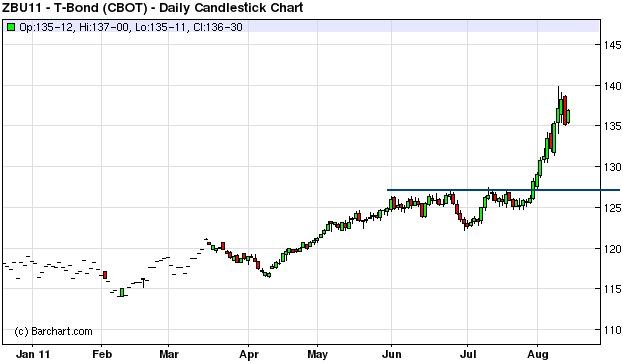
When we combine the likely reduction in the perceived need for a safe haven with sentiment indicators, the T-Bond's recent near-vertical price advance and the closeness of long-term resistance defined by the December-2008 peak, we conclude that we should be short- and intermediate-term bearish on T-Bonds.
Acknowledging that our bias is to be too bearish on T-Bonds, we are going to place a 'stop' on our bearish outlook. Specifically, if the nearest T-Bond futures contract closes above its 9th August intra-day high (140 in the September futures), we will shift back to "neutral".
Current Market Situation
With reference to the following daily chart of the September T-Bond futures, short-term downside risk is defined by support at around 127. Resistance is at the 9th August spike high.
We don't attempt to trade every opportunity that crops up in the markets and at this stage we have no intention of betting against the T-Bond. If we were going to make such a bet we would probably do so via long-dated put options on TLT. We know that TBT (the ProShares UltraShort 20+ year Treasury ETF) is a popular trading vehicle amongst the bond bears, but this fund has the same weakness as all leveraged (ultra-short and ultra-long) ETFs: due to its design, it has a strong inherent downward bias. TBT's downward bias is evidenced by the fact that it is now almost 30% lower than it was at the December-2008 major bond market peak.
Today versus 2008
We have been bearish on global equities and have warned that a 1-3 year cyclical decline was a distinct possibility. At the same time, we have maintained that there was almost no chance of a 2008-style crash occurring this year.
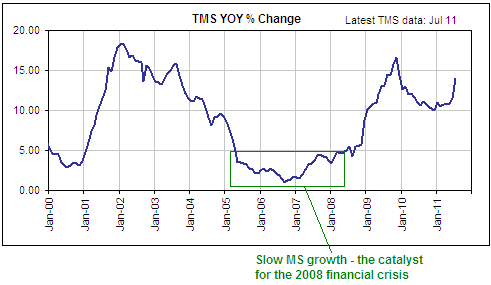
Thanks to the Keynesian policies implemented over the past three years, the economic problems are now worse than they were just prior to the 2007-2008 financial crisis. This is a good reason to be bearish on the economy and to tread very cautiously when speculating in equities, but it isn't a good reason to anticipate the sort of widespread panicked de-leveraging that occurred in 2008. The primary reason is that the monetary backdrop is completely different today than it was three years ago. We'll use the two charts displayed below to help explain what we mean.
The first chart shows the year-over-year rate of growth in TMS. With regard to this chart, notice the lengthy period of relatively slow money-supply growth that occurred prior to the 2008 crisis. This extended period of relatively slow money-supply growth wasn't the cause of the 2008 crisis, but it was the main catalyst. By way of further explanation, many years of rapid monetary inflation and market intervention led to mal-investment on a grand scale, but the mal-investment remained invisible to the masses (including most economists) while the money supply was rising rapidly. It was only after the rate of monetary inflation dropped to a low level and stayed there for a couple of years that the huge wastage of resources started to take an obvious toll.
Notice, also, that the money-supply's year-over-year growth rate has been much faster over the past couple of years than it was during the years leading up to the 2008 crisis. The growth rate peaked at around 16% in late 2009, but it has since remained high (above 10%) and recently accelerated upward.
The second chart underlines the difference between the current monetary situation and the situation just prior to the 2008 crash. It shows that the 3-month rate of change in TMS was only about 2% at the end of August-2008, versus about 21% today*.
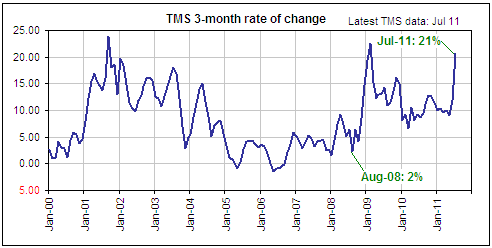
Today's vastly greater rate of monetary inflation is not an economic positive. In fact, it's a big economic negative and all but guarantees that the US economy will not commence a sustainable recovery anytime soon. However, it should support the nominal prices of equities and other assets.
A secondary reason to assign an extremely low probability to a 2008-style crash is that the events of 2008 are still fresh in the minds of central bankers. In particular, whereas the Fed was slow to turn on the money pumps during 2007-2008 (aggressive money-pumping didn't begin until September of 2008), it will likely react very quickly if evidence emerges over the next few months that money markets are seizing up.
Actually, the events of 2008 are still fresh in everyone's mind, which is why a lot of people are more worried about a 2008 repeat than they should be. There is a definite tendency for humans to overweight recent experience, meaning that there is a tendency to treat a very low-probability event as if it has a much higher probability simply because something similar happened recently. For example, as a result of the damage to oil/gas production facilities caused by Hurricane Katrina in 2005, many people were far more focused than they should have been on the risk of hurricane damage in the summer of 2006. For another example, the events of September-2001 caused people to become more concerned about the potential for terrorists to hijack planes and fly them into buildings, even though this particular act of terrorism became less likely as a result of 9/11.
In conclusion, there are a lot of economic problems at this time and we certainly wouldn't discourage anyone from being defensive, but the next major crisis probably won't look like the last one and it probably won't occur this year.
*We aren't sure why the growth rate in the US money supply has recently accelerated. It hasn't been caused by a large increase in US commercial bank credit and it doesn't appear to have been brought about by the Fed. In an earlier TSI commentary we speculated that the money-supply surge could be due to US dollars returning home from a foreign location (most likely Europe). This explanation is still plausible, but it has not yet been confirmed by the Dollar Index (we would have expected the Dollar Index to rally in response to a quick and significant reduction in the external supply of dollars). So, at this stage the cause of the money-supply surge is a mystery to us.
The Stock
Market
Current Market Situation
It's not every day that the NASDAQ's McClellan Oscillator drops to -119. In fact, prior to last week it hadn't happened since October-1987.
With the NASDAQ, by at least one short-term measure, becoming almost as 'oversold' last Monday as it did during the fateful October of 1987, we thought it would be appropriate to run a chart comparison of today's NASDAQ Composite Index and the same index from 1987. Here it is:
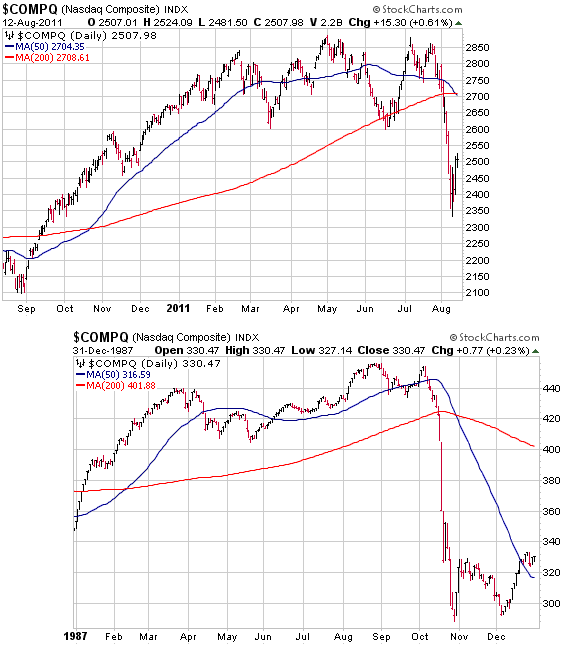
1987's percentage decline was twice as big as the recent decline (35% versus 18%), but the patterns are not dissimilar.
Notice that 1987's crash low was tested about 6 weeks later. This is typical, in that the lows of very sharp stock market declines are almost always tested. If the test is successful, the stage is then set for a strong rally.
Almost regardless of the intermediate-term scenario currently playing out, there's a good chance that last week's stock market low will be tested within the next 6 weeks. If the test is successful, the stage will potentially be set for a rally back to near the high of the past few months. If it isn't successful then we will have another piece of evidence that a cyclical bear market is underway.
If the senior US stock indices manage to successfully test their recent lows at some point over the next several weeks then it could make sense to buy the Brazilian stock market (via EWZ) and/or the Hong Kong stock market (via EWH) for a trade. However, we'll cross that bridge when we come to it.
A ban on short selling
As discussed in the Bloomberg article linked HERE, the short selling of financial stocks has just been banned by regulators in France, Spain, Italy and Belgium. This is a silly policy move because -- for the reasons discussed in the article -- it increases downside risk in the broad stock market and in the stocks that are being 'protected' by the ban. It also makes the stock market less efficient by getting in the way of price discovery.
This week's
important US economic events
| Date |
Description |
| Monday Aug 15 | Empire
State Manufacturing Index
TIC Report
Housing Market Index
| | Tuesday
Aug 16 | Housing Starts
Import and Export Prices
Industrial Production | | Wednesday
Aug 17 | PPI | | Thursday
Aug 18 | CPI
Existing Home Sales
Philadelphia Fed Survey
Leading Economic Indicators
| | Friday
Aug 19 | No important events
scheduled
|
Gold and
the Dollar
Gold
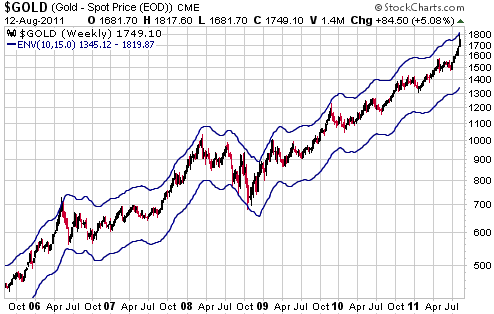
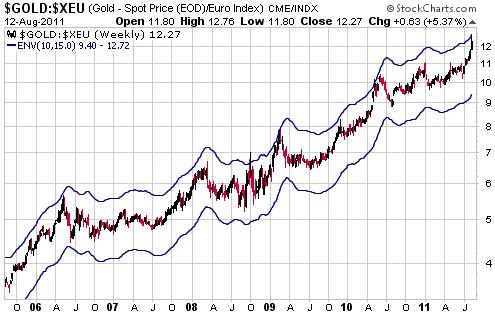
Displayed below are weekly charts of the US$ gold price and the euro gold price. Both charts include a moving average (MA) envelope, with the envelope defined by the 10-week moving average plus/minus 15%. Last week's big up-move took gold to the top of this MA envelope.
At no stage during gold's long-term bull market has either the US$ or the euro gold price made a sustained move above the aforementioned MA envelope. This means that a significant correction will soon begin or that gold is about to enter blow-off mode. The former possibility is by far the more likely, but the latter cannot be ruled out.
A correction over the next few weeks would likely take the gold price down to near the middle of its MA envelope, which means to the vicinity of the 50-day MA
($1560-$1600).
Over the past four months we have periodically hedged our precious metals exposure using SLV put options, and we currently hold some October SLV puts for insurance purposes. If gold returns to near last week's high or spikes to a new high over the coming fortnight then we will probably supplement our SLV insurance position with a GLD insurance position in the form of October $160 put options.
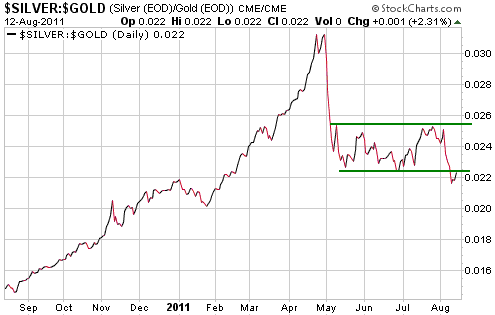
The following chart shows that the silver/gold ratio broke out to the downside from its multi-month trading range last week. This breakout is a bearish omen for 'risk' assets such as equities and high-yield bonds, but we question its sustainability because a) it occurred in parallel with the stock market becoming almost as 'oversold', on a short-term basis, as it ever gets, and b) it wasn't confirmed by an upside breakout in the Dollar Index. However, it will be prudent to treat the breakout as genuine until/unless future price action proves otherwise.
Gold Stocks
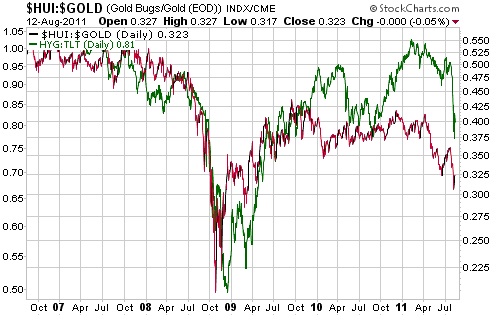
Gold stocks tend to perform poorly relative to gold bullion when the financial world is experiencing a general increase in risk aversion. As noted in previous TSI commentaries, this is the main reason for the pronounced weakness in the HUI relative to gold since the beginning of April. Another reason for relative weakness in gold stocks is the substantial increase in the average cost of gold production over the past 18 months.
The relationship between gold stocks, gold bullion and the market-wide trend in risk aversion is illustrated by the following chart. In this chart, the market-wide trend in risk aversion is represented by the HYG/TLT ratio (high-risk bonds relative to low-risk bonds). Notice that on an intermediate-term basis, the HUI/gold ratio usually trends in the same direction as the HYG/TLT ratio.
Below is a daily chart of the Junior Gold Miners ETF (GDXJ). GDXJ tested support at $32 at the end of the week before last and during the first two days of last week. It has since rebounded to the vicinity of its 50-day moving average.
Last week's rebound hasn't changed the overall chart pattern, in that it still has the look of a "head and shoulders" top. However, we are impressed that support at $32 held despite the frenzied shift away from risk that recently occurred.
There is still a realistic chance that GDXJ will break below support and drop to the mid-$20s, but the probability of such an outcome was reduced by last week's price action. Also, keep in mind that when obviously bearish chart patterns don't unfold the way they are 'supposed' to, a lot of people get caught off guard and are prompted to quickly cover short positions or increase long positions. This can result in a powerful rally.
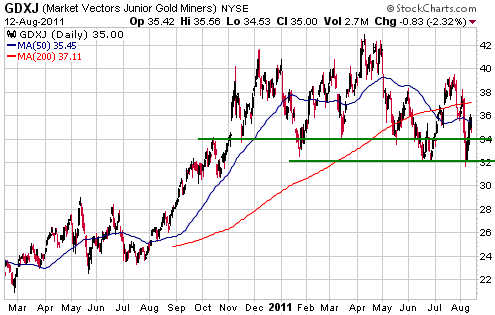
We will be interested to see if GDXJ and the gold-stock indices are able to remain above their recent lows as gold drops back to its 50-day moving average. If they can, the stage will be set for a multi-month advance in the gold sector.
Currency Market Update
The recent performance of the Dollar Index is about as non-committal as it could be. As evidenced by the following daily chart, at the end of last week the Dollar Index was at its 50-day moving average and roughly in the middle of its 3-month horizontal trading range.
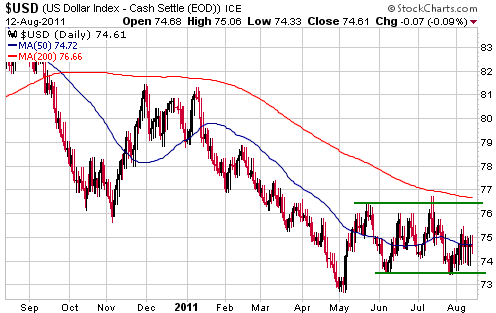
We downgraded our short- and intermediate-term US$ outlooks from "bullish" to "neutral" last week due to the dollar's lack of response to the recent market turmoil. Note, though, that while the potential for a strong US$ rally over the months ahead has been reduced, it certainly hasn't been eliminated. A daily close above 76.5 would signal that such a rally had begun, whereas a daily close below 73.5 would be evidence that the trading range of the past few months was a consolidation within a downward trend (as opposed to a bottoming pattern).
Update
on Stock Selections
Notes: 1) To review the complete list of current TSI stock selections, logon at
http://www.speculative-investor.com/new/market_logon.asp
and then click on "Stock Selections" in the menu. When at the Stock
Selections page, click on a stock's symbol to bring-up an archive of
our comments on the stock in question. 2) The Small Stock Watch List is
located at http://www.speculative-investor.com/new/smallstockwatch.html
Chart Sources
Charts appearing in today's commentary
are courtesy of:
http://stockcharts.com/index.html
http://www.barchart.com/

|









