|
-- Weekly Market Update for the Week Commencing 15th September 2014
Big Picture
View
Here is a summary of our big picture
view of the markets. Note that our short-term views may differ from our
big picture view.
In nominal dollar terms, the BULL market in US Treasury Bonds
that began in the early 1980s ended in 2012. In real (gold)
terms, bonds commenced a secular BEAR market in 2001 that will continue
until 2018-2020. (Last
update: 20 January 2014)
The stock market, as represented by the S&P500 Index,
commenced
a secular BEAR market during the first quarter of 2000, where "secular
bear market" is defined as a long-term downward trend in valuations
(P/E ratios, etc.) and gold-denominated prices. This secular trend will bottom sometime between 2014 and 2020.
(Last update: 22 October 2007)
A secular BEAR market in the Dollar
began during the final quarter of 2000 and ended in July of 2008. This
secular bear market will be followed by a multi-year period of range
trading.
(Last
update: 09 February 2009)
Gold commenced a
secular bull market relative to all fiat currencies, the CRB Index,
bonds and most stock market indices during 1999-2001.
This secular trend will peak sometime between 2014 and 2020.
(Last update: 22 October 2007)
Commodities,
as represented by the Continuous Commodity Index (CCI), commenced a
secular BULL market in 2001 in nominal dollar terms. The first major
upward leg in this bull market ended during the first half of 2008, but
a long-term peak won't occur until 2014-2020. In real (gold) terms,
commodities commenced a secular BEAR market in 2001 that will continue
until 2014-2020.
(Last
update: 09 February 2009)
Copyright
Reminder
The commentaries that appear at TSI
may not be distributed, in full or in part, without our written permission.
In particular, please note that the posting of extracts from TSI commentaries
at other web sites or providing links to TSI commentaries at other web
sites (for example, at discussion boards) without our written permission
is prohibited.
We reserve the right to immediately
terminate the subscription of any TSI subscriber who distributes the TSI
commentaries without our written permission.
Outlook Summary
Market
|
Short-Term
(1-3 month)
|
Intermediate-Term
(6-12 month)
|
Long-Term
(2-5 Year)
|
|
Gold
|
Neutral
(08-Sep-14) |
Bullish
(26-Mar-12) |
Bullish
|
|
US$ (Dollar Index)
|
Bearish
(27-Aug-14) |
Bearish
(25-Aug-14) |
Neutral
(19-Sep-07) |
|
Bonds (US T-Bond)
|
Neutral
(18-Aug-14)
|
Neutral
(18-Jan-12)
|
Bearish |
|
Stock Market
(DJW)
|
Bearish
(07-Apr-14) |
Bearish
(28-Nov-11) |
Bearish
|
|
Gold Stocks
(HUI)
|
Neutral
(08-Sep-14) |
Bullish
(23-Jun-10) |
Bullish
|
|
Oil |
Neutral
(02-Jun-14) |
Neutral
(31-Jan-11) |
Bullish
|
|
Industrial Metals
(GYX)
|
Neutral
(17-Feb-14) |
Neutral
(15-Sep-14) |
Bullish
(28-Apr-14) |
Notes:
1. The date shown below the current outlook is when the most recent outlook change occurred.
2. "Neutral", in the above table, means that we either don't have a
firm opinion or that we think risk and reward are roughly in balance with respect to the timeframe in question.
3. Long-term views are determined almost completely by fundamentals,
intermediate-term views by
fundamentals, sentiment and technicals, and short-term views by sentiment and
technicals.
Commodities
After doing enough during the first quarter of this year to
generate evidence that an intermediate-term upward trend had begun,
the Continuous Commodity Index (CCI) has since given back all of its
gains and is now testing its 2012 and 2013 lows. The severity of the
CCI's recent decline is due to the strong rally in the Dollar Index.
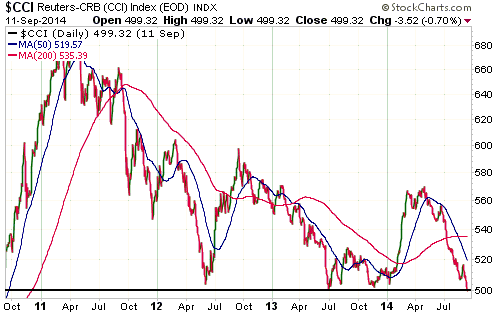
With the CCI now very 'oversold' and the Dollar Index very
'overbought', the stage is set for reversals. However, we would be
more comfortable in the sustainability of an upward CCI reversal if
it were preceded by a break below major support at 500. The reason
is that when a market breaks below major support AFTER having spent
a few years trending downward, the downside breakout will often mark
the end of the bearish trend. There are numerous historical examples
of this phenomenon, including the S&P500's downside breakouts just
prior to major lows in August-1982 and March-2009.
With regard to individual commodities, the current situations of
copper and oil are worth mentioning.
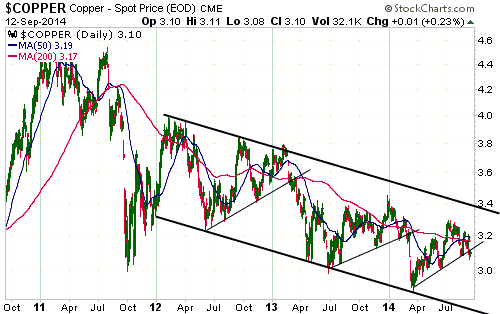
We've been operating under the assumption that while its short-term
outlook was uncertain, the copper market probably commenced a 1-2
year upward trend in March of this year. However, recent price
action throughout the commodity realm casts some doubt on this
intermediate-term outlook. Also, the copper price could be in the
process of breaking downward in similar fashion to how it broke
downward in early-2013 and earlier this year (see chart below). If
so, a decline to the channel bottom (the $2.70s) could be on the
cards. If such a decline were to happen it would probably be the
bear market's final 'washout'.
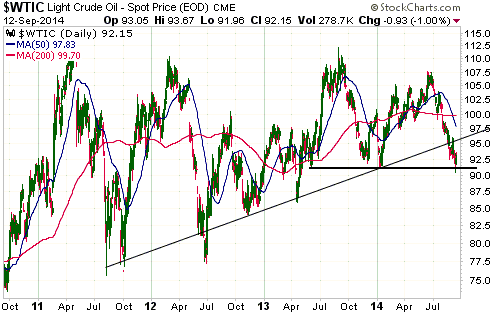
Oil became expensive by virtue of the fact that it held up better
than most commodities during 2012-2013, but it now seems to be in
the process of addressing its relative expensiveness. As illustrated
below, it has just dropped to lateral support defined by its low of
the past 15 months after having previously broken below a 3-year
trend-line. On a short-term basis it is now very 'oversold' and
could therefore soon begin to rebound, but such a rebound would
probably be the counter-trend variety.
The Stock
Market
The S&P500 Index (SPX) has fallen by only 1%
from its all-time high, and it took five trading days to accomplish this 1%
decline. Consequently, there is no evidence in the SPX's price action that
anything more than a minor setback is in progress, although valuation and
sentiment remain at dangerous extremes.
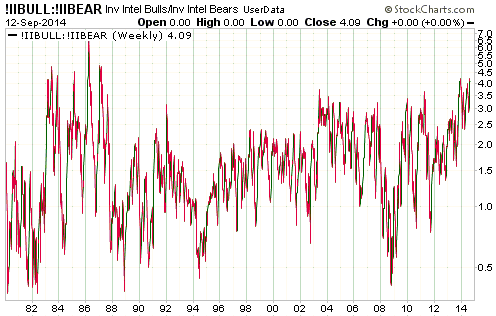
The chart displayed below puts the current sentiment situation into perspective.
It shows that, based on the Investors Intelligence survey, the ratio of bullish
advisors to bearish advisors is at its highest level since 1987. This doesn't
mean that a large decline is about to begin; it means that sentiment is
sufficiently extended into optimistic/complacent territory to set the scene for
such a decline.
Behind the veneer of stability created by the SPX's uneventful price action,
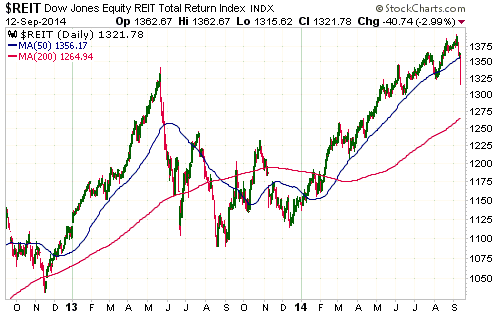
some interesting moves have just happened. First, the following chart shows that
the REIT sector of the US stock market has just reversed lower in dramatic
fashion. This price action suggests the beginning of at least a 1-2 month
correction.
Second, the banking sector of the US stock market, as represented by the Bank
Index (BKX), appears to be breaking out to the upside.
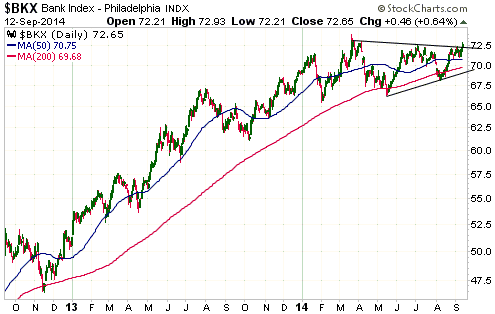
The recent moves in the REIT and banking sectors are related to the performance
of the T-Bond market, in that the downward correction in the T-Bond market is
clearly hurting the REITs and helping the bank stocks. We plan to cover the
inverse relationship between T-Bonds and bank stocks in this week's Interim
Update.
Also worth mentioning is that the Fed has been aggressively and relentlessly
siphoning wealth from the US economy as a whole into the banking industry since
2008. It has been the greatest undeserved wealth transfer in modern US history.
This periodically helps bank stocks to become strong, both in nominal terms and
relative to the broad market.
This week's
significant US economic events
(The most important events are shown
in bold)
| Date |
Description |
| Monday Sep 15 |
Empire State Mfg Survey
Industrial Production | | Tuesday
Sep 16 |
PPI
TIC Report | | Wednesday
Sep 17 |
FOMC Announcement & Yellen Press
Conference
CPI
Housing Market Index
Q2 Current Account Balance | | Thursday
Sep 18 |
Housing Starts
Philadelphia Fed Survey
|
| Friday Sep 19 |
Leading Economic Indicators |
Gold and
the Dollar
Gold
The Fundamentals
In the 18th August Weekly Update we noted that while gold's fundamental drivers
were still bullish on balance, they had become less so. This was mainly due to
the contraction in the US 10yr-2yr yield spread. Since mid-August gold's genuine
fundamentals have taken a further turn for the worse, such that it is now
appropriate to describe them as mixed. Of particular importance:
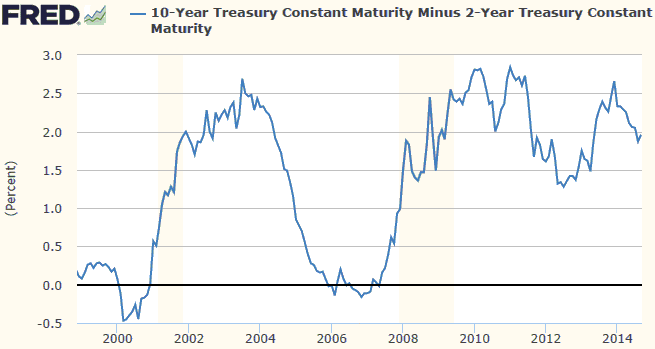
1) The US 10yr-2yr yield spread has contracted a little further, although we
would still describe it as neutral rather than bearish.
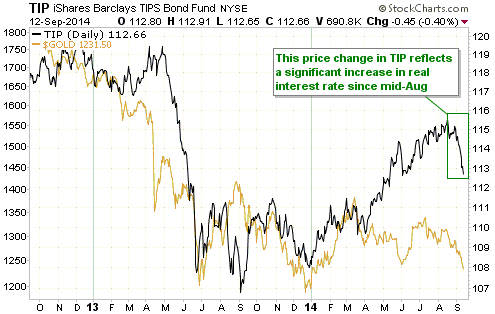
2) Overall, the real interest-rate backdrop has been getting more gold-bullish
since late-June of last year. However, since mid-August of this year there has
been a significant increase in real interest rates, which has clearly taken a
toll on the gold market.
The following chart illustrates how the direction of the real interest rate can
affect the gold price. The black line on this chart is the price of the iShares
TIPS Bond Fund (TIP), which moves in the opposite direction to the real interest
rate. For example, the sharp decline in TIP during April-June of last year
reflected a sharp increase in real interest rates, whereas the rebound in TIP
from last year's low reflects a downward trend in real interest rates. Because
gold is helped by a lower real interest rate and hurt by a higher real interest
rate, it will often move in the same direction as TIP.
We expect that the real interest rate will soon resume its downward trend, but
from gold's perspective it has been heading in the wrong direction over the past
four weeks.
3) The Dollar Index was gold-neutral while it was oscillating between 79.0 and
81.5, but this driver turned gold-bearish with the break above 81.5. The Dollar
Index is now very stretched to the upside and European equities have reversed
higher relative to US equities, which means that the US$ could be close to an
intermediate-term top. However, as things currently stand the foreign exchange
market represents a headwind for gold.
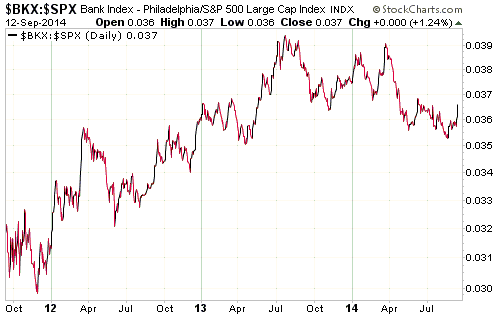
4) The banking sector's relative performance has generally been gold-bullish
since mid-2013, which is when the BKX/SPX ratio reached an important peak (gold
benefits from relative weakness in bank stocks as indicated by a downward trend
in the BKX/SPX ratio). On an intermediate-term basis this driver remains
supportive for gold, but the banking sector strengthened enough last week to
contribute to the short-term downward pressure on the gold price.
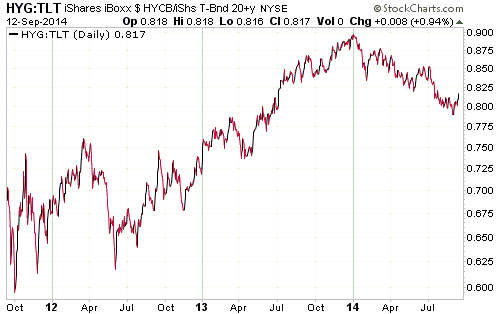
5) The HYG/TLT ratio has been working its way lower since the end of last year,
pointing to a modest widening trend in credit spreads. This trend is
gold-bullish, but, as is the case with the BKX/SPX ratio, from gold's
perspective the HYG/TLT ratio has moved in the wrong direction over the past two
weeks.
We expect that items 2) and 5) will start moving in gold's favour, shifting the
overall fundamental backdrop from 'mixed' to 'bullish', shortly after the US
stock market commences a meaningful decline. A meaningful decline, here, is one
that takes the S&P500 Index below its 200-day MA (currently at 1888 -- about 100
points below last week's close). However, if the US stock market keeps grinding
upward with only minor setbacks along the way, then the fundamental backdrop
will probably become more gold-bearish as economic confidence rises.
The Price Action
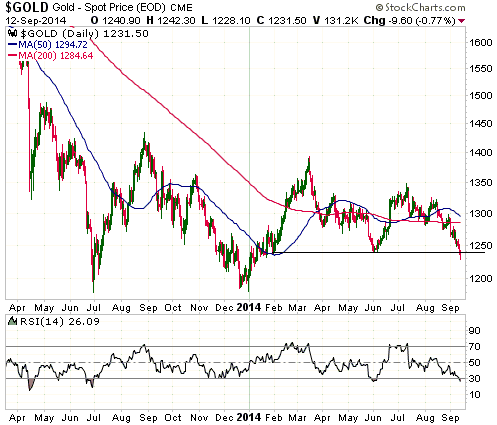
The US$ gold price has broken below support defined by its June low, but the
break below obvious support does not imply that there will be significant
additional downside. The reason is that the breakdown has occurred with the
market very 'oversold' over all timeframes.
If the gold price reverses upward and closes above $1251 (basis the
December-2014 contract) on either Monday or Tuesday of this week, then last
week's breakdown was false and we will have a reliable bullish signal. The most
likely alternative is a decline to the low-$1200s prior to an upward reversal
late this month.
A close above $1251 on any day this week would automatically shift our
short-term outlook back to 'bullish'.
Note that while gold and gold-mining stocks have generally trended in the
opposite direction to the broad stock market for more than 3 years, and while it
is therefore reasonable to expect that a stock market downturn would lead to
rallies in gold bullion and gold-mining stocks, it isn't reasonable to assume
that gold-related investments will immediately begin to rally as soon as the US
stock market shows signs of weakness. It could happen that way, but the inverse
relationship isn't so tight that it necessarily works on a very short-term
basis.
Gold Stocks
Current Market Situation
The HUI made a new correction low last Thursday before reversing course and
ending the day with a small gain. However, the reversal wasn't significant as
there was no follow-through to the upside on Friday. Thursday's intra-day low
remains the correction low to date, but on a daily closing basis there was a new
correction low on Friday.
On a more up-beat note, a small, but potentially significant, positive
divergence has developed between the HUI and the GDXJ/GDX ratio over the past 6
trading days. The divergence is indicated on the following chart.
There hasn't yet been sufficient strength in the GDXJ/GDX ratio to suggest that
a tradable rally has begun, but positive divergences between the HUI and the
GDXJ/GDX ratio occurred prior to the starts of the last two tradable rallies.
Last December the positive divergence began about 2 weeks prior to the start of
the rally and in the second quarter of this year the positive divergence began
about 3 weeks prior to the start of the rally.
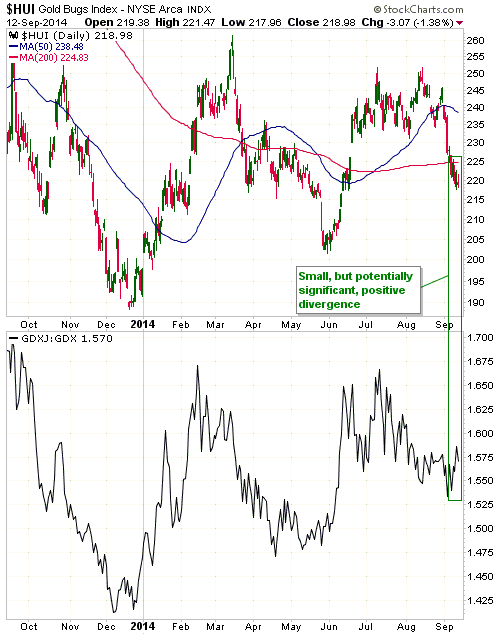
So, the past year's performance of the HUI relative to the GDXJ/GDX ratio
suggests that a tradable rally will begin within the coming fortnight. A literal
comparison with the late-1970s basing pattern also points to a bottom within the
next 2 weeks -- followed by a rally until mid-November.
MA Crossover Redux
As we've explained in many TSI commentaries over the years, the conventional
interpretation of moving-average (MA) crossovers is wrong. "Death crosses" (the
50-day MA crossing from above to below the 200-day MA) are supposed to be
bearish, but they usually occur near short-term bottoms and therefore usually
have short-term bullish implications. "Golden crosses" (the 50-day MA crossing
from below to above the 200-day MA) are supposed to be bullish, but they usually
provide no information about the future except in the case when they happen
after a sharp rally from a price bottom, in which case they usually have
short-term bearish implications.
This year's performance by the HUI provides a good example of how MA crossovers
usually work in reality, as opposed to the way many people think they work. With
reference to the above chart, notice that a) a "golden cross" occurred near the
top of a strong rally in March, b) a "death cross" occurred near a short-term
bottom in May, and c) another "golden cross" occurred near the top of the
June-July rally.
The Currency Market
The Pound and the Scottish Referendum
All of our readers are undoubtedly aware that on this coming Thursday (18th
September) there will be a very important referendum is Scotland. The referendum
will contain the single question: "Should Scotland be an independent country?"
If a simple majority vote "yes", then Scotland will no longer be part of the UK.
Surveys indicate that the vote will be close.
A "yes" vote would create many questions that would have to be answered over the
ensuing 18 months (if the "yes" vote carries the day then Scotland will become
independent in March-2016). These questions include:
1) As part of the UK, Scotland is responsible for part of the British
Government's debt. If Scotland becomes independent, will its new government
'wash its hands' of this debt-repayment responsibility or will there be a
negotiated settlement that involves an independent Scotland paying-off its
portion of the debt over time?
2) Will Scotland continue to use the British Pound? If so, on what basis? For
example, will there be a formal currency union, or will Scotland use the Pound
in a similar way to how some other countries currently use the US dollar?
3) If Scotland doesn't continue to use the Pound, what will become its official
money? Will there be a Scottish national currency, or will Scotland eventually
adopt the euro?
4) Given that the economies of Scotland and England are deeply integrated, what
would be the economic effects on England of a "yes" vote? For example, would the
resulting political uncertainty affect the Bank of England's monetary policy?
5) What would be the political effects on England of a "yes" vote? Would it lead
to the downfall of the current Conservative government? Or, given the fact that
Scotland is very much a Labour stronghold, would the removal of Scotland from
the UK result in a significant shift to the 'right' within the new, Scot-free
UK? And if there is a shift to the 'right', would Nigel Farage's UK Independence
Party (UKIP) gain more influence?
6) Would Scotland gaining independence set in motion a chain of events that lead
to the UK leaving the European Union (EU)?
We don't know the answers to the above questions, although it seems very likely
that an independent Scotland would continue to use the British Pound. According
to many commentators, this would create a big risk for Scotland, because its
government would be spending and borrowing in a currency it can't print, thus
reducing its financial flexibility and greatly limiting its ability to bail-out
banks in the future.
It says something about the world today that reducing the government's ability
to borrow money and bail-out banks is generally viewed as risky. It would, of
course, create risk for banks and those who feed at the government trough, but
if anything it would reduce risk for productive companies and individuals.
Almost regardless of how the above questions are eventually answered, we think
that concerns about how Scottish independence would affect the value of the
British Pound have been overblown. In fact, it is clear that massively
overblowing the risks of independence has been a deliberate ploy on the part of
the political and financial establishment, with the aim of scaring people into
voting "no". As far as we can tell, beyond short-term sentiment-driven
fluctuations neither the supply of nor the demand for the Pound will be
significantly altered by the referendum. As stated in last week's Interim
Update, we would therefore view an additional sharp decline in the Pound in
reaction to referendum success by the pro-independence forces as an opportunity
to 'go long' the Pound for an intermediate-term trade.
Unfortunately, the opportunity probably won't arise. We hope that Scotland votes
"yes" to independence, because it would be a step in right direction. More
specifically, it would be a step away from big government that would give
encouragement to other independence movements around the world (which is why the
vested interests in the political and financial status quo have campaigned
aggressively against it). However, we suspect that the establishment's concerted
scaremongering will win the day and result in more than 50% of Scottish
residents voting "no" on 18th September.
The Commodity Currencies
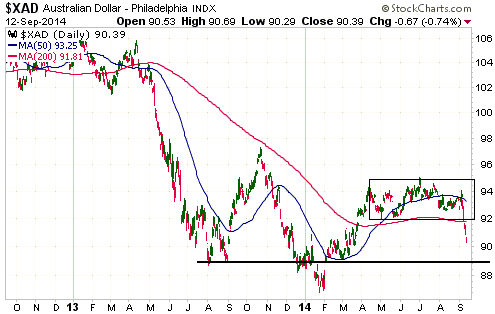
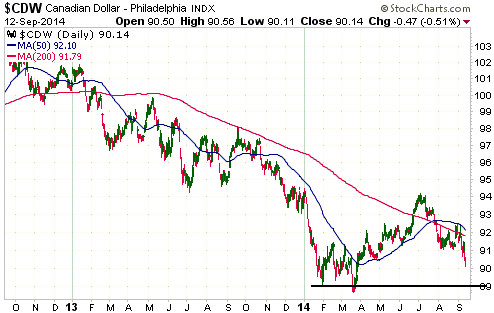
The pronounced broad-based weakness in commodity prices over the past two months
has put irresistible downward pressure on the Australian and Canadian dollars.
Both of these currencies are now very 'oversold' and probably close to
short-term bottoms, although the price action suggests that there will be some
additional downside.
The first of the following charts shows that the A$ has broken out to the
downside from its 5-month horizontal range. This price action suggests a target
of 89.
As previously advised, short-term trends in the A$ have lagged short-term trends
in the gold market over the past 18 months. This relationship suggests that the
A$ won't reach a short-term bottom until after gold reaches a short-term bottom.
The second of the following charts shows that the C$ resumed the decline from
its July high last week. As noted in an earlier commentary, it appears to be
headed for a test of major support near 89.
Updates
on Stock Selections
Notes: 1) To review the complete list of current TSI stock selections, logon at
http://www.speculative-investor.com/new/market_logon.asp
and then click on "Stock Selections" in the menu. When at the Stock
Selections page, click on a stock's symbol to bring-up an archive of
our comments on the stock in question. 2) The Small Stock Watch List is
located at http://www.speculative-investor.com/new/smallstockwatch.html
 Company
news/developments for the week ended Friday 12th September 2014: Company
news/developments for the week ended Friday 12th September 2014:
[Note: AISC = All-In Sustaining Cost, FS = Feasibility Study, IRR = Internal
Rate of Return, MD&A = Management Discussion and Analysis, M&I = Measured and
Indicated, NAV = Net Asset Value, NPV(X%) = Net Present Value using a discount
rate of X%, P&P = Proven and Probable, PEA = Preliminary Economic Assessment,
PFS = Pre-Feasibility Study]
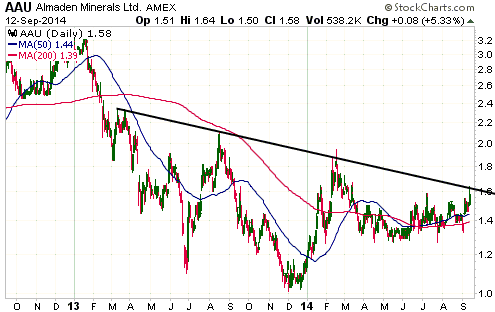
*Almaden Minerals (AAU) traded at a 6-month high last Friday,
which suggests that the market is beginning to recognise the value of its
Tuligtic gold-silver project. However, we will be (pleasantly) surprised if the
stock is able to surmount resistance in the low-US$1.60s in the absence of a
sector-wide turnaround.
*Asanko Gold (AKG) has completed a comprehensive review of the
original May 2012 resource estimate for the gold deposits that were acquired
from PMI Gold in February 2014. These deposits comprise Phase 1 of the Asanko
gold mine development.
The results of the new resource estimate for Phase 1 are not materially
different to PMI's 2012 estimate and therefore confirm the validity of the
previous estimate. Specifically, the M&I component has increased by about 0.4M
ounces to 3.54M ounces and the Inferred component has decreased by the same
amount to 1.0M ounces. Importantly, however, the new estimate more precisely
represents grade distribution and continuity within the deposits, and, as a
result, the resource model now supports the ability to plan the mine with the
selectivity required to manage grade control and volumes. In short, AKG has just
successfully completed another step along the development path.
*Golden Star Resources (GSS) currently has a $50M secured
medium-term loan facility from Ecobank, with $10M still available for drawdown.
Also, GSS announced last week that it has just signed a commitment letter with
Ecobank regarding an additional $25M secured medium-term loan facility. It
therefore now has a total of $35M of available credit.
As a high-cost producer with a non-robust balance sheet, GSS's financial
position has been seriously weakened by the gold market's prolonged basing
process. For relatively low-cost, well-financed producers such as EDV.TO, EVN,AX,
RIOM and TGD, the extension of gold's basing process is an inconvenience, but
for higher-cost producers such as GSS and RMS.AX it is potentially
life-threatening.
GSS's survival is not yet in doubt and the loan facility announced last week
provides some additional breathing room, but to avoid a large and extremely
dilutive equity financing the gold price will have to make a sustained move
above $1400/oz within the coming 12 months. We are obviously expecting gold to
do exactly that, but over the past 2 years all the surprises have been negative.
*Lydian International (LYD.TO) published the results of the
revised FS for its Amulsar gold project in Armenia. For the last few months
we've suggested holding off on any new buying of this stock pending a review of
these FS results.
The updated economics of the project and LYD's valuation are discussed below.
*Pilot Gold (PLG.TO) announced the latest batch of drilling
results from the Kinsley Mountain project (Nevada). Kinsley Mountain hosts the
Western Flank target, which contains high-grade gold at depth, and the Secret
Spot target, which contains a near-surface low-grade gold deposit.
Highlights from the latest batch of Western Flank drilling results are 6.19 g/t
gold over 45.7 metres in PK175CA and 3.91 g/t gold over 18.3 metres in PK159C.
Highlights from the latest batch of Secret Spot drilling results are 1.34 g/t
gold over 25.9 metres and 1.09 g/t over 13.7 metres and 3.02 g/t over 6.1 metres
in PK153.
Kinsley Mountain continues to progress, but it is still too early in the
exploration process to determine a value for this project. It has the potential
to be very valuable, with "potential" being the operative word.
The Kinsley Mountain project is 79% owned by PLG and 21% owned by Nevada Sunrise
Gold (NEV.V). Whereas PLG has many irons in the fire, NEV is a pure -- albeit
very illiquid and therefore difficult to buy/sell -- play on Kinsley Mountain.
We brought NEV to the attention of our readers and added it to the TSI Small
Stocks Watch List early this year when it was trading at C$0.17. It subsequently
traded as high as C$1.50 in response to the excellent Kinsley Mountain drilling
results reported by PLG, but has since dropped all the way back to C$0.68 in
response to a slower and less spectacular flow of drilling news and the general
funk in the market for gold-mining stocks. With 22M shares on issue, this means
that it is now being valued by the market at around $15M.
If Kinsley lives up to its full potential then NEV's 21% stake in the project
will ultimately be worth at least an order of magnitude more than the company's
current market cap. On the other hand, if future exploration fails to prove that
Kinsley contains a valuable deposit, then NEV's stake in the project will be
worth almost nothing. That's the very rough reward-versus-risk equation for this
microcap stock.
*True Gold Mining (TGM.V) announced that it has entered into a
long-term cement supply contract with a new cement plant in Burkina Faso. This
contract is expected to generate approximately US$35M in total operating cost
savings over the base-case Feasibility Study for the Karma gold project,
boosting the NPV(5%) by about $20M (from $196M to $216M) and the IRR by about 3%
(from 46% to 49%) at a gold price of $1300/oz. Note that at a gold price of
around $1250/oz the project is still economically robust, with an updated
NPV(5%) and IRR of $198M and 46%, respectively. This is obviously good news.
*UEX Corp. (UEX.TO) has identified prospective targets for a
10000m, $2.5M drilling program at its Hidden Bay uranium project in Athabasca.
The targets will be drilled over the coming North American winter.
Hidden Bay contains a large, low-grade uranium resource. It has some potential,
but almost all of UEX's value is currently associated with its high-grade Shea
Creek uranium project.
Although UEX has enough cash to fund the above-mentioned drilling program, the
company has decided to top-up its treasury with an additional $2M or so by
issuing new flow-through shares at C$0.43/share.
Quarterly index and ETF changes affecting TSI stocks
The following stocks have been and/or will be impacted by index or
ETF changes scheduled to take effect after the close of trading on
Friday 19th September. Needless to say, the addition of a stock to
an index/ETF or an increase in a stock's weighting in an ETF puts
temporary upward pressure on its price, whereas the removal of a
stock from an index/ETF or a decrease in a stock's weighting in an
ETF puts temporary downward pressure on its price.
1. Asanko Gold (AKG)
(AKG is being ADDED to the S&P/TSX Global Gold and Global Mining
Indexes. Also, AKG's weighting in GDXJ is being INCREASED from 1.94%
at the June-2014 quarterly review to 2.29%. At the end of last week
the weighting was 2.06%, so GDXJ will have to buy some additional
AKG shares this week.)
2. Energy Fuels (EFR.TO)
(EFR is being ADDED to the S&P/TSX SmallCap Index.)
3. Pilot Gold (PLG.TO)
(PLG is being ADDED to the S&P/TSX SmallCap Index.)
4. Rio Alto Mining (RIO.TO)*
(RIO is being ADDED to the S&P/TSX Global Gold and Equal Weight
Global Gold Indexes. Also, RIO's weighting in GDXJ is being
INCREASED from 1.38% at the June-2014 quarterly review to 5.16%. At
the end of last week the weighting was 4.30%, so GDXJ will have to
buy some additional RIO shares this week.)
5. Sabina Gold and Silver (SBB.TO)
(SBB is being REMOVED from the S&P/TSX SmallCap Index.)
*RIO is no longer in the TSI Stocks List, but we are
following it closely due to our personal financial stake. Also, we
suspect that many TSI subscribers still have some exposure to the
stock. The following information might therefore be of general
interest:
A GDXJ weighting increase from 1.38% to 5.16% is huge for a stock of
RIO's size and liquidity. It equates to more than $90M of buying.
However, a lot of the buying has already happened.
At the end of last week, RIO had a 4.30% weighting in GDXJ. This
indicates to us that GDXJ has bought roughly 28M RIO shares over the
past couple of months, which is about 8.5% of the expanded share
capital of the company and probably accounts for the bulk of the
recent relative strength in the RIO stock price.
To get RIO's weighting up to 5.16%, we estimate that GDXJ will have
to purchase about 6.5M more RIO shares. This additional demand
should push the price of RIO shares upward again this week unless
the sector-wide depression deepens and creates offsetting supply. In
any case, the unusual upward pressure on the RIO stock price should
end by the close of trading this coming Friday.
Our intention is to sell the balance of our RIO shares (we are still
holding about half of our original position) by the end of this
week.
List of candidates for new buying
From within the ranks of TSI stock selections, the best candidates
for new buying at this time are:
1) EDV.TO (last Friday's closing price: C$0.83).
2) EVN.AX (last Friday's closing price: A$0.68).
3) PVG (last Friday's closing price: US$6.35).
4) TGD (last Friday's closing price: US$1.42).
5) TGM.V (last Friday's closing price: C$0.38).
Lydian International (LYD.TO). Shares: 152M issued, 158M fully
diluted. Recent price: C$0.85
The following table compares the results of the revised FS for LYD's
Amulsar gold project with the results of the project's original
(September-2012) FS. The revised study incorporates a new site
layout to accommodate the relocation of the heap leach facility as
required by the Armenian government.
The comparison isn't strictly "apples to apples", because the
original FS shows pre-tax economics at a gold price of $1100/oz and
the revised FS shows post-tax economics at a gold price of $1250/oz.
However, we are making the assumption that the lower assumed gold
price in the original study makes up for the fact that the economics
calculated in this study don't account for taxation. In other words,
we are making the assumption that if taxes had been properly
accounted for in the original study then a gold price of $1250/oz
would have been needed to obtain similar NPV and IRR figures.
Cutting to the chase, the revised FS indicates that the economics of
the Amulsar project are far less robust than indicated by the
original FS. In fact, the differences between the two studies are
big enough to suggest that the original study was flawed. While it
is understandable that some costs have changed over the past two
years, why has the metallurgical recovery fallen from 88% to 84% and
the strip ratio increased from 2.2:1 to 2.8:1?
The economics of the Amulsar project still appear to be good enough
to justify financing and building a mine with a gold price of at
least $1300/oz. It's just that the lower NPV and the much higher
initial capex revealed by the revised FS indicate that LYD offers
considerably less value than we previously believed. Rather than the
economics justifying a stock price of at least C$2.00/share at
$1300/oz, we now think that they justify a stock price of no more
than C$1.00/share.
This means that LYD is now close to fair value and that a higher
value for this stock will require a higher gold price. At the same
time, there are other gold stocks that offer good value at the
current gold price. These are the ones upon which new buying should
be focused.
|
|
Lydian International (LYD.TO) |
Lydian International (LYD.TO) |
|
Project Name |
Amulsar |
Amulsar |
|
Location |
Armenia |
Armenia |
|
Engineering Study / Date |
FS / Sep-2012 |
Revised FS / Sep-2014 |
|
Planned Mine Type |
Open Pit |
Open Pit |
|
M&I Resource (oz) |
2.4M |
3.0M |
|
Avg Resource Grade |
1.14g/t |
0.77g/t |
|
P&P Reserve (oz) |
2.3M |
2.5M |
|
Metallurgical Recovery |
88% |
84% |
|
Strip Ratio |
2.23:1 |
2.8:1 |
|
Avg Annual Production (oz) |
170K |
205K |
|
Cash Cost (per oz) |
$468 |
$642 |
|
All-In Cost (per oz) |
|
$701 |
|
Mine Life |
12 years |
10.4 years |
|
Initial Capital Cost ($M) |
270 |
426 |
|
Assumed Gold Price (US$) |
1100 |
1250 |
|
NPV ($M) |
513 |
306 |
|
IRR |
23.8% |
20.2% |
|
Capital Payback Period |
4.5 years |
Not specified |
|
Project Ownership Percent |
100% |
100% |
|
NPV of Company Stake ($M) |
513 |
306 |
|
Current Stock Price (US$) |
0.9 |
0.9 |
|
Share Count (M) |
152 |
152 |
|
Current Market Cap ($M) |
137 |
137 |
|
Net Cash ($M) |
20 |
20 |
|
Current Enterprise Value ($M) |
117 |
117 |
|
EV/NPV |
23% |
38% |
|
Current Discount to NPV |
77% |
62% |
|
EV + Capital Cost (EVCC) |
387 |
543 |
|
EVCC/NPV |
0.75 |
1.77 |
Chart Sources
Charts appearing in today's commentary
are courtesy of:
http://stockcharts.com/index.html
http://research.stlouisfed.org/

|









