|
-- Weekly Market Update for the Week Commencing 15th December 2014
Big Picture
View
Here is a summary of our big picture
view of the markets. Note that our short-term views may differ from our
big picture view.
In nominal dollar terms, the BULL market in US Treasury Bonds
that began in the early 1980s ended in 2012. In real (gold)
terms, bonds commenced a secular BEAR market in 2001 that will continue
until 2018-2020. (Last
update: 20 January 2014)
The stock market, as represented by the S&P500 Index,
commenced
a secular BEAR market during the first quarter of 2000, where "secular
bear market" is defined as a long-term downward trend in valuations
(P/E ratios, etc.) and gold-denominated prices. This secular trend will bottom sometime between 2014 and 2020.
(Last update: 22 October 2007)
A secular BEAR market in the Dollar
began during the final quarter of 2000 and ended in July of 2008. This
secular bear market will be followed by a multi-year period of range
trading.
(Last
update: 09 February 2009)
Gold commenced a
secular bull market relative to all fiat currencies, the CRB Index,
bonds and most stock market indices during 1999-2001.
This secular trend will peak sometime between 2014 and 2020.
(Last update: 22 October 2007)
Commodities,
as represented by the Continuous Commodity Index (CCI), commenced a
secular BULL market in 2001 in nominal dollar terms. The first major
upward leg in this bull market ended during the first half of 2008, but
a long-term peak won't occur until 2014-2020. In real (gold) terms,
commodities commenced a secular BEAR market in 2001 that will continue
until 2014-2020.
(Last
update: 09 February 2009)
Copyright
Reminder
The commentaries that appear at TSI
may not be distributed, in full or in part, without our written permission.
In particular, please note that the posting of extracts from TSI commentaries
at other web sites or providing links to TSI commentaries at other web
sites (for example, at discussion boards) without our written permission
is prohibited.
We reserve the right to immediately
terminate the subscription of any TSI subscriber who distributes the TSI
commentaries without our written permission.
Outlook Summary
Market
|
Short-Term
(1-3 month)
|
Intermediate-Term
(6-18 month)
|
Long-Term
(2-5 Year)
|
|
Gold
|
N/A |
Bullish
(26-Mar-12) |
Bullish
|
|
US$ (Dollar Index)
|
N/A |
Neutral
(29-Sep-14) |
Neutral
(19-Sep-07) |
|
US Treasury Bonds (TLT)
|
N/A |
Neutral
(18-Jan-12)
|
Bearish |
|
Stock Market
(DJW)
|
N/A |
Bearish
(28-Nov-11) |
Bearish
|
|
Gold Stocks
(HUI)
|
N/A |
Bullish
(23-Jun-10) |
Bullish
|
|
Oil |
N/A |
Neutral
(31-Jan-11) |
Bullish
|
|
Industrial Metals
(GYX)
|
N/A |
Neutral
(15-Sep-14) |
Bullish
(28-Apr-14) |
Notes:
1. Our short-term expectations are discussed in the commentaries, but except in
special circumstances we won't attempt to assign a "bullish", "bearish" or
"neutral" label to these expectations.
2. The date shown below the current outlook is when the most recent outlook change occurred.
3. "Neutral" means that we think risk and reward are roughly in balance with respect to the timeframe in question.
4. Long-term views are determined almost completely by fundamentals and intermediate-term views
are determined by a combination of fundamentals, sentiment and technicals.
Extreme
Oil Market Sentiment
Based on the commentary we've seen over the past week, there are
two things that everyone now knows: the oil price is destined to go
much lower and the Dollar Index is destined to go much higher.
However, what everyone knows is usually not worth knowing.
The change in oil-market sentiment over the past few months has been
incredible. It has been way out of proportion to the change in the
so-called fundamentals. In July the market was already well-supplied
and anyone who was paying attention was already well-aware that the
economies of China, the euro-zone and Japan were weak and getting
weaker (implying: reduced global demand for oil). And yet, the oil
price was holding at around $100/barrel and not many people were
expecting a large price decline. Now, after the price has plummeted
to $57/barrel, almost everyone is expecting a large price decline.
Why? Because the world is supposedly swamped with oil supply and the
supply surplus is only going to get worse.
The oil market's fundamentals certainly do look bearish, but at some
point the bearish fundamentals will have been fully discounted. The
price will then begin to trend upward, despite the absence of any
fundamental improvement.
Nobody knows the price at which the bearish fundamentals will have
been fully discounted, but sentiment provides clues. When almost
everyone is bearish it can mean that the worst-case scenario is
close to being discounted by the current price.
Sentiment-wise, however, there remains one obstacle to a sustainable
price bottom. Market Vane's bullish percentage is as low as it ever
gets, but speculative capitulation in the oil futures market remains
conspicuous by its absence. As at 9th December, speculators were
still net-long by about 260K contracts of Light Sweet Crude Oil
futures on the NYMEX. As mentioned in previous commentaries, the
speculative net-long position will probably have to fall to 100K
contacts or lower before an intermediate-term price bottom is in
place.
The current sentiment-survey and momentum extremes suggest the
potential for a strong multi-week price rebound, but the lack of
speculative capitulation in the futures market and the historical
record of major oil-price bottoms suggest that the oil market is
still at least a few months away from its ultimate price low.
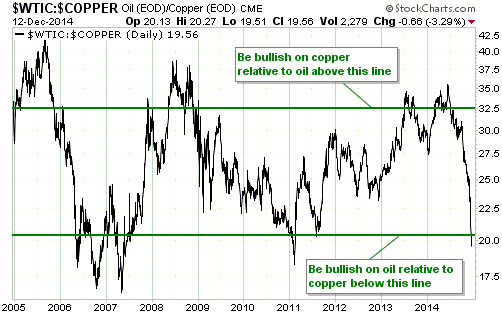
Also worth mentioning is that in addition to being extremely
'oversold' by most technical and sentiment indicators, oil is now
cheap relative to industrial metals such as copper. The following
chart illustrates this point. Therefore, rather than directing
bearish speculations towards a nearly-sold-out oil market, at this
time it makes more sense to focus them on copper.
The Stock
Market
Charts of Interest
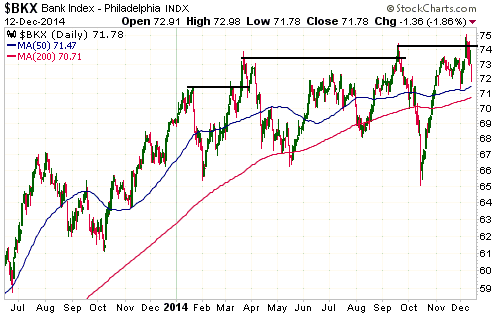
Last week the US Bank Index (BKX) continued its pattern of reversing downward
within 1-3 days of making a new 12-month high.
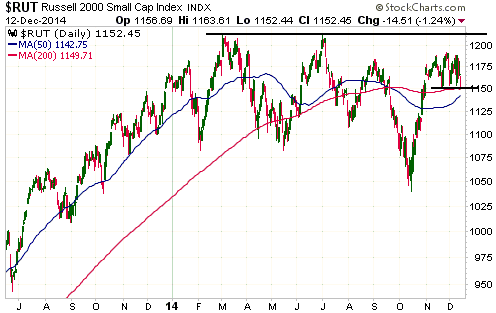
The Russell2000 SmallCap Index (RUT) has been among the weakest of the
high-profile US stock indices since it peaked in March, but last week it
actually held up well in the face of a broad-based market decline. Small-cap US
stocks tend to be relatively strong from mid-December until mid-January, so the
RUT has seasonality in its favour over the next few weeks.
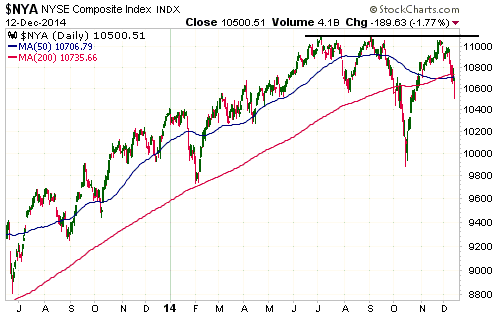
The NYSE Composite Index (NYA) double-topped in July and September. It then made
a slightly lower high in late-November before pulling back sharply.
Having topped just above 11000 on three occasions this year, the NYA is now in
an interesting position. Triple tops are rare, but they do happen. If the NYA is
unable to get back above its 50-day and 200-day MAs in the next few weeks then
it has probably triple-topped. Another realistic possibility that would also
mesh with an intermediate-term bearish scenario involves the NYA breaking out to
a marginal new high in January and then reversing course. This would be similar
to how it topped in 2000 and 2007.
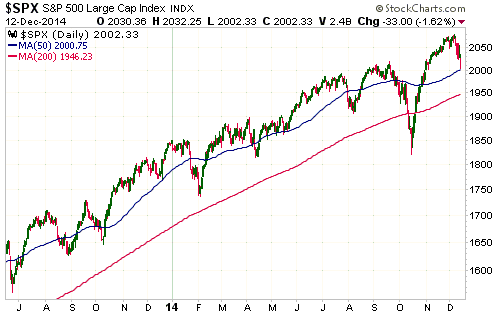
The S&P500 Index (SPX) has pulled back to its 50-day MA, which is something it
has done on several occasions over the past two years. On only one of these
occasions did it continue down to its 200-day MA. That happened in October of
this year.
The October-2014 break below the 200-day MA was reversed in spectacular and
surprising fashion (a rebound that retraced 50%-75% of the decline would have
been typical, but what we got was a quick move to a new high). The next break
below the 200-day MA is likely to have longer-term implications.
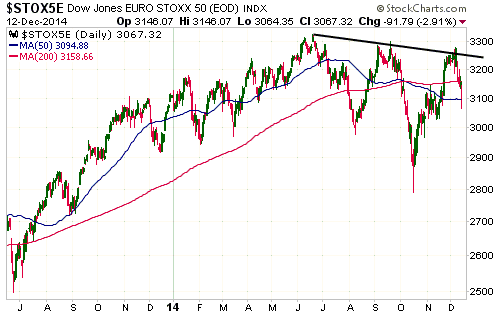
The STOX5E, the European equivalent of the Dow Industrials Index, ended the week
before last at an important resistance level. Not surprisingly, it was unable to
overcome this resistance last week and declined with the senior US stock
indices.
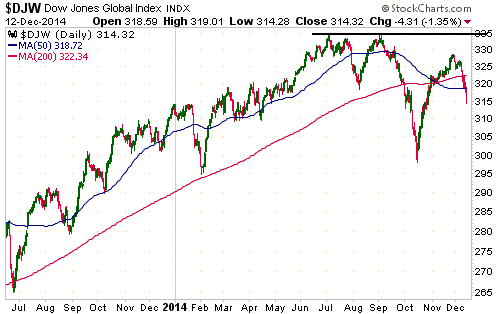
The chart of the Dow Jones World Index (DJW) displayed below looks similar to,
although a little more bearish than, the NYA chart displayed above. Like the NYA
the DJW double-topped in July and September, but unlike the NYA the DJW did not
make it back to the vicinity of its Q3 high in November. Instead, it has
recently turned downward from well below the highs made earlier in the year.
Last week provided more evidence in support of the longer-term bearish case.
This is not because the senior stock indices declined, but because there was
further deterioration in indicators of economic confidence (e.g. credit spreads)
and market internals (e.g. the numbers of stocks making new highs and lows).
Due to seasonal influences we suspect that there will be some, but not a lot of,
additional downside over the next week, followed by a rebound into early
January. It will be interesting to see how the aforementioned indicators of
economic confidence and market internals behave during the next rebound.
This week's
significant US economic events
(The most important events are shown
in bold)
| Date |
Description |
| Monday Dec 15 |
TIC Report
Industrial Production
Empire State Mfg Index
Housing Market Index | | Tuesday
Dec 16 |
Housing Starts | | Wednesday
Dec 17 |
FOMC Announcement
CPI
Q3 Current Account Balance | | Thursday
Dec 18 |
Philadelphia Fed Survey
|
| Friday Dec 19 |
Kansas City Fed Mfg Index
Quadruple Witching |
Gold and
the Dollar
Gold
Is the end of QE bearish for gold?
The conventional view is that Fed money creation is necessarily bullish for gold
and that a tightening of monetary conditions beginning with the cessation of Fed
money creation is necessarily bearish for gold. It's strange that this view is
popular given that gold was clearly hurt more than helped by the QE program that
extended from October of 2012 through to October of this year. If gold is now
going to be hurt by a 'tighter' Fed, the implication is that regardless of what
the Fed does it's bearish for gold. If the Fed aggressively pumps money into the
economy, it's bearish for gold. If the Fed stops pumping money, it's bearish for
gold. If the Fed not only stops pumping money but starts hiking interest rates,
it's astronomically bearish for gold! Rather than relying on conventional
wisdom, which is usually wrong when applied to the gold market, we'll now turn
to some historical data in an effort to understand how gold will likely react to
a less 'accommodative' Federal Reserve.
First, some data from the distant past.
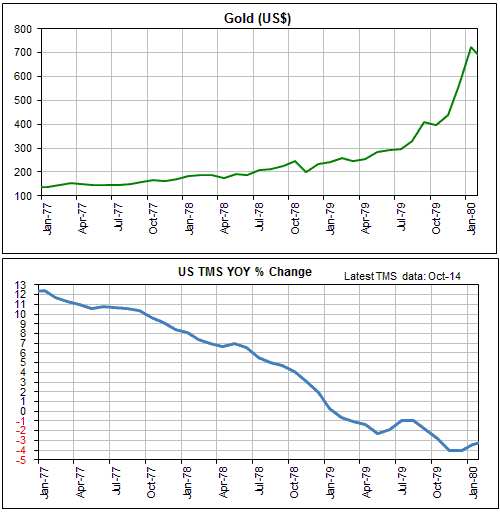
The following charts show the US$ gold price from January-1977 through to the
end of 1979 and the annual rate of change in US TMS (True Money Supply) over the
same period. These charts tell us that US monetary conditions became
progressively tighter throughout the huge 3-year gold rally of 1977-1979 and
that the biggest gains in the gold price occurred in 1979 -- when the US was
experiencing monetary DEFLATION. In fact, during no 12-month period over the
past 60 years were US monetary conditions tighter than they were throughout
1979.
This doesn't imply that tighter monetary conditions are bullish for gold. It
implies that under certain conditions gold is quite capable of making large
gains in parallel with a tighter Fed.
Next, some data from the recent past.
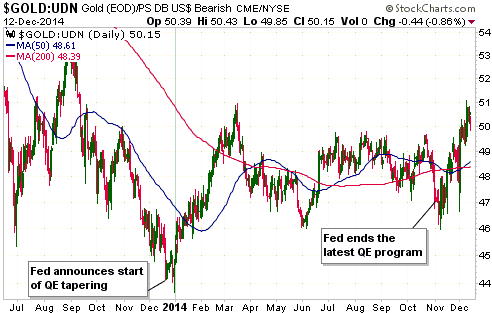
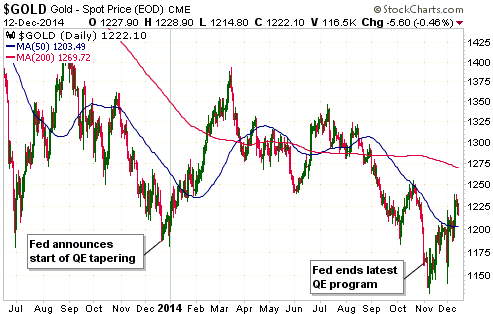
The Fed announced the beginning of its QE "tapering" on 18th December 2013. The
following charts show that within a few days of this announcement gold made a
major bottom in non-US$ terms (the gold/UDN ratio is an indicator of gold's
performance in terms of a basket of important currencies excluding the US$) and
an intermediate-term bottom in US$ terms.
The Fed then methodically "tapered" its QE program during 2014 and announced the
completion of the program on 29th October. The following charts also show that
within a few days of this announcement gold made short-term bottoms in both
non-US$ terms and US$ terms. It's distinctly possible that these short-term
bottoms will turn out to have longer-term significance, with the early-November
bottom in gold/UDN potentially marking the end of the first correction in a new
bull market and the early-November bottom in the US$ gold price potentially
marking the end of the cyclical bear market.
The critical point to understand is that gold's perceived value moves in the
opposite direction to confidence in central banking and the economy. During
periods when a general belief takes hold that the central bank's money-pumping
is improving the economy's prospects, the money-pumping turns out to be an
intermediate-term bearish influence on the gold market. However, the
money-pumping distorts the economy in a way that eventually leads to substantial
economic weakness.
A tightening of monetary conditions will begin to reveal the distortions
(mal-investments) caused by the preceding 'monetary accommodation', which is why
the demand for gold will sometimes increase as the Fed becomes more restrictive.
In such a situation gold isn't gaining ground because the Fed is tightening, it
is gaining ground because tighter monetary conditions are shining a light on the
economic damage caused by the earlier money-pumping.
In simpler terms, gold gets hurt by the boom and helped by the bust, so anything
that perpetuates the boom is bearish for gold and anything that helps bring on
the bust that inevitably follows an inflation-fueled boom is bullish for gold.
Current Market Situation
The past week was good for gold, with the price rising to the bottom of the
$1240-$1250 resistance range before pulling back. We continue to believe that
this resistance will cap gold's upside during December, although the recent
weakness in the stock market has improved the chances of a near-term upside
breakout in the gold market.
We will be interested to see the statement put out by the Fed at the conclusion
of the FOMC Meeting on 17th December and how the various markets react. Due to
the crash in the oil price and the potential effect of this price change on the
meaningless Keynesian economic aggregates upon which the Fed fixates, it's
possible that the coming FOMC statement will be more 'dovish' than the preceding
one. Such a development wouldn't matter beyond the very short-term, but it would
probably give the gold price a temporary boost.
Silver
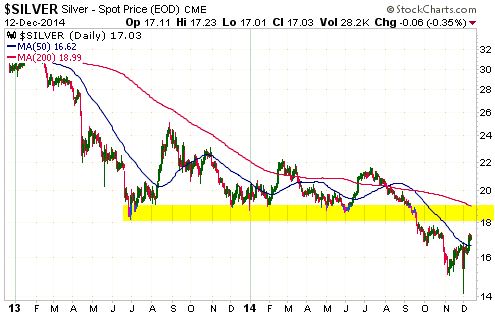
The gold market has dragged the silver market off the floor. The silver price
broke above its 50-day MA last Tuesday and sustained the breakout through to
week's end.
Silver has major resistance at $18-$19. There's a good chance that this
resistance will be tested within the next 5 weeks, but it will need to be
solidly breached to signal an end to the bear market.
Gold Stocks
Current Market Situation
There was no significant change in gold's fundamentals over the past two weeks,
but gold-mining fundamentals improved markedly due to the large rise in the gold
price relative to the oil price. This change in relative prices implies improved
profit margins for gold mining, especially open-pit gold mining where the cost
of fuel is typically 20%-30% of the total mine operating cost.
Despite the improvement in gold-mining profit margins that will stem from the
rise in the gold/oil ratio, the gold-mining sector performed poorly relative to
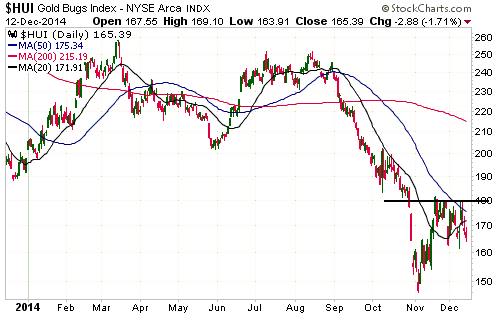
gold over the past three weeks. Last week was similar to the preceding two
weeks, with the HUI rising to test the 180 level and then pulling back to end
the week below its 20-day MA. In essence, the HUI has now spent three weeks
oscillating within a 15-point range.
The HUI has held up better than GDXJ, though. Whereas the HUI has oscillated
within a horizontal range over the past three weeks, GDXJ, a proxy for the
junior end of the gold-mining sector, has trended lower and is now within
spitting distance of its early-November low.
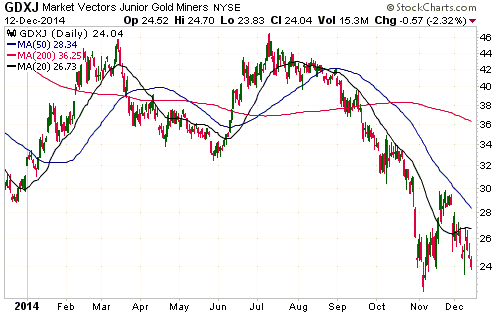
The recent weakness in GDXJ relative to the HUI can be explained by tax-loss
selling, which will probably run its course by Christmas. However, tax-loss
selling isn't a good explanation for the recent weakness in the HUI relative to
gold.
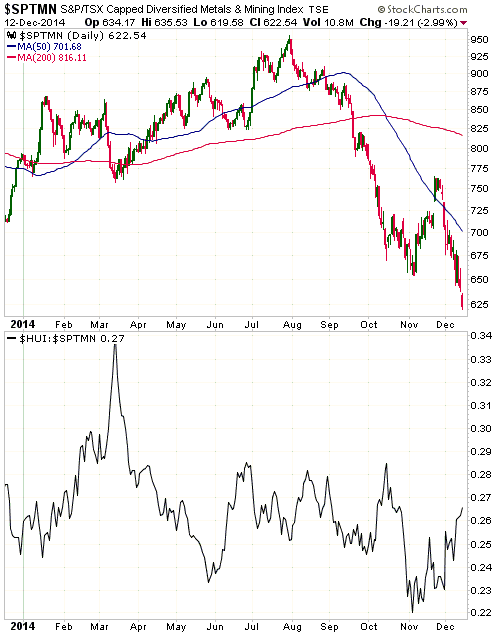
A better explanation is provided by the following chart. The top section of the
chart shows that the Metals and Mining Index (SPTMN) plunged over the past few
weeks and ended last week well below its early-November low, while the bottom
section of the chart shows that the HUI/SPTMN ratio has rebounded strongly since
early-November. In other words, although gold mining stocks have recently been
weak relative to gold, they have been very strong relative to mining stocks in
general.
The point we are getting around to is that the HUI's sideways movement over the
past few weeks is probably the result of gold mining stocks being lifted by the
strength in gold and weighed down by the general weakness in mining.
Unless gold bullion does the unexpected and drops back below $1200, the
gold-mining sector is likely to make a catch-up move to the upside late this
month and/or during January.
Canadian Junior Resource Stocks
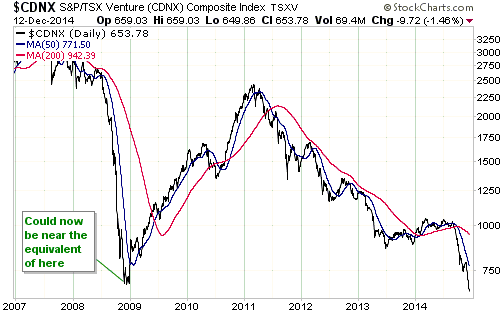
A chart of the TSXV Composite Index (CDNX), a proxy for junior Canadian resource
stocks, is displayed below.
Whereas the larger-sized resource stocks rebounded from October-November lows
following the crash of 2008, the juniors continued to decline until
late-December due to the effects of tax-loss selling. The current situation, at
least with regard to the gold-mining sector, appears to be similar.
The Currency Market
The Dollar Index
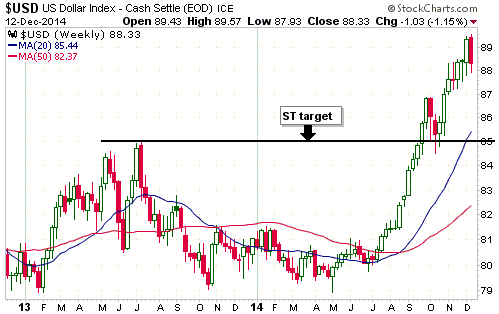
At the end of the week before last the Dollar Index was sufficiently stretched
to the upside that a lower weekly close was all it would take to signal a trend
reversal. As illustrated by the following weekly chart, we now have a lower
weekly close. A daily close below 87.9 would provide the next piece of evidence
that a short-term trend reversal has occurred.
If the short-term trend has reversed then support at 85 will likely be tested
within the next two months.
The 'waters were muddied' last week by enough relative weakness in European
equities to push the VGK/SPY ratio (our preferred measure of how European
equities are performing relative to US equities) to a marginal new low for the
year. However, we'll take the Dollar Index's price action at face value.
The Euro
In the currency and gold markets, speculators drive the price -- buying during
the upward trends and selling during the downward trends. The commercial traders
take the other side -- selling or hedging during the upward trends and buying or
covering hedges during the downward trends. This is why the speculators will
always look wrong and the commercials will always look right at short-term price
extremes.
The challenge/difficulty is that there is no fixed level that constitutes an
extreme. A large build-up in the speculative net-long position indicates that
speculators, as a group, are very bullish, which is a situation that invariably
arises near a price top, whereas a large build-up in the speculative net-short
position indicates that speculators, as a group, are very bearish, which is a
situation that invariably arises near a price bottom. However, the price
sometimes moves a lot higher after speculators become very bullish and a lot
lower after speculators become very bearish. This means that a high level of
bullishness or bearishness on the part of speculators is a necessary, but not a
sufficient, condition for a price extreme.
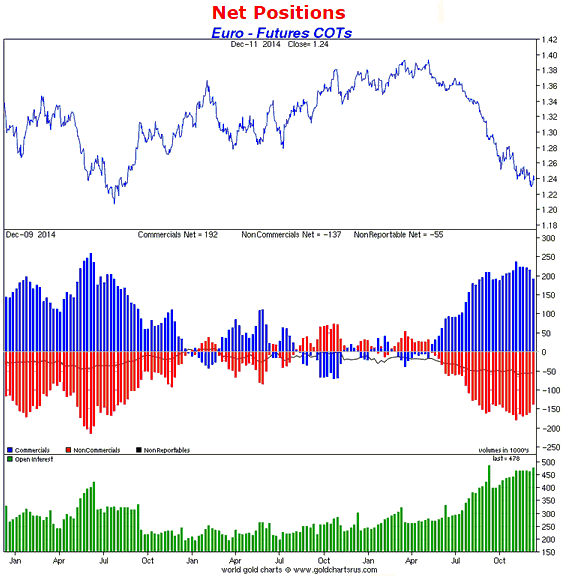
A good example is the speculative net-position in euro futures over the past
several months. When the euro was trading at 136 in July, the speculative
net-short position was already at a 12-month high. By the time the euro fell to
134 in August, the speculative net-short position had risen to near 2012's
all-time high. It then remained near an all-time high as the price fell from 134
to 123, thanks to news-flow that provided continuous fodder for bearish
speculations on European equities and the euro.
The euro is now showing preliminary signs of having bottomed on at least a
short-term basis and the speculative net-short position in euro futures has
begun to shrink.
Updates
on Stock Selections
Notes: 1) To review the complete list of current TSI stock selections, logon at
http://www.speculative-investor.com/new/market_logon.asp
and then click on "Stock Selections" in the menu. When at the Stock
Selections page, click on a stock's symbol to bring-up an archive of
our comments on the stock in question. 2) The Small Stock Watch List is
located at http://www.speculative-investor.com/new/smallstockwatch.html
 Company
news/developments for the week ended Friday 12th December 2014: Company
news/developments for the week ended Friday 12th December 2014:
[Note: AISC = All-In Sustaining Cost, FS = Feasibility Study, IRR = Internal
Rate of Return, MD&A = Management Discussion and Analysis, M&I = Measured and
Indicated, NAV = Net Asset Value, NPV(X%) = Net Present Value using a discount
rate of X%, P&P = Proven and Probable, PEA = Preliminary Economic Assessment,
PFS = Pre-Feasibility Study]
*Clifton Star (CFO.V) is the scene of some corporate activity.
With the support of shareholders owning a total of about 30% of the company,
Harry Miller, the former CEO of the company, is seeking to replace the existing
board and senior management. Details of the proposed new directors and the
reasons for taking this action can be read at
http://www.kitco.com/pr/1267/article_12092014092104.pdf.
In response to the aforementioned action by Mr. Miller, CFO's chairman sent a
letter to shareholders claiming that "Harry Miller is attempting to execute a
"cashless takeover" to gain full control of your Company without any plans or
paying a control premium". This is complete rubbish. Nobody is attempting a
takeover, only the replacement of the current board of directors and CEO.
The replacement of the current directors and senior management as outlined in
the above-linked press release would pave the way for the option covering 90% of
the Duparquet project to be renegotiated. Due to the poor relationship between
the optionors and current management, new management will be needed to make
renegotiation possible. It is therefore important for all CFO shareholders that
the corporate changes proposed by Mr. Miller happen as quickly as possible.
In other CFO news, the company has received $2.7M in tax credits and therefore
now has about $3.5M of cash on hand. This is probably enough to 'keep the wheels
turning' for the next 6 months.
Depending on the stock price at the time, CFO could again become an interesting,
albeit a high-risk, speculation if/when the proposed board changes take place.
*Pilot Gold (PLG.TO) reported new drilling results from the
Kinsley Mountain gold project, Nevada. The highlights, which came from infill
drilling of the Western Flank target, include 17.4 g/t gold over 21.6 metres,
6.05 g/t gold over 30.5 metres, and 4.39 g/t gold over 29.2 metres.
PLG's geologists believe that the Western Flank is not the only high-grade zone
at Kinsley Mountain. If they can find one or more similar zones, then Kinsley
Mountain will become an extremely valuable project.
Kinsley Mountain is owned 79% by PLG and 21% by Nevada Sunrise Gold (NEV.V). NEV,
an illiquid microcap, is a pure play on the future success of PLG's Kinsley
Mountain exploration work, whereas PLG has a few 'irons in the fire'.
*Pretium Resources (PVG) announced that it is raising about C$99M
by issuing 15.7M new shares at C$6.30/share. 12.8M of the new shares are being
purchased by Zijin Mining, a Shanghai and Hong Kong listed company and the
largest gold producer in China, and the rest are being purchased by existing
shareholders in order to maintain their percentage stakes in the company. This
financing dilutes PVG's per-share value, but reduces risk and brings on board a
well-financed, long-term major shareholder (Zijin). Taking everything --
including the difficult market environment -- into account, this is a reasonable
deal for PVG.
The Brucejack project's initial capex is estimated to be $750M, so a lot more
money will have to be raised. However, according to PVG the placement to Zijin
and other investors constitutes a significant portion of the equity component of
the financing required to bring the Brucejack Project into production. This
implies that the company plans to debt-finance the bulk of the initial capex and
that substantial additional shareholder dilution will not happen.
*True Gold Mining (TGM.V) advised that a disturbance in a local
community prompted it to temporarily halt some of the construction activities at
the Karma project (Burkina Faso). The Karma site has apparently not been
affected by the disruption and commercial production is still expected by the
end of 2015. No other details were provided.
List of candidates for new buying
From within the ranks of TSI stock selections the best candidates
for new buying at this time, listed in alphabetical order, are:
1) AAU (last Friday's closing price: US$0.96).
2) AKG (last Friday's closing price: US$1.64).
3) EDV.TO (last Friday's closing price: C$0.43).
4) EVN.AX (last Friday's closing price: A$0.57).
5) TGD (last Friday's closing price: US$1.04).
Note that the above list is limited to five stocks. It will
sometimes contain less than five, but it will never contain more
than five regardless of how many stocks are attractively priced for
new buying.
Potential new TSI stock selection
Last week we wrote that we were becoming interested in an
intermediate-to-long-term speculation on natural gas equities, via
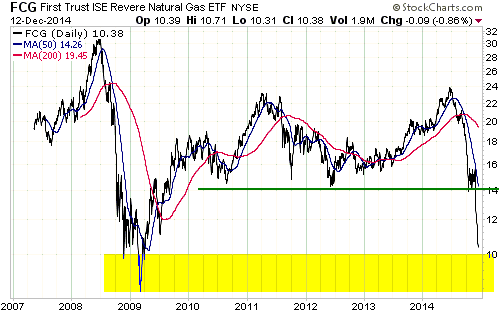
FCG. We wrote that we would probably 'pull the trigger' if FCG
became available at around $10 within the next few weeks.
FCG continued to fall in sympathy will the oil price last week and
is getting close to the major support that begins at $10. The $9-$10
range would be a very attractive entry point for either a short-term
trade in anticipation of a rebound to $14 or a long-term trade in
anticipation of a multi-year advance from whatever low is made over
the coming few months.
We will add FCG to the TSI List if it trades at $9.80.
Cancelling the planned GQM buy
A few weeks ago we said that we would add Golden Queen Mining (GQM.TO)
to the TSI Stocks List if it traded at C$0.82. It subsequently
hasn't come close to our suggested buy price.
It's certainly possible that GQM will trade at our previously
suggested buy level within the next few weeks, but we no longer plan
to add it to the TSI List. The main reason is the unquantifiable (at
this stage) effect of an upcoming reserve reduction -- as outlined
in a 25th November GQM press release -- on the economics of the
company's Soledad gold-silver project.
Chart Sources
Charts appearing in today's commentary
are courtesy of:
http://stockcharts.com/index.html
http://www.sharelynx.com/

|









