|
-- Weekly Market Update for the Week Commencing 16th February 2009
Big Picture
View
Here is a summary of our big picture
view of the markets. Note that our short-term views may differ from our
big picture view.
In nominal dollar terms, the BULL market in US Treasury Bonds
that began in the early 1980s will end by mid-2010. In real (gold)
terms, bonds commenced a secular BEAR market in 2001 that will continue
until 2014-2020. (Last
update: 09 February 2009)
The stock market, as represented by the S&P500 Index, commenced
a secular BEAR market during the first quarter of 2000, where "secular
bear market" is defined as a long-term downward trend in valuations
(P/E ratios, etc.) and gold-denominated prices. This secular trend will bottom sometime between 2014 and 2020. (Last update: 22 October 2007)
A secular BEAR market in the Dollar
began during the final quarter of 2000 and ended in July of 2008. This
secular bear market will be followed by a multi-year period of range
trading. (Last
update: 09 February 2009)
Gold commenced a
secular bull market relative to all fiat currencies, the CRB Index,
bonds and most stock market indices during 1999-2001. This secular trend will peak sometime between 2014 and 2020. (Last update: 22 October 2007)
Commodities,
as represented by the Continuous Commodity Index (CCI), commenced a
secular BULL market in 2001 in nominal dollar terms. The first major
upward leg in this bull market ended during the first half of 2008, but
a long-term peak won't occur until 2014-2020. In real (gold) terms,
commodities commenced a secular BEAR market in 2001 that will continue
until 2014-2020. (Last
update: 09 February 2009)
Copyright
Reminder
The commentaries that appear at TSI
may not be distributed, in full or in part, without our written permission.
In particular, please note that the posting of extracts from TSI commentaries
at other web sites or providing links to TSI commentaries at other web
sites (for example, at discussion boards) without our written permission
is prohibited.
We reserve the right to immediately
terminate the subscription of any TSI subscriber who distributes the TSI
commentaries without our written permission.
Outlook Summary
Market
|
Short-Term
(0-3 month)
|
Intermediate-Term
(3-12 month)
|
Long-Term
(1-5 Year)
|
Gold
|
Neutral
(17-Dec-08)
|
Bullish
(12-May-08)
|
Bullish
|
US$ (Dollar Index)
|
Bearish
(21-Jan-09)
| Neutral
(16-Feb-09)
|
Neutral
(19-Sep-07)
|
Bonds (US T-Bond)
|
Bearish
(21-Nov-08)
|
Bearish
(22-Sep-08)
|
Bearish
|
Stock Market (S&P500)
|
Bullish
(16-Oct-08)
|
Neutral
(02-Feb-09)
|
Bearish
|
Gold Stocks (HUI)
|
Bullish
(12-Jan-09)
|
Bullish
(12-May-08)
|
Bullish
|
| Oil | Bullish
(17-Nov-08)
| Neutral
(22-Sep-08)
| Bullish
|
Industrial Metals (GYX)
| Bullish
(26-Nov-08)
| Neutral
(22-Sep-08)
| Bullish
|
Notes:
1. In those cases where we have been able to identify the commentary in
which the most recent outlook change occurred we've put the date of the
commentary below the current outlook.
2. "Neutral", in the above table, means that we either don't have a
firm opinion or that we think risk and reward are roughly in balance with respect to the timeframe in question.
3. Long-term views are determined almost completely by fundamentals,
intermediate-term views by giving an approximately equal weighting to
fundmental and technical factors, and short-term views almost
completely by technicals.
Inflation Update
Differences between now and the 1930s
As most of our readers would be well aware, there has been explosive
growth in the Fed's balance sheet and Federal Reserve credit since last
September. This dramatic increase in Federal Reserve credit has led to
a far less dramatic, but still very meaningful, increase in monetary
aggregates including M2 and TMS (M2 and TMS are up about 10%
year-over-year).
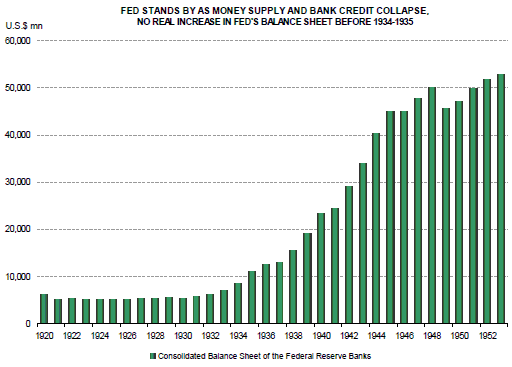
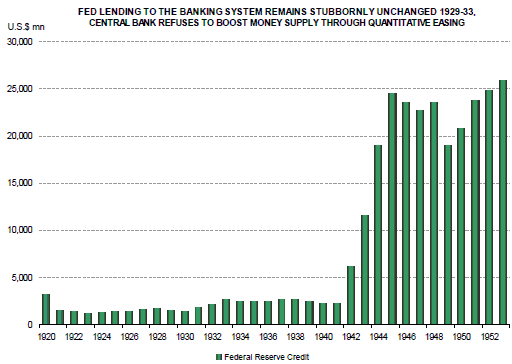
The following charts were copied from a presentation by John Kemp entitled "A Distant Mirror: Credit contraction, monetary policy and commodity prices during the Great Depression"
and together make the point that the current monetary situation could
hardly be more different to the monetary situation of the early 1930s.
The first chart shows that there was no significant increase in the
Fed's balance sheet prior to 1934-1935, the second chart shows that
Federal Reserve credit was almost unchanged throughout the 1930s, and
the third chart shows that M2 fell quite sharply during the early
1930s.
Regardless of the
direction of the change, large changes in the money supply always cause
problems. However, we doubt that the Fed could have created a more
friendly economic environment during the early 1930s by counteracting
the decline in the money supply. The root problem during the 1930s was
that the ultra-easy monetary conditions of the preceding decade had led
to the excessive expansion of debt and to mal-investment on a grand
scale. Borrowing more money into existence could not have ameliorated
the situation or even helped smooth the transition to the next phase of
economic growth, although, like the many other official efforts to
prevent the economy from completing a necessary re-adjustment, it could
have made things worse. The point is that the money-supply contraction
of the early 1930s was not the problem; it was a SYMPTOM of the
problem. A disease can never be cured by covering up a symptom, but
covering up a symptom can prevent the appropriate corrective measures
from being taken. For example, if insufficient savings are part of the
problem then the road to recovery involves the accumulation of savings,
which means that policies designed to increase consumer spending (bring
about a further reduction in savings) can only make things worse.
Despite the large contraction in the money supply during the early
1930s the depression would probably have ended in 1932 if not for
government intervention. The "New Deal"* policies of Franklin Roosevelt
were the main reason why the depression lasted 15 years and came to be
known as the Great Depression.
Unfortunately, today's policymakers seem intent on making the same
mistakes that were made during the 1930s and adding the mistake of
monetary inflation to the mix.
*There were
actually three New Deals. The first New Deal was the name given to the
set of policies espoused by Roosevelt during the 1932 election
campaign, but it proved to be nothing more than a bunch of lies and
propaganda designed to garner votes. The second New Deal was, in many
ways, the opposite of the first New Deal, and constituted the set of
policies that were actually implemented by Roosevelt on taking office.
Many of these policies had to be abandoned because they were total
disasters or because they were declared unconstitutional by the Supreme
Court, thus paving the way for other policies (the third New Deal) that
were introduced on an ad hoc basis over the years. In general, policies
were selected based on their vote-getting potential with no regard to
broad or long-term economic consequences.
Current Situation
The Fed has paused to take a breath. The total amount of Fed credit is
now $970B higher (a bit more than 100% higher) than it was 12 months
ago, but $420B lower than it was at the beginning of this year. In
other words, there has been a 30% reduction in Reserve Bank credit over
the past 5-6 weeks. As far as we can tell, about half of this reduction
is due to the closing out of currency swaps between the Fed and other
central banks. Under these swap arrangements the Fed provided US
dollars to other central banks in exchange for the other banks'
currencies in order to address a temporary spike in US$ demand. The
unwinding of the swaps suggests that the short-term demand for US
dollars outside the US is subsiding to more normal levels.
It is not surprising that the Fed has calmed down a little given that
signs of financial stress have dissipated over the past two months. In
particular, the TED Spread has plunged, credit spreads have been
narrowing, the T-Bill yield has bounced, the Yen has been rolling over,
the T-Bond price has fallen (indicating reduced flight-to-safety
buying), the currency market has been a lot less volatile, and it has
been almost three months since the stock market made a new low.
When the next bout of instability begins -- quite likely during the
second or third quarter of this year -- you can be sure that the Fed
will swing back into full pump-priming mode because it operates under
the mistaken belief that economic problems can be solved, or lessened,
by creating money out of nothing.
Bonds
The
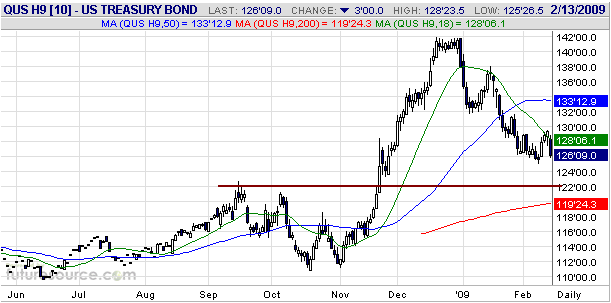
daily chart displayed below shows that the March T-Bond futures
contract has been in a short-term downward trend since mid December. A
test of important support at 122 appears to be on the cards.
If 122 holds then the potential for bonds to make a marginal new high
during the second half of this year will be undiminished, whereas a
decisive breach of this support would be persuasive evidence that a
major peak was put in place last December.
The Stock
Market
The Big Picture
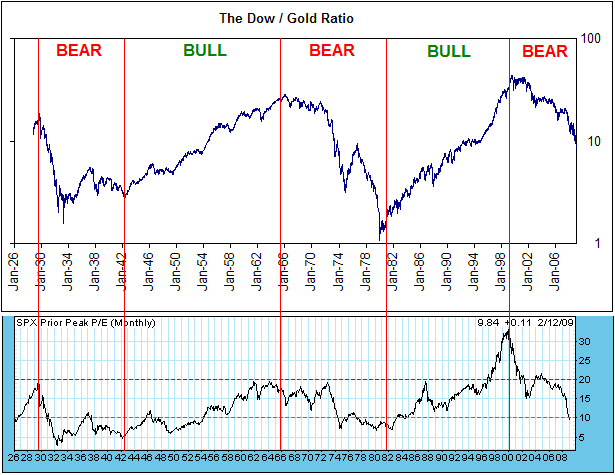
Below is a chart that we show once or twice per year, every year. We
don't show it more often than that because it presents a very long-term
picture that doesn't usually change significantly from month to month
or even from year to year, but we like to show it at least once per
year because it is, in our opinion, the most important chart in the
world for long-term equity investors. The importance of this chart is
that it takes currency fluctuations out of the equation and reveals the
US stock market's REAL long-term trend.
The stock market's real long-term trend can be defined by its
performance in gold terms or, just as appropriately, by the trend in
its average valuation (price/earnings ratio, dividend yield, etc.). It
doesn't matter which of these two measures is used because, as
evidenced by our chart, the long-term trends in the stock market's
performance relative to gold (as measured by the Dow/Gold ratio) and
the S&P500's valuation (as measured by the price/peak-earnings
ratio developed by John Hussman) are always in synch with each other.
When we take variations in the purchasing power of money out of the
equation -- as we've done in the following chart -- the stock market's
trend becomes crystal clear. In particular, it is clear that a
long-term bear market began during 1999-2001 and that the 2003-2007
rally -- a rally that led to a new all-time high for the Dow
Industrials Index in nominal dollar terms -- was just a rebound within
a secular bear market.
Note that while we
can categorically state that a bear market was in progress throughout
the past eight years, we can't state with absolute certainty that a
bear market is still in progress today. This is because it is possible
that the bear market ended last Thursday (the day of the most recent
new multi-year low in the Dow/Gold ratio). Extremely unlikely, but
possible. Putting it another way, in real time the direction of the
market's long-term trend is always a matter of opinion because there
will always be a possibility that the trend has just changed, but it's
a matter of fact that a secular bear trend in the US stock market was
still in force as of last Thursday.
On a related matter, gold's long-term trend is always the opposite of
the stock market's long-term trend. This relationship is due to gold's
historical role as money, and it hasn't been materially altered by the
changes to the monetary system that have occurred over the generations.
Consequently, it's a very good bet that gold's secular bull market will
last as long as, but no longer than, the secular bear market in
equities.
Current Market Situation
In the short-term, the broad stock market continues to struggle. It
doesn't look like it is about to break down, but at the same time it
seems incapable of making any real upward progress.
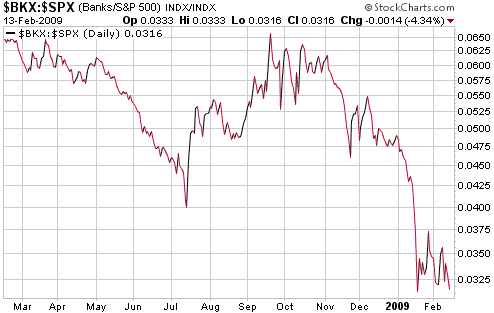
The banking sector remains weak on both an absolute and relative basis.
To be specific, the Bank Index (BKX) ended last week near its bear
market low in nominal terms and relative to the S&P500 Index (SPX).
The following chart shows the BKX/SPX ratio.
It's unlikely that the stock market will manage a tradable rally until
the general belief begins to take hold that the worst is over for the
banks. By the way, we don't think the worst is over for the banks, but
sentiment is at such a low ebb right now that it won't take much of a
sentiment shift to ignite a 1-3 month rebound.
One area of the
market that should do well once a short-term upward trend gets underway
-- assuming that a short-term upward trend will get underway in the
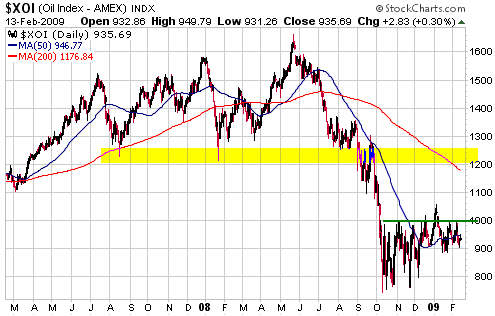
not-too-distant future -- is energy. With reference to the following
daily chart, a sustained break above 1000 by the AMEX Oil Index (XOI)
would create an upside objective of 1200-1250.
Gold has been the
only sector of the market that has recently been working, but when the
broad market eventually begins to move upward with some conviction our
non-gold stocks will probably begin to out-perform our gold stocks.
However, we would continue to maintain a much higher weighting in gold
than anything else because whereas most other sectors stand a good
chance of experiencing a tradable 1-3 month rebound, the gold sector is
probably in the early part of a new cyclical bull market that will last
at least three years.
This week's
important US economic events
| Date |
Description |
Monday Feb 16
| US markets closed for Presidents Day
| Tuesday Feb 17
| Treasury International Capital (TIC) Report
Housing Market Index
| | Wednesday Feb 18
| Housing Starts
Import and Export Prices
Industrial Production
FOMC Minutes
| | Thursday Feb 19
| PPI
Leading Indicators
| | Friday Feb 20
| CPI
Equity Options Expiration
|
Gold and
the Dollar
Gold
Over the past few weeks gold has been responding more to economic data
and the performance of the broad stock market than to changes in the US
dollars' foreign exchange value. Specifically, gold has tended to
advance in response to dismal economic data and stock market weakness,
and to ease back in response to signs of hope. This has created a
near-term positive correlation between gold and the Dollar Index
because the US dollar's foreign exchange value has also tended to rise
in response to bad economic news and stock market weakness.
We expect that both gold and the Dollar Index will go into
'consolidation mode' after the stock market eventually begins to rally
in earnest, but in our opinion neither has a lot of downside risk. It
is more a case of the upside potential being limited in the short-term
if, as we assume, a stock market rebound lies in store.
Gold Stocks
The AMEX Gold BUGS Index (HUI) broke out to the upside last Wednesday.
It pulled back on Thursday and Friday, but maintained its breakout.
Additional gains are likely over the coming month.
A couple of potentially significant bearish divergences are developing
in the gold sector. The first is the failure of the HUI/gold ratio to
confirm last week's upside breakout by the HUI, which was discussed in
the latest Interim Update. The second is discussed below.
Royal Gold (NYSE: RGLD) has a tendency to reach intermediate-term peaks and troughs well in advance of the HUI. For example:
a) RGLD peaked in January of 2006 -- about 4 months in advance of the HUI
b) RGLD bottomed in June of 2007 -- about 1.5 months in advance of the HUI
c) RGLD peaked in November of 2007 -- about 4 months in advance of the HUI
Significantly, RGLD's most recent peak occurred on the first trading
day of 2009, and when the HUI surged to a new multi-month high last
Wednesday RGLD was 10% below its early-January high. This divergence
between the HUI and RGLD is readily apparent on the following chart.
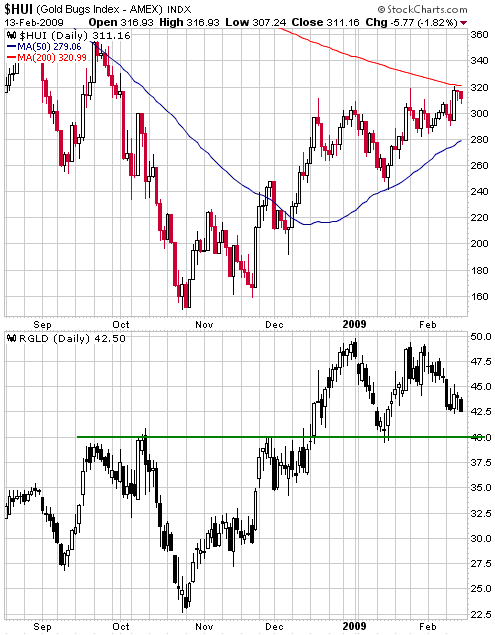
RGLD's decisive break
above long-term resistance at $40 created a technical objective of
around $58. The January high was well short of this objective, so it
wouldn't surprise us if the divergence between RGLD and the HUI were
eliminated over the weeks ahead by RGLD moving to a new high.
Considering the amount of time by which the 2006 and 2007
intermediate-term peaks in RGLD led the corresponding peaks in the HUI,
it also wouldn't surprise us if RGLD's January peak proved to be the
intermediate-term variety. The reason is that one of the most likely
times for an intermediate-term peak in the gold sector, based on this
sector's cyclical tendencies and intermediate-term rally durations, is
April. If RGLD peaked in January and the HUI peaks in April then the
time between the two peaks will be about 4 months (the same as 2006 and
2007).
The bottom line is that if RGLD fails to make a new high over the weeks
ahead then the probability will increase that a HUI peak will be in
place by the end of April.
Currency Market Update
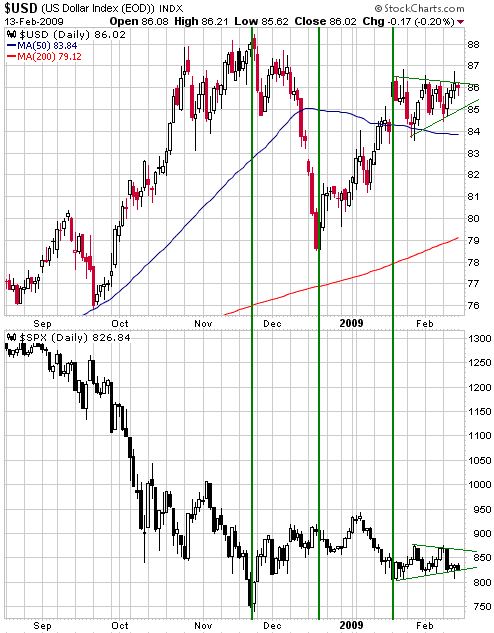
Indecisiveness in the currency market since mid January has paralleled
indecisiveness in the stock market. This is not a coincidence. As
evidenced by the following chart, there has been a close relationship
between the currency and stock markets for the past several months. To
be more specific, the chart shows that a large decline in the
S&P500 Index last year went hand-in-hand with a large rise in the
Dollar Index, with both moves culminating in the second half of
November. It also shows that the stock market's initial rally from its
November low was accompanied by a sharp decline in the Dollar Index,
and that stock market weakness from mid-December through to mid-January
occurred alongside US$ strength. Triangular patterns, indicating a
general lack of conviction, then began to develop in both the
S&P500 and the Dollar Index.
For both the Dollar Index and the SPX, taking out the extremes of the
past month would establish the direction of the short-term trend.
We expect the SPX to
break out to the upside from its multi-week consolidation, and, as a
result, we expect the Dollar Index to head lower. However, our view is
that the Dollar Index's short-term downside potential is only 5-6
points, versus upside potential of 3-4 points. In other words, our
short-term bearish outlook for the Dollar Index is marginal.
We continue to believe that the currencies with the potential to make
the biggest moves in the short-term are the Australian Dollar and the
Yen (up for the A$, down for the Yen), but this potential will only be
realised if the stock market rallies.
With regard to the intermediate-term, it is becoming increasing
difficult to justify a bearish view on the Dollar Index because
euro-related risks are growing. As outlined in last week's Interim
Update and in Ambrose Evans-Pritchard's 14th February article in the Telegraph,
European banks have huge exposure to 'dodgy' emerging-market loans.
Also, the euro remains over-valued against the US$ on a
purchasing-power-parity basis and the interest rate advantage currently
enjoyed by the euro is likely to disappear over the months ahead.
Lastly, there's the ever-present risk that Europe's monetary union will
begin to break apart as the member countries with the weakest economies
decide that they need the freedom to inflate at will. The USD/EUR
exchange rate constitutes more than 50% of the Dollar Index, so euro
weakness will almost always boost the Dollar Index even though this
index includes several other currencies.
We turned intermediate-term bearish on the Dollar Index last November,
but since that time the euro's downside potential has increased
relative to the US dollar's downside potential. As a result, we are now
upgrading our intermediate-term Dollar Index view to "neutral". If
nothing else changes in the mean time, a decline by the Dollar Index to
the low-80s within the coming 2 months would cause us to further
upgrade our intermediate-term Dollar Index view (to "bullish").
Update
on Stock Selections
(Note: To review the complete list of current TSI stock selections, logon at http://www.speculative-investor.com/new/market_logon.asp
and then click on "Stock Selections" in the menu. When at the Stock
Selections page, click on a stock's symbol to bring-up an archive of our comments on the stock in question)
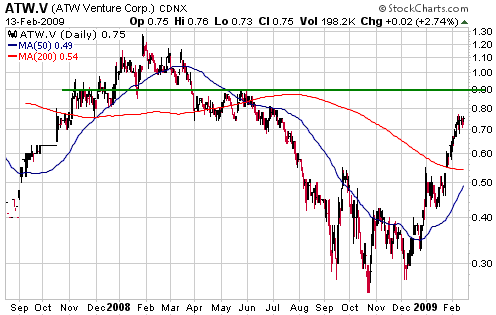
 ATW Gold (TSXV: ATW). Shares: 60M issued, 92M fully diluted. Recent price: C$0.75 ATW Gold (TSXV: ATW). Shares: 60M issued, 92M fully diluted. Recent price: C$0.75
ATW owns two gold projects in Western Australia, the Burnakura Project
and the Gullewa Project. The projects are about 300km apart and have
total combined NI 43-101 resources of roughly 1M ounces.
The size of ATW's gold resource will almost certainly grow, but ATW has
never really been an exploration play; rather, from our perspective it
has always been a play on the potential for near-term production and
cash flow from gold mines in a politically secure location. As we wrote
when we added the stock to the TSI List in June of last year:
"There should be plenty
of drilling news from ATW over the next few months, but the key to the
stock's upside potential lies with getting Burnakura into production.
Bringing Burnakura into production at 40K oz/year would justify a stock
price of at least C$1.00/share at current metal prices, allowing
nothing for Gullewa or Burnakura's expansion potential. However, if
ATW's management is able to establish credibility by successfully
bringing Burnakura into production over the coming four months then the
market will almost certainly begin to discount success with the Gullewa
project, leading to a much higher stock price."
It has taken a little longer than originally envisaged, but according
to a recent ATW press release the Burnakura project is now within three
weeks of going into production at the rate of 35K ounces/year. This is
5K oz/yr less than the mine plan at the time of our June-2008 write-up,
but the A$-denominated gold price is now more than 40% higher than it
was then. Depending on the cost at which ATW is able to produce its
gold, at the current gold price Burnakura's 35K ounces/year production
could be worth a lot more than C$1.00/share. And then there is
Burnakura's expansion potential and the value of the Gullewa project to
consider (we expect that Gullewa will be developed into a mine that
produces about 60K ounces per year of gold).
Until ATW proves that the Burnakura mine operates as planned the risk
will remain high. At the same time, the potential rewards are high and
the rewards could come within the next two months.
The following chart shows that ATW is extended on a short-term basis
and has significant resistance at C$0.90-C$1.00. Consequently, we
wouldn't do any new buying unless the stock pulled back to the
low-C$0.60s. Alternatively, those who currently have no exposure to ATW
could consider taking a small initial position near the current price
with the aim of buying more following a pullback.
Precision Drilling Trust (NYSE: PDS, TSX: PD.UN). Shares: 206M (incl. recent financing). Recent price: US$3.22
Last week PDS, a natural gas drilling company with operations in Canada
and the US, announced financing arrangements comprising an offering of
new trust units (46M units at US$3.75 to raise US$172M) and a US$250M
offering of senior notes. These arrangements will strengthen the
company's balance sheet and reduce risk, but they have put additional
short-term downward pressure on the stock price. Once the stock market
has digested the new offerings the stock price should recover.
PDS also announced its Q4-2008 financial results last week. The company
had net earnings of US$0.58 per unit in Q4, which equates to
US$2.33/unit annualised. At a price/earnings ratio of 10 the Q4
earnings would imply a unit price of US$23. The number of units has
since increased by almost 30%, but the Q4 results include only one week
of earnings related to the Grey Wolf acquisition.
This year's earnings will almost certainly be a lot lower than last
year's due to the reduction in drilling activity in both the US and
Canada stemming from the decline in the natural gas price. However, the
Q4 results show what PDS is capable of achieving when drilling activity
returns to a more normal level.
PDS's current low price reflects an excessively pessimistic (in our
opinion) outlook for natural gas, the short-term effects of the recent
financing, and the company's decision to eliminate its monthly
distribution in order to accelerate the pace of debt repayment. Like
almost all companies involved in the natural-gas production business
its future profitability hinges on the gas price, but it provides more
upside leverage than most other companies because its market value has
been pushed to such a low level.
Chart Sources
Charts appearing in today's commentary
are courtesy of:
http://stockcharts.com/index.html
http://www.futuresource.com/
http://www.decisionpoint.com/

|