|
-- Weekly Market Update for the Week Commencing 16th February 2015
Big Picture
View
Here is a summary of our big picture
view of the markets. Note that our short-term views may differ from our
big picture view.
In nominal dollar terms, the BULL market in US Treasury Bonds
that began in the early 1980s ended in 2012. In real (gold)
terms, bonds commenced a secular BEAR market in 2001 that will continue
until 2018-2020. (Last
update: 20 January 2014)
The stock market, as represented by the S&P500 Index,
commenced
a secular BEAR market during the first quarter of 2000, where "secular
bear market" is defined as a long-term downward trend in valuations
(P/E ratios, etc.) and gold-denominated prices. This secular trend will bottom sometime between 2014 and 2020.
(Last update: 22 October 2007)
A secular BEAR market in the Dollar
began during the final quarter of 2000 and ended in July of 2008. This
secular bear market will be followed by a multi-year period of range
trading.
(Last
update: 09 February 2009)
Gold commenced a
secular bull market relative to all fiat currencies, the CRB Index,
bonds and most stock market indices during 1999-2001.
This secular trend will peak sometime between 2014 and 2020.
(Last update: 22 October 2007)
Commodities,
as represented by the Continuous Commodity Index (CCI), commenced a
secular BULL market in 2001 in nominal dollar terms. The first major
upward leg in this bull market ended during the first half of 2008, but
a long-term peak won't occur until 2014-2020. In real (gold) terms,
commodities commenced a secular BEAR market in 2001 that will continue
until 2014-2020.
(Last
update: 09 February 2009)
Copyright
Reminder
The commentaries that appear at TSI
may not be distributed, in full or in part, without our written permission.
In particular, please note that the posting of extracts from TSI commentaries
at other web sites or providing links to TSI commentaries at other web
sites (for example, at discussion boards) without our written permission
is prohibited.
We reserve the right to immediately
terminate the subscription of any TSI subscriber who distributes the TSI
commentaries without our written permission.
Outlook Summary
Market
|
Short-Term
(1-3 month)
|
Intermediate-Term
(6-18 month)
|
Long-Term
(2-5 Year)
|
|
Gold
|
N/A |
Bullish
(26-Mar-12) |
Bullish
|
|
US$ (Dollar Index)
|
N/A |
Bearish
(26-Jan-15) |
Neutral
(19-Sep-07) |
|
US Treasury Bonds (TLT)
|
N/A |
Neutral
(18-Jan-12)
|
Bearish |
|
Stock Market
(DJW)
|
N/A |
Bearish
(28-Nov-11) |
Bearish
|
|
Gold Stocks
(HUI)
|
N/A |
Bullish
(23-Jun-10) |
Bullish
|
|
Oil |
N/A |
Bullish
(17-Dec-14) |
Bullish
|
|
Industrial Metals
(GYX)
|
N/A |
Neutral
(15-Sep-14) |
Bullish
(28-Apr-14) |
Notes:
1. Our short-term expectations are discussed in the commentaries, but except in
special circumstances we won't attempt to assign a "bullish", "bearish" or
"neutral" label to these expectations.
2. The date shown below the current outlook is when the most recent outlook change occurred.
3. "Neutral" means that we think risk and reward are roughly in balance with respect to the timeframe in question.
4. Long-term views are determined almost completely by fundamentals and intermediate-term views
are determined by a combination of fundamentals, sentiment and technicals.
No
Interim Update this week
Please note that there will be no Interim Update this week and
that we will be incommunicado (on a remote island with no internet
access) during Tuesday-Wednesday.
Last week's posts at the TSI Blog
New gold bull market will make 2008-2011 look tame
Cambodia, Gresham's Law and Corruption
What does the copper inventory tell us about the
copper price?
The short answer is: nothing. Here comes a longer answer.
We used to keep a close eye on changes in the
reported copper inventory, especially the LME (London Metal Exchange) inventory,
based on the belief that changes in the reported inventory contained information
about the likely future direction of the copper price. After a while, however,
it became clear to us that there was no consistent relationship between the
reported inventory level and the recent or future price performance.
Consequently, although we continued to occasionally check what was happening to
inventory levels, we stopped factoring the information into our price outlook.
But why doesn't the reported copper inventory typically provide useful
information about the copper price? After all, shouldn't a large decline in the
reported inventory be indicative of substantially reduced supply, which would
have bullish price implications, and shouldn't a large rise in the reported
inventory be indicative of substantially increased supply, which would have
bearish price implications?
The answer is that the reported inventory is generally NOT indicative of the
overall supply situation in the market.
The reasons that there is no consistent relationship between the reported
inventory and the market's overall supply situation are covered in a recent
article by Andy Home. A key point is that a large increase or decrease in
the reported inventory position could reflect the movement of metal into or out
of the LME system with no change in total supply or even in the physical
location of the metal. For example, the afore-linked article notes that on
Thursday 5th February there was a sudden large increase in the reported LME
inventory as the result of someone "warranting" (in effect: registering for sale
via the LME) metal that was already in the warehouse, which in this day and age
is something that can be done with the stroke of a keyboard. Why did this
happen? The most likely reason is to make a physical delivery against a short
position on the LME.
The Andy Home article goes on to explain that when the market is in
"backwardation", as is currently the case, there is a financial incentive for
short positions to be closed by making physical delivery. This is because any
short-seller who rolls his position forward will have to pay the
"backwardation". When this happens there is no change in overall supply, but the
reported LME inventory increases.
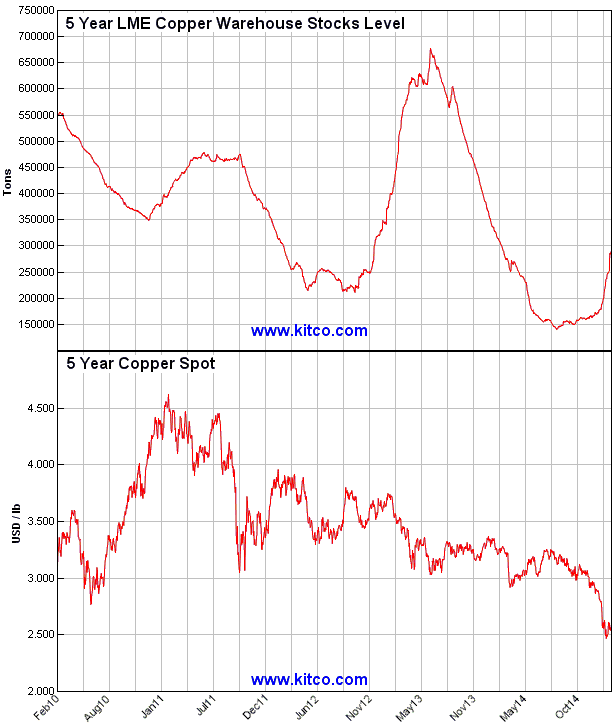
The lack of a consistent relationship between the LME copper inventory and the
copper price is evident on the following chart. The sharp price decline of the
past few months has gone with a rising inventory, but note that the inventory
level had plunged over the preceding 12 months and was at a 5-year low prior to
the start of the sharp price decline. Anyone who took the unusually low level of
the reported inventory in mid-2014 as a reason to make a bullish bet on the
copper price would have been as wrong as they could be.
The bottom line is that you won't get any reliable insight into the likely
future performance of the copper price by tracking the reported copper
inventory.
The Stock
Market
The US
Current Market Situation
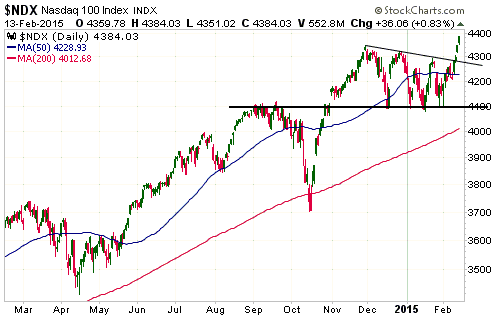
Although the breakout hasn't been confirmed by all of the important US stock
indices, it is fair to say that the US stock market broke out to the upside last
week and in doing so marked the choppy December-January price action as a
consolidation within an upward trend. Of particular significance, the following
chart shows that the NASDAQ100 Index (NDX), the index that has often led to the
upside over the past several years, clearly broke out to a new multi-year high
during the final two days of last week.
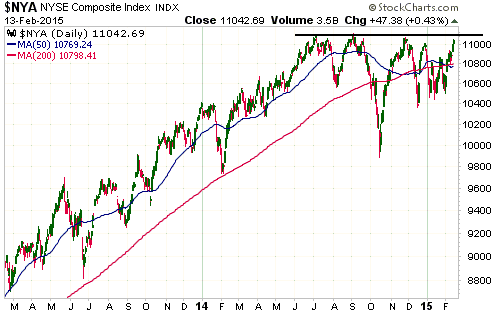
The next chart reveals that the NYSE Composite (NYA) is one of the indices that
haven't yet confirmed the break to new highs. However, there's a good chance
that it will make its own way to new highs within the weeks immediately ahead.
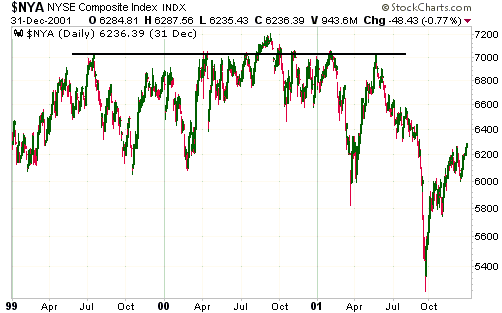
In last week's Interim Update we wrote that given on our longer-term bearish
outlook, two short-term scenarios were equally plausible. One was that the
market had already made a major top and would soon begin to trend downward. This
scenario was subsequently ruled out. The other was that the market would make a
new high within the next few weeks before reversing lower and commencing a 1-2
year bearish trend. This scenario, which is still very much in play, would be
similar to how the NYA peaked during 2000 and how several indices peaked during
2007.
Here's a chart showing the NYA's major top in 2000. Notice the upside breakout
above obvious resistance in August of 2000. The NYA sustained the breakout for
about two weeks and then rolled over into a downward trend that would last about
two years and reduce the price by almost 40%.
An upside breakout that fails within a few weeks is, we think, the most probable
scenario, but there is more to be lost than gained by betting on a potential
breakout failure at this time. It makes more sense to wait for evidence of
failure before taking any new bearish positions, because the evidence will
emerge while the price is still close to its high.
The best thing that the US stock market currently has going for it is the
evolving stock-market situation outside the US. Here's what we are referring to:
1. The strongest euro-zone stock markets clearly broke out to the upside last
month and have sustained their breakouts.
2. The weakest euro-zone stock markets appear to be following suit.
3. The Japanese stock market looks set to break out to new multi-year highs in
the near future.
4. There are signs that a multi-month bottom is in place for EEM, a proxy for
emerging-market equities.
A coal speculation worth considering
The most unloved sector of the US stock market isn't the gold sector, it's the
coal sector. The coal sector was very much out of favour and cheap prior to the
collapse in the oil price, but this didn't prevent it from taking a big hit when
other energy-related equities plunged in reaction to oil's steep price decline.
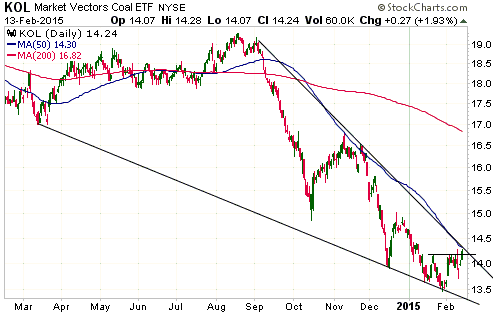
Furthermore, whereas the Energy Sector ETF (XLE) has rebounded by about 15% from
its January low, the Market Vectors Coal ETF has gained only 5% from its low.
This is despite the fact that KOL is down by about 70% from its 2011 peak.
The world will continue to rely heavily on coal for large-scale power generation
for a long time to come, so although it is unfashionable the coal-mining
industry will survive and will have to generate sufficient returns to attract
new investment. This tells us that at some point KOL will bottom out and
commence a major upward trend.
We suspect that the bottom for KOL is either already in place or will be put in
place during the first half of this year at not far below the January low, and
that KOL's price will be much higher a year from now.
Europe
A little more than two weeks ago (in the 28th January Interim Update) we said
that it could make sense to buy the Global X Greece ETF (GREK) for an
intermediate-term trade. Our reasoning was that given the steep price decline of
the preceding 10 months and the fact that Greece's stock market had the world's
lowest Cyclically-Adjusted P/E ratio (CAPE) prior to the start of this steep
decline, the market appeared to have factored in the worst-case scenario and
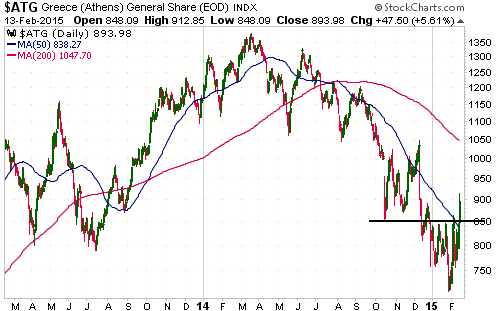
then some. Driven by a sharp rebound in the Athens General Share Index (ATG) and
stabilisation of the euro, GREK has since gained 28%.
The following daily chart shows that ATG broke above short-term resistance last
Friday and ended the week at a 2-month high. This price action suggests that
January's downside breakout was a 'fakeout'. It also suggests that Greece will
remain in the euro-zone and the ECB will have some success in its new efforts to
'kick the can down the road' by generating "inflation".
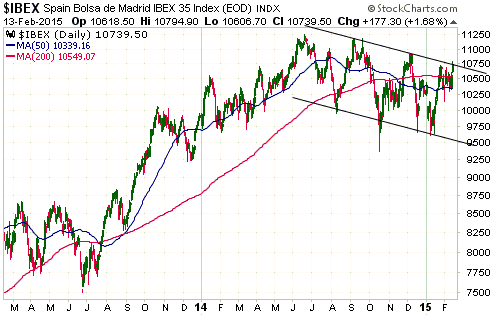
The rise by Spain's IBEX 35 Index to its channel top is another sign that the
ECB will have some success in its attempts to generate "inflation". If the IBEX
makes additional upward progress from here, which it looks set to do, it will
mark the choppy price action of the past 7 months as a consolidation within a
multi-year upward trend.
This week's
significant US economic events
(The most important events are shown
in bold)
| Date |
Description |
| Monday Feb 16 |
US (and Canadian) markets closed for public
holiday | | Tuesday
Feb 17 |
Empire State Mfg Survey
Housing Market Index
TIC Report | | Wednesday
Feb 18 |
FOMC Minutes
Housing Starts
PPI
Industrial Production | | Thursday
Feb 19 |
Philadelphia Fed Survey
Leading Economic Indicators
|
| Friday Feb 20 |
No important events scheduled |
Gold and
the Dollar
Gold
The Fundamentals
The popular claim that deflation is currently a big threat is unadulterated
hogwash. Europe, apparently, is the focal point of the deflation threat, but the
rate of growth in euro supply was more than 9% last year and will probably move
into double digits after the ECB's new inflation program kicks off. Furthermore,
European stock indices are starting to become very strong, which is something
that would definitely not be happening if deflation were a probable outcome.
The view that there is a high risk of deflation is a mistake, but it's a
forgivable mistake. It is based on either the misinterpretation of evidence or
looking at the wrong evidence. What's not forgivable is claiming that central
banks should be ramping up the money supply to prevent deflation, because even
if there were a decent chance of deflation actually happening it would be
counter-productive to create large amounts of new money out of nothing. The
reason is that the creation of money out of nothing falsifies price signals on a
grand scale, leading to investing errors throughout the economy. Regardless of
the circumstances, an economy can never be helped via policies that make the
economy less efficient.
In any case, there are signs in the financial markets that inflation
expectations have begun to increase from low levels. All else remaining the
same, rising inflation expectations are bullish for gold. However, all else
never remains the same. The fact is that rising inflation expectations are only
bullish for gold to the extent that they rise relative to nominal interest
rates. Putting it another way, rising inflation expectations are only bullish
for gold to the extent that they result in a lower real interest rate, the real
interest rate being the nominal interest rate minus the EXPECTED rate of
currency depreciation.
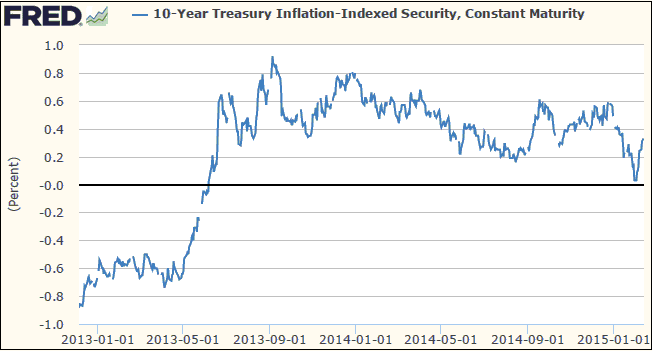
Over the past four weeks there was an up-tick in US inflation expectations, but
this up-tick was less than the increase in nominal interest rates over the same
period. The net effect was a small rise in the real US interest rate (as
indicated on the following chart by the 10-year TIPS yield) and some downward
pressure on the gold price from this particular fundamental driver. However,
taking a wider-angle view there has been a slight downward bias in the real US
interest rate since Q3-2013, so this fundamental factor is still a
neutral-to-bullish influence on gold's intermediate-term price trend.
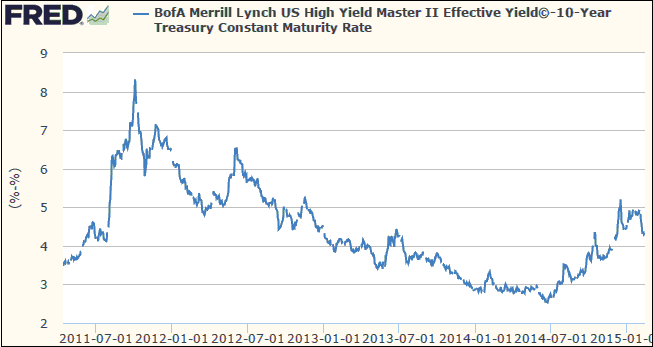
Widening credit spreads indicate declining economic confidence and are therefore
bullish for gold. As illustrated by the following chart, the trend in credit
spreads was bearish for gold from late-2011 through to around June of 2014, at
which point it turned gold-bullish. Trends don't move in straight lines and
there has been a narrowing of credit spreads over the past two months, but we
still view this fundamental driver as bullish for gold.
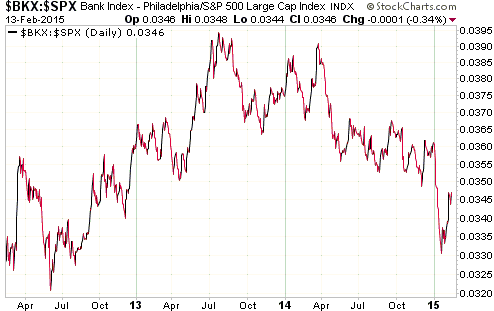
Talking about trends not moving in straight lines, the BKX/SPX ratio has
rebounded strongly over the past four weeks within the context of a longer-term
declining trend. The overall trend (weakness in bank stocks relative to the
broad market) remains gold-bullish, but the recent sharp rebound in the banking
sector's relative performance has no doubt contributed to gold's downward
correction.
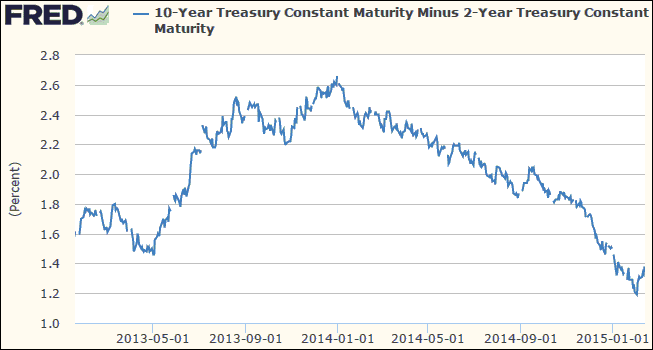
The US dollar's performance on the foreign exchange market has clearly been
gold-bearish over the past 6 months, but the most important fundamental driver
of the gold market that remains definitively bearish is the US yield curve, as
represented on the following chart by the yield spread between 10-year and
2-year Treasury Notes. A rising yield-spread (long-term interest rates rising
relative to short-term interest rates) is bullish for gold because it is the
result of either rising inflation expectations or declining financial-market
liquidity, whereas a falling yield-spread is bearish for gold because it is the
result of either declining inflation expectations or aggressive boom-time
speculation.
It's possible that the US yield curve is just beginning to move in gold's favour,
but it has certainly been a bearish influence over the past 12 months.
Overall, the fundamental backdrop can still be aptly described as neutral or
slightly bullish for the US$ gold price, depending on how much weight is
assigned to each driver. However, due to the large gains made by gold relative
to oil and in terms of currencies other than the US$, the fundamental backdrop
for gold mining is very bullish. That's especially the case for gold miners
operating outside the US.
The Price Action
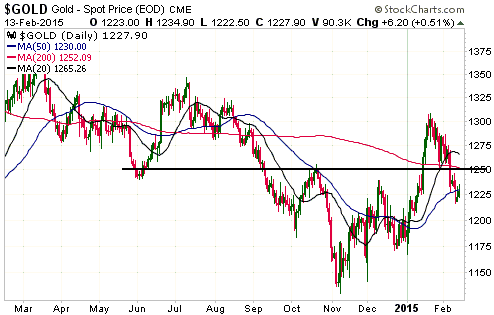
The US$ gold price did very little last week. The net change over the course of
the week was a decline of only $6 and the daily oscillations were small.
The corrective process should continue for at least a few more weeks, but within
this process there will be rebounds. Resistance at $1250 and the 20-day MA (the
mid-$1260s) are likely targets for a rebound over the coming fortnight.
Gold Stocks
Current Market Situation
Last week's performance by the HUI was similar to last week's performance by the
US$ gold price, meaning that the HUI didn't move by much in either direction and
ended the week with a small loss. Support at around 180 remains a likely target
for a correction low in the HUI.
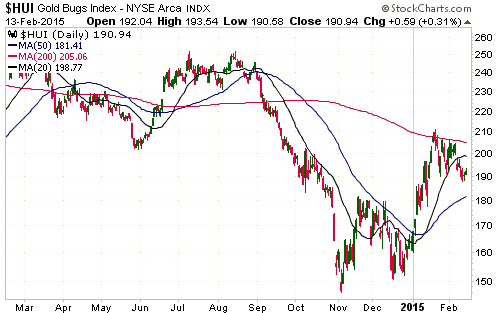
We suspect that the correction in the gold-mining sector will end sooner than
the correction in the bullion market. It won't surprise us, for example, if a
rally to a lower high in the gold price (within the context of an on-going
correction) is accompanied by a rally to a new high for the year in the HUI. Be
aware, though, that the HUI must hold support at 180 to maintain its bullish
posture. A daily close below 180 would open up the possibility that a re-test of
the November-2014 low is on the cards.
GFI versus KGC
On a few occasions last year we mentioned that Gold Fields Ltd. (GFI) and
Kinross Gold (KGC) offered the best value among the senior gold-mining stocks.
We have generally preferred GFI due to its lower country risk, although KGC was
one of the most obvious buys in the stock market when it dropped to US$2.00 last
November. We suggested a short-term trade in KGC at that time in anticipation of
a quick rebound to US$3.00. Also, the TSI Stocks List has some exposure to both
stocks via January-2016 call options.
GFI and KGC rebounded strongly from their November-2014 bottoms, with GFI doing
well enough to reach a 16-month high in January and KGC fully retracing its
September-November-2014 crash. However, they both plunged last week after
announcing their Q4-2014 results and 2015 guidance, despite reporting
year-over-year cost declines of around 15% and decent cash flows. It's therefore
an opportune time to briefly review our assessments.
GFI achieved good production and cost results for the final quarter of last year
and forecast similar production for 2015, but announced further delays to the
ramping up of its South Deep mine in South Africa. This was the main reason for
the sharp decline in its stock price. The South Deep mine is GFI's only
remaining South African operation and has been a thorn in the company's side for
years.
Also, GFI advised the market that due largely to oil-price hedging it would not
achieve a significant benefit during 2015 from last year's decline in the oil
price. This was a negative surprise.
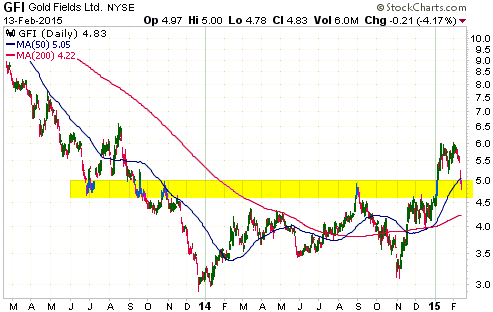
Regarding price action and current valuation, a normal correction would have
taken GFI from the January high of around US$6.00 to the 50-day MA and lateral
support at around US$5.00. However, the reaction to last week's news has led to
a greater-than-normal correction. GFI ended the week at US$4.83, which is
roughly in line with its book value. A decline to the vicinity of the 200-day MA
(the $4.20s) now looks possible.
Like GFI, KGC achieved good production and cost results for the final quarter of
last year. However, this good news was overshadowed by a few negative surprises.
One of the negative surprises was that 2015 production is forecast to be about
200K ounces less than 2014 production, but the main one was another large ($1B)
non-cash asset writedown. KGC appeared to have thrown out everything except the
kitchen sink when writing down the accounting values of its assets in 2013, so
another large writedown was not expected by us or by the market. It seems that
the kitchen sink is now gone as well, so the asset writedown phase must surely
now be over.
Despite having a much stronger balance sheet than GFI (zero net debt for KGC
versus $1.5B of net debt for GFI), KGC has a much lower valuation. By a number
of measures including book value, we estimate that KGC's current valuation is at
least 35% lower than GFI's current valuation. The discount is justified in part
by KGC's much greater country risk (KGC's most profitable mine is in Russia,
whereas almost half of GFI's production comes from Australia), but it looks
excessive to us.
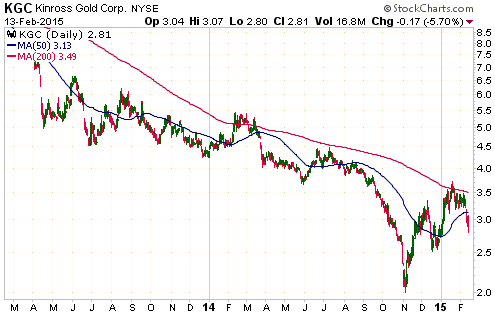
KGC has strong chart-based support at US$2.50-$2.60. We will be interested in
adding exposure to this stock at around US$2.60.
The Currency Market
The Dollar Index
Many analysts continue to cite anticipation of Fed rate hikes as the main reason
for the US dollar's surge from its June-2014 low to its January-2015 high.
However, while there were almost certainly multiple reasons for the US dollar's
strong rise, we can be sure that anticipation of Fed rate hikes wasn't one of
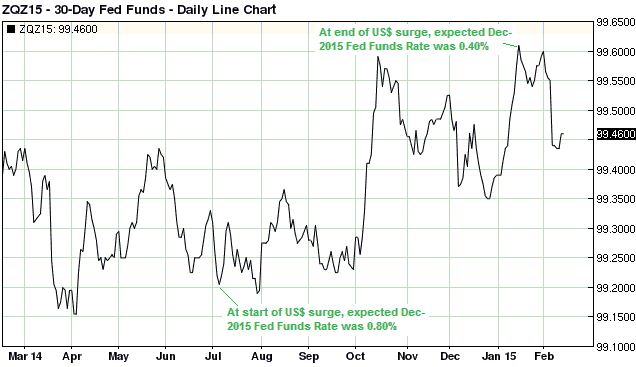
them. The following chart of the December-2015 Fed Funds Futures explains why.
It shows that at the start of the dollar's big rally the market was expecting
the Fed Funds Rate (FFR) to be 0.8% (100 - 99.2) in December-2015 and that at
the end of the dollar's big rally the market was expecting the FFR to be 0.4%
(100 - 99.6) in December-2015. In other words, the market's expectations of what
the Fed's targeted interest rate would be in December of 2015 fell by 0.4% over
the course of the dollar's big rally.
As pointed out in previous commentaries, we think the main reason for the US$
rally was strength in US equities relative to European equities. However,
declines in European interest rates relative to US interest rates could have
also played a part, as could positive feedback whereby a rise in the US$ causes
a sell-off in commodity prices, which reinforces the upward trend in the US$,
and so on. The positive feedback will work the other way when the US$ begins to
trend downward and commodity prices turn upward.
A multi-month US$ downward trend driven primarily by relative strength in
European equities could be underway, but more evidence is required.
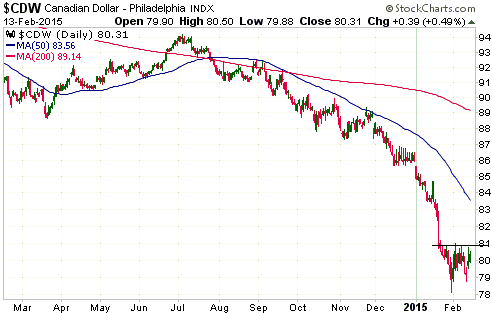
The C$
The Canadian Dollar (C$) is showing early signs of having bottomed. A daily
close above 0.81 would be a clearer sign that a bottom is in place.
Updates
on Stock Selections
Notes: 1) To review the complete list of current TSI stock selections, logon at
http://www.speculative-investor.com/new/market_logon.asp
and then click on "Stock Selections" in the menu. When at the Stock
Selections page, click on a stock's symbol to bring-up an archive of
our comments on the stock in question. 2) The Small Stock Watch List is
located at http://www.speculative-investor.com/new/smallstockwatch.html
 Company
news/developments for the week ended Friday 13th February 2015: Company
news/developments for the week ended Friday 13th February 2015:
[Note: AISC = All-In Sustaining Cost, FS = Feasibility Study, IRR = Internal
Rate of Return, MD&A = Management Discussion and Analysis, M&I = Measured and
Indicated, NAV = Net Asset Value, NPV(X%) = Net Present Value using a discount
rate of X%, P&P = Proven and Probable, PEA = Preliminary Economic Assessment,
PFS = Pre-Feasibility Study]
*Almaden Minerals (AAU) announced that it has raised C$5.5M by
issuing new shares at C$1.25/share. By our calculations this means that AAU now
has about C$15M in its treasury, which should be enough to fund the company's
exploration and engineering work for at least 12 months.
*Asanko Gold (AKG) has completed its previously announced bought
deal financing by issuing 22.8M shares at C$2.02/share to raise a total of
C$46M. Interestingly, the full overallotment option was exercised by the
underwriters despite the stock price at the time of closing being about 10%
below the financing price.
*Premier Gold (PG.TO) announced that it has swapped early-stage
exploration projects with Goldcorp, with PG ending up with 100% of the Hasaga
gold project in Red Lake, Ontario. This news is not significant, at least not at
this time. Of course, if future exploration reveals an economic gold deposit at
Hasaga then the news was significant.
*Timmins Gold (TGD) reported drilling results that indicated the
potential to grow production at its San Francisco gold mine (Mexico) by widening
the existing pit and via underground development from the existing open pit.
This is good news.
*True Gold Mining (TGM.V): On-market buying of TGM shares by the
company's most important insider (Mark O'Dea) continued last week. The total
number of shares bought by the company's CEO from 28th January through to 12th
February is 555K.
List of candidates for new buying
From within the ranks of TSI stock selections the best candidates
for new buying at this time, listed in alphabetical order, are:
1) AAU (last Friday's closing price: US$1.10).
2) AKG (last Friday's closing price: US$1.55).
3) EDV.TO (last Friday's closing price: C$0.60).
4) PG.TO following a pullback to C$2.10-$2.20 (last Friday's closing
price: C$2.45).
5) TGD (last Friday's closing price: US$1.01).
Note that the above list is limited to five stocks. It will
sometimes contain less than five, but it will never contain more
than five regardless of how many stocks are attractively priced for
new buying.
Chart Sources
Charts appearing in today's commentary
are courtesy of:
http://stockcharts.com/index.html
http://www.barchart.com/
http://www.kitco.com/
http://research.stlouisfed.org/

|









