|
-- Weekly Market Update for the Week Commencing
16th June 2014
Big Picture
View
Here is a summary of our big picture
view of the markets. Note that our short-term views may differ from our
big picture view.
In nominal dollar terms, the BULL market in US Treasury Bonds
that began in the early 1980s ended in 2012. In real (gold)
terms, bonds commenced a secular BEAR market in 2001 that will continue
until 2018-2020. (Last
update: 20 January 2014)
The stock market, as represented by the S&P500 Index,
commenced
a secular BEAR market during the first quarter of 2000, where "secular
bear market" is defined as a long-term downward trend in valuations
(P/E ratios, etc.) and gold-denominated prices. This secular trend will bottom sometime between 2014 and 2020.
(Last update: 22 October 2007)
A secular BEAR market in the Dollar
began during the final quarter of 2000 and ended in July of 2008. This
secular bear market will be followed by a multi-year period of range
trading.
(Last
update: 09 February 2009)
Gold commenced a
secular bull market relative to all fiat currencies, the CRB Index,
bonds and most stock market indices during 1999-2001.
This secular trend will peak sometime between 2014 and 2020.
(Last update: 22 October 2007)
Commodities,
as represented by the Continuous Commodity Index (CCI), commenced a
secular BULL market in 2001 in nominal dollar terms. The first major
upward leg in this bull market ended during the first half of 2008, but
a long-term peak won't occur until 2014-2020. In real (gold) terms,
commodities commenced a secular BEAR market in 2001 that will continue
until 2014-2020.
(Last
update: 09 February 2009)
Copyright
Reminder
The commentaries that appear at TSI
may not be distributed, in full or in part, without our written permission.
In particular, please note that the posting of extracts from TSI commentaries
at other web sites or providing links to TSI commentaries at other web
sites (for example, at discussion boards) without our written permission
is prohibited.
We reserve the right to immediately
terminate the subscription of any TSI subscriber who distributes the TSI
commentaries without our written permission.
Outlook Summary
Market
|
Short-Term
(1-3 month)
|
Intermediate-Term
(6-12 month)
|
Long-Term
(2-5 Year)
|
|
Gold
|
Bullish
(10-Jun-14) |
Bullish
(26-Mar-12) |
Bullish
|
|
US$ (Dollar Index)
|
Bearish
(16-Apr-14) |
Bearish
(27-Jan-14) |
Neutral
(19-Sep-07) |
|
Bonds (US T-Bond)
|
Bullish
(11-Dec-13)
|
Neutral
(18-Jan-12)
|
Bearish |
|
Stock Market
(DJW)
|
Bearish
(07-Apr-14) |
Bearish
(28-Nov-11) |
Bearish
|
|
Gold Stocks
(HUI)
|
Bullish
(10-Jun-14) |
Bullish
(23-Jun-10) |
Bullish
|
|
Oil |
Neutral
(02-Jun-14) |
Neutral
(31-Jan-11) |
Bullish
|
|
Industrial Metals
(GYX)
|
Neutral
(17-Feb-14) |
Bullish
(28-Apr-14) |
Bullish
(28-Apr-14) |
Notes:
1. The date shown below the current outlook is when the most recent outlook change occurred.
2. "Neutral", in the above table, means that we either don't have a
firm opinion or that we think risk and reward are roughly in balance with respect to the timeframe in question.
3. Long-term views are determined almost completely by fundamentals,
intermediate-term views by
fundamentals, sentiment and technicals, and short-term views by sentiment and
technicals.
The misleading nature of
GDP
A
good article covering some of the problems with the statistic known as Gross
Domestic Product (GDP) was posted at Forbes on 8th June. The core problem is
that an increase in GDP is supposed to represent economic growth, but it
doesn't. GDP is just a measure of some types of monetary spending and does not
differentiate between productive and non-productive spending. According to the
way GDP is calculated and used, spending that is 100% wasteful, such that for
every X$ spent there is a reduction of X$ in real wealth, grows the economy by
as much as the same dollar amount of productive spending.
Due to the way GDP is calculated, with counter-productive spending supposedly
generating just as much 'growth' as productive spending, it is possible for a
country to become poorer while legitimately reporting strong GDP growth. There
are many historical examples of this, including the US economy during 1941-1945
(the strongest 'real' GDP growth in US history occurred while wealth was being
destroyed at the fastest pace in US history), the US economy during 1976-1979
(the economy was clearly getting weaker while annual 'real' GDP growth averaged
around 5%), and the Soviet Union during most of its existence (right up to the
point where it collapsed in a pile of economic rubble).
The most important aspect of the core problem mentioned above is that government
spending is counted in GDP as if it were just as additive to the economy as
private spending. But how can this be, when every dollar spent by the government
must first be either borrowed or stolen from the private sector?
Interestingly, statisticians haven't always viewed government spending as an
economic plus. Prior to the invention of the GDP statistic in the late-1930s,
measures of economic growth showed the economy shrinking if private output
declined, even if government spending was expanding output elsewhere in the
economy. Although there will always be insurmountable problems with any attempt
to reduce an economy to a single number or simple equation, recognition by the
calculators of GDP that government spending does not add to the economy and in
many cases -- such as the case where the spending is war-related -- subtracts
from the economy, would certainly be a step in the right direction.
Today's near-universal belief in the importance and usefulness of the GDP number
is one of many indications that the science of economics is unique. It is the
one science that has gone backwards over the past 90 years.
Commodities
Oil
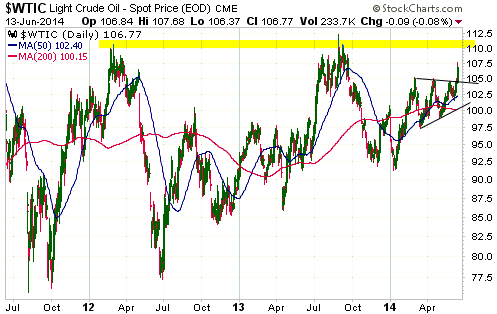
In reaction to developments that could reduce or completely stop oil production
in Iraq, the oil price broke above short-term resistance during the second half
of last week. This breakout suggests that the more important longer-term
resistance at $110-$112 will soon be tested.
We are "neutral" on the oil price. Oil is expensive relative to most other
commodities, but its relatively high valuation could continue to be supported by
geopolitical events that threaten to curtail supply.
Copper
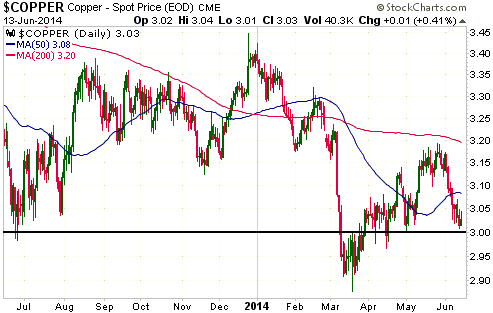
In the copper market there was a false breakout below major support at $3.00 in
March. We suspect that this false downside breakout marked the end of copper's
cyclical bear market. The price subsequently rebounded to just below $3.20 in
May, before dropping back to re-test major support at $3.00 last week.
Although we expect a successful test of the $2.90-$3.00 support range followed
by a multi-month rally to well above the May high, there is sufficient
short-term risk of a final decline to new lows to keep our short-term outlook at
"neutral". If there is going to be a final decline to new lows it will likely
happen within the next two months.
As an aside, the copper and gold markets have been inversely correlated since
Q4-2013. For example, gold's year-to-date high in March coincided with copper's
year-to-date low, copper's late-May high coincided with a low in the gold
market, and over the past two week's there has been a downturn in the copper
market in parallel with an upturn in the gold market. This inverse relationship
is interesting, but we don't expect it to persist beyond the short-term.
We plan to add some copper exposure to the TSI Stocks List within the next two
months, following either a spike to new lows or evidence that the March low has
been successfully tested.
The Stock
Market
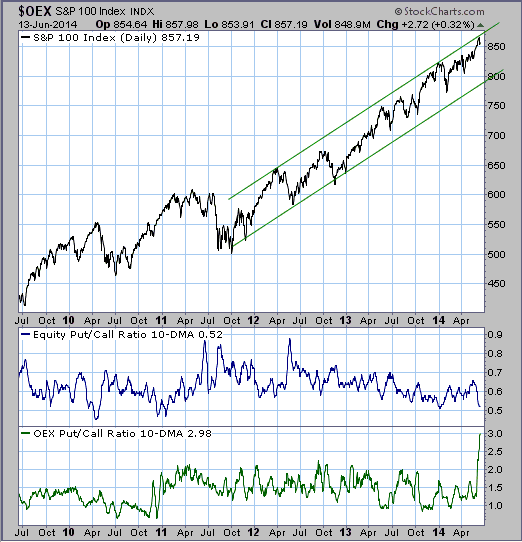
The US stock market's put/call sell signal
that we mentioned last week has become more pronounced, with the 10-day MA of
the equity put/call ratio remaining near its lows of the past three years
(indicating 'dumb money' complacency) and the 10-day MA of the S&P100 Index (OEX)
put/call ratio moving well beyond its highs of the past few years (indicating
'smart money' fear). This complacency on the part of the 'dumb money' and fear
on the part of the 'smart money' is occurring with the OEX having just reached
the top of a channel that dates back to the October-2011 bottom.
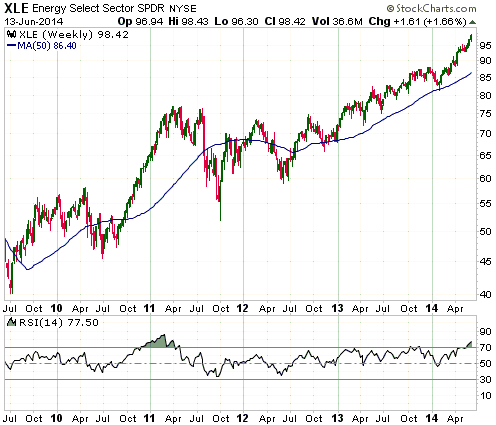
While the oil price has just broken above short-term resistance and does not yet
look extended to the upside, the following weekly chart of XLE (Energy Sector
ETF) indicates that the oil sector of the stock market is in upside blow-off
mode. This suggests that there is substantial downside risk in oil-related
equities, partly because these equities tend to be influenced just as much by
the broad stock market as by the oil price.
On an intermediate-term basis we think that the broad US stock market's
risk/reward is worse than the oil sector's risk reward, but the oil sector is
now sufficiently 'overbought' that a short-term decline of at least 15% looks
likely. Anyone with significant exposure to the oil sector should therefore
consider hedging against this possibility via the purchase of XLE put options,
especially if the upside blow-off continues over the days ahead in response to
additional bad news from Iraq.
This week's
important US economic events
| Date |
Description |
| Monday Jun 16 |
TIC Report
Empire State Mfg Survey
Industrial Production
Housing Market Index | | Tuesday
Jun 17 |
CPI
Housing Starts | | Wednesday
Jun 18 |
FOMC Meeting Announcement
Current Account Balance | | Thursday
Jun 19 |
Philadelphia Fed Survey
Leading Economic Indicators
|
| Friday Jun 20 |
Quadruple Witching |
Gold and
the Dollar
Gold
We've written that gold needs to get back above $1280 on a daily closing basis
to confirm that the short-term trend has reversed from down to up, but $1292 is
actually a more significant price level. A daily close above $1292 would break
gold above its short-term channel top as well as its 50-day, 150-day and 200-day
moving averages. This is a feat that has already been accomplished by GDXJ and
has almost been accomplished by the HUI. We expect that it will be accomplished
by gold bullion within the next three weeks, but hopefully not in response to
news from Iraq.
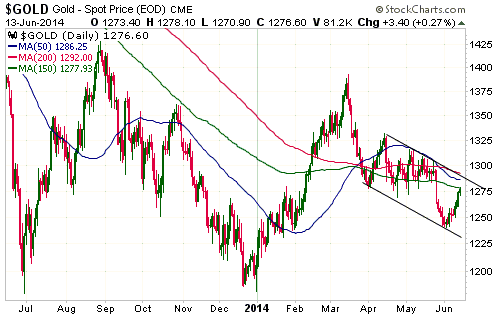
When the gold price rose to around $1350 in late February we thought it was due
for a correction that could take it down as far as the $1270s. The Ukraine drama
then began, which quickly pushed the gold price up to almost $1400 in early
March. We said at the time that as is always the case when gold is bid-up in
reaction to international military conflict or the increasing threat of
international military conflict, all the price gains achieved by gold on the
back of the Ukraine news would be relinquished. This turned out to be so, but
with the clarity that only hindsight can provide we now see that the upward
price spike in reaction to the Ukraine drama had a much larger effect than
originally anticipated. In a financial-market version of Newton's Third Law of
Motion (for every action there is an equal and opposite reaction), the surge of
uninformed gold-buying prompted by the Ukraine news set the stage for a deeper
and longer correction than would otherwise have happened.
Due to the latest
developments in Iraq, with Sunni jihadist militants have taken control of
the country's second-largest city and a further escalation of violence seemingly
on the cards, understanding how gold typically responds to increasing
geopolitical instability could be of near-term importance. That's why we just
revisited gold's reaction to the Ukraine drama.
The recent upturn in gold-related investments does not appear to be due to the
latest developments in Iraq, but if gold spikes upward in the near future in
response to a worsening situation in Iraq then the start of the next multi-month
advance in the gold price would likely be postponed. This is because any
Iraq-related gains would subsequently be given back and because the surge of
uninformed buying would weaken the structure of the market.
Now, if the situation in Iraq were to worsen to the point where it provoked
another large-scale US military intervention, then the backdrop would become
increasingly gold-bullish. This would not be directly due to the military action
itself, but due to the damage to the US economy inflicted by the government
wasting a lot more resources on another counter-productive escapade. However,
history teaches us that even in this case the initial price gains would likely
be given back in full.
Gold Stocks
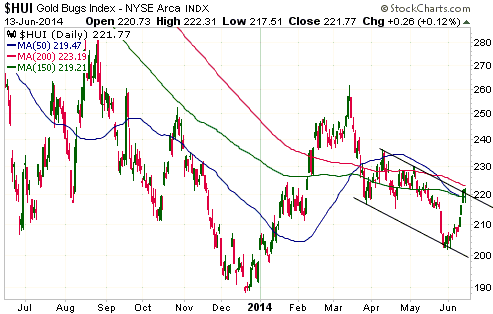
The 216-220 range for the HUI was the scene of a battle between bears and bulls
on the way down, with the bears eventually getting the upper hand. Closing back
above the top of this range is therefore a clear sign that the trend has changed
and that the bulls now have the upper hand.
Last week's breakout by the HUI was marginal and at the end of last week the
200-day MA had not been exceeded, but taken alongside the surge in the GDXJ/GDX
ratio there is little remaining doubt that a correction low is in place and that
a rally to new highs for the year has begun. If this is the case then the HUI's
correction low roughly coincided with a "death cross" (the 50-day MA crossing
from above to below the 200-day MA), which is normal. Despite its name, the
"death cross" is one of the most reliable short-term BULLISH signals in the
realm of technical analysis. Actually, we don't know of a more reliable
short-term bullish signal.
Note that a HUI pullback to below 220 over the days ahead wouldn't negate last
week's bullish price action, but the HUI must remain above 215 on a daily
closing basis to maintain its short-term bullish posture.
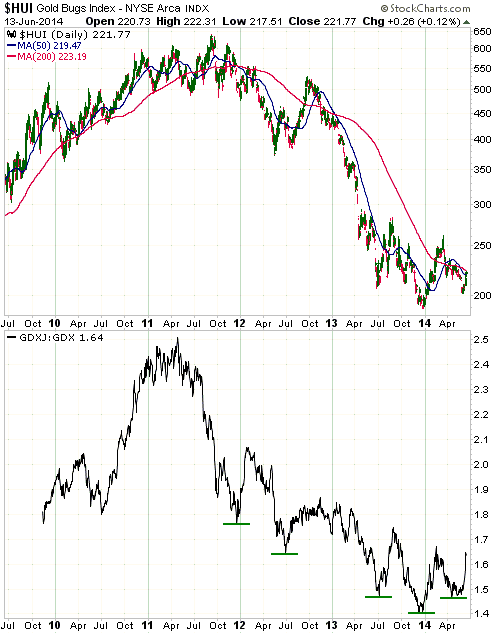
The following chart compares the HUI with the GDXJ/GDX ratio (junior gold stocks
relative to senior gold stocks) since GDXJ's inception in 2009. Notice that:
a) GDXJ led on the way up and on the way down.
b) There was a multi-month bearish divergence in 2011, with the HUI rising to
new highs while GDXJ/GDX trended downward.
c) For the first time in years, the GDXJ/GDX ratio has just made a higher low.
The leadership of GDXJ/GDX at important turning points is somewhat
counterintuitive, because a reasonable argument could be made that the
higher-risk/more-speculative stocks should outperform near the end of a cyclical
bull market and underperform near the beginning of a cyclical bull market.
However, the fact that GDXJ/GDX led to the downside during 2011 lends weight to
the idea that its relative strength since last December is indicating a major
upward trend reversal.
The GDXJ/GDX ratio is likely to 'take a breather' this week. In fact, we would
not be surprised to see the overall sector consolidate for at least one week,
with or without some follow-through to the upside over the next 1-2 days.
The Currency Market
Revisiting the "Reserve Currency" Myth
The US$ cannot lose its "reserve currency status" because under the current
monetary system there is no such thing as "reserve currency status".
The US$ is the most popular "reserve" currency by a huge margin, but this is not
because governments choose to hold it in reserve or because it has a certain
official status. Instead, governments around the world favour US dollars for
their currency reserves because the US$ is by far the most popular currency in
the global marketplace. In other words, when governments denominate the bulk of
their foreign currency reserves in US dollars they are simply reacting to a
marketplace reality.
The reality is that in terms of use in international financial dealings, no
other currency comes remotely close to the US$. This is not going to change
within the next several years (the euro, the dollar's main competitor, is a very
distant second and has lost ground to the US$ over the past couple of years) and
it's never going to change due to the government of Russia or China or Iran or
any other country deciding that it should change. Political threats to abandon
the dollar can be ignored. They are just hot air.
On a related matter, international money flows associated with investing and
speculation are about 50-times greater than international money flows associated
with trade. Bear this in mind the next time you read a comment along the lines
of "the US$ is going to get weaker because Country X is going to stop pricing
its oil in dollars". Something else to bear in mind is that China's massive
official currency reserve, which was built up over two decades of exchange-rate
manipulation and trade surpluses, is equivalent to about one day of current
turnover on the foreign exchange market. One day.
The US$ will eventually lose popularity as an international medium of exchange,
which will lead to it becoming less popular as an official reserve currency. The
point we want to emphasise today is that the loss of popularity as a reserve
will be an effect, not a cause, of US$ weakness.
Current Market Situation
We turned intermediate-term bullish on the senior commodity currencies (the A$
and the C$) early this year. Regardless of whether or not their cyclical bear
markets were over, these currencies were expected to trend upward through 2014
in parallel with a gradual shift in relative strength towards most things
commodity-related.
So far, so good. The A$ moved sharply higher from late-January through to
early-April and then commenced what looks very much like a mid-trend
consolidation. Based on the lead-lag relationship between gold and the A$ this
consolidation could continue for another 2-3 weeks, but in any case we expect
the A$ to work its way up to at least the high-90s over the months ahead.
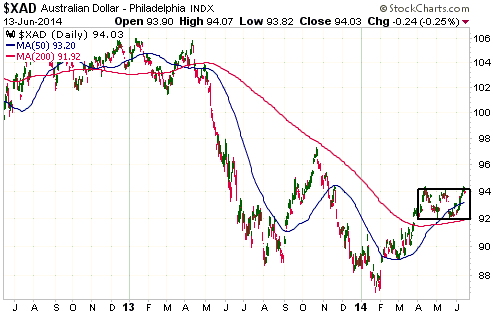
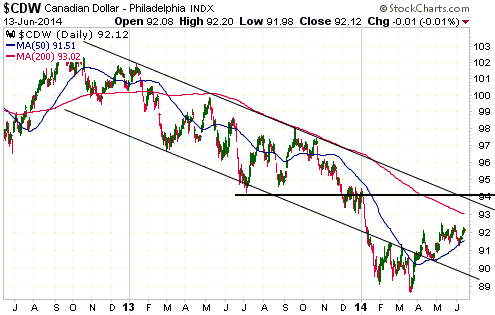
The C$ has been weaker than the A$ this year; however, it is slowly but surely
strengthening. The confluence of resistance at 93-94 is a reasonable 2-month
target.
Updates
on Stock Selections
Notes: 1) To review the complete list of current TSI stock selections, logon at
http://www.speculative-investor.com/new/market_logon.asp
and then click on "Stock Selections" in the menu. When at the Stock
Selections page, click on a stock's symbol to bring-up an archive of
our comments on the stock in question. 2) The Small Stock Watch List is
located at http://www.speculative-investor.com/new/smallstockwatch.html
 Company
news/developments for the week ended Friday 13th June 2014: Company
news/developments for the week ended Friday 13th June 2014:
[Note: AISC = All-In Sustaining Cost, FS = Feasibility Study, IRR =
Internal Rate of Return, MD&A = Management Discussion and Analysis,
M&I = Measured and Indicated, NAV = Net Asset Value, NPV(X%) = Net
Present Value using a discount rate of X%, P&P = Proven and
Probable, PEA = Preliminary Economic Assessment, PFS =
Pre-Feasibility Study]
*Lydian International (LYD.TO) had significant insider buying over
the past two weeks, with Howard Stevenson, the CEO, picking up
50,000 shares in the public market at around C$1.00.
We should soon get important news from LYD in the form of a revised
FS for its Amulsar gold project.
*Pilot Gold (PLG.TO) reminded the market that it has valuable
assets in addition to Kinsley Mountain (Nevada) by reporting a
drilling result that constitutes a new discovery at its TV Tower
project in Turkey. The result, which came from the first hole
drilled into a new gold-copper porphyry target called the Valley
Porphyry, was 0.99 grams/tonne gold and 0.39% copper over 153.1
metres starting from near the surface. This is good news as it adds
to the TV Tower project's considerable potential.
Also, PLG announced that it was buying Cadillac Resources (TSXV: CQX),
a tiny exploration-stage gold miner, for shares and warrants with a
current market value of around C$7M. The asset being acquired is the
Goldstrike project in Utah. Goldstrike is a past-producing, oxide
heap leach project that PLG's top-notch exploration team will now
incubate.
Although the CQX acquisition is very small, the announcement put
some downward pressure on PLG's stock price last Friday.
*Ramelius Resources (RMS.AX) has agreed to pay about $4M to
acquire the Kathleen Valley gold project, which is located close to
RMS's Vivien gold project in Western Australia. This may or may not
be a reasonable price to pay for an exploration-stage project with
130K ounces of resources, but either way we think that RMS should be
conserving its cash given that its Mt Magnet operation is cash-flow
negative at the current gold price.
*Rio Alto (RIO.TO, RIOM) is no longer part of the TSI List, but we
still have a large position in the stock in our own accounts and are
therefore still following its progress closely.
A recent note put out by Canaccord included a comment about RIO
likely getting a significantly higher weighting in GDXJ due to the
SUE takeover. If so it would mean increased demand for RIO shares
during the weeks following the completion of the merger (sometime in
August?), which could create the selling opportunity we are hoping
for.
As we said in our previous discussions of the RIO-SUE merger, the
only problem we have with this deal is the price being paid. Our
view is that RIO's management is exchanging half the company for an
asset that, although a logical fit with RIO's existing business, is
not worth more than one quarter of the company. A consequence will
be a substantially reduced per-share value for the post-merger RIO.
*True Gold Mining (TGM.V) announced drilling results that have
potentially extended one of the shallow, oxidised gold deposits at
its construction-stage Karma project (Burkina Faso) by 50%. The most
notable result was 29.5 g/t Au over 6.0 metres.
One of the reasons we like TGM as a longer-term speculation is the
high probability that the company's Karma project has a lot more
economically-viable gold than the amount included in the FS. If so,
the FS substantially understates the project's net asset value.
List
of candidates for new buying
From within the ranks of TSI stock selections, the best candidates for new
buying at this time are:
1) EDV.TO (last Friday's closing price: C$0.81).
2) EVN.AX (last Friday's closing price: A$0.84).
3) ORE.TO (last Friday's closing price: C$0.68).
4) RSG.AX (last Friday's closing price: A$0.62).
5) TGM.V (last Friday's closing price: C$0.42).
Review
of price action for individual stocks
The stocks of companies with economically-viable businesses at the current gold
price generally held up well during the recent sector-wide downturn, and three
weeks ago it was already apparent that many of these stocks were close to
completing routine corrections. Examples from the TSI Stocks List are charted
below. Also displayed below is the chart of a TSI stock that doesn't have a
viable business at the current gold price, but is showing signs of having
reversed upward nonetheless.
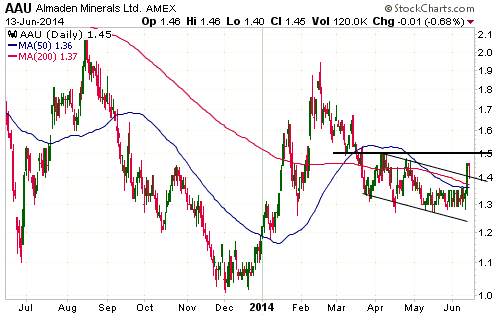
1. AAU signaled an end to its correction by breaking above resistance at US$1.40
last week. There is additional resistance at US$1.50 that must now be overcome,
after which a rise to around US$2.00 would be on the cards.
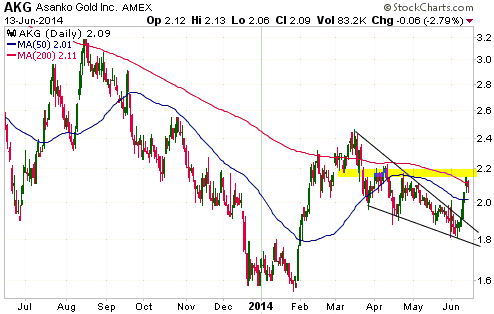
2. AKG's recent close above US$2.00 was an early warning that its correction is
over. A break above US$2.20 would be more conclusive evidence.
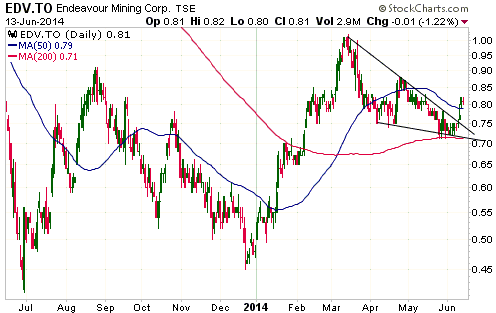
3. EDV.TO has been a relatively strong gold stock since the beginning of this
year (actually, EDV's relative strength began almost 12 months ago). It signaled
that its correction is probably over when it closed above C$0.80 last Thursday.
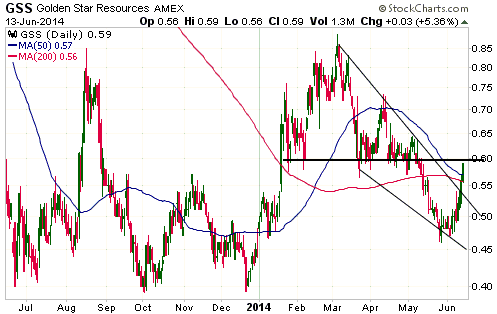
4. GSS does not have a viable business at the current gold price (we estimate
that GSS would need an average gold price of at least $1350/oz to be
profitable), but there are preliminary signs in the price action that it has
completed its correction. A daily close above US$0.60 would be a more definitive
sign.
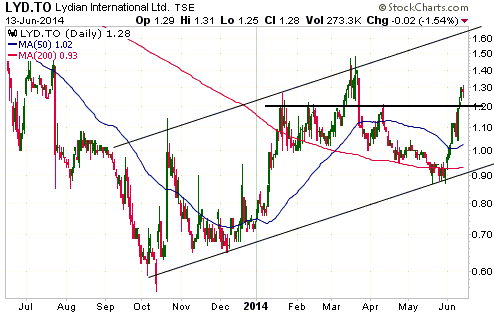
5. LYD.TO has been very strong over the past three weeks and is now short-term
'overbought'. We would hold off on new buying pending the results of the Amulsar
project's updated FS.
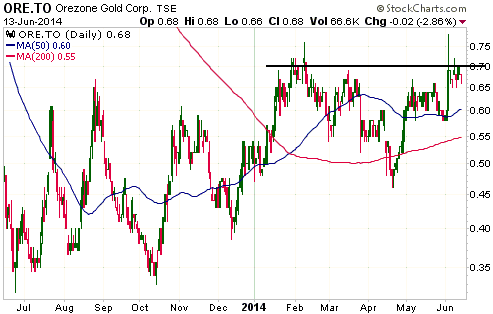
6. ORE.TO completed its correction back in April and is now testing resistance
defined by its highs of the year. A break above C$0.70 would create a short-term
target of around C$1.00.
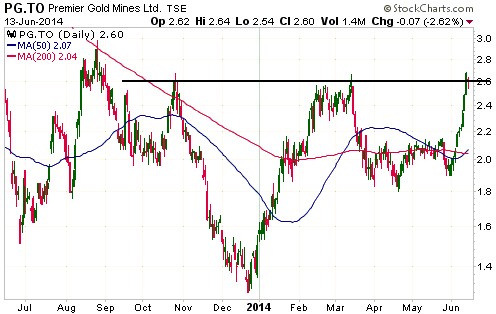
7. PG.TO completed its correction back in April and rocketed up to
intermediate-term resistance last week. It is now 'overbought' and is no longer
a good candidate for new buying, but the stock's intermediate-term risk/reward
is still attractive.
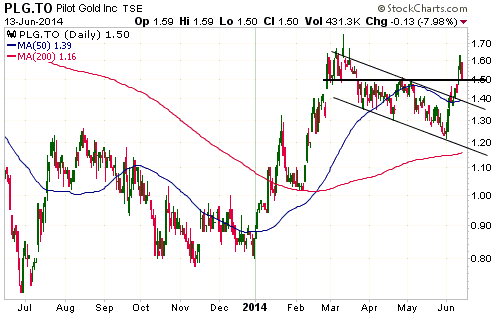
8. Last week's break above C$1.50 signaled an end to PLG.TO's correction. C$2.00
looks like a realistic short-term target, but some consolidation around C$1.50
could precede the next meaningful rise.
9. TGM.V signaled an end to its correction a couple of weeks ago, but it has run
into a wall of supply in the low-C$0.40s. Our short-term target is C$0.50.
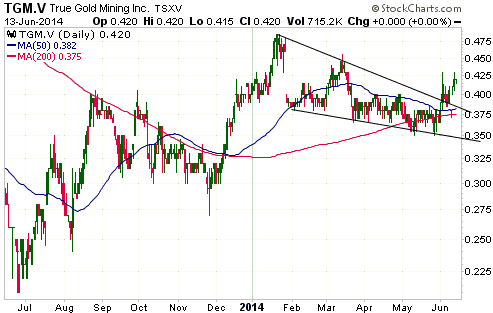
Chart Sources
Charts appearing in today's commentary
are courtesy of:
http://stockcharts.com/index.html

|









