|
-- Weekly Market Update for the Week Commencing 17th February 2014
Big Picture
View
Here is a summary of our big picture
view of the markets. Note that our short-term views may differ from our
big picture view.
In nominal dollar terms, the BULL market in US Treasury Bonds
that began in the early 1980s ended in 2012. In real (gold)
terms, bonds commenced a secular BEAR market in 2001 that will continue
until 2018-2020. (Last
update: 20 January 2014)
The stock market, as represented by the S&P500 Index,
commenced
a secular BEAR market during the first quarter of 2000, where "secular
bear market" is defined as a long-term downward trend in valuations
(P/E ratios, etc.) and gold-denominated prices. This secular trend will bottom sometime between 2014 and 2020.
(Last update: 22 October 2007)
A secular BEAR market in the Dollar
began during the final quarter of 2000 and ended in July of 2008. This
secular bear market will be followed by a multi-year period of range
trading.
(Last
update: 09 February 2009)
Gold commenced a
secular bull market relative to all fiat currencies, the CRB Index,
bonds and most stock market indices during 1999-2001.
This secular trend will peak sometime between 2014 and 2020.
(Last update: 22 October 2007)
Commodities,
as represented by the Continuous Commodity Index (CCI), commenced a
secular BULL market in 2001 in nominal dollar terms. The first major
upward leg in this bull market ended during the first half of 2008, but
a long-term peak won't occur until 2014-2020. In real (gold) terms,
commodities commenced a secular BEAR market in 2001 that will continue
until 2014-2020.
(Last
update: 09 February 2009)
Copyright
Reminder
The commentaries that appear at TSI
may not be distributed, in full or in part, without our written permission.
In particular, please note that the posting of extracts from TSI commentaries
at other web sites or providing links to TSI commentaries at other web
sites (for example, at discussion boards) without our written permission
is prohibited.
We reserve the right to immediately
terminate the subscription of any TSI subscriber who distributes the TSI
commentaries without our written permission.
Outlook Summary
Market
|
Short-Term
(1-3 month)
|
Intermediate-Term
(6-12 month)
|
Long-Term
(2-5 Year)
|
|
Gold
|
Bullish
(13-Jan-14) |
Bullish
(26-Mar-12) |
Bullish
|
|
US$ (Dollar Index)
|
Neutral
(13-Jan-14) |
Bearish
(27-Jan-14) |
Neutral
(19-Sep-07) |
|
Bonds (US T-Bond)
|
Bullish
(11-Dec-13)
|
Neutral
(18-Jan-12)
|
Bearish |
|
Stock Market
(DJW)
|
Bearish
(13-Jan-14)
|
Bearish
(28-Nov-11) |
Bearish
|
|
Gold Stocks
(HUI)
|
Neutral
(17-Feb-14) |
Bullish
(23-Jun-10) |
Bullish
|
|
Oil |
Neutral
(30-Jul-12) |
Neutral
(31-Jan-11) |
Bullish
|
|
Industrial Metals
(GYX)
|
Neutral
(17-Feb-14) |
Neutral
(06-Jan-14) |
Neutral
(11-Jan-10) |
Notes:
1. In those cases where we have been able to identify the commentary in
which the most recent outlook change occurred we've put the date of the
commentary below the current outlook.
2. "Neutral", in the above table, means that we either don't have a
firm opinion or that we think risk and reward are roughly in balance with respect to the timeframe in question.
3. Long-term views are determined almost completely by fundamentals,
intermediate-term views by
fundamentals, sentiment and technicals, and short-term views by sentiment and
technicals.
Economics Myths
Our original intention was to explain where
we agreed and disagreed with the article by Cullen Roche at "Pragmatic
Capitalism" (is there any other kind of capitalism?) titled "The
Biggest Myths in Economics". Instead, while we are still going to refer
extensively to the Roche article we will do so within the context of our own
list of economics myths. We would have preferred to have kept our list to ten
items, but it was a challenge just to restrict it to eleven. Unfortunately, our
list is by no means comprehensive.
Myth #1: Banks "lend reserves"
This is the second myth in the Roche article. He is 100% correct when he states:
"...banks don't make lending decisions based on the quantity of reserves they
hold. Banks lend to creditworthy customers who have demand for loans. If there's
no demand for loans it really doesn't matter whether the bank wants to make
loans. Not that it could "lend out" its reserve anyhow. Reserves are held in the
interbank system. The only place reserves go is to other banks. In other words,
reserves don't leave the banking system so the entire concept of the money
multiplier and banks "lending reserves" is misleading."
Any analyst who takes a cursory look at historical US bank lending and reserves
data will see that there has been no relationship between bank lending and bank
reserves for at least the past few decades. We live in hope that the economics
textbooks will eventually be updated to reflect this reality, although compared
to some of the other errors in the typical economics textbook, this one is
minor.
Myth #2: The Fed's QE boosts bank reserves, but doesn't boost the money
supply
We've dealt with this myth at length in previous commentaries. Anyone who
believes that the Fed's QE adds to bank reserves but not the money supply does
not understand the mechanics of the asset monetisation process. It's a fact that
for every dollar of assets purchased by the Fed as part of its QE, one dollar is
added to bank reserves at the Fed and one dollar is added to demand deposits
within the economy (the demand deposits of the securities dealers that sell the
assets to the Fed).
A related myth is that the Fed is powerless to expand the money supply if the
commercial banks aren't expanding their loan books. It is certainly the case
that prior to 2008 almost all new money was loaned into existence by commercial
banks, but this wasn't because the Fed didn't have the ability to directly
expand the money supply. From the Fed's perspective, there was simply no reason
to use its direct money-creation ability prior to September of 2008.
In order to maintain the false belief that US monetary inflation requires
commercial bank credit expansion an analyst must not only be unaware of QE
mechanics, he must also ignore the readily available monetary and credit data.
As evidence we point out that from the end of August-2008 through to the end of
January-2014 the US money supply (the sum of physical currency in circulation
plus bank demand deposits plus bank savings deposits) increased by about $4.4T
and commercial bank credit increased by about $1.1T, leaving about $3.3T of new
money that cannot be explained by commercial bank expansion. Not coincidentally,
over the same period the Fed monetised about $3.3T of securities via its various
QE programs.
Myth #3: The US government is running out of money and must pay back the
national debt
This is the third myth in the Roche article. The reality is that no government
will ever run short of money as long as its spending and debt are denominated in
a currency it can create, either directly or indirectly (via a central bank).
The lack of any normal financial limit on the extent of government spending and
borrowing is a very bad thing.
Myth #4: The federal debt is a bill that each citizen is liable for
This is similar to the fourth myth in the Roche article, although the Roche
explanation contains statements that are either misleading or wrong. Before we
take issue with one of these statements, we note that a popular scare tactic is
to divide the total government debt by the population to come up with a figure
that supposedly represents a liability of every man, woman and child in the
country. For example, according to
http://www.usdebtclock.org/ the US Federal debt amounts to about $55,000 per
citizen or $150,000 per taxpayer. For most people this is a lot of money, but it
doesn't make sense to look at the government debt in this way. Rightly or
wrongly, the government's debt will never be paid back. It will grow
indefinitely, or at least until it gets defaulted on. There are negative
indirect consequences of a large government debt, but it is wrong to think of
this debt as something that will have to be repaid by current citizens or future
citizens.
The Roche statement that we take issue with is: "...the government doesn't
necessarily reduce our children's living standards by issuing debt. In fact, the
national debt is also a big chunk of the private sector's savings so these
assets are, in a big way, a private sector benefit."
The government doesn't create wealth and therefore cannot possibly create real
savings. To put it another way, real savings cannot be created out of thin air
by the issuing of government debt. What happens when the government issues debt
is that savings are diverted from the private sector to the government. In any
single instance the government will not necessarily use the savings less
efficiently than they would have been used by the private sector, but logic and
a veritable mountain of history tells us that, on average, government spending
is less productive than private-sector spending. In fact, government spending is
often COUNTER-productive.
Myth #5: QE is not inflationary
Our fifth myth is the opposite of Cullen Roche's fifth myth. According to Roche,
it's a myth that QE is inflationary. His argument:
"Quantitative Easing (QE) ... involves the Fed expanding its balance sheet in
order to alter the composition of the private sector's balance sheet. This means
the Fed is creating new money and buying private sector assets like MBS or
T-bonds. When the Fed buys these assets it is technically "printing" new money,
but it is also effectively "unprinting" the T-bond or MBS from the private
sector. When people call QE "money printing" they imply that there is magically
more money in the private sector which will chase more goods which will lead to
higher inflation. But since QE doesn't change the private sector's net worth
(because it's a simple swap) the operation is actually a lot more like changing
a savings account into a checking account. This isn't "money printing" in the
sense that some imply."
There is a lot wrong with this argument. For starters, in one sentence he says "when
people call QE "money printing" they imply that there is magically more money in
the private sector", and yet in the preceding sentence he states that the
Fed adds new money to the economy when it purchases assets. So, there is no need
for anyone to imply that there is "magically more money" as a result of QE,
because, as Mr. Roche himself admits, the supply of money really does increase
as a result of QE. (As an aside, recall that in the previous myth Mr. Roche
implied that the government could magically increase the private sector's
savings by going further into debt.)
The instant after the Fed monetises some of the private sector's assets there
will be more money, the same quantity of goods and less assets in the economy.
Until the laws of supply and demand are repealed this will definitely have an
inflationary effect, because there will now be more money 'chasing' the same
quantity of goods and a smaller quantity of assets. However, the details of the
effect will be impossible to predict, because the details will depend on how the
new money is used. We can be confident that the initial effect of the new money
will be to elevate the prices of the sorts of assets that were bought by the
Fed, but what happens after that will depend on what the first receivers of the
new money (the sellers of assets to the Fed) do, and then on what the second
receivers of the new money do, and so on. It's a high-probability bet that the
new money will eventually work its way through the economy and lead to the sort
of "price inflation" that the average economist worries about, but this could be
many years down the track. This type of "price inflation" problem hasn't emerged
yet and probably won't emerge this year, but the price-related effects of the
Fed's QE should be blatantly obvious to any rational observer. One of the most
obvious is that despite being 6 years into a so-called "great de-leveraging",
the S&P500 recently traded 17% above its 2007 peak.
Myth #6: Hyperinflation can be caused by factors unrelated to money
This is almost the opposite of Roche's sixth myth. He argues that hyperinflation
is not caused by "money printing", but is, instead, caused by events such as the
collapse of production, the loss of a war, and regime change or collapse.
While the events mentioned by Cullen Roche tend to precede hyperinflation, they
only do so when they prompt a huge increase in the money supply. To put it
another way, if these events do not lead to a huge increase in the money supply
then they will not be followed by hyperinflation.
The fact is that hyperinflation requires both a large increase in the supply of
money and a large decline in the desire to hold money. Over the past several
years there has been a large increase in the US money supply, although certainly
not large enough to cause hyperinflation, along with an increase in the desire
to hold money that has partially offset the supply increase.
Myth #7: Increased government spending and borrowing drives up interest rates
This is almost the same as Roche's seventh myth. An increase in government
spending and borrowing makes the economy less efficient and causes long-term
economic progress to be slower than it would have been, but it doesn't
necessarily drive up the yields on government bonds. This is especially so
during periods when deep-pocketed price-insensitive bond buyers such as the Fed
and other central banks are very active in the market.
Myth #8: The Fed provides a net benefit to the US economy
It never ceases to amaze us that people who understand that it would make no
sense to have central planners setting the price of eggs believe that it is a
good idea to have central planners setting the price of credit.
The real reason for the Fed's creation is of secondary importance. No conspiracy
theory is required, because the fact is that even if the Fed were established
with the best of intentions and even if it were managed by knowledgeable people
with the best of intentions, it would be a bad idea. This is because the Fed
falsifies the price signals that guide business and other investing decisions.
Myth #9: Different economic theories are needed in different circumstances
The myth that different times call for different economic theories, for example,
that the valid theories of normal times must be discarded and replaced with
other theories during economic depressions, has been popularised by Paul Krugman.
However, he has only gone down this track because he is in the business of
promoting an illogical theory.
A good economic theory will work, that is, it will explain why things happened
the way they did and provide generally correct guidance about the likely future
direct and indirect effects of current actions, under all circumstances. It will
work for an individual on a desert island, it will work in a rural village and
it will work in a bustling metropolis. It will work during periods of strong
economic growth and it will work during depressions.
Myth #10: The economy is driven by changes in aggregate demand
This and the next myth are related and are the most destructive myths in our
list. The notion that the economy is driven by changes in aggregate demand, with
recessions/depressions caused by mysterious declines in aggregate demand and
periods of strong growth caused by equally mysterious increases in aggregate
demand, is the basis of the Keynesian religion and the justification for
countless counter-productive monetary and fiscal policies.
Changes in aggregate demand are effects, not causes, of economic growth. More
specifically, an increase in consumption is at the end of a three-step sequence
that has as its first two steps an increase in saving/investment and an increase
in production. For an increase in consumption to be sustainable it MUST be
funded by an increase in production. By the same token, an artificial boost in
consumption (demand) caused by monetary and/or fiscal stimulus will be both
unsustainable and wasteful. It is like eating the seed corn -- it helps satisfy
hunger in the short-term, but ultimately results in less food.
A related point is that there has never been "insufficient aggregate demand" and
there never will be "insufficient aggregate demand", at least not until everyone
has everything they want. In the real world, the ability to demand/consume is
limited only by the ability to produce the right things. Consequently, what is
typically diagnosed as "insufficient aggregate demand" is actually insufficient
production, or, to put it more accurately, a production-consumption mismatch
resulting from the economy becoming geared-up to produce too many of some things
and not enough of others.
Myth #11: Consumer spending is about 70% of the US economy
Consumer spending involves taking something out of the economy, so it is
mathematically impossible for consumer spending to be more than 50% of the
economy. Consumer spending does account for about 70% of US GDP, but that's only
because the GDP calculation omits about half the economy (GDP leaves out all
intermediate stages of production). Due to the fact that the GDP calculation
includes 100% of consumer spending and only about half the total economy, 35%
would be a more accurate estimate of US consumer spending as a percentage of the
total US economy.
Industrial Metals Update
Our short-term Industrial Metals outlook has
shifted from "bullish" to "neutral" due to the risk that stock market weakness
will cause copper to break below support.The Stock
Market
The US Market
The NASDAQ100 Index (NDX) has broken above its January high, the S&P500 Index
(SPX) has moved up to within 1% of its January high, and several other important
US stock indices remain comfortably below their January highs. The NDX's new
high is therefore unconfirmed at this time.
If the SPX (see chart below) makes a new high this week it will add to the
similarity between the current situation and June-August of 2007, provided that
the new high is marginal and quickly followed by a downward reversal.
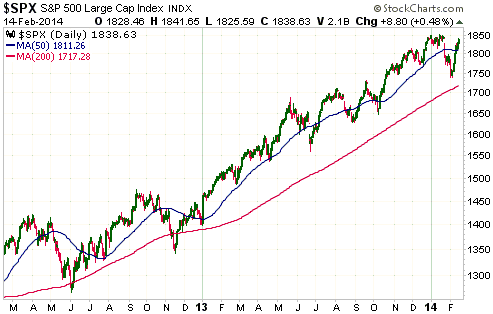
A clue as to what's in store for the US stock market will be the SPX's February
close. A February close below the January close (1783) would be a short-term and
an intermediate-term bearish omen.
The Emerging Markets
As a group, the emerging markets clearly offer better value than the US market.
However, due to obvious inflation problems in many "emerging" economies and the
performances of the related stock markets, emerging market equities, as
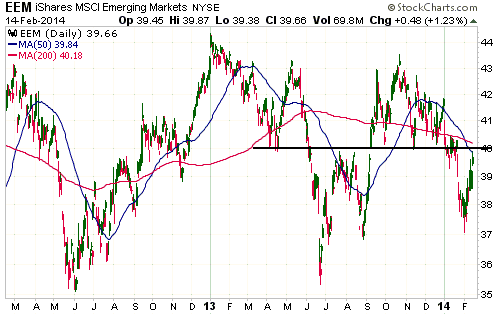
represented on the following daily chart by EEM, have greater short-term
downside potential than US equities.
EEM has rebounded to just below its breakdown level, which now roughly coincides
with its 50-day and 200-day moving averages. This is about as far as the rebound
should go IF it is a routine counter-trend move.
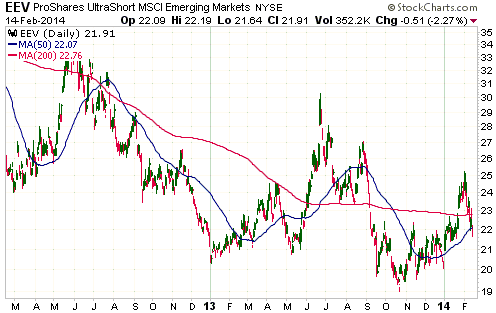
EEM's rebound to its breakdown level has prompted us to add EEV, a leveraged bet
against the emerging markets, to the TSI List as a short-term trading position.
We think that EEV has short-term upside potential in the 20%-40% range.
This trade will be exited at a loss if EEM achieves consecutive daily closes
above $40.20.
This week's
important US economic events
| Date |
Description |
| Monday Feb 17 |
US markets closed for public holiday | | Tuesday
Feb 18 |
Empire State Mfg Survey
TIC Report
Housing Market Index | | Wednesday
Feb 19 |
Housing Starts
PPI
FOMC Minutes | | Thursday
Feb 20 |
CPI
Philadelphia Fed Survey
Leading Economic Indicators
|
| Friday Feb 21 |
Existing Home Sales |
Gold and
the Dollar
Gold and Silver
Gold rallying in response to strong physical demand?
Whenever the gold price moves higher the standard response of most gold-bullish
newsletter writers and bloggers is to state something along the lines of: "Gold
is rallying in response to strong physical demand." According to these analysts,
strong physical demand is almost always the cause of a price rise, whereas the
selling of 'paper gold' is almost always the cause of a price decline. This type
of analysis is complete nonsense.
The demand for physical gold is always equal to the supply of physical gold,
with price being the variable that keeps the two in balance. Consequently, if
the price of gold has risen over a period then we know that during this period
there was an attempt by demand to increase relative to supply and that the price
had to rise to restore balance. This applies to physical gold and so-called
'paper gold'. Other than by referring to the price, there will never be any way
of knowing whether there was an attempt by demand to rise relative to supply or
an attempt by supply to rise relative to demand.
Based on price action, we know with 100% certainty that there was an attempt
over the past several weeks for gold demand to increase relative to gold supply
in both the physical market and the paper market. We also know that during 2013
there was an attempt by supply to increase relative to demand in both the
physical market and the paper market.
Claiming that the price is rising due to increasing demand relative to supply
is, at best, a statement of the bleeding obvious. However, many gold-market
commentators are delusional in that they not only believe it is possible to
determine the supply-demand situation without referring to price (by, for
example, measuring the flows of gold from one part of the market to another),
they also believe that it is possible for demand to increase relative to supply
in parallel with a FALLING price.
Current Market Situation
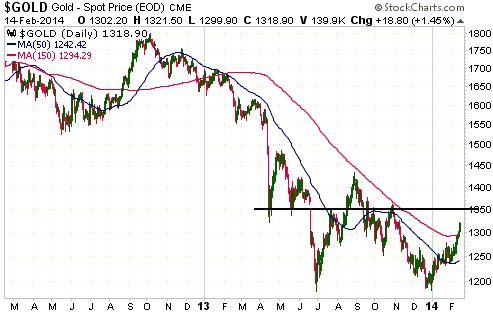
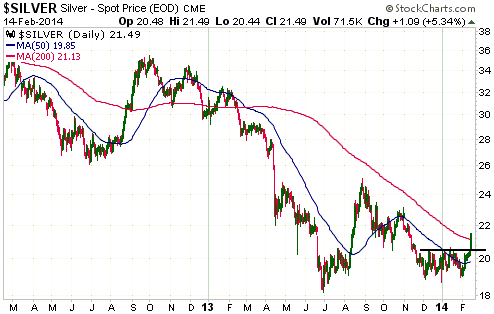
The evidence of a major trend reversal continues to pile up. For example, last
week the US$ gold price broke decisively above its 150-day MA (the red line on
the first of the following charts) and the US$ silver price blasted through
resistance at $20.50 (refer to the second of the following charts).
The next significant resistance for gold lies at $1350. We expect that this
resistance will be overcome within the first half of this year, but not within
the next few weeks. Furthermore, if gold moves up to test this resistance in the
near future the short-term downside risk will then be as high as the remaining
short-term upside potential. Our short-term gold outlook will therefore shift
from "bullish" to "neutral" if gold moves up to the $1340s within the next two
weeks.
Silver is likely to trade at least as high as $23 and could trade as high as
$24-$25 within the next three months. Silver also has the potential to trade as
high as $30 (but not significantly higher than that) before year-end.
Gold's recent performance relative to the US$ is interesting, but its recent
performance relative to some other commodities is even more interesting. Of
particular note:
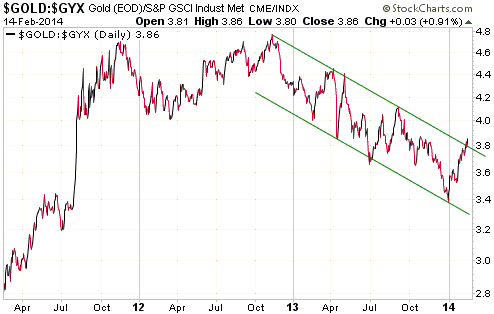
a) The gold/GYX ratio (gold relative to industrial metals) has just broken above
the top of a downward-sloping channel that began to form in October of 2012.
This is a bearish omen for the broad stock market.
b) The platinum/gold ratio has broken out to the downside, suggesting that
platinum peaked relative to gold early this year. We won't be surprised if the
early-2014 peak in the platinum/gold ratio is tested later this year in similar
fashion to this ratio's August-2012 test of its late-2011 bottom, but our guess
at this early stage is that an important trend reversal is in the works.
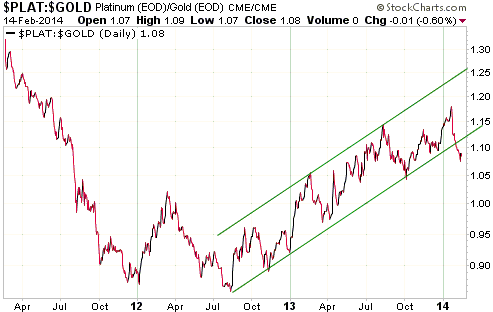
The recent breakouts in the gold/GYX and platinum/gold ratios reflect a decline
in economic confidence.
Gold Stocks
There is now considerable price-related evidence that the HUI (and the other
gold-stock indices and ETFs) made a major bottom at the end of last year. For
example, the current rally has differentiated itself from last year's short-term
counter-trend rebounds by decisively breaking above the 150-day moving average.
However, the obvious evidence of a major reversal has not created a short-term
buying opportunity (the short-term buying opportunity occurred at lower prices).
In fact, it has probably set the stage for a multi-week consolidation.
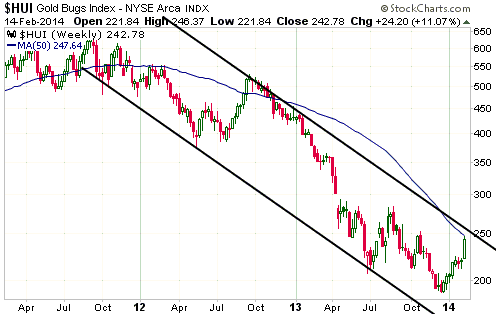
The next piece of the puzzle will come in the form of a weekly close above the
price channel drawn on the following weekly HUI chart. When it happens, such an
event will differentiate the current rally from the intermediate-term
counter-trend rebound that occurred in 2012. Note, though, that we won't be
confident in the position of the channel lines drawn on this chart until after
the next significant weekly decline or reversal. The reason is that the next
significant weekly decline/reversal should help define the channel top, which at
the moment could lie anywhere between 245 and 265.
The HUI, the XAU and GDXJ are now 'overbought' on a short-term basis, as are
many individual senior and junior gold-mining stocks. This certainly doesn't
preclude additional gains over the days ahead, but our guess is that even if the
HUI were to quickly gain another 5% it would subsequently trade below its
current price before resuming its upward trend.
Also worth mentioning is that the gold sector is now vulnerable to substantial
weakness in the broad stock market. Over the bulk of the past two years the HUI
and the SPX have trended in opposite directions. This inverse relationship will
likely continue on an intermediate-term basis, but the two indices are now
short-term 'overbought' together.
Further to the above, our short-term HUI outlook has shifted from "bullish" to
"neutral".
With a lot more evidence of a major reversal now in hand, in this week's Interim
Update we plan to take another look at how the gold sector fared following major
upward reversals in 1970, 1976 and 2000.
Currency Market Update
The currency market is ignoring bad news emanating from Europe. This is a sign
that the short-term path of least resistance is turning up for the euro and down
for the Dollar Index.
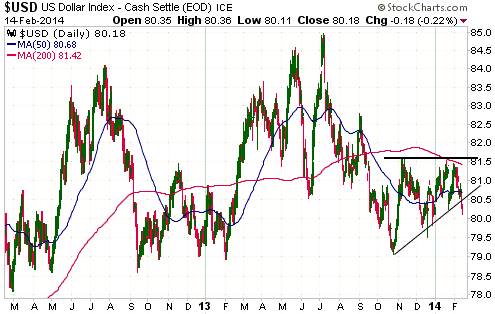
As illustrated below, the Dollar Index successfully tested resistance at around
81.5 during the week before last and broke below short-term trend-line support
last week. This is bearish price action, but we suspect that additional
near-term downside will be limited by support at 79.5. Also, the Dollar Index
could be supported over the next few weeks by a general 'flight to safety'
prompted by a declining stock market.
Updates
on Stock Selections
Notes: 1) To review the complete list of current TSI stock selections, logon at
http://www.speculative-investor.com/new/market_logon.asp
and then click on "Stock Selections" in the menu. When at the Stock
Selections page, click on a stock's symbol to bring-up an archive of
our comments on the stock in question. 2) The Small Stock Watch List is
located at http://www.speculative-investor.com/new/smallstockwatch.html
 Company
news/developments for the week ended Friday 14th February 2014: Company
news/developments for the week ended Friday 14th February 2014:
[Note: AISC = All-In Sustaining Cost, FS = Feasibility Study, IRR =
Internal Rate of Return, MD&A = Management Discussion and Analysis,
M&I = Measured and Indicated, NAV = Net Asset Value, NPV(X%) = Net
Present Value using a discount rate of X%, P&P = Proven and
Probable, PEA = Preliminary Economic Assessment, PFS =
Pre-Feasibility Study]
*Asanko Gold (AKG) issued a press release that indicated a change
in development plan for the company's Esaase and Obotan gold
projects in Ghana.
The previous development plan was explained as follows in the 17th
December press release that announced the merger with PMI Gold:
"Asanko intends to proceed with the development of the fully
financed Esaase gold project, with permits expected imminently. The
definitive feasibility study is nearing completion and is expected
to be released in early 2014 with the work on it thus far broadly
confirming the conclusions of the May, 2013, prefeasibility study.
The DFS envisages the commencement of construction in the first
quarter of 2014 and steady-state production of 200,000 ounces of
gold per year by the end of 2015.
Preliminary work has been carried out to investigate the various
options that are available for a more integrated development of the
Obotan and Esaase gold projects. Based on the initial findings, the
best approach is to first develop Esaase and then commence the
development of Obotan."
So, the previous plan was to first develop Esaase and then develop
Obotan.
The new plan announced last week is to develop an open-pit mining
operation that a) encompasses the Esaase and Obotan pits, and b) is
constructed in two phases, with the first phase involving the
construction of processing facilities and a mine at Obotan. It is
envisaged that the first phase will begin construction during the
second or third quarters of this year and will result in a
production rate of 200K ounces/year in 2016. The second phase
involves increasing the production rate via the construction of a
mine at Esaase and will commence after the first phase is finished.
As we understand it, the plan is for the Esaase ore to be
transported 20-30kms to the processing facilities at Obotan.
The development plan will apparently be finalised following the
completion of economic analyses in the second quarter of this year.
Although the change advised by AKG last week seems logical, sudden
changes in plans always make us suspicious. We always wonder: What
aren't they telling us?
In this case, perhaps what they aren't telling us is that it makes
no sense to start construction of the Esaase mine in the near future
(as per the previous plan) because the studies completed to date
indicate that the Esaase mine would not be economically viable at
the current gold price. The Obotan mine, however, would be economic
at the current gold price, assuming that the figures included in the
FS published in late-2012 are still applicable. For this reason we
were surprised by the plan outlined in the December-2013 press
release (the one that involved developing Esaase first).
*Golden Star Resources (GSS) reported its reserve and resource
estimates as at 31st December 2013.
Due to a lower gold price assumption, many gold producers have
reported or will be reporting lower reserves. The reason is that
some of the in-ground resources that would be economic to extract
and could therefore be classified as "reserves" at the gold price
that most producers would have assumed in their calculations at the
end of 2012, are not economic near the current gold price. To put it
another way: the gold is still there, but in order to be classified
as a "reserve" there must be a reasonable expectation that it could
be profitably extracted.
In GSS's case the effects of the lower gold price assumption
($1300/oz at the end of 2013 versus $1450/oz at the end of 2012) and
mining depletion were partially offset by reserves added through
exploration success at the Wassa project. The net effect was an 8%
reduction in P&P reserves -- from 4.31M ounces to 3.95M ounces. This
is obviously not good, but it certainly isn't unexpected and doesn't
significantly reduce GSS's speculative merit.
*Ramelius Resources (RMS.AX) advised that its Mt Magnet processing
plant was back to operating at 100% capacity. It had been operating
at approximately 85% capacity due to the failure of the ball-mill
motor last November and the temporary use of a smaller motor.
On a short-term basis, RMS is more interesting now than it has been
for many months. This is due to the return to 100% capacity at the
Mt Magnet mine, the upside breakout in the gold price, and the
potential for a catch-up move.
*Sabina Gold and Silver (SBB.TO) advised that it has received
notice from the relevant government agency that the Back River draft
environmental impact statement (DEIS) conforms to the environmental
assessment guidelines and that the technical review process has
begun.
Environmental permitting for a project like Back River is a long and
arduous process. The technical review will extend into the second
half of this year and will be followed by technical meetings. The
results of the review and the meetings will then be used in the
preparation of the final environmental impact statement (FEIS).
SBB also advised that an updated Back River resource estimate should
be available before the end of this month. This will be the next
news of significance for SBB.
List
of candidates for new buying
From within the ranks of TSI stock selections, the best candidates for new
buying at this time are:
1) LYD.TO in the low-C$1 area (last Friday's closing price: C$1.17). LYD's
latest equity financing is scheduled to close on Tuesday 18th Feb, thus removing
a source of downward pressure on the stock.
2) SBB.TO at around C$0.90 (last Friday's closing price: A$0.95).
Profit-taking
ideas
All of the gold-silver stocks in the TSI Stocks List remain very under-valued
and are likely to trade at much higher prices later this year, but good
money-management practice involves taking some money out of the market following
quick and large percentage gains (and putting some money back into the market
following meaningful pullbacks). How much is sold and which stocks are sold by
an individual should largely be determined by that individual's current exposure
and financial situation, so all we can do is provide ideas as to where it could
make sense to reduce exposure to particular stocks. Here are some ideas:
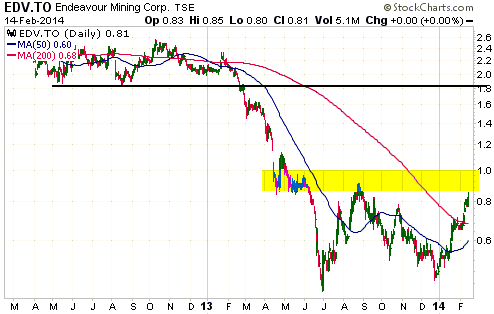
1) Endeavour Mining (EDV) has intermediate-term resistance at C$0.85-$1.00,
after which there is no chart-related resistance until the C$1.80s. Depending on
current exposure, it could make sense to do a small amount of selling within the
lower resistance range.
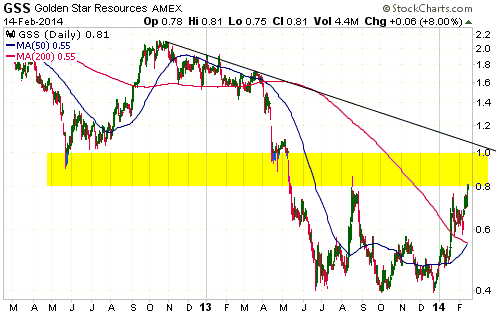
2) Golden Star Resources (GSS) has a wide range of intermediate-term resistance
at US$0.80-$1.00. It could be appropriate to 'take some money off the table'
within this range.
3) Premier Gold (PG) broke upward from a 2-year price channel last week, which
prompted a quick rise to resistance at C$2.50. There is also resistance at
C$3.00, C$3.50 and then C$4.00. It would be reasonable to make a partial exit in
the C$3.00-$3.50 range, or perhaps just below this range, if the stock surges to
this price region within the next couple of weeks.

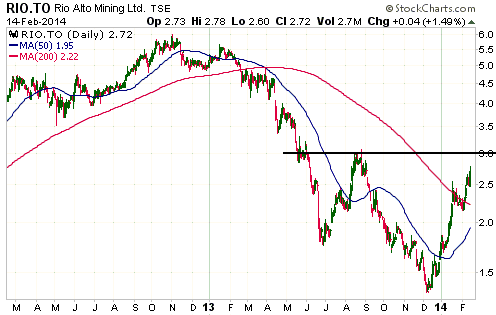
4) Rio Alto (RIO.TO / RIOM) has resistance at C$3.00. With gold now above $1300
fair value for this stock is north of C$5, but depending on current exposure it
could make sense to 'take some money off the table' near C$3.00 if an
opportunity to do so arises within the next couple of weeks.
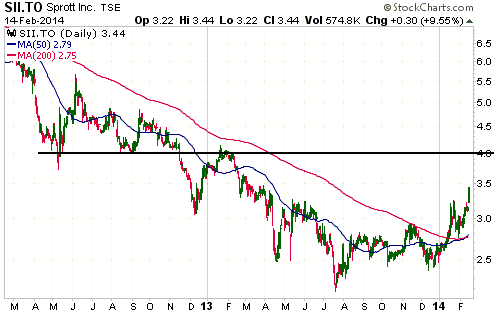
5) Sprott Inc. (SII.TO) has major resistance at C$4.00. Some selling would be
appropriate if this resistance is approached over the weeks immediately ahead.
Note: Just as it is a mistake to buy too much too soon during a decline, it is a
mistake to sell too much too soon during a rally. Of course, it is only with the
benefit of hindsight that you know for sure what constitutes "too much" and "too
soon", but the way to deal with the uncertainty is to gradually scale in and
scale out.
We think that the gold sector is now 6-7 weeks into a cyclical bull market that
will last 3-5 years, so we don't perceive any urgency to sell anything
gold-related or silver-related at this time. However, it is a lot easier to
'ride' a bull market if you do some selling into the periodic surges and some
buying into the periodic purges.
We did a bit of selling within the gold sector late last week and will do a bit
more selling if the surge continues over the days ahead.
Updates
on short-term TSI trading positions
For TSI record purposes, we will do the following:
1) Immediately exit the short-term trading position in AKG using Friday's
closing price of US$2.24 for record purposes. This decision is solely based on
the stock's quick rise to its 200-day MA. The result is a profit of 34.1%.
2) Exit the short-term trading position in EDV.TO if the stock trades at C$0.93.
The current price is C$0.81.
3) Exit the short-term trading position in EVN.AX if the stock trades at A$0.96.
The current price is A$0.83.
4) Exit the short-term trading position in GFI if the stock trades at US$4.60
($4.60 is a few percent below the 200-day MA). The current price is US$4.09.
5) Exit the short-term trading position in RIO.TO if the stock trades at C$2.90.
The current price is C$2.72.
6) Add a short-term trading position in Orezone Gold (ORE.TO) at Friday's
closing price of C$0.65. Here's a synopsis of the ORE story, including our
reasons for thinking it makes a good short-term speculation:
ORE owns the Bombore project, an exploration-stage gold project in Burkina Faso
with 4.6M ounces of M&I resources at an average grade of 1.01-g/t. The total
resource is really two deposits -- a near-surface 1.3M-ounce deposit suitable
for heap-leach (HL) mining and a larger/deeper sulphide deposit that would have
to be mined via a different method (perhaps carbon in leach (CIL)). The sulphide
deposit has option value, but is probably not economic at the current gold
price. However, a recently completed PEA indicates that the HL-amenable deposit
could, for a capital cost of about $180M, be developed into a profitable
120K-oz/yr mine at a gold price of $1250/oz. Specifically, the PEA estimated
that at $1250/oz the HL mine would have an IRR and NPV(5%) of 23.9% and US$159M,
resp. These are better-than-average economics.
ORE has 96M shares outstanding, so at its current price of C$0.65 its market cap
is about C$62M. It also has about $10M of cash, so its current enterprise value
is about $52M. The enterprise value is a long way below the estimated NPV of the
proposed HL mine, but ORE's valuation is in line with the valuations of many
other exploration-stage gold miners. Under-valuation is more the norm than the
exception at this time.
ORE's valuation is attractive, but not unusually so. What draws us to this stock
is the combination of attractive valuation and constructive price action. With
reference to the following chart, it looks like ORE completed an 8-month basing
pattern when it recently broke above C$0.60.
There is a risk that the stock will pull back as far as the low-C$0.50s before
resuming its advance, but the optimum place to take a trading position would be
in the low-C$0.60s (at or just above the breakout level). The chart pattern
suggests short-term upside potential to C$1.00-$1.20.

Chart Sources
Charts appearing in today's commentary
are courtesy of:
http://stockcharts.com/index.html

|









