|
-- Weekly Market Update for the Week Commencing 17th March 2014
Big Picture
View
Here is a summary of our big picture
view of the markets. Note that our short-term views may differ from our
big picture view.
In nominal dollar terms, the BULL market in US Treasury Bonds
that began in the early 1980s ended in 2012. In real (gold)
terms, bonds commenced a secular BEAR market in 2001 that will continue
until 2018-2020. (Last
update: 20 January 2014)
The stock market, as represented by the S&P500 Index,
commenced
a secular BEAR market during the first quarter of 2000, where "secular
bear market" is defined as a long-term downward trend in valuations
(P/E ratios, etc.) and gold-denominated prices. This secular trend will bottom sometime between 2014 and 2020.
(Last update: 22 October 2007)
A secular BEAR market in the Dollar
began during the final quarter of 2000 and ended in July of 2008. This
secular bear market will be followed by a multi-year period of range
trading.
(Last
update: 09 February 2009)
Gold commenced a
secular bull market relative to all fiat currencies, the CRB Index,
bonds and most stock market indices during 1999-2001.
This secular trend will peak sometime between 2014 and 2020.
(Last update: 22 October 2007)
Commodities,
as represented by the Continuous Commodity Index (CCI), commenced a
secular BULL market in 2001 in nominal dollar terms. The first major
upward leg in this bull market ended during the first half of 2008, but
a long-term peak won't occur until 2014-2020. In real (gold) terms,
commodities commenced a secular BEAR market in 2001 that will continue
until 2014-2020.
(Last
update: 09 February 2009)
Copyright
Reminder
The commentaries that appear at TSI
may not be distributed, in full or in part, without our written permission.
In particular, please note that the posting of extracts from TSI commentaries
at other web sites or providing links to TSI commentaries at other web
sites (for example, at discussion boards) without our written permission
is prohibited.
We reserve the right to immediately
terminate the subscription of any TSI subscriber who distributes the TSI
commentaries without our written permission.
Outlook Summary
Market
|
Short-Term
(1-3 month)
|
Intermediate-Term
(6-12 month)
|
Long-Term
(2-5 Year)
|
|
Gold
|
Neutral
(25-Feb-14) |
Bullish
(26-Mar-12) |
Bullish
|
|
US$ (Dollar Index)
|
Bearish
(05 Mar-14) |
Bearish
(27-Jan-14) |
Neutral
(19-Sep-07) |
|
Bonds (US T-Bond)
|
Bullish
(11-Dec-13)
|
Neutral
(18-Jan-12)
|
Bearish |
|
Stock Market
(DJW)
|
Neutral
(03-Mar-14)
|
Bearish
(28-Nov-11) |
Bearish
|
|
Gold Stocks
(HUI)
|
Bullish
(03-Mar-14) |
Bullish
(23-Jun-10) |
Bullish
|
|
Oil |
Bearish
(12-Mar-14) |
Neutral
(31-Jan-11) |
Bullish
|
|
Industrial Metals
(GYX)
|
Neutral
(17-Feb-14) |
Neutral
(06-Jan-14) |
Neutral
(11-Jan-10) |
Notes:
1. The date shown below the current outlook is when the most recent outlook change occurred.
2. "Neutral", in the above table, means that we either don't have a
firm opinion or that we think risk and reward are roughly in balance with respect to the timeframe in question.
3. Long-term views are determined almost completely by fundamentals,
intermediate-term views by
fundamentals, sentiment and technicals, and short-term views by sentiment and
technicals.
Economics Myths 12, 13 and
14
In the 17th February Weekly Update we
presented a list of eleven economics myths. We subsequently posted this
discussion as a
free
article, although in the free article we added a twelfth myth. Prompted by
some stuff we've recently read, we are now adding two more myths to our list.
Below are Myth #12 (for TSI subscribers who didn't read the free article) and
the two new additions to our list of economics myths.
Myth #12: Inflation is not a problem unless the CPI is rising quickly
The conventional wisdom that "inflation" is not a major concern unless the CPI
is rising quickly is not only wrong, it is also dangerous. It is wrong because
monetary inflation affects different prices in different ways at different
times, but the resultant price distortions always end up causing economic
problems. It is dangerous because it leads people to believe that there are no
serious adverse consequences of central-bank money printing during periods when
the prices included in the CPI are not among the prices that are being driven
skyward by money printing.
Myth #13: Interest rates are the price of money
People who comment on economics and the financial markets often say that the
interest rate is the price of money. For example, John Mauldin's 9th March
article titled "The
Problem With Keynesianism" has multiple references to interest rates being
the price of money. This is wrong.
The price of money is what money can buy. For example, if an apple is sold for
$1, then the price of a unit of money (one dollar) in that transaction is one
apple. To put it another way, the price of money is the purchasing power of
money. It rises and falls in response to changes in the supply of and the demand
for money and changes in the supply of and the demand for the things for which
money is traded.
The interest rate, on the other hand, can be correctly viewed as either the
price of credit or the price of time. In the case where there is no risk of
default and no risk of purchasing-power loss due to inflation, the interest rate
will be determined by the perceived benefit of getting money immediately versus
getting it at some future time.
In summary, although changes in one can affect the other, the interest rate and
the price of money are very different things.
Myth #14: Policymakers should try to boost employment and real wages
The conventional wisdom that policies should be put in place to boost employment
and real wages confuses cause and effect. Just as rising consumption is an
effect, not a cause, of economic growth (refer to Myth #11 in our Economics
Myths article), rising employment and real wages are effects of economic growth.
For example, the rebound in the US economy from its 2009 trough hasn't been
unusually weak due to the unusually slow recovery in employment, there has,
instead, been an unusually slow recovery in employment because there has not
been a strong recovery in the economy.
Consequently, the best way to get rising employment and real wages is to remove
the obstacles to economic progress. The government and the central bank are by
far the biggest obstacles, so minimising the government and eliminating the
central bank would be effective.
Ukraine
The Telegraph article linked
HERE discusses the extreme propaganda being fed to the Russian people
regarding the situation in Ukraine. Here's an excerpt:
"As Sunday's referendum, in which the people of Crimea will decide whether to
join Russia, approaches, the images on Russian television are astonishing. They
are more propagandistic and venomous than anything I can remember even from
Soviet times. Breathless presenters whip up hysteria with bloodcurdling stories
of atrocities being committed by the "neo-Nazi junta" now governing Ukraine.
Overheated "victims" beg Putin to help, kindly Russians offer to give refuge to
the terrified people fleeing Ukraine, and menacing music accompanies montages of
swastikas, fascist thugs armed with clubs, and black-and-white images of
Hitler's troops and burning villages."
The mainstream Western media is spewing out less-blatant, although still very
misleading, propaganda of its own. Senior politicians on all sides are jockeying
for position. They are attempting to concoct justifications for aggressive
responses and counter-responses, and the mainstream media are generally toeing
the political line.
Later today (Sunday 16th March) the people of Crimea will vote on whether or not
to become part of Russia. That they will vote "yes" to joining Russia is
apparently a near-certainty. Regardless of Vladimir Putin's real motivations,
why shouldn't the people of Crimea be allowed to join Russia if that's what they
want? According to the US government and its Western allies, it shouldn't be
allowed because it goes against Ukraine's Constitution. So let's get this
straight: According to the US government's actions, the US Constitution is just
a piece of paper that can be violated at will, but according to the US
government's words, the Ukrainian Constitution is sacrosanct.
If, as expected, the people of Crimea vote "yes" to joining Russia, it is also
expected that Russia will then quickly move to annex Crimea. Assuming that the
US and its Western allies make good on their threats, this will result in
sanctions against Russia. Given that sanctions of sufficient severity to
seriously damage Russia's economy would also seriously damage the economies of
Western Europe, it's a good bet that any sanctions will be the 'token' variety.
Our best guess at this time is that Crimea will become part of Russia and the
crisis will soon 'blow over' with minimal effect on the global economy. This
also appears to be the financial markets' best guess.
Uranium Update
Although the market for uranium (the
commodity) has flat-lined near multi-year lows since the third quarter of last
year, there has been considerable strength over the past few months in uranium
mining equities. This strength in the equities enabled URA, the Global X Uranium
ETF, to signal a major upward trend reversal by breaking decisively above its
50-week MA.
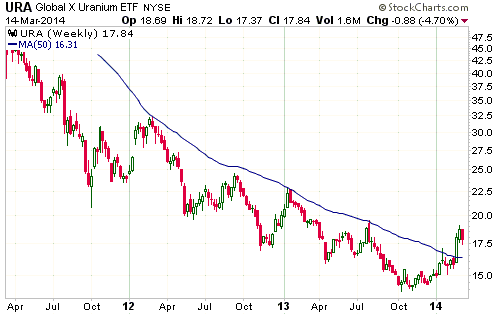
Obvious confirmations of trend reversals often don't constitute buy signals.
That's especially the case when the confirmation immediately follows a sharp
rise in price. The buy signal -- if there is such a thing -- is created by the
pullback to support that tends to get underway shortly after the obvious
confirmation.
In URA's case there was one week of additional upside following the obvious
confirmation of a trend reversal. A correction then began. The correction will
potentially take URA down to its 50-week moving average, which acted as
resistance during 2012-2013 and should now act as support. We would consequently
view a pullback to the mid-$16s as an opportunity for new buying.
The Stock
Market
We read that last week's decline in the
S&P500 Index (SPX) was its biggest in 7 weeks, but that's not saying very much
because there were no significant weekly declines over the preceding 7 weeks.
The SPX was down about 2% last week, which means that it is now about 2% below
its all-time high.
While the US stock market continues to shake-off all threats to its upward
trend, the upward trends in some other important stock markets have taken
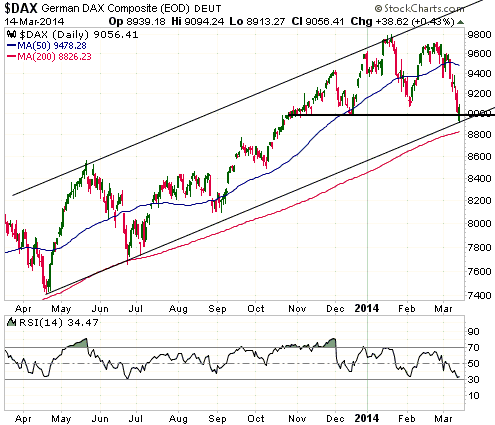
meaningful hits. Our first example is Germany's stock market. As illustrated by
the following daily chart, Germany's DAX Composite tested its intermediate-term
channel bottom and lateral support defined by its lows of the past 5 months last
Friday. It is short-term 'oversold' and has held support for now, but all it
would take to confirm an intermediate-term trend reversal is a weekly close
below last Friday's intra-day low.
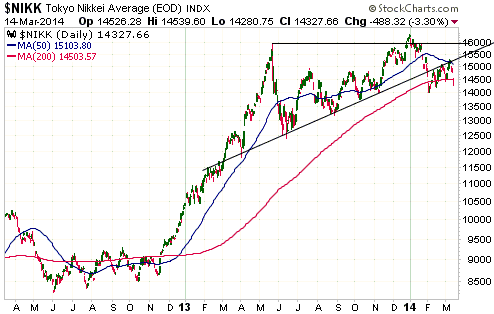
Our second example is Japan's stock market. As illustrated by the following
daily chart, Japan's Nikkei225 Index broke out to the downside in January and
appears to have just resumed its decline after rising for a few weeks in a
successful test of its breakout.
The Nikkei has support at 14,000 and then at 12,500.
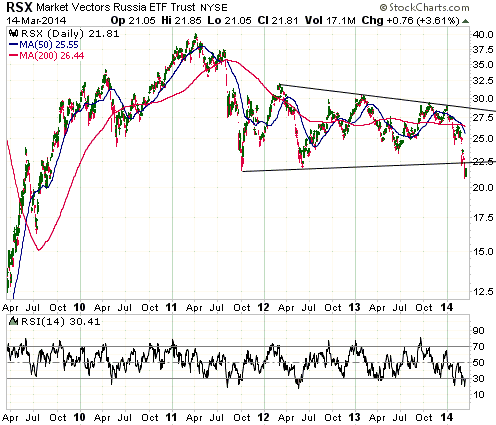
In response to current events, here is a daily chart showing the performance of
the Market Vectors Russia ETF (RSX). RSX has broken below major support, but,
interestingly, gained 3.6% last Friday despite the Ukraine-related uncertainty.
This rebound was probably a reaction to the ETF being very stretched to the
downside on a short-term basis.
At some point this year we will probably become interested in buying RSX, but
right now we are viewing it solely as an indicator of the seriousness of the
Ukraine conflict.
This week's
important US economic events
| Date |
Description |
| Monday Mar 17 |
Empire State Mfg Survey
TIC Report
Industrial Production
Housing Market Index | | Tuesday
Mar 18 |
CPI
Housing Starts | | Wednesday
Mar 19 |
FOMC Announcement and Yellen Press
Conference
Current Account Balance | | Thursday
Mar 20 |
Philadelphia Fed Survey
Existing Home Sales
Leading Economic Indicators
|
| Friday Mar 21 |
"Quadruple Witching" |
Gold and
the Dollar
Gold
That the gold market is short-term 'overbought' is obvious from a glance at the
following daily chart. No technical indicators are required. This simply means
that now is not a good time for new buying.
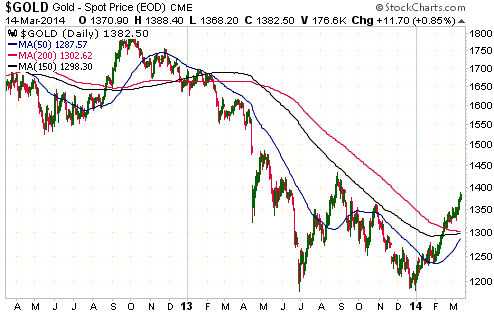
Although gold is sufficiently stretched to the upside on a short-term basis for
sensible gold bulls to temper their enthusiasm, it seems that almost every week
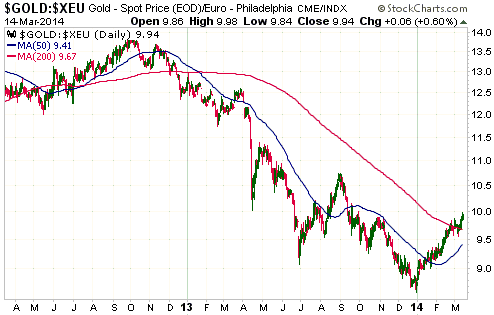
there is a new piece of evidence confirming December's major upward trend
reversal. Last week's addition to the pile of evidence was the clear break by
the euro-denominated gold price (gold/euro) above its 200-day MA. This further
differentiates the current rally from the counter-trend rebounds that happened
in 2013.
The biggest immediate threat to gold's short-term upward trend is the Ukraine
situation. The reason is covered in the following excerpts from the "Gold and
Military Conflict" discussion in the 5th March Interim Update:
"...there is often an increase in the speculative demand for gold in reaction
to international military conflict or the rising risk of international military
conflict, causing the gold price to quickly gain some ground. However, the price
gains made on the back of such developments are never sustained.
Buying gold in response to rising tensions between militarily-significant
governments is more akin to superstition than reasoned analysis. The fact is
that military action is only bullish for the US$ gold price to the extent that
the action results in either meaningful "inflation" or meaningful economic
weakness in the US and/or Europe, but even in these cases the initial rally will
be retraced."
And:
"It is possible...that the [Ukraine] conflict will escalate and the gold
price will surge in response. Just bear in mind that any price-surge in response
to news of this nature would likely be retraced in full."
Based on the historical record we can be confident that gold will fully retrace
any price gains made on the back of Ukraine fears. The problem is that there
will be no way of knowing how much of gold's rally is due to these fears,
because at the same time as gold is being artificially/temporarily boosted by
military-conflict superstition it is also being boosted by genuine fundamental
influences such as evidence of economic weakness. At this stage our best guess
is that the rise to around $1350 was underpinned by genuine fundamental drivers,
whereas the additional gains have been mostly due to the goings-on in the
Ukraine. In other words, we guess that there is presently no more than $30 of
military-conflict-related premium in the gold price. This is not enough to be
worried about, but if events in and around Ukraine conspire to push gold up to
the $1420s this week then the stage would be set for a significant multi-week
correction.
Gold Stocks
Updated historical comparisons
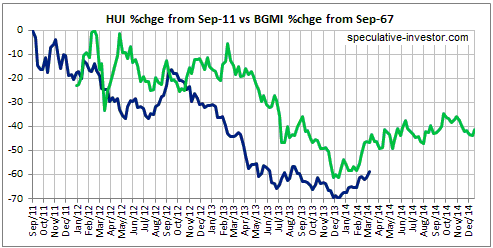
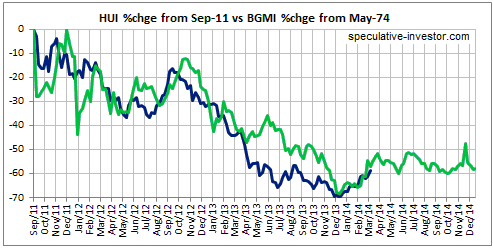
It's time to update our charts comparing the gold sector's current situation
with its situation following the large declines of 1968-1970, 1974-1976 and
1998-2000, using the Barrons Gold Mining Index (BGMI) to show performance during
the 1970s and the HUI to show the more recent performance.
First up, the BGMI's performance following the cyclical bottom of 1970 suggests
that the HUI's current advance will soon become more 'choppy' and that the bulk
of this year's gain will be in place by the end of June.
Next, the BGMI's performance following the cyclical bottom of 1974 suggests that
there will be a peak around the end of this month followed by a long period of
horizontal range-trading.
Lastly, the HUI's performance following the secular bottom of 2000 suggests that
there will be a multi-week pullback from a late-March short-term high followed
by a strong advance to an intermediate-term peak in June.
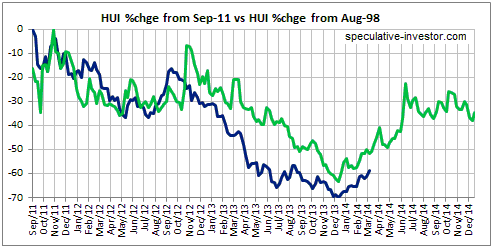
The historical record's overarching message is that the bulk of this year's
gains will be in place by the end of June, a message that is supported by the
relatively large number of equity financings arranged over the past two months.
Due to the upward trend in prices, many of the participants in financings during
January-March will take profits when the standard 4-month hold periods expire
during May-July. This additional supply will put downward pressure on prices.
Current Market Situation
It might seem as though the gold-stock indices reacted anemically to last week's
break above $1350 in the gold price, but significant upward progress was made in
that last week's gain was sufficient to break the HUI above the top of its
long-term downward-sloping price channel. Refer to the following weekly chart
for details.
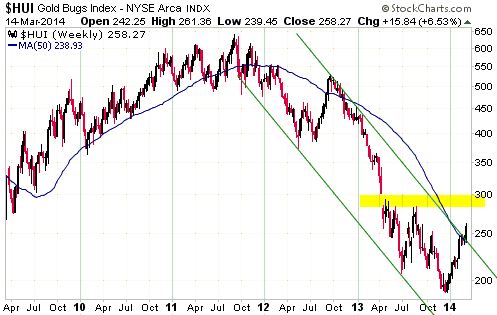
It will make sense to be a little more aggressive about selling gold stocks when
the HUI gets to resistance in the 280-300 range. It will get there -- the only
unknown is whether it will get there within the next two weeks as part of a
Ukraine- and China-inspired flight to safety or 1-2 months from now as part of a
more orderly advance.
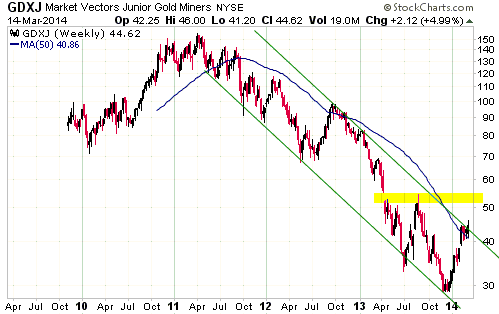
HUI resistance at 280-300 is equivalent to resistance in the low-$50s for the
Junior Gold Miners ETF (GDXJ). GDXJ under-performed last week and was unable to
break above its channel top (refer to the weekly chart displayed below). This
indicates that the modest increase in risk aversion that affected many financial
markets last week also affected the market for gold-mining stocks (the
higher-risk gold-mining stocks were relatively weak).
The Currency Market
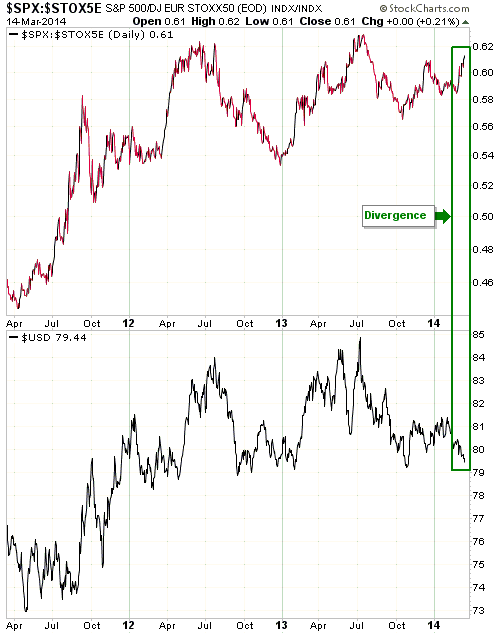
The following chart shows that over the past few years the Dollar Index has
usually trended in the same direction as the SPX/STOX5E ratio (the ratio of
large-cap US equities to large-cap European equities). It also shows that a
divergence from the normal relationship has recently occurred, with the US$
weakening even though US equities were relatively good performers.
This divergence could be related to the brewing conflict involving Ukraine,
Russia and the West, but whatever its cause an implication is that the Dollar
Index probably won't make a sustained break below 79 in the near future
(although a spike below 79 would not be surprising).
Updates
on Stock Selections
Notes: 1) To review the complete list of current TSI stock selections, logon at
http://www.speculative-investor.com/new/market_logon.asp
and then click on "Stock Selections" in the menu. When at the Stock
Selections page, click on a stock's symbol to bring-up an archive of
our comments on the stock in question. 2) The Small Stock Watch List is
located at http://www.speculative-investor.com/new/smallstockwatch.html
 Company
news/developments for the week ended Friday 14th March 2014: Company
news/developments for the week ended Friday 14th March 2014:
[Note: AISC = All-In Sustaining Cost, FS = Feasibility Study, IRR =
Internal Rate of Return, MD&A = Management Discussion and Analysis,
M&I = Measured and Indicated, NAV = Net Asset Value, NPV(X%) = Net
Present Value using a discount rate of X%, P&P = Proven and
Probable, PEA = Preliminary Economic Assessment, PFS =
Pre-Feasibility Study]
*Asanko Gold (AKG) issued its mandatory annual reports for 2013.
The financial statements indicate that the company ended the year
with working capital of around $170M, which is $10M less than we
were expecting thanks to greater-than-expected spending on project
development.
Due to the recently-completed merger with PMI Gold, AKG's current
balance sheet is now very different from the balance sheet included
in the aforementioned reports. We will therefore have to wait for
the Q1-2014 reports to get a clear picture of the company's current
financial situation.
Construction of Phase 1 of the Asanko Gold Mine is scheduled to
begin in Q3-2014. Phase 1 is expected to result in annual production
of 200K ounces in 2016. It is fully permitted and involves the
development of an open-pit mine and processing facilities at the
Obotan project contributed by PMI Gold.
*Dragon Mining (DRA.AX) reported updated resource estimates for
its projects in Finland and Sweden. Here's a summary of the updated
gold resource:
a) At the Vammala Production Centre (Finland), the resource now
contains 263K ounces in the M&I category and 97K ounces in the
Inferred category (down 18% since the preceding estimate).
b) At the Svartliden Production Centre (Sweden), the resource now
contains 45K ounces in the M&I category and 6K ounces in the
Inferred category (down about 60% since the preceding estimate).
c) At the Kuusamo project (Finland), the resource now contains 315K
ounces in the M&I category and 192K ounces in the Inferred category
(up 10% since the preceding estimate).
Overall, there was a small decline due to mining depletion and more
stringent grade assumptions.
*Pilot Gold (PLG.TO) reported additional drilling results from the
Western Flank target at its Kinsley Mountain gold project in Nevada.
Just to set the scene, last November PLG reported an exceptional
intercept of 8.53 g/t gold over 36.6 metres from Hole PK91CA drilled
into the Western Flank target. This intercept was preliminary,
albeit significant, evidence that the company was onto something
special. More evidence came via an exceptional intercept of 6.85 g/t
Au over 41.7 metres from Hole PK127C reported last month.
Still more evidence that PLG is onto something special (a
multi-million-ounce gold deposit with good continuity and high
grades over substantial widths) came last week with the reporting of
two additional spectacular intercepts: 10.5 g/t Au over 42.7 metres
in Hole PK131C (the best hole ever drilled at Kinsley) and 7.53 g/t
Au over 53.3 metres in Hole PK132C. There is still a long way to go,
but the evidence is now well beyond preliminary. Actually, PLG's
Kinsley Mountain discovery is showing signs of being one of the best
gold discoveries of the past few years.
On the back of the three Kinsley Mountain drill holes reported over
the past few weeks, PLG's stock price has gained about 20%. On the
back of the same drilling news the stock price of Nevada Sunrise
Gold (NEV.V), PLG's minority partner at Kinsley Mountain with a 21%
stake in the project, has gained about 300%. The leverage offered by
NEV to successful drilling at Kinsley Mountain is why we highlighted
this illiquid microcap's speculative appeal and added it to the TSI
Small Stocks Watch List in early February when it was trading at
C$0.17.
In other PLG news, the company announced that it is topping up its
treasury via a $20M "bought deal" equity financing priced at
C$1.53/share. This is a reasonable move. The right time for
exploration-stage miners to raise money is when speculative demand
is relatively strong and there is no urgent need for the cash. This
is the time when the smart managers (e.g., the managers of PLG and
PVG) do the bulk of their fund raising. The wrong time for
exploration-stage gold miners to raise money is when the market is
weak and the 'cash cupboard' is almost bare.
*Pretium Resources (PVG) announced that James Currie has been
appointed as chief operating officer of the company to lead the
development of the high-grade Brucejack project into production. Mr.
Currie previously led the construction and development of New Gold's
New Afton gold mine in B.C., which went into production ahead of
schedule in 2012.
Note that PVG's plan is NOT to build a mine at Brucejack. Its plan
is to sell the project to a senior or mid-tier producer prior to the
start of mine construction. However, to strengthen its negotiating
position it must continue to do everything it needs to do to rapidly
move the project into the construction phase.
List
of candidates for new buying
From within the ranks of TSI stock selections, the best candidates for new
buying at this time are:
1) AAU in the US$1.40s (last Friday's closing price: US$1.53).
2) ORE.TO (last Friday's closing price: C$0.67).
3) PLG.TO in the low-C$1.50s (last Friday's closing price: C$1.57). A new buying
opportunity is being created by the fact that the C$1.53/share financing
announced last week has prevented PLG's share price from responding
appropriately to the exceptional Kinsley Mountain drilling results.
4) RSG.AX below A$0.70 (last Friday's closing price: A$0.70).
Note: Sometimes value, and value alone, will prompt us to single-out a stock as
one of the few best candidates for new buying. For example, RIOM during the
final two months of last year. Most of the time, however, we take into account
value and the price chart when coming up with our weekly short-list of 'best
buys'.
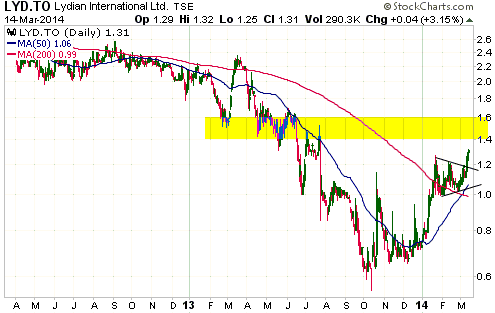
A good place for new buying is near the bottom of what appears to be a
consolidation pattern within a short-term upward trend. For example, over the
past month we've regularly included LYD.TO in our short-list of 'best buys',
with our specific suggestion being to buy in the low-C$1 area. With reference to
the first of the following daily charts, this was because the low-C$1 area
coincided with the lower portion of a consolidation pattern and also with two
moving averages. LYD broke upward from this consolidation pattern last week and
is probably on its way to resistance at C$1.40-$1.60. For another example, a
week ago and again this week we suggested buying AAU in the US$1.40s. With
reference to the second of the following daily charts, this was/is because the
stock has been drifting downward for about one month and would reach its 200-day
and 50-day moving averages in the high-US$1.40s.

List
of candidates for profit-taking
Here are some ideas as to where it could make sense -- depending on an
individual's current positioning -- to scale back exposure to certain stocks:
1) EDV.TO is testing intermediate-term resistance at C$0.95-C$1.00. Some selling
could be appropriate at this level. Note that longer-term resistance at C$1.80
is a realistic 6-12 month target.
2) LYD.TO would be a short-term selling candidate at around C$1.50.
3) PG.TO would be a short-term selling candidate at around C$3.00.
4) PVG would be a short-term selling candidate at US$7.50-$8.50.
5) RIOM would be a short-term selling candidate at US$2.70-$2.90, even though it
would still offer excellent value at this price. Note that US$4 is a realistic
intermediate-term target for this stock.
Chart Sources
Charts appearing in today's commentary
are courtesy of:
http://stockcharts.com/index.html

|









