|
-- Weekly Market Update for the Week Commencing 17th May 2010
Big Picture
View
Here is a summary of our big picture
view of the markets. Note that our short-term views may differ from our
big picture view.
In nominal dollar terms, the BULL market in US Treasury Bonds
that began in the early 1980s will end by mid-2010. In real (gold)
terms, bonds commenced a secular BEAR market in 2001 that will continue
until 2014-2020. (Last
update: 09 February 2009)
The stock market, as represented by the S&P500 Index, commenced
a secular BEAR market during the first quarter of 2000, where "secular
bear market" is defined as a long-term downward trend in valuations
(P/E ratios, etc.) and gold-denominated prices. This secular trend will bottom sometime between 2014 and 2020. (Last update: 22 October 2007)
A secular BEAR market in the Dollar
began during the final quarter of 2000 and ended in July of 2008. This
secular bear market will be followed by a multi-year period of range
trading. (Last
update: 09 February 2009)
Gold commenced a
secular bull market relative to all fiat currencies, the CRB Index,
bonds and most stock market indices during 1999-2001. This secular trend will peak sometime between 2014 and 2020. (Last update: 22 October 2007)
Commodities,
as represented by the Continuous Commodity Index (CCI), commenced a
secular BULL market in 2001 in nominal dollar terms. The first major
upward leg in this bull market ended during the first half of 2008, but
a long-term peak won't occur until 2014-2020. In real (gold) terms,
commodities commenced a secular BEAR market in 2001 that will continue
until 2014-2020. (Last
update: 09 February 2009)
Copyright
Reminder
The commentaries that appear at TSI
may not be distributed, in full or in part, without our written permission.
In particular, please note that the posting of extracts from TSI commentaries
at other web sites or providing links to TSI commentaries at other web
sites (for example, at discussion boards) without our written permission
is prohibited.
We reserve the right to immediately
terminate the subscription of any TSI subscriber who distributes the TSI
commentaries without our written permission.
Outlook Summary
Market
|
Short-Term
(0-3 month)
|
Intermediate-Term
(3-12 month)
|
Long-Term
(1-5 Year)
|
Gold
|
Bullish
(12-Apr-10)
|
Bullish
(12-May-08)
|
Bullish
|
US$ (Dollar Index)
|
Neutral
(20-Jan-10)
| Bullish
(02-Nov-09)
|
Neutral
(19-Sep-07)
|
Bonds (US T-Bond)
|
Neutral
(17-May-10)
|
Bearish
(14-Dec-09)
|
Bearish
|
Stock Market (S&P500)
|
Neutral
(09-May-10)
|
Bearish
(11-May-09)
|
Bearish
|
Gold Stocks (HUI)
|
Neutral
(19-Apr-10)
|
Neutral
(16-Sep-09)
|
Bullish
|
| Oil | Neutral
(28-Oct-09)
| Bearish
(01-Mar-10)
| Bullish
|
Industrial Metals (GYX)
| Bearish
(21-Sep-09)
| Bearish
(25-May-09)
| Neutral
(11-Jan-10)
|
Notes:
1. In those cases where we have been able to identify the commentary in
which the most recent outlook change occurred we've put the date of the
commentary below the current outlook.
2. "Neutral", in the above table, means that we either don't have a
firm opinion or that we think risk and reward are roughly in balance with respect to the timeframe in question.
3. Long-term views are determined almost completely by fundamentals,
intermediate-term views by giving an approximately equal weighting to
fundamental and technical factors, and short-term views almost
completely by technicals.
Recap
There were a number of interesting developments in the financial world over the past fortnight. Most notably:
1. The debt-related problems of Greece's government continued to grow,
as did the risk that Greece's debt crisis would quickly evolve into a
broader euro-zone debt crisis. This caused interest rates and insurance
costs on "PIIGS" debt to rise sharply.
2. The increasingly precarious financial position of Europe's most
debt-stricken governments put additional downward pressure on the euro
and was the catalyst for a rapid global stock market decline that led
to a decisive break below support by an 'overbought' US stock market.
3. The euro's unrelenting weakness combined with plunging equity prices
and surging PIIGS-related interest rates caused policy-makers to panic.
4. Panic on the part of policy-makers manifested itself on 9th May in
the form of a trillion dollar support package for troubled euro-zone
governments, involving a) the replacement of bank debt by EU debt, b)
debt monetisation by the ECB, c) the provision of funds by the IMF, and
d) a promise by the US Federal Reserve to make an unlimited quantity of
US dollars available to the ECB -- as part of a new currency swap
programme -- to ensure sufficient "liquidity".
5. Prior to the announcement of the trillion-dollar support package the
stage was already set for a sharp rebound in the stock market (by
virtue of how 'oversold' it had become), so it is debatable as to
whether policy-makers' efforts had a significant effect on the stock
market. What isn't debatable is that these efforts had the intended
effect of suppressing the interest rates on PIIGS government debt and
other low-quality/high-risk debt.
6. As has happened numerous times over the past 12 years, resources
were consumed and prices were distorted in a counter-productive effort
to avoid short-term pain.
7. The gold market broke to new highs as speculators discounted the
inflation and economic weakness that will inevitably result from the
latest -- but undoubtedly not the last -- in a long line of 'rescues'.
An excellent synopsis from a non-Austrian
John Hussman is not a member of the "Austrian" school of economics, but
his analysis often has an "Austrian" flavour. The following excerpt
from his 10th May Weekly Comment is a good example:
"...the capital that is
used to provide the bailout goes from the hands of savers into the
hands of bondholders who made bad investments. We are not only
allocating global savings to governments. We are further allocating
global savings precisely to those who were the worst stewards of the
world's capital. From a productivity standpoint, this is a nightmare.
New investment capital, properly allocated, is almost invariably more
productive than existing investment, and is undoubtedly more productive
than past bad investment. By effectively re-capitalizing bad stewards
of capital, at the expense of good investments that could otherwise
occur, the policy of bailouts does violence to long-term prospects for
growth. Looking out to a future population that will increasingly rely
on the productivity of a smaller set of younger workers (and foreign
labor) in order to provide for an aging demographic, this is not a
luxury that our nation or the world can afford.
"Failure" and
"restructuring" mean only that bondholders don't get 100 cents on the
dollar. We can continue to bail out the poor stewards of capital who
voluntarily made bad, unproductive investments, and waste our future
productivity in order to make those lenders whole, or we can turn the
debate toward deciding the best strategies for restructuring existing
debt."
We couldn't agree more.
The Australian government takes aim at its foot
Proposed changes to
taxation in Australia would substantially increase the tax paid by
resource companies. According to the article posted HERE,
the introduction of a "Resources Super Profits Tax (RSPT)" would
increase the effective tax rate for a mining company operating in
Australia to 58% from the current 43%. This would put Australia well
ahead (in a bad way) of the US at 40% and Brazil at 38%.
In planning to increase taxes on mining companies, the Australian
federal government is behaving like...well...like a typical government
in a modern democracy. Modern democracy is all about robbing Peter to
pay Paul in order to obtain Paul's vote. In this case, the plan is to
rob the mining industry to a greater extent than it is already being
robbed in order to fund entitlements and tax reductions elsewhere.
Even if the proposed tax-related legislation is destined to become law,
it probably won't do so until 2012. Also, there is a chance that it
won't come into effect at all or that the final version of the
legislation will differ markedly from the current proposal.
Although the desire of the current Australian government to extract
more money from the resource sector should be of interest to investors
in Australia-based mining companies, due to the time delays and
unknowns involved with the proposed legislation it is not, at this
stage, a major consideration for us.
Treasury Bond Update
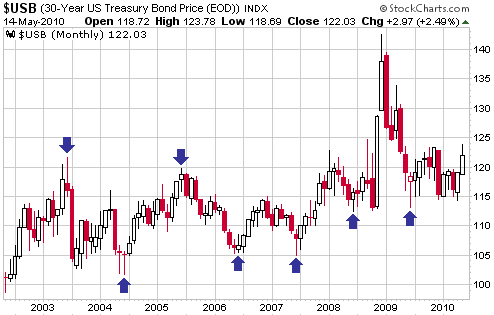
One of the most
reliable cycles over the past decade has been the tendency of the
T-Bond to reach an intermediate-term turning point (a high or a low) in
June. In fact, the T-Bond market's "June cycle" has a 100% success rate
since 2003, meaning that it has made an intermediate-term high or low
in June during each of the past 7 years. The arrows on the following
monthly chart identify these June turning points.
"Our current view is that
the T-Bond is more likely to make a low than a high in June of 2010,
but for this to be the case it will, within the next few weeks, have to
break decisively below the bottom of the 114.5-118.0 range indicated on
the following daily futures chart. On the other hand, a solid break
above 118 at some point over the next few weeks would indicate that the
T-Bond was more likely to trend upward to a June peak."
Thanks to a wave of flight-to-safety buying and short covering in
response to the euro zone problems and the stock market sell-off, the
T-Bond broke out to the upside from its short-term trading range.
Consequently, if June of 2010 is going to provide us with an
intermediate-term turning point it will have to be a turn from up to
down.
Additional gains in the T-Bond over the next few weeks could set up a
good opportunity to bet against this market via index funds or options,
but we will cross that bridge when we come to it.
The Stock
Market
Emerging-market and commodity-related equities
Over the past few years, investing in ETFs that track high profile
emerging markets such as China and Brazil has effectively been the same
as investing in the stocks of large industrial-metal producers.
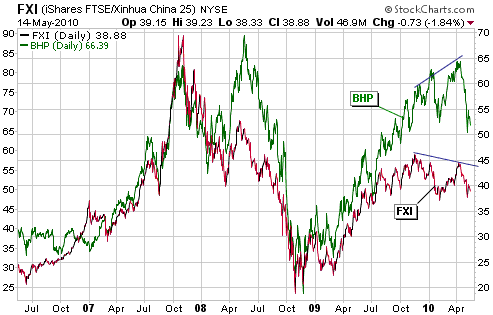
The close ties between emerging market and commodity-related equities
are illustrated by the following two charts, the first of which
compares the performances of FXI (an ETF that tracks an index of
large-cap Chinese stocks) and BHP (the world's largest diversified
mining company). Notice that FXI and BHP have generally moved together
over the past four years, although FXI peaked well in advance of BHP in
both 2007-2008 and 2009-2010.
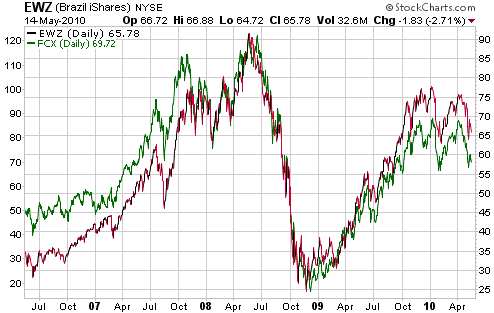
The second chart
compares the performances of EWZ (an ETF that tracks the Brazilian
stock market) and FCX (the world's largest listed copper producer). The
performances are almost identical, with not a single meaningful
divergence over the past four years.
For both fundamental
and technical reasons, we think the emerging markets and the large-cap
industrial-metal miners will be amongst the best candidates for BEARISH
speculations over the months ahead. The fundamental reason is that
global economic growth is likely to be much weaker over the next 12
months than most people expect. The technical reason is that FXI, EWZ
and FCX failed to make new 52-week highs over the past three months and
thus demonstrated weakness relative to the S&P500 Index.
Current Market Situation
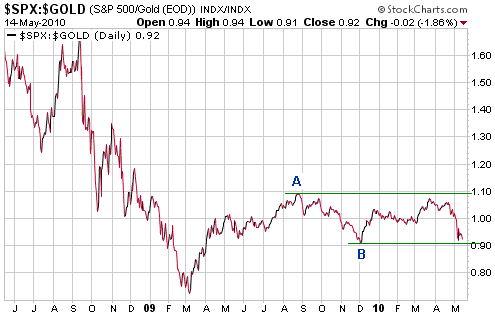
As discussed in the 24th February Interim Update and the 29th March
Weekly Update, the intermediate-term consolidations in the
S&P500/gold ratio over the past several years have encompassed an
initial sharp rally followed by a lengthy period of oscillating within
a horizontal range, with the boundaries of the horizontal range being
defined by the peak of the initial rally (point A) and the bottom of
the first pullback following the initial rally (point B).
The chart displayed below shows that SPX/gold tested the top of its
horizontal range in March and is currently testing the bottom of the
range. A decisive break below the bottom of this range would be a clear
signal that the US stock market was on its way to a new multi-decade
low in gold terms.
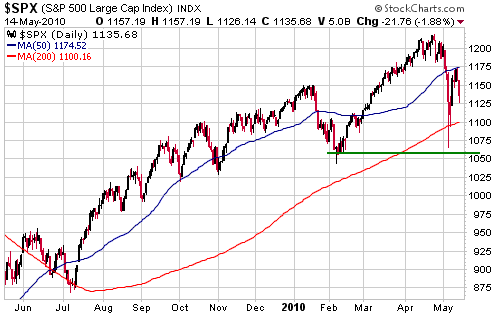
Turning to the
nominal (US$-denominated) S&P500 Index, the following chart shows
that the early-May downward spike ended just above support defined by
the February low. This support is now very important, particularly
since many people believe that the market's steep decline was primarily
the result of a trading or computer error. Taking out the February low
would validate the early-May decline in the minds of many traders and
leave little room for doubt that the post-crash recovery -- which some
analysts have labeled as a cyclical bull market -- ended in April.
In our opinion, the most likely outcome is that support defined by the
February and early-May lows will hold for 1-2 months before being
breached.
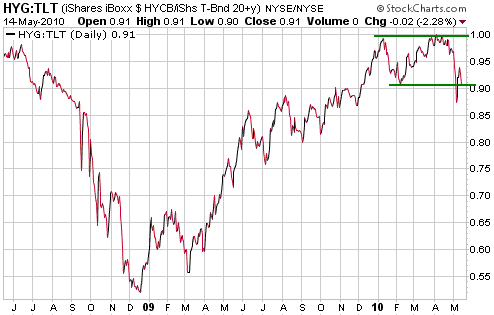
Lastly, it is worth
noting that the stock market's recent plunge was confirmed by a
material widening of credit spreads, as indicated by a quick drop to a
new low for the year by the HYG/TLT ratio. HYG/TLT appears to have
topped over the past 4-5 months in similar fashion to the way it
bottomed between December of 2008 and March of 2009.
We are hoping that
the markets will provide us with good opportunities to accumulate new
hedges -- in the form of put options and/or inverse index funds --
during June-July, but as usual our primary method of hedging will be
via a large 'cash cushion'.
This week's
important US economic events
| Date |
Description |
Monday May 17
| Treasury International Capital Report
Housing Market Index
| | Tuesday May 18 | Housing Starts
Producer Price Index
| | Wednesday May 19
| Consumer Price Index
FOMC Minutes
| | Thursday May 20
| Leading Economic Indicators
| | Friday May 21
| No important events scheduled
|
Gold and
the Dollar
Gold
A point we've made numerous times over the years is that gold is not
primarily a play on a decline in the US dollar's foreign exchange
value; it is a play on a general decline in monetary confidence.
Evidence in support of this view is the fact that the spectacular
advance in the gold price that began during the second half of 1978 and
ended in January of 1980 was accompanied by stability in the US
dollar's value against most other major fiat currencies. The recent
market action constitutes additional evidence.
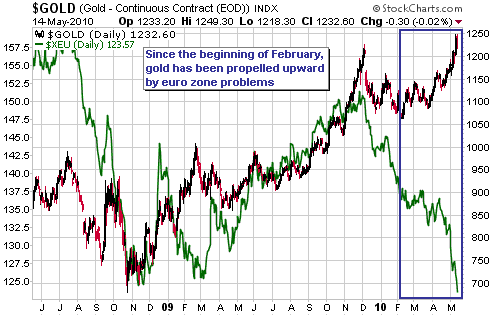
The increase in the US$ gold price from its early-February correction
low in the mid-$1000s to last week's high of $1250 has clearly been
driven by plunging confidence in the euro, not the US$. The following
chart comparison of the US$ gold price and the euro confirms that this
is the case (the chart shows the US$ gold price gathering strength over
the past few months as the euro accelerated downward against the US$).
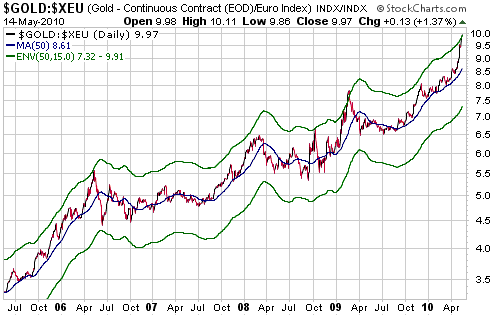
As investors with
substantial exposure to gold, one concern we have right now is that the
surge in the US$ gold price and the accompanying plunge in the euro/US$
exchange rate has pushed the euro-denominated gold price (gold/euro)
16% above its 50-day moving average. Consequently, in euro terms gold
is now more 'overbought' than it was at the intermediate-term peak of
May-2006 and almost as 'overbought' as it was at the intermediate-term
peak of February-2009. The situation is depicted below.
During the final 18
months of gold's long-term bull market the technical indicators we use
to help us weigh risk against reward will stop working, because during
this period gold will probably become extremely 'overbought' and then
quickly double in price. Our opinion is that the end of the bull market
is still a few years away and, therefore, that the traditional
indicators should continue to be useful for a while, but there is a
small -- although not insignificant -- possibility that a complete
breakdown in the euro could send gold into 'blow-off' mode earlier than
expected. This is why it is very important to maintain a sizeable
'core' gold position, despite the elevated level of gold/euro.
In US$ terms, gold would need to rise to at least 1300 to be at risk of
experiencing something more serious than a routine short-term
correction.
Silver
At this time gold is the only pure monetary commodity, which is why it
has been the only major commodity to make new price highs in response
to the burgeoning debt crisis. Silver, on the other hand, is part
monetary commodity and part industrial commodity. This has meant that
since late 2007 it has been subject to powerful countermanding forces.
Specifically, it has been pushed upward by falling confidence in the
official monetary system and pulled downward by the global economic
downturn. The end result is the following chart, which shows that over
the past two years silver has gone nowhere in a very interesting way.
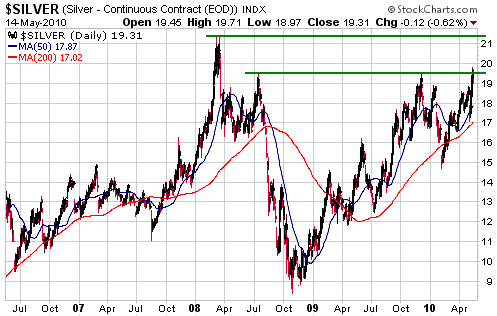
At some point the
rise in the monetary component of silver's overall demand should
overwhelm the industrial component, propelling silver sharply higher in
both gold and US$ terms. However, as things currently stand we think
silver's position is more precarious than gold's. This is because it is
butting up against considerable chart-based resistance (gold has no
overhead resistance) and because the broad stock market has probably
embarked on an intermediate-term decline (silver tends to weaken
relative to gold when the stock market trends downward). Experienced
options traders could therefore use SLV (silver ETF) January-2011 put
options to partially hedge their exposure to gold- and silver-related
investments.
Gold Stocks
Our favoured scenario is that the gold sector, as represented by the
HUI, will peak this month and then decline to an October low. Assuming
that the intermediate-term correction that began in early December of
2009 is still in progress, the October low should be close to the
February low (around 370). We therefore think that investors should be
looking for opportunities to scale back to their 'core' exposure.
The following chart is consistent with the idea that a short-term peak
will soon be put in place, because it shows that the HUI is
'overbought'. We cannot, however, rule out the possibility that the
intermediate-term correction that began last December is over and that
a major advance has begun.
Novices often think they KNOW what's going to happen and bet everything
on one particular scenario, whereas seasoned speculators generally
understand -- and take into account -- that there are always many
possible outcomes.
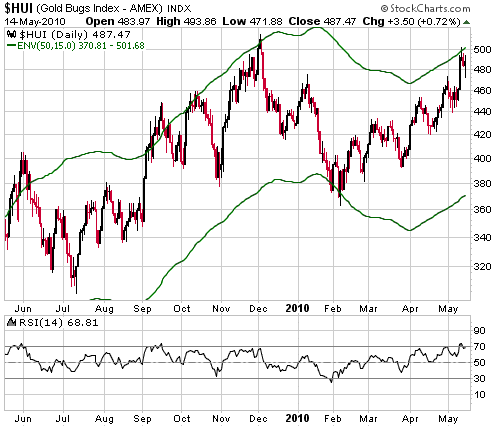
In our opinion, the
most bullish thing that the HUI could do from here would be to
consolidate for a few weeks between 460 and 500, and then break out to
a new high. The consolidation would eliminate the short-term
'overbought' condition and the subsequent break to a new high would
confirm that a new intermediate-term advance had begun.
Currency Market Update
Over the past few weeks it has almost seemed as if the euro zone's
political leaders were TRYING to make as many wrong moves as possible
in the shortest possible timeframe. Let's put it this way: it is
difficult to imagine how they could possibly have done more harm in
such a short time if they were trying. For example, the bailouts that
have been cobbled together in an effort to prevent the holders of
government debt from suffering losses on their bad investments are
completely counter-productive, and now we have Portugal's government
deciding to introduce a "crisis tax" involving increases income,
corporate and value-added tax rates. Increasing taxes at this time is
so illogical it boggles the mind.
We again ask the question: why can't bondholders be allowed to suffer
losses on their investments? Or, putting it another way: why should
wealth be forcibly transferred from individuals and corporations that
did not make bad investments to support banks and other corporations
that did?
Angela Merkel, Germany's Chancellor, has characterised the current
predicament as "us against them", with "us" being the government and
the people and "them" being the evil speculators that supposedly
dominate 'the market'. In reality, it's the government and the banking
industry versus individual freedom and the real economy.
As mentioned in an earlier update, the government debt crisis is
beginning in Europe because the structure of Europe's monetary union
prevents technically insolvent governments from making full use of
monetary inflation to maintain the illusion of solvency. The crisis
will eventually spread to the US, but before it does there will
probably be more problems in Europe and weakness in the euro.
There are, however, three points in the euro's favour. The first is the
RSI (Relative Strength Index) included at the bottom of the following
weekly chart, which indicates that the euro is now more oversold than
it has been at any time over the past decade. The second is the general
awareness of the euro's inherent problems, meaning that the current
exchange rate at least partially discounts the problems. These two
points suggest the potential for a 1-3 month rebound fueled by short
covering. The third point is the US Federal Reserve, in that the Fed
has the power to support the euro by devaluing the US$ and will likely
make use of this power if the euro continues to slide. Due largely to
the presence of the Fed, we suspect that the euro will drop no lower
than 1.15 over the remainder of this year.
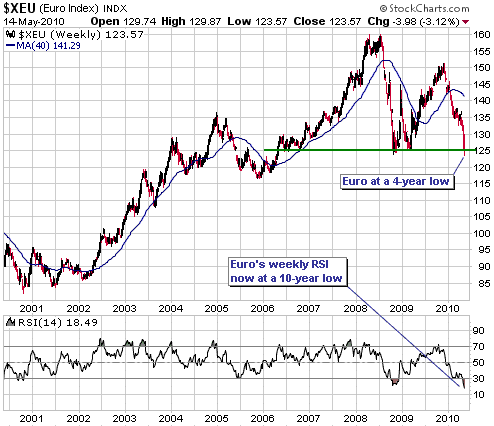
If the euro had
commenced a counter-trend rebound from the low-1.30s, as we thought it
might last month, then it would have had the potential to move up to
around 1.42 before resuming its bear market. It wasn't to be, though,
and the currency has fallen all the way to a new 4-year low.
A rebound that begins from near the current level could make it up to around 1.35, but probably no higher than that.
As noted above, the euro is dramatically 'oversold' and its problems
are now well known (read: the problems are at least partially reflected
in the market). This is not the case when it comes to the senior
commodity currencies (the A$ and the C$). Consequently, there is a good
chance that the commodity currencies will be weaker than the euro over
the next 6 months.
Update
on Stock Selections
(Notes: 1) To review the complete list of current TSI stock selections, logon at http://www.speculative-investor.com/new/market_logon.asp
and then click on "Stock Selections" in the menu. When at the Stock
Selections page, click on a stock's symbol to bring-up an archive of
our comments on the stock in question. 2) The Small Stock Watch List is
located at http://www.speculative-investor.com/new/smallstockwatch.html)
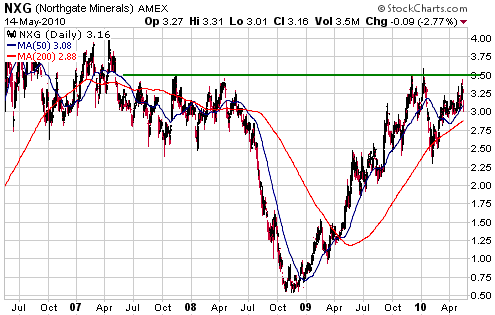
 Northgate Minerals (AMEX: NXG, TSX: NGX). Shares: 290M issued, 297M fully diluted. Recent price: US$3.16 Northgate Minerals (AMEX: NXG, TSX: NGX). Shares: 290M issued, 297M fully diluted. Recent price: US$3.16
NXG reported its Q1 financial results and updated 2010 production
guidance last Tuesday. The bad news is that the company is going to
produce less gold in 2010 than we were expecting.
The good news is that NXG is attempting to revive the Kemess North
gold/copper project. The multi-million-ounce Kemess North project had
to be shelved a few years ago due to permitting issues associated with
the planned open-pit operation, but it seems that the potential may
exist to mine part of the project (1.4M ounces of gold and 500M pounds
of copper) using an underground block caving method. An international
engineering firm has been commissioned to assess this potential.
If the block caving method is determined to be economically viable then
our NXG valuation would probably rise by US$0.30-$0.60 per share.
NXG has resistance at US$3.50 and strong support at US$2.50-$3.00. We
think it is a good candidate for new buying below US$3.00.
Franco Nevada March-2012 C$32.00 Warrants (TSX: FNV.WT). Recent price: C$5.55
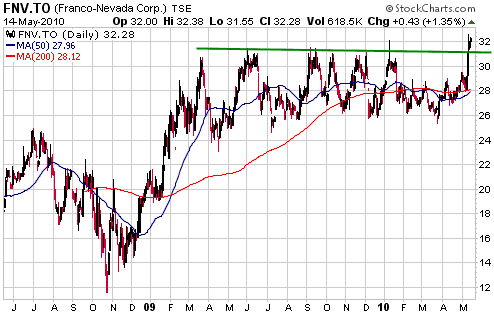
Franco Nevada (TSX: FNV), a gold royalty company, appears to be breaking out to the upside from a 14-month-long consolidation.
The stock is
'overbought' on a short-term basis and could soon pull back, but if
last week's breakout is genuine then any downward correction over the
weeks ahead should hold at around C$29.
Our interest is in the FNV March-2012 warrants, rather than the stock
itself. If the breakout is genuine then the stock price is probably on
its way to C$40, and if the stock price rises to $40 then the warrant
price should rise to at least $10. This is our current
intermediate-term target for the warrants.
The warrants are significantly under-priced relative to the stock and
could therefore be purchased near Friday's closing price, but a better
opportunity to buy the warrants would almost certainly arise if the
stock were to pull back to around C$29.
US Silver (TSXV: USA). Shares: 251M issued, 289M fully diluted. Recent price: C$0.225
On a market-cap-per-ounce-of-production basis, USA.V is the cheapest
silver producer we know of. There's a good reason for this relative
cheapness, however, which is that its per-ounce production cost is
high. For example, USA just reported Q1 results that indicated a cash
cost per silver ounce produced of $12.59. And the cost would have been
even higher if not for the effects of copper and lead byproducts.
Due to its relatively high cost structure, USA should be an extremely
good performer when the silver price breaks above its high of the past
few years. The other side of the coin is that if silver and base-metal
prices experience significant declines over the months ahead then USA
could begin to lose money on every ounce it produces.
The chart (see below) shows that USA has built a substantial base over
the past 20 months with resistance at C$0.25. This resistance was
tested last week.
If we were confident that silver was about to make a sustained break
above resistance at $19.50 then we would view USA.V as a clear-cut
'buy' near its current price, but we aren't confident that this is
about to happen. For new buying at this time we would therefore be more
inclined to focus on silver stocks that don't NEED short-term strength
in the silver price. Sabina Silver (TSX: SBB) is one example.
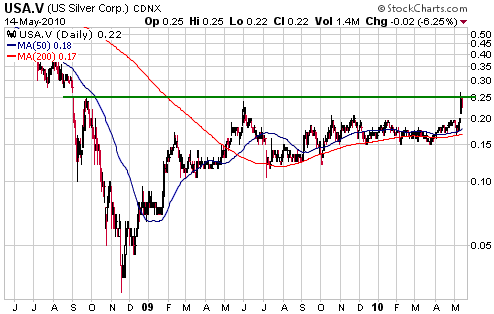
Chart Sources
Charts appearing in today's commentary
are courtesy of:
http://stockcharts.com/index.html

|