|
-- Weekly Market Update for the Week Commencing 17th November 2008
Big Picture
View
Here is a summary of our big picture
view of the markets. Note that our short-term views may differ from our
big picture view.
Bonds commenced a secular BEAR market in
June of 2003. (Last
update: 22 August 2005)
The stock market, as represented by the S&P500 Index, commenced
a secular BEAR market during the first quarter of 2000, where "secular
bear market" is defined as a long-term downward trend in valuations
(P/E ratios, etc.) and gold-denominated prices. This secular trend will bottom sometime between 2014 and 2020. (Last update: 22 October 2007)
The Dollar commenced a secular BEAR market during the final quarter of 2000. The
first major downward leg in this bear market ended during the first
quarter of 2005, but a long-term bottom won't occur until 2008-2010. (Last update: 28 March 2005)
Gold commenced a
secular bull market relative to all fiat currencies, the CRB Index,
bonds and most stock market indices during 1999-2001. This secular trend will peak sometime between 2014 and 2020. (Last update: 22 October 2007)
Commodities, as
represented
by the CRB Index, commenced a secular BULL market in 2001. The first
major upward leg in this bull market ended during the first half of 2008, but a long-term
peak won't occur until 2014-2020. (Last update: 03 November 2008)
Copyright
Reminder
The commentaries that appear at TSI
may not be distributed, in full or in part, without our written permission.
In particular, please note that the posting of extracts from TSI commentaries
at other web sites or providing links to TSI commentaries at other web
sites (for example, at discussion boards) without our written permission
is prohibited.
We reserve the right to immediately
terminate the subscription of any TSI subscriber who distributes the TSI
commentaries without our written permission.
Outlook Summary
Market
|
Short-Term
(0-3 month)
|
Intermediate-Term
(3-12 month)
|
Long-Term
(1-5 Year)
|
Gold
|
Bullish
(30-Jun-08)
|
Bullish
(12-May-08)
|
Bullish
|
US$ (Dollar Index)
|
Bearish
(17-Nov-08)
| Neutral
(22-Sep-08)
|
Neutral
(19-Sep-07)
|
Bonds (US T-Bond)
|
Neutral
(14-Jul-08)
|
Bearish
(22-Sep-08)
|
Bearish
|
Stock Market (S&P500)
|
Bullish
(16-Oct-08)
|
Bullish
(08-Oct-08)
|
Bearish
|
Gold Stocks (HUI)
|
Bullish
(30-Jun-08)
|
Bullish
(12-May-08)
|
Bullish
|
| Oil | Bullish
(17-Nov-08)
| Neutral
(22-Sep-08)
| Bullish
|
Industrial Metals (GYX)
| Neutral
(18-Jun-08)
| Neutral
(22-Sep-08)
| Bullish
|
Notes:
1. In those cases where we have been able to identify the commentary in
which the most recent outlook change occurred we've put the date of the
commentary below the current outlook.
2. "Neutral", in the above table, means that we either don't have a
firm opinion or that we think risk and reward are roughly in balance with respect to the timeframe in question.
3. Long-term views are determined almost completely by fundamentals,
intermediate-term views by giving an approximately equal weighting to
fundmental and technical factors, and short-term views almost
completely by technicals.
Inflation Watch
Last week was more of the
same on the monetary inflation front, with another large increase in
reserve bank credit and little change in broader measures of money
supply such as TMS and M2.
Currently, the US Treasury has $621B on deposit at the Fed and the
commercial banks have a combined total of $364B of excess reserves on
deposit at the Fed. This means that there is now close to 1 trillion
dollars of money at the Fed that should eventually work its way into
the economy and into the broader measures of money supply. The big
question is: how long will it take for this to happen?
We don't know, although we suspect that the current administration will
want to allocate a large chunk of the Treasury's $621B over the coming
two months, because after that it will no longer by the current
administration and will lose the ability to control who gets what.
Commodities
Oil
"Peak Oil" appears to be a valid theory. By that we don't mean that the
world appears to be running out of oil, but that the rate of an oil
field's production tends to go into decline after 50% of the field's
below-ground reserves have been extracted.
While "Peak Oil" should help to underpin the oil price over the
long-term, we doubt that it will ever be a dominant intermediate-term
price driver. In any case, despite the many claims to the contrary it
certainly wasn't a dominant price driver over the past two years. The
fact is that "Peak Oil" was just as valid when the per-barrel oil price
was in the $50s in January of 2007 as it was when the price was in the
$140s in July of 2008 and as it is now with the price back in the $50s.
The oil price has made an incredible round trip; however, the oil
supply situation hasn't changed much over the past 2 years, and
neither, for that matter, has global oil consumption. The monetary
realm is where the big changes have occurred. Note, for instance, the
strong inverse correlation between oil and the Dollar Index illustrated
by the following chart.
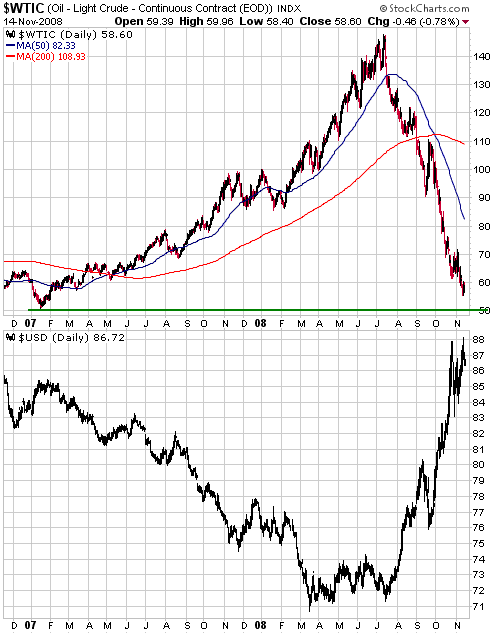
As we see it, the short-term risk is that the Dollar Index will spike
up to around 90 over the coming week or so before it begins to correct.
In this case the oil price would probably fall to support at $50, but
$50 is only about $5 below last week's low. The other side of the coin
is that a routine bear market rebound would take the oil price back to
$75-$80.
Further to the above, we think the short-term risk/reward is now
sufficiently skewed towards reward to warrant upgrading our short-term
oil market outlook to "bullish".
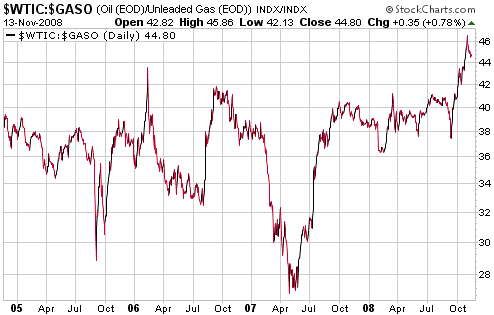
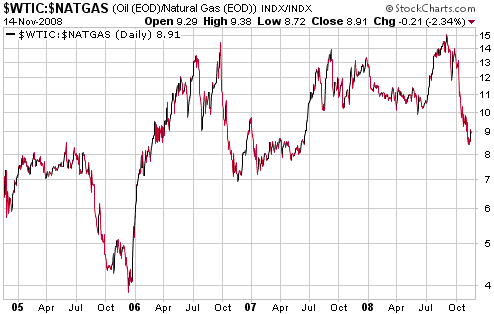
On a related matter, although it has fallen a long way in US$ terms the
following charts show that the price of oil is still extremely high
relative to the price of gasoline and moderately high relative to the
price of natural gas (the long-term average for the oil/natgas ratio is
around 6). This should mean that if the oil market rallies over the
coming few months in response to a US$ pullback, the gasoline and
natural gas markets will rally even more.
We expect the prices of copper, nickel, zinc and lead to rebound over
the coming 6 months in parallel with a stock market rebound, but we
will maintain a short-term "neutral" view on these metals until more
evidence of a stock market bottom has emerged.
Freight Rates
The Baltic Dry Index (BDI) is "...an
assessment of the price of moving the major raw materials by sea.
Taking in 26 shipping routes measured on a timecharter and voyage
basis, the index covers Supramax, Panamax, and Capesize dry bulk
carriers carrying a range of commodities including coal, iron ore and
grain." Refer to http://en.wikipedia.org/wiki/Baltic_Dry_Index for more details.
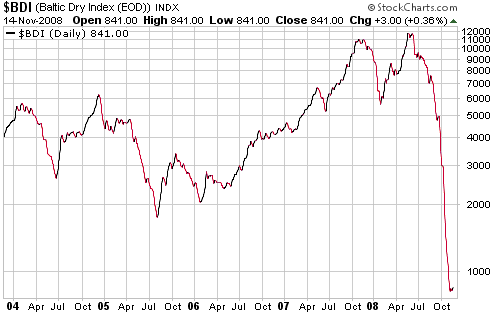
The BDI is reputedly a barometer of the volume of global trade, but if
this is the case then global trade has almost come to a stop because
the BDI has lost more than 90% of its value over the past few months
(see chart below). Global trade in commodities would certainly have
fallen over the past few months in response to weakening economic
growth, but not by anywhere near the extent indicated by the BDI. The
BDI's crash is probably related more to the inability to obtain credit
-- specifically, the reluctance of banks to provide letters of credit
-- than to a collapse in the volume of trade. Quite likely, the BDI
will rebound strongly over the coming months in response to a general
loosening of credit.
The bull market in acronyms
One of the more trivial
-- but interesting, nonetheless -- similarities between the present day
and the 1930s is the proliferation of government programmes known by
the initial letters of the words in their names. Created during the
1930s were the RFC (Reconstruction Finance Corporation), the NRA
(National Recovery Act), the NRPB (National Resources Planning Board),
the PWA (Public Works Administration), the FWA (Federal Works Agency),
the HOLC (Home Owners Loan Corporation), the AAA (Agricultural
Adjustment Administration), the WPA (Works Progress Administration),
the TVA (Tennessee Valley Authority), the FNMA (Federal National
Mortgage Association, a.k.a. Fannie Mae), the FSCC (Federal Surplus
Commodity Corporation), and many dozens of others. Notable creations
over the past year include the TAF (Term Auction Facility), the TSLF
(Term Securities Lending Facility), the PDCF (Primary Dealer Credit
Facility), the TARP (Troubled Asset Relief Program), and the CPFF
(Commercial Paper Funding Facility).
We expect the bull market in acronyms to continue, and probably even
accelerate, under the Obama administration. Too bad, then, that there
isn't a tradable index that rises whenever a new government
financial/economic-aid programme known by its initials is born. Buying
such an index would be an easy way to make money.
The Stock
Market
To confirm that it has
bottomed the S&P500 Index will have to break decisively above
resistance at 1000, but as each week goes by we continue to see more
evidence that the stock market is forming a base. For example, we
mentioned in last week's Interim Update that each subsequent return by
the senior stock indices to the vicinity of their 10th October lows had
been accompanied by a reduced quantity of new individual stock lows.
This positive divergence became more pronounced last Thursday when
spikes by the indices to well below their 10th October intra-day lows
were accompanied by a relatively small number -- small, that is,
relative to what happened on 10th and 24th October -- of NYSE stocks
making new 52-week lows. Almost no stocks are currently making new
52-week highs, but this is to be expected following such a large
decline in the broad market. The number of new 52-week highs won't
likely rise by much until the senior indices are at least a few weeks
into a rally.
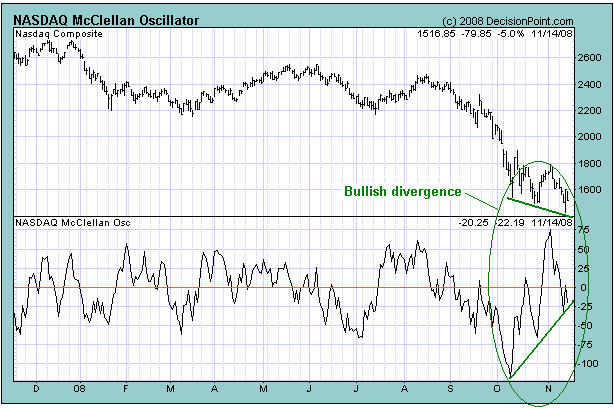
Other signs of base formation to emerge last week include Thursday's
key price reversal and the positive divergence illustrated by the
following chart. The chart shows that declining lows in the NASDAQ
Composite Index over the past 5 weeks have been accompanied by rising
lows in the NASDAQ's McClellan Oscillator.
This week's
important US economic events
| Date |
Description |
Monday Nov 17
| Industrial Production
Capacity Utilisation
| | Tuesday Nov 18 | PPI
Net Foreign Purchases of US Securities
| | Wednesday Nov 19
| CPI
Housing Starts
FOMC Minutes
| | Thursday Nov 20
| Leading Economic Indicators
| | Friday Nov 21
| No important events scheduled
|
Gold and
the Dollar
Gold
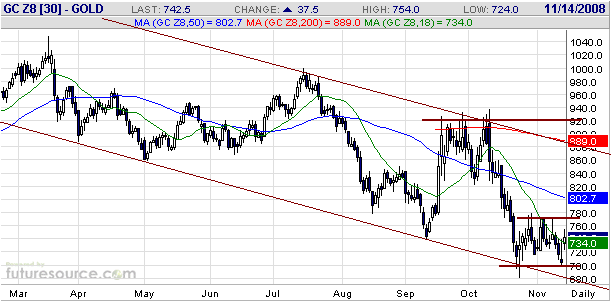
The December gold contract's short-term support and resistance levels
at $700 and $770, respectively, are drawn on the following daily chart,
as are intermediate-term resistance at $920 and the channel that has
defined gold's progress since its March-2008 peak.
Gold dropped to short-term support last Thursday and then rebounded,
but needs to close above $770 to signal a short-term bottom and project
a rise to the channel top. A daily close above $920 would suggest that
the overall correction had ended and that gold's next multi-year
advance had begun.
A bottom hasn't yet
been signaled, but the short-term downside risk appears to be low. A
final downward spike will remain a possibility until a daily close
above $770, but given the bullish structure of the market -- the
Commitments of Traders situation is more bullish than it has been in
over three years, which suggests that the de-leveraging of gold
speculators has run its course -- a substantial extension of the
downward trend is unlikely.
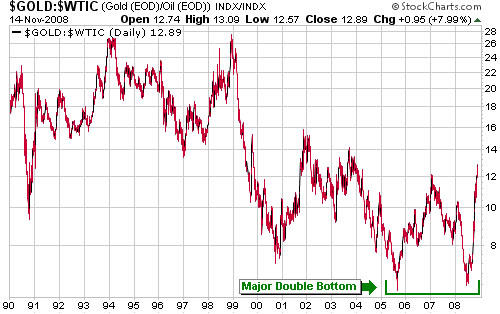
The following chart shows that the gold/oil ratio tested its 2005 major
low a few months ago and has since rocketed up to its highest level
since late-2003. You would never know it from the performances of
gold-mining shares, but gold's recent strength relative to oil
represents a substantial improvement in gold-mining profit margins that
should start becoming evident in this quarter's financial results.
In our opinion, the
world has entered an extended period in which the rate of economic
growth will be unusually slow. The mismatch between consumption and
production caused by the massive global credit bubble necessitates a
painful period of realignment, but governments are desperately trying
to prevent this realignment from occurring by applying counter-cyclical
fiscal and monetary policies. These policies are all but guaranteed to
prolong the agony, transforming what would potentially have been a
sharp 1-2 year downturn into a 5-10 year depression. Such an economic
environment greatly favours gold over oil, so we expect that the recent
sharp rally in the gold/oil ratio will prove to be just the first leg
of a major multi-year advance. It is quite likely, however, that there
will be a counter-trend move over the next few months, with gold/oil
retracing some of its post-July-2008 gains before returning to its
upward path.
Gold Stocks
In last week's Interim Update we wrote:
"...17th November (next
Monday) is an important anniversary date for the gold sector.
Specifically, 17th November-2000 was the date on which a 20-year bear
market ended and a new long-term bull market began. Furthermore, 4
years to the day after the November-2000 major turning point the gold
sector, as represented by the AMEX Gold BUGS Index (HUI), hit an
intermediate-term high (the peak on 17th November of 2004 was followed
by a large 6-month decline). We are therefore now approaching the
8-year anniversary of the November-2000 major low and the 4-year
anniversary of the November-2004 intermediate-term high.
Will 17th November of
2008 prove to be another important turning point? If it does it will
obviously have to be a turn from down to up."
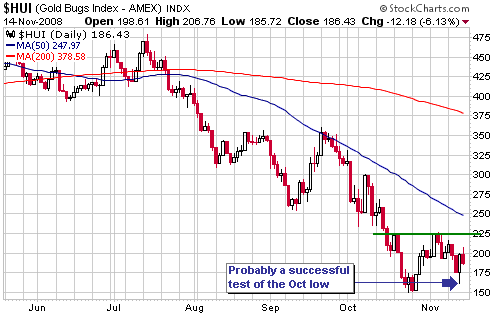
The HUI dropped back to near its October low on Thursday 13th November
before reversing upward, so it could be that there was an important
turning point two trading days prior to the 17th November anniversary.
However, Friday's poor performance partly negated Thursday's bullish
action, and in any case another test of the October low will remain a
possibility worth considering until the HUI has broken above resistance
at 225.
Interestingly, there
was a very important low for the gold-stock indices on 19th November of
2001, meaning that the anniversaries of three important turning points
occur during the first three trading days of this week. These
anniversaries would add to the significance of an upward reversal that
occurred within the next few days.
Currency Market Update
The G-20 Meeting
In last week's Interim Update we wrote the following regarding the
likely outcome of the 15th November G-20 Heads of State Meeting in
Washington:
"We will be surprised if
anything earth-shattering comes out of this meeting. We certainly don't
expect a new monetary system to be one of the outcomes. Our guess is
that the heads of state will encourage each other to spend more (and
thus inflate more) and create more regulations, as if the inflation
that has already occurred and the regulations that are already in place
haven't caused enough problems."
Unfortunately, we were close to the mark. According to the Associated Press article posted at http://biz.yahoo.com/ap/081115/meltdown_summit.html:
""We must lay the
foundation for reform to help ensure that a global crisis, such as this
one, does not happen again," the leaders said in lengthy statement
after the emergency summit.
The plan endorses an
early warning system for problems such as the speculation frenzy that
fed the U.S. housing bubble. It also calls for the creation of
"supervisory colleges" of financial regulators from many nations to
better detect risky investing and other potential problems."
And:
"Leaders backed efforts
to improve international monitoring of markets and bolstering rules
about how companies value their assets, a weakness seen as partly
responsible for the crisis at hand. Those steps are aimed at making the
global financial system more accountable to investors and more
transparent to regulators."
And:
"A thorny issue was
whether all nations should pledge to enact government spending plans to
stimulate their economies. The leaders supported the benefits of that
approach, but stopped short of a commitment for all to act at the same
time, as some Europeans had favored.
The leaders pledged to
"use fiscal measures" to energize individual countries' economies "as
appropriate." They recognized the importance of the Federal Reserve and
other central banks to order interest rate reductions to help cushion
the economic fallout."
In other words, governments have placed the blame for the crisis on
greed and frenzied speculation within the private sector. Furthermore,
they have decided to expand their own power with the aim of preventing
a similar crisis from occurring in the future, and generally support
the idea that an increase in the rate at which they spend taxpayers'
money will help stimulate economic growth.
Not unexpectedly, the heads of state have chosen to ignore the root
causes of the crisis. Chief among these root causes are central bank
manipulation of the price of credit, government intervention in the
economy (regulations designed to promote sub-prime lending, for
example), and a debt-based monetary system under which new money is
created 'out of thin air'.
The responses of policy-makers are usually predictable, at least in
general terms. However, it is far more difficult to predict the
short-term responses of financial markets to the actions of
policy-makers, because a lot depends on what the markets had discounted
prior to the actions. For example, the outcome of the G-20 Meeting was
really just more of the same, but we don't know how the markets will
react because we don't know what other traders/investors were
expecting.
Current Market Situation
It looks like the Dollar Index successfully tested its October high
last week in parallel with the stock market's test of its October low.
However, a downward reversal hasn't yet been signaled.
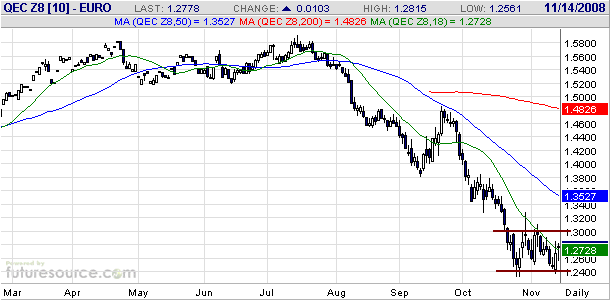
The following daily chart shows that the December euro has short-term
support at 1.24 and resistance at 1.30. A downward reversal in the US$
would be signaled by a daily close above 1.30 by December euro futures.
Also, a daily close above $770 by December gold would be a reliable
indication that the US$ had made a peak of at least short-term
significance.
As things currently
stand a currency market reversal has not been signaled, leaving open
the possibility that the Dollar Index will spike up to around 90 within
the coming 1-2 weeks. However, we think that the dollar's short-term
downside risk now exceeds its upside potential and have therefore
downgraded our short-term dollar view from "neutral" to "bearish".
Update
on Stock Selections
(Note: To review the complete list of current TSI stock selections, logon at http://www.speculative-investor.com/new/market_logon.asp
and then click on "Stock Selections" in the menu. When at the Stock
Selections page, click on a stock's symbol to bring-up an archive of our comments on the stock in question)
 International Royalty Corp. (TSX: IRC, AMEX: ROY). Shares: 78M issued, 84M fully diluted. Recent price: C$1.49 International Royalty Corp. (TSX: IRC, AMEX: ROY). Shares: 78M issued, 84M fully diluted. Recent price: C$1.49
IRC is a small royalty company that currently generates most of its
income from base-metal royalties (mainly nickel) but will have
increasing exposure to gold as development-stage projects come on line
over the next few years. As a royalty company almost all of its
expenses are discretionary, giving it considerable financial
flexibility. Moreover, it is subject to almost none of the risks
associated with mining.
According to the latest quarterly results issued last Friday, despite
the large decline in the nickel price the company remains cash-flow
positive and financially solid. Of particular note, it has only used
US$5M of a US$40M revolving credit facility, which means that it has
the ability to take advantage of today's depressed market environment.
The biggest negative that we perceive continues to be the delays to
Barrick Gold's Pascua-Lama project (a huge gold project on the border
of Chile and Argentina) relating to permits and tax agreements. As
noted in the 12th May 2008 Weekly Update: "The
Pascua-Lama royalty owned by IRC is by far the company's most important
gold royalty, so the delays to the start of mine construction at this
project have had a negative impact on IRC's stock price. Due to the
importance of this project to Barrick Gold and to the two countries
involved, we expect that the issues delaying the start of construction
will be resolved in the not-too-distant future."
IRC is presently trading at around one-third of its book value and is,
we think, a good candidate for new buying at this level despite its
current substantial exposure to base-metal projects. The base metal
exposure probably won't hurt over the next 3-6 months because the
prices of these metals should rebound in parallel with a stock market
rebound.
Gassy Trusts
Penn West (TSX: PWT.UN, NYSE: PWE) and Advantage (TSX: AVN.UN, NYSE:
AAV), two of the five Canadian energy trusts that comprise the TSI
Energy Trust Index (TETI), released their latest quarterly reports last
week. As was the case with the three trusts that reported earlier,
PWT's and AVN's results revealed that there would be no danger of cuts
in monthly distributions as long as there wasn't a large additional
decline in the natural gas price. Of particular interest, payout ratios
for PWT and AVN during the recently completed quarter were 59% and 54%,
respectively.
At Friday's closing prices, PWT yields 21.0% and AVN yields 22.7%. Both are suitable for new buying near current levels.
Orsu Metals (TSX: OSU) (Formerly European Minerals). Shares: 457M issued, 621M fully diluted. Recent price: C$0.045
Commenting on OSU in the 5th November Interim Update, we wrote: "The
question is: will the Varvarinskoye gold/copper mine achieve its design
parameters over the coming 2 quarters without the need for additional
financing? The next set of financial results will hopefully get us
closer to answering the above question."
The "next set of financial results" was released last Thursday, and
based on these results the answer to the above question is: no, OSU
will either need to arrange additional financing or negotiate a change
in the repayment schedule for its current debt. The company has
sufficient cash on hand to make the $17M debt payment due at the end of
December, but if it made this payment it would not have enough cash to
pay its other expenses.
The ramp-up to full production appears to be progressing well under the
supervision/control of the company's new management, so if the
short-term 'cash crunch' can be resolved the stock price should rebound
strongly. We suspect that it will be resolved, but there's obviously a
lot of risk. This risk is why the stock is trading at such a low level.
Chart Sources
Charts appearing in today's commentary
are courtesy of:
http://stockcharts.com/index.html
http://www.futuresource.com/
http://www.decisionpoint.com/

|









