|
-- Weekly Market Update for the Week Commencing
18th March 2013
Big Picture
View
Here is a summary of our big picture
view of the markets. Note that our short-term views may differ from our
big picture view.
In nominal dollar terms, the BULL market in US Treasury Bonds
that began in the early 1980s will end by 2013. In real (gold)
terms, bonds commenced a secular BEAR market in 2001 that will continue
until 2014-2020. (Last
update: 23 January 2012)
The stock market, as represented by the S&P500 Index,
commenced
a secular BEAR market during the first quarter of 2000, where "secular
bear market" is defined as a long-term downward trend in valuations
(P/E ratios, etc.) and gold-denominated prices. This secular trend will bottom sometime between 2014 and 2020.
(Last update: 22 October 2007)
A secular BEAR market in the Dollar
began during the final quarter of 2000 and ended in July of 2008. This
secular bear market will be followed by a multi-year period of range
trading.
(Last
update: 09 February 2009)
Gold commenced a
secular bull market relative to all fiat currencies, the CRB Index,
bonds and most stock market indices during 1999-2001.
This secular trend will peak sometime between 2014 and 2020.
(Last update: 22 October 2007)
Commodities,
as represented by the Continuous Commodity Index (CCI), commenced a
secular BULL market in 2001 in nominal dollar terms. The first major
upward leg in this bull market ended during the first half of 2008, but
a long-term peak won't occur until 2014-2020. In real (gold) terms,
commodities commenced a secular BEAR market in 2001 that will continue
until 2014-2020.
(Last
update: 09 February 2009)
Copyright
Reminder
The commentaries that appear at TSI
may not be distributed, in full or in part, without our written permission.
In particular, please note that the posting of extracts from TSI commentaries
at other web sites or providing links to TSI commentaries at other web
sites (for example, at discussion boards) without our written permission
is prohibited.
We reserve the right to immediately
terminate the subscription of any TSI subscriber who distributes the TSI
commentaries without our written permission.
Outlook Summary
Market
|
Short-Term
(1-3 month)
|
Intermediate-Term
(6-12 month)
|
Long-Term
(2-5 Year)
|
|
Gold
|
Bullish
(17-Oct-12)
|
Bullish
(26-Mar-12)
|
Bullish
|
|
US$ (Dollar Index)
|
Neutral
(24-Dec-12)
|
Neutral
(09-Jan-12)
|
Neutral
(19-Sep-07)
|
|
Bonds (US T-Bond)
|
Neutral
(12-Nov-12)
|
Neutral
(18-Jan-12)
|
Bearish |
|
Stock Market
(DJW)
|
Bearish
(30-Jul-12)
|
Bearish
(28-Nov-11)
|
Bearish
|
|
Gold Stocks
(HUI)
|
Bullish
(24-Dec-12)
|
Bullish
(23-Jun-10)
|
Bullish
|
|
Oil |
Neutral
(30-Jul-12)
|
Neutral
(31-Jan-11)
|
Bullish
|
|
Industrial Metals
(GYX)
|
Neutral
(30-Jul-12)
|
Neutral
(29-Aug-11)
|
Neutral
(11-Jan-10)
|
Notes:
1. In those cases where we have been able to identify the commentary in
which the most recent outlook change occurred we've put the date of the
commentary below the current outlook.
2. "Neutral", in the above table, means that we either don't have a
firm opinion or that we think risk and reward are roughly in balance with respect to the timeframe in question.
3. Long-term views are determined almost completely by fundamentals,
intermediate-term views by
fundamentals, sentiment and technicals, and short-term views by sentiment and
technicals.
Money-Pumping Update
The Fed continues to pump aggressively
During the six months since last September's introduction of "QE3", the Fed has
grown its balance sheet by $341B by monetising (buying with money created out of
nothing) mortgage-backed securities and Treasury securities. Moreover, $201B of
this $341B increase has occurred over the past two months.
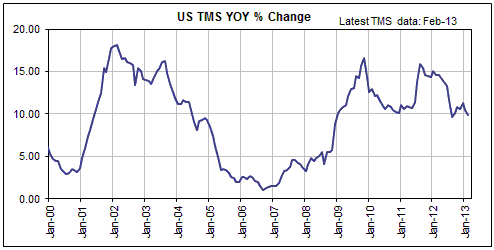
The recent acceleration in the Fed's money creation hasn't yet had a noticeable
effect on the year-over-year (YOY) rate of growth in US True Money Supply (TMS).
As illustrated below, at the end of February-2013 the YOY TMS growth rate was at
the bottom of its 4-year range. The bottom of the 4-year range is still high by
historical standards (almost 10%), but our calculation of the current monetary
inflation rate is lower than expected considering what the Fed has done over the
past few months.
We can't be certain, but the lack of response in US TMS to the Fed's recent
aggressive money-pumping probably stems from the fact that the US TMS
calculation is, by definition, the amount of US dollars within the US economy.
It isn't the global supply of US dollars, which means that in addition to
monetary inflation and deflation in the US it will be affected by the flow of
dollars into and out of the US. For example (and as noted in TSI commentaries at
the time), US TMS was given a significant artificial boost during the second
half of 2011 and the first half of 2012 by eurodollars (dollars deposited in
bank accounts outside the US) fleeing Europe's beleaguered banks for the
perceived relative safety of the US banking system. With a general belief taking
hold over the past six months that Europe's debt crisis is over it's likely that
at least some of the money that fled Europe for the relative safety of the US
has shifted back to Europe, creating a partial offset in our TMS calculation to
the Fed's recent money-pumping.
By the way, bank depositors in Cyprus, a tiny euro-zone country with a
disproportionately large banking industry, are being asked to take a 'hair-cut'
of up to 10% on their deposited funds as part of a bail-out just cobbled
together by the euro-zone's political and monetary leadership. This news could
lead to another reversal in the net flow of dollars between Europe and the US if
it creates fear that depositors in one of the larger euro-zone countries will
lose some of their money.
While the flow of money to/from the US makes it more difficult for us to monitor
what's happening on the monetary inflation front, it doesn't alter the actual
situation. International money flows made the calculated rate materially higher
than the actual rate from mid-2011 through to mid-2012 and are probably now
making the calculated rate materially lower than the actual rate, but the actual
rate is only affected by the money-creation/destruction activities of the Fed
and US-based commercial banks.
The money pumping temporarily creates the illusion of a real recovery
Creating money out of nothing and pumping it into the economy can't possibly
help the overall economy. Some individuals will be helped at the expense of
others, but the net effect over the long term will be a weaker overall economy.
This is because the monetary inflation distorts the price signals upon which
producers and investors rely. The only question relates to exactly how prices
will be distorted. Which prices will rise the most and when will these price
rises occur?
The answer to the above question is never known in advance of the money-pumping,
even by those doing the pumping. However, educated guesses can be made. When the
economy has been greatly weakened due to the effects of earlier
monetary-inflation-caused price distortions (mal-investments), gold will almost
certainly be a major long-term 'beneficiary' of the money-pumping. That's unless
gold has already become so expensive that it has fully discounted the future
economic problems. In such circumstances gold will also often be a major
short-term beneficiary, although that certainly hasn't been the case over the
past six months. Over the past six months the stock market has been the biggest
beneficiary of the monetary inflation. This has surprised us more than it really
should have.
That the monetary inflation has boosted nominal equity prices isn't a surprise.
Due to the way that "QE" pushes new money into the economy, stock markets will
often be among the early beneficiaries. We are referring to the fact that the
early receivers of the new money created by "QE" programs of the type
implemented by the Fed will include investors/speculators who are likely to
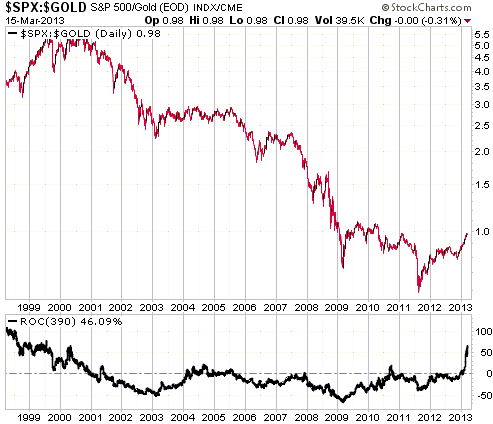
direct some of the new money towards equity purchases. The surprise is that for
the moment the monetary inflation has given equity prices a substantial boost in
REAL terms (in purchasing power terms and relative to gold). This is indicated
by the following daily chart of the S&P500/gold ratio and the S&P500/gold
ratio's 390-day (roughly 18-month) rate-of-change (ROC). There is no evidence in
this chart that the S&P500 Index has ended its secular bear market relative to
gold, but notice that S&P500/gold's 390-day ROC recently hit its highest level
since the major stock market peak and gold trough of 1999-2000.
The market action of the past several months has brought about an unusually-wide
divergence between economic performance and stock market performance. Clearly,
the financial markets are discounting a real recovery in response to
money-pumping. They will be proven wrong, but not necessarily right away.
The Stock
Market
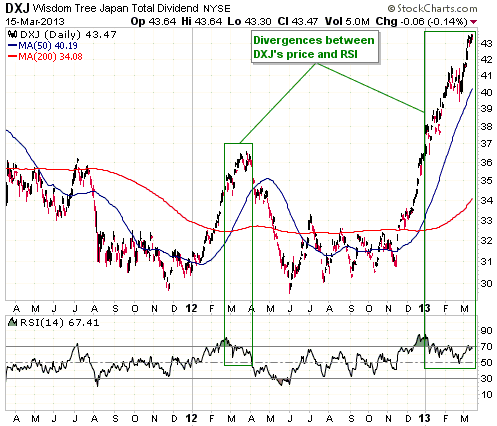
Everyone is bullish on DXJ, a proxy for the
Yen-denominated performance of Japan's stock market (DXJ is quoted in US
dollars, but currency changes are hedged such that DXJ's performance reflects
the performance of the Japanese stock market in Yen terms). Everyone is bullish
on DXJ because everyone knows that the Bank of Japan (BOJ) is going to deviate
from its practice of the past twenty years and inflate the Yen to oblivion.
Everyone knows that this will happen even though the BOJ has a) not yet done
anything different and b) stated that it will not do anything different until at
least early-2014. Everyone also knows that aggressively inflating the Yen will
boost the Japanese economy, even though continued Yen depreciation would greatly
increase Japan's energy-cost burden, reduce productivity due to the price
distortions caused by the inflation, and lead to a sufficiently large rise in
interest rates to bring about a government debt default.
Will everyone be right for the first time in history? Perhaps, but that's not a
good bet.
We are becoming increasingly interested in taking a bearish DXJ position, either
by purchasing August put options or by going short. However, we haven't done
anything yet. Our preference would be to purchase August put options, but the
options are difficult to trade due to insufficient liquidity.
It was an uneventful week for the US stock market. The S&P500 Index ended the
week up 10 points, while the NASDAQ100 Index (NDX) ended the week down 5 points.
The NDX remains near the top of its "rising wedge".
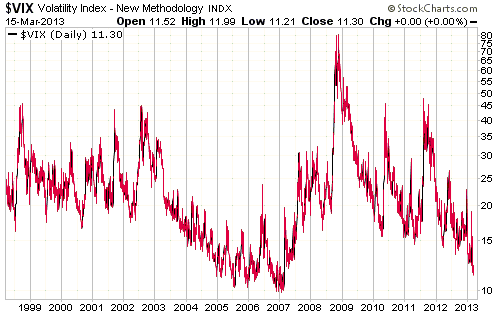
The lack of stock market volatility has led to a decline in the Volatility Index
(VIX) to a new 6-year low (see chart below). Could the VIX move down to the
multi-decade low reached near the end of 2006 and the beginning of 2007?
Possibly, but that would constitute an additional decline of only 10%.
The VIX is almost certainly within 10% of a major low. This suggests a trading
opportunity, but the case for going long the VIX (via an ETN or the futures
market or call options) isn't as 'open and shut' as it superficially seems. One
reason is that the VIX could bounce around near its low for a couple of months,
but the main reason is the substantial "contango" in the VIX futures market. In
effect, the futures market has already priced-in the likelihood of increased
volatility. For example, while the 'cash' VIX ended last week at 11.3, April VIX
futures ended the week at 14.70 and August VIX futures ended the week at 17.9.
This effectively means that the futures market has priced-in a 30% increase in
the VIX over the next month and a 60% increase in the VIX over the next five
months. This doesn't negate the opportunity to profit from going long the VIX,
but it means that traders will have to be very accurate with their timing to
avoid getting 'eaten alive' by the contango.
This week's
important US economic events
| Date |
Description |
| Monday Mar 18 |
Housing Market Index | | Tuesday
Mar 19 |
Housing Starts | | Wednesday
Mar 20 |
FOMC Announcement | | Thursday
Mar 21 |
Existing Home Sales
Philadelphia Fed Survey
Leading Economic Indicators
|
| Friday Mar 22 |
No important events scheduled |
Gold and
the Dollar
Gold
The amount of gold bullion held by GLD, the largest gold ETF, has dropped by
about 120 tonnes since the beginning of this year. Over the same period the US$
gold price has dropped from $1657 to $1595. Of greater interest, since 20th
February the amount of bullion held by GLD has dropped by about 70 tonnes (about
2.1M ounces) while the gold price has RISEN from $1588 to $1595.
The relationship between changes in GLD's bullion holdings and the gold price
hasn't been consistent enough over the years to enable it to be used as a timing
indicator. That GLD's bullion quantity has declined by a significant amount over
the past 4 weeks in parallel with a small rise in the gold price does, however,
support the view that there is a mismatch between gold-market sentiment and
price performance, with sentiment being disproportionately bearish. We say this
because the decline in GLD's holdings means that there has been greater urgency
to sell on the part of GLD holders than on the part of gold
investors/speculators in general, which, in turn, suggests that the 'dumb money'
(the public) has been more eager to sell than the 'smart money'.
The change in GLD's holdings is definitely not something we would rely on, but
it adds to the evidence that the sentiment situation is constructive.
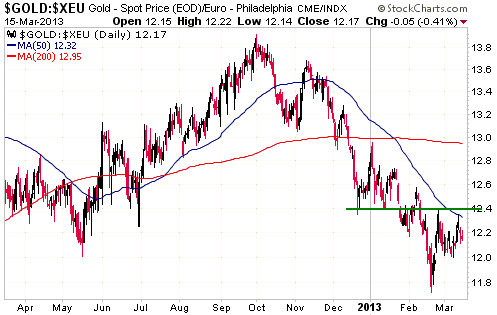
The US$ gold price is struggling with resistance at $1600 and the euro gold
price (gold/euro), a daily chart of which is displayed below, is struggling with
resistance at 1230-1240. If gold/euro manages to close above 1240 in the near
future (a likely outcome), the short-term chart-based target will be 1300.
Gold Stocks
The HUI's performance over the past week was neither bullish nor bearish. The
preceding week's upward reversal was not invalidated, but, at the same time, no
additional evidence of a sustainable price low emerged.
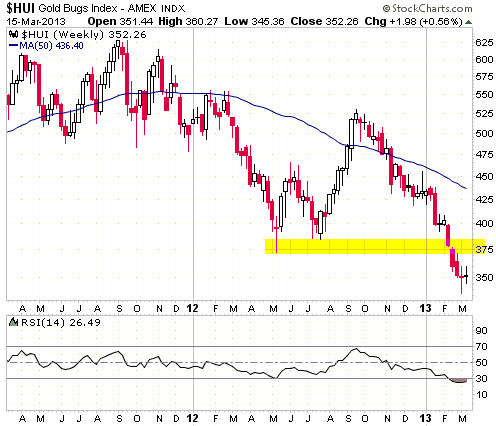
The following weekly chart shows that the HUI remains extremely 'oversold' (as
indicated by the steepness of the decline and the unusually low level of the
weekly RSI displayed at the bottom of the chart), with an important price low
possibly having been put in place during the week before last. A daily close
above the 373-385 resistance range would elevate this possibility to a high
probability.
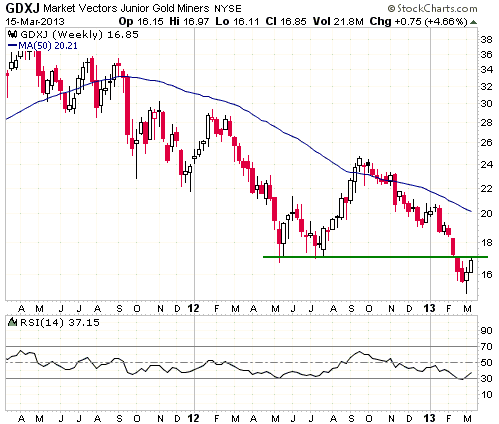
Last week was better for the junior gold miners represented by GDXJ than for the
senior gold miners represented by the HUI. As illustrated by the following
weekly chart, GDXJ built on the preceding week's upward reversal over the course
of last week. It is now testing resistance at $16.73-$17.30, which is the
equivalent of HUI resistance at 373-385.
There's presently a lot of bearish gold-mining commentary doing the rounds. This
is something that always happens near important price lows in any market,
although the proliferation of bearish commentary doesn't guarantee that an
important price low is at hand.
Just keep in mind that after a market has been trending downward for a long time
the price chart will always look ugly and the reason for an imminent reversal
from down to up will never be obvious. That's the nature of a financial market.
Currency Market Update
83 was the chart-based short-term target for the Dollar Index after it broke
above 80.5. After finally reaching this target last week the Dollar Index has
begun to pull back. A normal pullback would take it down to 81.0-81.5.
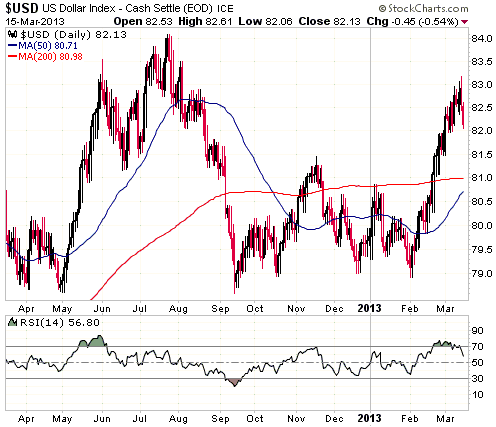
Although the US dollar's recent strength coincided with stock market strength, a
longer and more substantial US$ advance will likely require pronounced stock
market weakness. In particular, we doubt that the Dollar Index will be able to
make a sustained move above last year's high of 84 unless/until the broad stock
market embarks on an intermediate-term downward trend.
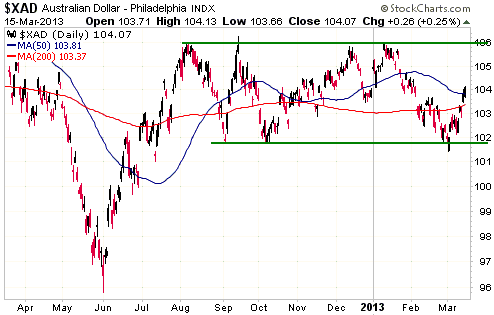
The Australian Dollar (A$) has just bounced from the bottom to the middle of its
8-month horizontal trading range. Sentiment indicators suggest the potential for
the A$ to make additional gains over the next few weeks, but a lot will depend
on the timing of a stock market peak. The period from early-January through to
early-March was strange, in that commodities and the commodity currencies were
weak in parallel with a strengthening broad stock market. However, we doubt that
the A$ will be able to extend its rebound if the stock market begins to trend
downward.
Note that a daily close below support at 101.5-102.0 would suggest that a
decline to 96 (last year's low) was in progress.
Update
on Stock Selections
Notes: 1) To review the complete list of current TSI stock selections, logon at
http://www.speculative-investor.com/new/market_logon.asp
and then click on "Stock Selections" in the menu. When at the Stock
Selections page, click on a stock's symbol to bring-up an archive of
our comments on the stock in question. 2) The Small Stock Watch List is
located at http://www.speculative-investor.com/new/smallstockwatch.html
 Company
news/developments for the week ended Friday 15th March 2013: Company
news/developments for the week ended Friday 15th March 2013:
[Note: FS = Feasibility Study, IRR = Internal Rate of Return, MD&A =
Management Discussion and Analysis, M&I = Measured and Indicated,
NAV = Net Asset Value, NPV(X%) = Net Present Value using a discount
rate of X%, P&P = Proven and Probable, PEA = Preliminary Economic
Assessment, PFS = Pre-Feasibility Study]
*Americas Bullion Royalty Corp. (AMB.TO) announced that it has
received an additional 6.2M shares of Silver Predator Corp. (SPD.TO)
under Silver Predator's option agreement to acquire a 100% interest
in the Taylor Project (a past-producing open-pit silver mine in
Nevada). AMB now owns about 13.8M shares of Silver Predator, or
about 25% of the company. If SPD completes its earn-in to the Taylor
project then AMB will end up with an additional 5M-6M SPD shares,
taking its ownership stake to around 33%. With SPD shares trading at
only C$0.12 the current value of AMB's stake is not significant.
However, this investment could pay-off for AMB in the future.
There was more news from AMB after the close of trading last Friday.
The news was bearish, but not in a big way. We are referring to the
announcement that AMB has arranged a non-brokered private placement
of up to 8.5 million shares at a price of 24 cents per share to
raise up to $2.04M. It's not good that the company is issuing new
equity at such a low price, but the damage is mitigated by the fact
that the placement is small (it will increase the total share count
from 153M to 162M) and includes no stock warrants.
This unexpected placement is possibly a knock-on effect of the delay
to the government approval of the Brewery Creek project discussed in
AMB's
19th February press release. The approval delay could prevent
AMB from drawing additional funds from the
$35M credit facility provided by Red Kite last September.
A typical reaction to this news would result in AMB dropping to the
C$0.24 financing price, creating a much better buying opportunity
than we thought would occur.
*Dragon Mining (DRA.AX) reported the results of drilling below the
current underground workings at its Orivesi gold mine (Orivesi is
one of the two mines that provide ore for the company's Vammala
production centre in Finland). There were some good intercepts,
including 30.8m of 11.1-g/t gold.
DRA is finding enough new gold to sustain its production rate. The
problem is the cost of production.
*Endeavour Mining (EDV.TO, EVR.AX) had two pieces of good news.
First, the final results of in-fill drilling at the company's
development-stage Hounde project in Burkina Faso had numerous good
intercepts, including 73.9m of 5.26 g/t gold and 38.0m of 5.93 g/t
gold. These drilling results probably won't significantly increase
the overall project resource, but they demonstrate continuity of the
mineralisation and should improve the project's economics by
enabling Inferred resources to be upgraded to the M&I category. The
next important milestone for the Hounde project is the completion of
the FS, which is scheduled for late this year.
The other piece of good news was the announcement that the
construction of EDV's Agbaou Gold Mine in Cote d'Ivoire is on-budget
and on-schedule. Initial production is scheduled for Q1-2014.
Although you would never know it by looking at the stock price, EDV
continues to operate very well. Eventually the stock market will
notice.
*Pinetree Capital (PNP.TO) announced that as at February 28, 2013
its per-share net asset value (NAV) was C$1.28. Taking into account
the TSXV market action since 28th February, its current per-share
NAV is probably about C$1.26. This compares to last Friday's closing
price of C$0.62.
*Ramelius Resources (RMS.AX) made two announcements last week,
both of which were positive in a small way.
First, the company reported an initial underground resource of 63K
ounces below the Water Tank Hill pit at its Mt Magnet gold mining
operation. When combined with the previously-defined 62K ounces
below the nearby St George pit, RMS believes that it now has
sufficient resources in close proximity to the existing St George
decline to justify an engineering study to demonstrate the economic
viability of mining these underground resources. It is expected that
the study will be completed during the June quarter.
Second, the company reported that mining of the Western Queen South
deposit, which is located about 90kms from the Mt Magnet mining
operation, has commenced. Western Queen South is expected to add 23K
ounces of production during its 12-month life.
*Sabina Gold and Silver (SBB.TO) had its highest trading volume of
the year and its third-highest trading volume of the past seven
months last Friday. The relatively high volume was almost certainly
related to SBB's deletion from two S&P/TSX indices (as mentioned in
last week's Interim Update). That the stock ended the day only 1c
lower is bullish, considering the downward pressure created by the
selling of index-tracking funds.

*International Tower Hill Mines (THM) reported its results for the
year-ended 31st December 2012 and updated the market on its
progress. Here are the two most important details:
1) THM had $27M of working capital as at 31st December. Based on
budgeted expenditure, this will be enough to fund the company for
another 6-9 months. This means that THM will have to arrange some
sort of financing or strategic alliance before year-end, but
additional financing is not urgently required.
2) The Livengood FS is said to be on schedule and on budget. We
assume this means that the FS will be complete by June-2013.
We don't have a good handle on the economics of the Livengood
project. We doubt that anybody does. The reason is that the most
recent analysis of the project's economics was the updated PEA
completed way back in August of 2011 (THM decided to bypass the PFS
stage and go straight from PEA to FS), and in the mean-time there
have been substantial changes to the mine plan and the costs of
building/operating a mine. We expect the FS to show that the project
is economically robust at a gold price of around $1500/oz and that
THM is extremely under-valued, but the current market obviously
isn't prepared to allow anything for speculative potential.
*Volta Resources (VTR.TO): Company insiders (senior managers and
directors) recently bought 192,000 shares of VTR at C$0.30-$0.31 in
the public market. In dollar terms this isn't a lot, but it's enough
to be considered a positive development. We like it when managers
and directors put their money where their mouths are.
Schedule
of resource updates and economic analyses
The following table is a quick reference for the expected timing of resource
updates and economic analyses (PEA, PFS and FS) for the exploration-stage mining
stocks in the TSI Stock Selections list.
|
Company Name |
Symbol |
Schedule of Resource Estimates & Economic Analyses |
|
Americas Bullion Royalty |
AMB.TO |
a) Brewery Creek Updated Res and PFS: Q2-2013, b) Initial Res for
Duke-Trapper-Royale royalty: Q2-2013 |
|
Asanko Gold |
AKG |
a) Revised PFS: Apr-2013, b) FS: Q3-2013 |
|
Batero Gold |
BAT.V |
a) Updated Res + PEA: Q2-2013, b) FS: Q2-2014 |
|
Carpathian Gold |
CPN.TO |
PFS for Rovina Valley project (Romania): Apr-2013 |
|
Clifton Star Resources |
CFO.V |
a) Updated Res: H2-2013, b) PFS: Mar-2014 |
|
Pilot Gold |
PLG.TO |
|
|
Pretium Resources |
PVG.TO |
a) FS: Jun-2013, b) Bulk Sample Test Results: Q4-2013 |
|
Rio Novo Gold |
RN.TO |
|
|
Sabina Gold & Silver |
SBB.TO |
a) Updated Res: Mar-2013, b) PFS: Q3-2013, c) FS: Q3-2014 |
|
Sandspring Resources |
SSP.V |
Updated Res + PFS: Q1-2013 |
|
International Tower Hill Mines |
THM |
Livengood FS: Jun-2013 |
|
Volta Resources |
VTR.TO |
Kiaka FS: Q3-2013 |
Highest
Priority Buys
The stocks that an individual buys will be determined by his/her current
exposure, financial situation and risk tolerance, but this is roughly how we
would now prioritise TSI gold/silver stocks for new buying (highest priority
first). Stocks not mentioned below have less appeal in the current environment,
but will possibly become higher-priority buys when the market improves.
a) Producers: Endeavour (EDV.TO, EVR.AX), Evolution (EVN.AX), Golden Star (GSS),
Ramelius (RMS.AX).
b) Explorers/Developers: Pretium (PVG), Almaden (AAU), Sabina (SBB.TO), Asanko (AKG),
Americas Bullion Royalty (AMB.TO), Batero (BAT.V), Clifton Star (CFO.V).
Chart Sources
Charts appearing in today's commentary
are courtesy of:
http://stockcharts.com/index.html

|









