|
-- Weekly Market Update for the Week Commencing 18th June 2012
Big Picture
View
Here is a summary of our big picture
view of the markets. Note that our short-term views may differ from our
big picture view.
In nominal dollar terms, the BULL market in US Treasury Bonds
that began in the early 1980s will end by 2013. In real (gold)
terms, bonds commenced a secular BEAR market in 2001 that will continue
until 2014-2020. (Last
update: 23 January 2012)
The stock market, as represented by the S&P500 Index, commenced
a secular BEAR market during the first quarter of 2000, where "secular
bear market" is defined as a long-term downward trend in valuations
(P/E ratios, etc.) and gold-denominated prices. This secular trend will bottom sometime between 2014 and 2020. (Last update: 22 October 2007)
A secular BEAR market in the Dollar
began during the final quarter of 2000 and ended in July of 2008. This
secular bear market will be followed by a multi-year period of range
trading. (Last
update: 09 February 2009)
Gold commenced a
secular bull market relative to all fiat currencies, the CRB Index,
bonds and most stock market indices during 1999-2001. This secular trend will peak sometime between 2014 and 2020. (Last update: 22 October 2007)
Commodities,
as represented by the Continuous Commodity Index (CCI), commenced a
secular BULL market in 2001 in nominal dollar terms. The first major
upward leg in this bull market ended during the first half of 2008, but
a long-term peak won't occur until 2014-2020. In real (gold) terms,
commodities commenced a secular BEAR market in 2001 that will continue
until 2014-2020. (Last
update: 09 February 2009)
Copyright
Reminder
The commentaries that appear at TSI
may not be distributed, in full or in part, without our written permission.
In particular, please note that the posting of extracts from TSI commentaries
at other web sites or providing links to TSI commentaries at other web
sites (for example, at discussion boards) without our written permission
is prohibited.
We reserve the right to immediately
terminate the subscription of any TSI subscriber who distributes the TSI
commentaries without our written permission.
Outlook Summary
Market
|
Short-Term
(0-3 month)
|
Intermediate-Term
(3-12 month)
|
Long-Term
(1-5 Year)
|
| Gold
|
Bullish
(26-Mar-12)
|
Bullish
(26-Mar-12)
|
Bullish
|
| US$ (Dollar Index)
|
Neutral
(28-May-12)
| Neutral
(09-Jan-12)
|
Neutral
(19-Sep-07)
|
| Bonds (US T-Bond)
|
Neutral
(11-Apr-12)
|
Neutral
(18-Jan-12)
|
Bearish
|
| Stock Market
(DJW)
|
Neutral
(25-Apr-12)
|
Bearish
(28-Nov-11)
|
Bearish
|
| Gold Stocks
(HUI)
|
Bullish
(26-Mar-12)
|
Bullish
(23-Jun-10)
|
Bullish
|
| Oil | Neutral
(31-Jan-11) | Neutral
(31-Jan-11)
| Bullish
|
| Industrial Metals
(GYX)
| Neutral
(22-Nov-11)
| Neutral
(29-Aug-11)
| Neutral
(11-Jan-10)
|
Notes:
1. In those cases where we have been able to identify the commentary in
which the most recent outlook change occurred we've put the date of the
commentary below the current outlook.
2. "Neutral", in the above table, means that we either don't have a
firm opinion or that we think risk and reward are roughly in balance with respect to the timeframe in question.
3. Long-term views are determined almost completely by fundamentals,
intermediate-term views by giving an approximately equal weighting to
fundamental and technical factors, and short-term views almost
completely by technicals.
It's risky to anticipate
QE
Gold and "risk" assets rally whenever traders get the faintest scent that more QE (a central bank program designed to increase the money supply) is coming. Our view is that while more QE will eventually happen, buying in anticipation of such a policy move is fraught with danger.
Things are bad enough in the euro-zone (EZ) to justify* more QE at any time. Also, the rate of monetary inflation is low in the EZ, which lends support to the assertion that the ECB could do more good than harm by pumping money into the economy. However, the Fed is not in a position to implement another QE program in the near future, for the following reasons.
First, QE2 is widely (and correctly) perceived as a failure. In particular, a critical mass of people is aware that QE2 elevated the stock market and the cost of living, but did nothing to improve economic conditions for the average person.
Second, with the election less than 5 months away there would be a huge political backlash against the Fed if it initiated a new round of QE without an airtight excuse. To be politically feasible, the QE would have to be in response to a US (not EZ) economic emergency. To put it more clearly, things would have to get much worse for the US economy, the US stock market and/or the US banking system before more Fed QE would become a politically viable option.
Third, given the current grotesque size of its balance sheet the Fed would rather reduce than increase monetary accommodation. That's why the actions it has taken over the past 11 months have changed the mix of items on its balance sheet but haven't increased the balance sheet's overall size. More QE would result in a large increase in the Fed's balance sheet, which the Fed would prefer to avoid if at all possible.
Here is another point worth contemplating. Even if we make the dubious assumption that the Fed is prepared to adjust monetary policy to improve Obama's chances of being re-elected, there is no guarantee that more QE over the months ahead would help achieve such an objective. It could actually achieve the opposite. This is because beyond knee-jerk reactions in all markets, there's a realistic possibility that a new QE program would do nothing other than raise the prices of oil and gold (and silver -- when we say gold we mean gold and silver) while the economy continued to weaken. In fact, the only price that would be sure to make a large and sustainable gain on the back of more QE is the price of gold. There was a preview of what we are talking about on 1st June, when much weaker-than-expected US employment data sparked the idea that more QE was on the way. Gold quickly rose $60 while the prices of most other assets fell.
As an aside, the Fed could take a backdoor approach to increased monetary accommodation by encouraging the commercial banks to lend more money into existence. This is something we discussed last year and could be done by cutting the interest rate paid by the Fed on excess reserves or, if that failed to provide sufficient incentive for the banks to put the reserves to work, charging the banks to hold excess reserves. This course of action could boost the money supply without drawing unwanted political attention to the Fed.
Summing up, the prices of many assets will probably move a lot lower between now and when the Fed announces a new monetary inflation program. Furthermore, if speculators 'jump the gun' and bid up asset prices in anticipation of future Fed-sponsored inflation they will eliminate the justification for the inflation. In other words, the more that prices rise in anticipation of a new round of QE the less reason there will be for central banks to implement a new round of QE.
The upshot is that there is a lot more to be lost than gained by making large purchases of anything in anticipation of QE. A more prudent approach would entail waiting for the formal announcement before establishing QE-related trading positions. The right positioning could then be determined based on market prices at the time.
*Creating money out of nothing is never justified by good economic theory, but there are times when it can be justified based on the flawed theories that dominate the thinking of most policy-makers.
This week's meeting of the
price fixers
The FOMC is scheduled to meet on Tuesday-Wednesday of this week and to issue its updated monetary policy statement on Wednesday afternoon in the US. The statement probably won't announce any new programs of significance, but almost certainly will contain a vague assurance to the effect that the Fed remains willing to act if necessary. "Operation Twist" could be extended, although it will be difficult to justify an extension considering the incredibly low level of long-term interest rates.
Despite the FOMC meeting, over the days ahead most eyes will be focused on Europe and the
ECB.
T-Bond Update
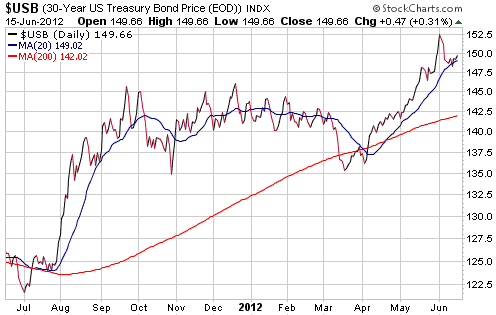
We mentioned in previous commentaries that a break below the 20-day moving average (MA) would be preliminary evidence that an intermediate-term peak is in place for the 30-year T-Bond. The following chart shows that the T-Bond pulled back to this MA during the first half of June, but that a decisive breach has not yet happened.
Due to the precarious overall financial-market situation relating to the EZ crisis, we probably won't be placing any bets against the T-Bond this week even if evidence of a top emerges via a clear-cut breach of the 20-day MA. From our perspective the situation is too uncertain to be making any short-term trades. We are sticking with long-term speculations/investments and cash.
The Stock
Market
The S&P500 Index (SPX) broke above the top of what looks like a short-term basing pattern last Friday. The 'measured target' created by the breakout is 1400, but there is a lot of resistance beginning at 1350.
Displayed below is a daily chart that reflects the current US stock market situation. The top section of the chart shows the SPX, including the short-term resistance at 1335 that was breached on Friday and the longer-term resistance at 1350 that will probably be tested within the next few days. The bottom section of the chart shows the RUT/SPX ratio, an indicator of how small-cap stocks are performing relative to large-cap stocks.
The RUT/SPX ratio generally moves with the SPX, but useful information can be gleaned from the occasions when it either diverges from the SPX or fails to confirm a new high/low in the SPX. For example, RUT/SPX fell while the SPX rose during February (a bearish divergence) and then failed to confirm the SPX's decline to a new multi-month low in May (a bullish non-confirmation). Over the past fortnight the RUT/SPX ratio has diverged bearishly from the SPX, which suggests that this month's rally is more likely to be a counter-trend reaction than the start of a new upward leg.
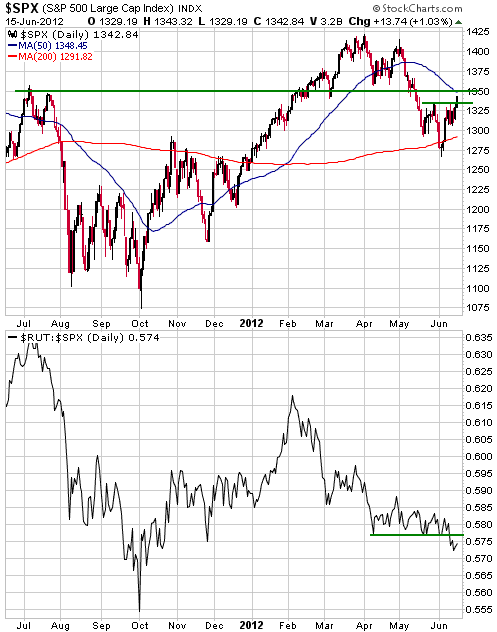
Our view is that the market is in the midst of a counter-trend rebound. In other words, we expect the current rally to end below the March-April peak and to be followed by a decline to new lows for the year. The rally could end immediately or it could continue for long enough to test the high that was made earlier in the year. Neither outcome would surprise us.
This week's
important US economic events
| Date |
Description |
| Monday Jun 18 | Housing
Market Index
| | Tuesday Jun 19 | Housing
Starts
| | Wednesday Jun 20 | FOMC
Statement | | Thursday
Jun 21 |
Existing Home Sales
Philadelphia Fed Survey
Leading Economic Indicators
|
| Friday Jun 22 | No
important events scheduled
|
Gold and
the Dollar
Gold and Silver
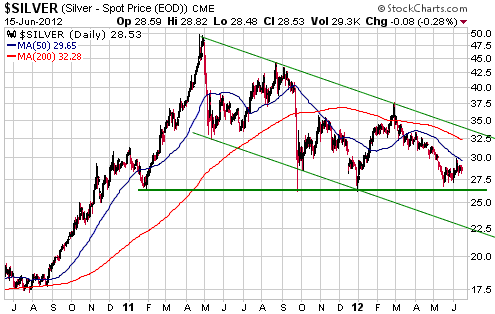
As illustrated below, since peaking in April of 2011 silver has been oscillating within a wide downward-sloping channel. There is a risk that silver will make one more trip to the channel bottom before its correction comes to an end, but there's a higher probability that the ultimate correction low was put in place last September at just above $26.00 and that this low was successfully tested in December-2011 and May-2012.
As far as the next few weeks are concerned, upside potential is probably limited by the channel top and downside potential is probably limited by strong support in the $26-$27 range.
In one respect gold is in a similar position to silver in that it probably bottomed last September and then successfully tested its low in December and May. The difference is that gold benefits to a greater extent than silver from financial-market turmoil, which means that in the current environment it has less downside risk.
We think that gold has maximum short-term upside potential to around $1800 and short-term downside risk to around $1550.
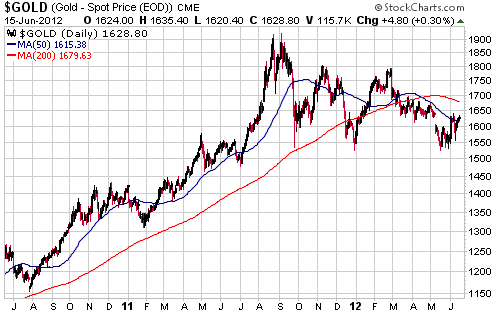
Our view continues to be that while gold and silver have probably bottomed, they are still at least a few months away from commencing their next intermediate-term upward trends in US$ terms. In other words, we are expecting a few more months of 'choppy' price action.
Gold Stocks
Current Market Situation
The gold-stock indices are continuing to consolidate following strong rebounds from their May lows. They are consolidating in currency terms and relative to the broad stock market.
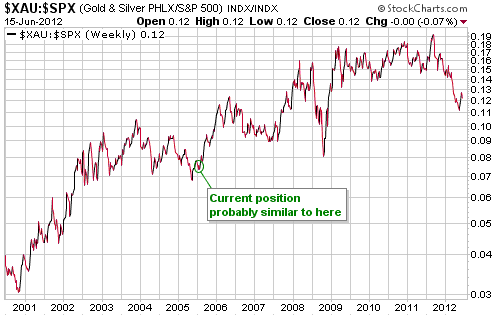
As noted on the following weekly chart of the XAU/SPX ratio, the gold sector's current consolidation relative to the broad stock market looks similar to what happened in June of 2005.
Strange price action on Friday 15th June
Although the XAU and the HUI did very little late last week, many individual gold stocks experienced big price changes and/or heavy volumes. For example, Friday's drama within the ranks of junior and mid-tier gold stocks included:
- Aurcana Corp. (AUN.V) - down 12% on 25x average volume
- AuRico Gold (AUQ) - down 1% on 3x average volume
- Avion Gold (AVR.TO) - up 6% on 3x average volume
- Aurizon Mines (AZK) - down 5% on 5x average volume
- Great Basin Gold (GBG) - down 14% on 10x average volume
- Golden Star Resources (GSS) - down 13% on 4x average volume
- Guyana Goldfields (GUY.TO) - down 13% on 7x average volume
- International Tower Hill Mines (ITH.TO) - down 15% on 8x average volume
- Jaguar Mining (JAG.TO) - down 6% on 7x average volume
- New Gold (NGD) - down 5% on 3x average volume
- Nevsun Resources (NSU) - down 2% on 6x average volume
- Sabina Gold and Silver (SBB.TO) - up 5% on 5x average volume
- Exeter Resource (XRA) - down 9% on 3x average volume
In addition to the unusually large trading volumes of many junior mining stocks, there were some unusually wide bid-ask spreads at the close on Friday. For example, Bear Creek Mining (BCM.V) was quoted C$2.45 bid and C$2.70 ask, Clifton Star (CFO.V) was quoted C$1.09 bid and C$1.28 ask, ITH.TO was quoted C$2.65 bid and C$3.00 ask, and SBB.TO was quoted C$2.11 bid and C$2.40 ask.
None of the above can be explained by company-specific fundamentals or market-wide trends. Clearly, games were being played on Friday that had nothing to do with the merits of the individual stocks involved.
The bulk of Friday's strange high-volume price action appears to stem from changes to the composition of the Junior Gold Miners ETF (GDXJ) and changes to the S&P/TSX Composite, Gold and Mining indices that become effective at the open on 18 June. The index changes are detailed
HERE.
It's likely that Friday's abnormal price moves will be reversed over the next few days.
Currency Market Update
Another harebrained scheme
The European Redemption Pact (ERP) is one of the many schemes that have been talked about as potential solutions to the EZ sovereign debt crisis. Unfortunately, if this scheme gets off the ground it won't solve anything. Fortunately, there is very little chance that it will get off the ground.
As outlined in an article
published in The Telegraph on 29th May, the salient features of the ERP are:
1. EZ governments transfer debt in excess of 60% of GDP into a "sinking fund"
2. The debt is covered by eurobonds issued by the fund
3. A new EZ-wide tax is put in place to pay down the debt over a couple of decades
4. Each government remains responsible for repayment of its own portion of the combined debt and pledges gold/currency reserves amounting to 20% of its eurobond debt as collateral. This means that the eurobonds are partially backed by gold.
There are many problems with this proposed scheme for making government debt burdens more manageable. First, it would apply the same logic that contributed to the mortgage-finance bubble and collapse in the US. The logic is that you can magically transform junk debt into investment-grade debt by lumping debts of varying quality into a single security. In effect, a gold-backed eurobond would be a type of CDO. Second, it would involve a new tax, which is the last thing that troubled EZ economies need. Third, the EZ governments with the most serious debt problems would not be able to provide sufficient collateral. For example, Ireland has almost no gold (it has 6 tonnes, which has a current market value of only 240M euros), Greece has only 4.5B euros of gold, and Spain has only 11.2B euros of gold. Of the countries that appear to be closest to the financial precipice, Italy has by far the most gold. However, the current market value of Italy's 2,451-tonnes of gold is still less than half the amount it would need to cover 20% of its excess debt (the debt above 60% of GDP). Fourth, if a heavily-indebted government has access to a large gold reserve, why would it pledge this reserve to a fund controlled by another government or group of governments? If it wanted to put its gold reserve to use in reducing its debt burden, it could simply issue its own gold-backed bonds. Fifth, we assume that each country would retain physical possession of the gold put up as collateral, which raises the question: what happens if a government fails to make its payments to the fund and refuses to cough-up the collateral?
Of greatest importance, however, is that in the unlikely event that the ERP was implemented it would be another big step in the wrong direction. It would be another case of channeling resources from the rest of the economy to prevent bondholders from taking losses on their investments.
Our advice to Europe's political leadership: Default on the debt and let bondholders bear the consequences of their bad investments. Stop concocting new ways of shifting these consequences onto everyone else.
Current Market Situation
The betting is that the pro-bailout New Democracy party will be first past the post in Greece's election and that the anti-bailout Syriza party will come in second. This is undoubtedly part of the reason that stock markets and the euro strengthened late last week. Traders were also made to feel more bullish by a rumour that central banks were ready to act if the results of Greece's election led to financial-market turmoil. It seems that in the minds of some traders, this rumour transformed a Syriza victory from a potential minus to a potential plus.
We wonder why such rumours are given any credence. This is not because they are clearly false, but because central banks are ALWAYS ready to act (pump money) if the perceived need arises.
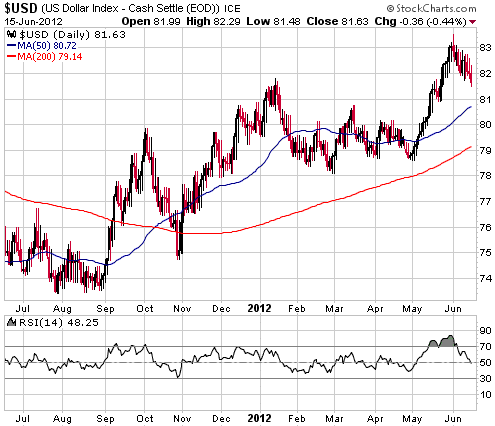
The following chart shows that the Dollar Index commenced a downward correction on 1st June. Not coincidentally, this is also when the stock market commenced an upward correction. If the stock market's upward correction continues, then so will the dollar's downward correction.
Update
on Stock Selections
Notes: 1) To review the complete list of current TSI stock selections, logon at
http://www.speculative-investor.com/new/market_logon.asp
and then click on "Stock Selections" in the menu. When at the Stock
Selections page, click on a stock's symbol to bring-up an archive of
our comments on the stock in question. 2) The Small Stock Watch List is
located at http://www.speculative-investor.com/new/smallstockwatch.html
 A bigger variety of speculations will probably be of interest later this year, but at this time there isn't much to do except pick away at high-potential gold juniors as opportunities present themselves. A bigger variety of speculations will probably be of interest later this year, but at this time there isn't much to do except pick away at high-potential gold juniors as opportunities present themselves.
Short-term buying opportunities have been created by last Friday's reactions to index changes. The two we'll single out are Golden Star Resources (GSS) and International Tower Hill Mines (THM). If these stocks are still available near Friday's closes when trading resumes on Monday, some buying would definitely be appropriate for anyone wanting to build-up their exposure.
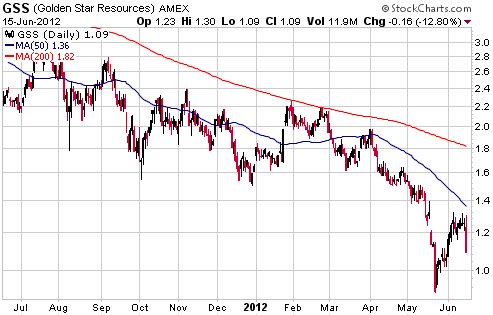
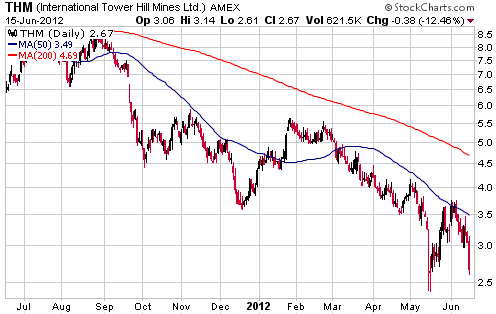
Chart Sources
Charts appearing in today's commentary
are courtesy of:
http://stockcharts.com/index.html

|









