|
-- Weekly Market Update for the Week Commencing
18th August 2014
Big Picture
View
Here is a summary of our big picture
view of the markets. Note that our short-term views may differ from our
big picture view.
In nominal dollar terms, the BULL market in US Treasury Bonds
that began in the early 1980s ended in 2012. In real (gold)
terms, bonds commenced a secular BEAR market in 2001 that will continue
until 2018-2020. (Last
update: 20 January 2014)
The stock market, as represented by the S&P500 Index,
commenced
a secular BEAR market during the first quarter of 2000, where "secular
bear market" is defined as a long-term downward trend in valuations
(P/E ratios, etc.) and gold-denominated prices. This secular trend will bottom sometime between 2014 and 2020.
(Last update: 22 October 2007)
A secular BEAR market in the Dollar
began during the final quarter of 2000 and ended in July of 2008. This
secular bear market will be followed by a multi-year period of range
trading.
(Last
update: 09 February 2009)
Gold commenced a
secular bull market relative to all fiat currencies, the CRB Index,
bonds and most stock market indices during 1999-2001.
This secular trend will peak sometime between 2014 and 2020.
(Last update: 22 October 2007)
Commodities,
as represented by the Continuous Commodity Index (CCI), commenced a
secular BULL market in 2001 in nominal dollar terms. The first major
upward leg in this bull market ended during the first half of 2008, but
a long-term peak won't occur until 2014-2020. In real (gold) terms,
commodities commenced a secular BEAR market in 2001 that will continue
until 2014-2020.
(Last
update: 09 February 2009)
Copyright
Reminder
The commentaries that appear at TSI
may not be distributed, in full or in part, without our written permission.
In particular, please note that the posting of extracts from TSI commentaries
at other web sites or providing links to TSI commentaries at other web
sites (for example, at discussion boards) without our written permission
is prohibited.
We reserve the right to immediately
terminate the subscription of any TSI subscriber who distributes the TSI
commentaries without our written permission.
Outlook Summary
Market
|
Short-Term
(1-3 month)
|
Intermediate-Term
(6-12 month)
|
Long-Term
(2-5 Year)
|
|
Gold
|
Bullish
(10-Jun-14) |
Bullish
(26-Mar-12) |
Bullish
|
|
US$ (Dollar Index)
|
Neutral
(10-Jul-14) |
Neutral
(10-Jul-14) |
Neutral
(19-Sep-07) |
|
Bonds (US T-Bond)
|
Neutral
(18-Aug-14)
|
Neutral
(18-Jan-12)
|
Bearish |
|
Stock Market
(DJW)
|
Bearish
(07-Apr-14) |
Bearish
(28-Nov-11) |
Bearish
|
|
Gold Stocks
(HUI)
|
Bullish
(10-Jun-14) |
Bullish
(23-Jun-10) |
Bullish
|
|
Oil |
Neutral
(02-Jun-14) |
Neutral
(31-Jan-11) |
Bullish
|
|
Industrial Metals
(GYX)
|
Neutral
(17-Feb-14) |
Bullish
(28-Apr-14) |
Bullish
(28-Apr-14) |
Notes:
1. The date shown below the current outlook is when the most recent outlook change occurred.
2. "Neutral", in the above table, means that we either don't have a
firm opinion or that we think risk and reward are roughly in balance with respect to the timeframe in question.
3. Long-term views are determined almost completely by fundamentals,
intermediate-term views by
fundamentals, sentiment and technicals, and short-term views by sentiment and
technicals.
Keynesian Economics and the imaginary "savings glut"
Looking at the world through a Keynesian lens is worse than
being totally uninformed about economics. If you are uninformed then
in all likelihood you will be well aware that you know nothing. You
will be under no illusions. However, if you have been indoctrinated
with Keynesian economic theories then what you see will often be the
opposite of reality, but at the same time you will be blissfully
unaware that your interpretation is very different from the way
things actually are. This will cause you to come up with nonsensical
explanations, a classic example being the "savings glut".
The "savings glut" was concocted by uber-Keynesian Ben Bernanke, and
eagerly embraced by the shifty Alan Greenspan, to explain the
seemingly endless demand for US mortgage-related debt and
low-quality interest-bearing securities during 2002-2006. According
to this view of the world, the 2002-2006 boom in the US credit
market and the associated boom in the stock market occurred because
$10/day Chinese factory workers living 20-to-a-room were saving too
much money. That, in simple terms, is what the past two Chairmen of
the Federal Reserve either believed (in Bernanke's case) or claimed
to believe because it was convenient (in Greenspan's case). It's
little wonder that US monetary policy has wreaked so much havoc over
the past 12 years.
In the real world, a "savings glut" is not possible. Saving is such
an important, foundational part of the economic growth process that
a sustainable increase in per-capita wealth cannot happen without an
increase in saving. To claim that there is too much saving is
therefore akin to claiming that living standards are rising too
quickly or that poverty is being eradicated too quickly. However,
"savings glut" is the sort of explanation that you could come up
with if you don't understand how ramping up the money supply and
suppressing interest rates affects the economy and the financial
markets.
The outcomes that Bernanke and many Keynesian economists blame on an
imaginary "savings glut" are actually caused by a money glut, or, to
be more accurate, rapid growth in the money supply. The reason is
that when money is created out of nothing at a fast pace it can
cause the essential links between consumption, long-term investment
and interest rates to break. Rather than a general increase in the
propensity to consume in the present leading to higher interest
rates and reduced long-term investment, a constant stream of new
money can enable interest rates to remain low in the face of
increasing eagerness to consume. The impression is thus created that
no trade-off is necessary, as both current consumption and long-term
investment rise in parallel. There is plenty of money or credit for
buying new consumer goods such as houses, cars, TV sets, furniture,
and clothes, and at the same time there is plenty of money or credit
to embark on capital-intensive long-term projects and to speculate
in stocks and bonds. It seems that the problem of scarcity has been
solved, and all it took was for central bankers and/or private
bankers to type a bunch of numbers into their computers. Why didn't
anyone think of it before?
Even a trade deficit, which is never a problem in and of itself, can
be symptomatic of rapid monetary inflation, because the ramp-up in
current consumption fueled by the easy money can result in greater
spending on imported goods. The important word here is
"symptomatic", because the problem is the domestic creation of new
money out of nothing, not the fact that some of the new money gets
exchanged for goods manufactured outside the country. With the
exception of a tiny portion that gets tucked away in mattresses, all
newly created money will get spent or invested, and then spent or
invested again, and again, and again.
Unfortunately, for reasons we've discussed numerous times in the
past, an economic boom fueled by monetary inflation is
self-defeating. It leads to a bust, and the economy ends up in a
much worse state than it would have been if the boom had never
occurred. To understand why this must be so, you need to look
through the lens of good economic theory. Of particular relevance to
this discussion, you cannot possibly understand the situation by
looking through a Keynesian lens, because if you do then what you
will see is a world where consumption comes first and therefore
doesn't have to be funded by anything, where unproductive spending
is just as beneficial as productive spending, and where saving is
bad if too many people are doing it. That is, you won't see the real
world.
Trying to understand the way the world works by starting with
Keynesian premises is like trying to understand the movements of the
planets by assuming that everything revolves around Earth. You end
up with a very complicated load of nonsense.
T-Bonds continue to defy almost
everyone's expectations
One of the main reasons that T-Bonds continue to
rise in price (fall in yield) is that most speculators continue to bet on a
price decline (a rise in long-term interest rates). In other words, the
sentiment backdrop remains supportive. It's worth noting, for example, that
despite the strong and consistent upward trend of the past 9 months, there is
still a substantial speculative net-short position across the 30-year T-Bond and
10-year T-Note futures markets. Therefore, higher T-Bond/T-Note prices and lower
long-term interest rates probably lie in store.
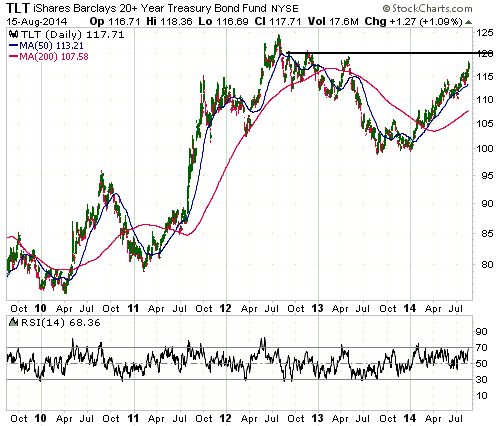
That being said, the iShares 20+ Year Treasury ETF (TLT) is now a) very
'overbought' by some measures (momentum, not sentiment), b) within 2% of
intermediate-term resistance at 120, and c) within 6% of its mid-2012 all-time
high. A test of resistance at 120 will almost surely happen and a test of the
all-time high will possibly happen prior to the next intermediate-term peak, but
a sustained break into all-time-high territory is very unlikely.
We were short-term bullish on US Treasury bonds from mid-December of last year
through to the end of last week. However, due to the extent to which the market
is 'overbought' and our opinion that the remaining upside potential is
relatively small, as of now we are short-term "neutral".
Just to be clear, we expect to see additional gains in the T-Bond price and
additional declines in the T-Bond yield over the next few months, but the
short-term risk/reward is no longer skewed towards reward. It is also not skewed
towards risk, meaning that the point hasn't yet been reached where it makes
sense to bet against this market.The Stock
Market
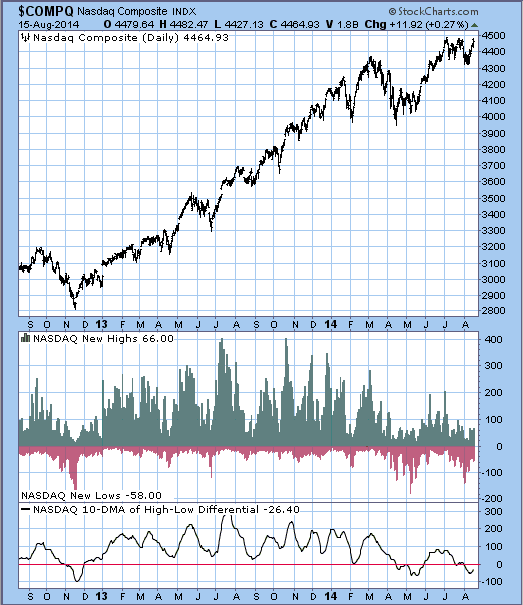
The following chart shows the NASDAQ
Composite Index, the numbers of individual NASDAQ stocks making new 52-week
highs and lows, and a 10-day moving average of the NASDAQ's high-low
differential. The chart tells us that:
1. Although the NASDAQ tested its July-2014 multi-year high last Friday, on the
same day only 66 NASDAQ stocks made new highs for the year. This contrasts with
200 new highs in early July and 400 new highs last October.
2. Despite last Friday's rise by the NASDAQ to its multi-year high, the 10-day
MA of the NASDAQ's high-low differential is not far above its low of the past 2
years.
The point is that the NASDAQ's rise is getting narrower and narrower. This is
something that often happens near the end of a bull market.
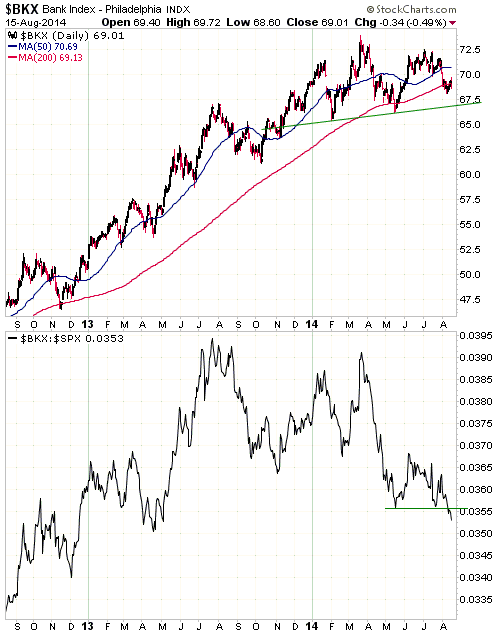
The next chart shows the Bank Index (BKX) and the BKX/SPX ratio (major bank
stocks relative to the broad stock market). In nominal terms, the BKX's
performance over the past 9 months looks like a major topping pattern. A weekly
close below 67 would confirm this interpretation. In relative strength terms,
the BKX appears to have peaked in July of last year and to have completed a
major topping pattern in April of this year.
The S&P500's recovery from its early-August low has now gone as far as it should
go if it is a counter-trend move.
This week's
important US economic events
| Date |
Description |
| Monday Aug 18 |
No important events scheduled | | Tuesday
Aug 19 |
CPI
Housing Starts | | Wednesday
Aug 20 |
FOMC Minutes | | Thursday
Aug 21 |
Philadelphia Fed Survey
Existing Home Sales
Leading Economic Indicators
|
| Friday Aug 22 |
No important events scheduled |
Gold and
the Dollar
Gold
Fundamentals
Gold's fundamental drivers are not uniformly bullish at this time (there is
rarely a time when they are), but as a group they are clearly still bullish. Of
particular importance:
1) The decline in long-term interest rates has caused the US 10yr-2yr yield
spread to contract to the point where this fundamental gold driver has shifted
from bullish to neutral. We suspect that it will become slightly more negative
for gold over the months ahead as the 10-year yield continues its downward trend
in absolute terms and relative to the 2-year yield.
2) The decline in long-term interest rates has also caused the real interest
rate to decline, resulting in the real interest-rate backdrop becoming more
gold-bullish. Furthermore, inflation expectations are unlikely to decline over
the next few months, so any additional reduction in the nominal long-term
interest rate should cause the real long-term interest rate to fall and be
supportive for gold. In effect, the bearish influence stemming from the
narrowing of the yield-spread is being counteracted by a decline in the real
interest rate.
3) As long as the Dollar Index continues to oscillate between 79.0 and 81.5, the
US dollar's exchange rate will be gold-neutral.
4) Last week's decline in the BKX/SPX ratio to a new 12-month low confirms that
the banking sector's relative performance remains decidedly gold-bullish.
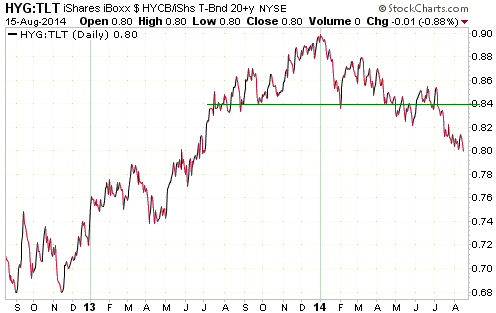
5) The following chart shows that the HYG/TLT ratio broke to a new 12-month low
last week, which means that credit spreads are continuing to widen. This is
decidedly gold-bullish.
Sentiment
The latest Commitments of Traders (COT) data show that the speculative net-long
position is still near its 12-month high. This means that speculative sentiment
remains a little stretched in the direction of short-term optimism, which
creates some downside risk but doesn't present a big problem when considered
alongside other indicators.
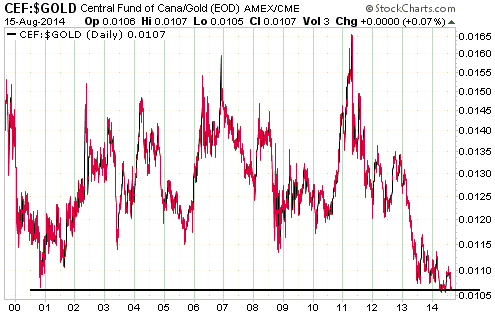
At the same time, the following chart shows that the CEF/gold ratio (the unit
price of the Central Fund of Canada, a gold and silver bullion fund, divided by
the gold price) remains near a 20-year low. This long-term sentiment indicator
is therefore still flashing a major buy signal.
Price Action
On a daily closing basis the gold price barely moved over the course of last
week. However, there was an intra-day spike up to test resistance near $1325 on
Thursday and then an intra-day spike down to the low-$1290s on Friday. At the
end of the week, gold was still above $1300 and still above its 65-week moving
average.
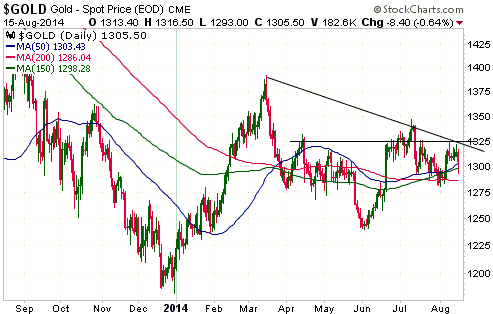
Gold needs to close above $1325 to remove most of the remaining doubt that a
rally to new highs for the year is underway. Until it does so, the short-term
gold bears will have some hope. We expect this hope to be extinguished within
the coming fortnight.
Silver
Silver closed at a new multi-week low last Friday. On a short-term basis it is
now very 'oversold' in dollar terms and relative to gold. Moreover, the
pronounced divergence between the silver price and the SIL/silver ratio that was
discussed in last week's Interim Update suggests that a short-term price low is
close at hand.

The Central Fund of Canada (CEF) is currently one of the best ways to obtain
exposure to precious metals, because:
a) CEF provides roughly equal exposure to gold and silver
b) CEF is trading at a 5.4% discount to its net asset value
c) Relative to gold, CEF is almost as cheap as it ever gets
Gold Stocks
Current Market Situation
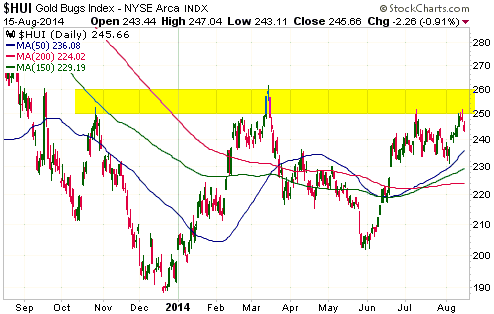
Since peaking in July, the HUI has essentially drifted sideways. This sideways
or slightly-downward drift looks like a run-of-the-mill short-term
consolidation, but we get the impression that it has caused considerable
consternation.
The resistance on the HUI chart (see below) that begins at 250 and extends up to
260 is very important and very obvious. It's therefore not surprising that moves
up to this resistance have, to date, prompted a sufficient increase in selling
pressure to cap the up-moves. At the same time, prices now appear to be well
supported just below current levels, which is preventing price declines from
gaining any traction.
Last Friday's price action was slightly bullish, for two reasons. First, gold's
break below $1300 early in the day did not lead to substantial weakness in
gold-mining stocks. In fact, we placed a few gold-stock buy orders just below
the market prior to the start of trading on Friday with the aim of catching a
downward spike, but not one of these orders was filled. Second, Friday's small
declines in the HUI and the gold price were accompanied by a small rise in GDXJ,
resulting in the GDXJ/GDX ratio ticking upward on the day. It's possible that
GDXJ has just completed another successful test of its 50-day MA.
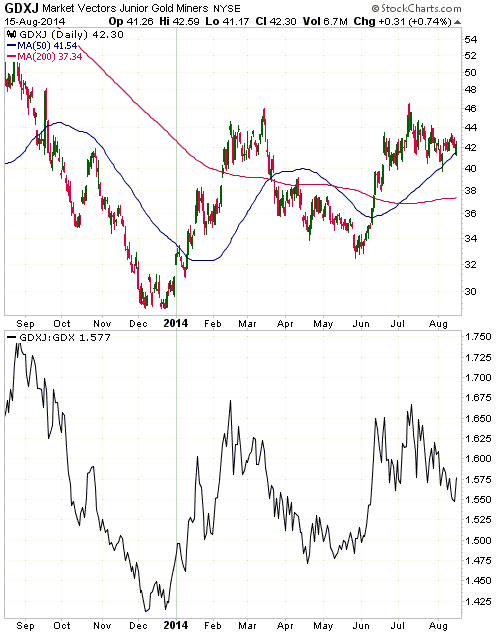
We expect resistance at 250 for the HUI and equivalent resistance at $45-$46 for
GDXJ to be breached before the end of this month.
Senior Gold Miners
We don't plan on publishing any detailed analysis of the senior gold-mining
stocks or adding any such stocks to the TSI List as long-term positions. For
information purposes, we just want to point out that Gold Fields Ltd (GFI) and
Kinross Gold (KGC) offer the best value within the realm of >1M-oz/year gold
producers.
Comparing GFI and KGC, at current prices KGC has the advantage of having a
slightly lower valuation. It also has the advantages of a 10%-lower all-in
sustaining cost per ounce and a stronger balance sheet. However, GFI has much
lower country risk than KGC, with GFI now getting less than 15% of its
production from high-risk South Africa and almost half of its production from
Australia (the lowest-risk country for mining), and KGC having its most valuable
assets in Russia (one of the highest-risk countries for mining). In our opinion,
the country-risk situation gives GFI a slight edge over KGC.
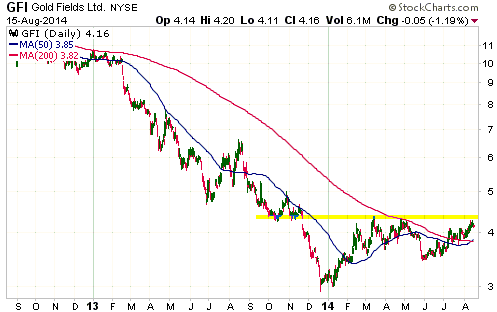
GFI is close to completing a major basing pattern (see chart below). Chart
huggers sometimes refer to this pattern as a "cup and handle".
A solid break above the top of the basing pattern would suggest a target of
US$6.00-$6.50. This target could be reached in 2014, although it is more
realistic to think of it as a viable 12-month objective.
The Currency Market
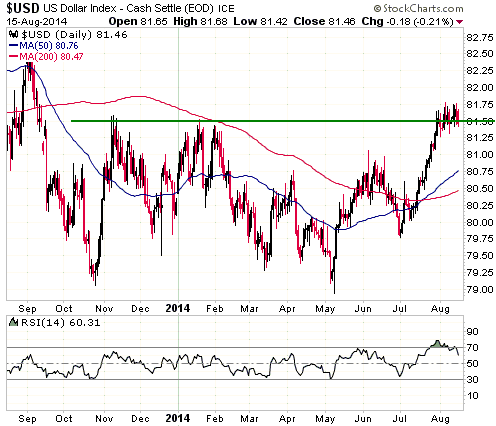
For the third week in a row, the Dollar Index failed to achieve a weekly close
above 81.5 after trading above 81.5 during the week. Last week it closed at
81.46. The week before last it also closed at 81.46, and the week before that it
closed at 81.43. Obviously, 81.5 is an important resistance level.
The Dollar Index's inability to achieve a weekly close above 81.5 means that
there isn't yet clear-cut evidence that its intermediate-term trend has reversed
upward, which, in turn, means that the scenario involving a final decline to the
low-70s remains alive. However, it should not be construed as bearish price
action. The fact is that by late last month the Dollar Index had become very
'overbought' on a short-term basis and was likely to consolidate for a few weeks
regardless of whether or not its intermediate-term trend had reversed up.
The Dollar Index has so far failed to decisively break above resistance at 81.5,
but the RSI included at the bottom of the following daily chart shows that the
sideways movement of the past 2-3 weeks has partly addressed the 'overbought'
condition.
We remain short- and intermediate-term "neutral" on the Dollar Index, waiting
for the market to 'tip its hand'.
Updates
on Stock Selections
Notes: 1) To review the complete list of current TSI stock selections, logon at
http://www.speculative-investor.com/new/market_logon.asp
and then click on "Stock Selections" in the menu. When at the Stock
Selections page, click on a stock's symbol to bring-up an archive of
our comments on the stock in question. 2) The Small Stock Watch List is
located at http://www.speculative-investor.com/new/smallstockwatch.html
 Company
news/developments for the week ended Friday 15th August 2014: Company
news/developments for the week ended Friday 15th August 2014:
[Note: AISC = All-In Sustaining Cost, FS = Feasibility Study, IRR = Internal
Rate of Return, MD&A = Management Discussion and Analysis, M&I = Measured and
Indicated, NAV = Net Asset Value, NPV(X%) = Net Present Value using a discount
rate of X%, P&P = Proven and Probable, PEA = Preliminary Economic Assessment,
PFS = Pre-Feasibility Study]
*Almaden Minerals (AAU) published its financial results for the
June quarter. Taking into account the balance sheet in the financial statements,
the spending that would have occurred since 30th June and the equity financing
completed at the end of last month, the company should currently have about
C$15M of working capital. This means that AAU should be fully funded for the
next 12 months.
AAU also reported some drilling results, the most notable of which was an
intercept of 2m grading 26-g/t gold from just outside the currently defined
deposit. Additional drilling is needed to determine the significance of this
intercept.
*Asanko Gold (AKG) published its financial results for the June
quarter. Based on these results we estimate that the company now has about
US$220M of working capital. It also has $150M of undrawn credit, which means
that it has access to about US$370M. The development of Phase 1 of the Asanko
gold mine (Ghana) is expected to cost about $290M, so AKG is fully funded
through to production.
*Endeavour Mining (EDV.TO, EVR.AX) published its financial results
for the June quarter. Despite having an excellent quarter in production terms,
EDV did no better than break even in bottom-line profit terms and suffered a
small ($6M) deterioration in its balance sheet.
Clearly, EDV can fully cover its costs at $1300/oz, which is more than many
other gold producers are capable of doing. However, it will need a gold price of
at least $1400/oz to become genuinely and meaningfully profitable.
*Energy Fuels (EFR.TO, UUUU), one of the two uranium stocks in the
TSI List, published its financial results for the June quarter and provided
updated guidance.
At the end of the June quarter EFR had working capital of $42M, which is
unchanged from the end of the preceding quarter. To ensure that it maintains a
healthy working-capital position during the indeterminable period between now
and when the spot uranium price moves above the company's production cost, EFR
will place its White Mesa Mill on standby following the completion of the
current mill run in the fourth quarter of this year. At that time the company
will have sufficient inventory to fulfill all of its existing long-term
contracts that must be met with produced pounds through 2017. It will then
deliver the inventory into these contracts, receiving a minimum of $57/pound.
For the contracts that don't have to be met with the company's own production,
EFR will purchase material in the spot market. Currently, purchasing in the spot
market for sale into long-term contracts yields a gross profit of about
$27/pound.
This is a reasonable course of action. It will enable EFR to conserve its cash
and weather the depressed conditions in the uranium market. After the uranium
price recovers, the White Mesa Mill will be restarted.
*Lydian International (LYD.TO) published its financial results for
the June quarter. The company has about US$20M of working capital, which should
be more than enough to get it to the point where a decision can be made to
construct a mine at the Amulsar gold project in Armenia.
The MD&A that accompanied LYD's quarterly financial results indicated that the
updated FS for the Amulsar project will be completed during Q3-2014 (that is, by
the end of next month). Although LYD currently offers very good value based on
the initial (September-2012) FS and appears to be 'oversold' within a long-term
basing pattern, we would hold off on new buying until after the updated FS is
published. The results of the updated FS will determine our next move with this
stock.
*Premier Gold (PG.TO) published its financial results for the June
quarter. Based on these results, the $21M asset purchase announced during the
week before last and the spending carried out since 30th June, we estimate that
working capital is now around $35M. Assuming PG doesn't make any more
substantial asset purchases, this should be enough to fund its operations for at
least the next 12 months.
*Pilot Gold (PLG.TO) published its financial results for the June
quarter. Based on the balance sheet at the end of June, we estimate that PLG
currently has about $27M of working capital. This should be enough to fully fund
the company for at least the next 12 months.
*Pretium Resources (PVG) has issued another 1M shares at
US$7.25/share as part of the equity financing completed about three weeks ago.
This was due to the underwriters exercising their Over-Allotment Option in full
-- a sign that there is strong demand for PVG shares at US$7.25.
Also, PVG has raised an additional US$3.5M by issuing 496K new shares to Liberty
Metals. This small financing stems from Liberty's right to maintain its pro-rata
stake in the company.
*True Gold Mining (TGM.V) announced that it has entered into a
"streaming deal" with a joint venture owned 75% by Franco Nevada and 25% by
Sandstorm Gold (hereafter called the "Streaming JV" or "SJV"). Before we get to
the details of TGM's deal, here's what we wrote in the 14th April 2014 Weekly
Update about this type of deal:
"In a market environment where debt and equity financing is often either
expensive or difficult for a junior gold (or silver) miner to obtain, a
streaming deal can look attractive. This is a deal whereby a miner sells the
right to purchase part of its future production at a very low price (usually no
more than $400/oz for gold) in exchange for an upfront payment, with the upfront
payment generally being used to finance the development or expansion of a mine.
The company buying the future production "stream" will typically be Franco
Nevada (FNV), Royal Gold (RGLD), Silver Wheaton (SLV) or Sandstorm Gold (SAND).
While a "streaming" deal can look like a reasonable way for a junior miner to
meet its short-term financing needs at the cost of reduced future profitability,
the risk is that by entering into the streaming deal the junior miner has
completely relinquished its opportunity to make a profit in the future. This is
because most gold mines have slim profit margins after all costs are accounted
for. Due to these typically-slim margins, a miner that agrees to sell 10%-20% of
its future production to a royalty or streaming company at a nominal price could
end up with nothing for its own stockholders even if it doesn't encounter major
operational problems. In effect, the mine could end up being operated solely for
the benefit of the royalty/streaming company."
Under the streaming deal announced last week, TGM will receive US$100M up front
to fund the development of the 100K-oz/year Karma gold mine in Burkina Faso in
exchange for:
1. A commitment to sell 20K ounces of gold per year, over the first 5 years of
production (2016-2020), to the SJV at 20% of the spot gold price.
2. A commitment to sell 6.5% of Karma gold production, from year 6 onward for
the life of the mine, to the SJV at 20% of the spot gold price.
At a gold price of $1500/oz, the SJV would get $120M over 5 years ($150M of gold
minus 20%) plus the 6.5% life-of-mine gold stream. Considering the time value of
money, $120M spread over 5 years beginning in 2016 is worth less than $100M in
the hand today. This means that at a gold price of $1500/oz or lower, the upside
for the SJV would be solely in the 6.5% royalty that takes effect in 2021.
Consequently, given the risks involved we would view this as a good deal for TGM
assuming an average gold price of $1500/oz or lower over the next 7 years.
However, we think that the gold price is headed much higher and will be over
$2000/oz by 2018. Assuming an average price of $2000/oz, the $100M that TGM is
receiving up front is worth substantially less than the "gold stream" without
even taking into account the 6.5% stream that takes effect in the sixth year of
production.
Because we are long-term bullish on gold, we don't like the way that TGM has
gone about financing its mine construction. The fact is that going down the
"streaming" route to complete the financing of the Karma project (TGM should now
have $160M-$170M, or $30M-$40M more than Karma's initial capex estimate) removes
a lot of the gold-price-related upside potential.
By expanding the Karma mine's production rate, TGM could add back some of the
upside potential removed by the "steaming" deal. The exploration results
achieved to date suggest that the mine WILL get bigger, but the details are
unknown at this time. Furthermore, TGM could add back ALL of the upside
potential removed by the "steaming" deal by purchasing $1500 gold call options
covering 20K ounces per year from 2016 through to 2020. For some unknown reason,
however, it is almost unheard of for gold mining companies with forward sales
commitments to use call options to mitigate the risk that would be created,
and/or the opportunity cost that would be incurred, due to a rising gold price.
Jumping to the conclusion: It's good that TGM has removed uncertainty by putting
in place the additional financing needed to take its project through to
production, but we will now be quicker to sell this stock unless it can recoup
the upside potential that has been given up as part of the financing.
List of candidates for new buying
From within the ranks of TSI stock selections, the best candidates
for new buying at this time are:
1) AAU at US$1.45 or lower (last Friday's closing price: US$1.49).
2) EDV.TO (last Friday's closing price: C$0.89).
3) EVN.AX (last Friday's closing price: A$0.75).
4) PLG.TO (last Friday's closing price: C$1.39).
5) TGM.V at C$0.42 or lower (last Friday's closing price: C$0.44).
Chart Sources
Charts appearing in today's commentary
are courtesy of:
http://stockcharts.com/index.html

|









