|
-- Weekly Market Update for the Week Commencing
19th January 2015
Big Picture
View
Here is a summary of our big picture
view of the markets. Note that our short-term views may differ from our
big picture view.
In nominal dollar terms, the BULL market in US Treasury Bonds
that began in the early 1980s ended in 2012. In real (gold)
terms, bonds commenced a secular BEAR market in 2001 that will continue
until 2018-2020. (Last
update: 20 January 2014)
The stock market, as represented by the S&P500 Index,
commenced
a secular BEAR market during the first quarter of 2000, where "secular
bear market" is defined as a long-term downward trend in valuations
(P/E ratios, etc.) and gold-denominated prices. This secular trend will bottom sometime between 2014 and 2020.
(Last update: 22 October 2007)
A secular BEAR market in the Dollar
began during the final quarter of 2000 and ended in July of 2008. This
secular bear market will be followed by a multi-year period of range
trading.
(Last
update: 09 February 2009)
Gold commenced a
secular bull market relative to all fiat currencies, the CRB Index,
bonds and most stock market indices during 1999-2001.
This secular trend will peak sometime between 2014 and 2020.
(Last update: 22 October 2007)
Commodities,
as represented by the Continuous Commodity Index (CCI), commenced a
secular BULL market in 2001 in nominal dollar terms. The first major
upward leg in this bull market ended during the first half of 2008, but
a long-term peak won't occur until 2014-2020. In real (gold) terms,
commodities commenced a secular BEAR market in 2001 that will continue
until 2014-2020.
(Last
update: 09 February 2009)
Copyright
Reminder
The commentaries that appear at TSI
may not be distributed, in full or in part, without our written permission.
In particular, please note that the posting of extracts from TSI commentaries
at other web sites or providing links to TSI commentaries at other web
sites (for example, at discussion boards) without our written permission
is prohibited.
We reserve the right to immediately
terminate the subscription of any TSI subscriber who distributes the TSI
commentaries without our written permission.
Outlook Summary
Market
|
Short-Term
(1-3 month)
|
Intermediate-Term
(6-18 month)
|
Long-Term
(2-5 Year)
|
|
Gold
|
N/A |
Bullish
(26-Mar-12) |
Bullish
|
|
US$ (Dollar Index)
|
N/A |
Neutral
(29-Sep-14) |
Neutral
(19-Sep-07) |
|
US Treasury Bonds (TLT)
|
N/A |
Neutral
(18-Jan-12)
|
Bearish |
|
Stock Market
(DJW)
|
N/A |
Bearish
(28-Nov-11) |
Bearish
|
|
Gold Stocks
(HUI)
|
N/A |
Bullish
(23-Jun-10) |
Bullish
|
|
Oil |
N/A |
Bullish
(17-Dec-14) |
Bullish
|
|
Industrial Metals
(GYX)
|
N/A |
Neutral
(15-Sep-14) |
Bullish
(28-Apr-14) |
Notes:
1. Our short-term expectations are discussed in the commentaries, but except in
special circumstances we won't attempt to assign a "bullish", "bearish" or
"neutral" label to these expectations.
2. The date shown below the current outlook is when the most recent outlook change occurred.
3. "Neutral" means that we think risk and reward are roughly in balance with respect to the timeframe in question.
4. Long-term views are determined almost completely by fundamentals and intermediate-term views
are determined by a combination of fundamentals, sentiment and technicals.
IF
Last week we wrote:
"The recent market trends are: up for the Dollar Index, the
T-Bond, gold and gold-mining stocks, and down for the euro, the
broad stock market and industrial commodities. If these trends
continue then there is a good chance that the 22nd-25th January
period will usher-in short-term price extremes, regardless of what
actually happens at the [22nd January] ECB meeting and in [the 25th
January elections in] Greece. This is just something to keep in mind
if, and only if, the current trends extend into 22nd-25th January."
The short-term trends mentioned above continued last week, so the
stage is set for multi-week price extremes to be put in place this
week.
Gold versus Oil
Here is a long-term monthly chart of the gold/oil
ratio. This chart uses monthly closing prices for all months prior to
January-2015 and last Friday's closing prices for January-2015, which means that
the chart doesn't show intra-month extremes. In particular, note that while the
current level is well above the monthly closing level for February-2009, on a
daily closing basis last week's high was roughly the same as the February-2009
high.
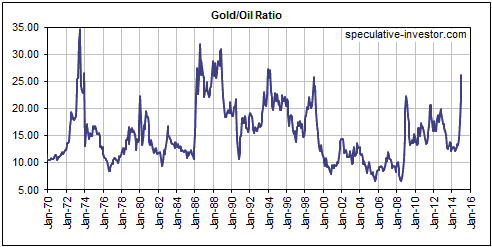
The point we want to make is that gold is now expensive relative to the world's
most useful commodity. It's as expensive, now, as it was near the peak of the
2007-2009 global financial crisis. There are financial-market scenarios under
which gold could get a lot more expensive relative to oil, but those scenarios
do not have high probabilities of happening this year. In other words, it isn't
reasonable to expect that gold will make substantial additional gains relative
to oil over the next several months.
Our expectation is that gold will not move much higher relative to oil, but that
the gold/oil ratio will have a high (by historical standards) average of around
20 this year. A gold/oil ratio of 20 implies healthy profit margins for gold
producers.The Stock
Market
The US
The S&P500 Index (SPX) fell for 5 days in a row before rebounding by 26 points
on Friday 16th January.
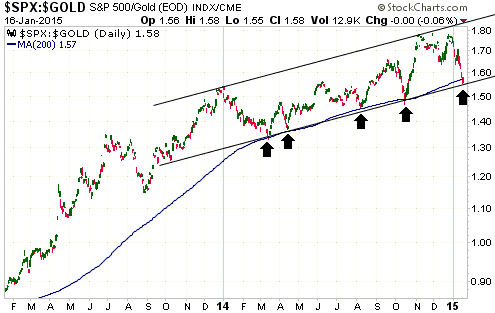
While there was an impressive rebound last Friday in dollar terms, there was no
rebound in gold terms. As illustrated by the following daily chart, the SPX/gold
ratio ended Thursday's session at support and remained at support on Friday. The
support is defined by the 200-day MA and the bottom of a channel.
The SPX/gold support that is currently being tested was successfully tested four
previous times over the past 12 months. In order to confirm that something more
than a routine short-term correction is in progress this support will have to be
solidly breached.
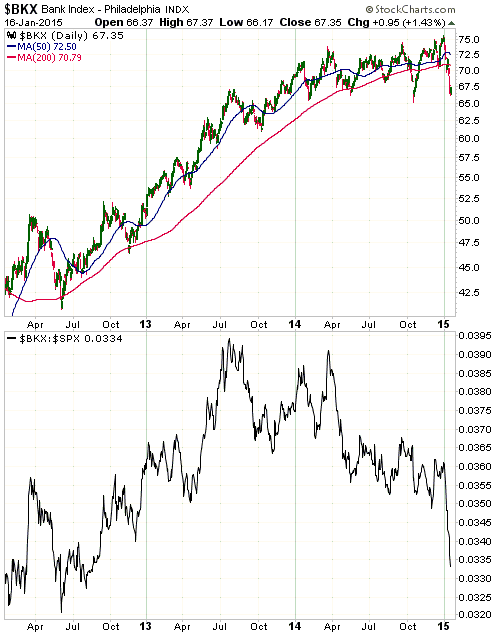
The following chart shows the Bank Index (BKX) and the BKX/SPX ratio.
In dollar terms the BKX has essentially traded sideways for more than 12 months,
but relative to the SPX it has been in a downward trend since July of 2013.
Notice that the BKX/SPX ratio tanked over the past two weeks and is now at its
lowest level in well over two years.
1-2 years of relative weakness in the banking sector preceded the major stock
market tops of 2000 and 2007.
The evidence is a long way from being conclusive, but there are several early
warning signs that a major top is in place in the US stock market.
Europe
The most important European stock indices are in interesting positions. For
example:
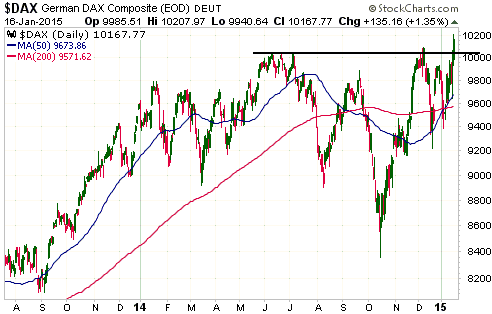
1) Germany's DAX Index broke above intermediate-term resistance and made a new
all-time high last Friday. This doesn't imply anything about the future, but it
means that the index is now in a position where it should soon generate either a
bullish or a bearish signal.
Sustaining the breakout over the next two weeks would generate a bullish signal,
whereas a solid break below 10,000 would indicate that the preceding upside
breakout was false (a bearish signal).
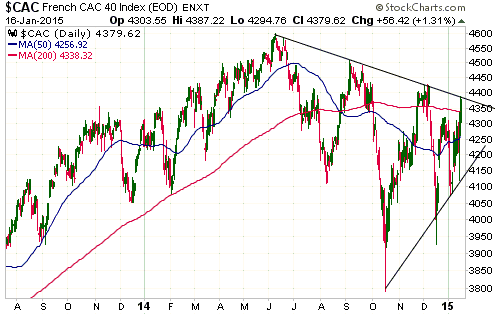
2) France's CAC40 Index ended last week at intermediate-term resistance.
3) The EURO STOXX 50 Index (STOX5E) is in a similar position to the CAC40,
although it hasn't quite made it up to intermediate-term resistance.
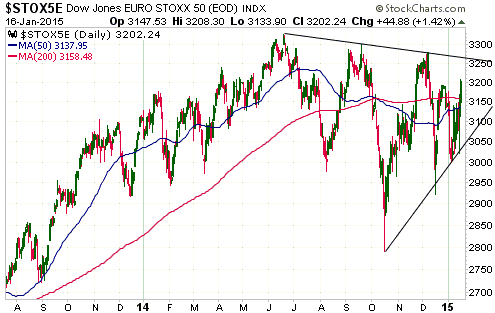
Either European stock markets will generate bearish signals in the near future,
with the DAX negating its upside breakout and both the CAC40 and the STOX5E
failing to end their sequences of declining tops, or they will generate bullish
signals, with the DAX solidifying its upside breakout and the other indices
breaking their declining-top sequences. The size of the monetary stimulus
package to be announced by the ECB on 22nd January will have a bearing on
whether the resolution is bullish or bearish.
This week's
significant US economic events
(The most important events are shown
in bold)
| Date |
Description |
| Monday Jan 19 |
US markets closed for public holiday | | Tuesday
Jan 20 |
No important events scheduled | | Wednesday
Jan 21 |
Housing Starts | | Thursday
Jan 22 |
Much-anticipated ECB meeting
|
| Friday Jan 23 |
Existing Home Sales |
Gold and
the Dollar
Gold
The Fundamentals
It's noteworthy that gold's recent upward reversal has happened in parallel with
falling inflation expectations, as was the case with the important upward
reversals that occurred in February-April of 2001 and November of 2008. Falling
inflation expectations are bearish for gold to the extent that they result in a
higher real interest rate (the real interest rate being the nominal interest
rate minus the expected (not the past) rate of currency depreciation), but
falling inflation expectations will tend to be part of the financial/economic
landscape when other influences are setting a multi-year gold rally in motion.
Also, the upward reversal has happened in parallel with strength in the Dollar
Index. A rising Dollar Index is bearish for gold, but it is just one influence
and can be overridden by other influences. These other influences are associated
with economic confidence and market liquidity, as indicated by credit spreads,
the yield curve, and the relative strength of the banking sector.
The overarching driver, as always, is confidence in the senior central bank, or,
since the advent of the ECB, confidence in the two senior central banks. Both of
the senior central banks managed to gain and retain the confidence of markets
from mid-2012 through to mid-2014 (due to luck more than anything else), but
around July of 2014 the markets started questioning the ECB's ability to make
good on its assurances of monetary support. It seems that the loss of confidence
in the ECB reached a critical level in November.
Confidence in the Fed remains high, but not as high as it was a few months ago.
The decline in confidence is evidenced by the breakdown in the BKX/SPX ratio
(featured in the Stock Market section of today's report) and the rising trend in
credit spreads. Of gold's main fundamental drivers, these are the ones that are
most clearly bullish at this time.
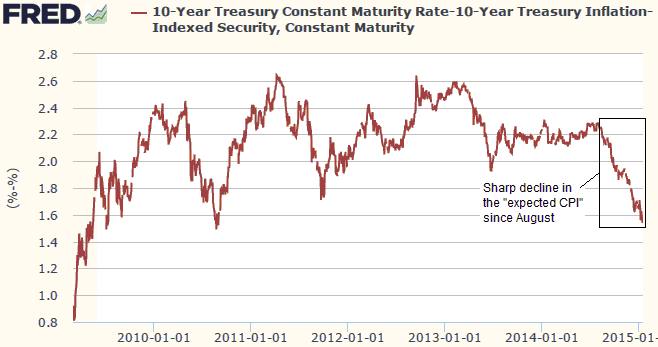
As mentioned above, inflation expectations have fallen. In fact, the following
chart shows that the 10-year "expected CPI" embarked on a steep decline last
August and is now approaching its lowest level since the first half of 2009 (a
time when the US economy was officially in recession). However, nominal interest
rates have declined by almost the same amount, which means that the combination
of nominal interest rates and inflation expectations (the real interest rate)
has been gold-neutral since August.
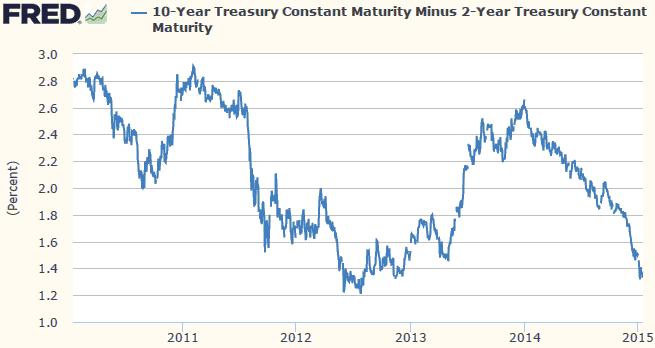
The US 10yr-2yr yield spread (a proxy for the yield curve) is the most important
fundamental gold-market driver that remains definitively bearish. As illustrated
by the following chart, the yield-spread has been trending downward (meaning:
the yield curve has been flattening) since early-2014.
Gold is quite capable of rallying for several months in the face of a declining
yield-spread, but a major (multi-year) gold rally is unlikely to begin until
after the yield-spread's trend reverses from down to up.
The Price Action
A catalyst probably wasn't required, but the Swiss National Bank (SNB) provided
one anyway. In response to the SNB news (discussed in the Currency Market
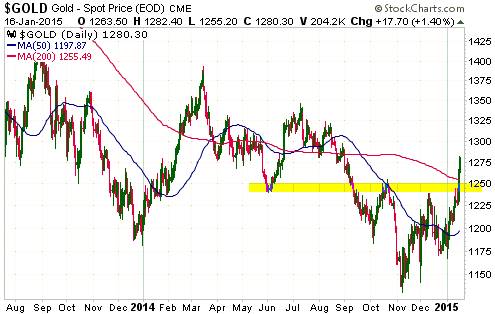
section), the US$ gold price broke solidly above lateral resistance at
$1240-$1250 and the 200-day MA at $1256. This is evidence that an
intermediate-term rally is in progress, although in US$ terms gold is now
short-term 'overbought' and looks set to make a multi-week top before the end of
this month.
Note that the magnitude of any downward correction in the US$ gold price over
the weeks ahead will probably be lessened by a concurrent downward correction in
the Dollar Index. Also note that former resistance at $1240-$1250 is now
support.
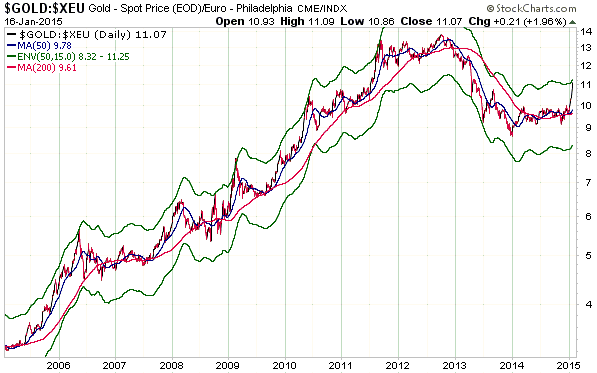
Gold is more stretched to the upside in euro terms, having quickly gained an
additional 10% since breaking above resistance at 1000. In fact, in euro terms
gold is intermediate-term 'overbought' and could be close, at least in terms of
time, to a top that holds for a few months.
The extent to which the euro-denominated gold price is stretched to the upside
is illustrated by the following chart. Gold/euro is now close to the top of a
moving-average envelope that has always limited intermediate-term rallies in the
past.
Quick note on silver
Silver has important resistance at $18.50-$19.00. We suspect that this
resistance will be tested but not sustainably breached within the next few
weeks.
Keep in mind that, contrary to a popular opinion, silver tends to lag gold
during the early stages (the first year at least) of new a bull market, so if a
new gold bull market began last November it would be normal for the silver/gold
ratio to make a multi-year low during the first half of this year.
Gold Stocks
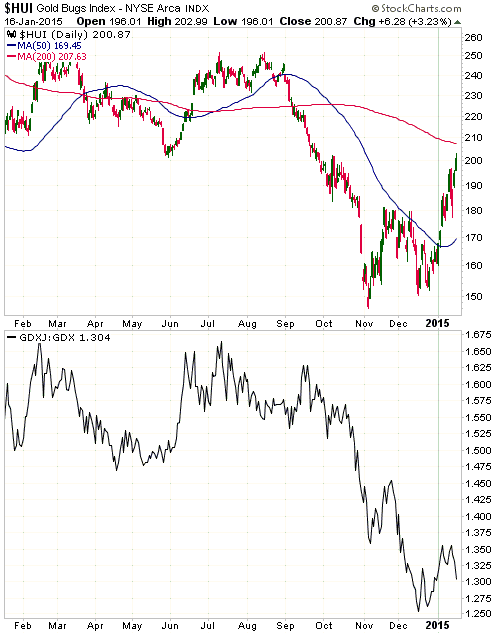
Gold's breakout last Thursday-Friday propelled the HUI to a new multi-month
high. It is now within 3% of its 200-day MA, which means that it is now within
3% of what we considered to be a likely target for the rally that began in
December. This doesn't mean that it is close to a top, although the minor
bearish divergence created by last week's decline in the GDXJ/GDX ratio (refer
to the bottom half of the following chart) suggests that a multi-week top will
soon be put in place.
We don't have an opinion about what will happen to the gold-mining sector this
week. There could be a sharp additional rise or a pullback (or both) as the
financial markets anticipate and then react to the outcome of the 22nd January
ECB meeting. That being said, with the gold-stock indices now moderately
extended to the upside and nearing their 200-day moving averages, we think that
significant additional strength over the coming days should be viewed as a
short-term selling opportunity.
One plausible scenario involves the HUI testing its 200-day MA this week and
then spending a few weeks consolidating between its 200-day and 50-day MAs
before resuming its upward trend.
The Currency Market
The SNB's Bombshell
The Swiss National Bank (SNB) dropped a figurative bombshell shortly after we
published the Interim Update last Thursday. When the Interim Update was
broadcast into cyberspace the gold price was trading about $6 below the
preceding day's COMEX closing price and the currency market was flat, but then
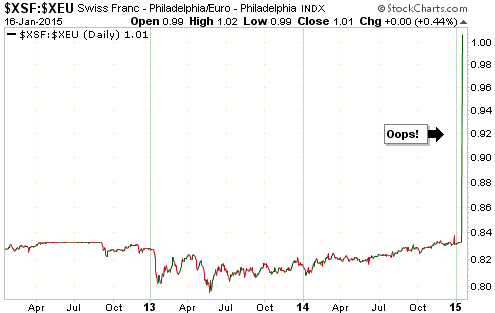
all hell broke loose when news that the SNB had eliminated the Swiss-Franc/euro
cap hit the wires. In the blink of an eye the SF was up by at least 20% relative
to everything, gold was up US$30 and the euro was down by another 2% against the
US$. The following chart illustrates the sudden revaluation of the SF relative
to the euro.
We briefly commented on the SNB news and the resulting moon-shot in the Swiss
Franc (SF) in a
blog post
after the close of last Thursday's trading session. Here are some additional
comments.
First, the SNB's decision back in August of 2011 to cap the SF/euro exchange
rate was a reaction to the SF's parabolic rise over the preceding 6 months. This
price action would likely have been followed by a large decline and/or years of
consolidation even if no action had been taken by the SNB. In other words, at
the point where the SNB took action to devalue the SF, future devaluation by the
market was already 'baked into the cake'.
Second, just like the build-up of pressure on the SNB in 2011 stemming from the
SF's seemingly unstoppable rise probably resulted in action finally being taken
at a time when the rise was about to end of its own accord, the build-up of
pressure on the SNB over the past several months stemming from the euro's (and
therefore the SF's) seemingly unstoppable decline probably resulted in action
finally being taken at a time when the decline was about to end of its own
accord. Of course, if the link to the euro had been maintained then the decline
against the US$ would not have ended in such a spectacular manner and the SF
would still be trading at around 0.83 euros rather than being at parity with the
euro.
Third, even though the decline in the SF would probably have soon ended without
any SNB action, it never made sense to tie the fate of the SF to the fate of the
euro. Doing so took on a risk that didn't need to be taken. The removal of the
official link was therefore a good move.
Fourth, the unhedged SF-denominated debts of anyone outside Switzerland just
became 20% larger. Consequently, the SNB's surprise move will have adverse
ramifications for banks and borrowers in other countries.
Fifth, the sudden huge rise in the SF will cause short-term pain for Swiss
exporters. However, it should be remembered that a) last week's SNB decision and
the resulting dramatic volatility were consequences of the ill-conceived 2011
decision to inflate the currency supply to whatever extent was required to cap
the SF relative to the euro, and b) Swiss exporters lobbied hard for the 2011
decision. In other words, exporters lobbied hard in 2011 for central bank action
that would boost their own short-term profitability by putting the long-term
viability of the currency at risk.
Sixth, Swiss consumers will be short-term beneficiaries of the sudden change in
the SF's relative value due to lower costs for imported products. The entire
economy will benefit over the long run if, as is likely, the removal of the euro
peg leads to slower inflation of Switzerland's money supply.
Seventh, until August-September of 2011 we regularly discussed the SF's
performance in TSI commentaries, but during the period when it was pegged to the
euro we rarely mentioned it. During this period there was no point analysing the
SF, since with the peg in place its performance was almost solely determined by
the performance of the euro. As a result of last week's news we will resume
coverage of the SF.
Current Market Situation
Kicking a downed opponent in the head is against the rules in most MMA (mixed
martial arts) competitions, but it is not against the rules in the currency
market. Last Thursday the euro was lying on the mat barely conscious when along
came the SNB and delivered the equivalent of a huge soccer kick to the head.
In its efforts to maintain the currency peg the SNB has been a substantial and
consistent buyer of euros over the past three years, so the decision to
eliminate the peg removes a significant source of euro demand. That being said,
when blatantly bearish news hits a market that has already been crushed, the
downward reaction to the news can quickly lead to an important price low.
The scene is set for an upward reversal in the euro this week, either just
before or just after the 22nd January ECB meeting. This is not only because the
market has already gone such a long way towards discounting bad outcomes for the
euro-zone, but also because the VGK/SPX ratio, a measure of European stocks
relative to US stocks, has turned higher.

Updates
on Stock Selections
Notes: 1) To review the complete list of current TSI stock selections, logon at
http://www.speculative-investor.com/new/market_logon.asp
and then click on "Stock Selections" in the menu. When at the Stock
Selections page, click on a stock's symbol to bring-up an archive of
our comments on the stock in question. 2) The Small Stock Watch List is
located at http://www.speculative-investor.com/new/smallstockwatch.html
 Company
news/developments for the week ended Friday 16th January 2015: Company
news/developments for the week ended Friday 16th January 2015:
[Note: AISC = All-In Sustaining Cost, FS = Feasibility Study, IRR = Internal
Rate of Return, MD&A = Management Discussion and Analysis, M&I = Measured and
Indicated, NAV = Net Asset Value, NPV(X%) = Net Present Value using a discount
rate of X%, P&P = Proven and Probable, PEA = Preliminary Economic Assessment,
PFS = Pre-Feasibility Study]
*Asanko Gold (AKG) announced that construction of Phase 1 of its
Asanko Gold Mine (Ghana) remains on schedule (the schedule calls for production
at the 190K-oz/yr gold mine to commence in Q1-2016) and on budget, with $170M of
the budgeted initial capex of $295M having been spent or committed to date.
The next important milestone for the company will be the publication of the FS
for Phase 2 at the end of Q1-2015. According to AKG's CEO, this is expected to
demonstrate the value of developing the adjacent Esaase deposit and expanding
production to 400,000 ounces of gold per annum.
*Endeavour Mining (EDV.TO, EVR.AX) announced excellent production
results for the final quarter of last year and the full year. Q4 production was
120K ounces of gold, which took the full-year production to 466K ounces. 2014
production guidance was 400K-440K ounces, so EDV's actual production was well
above the top end of its guidance. The AISC during Q4 is expected to be similar
to the Q3 figure, or about $990/oz.
2015 guidance is for production of 475K to 500K ounces at an AISC of
$930-$980/oz.
EDV was free-cash-flow positive during the final two quarters of 2014 and should
be free-cash-flow positive this year if the gold price averages more than
$1200/oz. In support of this statement, EDV's management estimates that the
company will have an all-in sustaining margin of $120M in 2015 assuming $1200/oz
for gold. Allowing $20M for growth-related capex and something for other costs
(G&A, taxes), this suggests to us that the company will add $50M-$80M to its
balance sheet this year if gold averages $1200/oz. At the current gold price the
cash addition to the balance sheet would likely be much greater.
Considering the stock's extremely low valuation, Friday's 9% gain (to
C$0.59/share) in EDV's price was a big under-reaction to the Q4 production
results. At the current gold price, we think that 'fair' value for EDV is north
of C$1.00/share.
*Golden Star Resources (GSS) reported its gold production for the
final quarter of 2014 and announced its production guidance for 2015.
During Q4-2014 the company produced 72K ounces of gold from its two mines in
Ghana. This brought the 2014 production total up to 261K ounces, which is line
with downwardly-revised guidance.
2015 production is expected to be about the same. Specifically, management's
2015 forecast is for production of around 260K ounces at an AISC of around
$1100/oz. The projected AISC suggests that GSS will need an average gold price
of at least $1300/oz to be meaningfully profitable and cash-flow positive.
GSS continues to be a high-risk/high-potential-reward play on the gold price. It
is not in any immediate danger of running out of cash, but in all likelihood it
will continue to bleed cash until the gold price makes a sustained move above
$1250/oz. It has the opportunity to reduce its average cost of production by
bringing the Wassa and Prestea underground mines into operation, but each of
these potential new operations would require about $40M of initial capex. We
doubt that GSS could cost-effectively finance this additional capex in the
current market.
*Ramelius Resources (ASX: RMS) reported some very good drilling
results from its Blackmans gold project. The highlights include gold intercepts
of 9m averaging 31.9-g/t from 41m, 25m averaging 7.6-g/t from 6m, and 13m
averaging 8.3-g/t from 23m. These shallow, high-grade results suggest the
potential for an open-pit mine at Blackmans and are made more significant by the
fact that Blackmans is located only 30kms from the company's Mt Magnet
processing facility (meaning that ore mined at Blackmans could be processed at
Mt Magnet).
The aforementioned drilling results caused a sharp rise in the RMS stock price
last Monday. The stock is now up by about 150% from its November low, but it is
rising from such a low base that it remains extremely cheap if we assume that
the recent operational improvement at Mt Magnet will be sustained.
*Sabina Gold and Silver (SBB.TO) advised that its Back River
project (Nunavut, Canada) was proceeding as planned through the permitting
process and that the Back River Final Environmental Impact Statement (FEIS) was
scheduled to be submitted in mid-2015. The FEIS will form the basis of a
recommendation by the Nunavut Impact Review Board (NIRB).
SBB also advised that the FS for the Back River project will be completed during
the first half of this year. This is the most important milestone for SBB with
regard to the coming 6 months.
Due to a larger M&I resource, higher average gold recoveries and other factors,
the FS is likely to reveal a significant improvement on the economics indicated
in the PFS. This is critical, because Back River will never be developed into a
mine unless it can be demonstrated that the economics are better than indicated
in the PFS.
*True Gold Mining (TGM.V): In early-December TGM advised that a
disturbance in the local community had prompted it to temporarily halt some of
the construction activities at the Karma project (Burkina Faso). No other
details were provided. In late-December the company advised that it was working
to address the concerns voiced by certain individuals in the local community and
expected to reach a resolution shortly. Again, no other details were provided.
Then, last Wednesday, TGM advised that a demonstration at the Karma mine had
resulted in some damage to the company's property and the temporary suspension
of operations. Once again, no information was provided regarding the reasons for
the conflict.
The stubborn refusal of TGM's management to provide the market with details
regarding the nature of the community-relations problems being encountered at
its project site is a blotch on management's credibility.
TGM's valuation and strong balance sheet suggest that it is a strong candidate
for new buying, but the uncertainty surrounding the disruptions to construction
progress at the Karma mine site has kept TGM out of our list of the best
candidates for new buying over the past several weeks and continues to do so. We
would be buyers at C$0.15/share, because at that price the worst-case scenario
would be discounted, but with the stock price in the C$0.20s we will wait for
more information before deciding what to do.
List of candidates for new buying
From within the ranks of TSI stock selections the best candidates
for new buying at this time, listed in alphabetical order, are:
1) AAU below US$1.10 (last Friday's closing price: US$1.14).
2) AKG in the mid-US$1.60s (last Friday's closing price: US$1.74).
3) EDV.TO (last Friday's closing price: C$0.59).
4) RSG.AX in the low-A$0.30s (last Friday's closing price: A$0.38).
5) TGD (last Friday's closing price: US$1.11).
Note that the above list is limited to five stocks. It will
sometimes contain less than five, but it will never contain more
than five regardless of how many stocks are attractively priced for
new buying.
Notes on the short-term trading positions in the TSI List
1) The short-term position in EVN.AX will automatically be exited if
the stock trades at A$0.97 within the coming fortnight.
2) The short-term position in AKG will automatically be exited if
the stock trades at US$2.03 within the coming fortnight.
3) The short-term position in TGD will automatically be exited if
the stock trades at US$1.37 within the coming fortnight.
The TSI List will retain long-term exposure to each of the above
stocks.
Chart Sources
Charts appearing in today's commentary
are courtesy of:
http://stockcharts.com/index.html
http://research.stlouisfed.org/

|









