|
-- Weekly Market Update for the Week Commencing 19th March 2007
Big Picture
View
Here is a summary of our big picture
view of the markets. Note that our short-term views may differ from our
big picture view.
Bonds commenced a secular BEAR market in
June of 2003. (Last
update: 22 August 2005)
The stock market, as represented by the S&P500 Index, commenced a secular BEAR market during the first quarter of 2000. The rally
that
began in October of 2002 will end during the first half of 2007. The ultimate bottom of
the secular bear market won't occur until the next decade. (Last update: 02 October 2006)
The Dollar commenced a secular BEAR market during the final quarter of 2000. The
first major downward leg in this bear market ended during the first
quarter of 2005, but a long-term bottom won't occur until 2008-2010. (Last update: 28 March 2005)
Gold commenced a
secular bull market relative to all fiat currencies, the CRB Index,
bonds and most stock market indices during 1999-2001. The first major
upward leg in this secular bull market ended in December of 2003, but a
long-term peak won't occur until at least 2008-2010. (Last update: 13
February 2006)
Commodities, as
represented
by the CRB Index, commenced a secular BULL market in 2001. The first
major upward leg in this bull market ended during the second quarter of
2006, but a long-term
peak won't occur until at least 2008-2010. (Last update: 08 January 2007)
Copyright
Reminder
The commentaries that appear at TSI
may not be distributed, in full or in part, without our written permission.
In particular, please note that the posting of extracts from TSI commentaries
at other web sites or providing links to TSI commentaries at other web
sites (for example, at discussion boards) without our written permission
is prohibited.
We reserve the right to immediately
terminate the subscription of any TSI subscriber who distributes the TSI
commentaries without our written permission.
Outlook Summary
Market
|
Short-Term
(0-3 month)
|
Intermediate-Term
(3-12 month)
|
Long-Term
(1-5 Year)
|
Gold
|
Bullish
(04-Oct-06)
|
Bullish
(29-Jan-07)
|
Bullish
|
US$ (Dollar Index)
|
Bearish
(14-Feb-07)
| Bullish
(31-May-04)
|
Bearish
|
Bonds (US T-Bond)
|
Bullish
(14-Feb-07)
|
Neutral
(23-Aug-06)
|
Bearish
|
Stock Market (S&P500)
|
Neutral
(19-Mar-07)
|
Bearish
(02-Jan-07)
|
Bearish
|
Gold Stocks (HUI)
|
Bullish
(04-Oct-06)
|
Bullish
(29-Jan-07)
|
Bullish
|
| Oil | Neutral
(12-Mar-07)
| Neutral
(25-Sep-06)
| Bullish
|
Industrial Metals (GYX)
| Neutral
(15-Jan-07)
| Bearish
(25-Sep-06)
| Bullish
|
Notes:
1. In those cases where we have been able to identify the commentary in
which the most recent outlook change occurred we've put the date of the
commentary below the current outlook.
2. "Neutral", in the above table, means that we either don't have a
firm opinion on which way the market will move or that we expect the
market to be trendless during the timeframe in question.
3. Long-term views are determined almost completely by fundamentals,
intermediate-term views by giving an approximately equal weighting to
fundmental and technical factors, and short-term views almost
completely by technicals.
A sustained or a momentary liquidity contraction?
...liquidity
can disappear in an instant with no change in money supply. ...the
combined performances of emerging market equities and debt should
provide a timely signal that a sustained and widespread liquidity
contraction...is occurring.
The way we define the terms, there's a big difference between liquidity
and money. This difference revolves around the fact that once money is
borrowed into existence it remains in existence until/unless the debt
is repaid*, whereas liquidity can disappear in an instant with no
change in money supply. For example, the rate of US money supply growth
hit a multi-decade high in late-2001 and remained at a
well-above-average level throughout 2002, but by the second half of
2002 the financial markets were suffering from a massive loss of
liquidity. The rapid growth of the US money supply during 2001-2002 and
the rapid growth of the global money supply during 2003-2006 ultimately
led to substantial liquidity within the financial markets, but the
point is that high money-supply growth can co-exist with low market
liquidity for an inconveniently long period (inconveniently long, that
is, for those who hope that surging money-supply growth will bail them
out of the leveraged speculations they entered during the preceding
boom times).
Recently, investors in sub-prime mortgage debt have discovered how
quickly liquidity can disappear once confidence takes a hit. At this
stage the liquidity contraction has largely been confined to the
sub-prime mortgage sector, but it could spread throughout the financial
world. If it does then the pundits who claim that the recent high rates
of money-supply growth all but guarantee rising asset prices over the
next several months will be in for a big surprise.
In conjunction with our favourite yield-spread indicators, the combined
performances of emerging market equities and debt should provide a
timely signal that a sustained and widespread liquidity contraction --
as opposed to just a momentary restriction of liquidity in response to
problems in one area -- is occurring. The reason is that the goings-on
of the past few weeks suggest that the emerging markets theme is
presently the focal point of speculation and is, therefore, amongst the
most vulnerable of the many investment themes to a MAJOR change in the
liquidity trend.
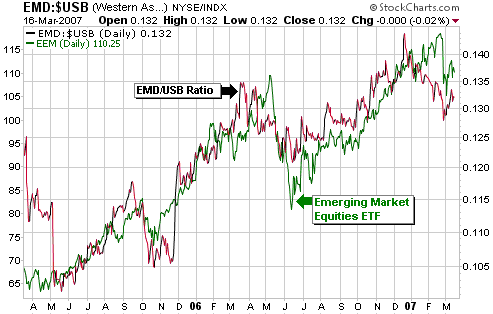
To be specific, if the financial world is going to experience more than
a momentary loss of liquidity then what we should see over the coming
month or so is substantial weakness in emerging market equities
ALONGSIDE a substantial widening of emerging market credit spreads.
With reference to the below chart, such an outcome would entail both
EMD/USB ratio (the Emerging Markets Income Fund divided by the US
Treasury Bond) and the EEM (an Emerging Market Equities ETF) moving to
much lower levels. EEM and EMD/USB dropped between mid-February and
early-March, but at this stage the declines look no worse than the
other routine corrections that have occurred over the past few years.
At the same time as
speculative bets on emerging market equities and debt are being exited
en masse there should be a sharp rally in the Yen because the Yen carry
trade has been such an important source of speculative financing and,
therefore, liquidity. A Yen rally based on the unwinding of carry
trades is, however, likely to be just a temporary phenomenon because as
long as Japan's monetary authorities insist on keeping the official
short-term interest rate close to zero there will be little chance of a
major bull market in the Yen.
As things currently stand it is possible to make a reasonable case that
we are witnessing the initial phase of a sustained liquidity
contraction and resultant 1-2 year bear market in growth-oriented
investments. But at the same time there are also signs that it could
turn out to be just another shakeout within a continuing
liquidity-driven bull market. After all, in order for a bull market to
climb the proverbial "wall of worry" it is essential that worries be
injected into the mix every now and then. In either case, though, the
downturn is probably not yet over.
*Many people
believe that debt defaults cause the supply of money to shrink, but
this is not so. A debt default will probably reduce the wealth of the
person/company making the loan, but if the loan originally resulted in
new money being created -- for example, a loan made by a commercial
bank to finance the purchase of a home -- then that money will have
been spent by the debtor and will remain within the economy following
the loan default. Of course, if the customers of a lender default on
their loans then the ability and/or desire of that lender to make
additional loans may be hampered. It is therefore possible for debt
defaults to bring about a reduction in the future rate of money supply
growth, but debt defaults do not directly affect the existing supply of
money.
Copper
The
copper price has been very strong over the past couple of weeks. This
rebound has undoubtedly been driven to a significant extent by
speculative short-covering, but it also has a fundamental basis in that
the amount of copper imported by China has surged since the beginning
of the year.
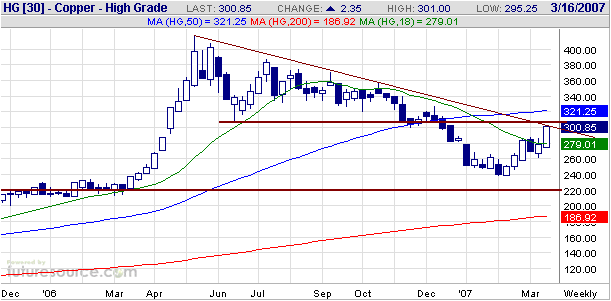
The following weekly chart of copper futures shows that the rebound
has, to date, taken the price up to intermediate-term resistance in the
low-$3 area. A weekly close above this resistance would suggest that
copper's correction was over and would therefore come as a surprise to
us because we've been expecting that the current rebound would be
followed by a decline to new correction lows.
The big test for copper and the other base metals is likely to come
during the stock market's next downward leg. These metals came through
the first downward leg relatively unscathed; which, by the way, is a
point in favour of the stock market being in a bull market correction
rather than a new bear market. We doubt, though, that they would
continue to hold up if global stock markets were to take-out their
March lows.
The Stock
Market
Current Market Situation
As noted in recent TSI commentaries, the stock market decline that
began during the final week of February has resulted in a mind-boggling
increase in fear/pessimism. For example, we've previously mentioned
that the sell-off caused market participants to purchase sufficient put
options to take the 10-day moving average of the CBOE put/call ratio to
an ALL-TIME high. Furthermore, short-selling statistics just published
by the NYSE reveal that the total number of shares sold short by the
public more than DOUBLED during the week ended 2nd March. We've never
before seen such a dramatic increase in short-selling.
The extreme shift in sentiment in parallel with what has, to date, been
a relatively minor correction is a bullish factor. Also on the positive
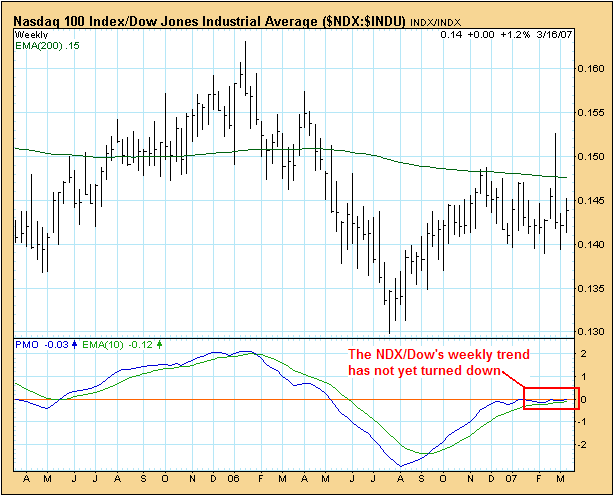
side of the ledger is the fact that the NDX, after warning of an
impending correction by being relatively weak for a few months, has
recently been holding up better than the Dow Industrials Index. Largely
due to the NDX's recent resiliency, the NDX/Dow ratio's weekly Price
Momentum Oscillator is yet to turn down (see chart below).
On the negative side
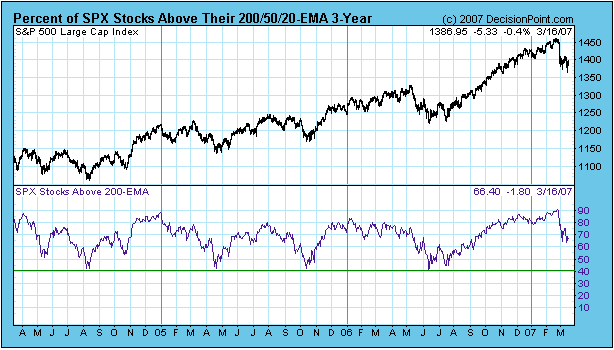
of the ledger as far as the short-term outlook is concerned, other US
stock market corrections over the past few years haven't ended until a)
the S&P500 Index has traded below its 200-day moving average, and
b) the number of S&P500 components trading above their respective
200-day moving averages has dropped to around 40%. As at Friday's
close, however, the S&P500 was still about 35 points above its
200-day MA and 66% of S&P500 stocks were still trading above this
moving average (see chart below).
In our opinion
there's a high probability that the stock indices will trade below
their March lows within the coming month. However, the fact that so
many people have recently 'jumped on the bearish bandwagon' has
substantially reduced the probability of the indices trading a LONG way
below their March lows in the short-term. We've therefore upgraded our
short-term outlook from "bearish" to "neutral".
Intermediate-Term Outlook
...we
perceive a very significant risk that equity valuations will be hit
later this year by the 'double whammy' of rising interest rates and
shrinking profit margins.
The current correction was in the works for months before it actually
began, but was finally catalysed in late February by a single-day
plunge in China's stock market and some unwinding of the Yen carry
trade. The troubles in the sub-prime mortgage world have since moved to
centre stage, providing the news backdrop to justify more weakness and
prompting a veritable stampede to the bearish side of the fence.
As discussed in last week's commentary, however, we think there are
things out there that pose much bigger threats to the cyclical bull
market in US equities than do the current front-page stories.
Specifically, we perceive a very significant risk that equity
valuations will be hit later this year by the 'double whammy' of rising
interest rates and shrinking profit margins.
Both of the aforementioned risks stem, in part, from the upward
pressure on food prices caused by the US Government's ethanol policy.
The idea is that the upward pressure on grain prices resulting from the
government-sponsored drive to rapidly expand ethanol production will
translate into broad-based hikes in food prices. Furthermore, this is
going to be happening at a time when a) the average wage-earner will no
longer be experiencing the positive wealth effect of an upward-trending
home price and will thus have more incentive than before to obtain wage
increases that offset his/her rising cost of living, and b) near-record
profit margins will provide considerable scope for corporations to pay
higher wages in order to retain their best workers.
Concurrent increases in food prices and labour costs will, in turn,
likely cause even the fudged government price indices to shout
"inflation problem", thus putting irresistible downward pressure on
bond prices (upward pressure on bond yields). And with labour grabbing
a larger slice of the pie, corporate profit margins will shrink.
Note, though, that the above-mentioned intermediate-term risks do not
appear to pose a short-term threat. In particular, long-term interest
rates are more likely to fall than rise over the coming 1-2 months.
This week's
important US economic events
| Date |
Description |
Monday Mar 19
| No significant events scheduled
|
Tuesday Mar 20
| Housing Starts
| | Wednesday Mar 21
| FOMC Policy Statement
| | Thursday Mar 22
| Leading Economic Indicators
| | Friday Mar 23
| Existing Home Sales
|
Gold and
the Dollar
Gold and the Euro
...it
is extremely likely that gold and the EUR/USD exchange rate will
eventually de-couple. ...It's just that they haven't de-coupled YET.
We never cease to be impressed by peoples' willingness to latch onto
the smallest piece of evidence that supports their preconceived view of
the world whilst ignoring a veritable mountain of conflicting evidence.
Such is the case regarding the relationship between the gold market and
the foreign exchange market.
The traditional inverse relationship between gold and the Dollar Index
manifests as a positive correlation between gold and the euro
(EUR/USD). For many years gold and the euro appeared to be 'joined at
the hip', but during the 6-month period from May through to November of
2005 they went separate ways with gold trending higher while the euro
drifted lower. However, this 6-month period proved to be a temporary
divergence similar to the one that occurred during 1993. The following
chart, for instance, shows that since November of 2005 gold and the
euro have, again, behaved as if they were joined at the hip. And yet,
due to the aforementioned 6-month divergence many gold market
commentators now labour under the assumption that gold and EUR/USD have
de-coupled.
Make no mistake -- it is extremely likely that gold and the EUR/USD
exchange rate will eventually de-couple. The reason is that if the
supplies of US dollars and euros continue to be inflated at rapid rates
then the monetary backdrop will inevitably become conducive to strength
in gold relative to BOTH currencies, regardless of what is happening
with the EUR/USD exchange rate.
It's just that they haven't de-coupled YET.
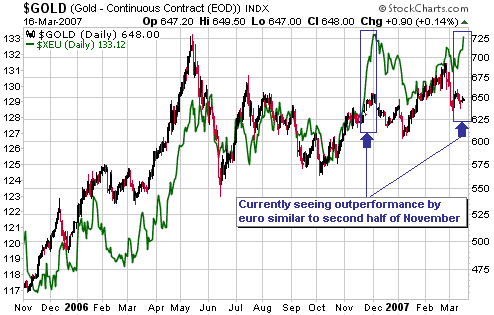
In the financial
markets the most useful information is often in the divergences, and
this is certainly true when it comes to the relationship between gold
and the euro. In particular, strength or weakness in the euro tends to
be unsustainable unless it is associated with strength or weakness in
gold. Or, putting it another way: gold tends to be the lead market at
turning points, with the euro sometimes diverging for a while before
falling into line with gold. For example and with reference to the
above chart, gold's downward reversal last May was a clear sign that
the euro's rally was effectively over even though the euro went on to
marginally exceed its May high in early June; and when the euro's
'moonshot' during the second half of November-2006 was not confirmed by
similar strength in gold it was an indication that the sharp currency
market move was an end rather than a beginning.
The current situation is starting to look similar to the situation
during the second half of November last year in that the euro has
recently been significantly stronger than gold. This suggests to us
that there isn't much scope for the euro to make additional gains.
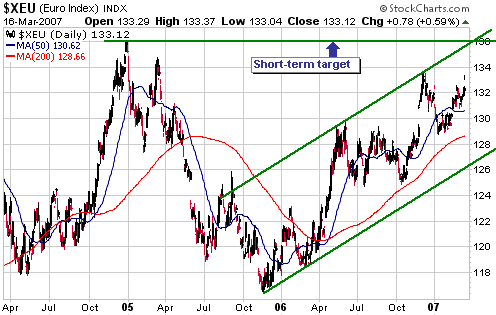
For some time our expectation has been that the euro would test
resistance defined by its December-2004 peak (1.36). This
intermediate-term resistance also roughly coincides with the top of the
euro's short-term channel (see chart below) and remains a viable
target. In other words, we think the euro could gain an additional 2%
from here, but no more than that.
As far as gold's near-term prospects are concerned our best guess is
that the rebound will continue for another 1-2 weeks, after which the
downward correction will resume. We expect gold to hold up better than
the euro during the next decline, but in order to shake-out sufficient
speculative 'longs' to set the scene for the next tradable rally the
March lows will probably have to be breached.
Gold Stocks
Beyond the very short-term a weakening stock market would likely become a positive for the gold sector...
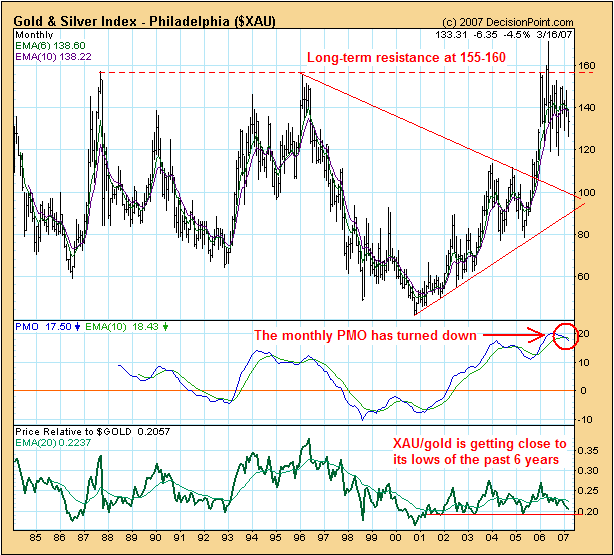
The gold sector of the stock market is becoming very oversold, as
evidenced by the gold stock indices dropping to near their lows of the
past 6 years relative to gold bullion and the recent drop to new
multi-year lows by Rydex PM's cumulative cash flow (the amount of cash
invested by the public in the Rydex Precious Metals Fund). In fact, if
not for our view that the broad stock market will have to take-out its
March lows before a decent rally becomes probable we would now be
operating under the belief that short-term bottoms are already in place
for the major gold stocks. But as it is, a plunge by the S&P500
Index to new lows for the year will probably result in the HUI and the
XAU moving below their early-March lows as market participants,
motivated by blind fear and/or margin calls, sell whatever stocks they
can.
We doubt, though, that the gold stock indices will trade more than a
few percent below their March lows over the next few weeks.
Furthermore, they should rebound quickly once some stability returns to
the broad market in similar fashion to the way a beachball held under
water will rebound once the force that's holding it down is removed.
Beyond the very short-term a weakening stock market would likely become
a positive for the gold sector because it would prompt the monetary
authorities to abandon all pretense at inflation fighting. The problem
for gold stocks occurs during the transition period -- the period from
the beginning of pronounced stock market weakness to the point where
the markets become convinced that the central bank is about to loosen
monetary policy in an effort to counteract the weakness. We therefore
don't view the potential for persistent stock market weakness as a
longer-term threat to the gold sector.
We've included the following monthly chart of the XAU to show three things:
First, the chart clearly shows the long-term resistance at 155-160 that
was re-tested during the second quarter of last year. We have no doubt
that this resistance will be taken-out and left a long way behind
within the next two years; the only question we have is whether it will
be taken out this year following a bit more consolidation in the
120-150 range (our "red scenario") or during 2008-2009 following a
large decline that takes the XAU back to 80-100 (our "blue scenario").
Second, the chart shows that the XAU's monthly Price Momentum
Oscillator (PMO) has turned down. Taken in isolation this means nothing
because once the monthly PMO has moved above 15 then almost every
intermediate-term correction will cause it to momentarily turn down.
Third, the chart shows that the XAU/gold ratio is close to its lows of
the past 6 years, but it's not quite there yet. This suggests that the
XAU's downside risk relative to gold is only about 7%.
Update
on Stock Selections
(Note: To review the complete list of current TSI stock selections, logon at http://www.speculative-investor.com/new/market_logon.asp
and then click on "Stock Selections" in the menu. When at the Stock
Selections page, click on a stock's symbol to bring-up an archive of our comments on the stock in question)
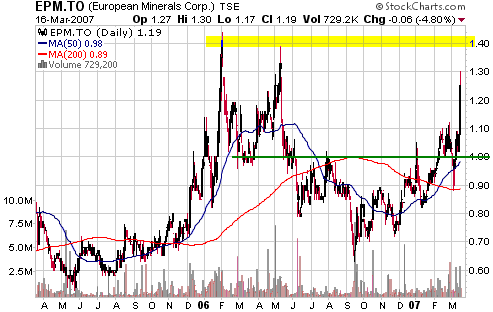
 European Minerals (TSX: EPM). Shares: 277M issued, 417M fully diluted. Recent price: C$1.19 European Minerals (TSX: EPM). Shares: 277M issued, 417M fully diluted. Recent price: C$1.19
EPM has recently come to life. After trading as low as C$0.88 during
the first week of March, it traded as high as C$1.30 late last week
before easing back to end Friday's session at C$1.19.
We don't know whether the increased speculative interest in EPM is due
to unfounded rumours of a takeover bid for the company; or due to
well-founded rumours of a takeover bid; or simply due to the market
belatedly coming to the realisation that EPM's Kazakhstan-based
gold/copper mine should generate enough cash during 2008 to justify a
higher valuation. Whatever the reasons for the renewed interest in the
stock, we would view a move up to around C$1.40 within the coming
fortnight as an opportunity to take PARTIAL profits. On the other hand,
if the stock were to pullback to around C$1.00 on the back of some
additional sector-wide weakness within the coming month then we would
view it as a buying opportunity.
Gryphon Gold (TSX: GGN). Shares: 47M issued, 57M fully diluted. Recent price: C$1.00
It is said that every cloud has a silver lining, although our personal
experience has been that only some clouds do. Last November's bad news
that forced GGN's management to shelve plans to put the Borealis oxide
deposit into production and, instead, focus on the project's
exploration potential, might turn out to be one of those silver-lined
-- or, in this case, gold-lined -- clouds. The reason is that a junior
gold mining company can add a lot more shareholder value by discovering
a large metal deposit than it can by putting a small mine into
operation, and the results from the first three holes of GGN's current
72-hole program were very promising indeed.
With reference to the following chart, the spike from C$0.86 to C$1.20
at the beginning of March was the market's reaction to the results from
the first three holes. GGN's price then dropped back in response to the
market-wide downturn and, no doubt, the selling of 'stale longs' who
viewed the stock's sudden strength as an opportunity to get out near
break-even. Since then the stock has been consolidating just below
trend-line resistance.
There's a lot of resistance in the C$1.10-1.20 range and this
resistance could keep a lid on the stock for a while. However, the
company should have a steady stream of drilling results to report over
the coming months and if future results confirm the potential indicated
by the first three holes then this resistance will almost certainly be
overcome.
GGN is a small stock with a relatively low average daily trading
volume, so it is not for everyone. Having said that, it is not as risky
as many other exploration plays. In particular, there is very little
political or environmental risk associated with this company and the
valuation is under-pinned by the in-ground resources that have already
been proven-up.
Speculators who can tolerate the micro-cap world's volatility and lack
of liquidity should consider picking away at GGN in the C$0.95-C$1.05
range.
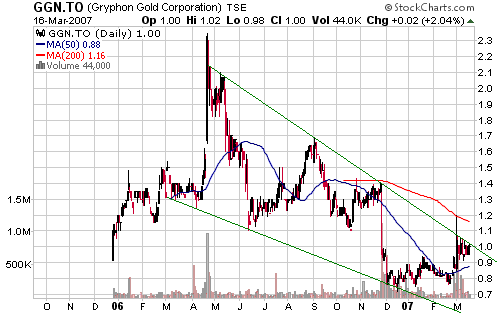
Chart Sources
Charts appearing in today's commentary
are courtesy of:
http://stockcharts.com/index.html
http://www.futuresource.com/
http://www.decisionpoint.com/

|









