|
-- Weekly Market Update for the Week Commencing 19th August 2013
Big Picture
View
Here is a summary of our big picture
view of the markets. Note that our short-term views may differ from our
big picture view.
In nominal dollar terms, the BULL market in US Treasury Bonds
that began in the early 1980s will end by 2013. In real (gold)
terms, bonds commenced a secular BEAR market in 2001 that will continue
until 2014-2020. (Last
update: 23 January 2012)
The stock market, as represented by the S&P500 Index,
commenced
a secular BEAR market during the first quarter of 2000, where "secular
bear market" is defined as a long-term downward trend in valuations
(P/E ratios, etc.) and gold-denominated prices. This secular trend will bottom sometime between 2014 and 2020.
(Last update: 22 October 2007)
A secular BEAR market in the Dollar
began during the final quarter of 2000 and ended in July of 2008. This
secular bear market will be followed by a multi-year period of range
trading.
(Last
update: 09 February 2009)
Gold commenced a
secular bull market relative to all fiat currencies, the CRB Index,
bonds and most stock market indices during 1999-2001.
This secular trend will peak sometime between 2014 and 2020.
(Last update: 22 October 2007)
Commodities,
as represented by the Continuous Commodity Index (CCI), commenced a
secular BULL market in 2001 in nominal dollar terms. The first major
upward leg in this bull market ended during the first half of 2008, but
a long-term peak won't occur until 2014-2020. In real (gold) terms,
commodities commenced a secular BEAR market in 2001 that will continue
until 2014-2020.
(Last
update: 09 February 2009)
Copyright
Reminder
The commentaries that appear at TSI
may not be distributed, in full or in part, without our written permission.
In particular, please note that the posting of extracts from TSI commentaries
at other web sites or providing links to TSI commentaries at other web
sites (for example, at discussion boards) without our written permission
is prohibited.
We reserve the right to immediately
terminate the subscription of any TSI subscriber who distributes the TSI
commentaries without our written permission.
Outlook Summary
Market
|
Short-Term
(1-3 month)
|
Intermediate-Term
(6-12 month)
|
Long-Term
(2-5 Year)
|
|
Gold
|
Bullish
(17-Oct-12)
|
Bullish
(26-Mar-12)
|
Bullish
|
|
US$ (Dollar Index)
|
Neutral
(24-Dec-12)
|
Bullish
(01-May-13)
|
Neutral
(19-Sep-07)
|
|
Bonds (US T-Bond)
|
Bullish
(24-Jun-13)
|
Neutral
(18-Jan-12)
|
Bearish |
|
Stock Market
(DJW)
|
Bearish
(15-Jul-13)
|
Bearish
(28-Nov-11)
|
Bearish
|
|
Gold Stocks
(HUI)
|
Bullish
(24-Dec-12)
|
Bullish
(23-Jun-10)
|
Bullish
|
|
Oil |
Neutral
(30-Jul-12)
|
Neutral
(31-Jan-11)
|
Bullish
|
|
Industrial Metals
(GYX)
|
Neutral
(30-Jul-12)
|
Neutral
(29-Aug-11)
|
Neutral
(11-Jan-10)
|
Notes:
1. In those cases where we have been able to identify the commentary in
which the most recent outlook change occurred we've put the date of the
commentary below the current outlook.
2. "Neutral", in the above table, means that we either don't have a
firm opinion or that we think risk and reward are roughly in balance with respect to the timeframe in question.
3. Long-term views are determined almost completely by fundamentals,
intermediate-term views by
fundamentals, sentiment and technicals, and short-term views by sentiment and
technicals.
No Interim Update this
week
Please note that we won't be able to do an
Interim Update this week. We will, however, send out an email alert if the
market action requires an urgent update.
The Stock
Market
The long-term trend
Whether the stock market is in a long-term bullish trend or a long-term bearish
trend can't be determined by looking at nominal prices. The reason is that the
nominal price of an investment is determined by the value of the investment AND
the value of the money in which the price is denominated, meaning, for example,
that it would be possible for a large rise in the stock market to be primarily
the result of a large decline in the value of money. To put it another way, if
the stock market's major trend were determined solely by the change in the
nominal price level, then the central bank could create a bull market simply by
depreciating the currency. How, then, should we determine the stock market's
long-term trend? Let us count the ways.
The first way is to look at the long-term trend in valuation terms (for example,
the average P/E ratio) rather than in nominal price terms. During a long-term
bull market the average valuation should make progressively higher highs and
higher lows, whereas during a long-term bear market the market's valuation
should make lower highs and lower lows. Furthermore, we know from the historical
record that once a long-term bull market gets underway it doesn't end until the
average valuation becomes very high, and that once a long-term bear market gets
underway it doesn't end until the average valuation becomes very low.
With regard to the US stock market, we present the following chart of the
S&P500's Cyclically-Adjusted P/E ratio (also known as the "Shiller P/E") and
point out that:
a) The average valuation was a lot lower at the 2007 peak than at the 2000 peak
and the average valuation was lower at the 2008-2009 bottom than at the
2002-2003 bottom. This tells us that a long-term bear market commenced in 2000.
b) Although the average valuation at the 2008-2009 bottom was reasonable, it
wasn't unusually low by historical standards. This suggests that the long-term
bear market did not end at that time.
c) The market now appears to be rolling over to the downside from a
significantly lower average valuation than existed at the 2007 peak. If this
turns out to be the case it will confirm that the long-term bear market is still
in progress.
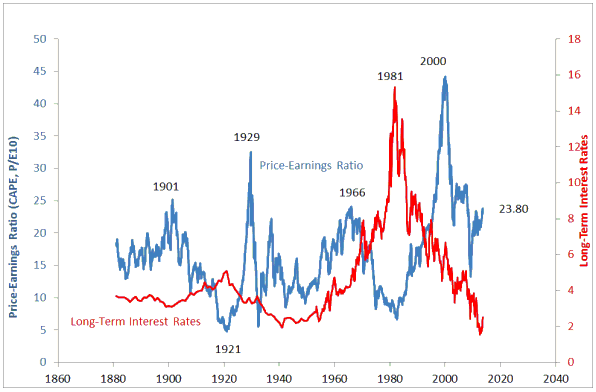
Chart Source:
http://www.irrationalexuberance.com/index.htm
As an aside, while the current valuation is very low compared to the valuation
at the 2000 peak, it is roughly the same as the valuation at the secular 1966
peak.
The second way of determining the stock market's long-term trend is to look at
performance in terms of inflation-adjusted (IA) currency. Provided that a
realistic measure of inflation adjustment is used, this will indicate whether
the market is falling or rising in purchasing-power terms. Irrespective of its
nominal price performance, an investment is not really in a bull market unless
its purchasing power is trending upward.
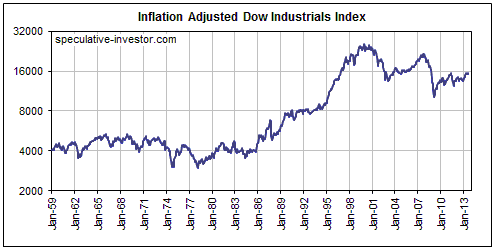
With regard to the US stock market, the following chart shows that the
inflation-adjusted (IA)* Dow Industrials Index has been making lower highs and
lower lows since 2000. This chart is therefore consistent with our assessment of
the long-term valuation trend -- it shows that a long-term bear market commenced
in 2000 and does not contain any evidence that the bear market is over.
The third and final way of determining the stock market's long-term trend is to
look at performance in terms of gold. This works because gold tends to at least
maintain its purchasing power over the very long haul and because secular gold
bull markets invariably coincide with secular equity bear markets.
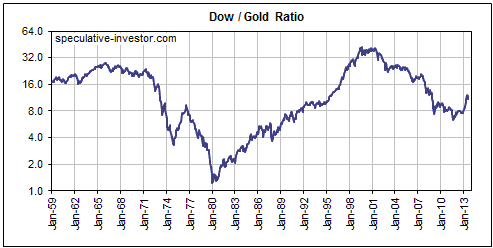
With regard to the US stock market, the following chart shows that the Dow/Gold
ratio commenced a long-term downward trend in 2000.
Fortunately, the three reasonable methods of determining the long-term trend of
the US stock market are in synch. Each method indicates that a long-term bear
market definitely began in 2000 and that the long-term bear market is probably
still in progress.
*We use a method of adjusting for the effects of US
monetary inflation that is far more accurate over the long term than either the
official CPI or the Shadowstats.com CPI.
Current Market Situation
The US
"The S&P 500 index has increased by over 34% since the beginning of 2011, of
which 28% has come from multiple expansion. During the same period, growth in
corporate earnings has slowed. The trailing 12-month earnings for S&P 500
companies rose 2.4% in 2012 and another 2.5% for the first seven months of this
year, registering the slowest earnings growth in non-recession years since 1998."
-- Scott Minerd, CIO at Guggenheim Partners
By closing below 1675 last week, the S&P500 Index signaled the start of either a
short-term correction or a new cyclical bear market. At this stage there's no
way of knowing which of these scenarios is happening.
It is reasonable to view the June low (1560) as the demarcation between a
routine short-term correction and a new bear market. If the June low is
decisively breeched it will mean that a 1-2 year bear market has probably begun.
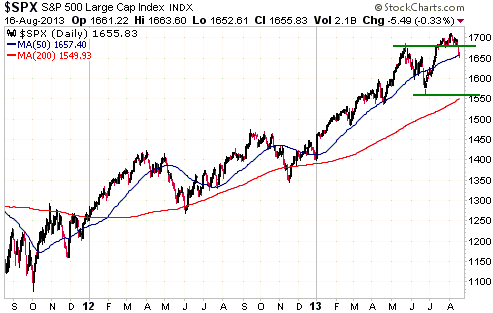
While the SPX needs to close below 1560 to clearly signal the start of a new
bear market, an earlier warning could be provided by the Home Construction
sector. After all, a lot of today's bullish economic and stock-market sentiment
is based to some extent on the belief that a new major upward trend has begun in
the residential real estate market.
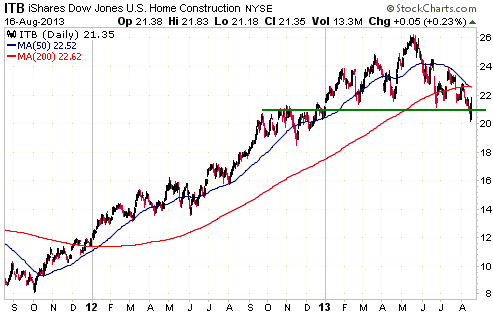
In this vein, the iShares Dow Jones Home Construction ETF (ITB) warrants close
scrutiny. As illustrated by the following chart, this ETF came close to breaking
out to the downside last week and ended the week slightly above important
support.
A sustained break below $21 by ITB would signal that a major top was in place
for this sector of the market and give an early warning that a major top was in
place for the overall market.
If the S&P500 drops by another 50-100 points over the next couple of weeks, Fed
officials will probably start making speeches in which they suggest that there
won't be any 'tapering' this year.
As previously explained, the Fed is caught in a trap of its own making. It has
created the situation where equity valuations and a lot of economic activity are
dependent upon the continuation of substantial 'monetary accommodation'. It
wants to reduce the level of accommodation and it wants to avoid short-term
pain, but doing both is not possible.
The Emerging Markets
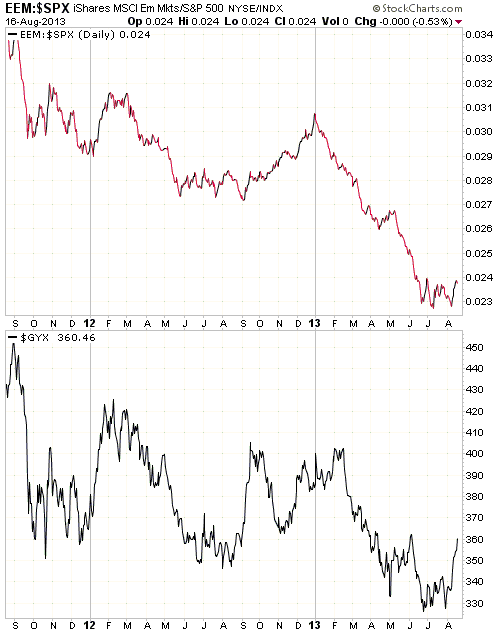
The following chart compares the EEM/SPX ratio (the "emerging markets" relative
to the US market) with the Industrial Metals Index (GYX). This chart illustrates
the comment we made in last week's Interim Update -- that emerging-market
equities are being temporarily supported by the same forces that are giving
industrial metals' prices a boost. In other words, it seems that the relative
performance of emerging-market equities is linked to the performance of the
industrial metals complex.
We are bearish on both EEM and the SPX, but the SPX is likely to be the poorer
performer as long as the industrial metals are rallying.
This week's
important US economic events
| Date |
Description |
| Monday Aug 19 |
No important events scheduled | | Tuesday
Aug 20 |
No important events scheduled | | Wednesday
Aug 21 |
Existing Home Sales
FOMC Minutes | | Thursday
Aug 22 |
Leading Economic Indicators
Kansas City Fed Mfg Index
|
| Friday Aug 23 |
New Home Sales |
Gold and
the Dollar
Gold and Silver
A short-term risk eliminated
We mentioned in TSI commentaries over the past few months that the large GLD
stake held by John Paulson's hedge fund constituted a short-term downside risk
for the gold price. This is because Paulson's fund qualified as a 'weak hand'
that could be forced to sell at some point. In public, Paulson said that he
remained bullish on gold and comfortable with his GLD position, but he would
naturally make such public statements regardless of whether his intention was to
hold or sell. The reason is that you would be stupid to do otherwise if your
long position was big enough that other traders would likely 'front run' your
selling, causing you to receive a lower price.
Due to a regulatory filing with the SEC last week we now know that Paulson
substantially reduced his GLD stake during the quarter ended 30th June -- from
around 22M shares to around 10M shares. This selling was no doubt partly
responsible for the June weakness in the gold price.
Paulson's GLD stake is no longer a significant short-term threat to the gold
market. In fact, news that the 'Paulson overhang' had been largely removed was
probably the catalyst for gold's upside breakout last Thursday.
Current Market Situation
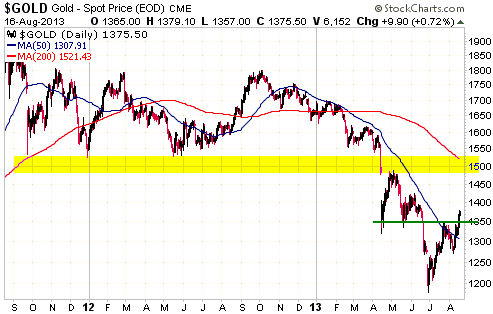
A week ago we wrote: "Important resistance lies at $1350. Taking out this
resistance could prompt many speculators to start thinking along the lines of
"hey, maybe the gold bull market has resumed", leading to significant upside
follow-through.
A test of longer-term resistance at $1480-$1530 will be a realistic possibility
in September if $1350 is decisively breeched in August."
As illustrated by the following daily chart, resistance at $1350 was decisively
breeched over the final two trading days of last week. This opens up the
possibility that longer-term resistance at $1480-$1530 will be tested in
September.
Gold sentiment remains constructive. In particular, the Central Gold Trust (GTU)
and the Central Fund of Canada (CEF) are still trading at discounts to their
respective net asset values and the speculative net-long position in COMEX gold
futures has only just begun to rise from a 10-year low.
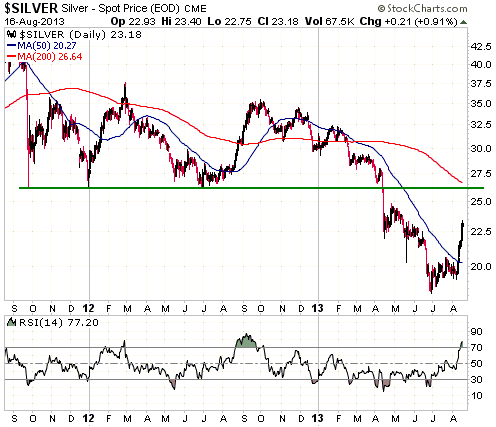
In last week's Interim Update we mentioned the $23-$24 range as a likely
short-term target for silver. Due to a price surge over the final two trading
days of last week, the bottom half of this range has already been reached.
Silver is now short-term 'overbought', but the speed of last week's price rise
increases the probability that major resistance at $26 (the extreme short-term
upside target mentioned in last week's Interim Update) will be tested prior to
the next 1-3 month peak.
Gold Stocks
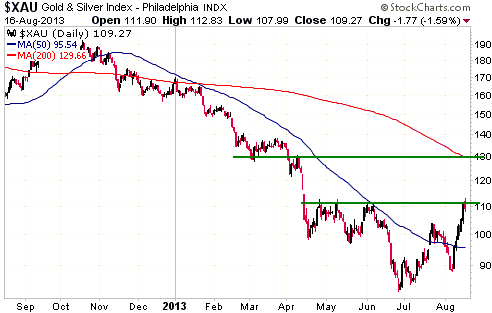
The HUI didn't quite make it to important resistance in the 290s last week, but
the XAU made it to equivalent resistance at 110-111. Refer to the following
daily chart for details.
If the XAU can consolidate for at least a few days and then break above 111, the
short-term target will be the 200-day MA and lateral resistance at around 130.
This higher resistance level should be viewed as the maximum realistic upside
potential with regard to the coming two months.
Note that 130 for the XAU is roughly equivalent to 330-340 for the HUI.
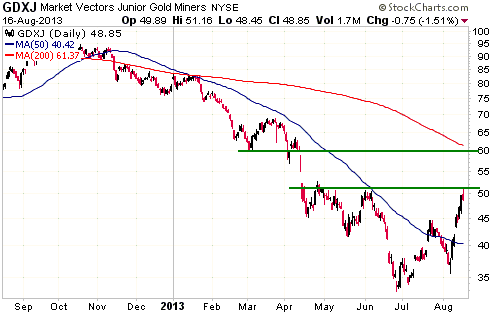
GDXJ, an ETF that holds junior gold and silver miners, has resistance at US$51
and then at US$60. The following daily chart shows that the lower of these
resistance levels was tested last Friday. The higher of these resistance levels
should be viewed as the maximum realistic upside potential with regard to the
coming two months.
Currency Market Update
It was an uneventful week in the currency market, with the major currencies
generally making insignificant moves.
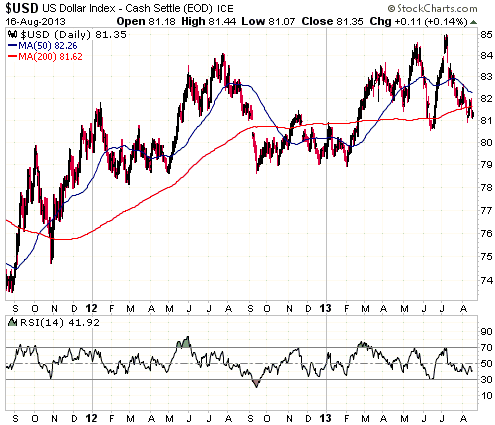
As was the case at this time last week, the Dollar Index could be close to a
short-term bottom. But as was also the case at this time last week, there is no
evidence that a meaningful/tradable US$ rally is about to get underway. Of
particular note, sentiment is neutral despite the Dollar Index's recent sharp
multi-week decline. In other words, speculators are presently more bullish on
the Dollar Index than they would ordinarily be considering the price action.
This creates the potential for a further shake-out of US$ longs prior to a
sustained reversal.
As has been the case for the entire year, the most important support for the
Dollar Index lies at 79. This support could be tested within the next few weeks
as part of a continuing correction, but it shouldn't be breeched.
Update
on Stock Selections
Notes: 1) To review the complete list of current TSI stock selections, logon at
http://www.speculative-investor.com/new/market_logon.asp
and then click on "Stock Selections" in the menu. When at the Stock
Selections page, click on a stock's symbol to bring-up an archive of
our comments on the stock in question. 2) The Small Stock Watch List is
located at http://www.speculative-investor.com/new/smallstockwatch.html
 Company
news/developments for the week ended Friday 16th August 2013: Company
news/developments for the week ended Friday 16th August 2013:
[Note: FS = Feasibility Study, IRR = Internal Rate of Return, MD&A =
Management Discussion and Analysis, M&I = Measured and Indicated,
NAV = Net Asset Value, NPV(X%) = Net Present Value using a discount
rate of X%, P&P = Proven and Probable, PEA = Preliminary Economic
Assessment, PFS = Pre-Feasibility Study]
*Asanko Gold (AKG) issued its quarterly reports for the June-2013
quarter. Of particular interest, as at 30th June AKG had no
long-term debt and $189M of working capital, making it one of the
best-positioned exploration-stage gold miners from a balance-sheet
perspective. Also of interest, the FS for AKG's Esaase gold project
is on track for completion during the final quarter of this year.
*Carpathian Gold (CPN.TO) issued its quarterly reports for the
June-2013 quarter. These reports indicate that the 100K-oz/year RDM
gold project in Brazil is on track to commence production this
quarter and to ramp up to design capacity in the final quarter of
2013. That's the good news. The bad news is that CPN's financial
situation is now precarious. Additional financing will be needed
within the next few months.
Interestingly and a little surprisingly, CPN's stock price rebounded
on strong volume after the quarterly report was published.
Considering the company's pressing need for additional financing,
further price strength over the next few weeks should be viewed as
an opportunity to scale out of this high-risk stock.
*Endeavour Mining (EDV.TO/EVR.AX) reported its financial results
for the quarter ended 30th June 2013. There were no surprises.
The all-in sustaining production cost during the quarter was
$1,038/oz, which is about 20% below the industry average. EDV's
management expects the cost to fall to $1,000/oz in 2014 due to
cost-reduction measures and the start-up of the low-cost Agbaou
mine.
EDV's liquidity position remains strong, in that the company had
about $100M of working capital at the end of June and recently added
another $100M by drawing down a long-term credit facility. It should
only need to invest another $30M-$35M to bring Agbaou into
production and its other projects should be cash-flow positive as
long as the gold price is above $1250/oz, meaning that the company
should have more than enough cash to fund its current operations and
its growth.
*Energy Fuels (EFR.TO) shareholders have approved the merger with
Strathmore Minerals (STM.TO). The approval of STM shareholders is
expected to happen at a meeting scheduled for 20th August and the
merger is expected to be completed on 28th August.
EFR shareholders have also approved a share consolidation. The share
consolidation (likely: 1 new share for 10 existing shares) has been
in the works for more than 12 months, will occur at the discretion
of the company's board of directors sometime after the merger with
STM is completed, and will hopefully pave the way for an NYSE
listing for EFR.
Separately, EFR issued its quarterly reports for the June-2013
quarter. Production at the company's White Mesa mill totaled 511,000
pounds of uranium and 490,000 pounds of vanadium during the quarter.
The uranium production cost worked out to about $39/pound.
At 30th June 2013 the company had $33.8M of working capital, which
is down from $42M at 30th September 2012 (the end of EFR's 2012
financial year) and up from $33M at 31st March 2013. During the
June-2013 quarter the company raised $6.6M via an equity financing,
which effectively means that its business was cash-flow negative by
about $6M during the June quarter and $15M during the 9 months since
the end of September last year. This is obviously not good, but it's
also not surprising considering the performance of the uranium
market.
EFR probably has enough working capital and financing options to
survive another year of low uranium prices, but good returns for
shareholders will require a much higher uranium price or the belief
that a much higher uranium price is in the cards.
*Golden Star Resources (GSS) reported its financial results for
the quarter ended 30th June 2013, the quarterly production results
having been reported about five weeks ago. The financial results
were bad, but not worse than expected.
GSS's main problem is its relatively high cost of production. In the
March quarter, for example, the company's consolidated cash
operating cost (the combined cash cost across its two operating
mines in Ghana) was $1124/oz. This was the net result of a
reasonable $809/oz cost at the Wassa mine and a very high $1531/oz
cost at the Bogoso mine. In the June quarter the consolidated cash
operating cost was $1078/oz, comprising a cost of $736/oz at Wassa
and a cost of $1584/oz at Bogoso, and the all-in sustaining
production cost was $1,378/oz.
The Wassa mine therefore continues to operate very well and is
generating significant positive cash-flow at the current gold price,
whereas the Bogoso mine continues to drain the company's cash at a
rapid pace. However, Bogoso's terrible performance was in line with
expectations considering the pit-wall failure that disrupted the
operation in early May. GSS's management previously announced its
plans to substantially reduce Bogoso's costs over the next few
quarters.
Like many other gold producers, GSS took a large non-cash impairment
charge during the June quarter to reflect the potential long-term
effects of a lower gold price. In GSS's case the non-cash charge was
about $170M.
GSS's balance sheet deteriorated by about $40M during the June
quarter, but the company isn't in danger of running out of cash this
year.
*Lydian International (LYD.TO) issued its quarterly reports for
the June-2013 quarter. Based on these reports, the company has about
$20M of working capital. This should be enough to fund it through
the next 12 months or until the start of mine construction at the
Amulsar gold project, whichever comes first. The timing of mine
construction will depend on the completion of the FS and the receipt
of all permits, both of which are dependent upon successful
resolution of the issue discussed in the 29th July Weekly Update.
LYD is trading at a very low valuation and has one of the most
economically robust feasibility-stage gold projects that we know of.
If not for the permitting/political issue discussed in our 29th July
commentary it would be our top candidate for new buying at current
prices, but until this issue is sorted out it would be prudent to
hold off on new buying.
*Pilot Gold (PLG.TO) issued its quarterly reports for the
June-2013 quarter. The key points are:
1) PLG has sufficient working capital ($29M at 30th June) to fully
fund its exploration programs for the next 18 months.
2) There will be a steady stream of drilling results over the
remainder of this year.
3) The company expects to complete an initial resource estimate for
the KCD Target at its TV Tower project (Turkey) by the end of this
year.
*Premier Gold (PG.TO) issued its quarterly reports for the
June-2013 quarter. These reports confirm that the company has about
$80M of working capital, which should be enough to fund it through
the next two years.
*Pretium Resources (PVG) reported results from the on-going bulk
sample program at its Brucejack high-grade project. The results from
underground drilling being done as part of the program continue to
confirm the projections of the resource model. And as is normal for
this gold deposit, the latest results included some spectacular
intercepts. For example, one hole intersected 10,850 g/t over 0.5m.
The bulk sample program is due to be completed early next month. The
independent consultant (Strathcona Mineral Services) will then
prepare its report.
*Rio Alto Mining (RIO.TO) issued its quarterly reports for the
June-2013 quarter.
Financial performance during the June quarter was a little worse
than we were expecting and, judging by the initial reaction of the
stock price, the market was expecting. For us, the negative surprise
was that while RIO's balance sheet remains healthy, there was a $13M
quarter-on-quarter decline in working capital.
Earnings and production costs were fine. The company reported an
all-in sustaining cash cost of $1,041/oz, which is about 20% below
the industry average, and adjusted net income for the quarter of
$0.06/share.
The stock price quickly recouped its initial post-results loss,
however, for two reasons. First, the company's management made a
bullish forecast for the second half of this year (RIO is forecast
to produce 110K-120K ounces of gold at an all-in sustaining cash
cost of less than $1000/oz during the second half of 2013). Second,
management noted that the average grade of the ore mined at the
company's flagship La Arena project was higher than the grade
projected by the resource model. To put it another way, the oxide
gold deposit is turning out to be richer than expected.
Candidates
for new buying
Over the past several weeks it has been very easy for us to identify short-term
buying opportunities, because all members of the TSI Stocks List were both very
under-valued and 'oversold'. However, this week it is a lot more difficult. A
good argument can be made that every TSI stock remains very under-valued, but as
a result of the price action some of the most obvious candidates for new buying
over recent weeks are now short-term 'overbought'.
In general, the relatively low-risk/high-quality juniors have enjoyed the
strongest rebounds. This prompts the question: With the lower-risk stocks having
risen sharply, does it make sense to start focusing on the higher-risk plays as
far as new buying is concerned?
With the one possible exception mentioned below, we don't think so. At this
early stage of what will probably turn out to be a new multi-year bull market in
the gold-mining sector it probably still makes sense to direct most new buying
towards the under-valued stocks of companies with strong balance sheets and
relatively low-risk assets. With most stocks in this category now 'overbought'
on a short-term basis, our current list of short-term buying opportunities
contains only two suggestions.
From within the ranks of TSI stock selections, the best candidates for new
buying at this time are:
- EDV.TO/EVR.AX at C$0.75 or lower (Friday's close: C$0.80)
- SBB.TO, ideally in the low-C$1.20s (Friday's close: C$1.30)
The one possible exception to the idea of maintaining focus on the relatively
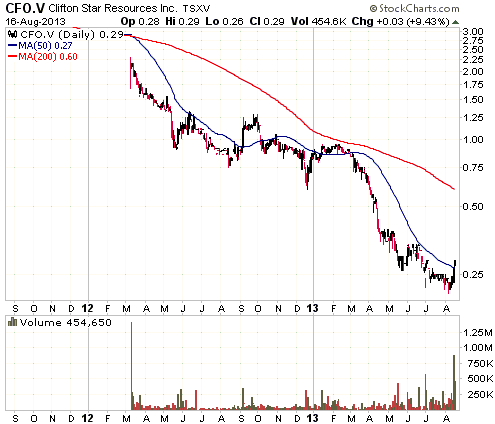
low-risk juniors is Clifton Star Resources (CFO.V). Although CFO's stock price
has only just begun to turn upward from an ultra-depressed level (see chart
below), last Thursday it had the highest single-day upside volume (in terms of
shares traded, not in dollar terms) since 2010. One of the risks is that the
company only has about $4M of cash, which means that it will have to raise more
money within the next 6 months.
It could be appropriate for risk-tolerant speculators to buy some CFO shares at
C$0.30 or lower.
Short-term
price targets and candidates for partial selling
Here are chart-based short-term upside price targets for TSI gold stocks that
have rebounded strongly over the past two weeks. Depending on individual
portfolio considerations, it could make sense to do some selling near these
price targets if the targets are reached by mid-September. Depending on
individual portfolio considerations, such as the amount of money at risk in a
particular stock, it could also make sense to do some selling at lower prices as
part of a methodical scale-in-during-weakness/scale-out-during-strength process.
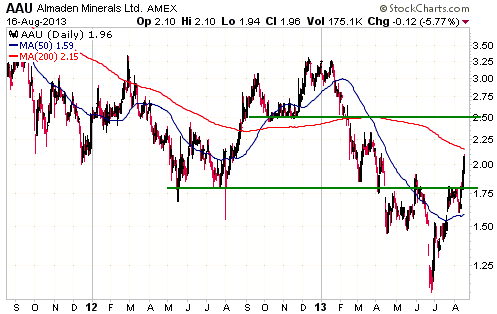
1) Almaden Minerals (AAU): AAU broke above resistance at US$1.80 last week. The
first target is the 200-day MA (currently at US$2.15), which was almost reached
last Friday. The more significant target with regard to taking money off the
table is lateral resistance at US$2.50.
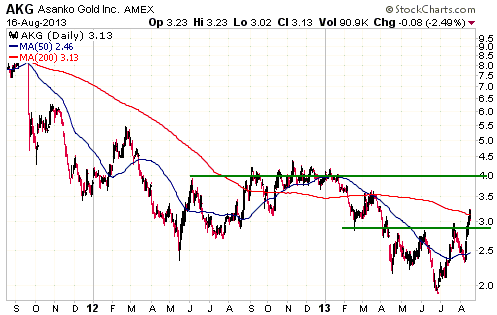
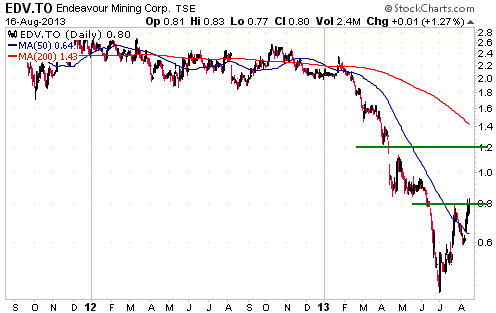
2) Asanko Gold (AKG): AKG's recent break above resistance at US$2.80-$2.90
suggests a short-term target of US$4.00.
3) Endeavour Mining (EDV.TO): EDV is testing minor resistance at C$0.80. A break
above C$0.80 will create near-term targets of C$1.00 and C$1.20, although EDV
won't encounter major chart-based resistance until it reaches C$1.80.
C$1.80 should be viewed as an extreme upside target as far as the remainder of
this year is concerned, but as a reasonable upside target with regard to the
coming 12 months.
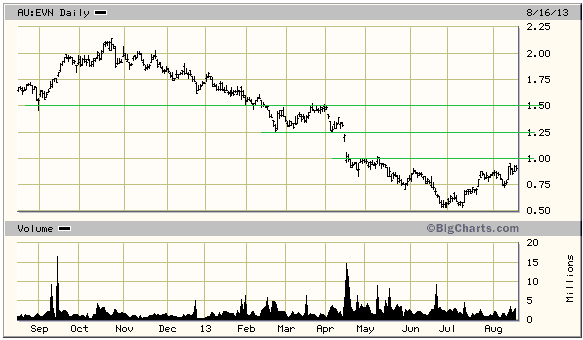
4) Evolution Mining (EVN.AX): EVN has resistance at A$0.95-$1.00, A$1.25 and
A$1.50. The first of these resistance levels is currently being tested and the
second is a realistic short-term target. We suspect that resistance at A$1.50
won't be tested until next year.
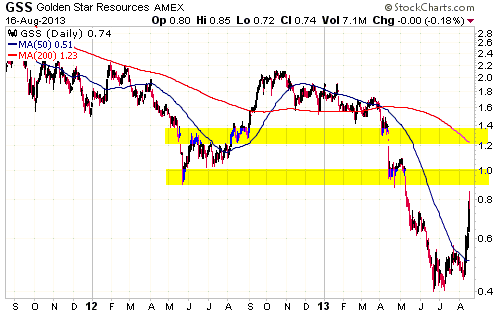
5) Golden Star Resources (GSS): GSS has significant resistance at US$0.90-$1.00.
This resistance was almost reached last week, which is remarkable considering
that the stock began the week at only US$0.47.
If GSS manages to break above US$1.00 within the next few weeks then the next
target will be the $1.20s.
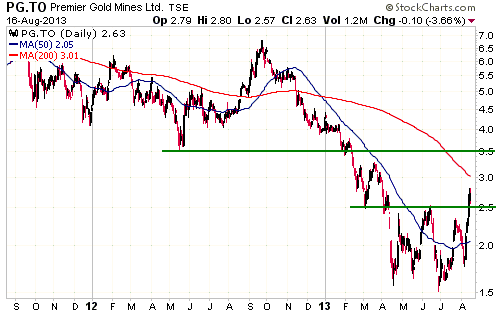
6) Premier Gold Mines (PG.TO): When PG broke above C$2.50 last week it completed
a multi-month basing pattern. Above the current price there is resistance at
C$3.00 and then at C$3.50. Ideally, former resistance at C$2.50 should now act
as support during any pullback over the days immediately ahead.
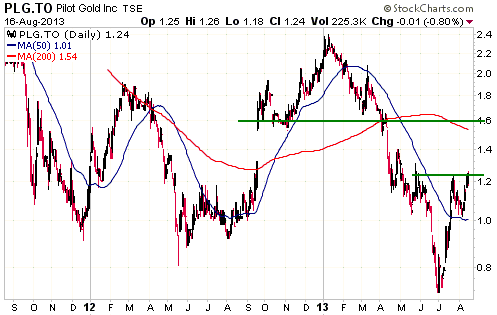
7) Pilot Gold (PLG.TO): PLG is testing resistance in the C$1.20s. If/when it
breaks through, the short-term target will be the C$1.50-$1.60 range.
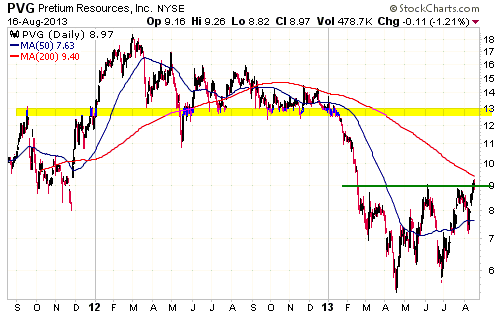
8) Pretium Resources (PVG): US$9.00 is the top of a multi-month basing pattern
for PVG. A break-out from the base will create a target of US$12.50, although
along the way the stock will undoubtedly encounter resistance at $10.00 and
$11.00.
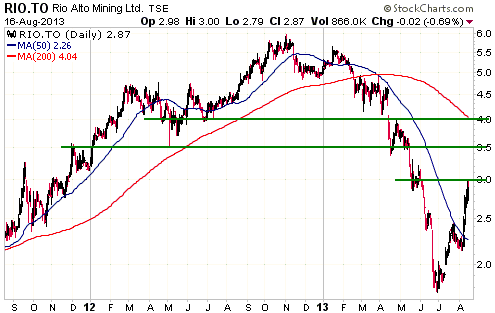
9) Rio Alto Mining (RIO.TO, RIOM): We added RIO to the TSI List at C$2.00 as a
short-term trade in anticipation of a rebound to C$3.00-$3.50. The lower
boundary of this target range was touched last Friday, but the potential exists
for significant additional upside following some consolidation below $3.
$3.50 will be the obvious target after a break above $3.00. For TSI record
purposes, we will exit the short-term position if the stock trades at C$3.30.
10) Sabina Gold and Silver (SBB.TO): SBB is bumping up against resistance at
C$1.35-C$1.40. If/when it breaks above this resistance, the short-term target
will be C$1.75-$2.00.
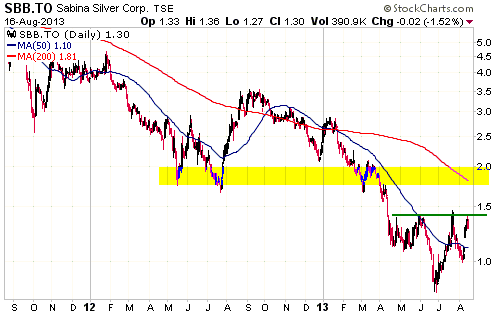
Chart Sources
Charts appearing in today's commentary
are courtesy of:
http://stockcharts.com/index.html
http://bigcharts.marketwatch.com/

|









