|
-- Weekly Market Update for the Week Commencing 19th November 2012
Big Picture
View
Here is a summary of our big picture
view of the markets. Note that our short-term views may differ from our
big picture view.
In nominal dollar terms, the BULL market in US Treasury Bonds
that began in the early 1980s will end by 2013. In real (gold)
terms, bonds commenced a secular BEAR market in 2001 that will continue
until 2014-2020. (Last
update: 23 January 2012)
The stock market, as represented by the S&P500 Index,
commenced
a secular BEAR market during the first quarter of 2000, where "secular
bear market" is defined as a long-term downward trend in valuations
(P/E ratios, etc.) and gold-denominated prices. This secular trend will bottom sometime between 2014 and 2020.
(Last update: 22 October 2007)
A secular BEAR market in the Dollar
began during the final quarter of 2000 and ended in July of 2008. This
secular bear market will be followed by a multi-year period of range
trading.
(Last
update: 09 February 2009)
Gold commenced a
secular bull market relative to all fiat currencies, the CRB Index,
bonds and most stock market indices during 1999-2001.
This secular trend will peak sometime between 2014 and 2020.
(Last update: 22 October 2007)
Commodities,
as represented by the Continuous Commodity Index (CCI), commenced a
secular BULL market in 2001 in nominal dollar terms. The first major
upward leg in this bull market ended during the first half of 2008, but
a long-term peak won't occur until 2014-2020. In real (gold) terms,
commodities commenced a secular BEAR market in 2001 that will continue
until 2014-2020.
(Last
update: 09 February 2009)
Copyright
Reminder
The commentaries that appear at TSI
may not be distributed, in full or in part, without our written permission.
In particular, please note that the posting of extracts from TSI commentaries
at other web sites or providing links to TSI commentaries at other web
sites (for example, at discussion boards) without our written permission
is prohibited.
We reserve the right to immediately
terminate the subscription of any TSI subscriber who distributes the TSI
commentaries without our written permission.
Outlook Summary
Market
|
Short-Term
(1-3 month)
|
Intermediate-Term
(6-12 month)
|
Long-Term
(2-5 Year)
|
|
Gold
|
Bullish
(17-Oct-12)
|
Bullish
(26-Mar-12)
|
Bullish
|
|
US$ (Dollar Index)
|
Bearish
(29-Oct-12)
|
Neutral
(09-Jan-12)
|
Neutral
(19-Sep-07)
|
|
Bonds (US T-Bond)
|
Neutral
(12-Nov-12)
|
Neutral
(18-Jan-12)
|
Bearish |
|
Stock Market
(DJW)
|
Bearish
(30-Jul-12)
|
Bearish
(28-Nov-11)
|
Bearish
|
|
Gold Stocks
(HUI)
|
Bullish
(22-Oct-12)
|
Bullish
(23-Jun-10)
|
Bullish
|
|
Oil |
Neutral
(30-Jul-12)
|
Neutral
(31-Jan-11)
|
Bullish
|
|
Industrial Metals
(GYX)
|
Neutral
(30-Jul-12)
|
Neutral
(29-Aug-11)
|
Neutral
(11-Jan-10)
|
Notes:
1. In those cases where we have been able to identify the commentary in
which the most recent outlook change occurred we've put the date of the
commentary below the current outlook.
2. "Neutral", in the above table, means that we either don't have a
firm opinion or that we think risk and reward are roughly in balance with respect to the timeframe in question.
3. Long-term views are determined almost completely by fundamentals,
intermediate-term views by
fundamentals, sentiment and technicals, and short-term views by sentiment and
technicals.
QE3 Update
It is taking longer than expected for the
new "QE" program announced by the Fed on 13th September to have a meaningful
effect on the Fed's balance sheet and hence on the US money supply. As far as we
know, this is due to the delay between when the Fed arranges to buy some MBS
(Mortgage Backed Securities) and when payment in the form of newly created money
is issued to the seller of the MBS. This delay can apparently be as much as a
couple of months. That being said, evidence of the Fed's new inflation program
has started to emerge.
The Fed's balance sheet is roughly the same size now as it was at the completion
of QE2 way back in early July of 2011. This means that the Fed has made no
direct contribution to the US money supply over the past 16 months. However, if
we zoom in on the recent past it becomes clear that the money pumps are being
cranked up. We note, in particular, that the Fed's balance sheet has expanded by
$53B since 12th September. This is a lot less than the $40B per month stipulated
under the latest QE program, but as we said above the difference can probably be
put down to settlement delays. From now on we should see an average of about
$40B per month added to the Fed's balance sheet as purchases agreed over the
preceding two months are settled by issuing new money.
This money pumping WILL cause some prices to rise.
Political/Country Risk
Behre Dolbear, a well-respected international
consultant to the mining industry, puts out an
annual political risk
assessment covering the most important countries for mining. The table
displayed below is a summary of the 2012 assessment. The table is ordered from
most risky (lowest point score) at the top to least risky (highest point score)
at the bottom. Note that despite possessing considerable mineral wealth,
Zimbabwe and Venezuela aren't included in the table due to their inherently low
ranking.
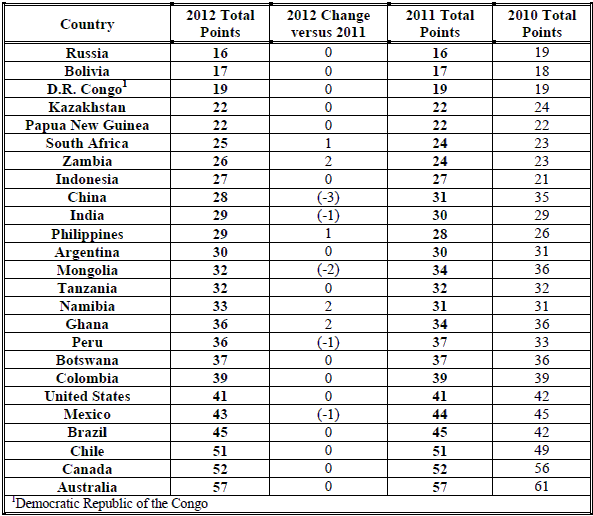
According to Behre Dolbear, these are the five riskiest countries to operate or
develop a mine:
Russia
Bolivia
D.R.C.
Kazakhstan
Papua New Guinea
And these are the five countries that Behre Dolbear considers to be the most
attractive from a political risk perspective:
Australia
Canada
Chile
Brazil
Mexico
Wherever possible, investors should limit themselves to the stocks of mining
companies that have their main assets in relatively low-risk countries.
A final point worth mentioning is that political risk is often not uniform
throughout a country. For example, Canada is generally (and correctly)
considered to be a relatively low-risk country, but some Canadian provinces are
more mining-friendly than others. All else being equal, an exploration-stage
mining project will have a better chance of moving through to production if it
is located in the Canadian province of Quebec than if it is located in the
Canadian province of British Columbia.
The Stock
Market
A buying opportunity in the O&G (Oil and
Gas) services sector?
Water management is a big deal for the companies using horizontal drilling and
multi-stage fracturing to extract oil and natural-gas from shale formations. And
Poseidon Concepts (PSN.TO), a supplier of fluid management services (water
storage tanks, mostly) to the O&G industry, positioned itself to capitalise on
the rapidly-growing needs of O&G drillers for more water and more efficient
methods of water storage. PSN's business expanded at a fast pace and its future
looked extremely bright ... right up until about 5.00PM last Wednesday when it
published its latest quarterly results. The quarterly results revealed several
problems, chief among them being that a business that was widely expected to
achieve additional strong growth had begun to shrink. Other problems revealed by
the quarterly results were a substantial decline in profit margin and a blow-out
in receivables.
The stock market reacted to the quarterly report by lopping 62% off PSN's market
capitalisation last Thursday (see chart below). This was one of the most sudden
and spectacular falls from grace we have ever seen. 50%+ single-day declines
aren't rare in the world of high-risk microcap mining stocks, but this was a
stock with a very profitable business, a billion dollar market cap, a strong
balance sheet and an 8% dividend yield that didn't appear to be vulnerable to
'bolts from the blue'.
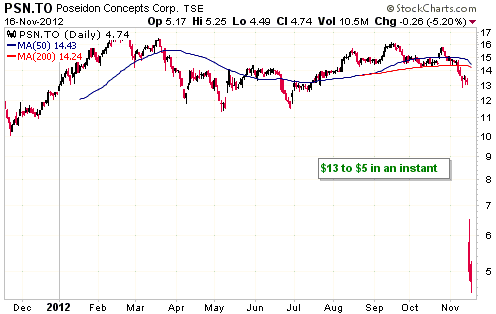
Upon noticing PSN's collapse last week our first thought was that it might make
sense to buy the stock in anticipation of a rebound. Our thinking was that a
return to double figures wouldn't happen anytime soon, but a rebound that
retraced only half of Thursday's decline would result in a profit of around 80%
for anyone who bought the stock near Thursday's closing price of $5. However, we
would only have attempted such a trade if we were confident that the market had
discounted the worst-case scenario, which we weren't/aren't. Despite the huge
sell-off, the stock did not appear to be cheap at C$5.00 if we made the
realistic assumption that further deterioration of the underlying business lay
ahead.
Our second thought, which occurred after we read through the PSN press release
that sparked the collapse, was that this does not augur well for the entire O&G
services sector. You see, PSN's revenues and margins didn't fall due to inroads
being made by its competitors; they fell due to an industry-wide downturn. As
stated by PSN:
"The combination of declining rig counts, delays to completion programs and,
ultimately, lower capital spending by exploration and production companies
attempting to rationalize service costs and stay within reduced 2012 budgets
meant lower utilization and pricing for Poseidon's tank fleet."
And: "The impact of the slowdown became evident to Poseidon in the second
half of the third quarter. Throughout the North American oil field service
industry, several fracturing-related and ancillary rental services experienced
significant spot market pricing declines, and Poseidon was not completely immune
to the adverse conditions."
And: "Poseidon's tank utilization and revenue in the quarter were further
affected as the company renegotiated terms on several long-term agreements with
specific, strategic customers due to changes in their project schedules and
capital budgets. Meanwhile, several other long-term agreements lapsed without
renewal or were suspended as certain customers' activities were reduced due to
macro considerations or capital budget constraints."
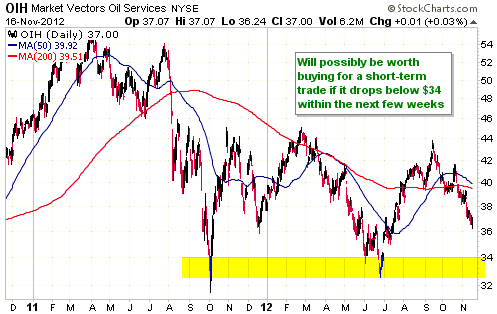
In late June we suggested 'going long' the O&G services sector -- via OIH and/or
PDS -- for a trade. That worked well. With the prices of most O&G services
stocks having pulled back considerably over the past two months (as evidenced by
the following daily chart of OIH) we were starting to think that the same
short-term trade could be in the offing, but the PSN news indicates otherwise.
At this stage there is too much scope for unpleasant surprises. Lower prices
will be needed to create a suitably attractive risk/reward.
Current Market Situation
The McClellan Oscillator is a useful indicator, but only when it reaches an
'oversold' extreme. Most of the time it can safely be ignored.
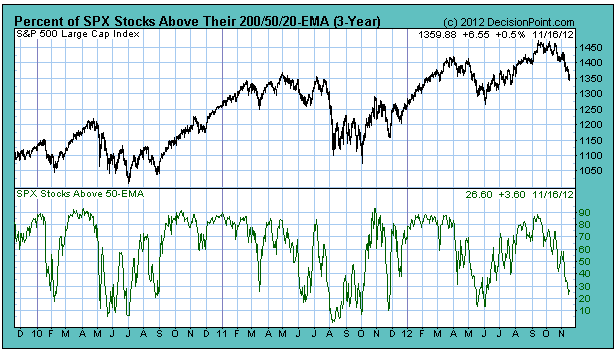
The percentage of SPX stocks above their respective 50-day moving averages is
similar, in that it provides useful information at 'oversold' extremes and at no
other time. The following chart shows that this indicator hit a low of 23% last
Thursday before recovering a little to end the week at 26.6%. Like the McClellan
Oscillator it is getting close to the sort of extreme that would point to a
market bottom of at least short-term significance, but it isn't there yet.
The "SPX Stocks Above 50-EMA" indicator will generate a reliable signal that the
market is close to a multi-month low if it moves below 15%.
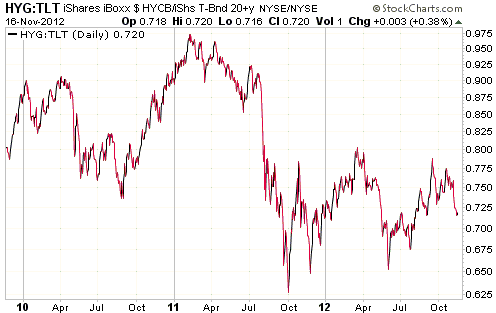
Below is a chart of the HYG/TLT ratio -- one of our favourite indicators of risk
aversion. When high-yield bonds (represented by HYG) are rising relative to
Treasury Bonds (represented by TLT) it suggests that the average market
participant is becoming less risk averse. In other words, it suggests that the
markets are in "risk on" mode. And when Treasury Bonds are doing better than
high-yield bonds we can conclude that the markets are in "risk off" mode.
The financial markets were clearly in "risk on" mode from August of 2010 through
to the first quarter of 2011 and were clearly in "risk off" mode from April-May
of 2011 through to November of 2011. However, over the past 12 months the risk
trend hasn't been clear. This reflects the counteracting forces in play. Central
banks are encouraging investors to take more risk and are periodically having
some 'success', but then attention shifts to the economic depression in some
euro-zone nations and/or China's slowdown and/or the US "Fiscal Cliff".
We suspect that a multi-month period of "risk on" will begin in the near future,
but to set the stage for such a period there could (ideally will) first be a
final 'whoosh' in the stock market. We aren't talking about a crash, just a
sharp multi-day decline that pushes the senior stock indices to 'oversold'
extremes.
This week's
important US economic events
| Date |
Description |
| Monday Nov 19 |
Existing Home Sales
Housing Market Index
| | Tuesday Nov 20 |
Housing Starts | | Wednesday
Nov 21 |
Consumer Sentiment
Leading Economic Indicators | | Thursday
Nov 22 |
US markets closed for Thanksgiving
|
| Friday Nov 23 |
No significant events scheduled
NYSE early close (1:00PM)
|
Gold and
the Dollar
Gold
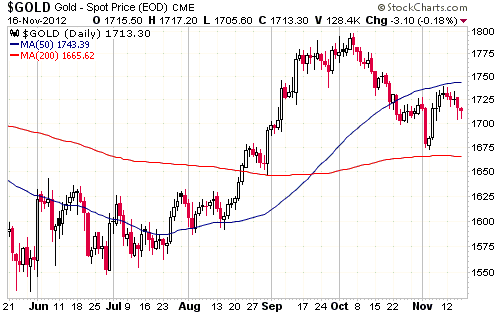
Gold drifted relentlessly lower over the course of last week, but only gave back
about half of what it gained the previous week. By falling last week at a slower
pace than it rose the week before last, the gold market provided us with some
additional evidence that the recent decline to the $1670s marked the end of the
correction that started shortly after the QE3 announcement.
The price-related evidence of a correction low is not conclusive and it is
obviously not a plus that the bullish divergence between the XAU/gold ratio and
the gold price was eliminated last week, but the price-related evidence will
only become conclusive after the price moves a lot higher and the vast majority
of significant gold bottoms over the past several years were not accompanied by
bullish divergences between the bullion and the mining stocks. It would have
made things easier if the bullish divergence between the stocks and the bullion
had remained intact, but such a divergence is certainly not a prerequisite for a
correction low in the bullion market.
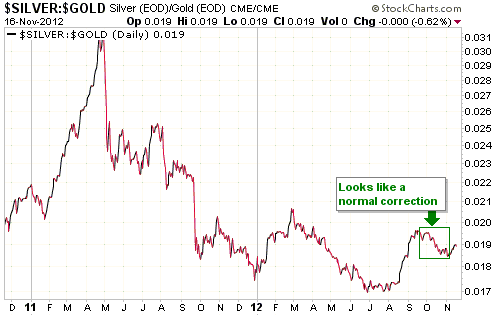
In addition to the odds being in favour of a correction low in the gold price,
they are also in favour of a correction low in the silver/gold ratio (see chart
below).
When the silver/gold ratio begins to trend downward it usually doesn't leave us
guessing for long, in that it tends to fall hard and fast soon after making an
important top. With reference to the following chart, notice, for example, the
three plunges that occurred last year. Now compare last year's price declines
with the decline of the past several weeks. At this stage the decline from the
September-2012 short-term top has the look of a normal correction within an
upward trend.
Gold Stocks
In last week's Interim Update, we wrote:
"...with very few exceptions the price action during any single trading day
will tell you precisely nothing about the future. One of the rare exceptions
entails a market experiencing a pronounced single-day reversal after moving
relentlessly in one direction over a period of at least several weeks. For
example, the gold-stock indices have now been trending downward for almost two
months and have just fallen for four days in succession. If they were to fall on
Thursday 15th November (making it five down-days in a row) and fall again during
the first hour of trading on Friday before reversing upward and ending the day
with a solid gain, then Friday's price action would be a short-term bullish
omen."
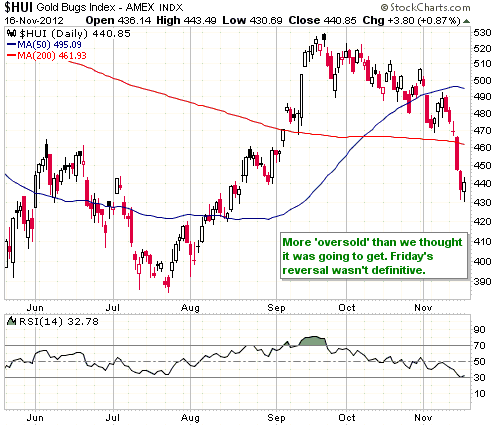
As it turned out, the gold-stock indices fall on Thursday 15th November (making
it five down-days in a row) and fell again during the first hour of trading on
Friday before reversing upward, but Friday's gain was too small to be considered
reliable evidence that a sustainable low is in place. That doesn't mean that a
sustainable low wasn't put in place late last week, only that such a low hasn't
yet been signaled by the price action. A low could be signaled by a strong (>3%)
rise in the HUI on Monday 19th November or a spike below last week's intra-day
low followed by a reversal that leads to a gain at the end of the trading day.
The current situation is that the HUI has fallen further than we thought it
would and become more 'oversold' than we thought it would during the predictable
correction from its September high. However, the more bearish short-term outcome
has increased the probability of a more bullish intermediate-term outcome. This
is because there is no longer any chance of an intermediate-term peak during
November-December of this year. By far the most likely intermediate-term
scenario is that the current correction will be followed by a rally that lasts
until May-June of 2013 or later.
The following chart shows the GLDX/GDX ratio, which means that it shows how
exploration-stage junior gold stocks have performed relative to major gold
stocks. Between February of 2011 and June of 2012, the exploration-stage juniors
represented by GLDX lost almost 50% of their value relative to the major gold
stocks represented by GDX. Since June of 2012 the juniors have essentially held
their own relative to the majors, but at this stage there is no evidence that
the intermediate-term trend has reversed direction.

A seasonal period of relative strength in the juniors begins late in the 4th
quarter and extends through to at least February of the following year. Last
year's seasonal strength in the juniors was smaller than average in terms of
both duration and magnitude, but it was still evident. If the overall gold
sector commenced a 1-2 year upward trend in May of 2012 (the most likely
scenario, in our opinion), then the seasonal rally that begins between now and
year-end should be at least as good as average.
We continue to like GLDX for a 3-5 month trade.
Currency Market Update
The Yen dropped quite sharply last week as the market anticipated more
aggressive attempts to inflate by the Bank of Japan. Other than that, very
little happened in the currency market.
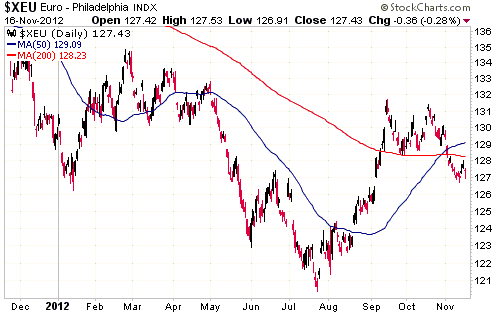
In a classic example of "buy the rumour sell the news", like most beneficiaries
of US$ inflation the euro rallied hard during the weeks leading up to the Fed's
"QE3" announcement and has been working its way downward since the day after
"QE3" was formally introduced. Our view is that the euro has unfinished business
on the upside and that this unfinished business will be taken care of after the
stock market reaches a short-term bottom. In other words, we expect the euro to
move above its September high before it commences its next intermediate-term
decline.
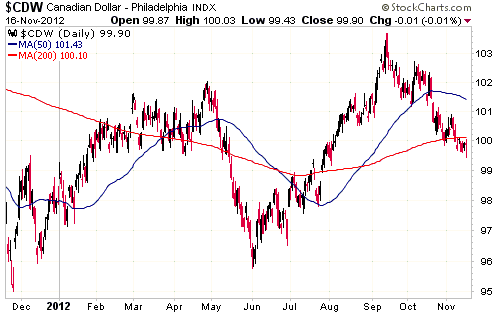
The Canadian Dollar (C$) has also pulled back since the QE3 announcement and
should also rally after the stock market reaches a short-term bottom. However,
for two reasons we suspect that the C$'s September peak will turn out to be the
intermediate-term variety. The first reason is that the price action looks more
like the initial leg of a new intermediate-term decline than a consolidation
within a continuing upward trend. The second reason is that despite the price
decline, the COT data and Market Vane's sentiment survey indicate that
speculators have remained steadfastly optimistic about the C$'s prospects. This
sort of mismatch between sentiment and price action is bearish.
In other words, the next short-term C$ rally will probably end below the
September high.
Update
on Stock Selections
Notes: 1) To review the complete list of current TSI stock selections, logon at
http://www.speculative-investor.com/new/market_logon.asp
and then click on "Stock Selections" in the menu. When at the Stock
Selections page, click on a stock's symbol to bring-up an archive of
our comments on the stock in question. 2) The Small Stock Watch List is
located at http://www.speculative-investor.com/new/smallstockwatch.html
 Company
news/developments for the week ended Friday 16th November 2012: Company
news/developments for the week ended Friday 16th November 2012:
[Note: FS = Feasibility Study, IRR = Internal Rate of Return, MD&A =
Management Discussion and Analysis, M&I = Measured and Indicated,
NAV = Net Asset Value, NPV(X%) = Net Present Value using a discount
rate of X%, P&P = Proven and Probable, PEA = Preliminary Economic
Assessment, PFS = Pre-Feasibility Study]
*Batero Gold (BAT.V) reported the second and final batch of
results from its 2012 drilling program. The best gold intercepts
from this batch of 28 holes were 143m grading 1.36-g/t, 96m grading
1.2-g/t and 83m grading 1.07-g/t. In each case the gold
mineralisation started at or just below the surface.
BAT is focused on the top 200m of the La Cumbre deposit (the part of
the deposit that contains oxidised and transition ore) at its
100%-owned Batero-Quinchia project. The next step will be the
preparation of an updated resource estimate, which is scheduled to
be complete by early 2013. This resource estimate and on-going
metallurgical testing will form the basis of a mine plan and
economic analysis for a starter pit.
Thanks to the recent investment by Peruvian gold miner Consorcio
Minero Horizonte (CMH), BAT is now well positioned to advance the La
Cumbre deposit to the point where a mine-construction decision can
be made.
*Elgin Mining (ELG.TO) reported its results for the September
quarter. After incurring disappointingly high production costs at
its Bjorkdal mine during the June quarter a significant reduction in
costs was necessary during the September quarter for the stock to
maintain its speculative appeal. A significant cost reduction
happened (the cash cost fell by about 11% from the previous
quarter). Consequently, the Bjorkdal mine in Sweden generated enough
cash to mostly offset the exploration expenditure at the company's
projects in Canada.
We expect to see a further improvement in the profitability of the
Bjorkdal mine during the December quarter due to increased
production and lower cash operating costs. This could lead to a good
selling opportunity after the December quarter results are reported
next February.
*Endeavour Mining (EDV.TO, EVR.AX) continues to fire on all
cylinders. The company reported last week that its operations in
Ghana and Burkina Faso generated about $41M of cash during the
September quarter and are on track to produce 200K ounces of gold
this year at a cash cost of $670-$690/oz. The stock is trading at
about 6-times this year's cash flow and cash flow is set to increase
substantially in 2013 and again in 2014. The stock is a buy below
C$2.20.
*Golden Predator (GPD.TO) reported that the Alligator Ridge Area
of Barrick Gold's Bald Mountain mine has P&P Reserves of 652K ounces
of gold. GPD owns a 1% Gross Sales Royalty (GSR) covering these
reserves. GPD also owns a 4% GSR covering the Duke-Trapper-Royale
portion of Barrick's Bald Mountain mine. An independent resource
estimate commissioned by GPD for the Duke-Trapper-Royale portion is
scheduled to be complete in Q2-2013.
As mentioned in the past, the main reason for our interest in GPD is
its royalty portfolio.
*International Tower Hill Mines (THM) published its financial
results for the latest quarter. Of greatest relevance, the company
had about $35M of working capital at 30th September. It expects this
to be sufficient to fund the completion of the Livengood FS (due
H1-2013) and for general working capital purposes through 2013. Our
guess is that the next equity financing will occur in Q2 or Q3 of
next year.
*Pilot Gold (PLG.TO) reported additional drilling results from its
TV Tower project in Turkey. The results were good, with the
highlights being 11.63 g/t gold over 32.5 metres, 3.40 g/t gold over
87.0 metres, and 10.03 g/t gold + 46.25 g/t silver + 3.89% copper
over 15.2 metres. Assays are pending for 21 completed holes, so more
drilling news should be forthcoming within the next few weeks.
*Pinetree Capital (PNP.TO) announced that its NAV was C$1.71/share
as at 31st October 2012. Based on how the markets have performed
since 31st October, we estimate that its NAV is presently about
C$1.60/share. This compares to Friday's closing price of
C$0.95/share.
PNP is similar to GLDX in that it is effectively a diversified play
on exploration-stage mining stocks. However, PNP is riskier and more
highly leveraged.
*Rio Novo Gold (RN.TO) reported that it had about $9M of working
capital as at 30th September. The company is therefore in no danger
of running out of money in the near future, but $9M is nowhere near
enough to cover the equity portion of the $150M of financing needed
to construct the Almas gold mine in Brazil.
*Sabina Gold and Silver (SBB.TO) reported the final results from
its 2012 drilling program at the Back River project. The highlight
was a hole grading 24.20g/t over 25.45m from one of the George
deposits. The next news of significance from SBB will probably be an
updated resource estimate early in 2013.
SBB is suitable for new buying near its current price in the
C$2.70s.
*Sandspring Resources (SSP.V), a tiny company with a 10M-oz gold
deposit in Guyana (the Toroparu project), reported its results for
the September quarter. Of particular interest to us, at 30th
September the company had $14M of working capital. Based on its
budgeted expenses over the remainder of the year we estimate that it
will end the year with about $7M of working capital. This probably
means that SSP will have to do another equity financing around
February-March next year.
Also of interest to us was the following excerpt from the company's
MD&A:
"Mr. Roditis [SSP's new COO] will begin by overseeing the ongoing
optimization of the Toroparu operating plan, which includes the
evaluation of a number of scenarios based on selective mining of the
higher grade core of the Toroparu deposit instead of bulk mining the
resource as previously defined. The objectives of the optimization
include defining an operation that provides a smaller initial
project capital cost and a capability to expand to optimal
throughputs financed from internally generated cash flow while
maintaining life of mine gold and copper production ranges reported
in the Company’s updated preliminary economic assessment."
It's good news that the company is shifting the focus of its mine
planning to a smaller and higher-grade operation with a lower
capital cost.
Based on the above-mentioned shift in focus and Hochschild Mining's
recent purchase of the large low-grade gold deposit of Andina
Minerals (the Hochschild-Andina news shows that large/low-grade gold
deposits are still capable of attracting the attention of major or
mid-tier miners if they are cheap enough), we are going to persevere
with SSP for now.
*UEX Corp. (UEX.TO) reported another interesting uranium intercept
(19.9 Metres Grading 1.55% U3O8) from drilling at the new Kianna
East discovery at its Shea Creek project. The uranium sector remains
in the doldrums with good news generally being ignored by the stock
market.
Chart Sources
Charts appearing in today's commentary
are courtesy of:
http://stockcharts.com/index.html
http://www.decisionpoint.com/

|









