|
-- Weekly Market Update for the Week Commencing 19th December 2011
Big Picture
View
Here is a summary of our big picture
view of the markets. Note that our short-term views may differ from our
big picture view.
In nominal dollar terms, the BULL market in US Treasury Bonds
that began in the early 1980s ended in December of 2008. In real (gold)
terms, bonds commenced a secular BEAR market in 2001 that will continue
until 2014-2020. (Last
update: 4 April 2011)
The stock market, as represented by the S&P500 Index, commenced
a secular BEAR market during the first quarter of 2000, where "secular
bear market" is defined as a long-term downward trend in valuations
(P/E ratios, etc.) and gold-denominated prices. This secular trend will bottom sometime between 2014 and 2020. (Last update: 22 October 2007)
A secular BEAR market in the Dollar
began during the final quarter of 2000 and ended in July of 2008. This
secular bear market will be followed by a multi-year period of range
trading. (Last
update: 09 February 2009)
Gold commenced a
secular bull market relative to all fiat currencies, the CRB Index,
bonds and most stock market indices during 1999-2001. This secular trend will peak sometime between 2014 and 2020. (Last update: 22 October 2007)
Commodities,
as represented by the Continuous Commodity Index (CCI), commenced a
secular BULL market in 2001 in nominal dollar terms. The first major
upward leg in this bull market ended during the first half of 2008, but
a long-term peak won't occur until 2014-2020. In real (gold) terms,
commodities commenced a secular BEAR market in 2001 that will continue
until 2014-2020. (Last
update: 09 February 2009)
Copyright
Reminder
The commentaries that appear at TSI
may not be distributed, in full or in part, without our written permission.
In particular, please note that the posting of extracts from TSI commentaries
at other web sites or providing links to TSI commentaries at other web
sites (for example, at discussion boards) without our written permission
is prohibited.
We reserve the right to immediately
terminate the subscription of any TSI subscriber who distributes the TSI
commentaries without our written permission.
Outlook Summary
Market
|
Short-Term
(0-3 month)
|
Intermediate-Term
(3-12 month)
|
Long-Term
(1-5 Year)
|
| Gold
|
Bullish
(14-Dec-11)
|
Neutral
(24-Jan-11)
|
Bullish
|
| US$ (Dollar Index)
|
Neutral
(22-Nov-11)
| Bullish
(12-Oct-11)
|
Neutral
(19-Sep-07)
|
| Bonds (US T-Bond)
|
Neutral
(19-Sep-11)
|
Bearish
(24-Aug-11)
|
Bearish
|
| Stock Market (S&P500)
|
Neutral
(22-Nov-11)
|
Bearish
(28-Nov-11)
|
Bearish
|
| Gold Stocks
(HUI)
|
Neutral
(28-Nov-11)
|
Bullish
(23-Jun-10)
|
Bullish
|
| Oil | Neutral
(31-Jan-11) | Neutral
(31-Jan-11)
| Bullish
|
| Industrial Metals
(GYX)
| Neutral
(22-Nov-11)
| Neutral
(29-Aug-11)
| Neutral
(11-Jan-10)
|
Notes:
1. In those cases where we have been able to identify the commentary in
which the most recent outlook change occurred we've put the date of the
commentary below the current outlook.
2. "Neutral", in the above table, means that we either don't have a
firm opinion or that we think risk and reward are roughly in balance with respect to the timeframe in question.
3. Long-term views are determined almost completely by fundamentals,
intermediate-term views by giving an approximately equal weighting to
fundamental and technical factors, and short-term views almost
completely by technicals.
Understanding why they do
what they do
It is appropriate to think of Keynesian economics as superficial economics, because this school of thought generally considers what's seen and ignores what's unseen. To put it another way, Keynesianism focuses on the current readily-observable situation and the immediate/direct effects of a policy while usually paying little or no attention to why the current situation came about and the indirect (not immediately obvious) consequences of a policy. This leads to nonsensical conclusions, such as that the economy can be helped via the destruction of wealth (destroying productive assets so that people can be 'gainfully' employed rebuilding them) and via institutionalised theft (counterfeiting by commercial banks and the central bank).
Using the famous hypothetical example of the broken window to explain what we mean, the typical Keynesian would account for the additional work and income of the glazier hired to fix the window but would make no effort to understand how the shopkeeper would have allocated his scarce resources if his window had remained intact. Taking the example where resources are "idle", the Keynesian would consider the direct effect of using increased government spending or central bank money-printing to put these resources to work but would not properly account for why the resources were idle in the first place and the effects on the rest of the economy of creating artificial demand for some resources*.
Due to its shallow nature, Keynesian economics is not useful in understanding how economies really function. However, it is useful in understanding the actions of policy-makers. Aside from the fact that almost all politicians are economically illiterate, if your overriding goal is to win the next election then what you want are policy-related effects that are short-term, obvious and direct. What you want is to be able to point to a bunch of guys in hard hats hammering away on a government-funded project, and to say: "Without the bill that I sponsored, these guys would not have jobs". The fact that the bill you sponsored will eventually lead to economic problems isn't relevant because not one person in a thousand will see the link between these problems and your "stimulus" bill.
Within the next five years there will probably come a day when Keynesian economics has been totally discredited**. Until then, there will be a lot of scope to make money by betting that policy-makers will act stupidly.
*The "idle resources" fallacy that underlies the justifications for various government stimulus programs was thoroughly debunked by William Hutt
in a book published way back in 1939 and was more recently (and more briefly) debunked by Robert Murphy in the article posted at
http://mises.org/daily/3290.
**Keynesian economics was almost totally discredited during the 1970s, but subsequently managed to claw its way back to a position of great influence. It is resilient because it seemingly gives politicians the scientific justification for doing what they already want to do, which is make themselves appear benevolent -- and thus garner the support of more than 50% of the voters -- by spending the money of some people to provide short-term benefits to other people.
Bond Market Update
The T-Bond is testing resistance defined by its September, October and November peaks. The chart pattern looks bullish on a very short-term basis in that the multiple tests of resistance improve the odds that the resistance will be breached, but we suspect that an upside breakout at this time wouldn't be followed by significant gains. An upside breakout could turn out to be a 'head fake', because the stage is set for a stock market rebound. A stock market rebound would likely be accompanied by a bond market pullback.

It is hard for us to imagine that the T-Bond could gain much additional ground on either a short-term or an intermediate-term basis. This is because its yield is already so low. However, sentiment indicators do not suggest that a major peak is at hand. We note, in particular, that Commercial traders are roughly flat the combination of T-Bond and T-Notes futures (we would expect them to have a large net-short position near a major bond market peak), and that Market Vane's bullish percentage is in the mid-70s for both T-Bond futures and T-Note futures (we would expect the bullish percentage to be at least 90 at a major peak).
It's possible for a major peak to occur in the absence of rampant optimism for the investment in question, but without such optimism there is no basis for making the call that a reversal of the long-term trend lies in the near future. Considering the evidence in hand at this time, the most the bears can reasonably hope for is a sharp pullback in the T-Bond price in parallel with the next multi-week stock market rally.
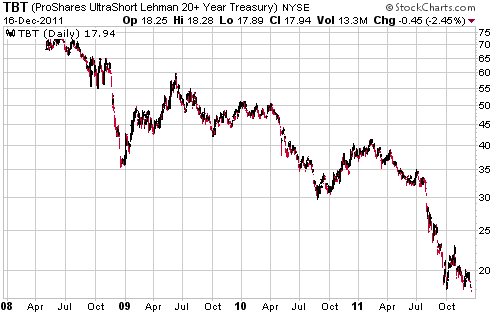
The T-Bond's strength has naturally led to weakness in TBT, an ultra-short bond ETF (TBT's daily percentage change is designed to be twice the inverse of the daily percentage change in 20+ year Treasurys). In fact, if you compare the above T-Bond chart with the TBT chart displayed below you will see that TBT has been even weaker than would superficially be expected. For example, notice that while the T-Bond is only marginally above its December-2008 peak, TBT is about 50% below its December-2008 bottom. As explained in the past, this 'unexpectedly' poor performance is a natural consequence of the way leveraged ETFs work. All double-short and double-long ETFs will leak value over time, which is why they should only ever be used as short-term trading vehicles.
Interesting Quote
"...what investors really want isn't just for someone to buy distressed European debt, but for someone to buy that debt and willingly take a loss on it so the money doesn't ever actually have to be repaid. This is a solvency issue - a shortfall between money owed and the resources to credibly repay it. There is no legal trick to get around that. Ultimately, you either have to restore credibility, or you have to restructure the claims through default or devaluation."
- From John Hussman's 12th December commentary
We agree, with the clarification that devaluation is a form of default that has greater long-term costs than direct default. When the debt default is direct, the lenders bear the entire cost of the default. When the default occurs via devaluation, the cost of the default is spread across all savers of the devalued currency and the economy is made less efficient due to the distortion of price signals.
The Stock
Market
The scene is set for a stock market rally into early January, the reason being that the market is moderately 'oversold' as we enter a time window with very positive seasonality. The rally might have begun late last week, but if not then it should begin some time this week.
Because the scene is set for a rally, a failure to rally over the next three weeks would be informative. Evidence that the market's short-term prospects are more bearish than we currently believe would be daily close below 2150 by the NDX during the coming week or a decline to a new multi-week low at any time after this week.

We have no desire to trade the anticipated short-term rally other than with beaten-down junior gold mining stocks that we like on a longer-term basis.
This week's
important US economic events
| Date |
Description |
| Monday Dec 19 | Housing
Market Index
| | Tuesday Dec 20 | Housing
Starts
| | Wednesday Dec 21 | Existing
Home Sales | | Thursday
Dec 22 |
Q3 GDP (next revision)
Consumer Sentiment
Leading Indicators
|
| Friday Dec 23 | Durable
Goods Orders
Personal Income and Spending
New Home Sales
|
Gold and
the Dollar
Gold
Mining the data to arrive at the desired conclusion
In his 10th December column at Barrons Magazine, Alan Abelson wrote:
"...in his latest market dispatch, the venerable technician Ian McAvity makes proper hash of the theory being bruited about by the usual suspect sources that gold is a bubble.
At $1,900 an ounce, he observes, gold was 2.2 times its early 1980 peak. U.S. gross domestic product and federal debt, he goes on, are some 5.5 times their early 1980 levels, while the Standard & Poor's 500 and overall credit-market debt are 11 to 12 times their levels in the early '80s.
Thus, "the real bubble," he contends, has been the "issuance of debt that is increasingly stifling any recovery in the Main Street economy." And there is no sign it won't continue to do so any time soon."
We aren't going to dispute the conclusion that gold is not in a bubble and that debt issuance is in a bubble of sorts. We are, however, going to dispute the way that this conclusion was substantiated.
In January of 1980 gold was more expensive in real terms than it had ever been, and the S&P500 Index was cheaper in real terms than it had ever been. The result was an all-time low in the S&P500/gold ratio. Naturally, then, if you take January 1980 as your starting point you will be able to show that gold still has a long way to go, in inflation-adjusted terms and relative to the S&P500 Index, to get back to where it started.
Refer to the sharelynx.com chart displayed below for an illustration of what we are talking about. The chart shows that despite everything that has happened over the past decade, the S&P500/gold ratio is still high compared to where it was in January-1980.
But what's the justification for using January-1980 as your starting point? Instead, why not start at January-1970?
The problem with using January-1970 as the starting point is that doing so does not lead to the conclusion that gold is still relatively cheap. This is because the S&P500 is now about 70% lower relative to gold than it was in January-1970.
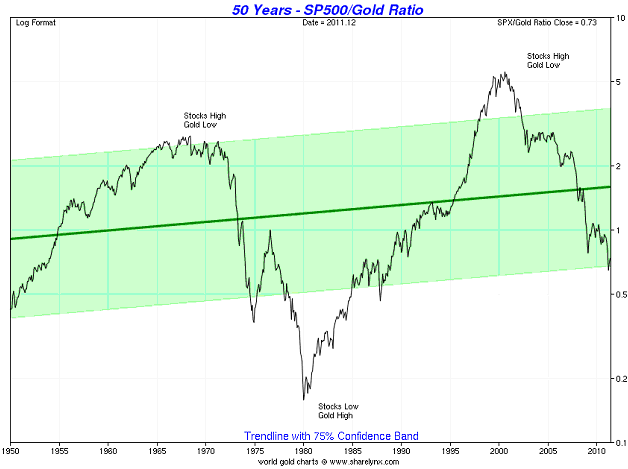
The upshot is that by selecting the right historical starting point it is possible to support the case that gold is cheap compared to the S&P500 or that gold is expensive relative to the S&P500 or that gold and the S&P500 are roughly where they should be relative to each other. Keep this in mind when you read/hear an argument about gold's relative valuation, especially if the argument is based on historical data that begin at a valuation extreme.
As we've previously explained, when gold rose to around $1900/oz earlier this year it could no longer reasonably be described as cheap relative to most other investments. It will probably get much more expensive over the next few years, but the days of gold being in the 'bargain basement' are gone.
Current Market Situation
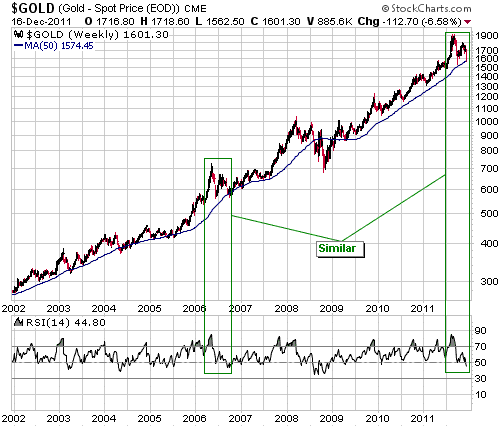
Displayed below is a weekly chart of gold covering the past 10 years. The blue line on the chart is gold's 50-week moving average.
With many people becoming concerned or excited about the prospect of a large decline in the gold price, we thought it was prudent to include a long-term chart that put the recent price action into perspective. As noted on our chart, the price action over the past 6 months looks similar to the price action during the 2006 correction. We like the comparison with 2006 because it meshes with our views that a) a short-term price low was either put in place last week or will soon be put in place within a few percent of last week's low, and b) the next major advance in the gold price probably won't begin until the final quarter of next year.
By the way, if the current correction continues to unfold in the same way as the 2006 correction then its ultimate low will be put in place within the next few weeks at marginally below the late-September low of $1532.
We would never 'hang our hats' on the idea that the current price action will duplicate the price action from some earlier period. With regard to the current situation in the gold market, the main points to understand are:
a) The recent price action is consistent with a routine intermediate-term correction.
b) There is no good fundamental reason to believe that anything more than a routine correction is in progress.
c) Price weakness REDUCES downside risk, so the lower the price goes the more bullish you should get. By the same token, the time to have been worried about downside risk was when the price was surging towards $2000/oz during August and almost everyone was forecasting additional short-term gains.
d) Sentiment is constructive.
e) The lower the price goes in the short-term the smarter the long-term bears will look, but keep in mind that anyone who has been bearish all the way up clearly doesn't understand the market. The understanding of the long-term bears will be no better today than it was at any time over the past 10 years, so their only real chance of being right in the future is by dumb luck.
Gold Stocks
Current Market Situation
Last week's price action proved that the correction/consolidation in the gold sector that began in December of last year is still in progress. The following weekly XAU chart shows that it has been a 'water torture' type of correction in that the decline has been slow, but relentless.
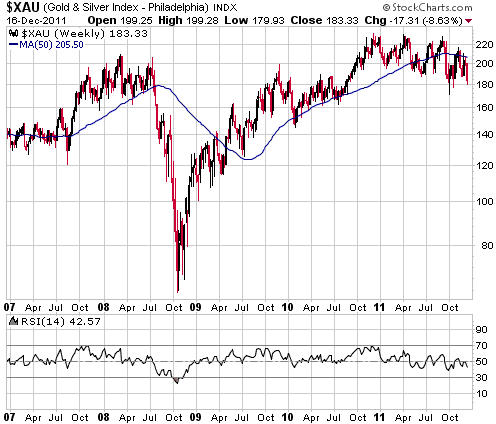
We don't know when the next intermediate-term upward trend will commence. Nobody does. What we know is that sentiment is very depressed right now in both the gold sector of the stock market and the bullion market, which substantially mitigates downside risk. It is certainly possible that the XAU will test its early-October intra-day low of around 170 in the near future, but there won't be scope for it to trade significantly lower than that until after there is a long-enough and large-enough rally to inject a lot more optimism into the market.
It is important to understand that the situation near the beginning of the 2008 crash in the gold sector was very different to the current situation. In July of 2008 many people were anticipating -- and were thus positioned for -- a huge rally in inflation plays, despite the fact that monetary conditions were moderately tight at the time. Today there is a modicum of hope that the central banks will flood the financial system with money, but overall sentiment could not be more different. In July of 2008 there was considerable fear of inflation because it was wrongly believed that the Fed was already pumping money with abandon. Today there is hope that central banks will pump in order to avert economic weakness and deflation, even though the monetary inflation rate is already quite high and even though monetary inflation is one of the main reasons for the economic weakness.
In summary, in July of 2008 we had extreme enthusiasm for inflation plays in parallel with moderately tight monetary conditions, whereas today we have minimal enthusiasm for inflation plays in parallel with loose monetary conditions.
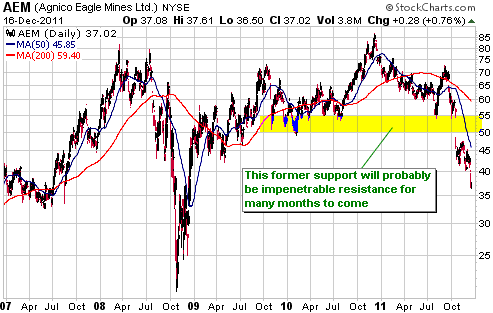
Moving along, a daily chart of Agnico Eagle (AEM) is displayed below. AEM's stock price tumbled from the mid-$50s to the low-$40s in October in reaction to news of an unexpected mine closure. It has since continued to slide and ended last week at $37.
It's likely that many AEM shareholders would view a rebound to former support at $50-$55 as an opportunity to get out, so this former support will probably act as impenetrable resistance for many months to come. However, the stock could easily rebound to the low-$50s during the next multi-week rally in the gold sector. It could therefore make a good short-term trade. The idea would be to accumulate a position at $37 or lower over the days ahead with the aim of exiting at around $50 during the first quarter of next year.
Per-ounce valuations for in-ground gold
We regularly see brokerage analysts and newsletter writers using $100/oz or even more when valuing the in-ground resources owned by junior gold mining companies. As explained by Danny Deadlock in a
recent article, under present market conditions it will usually make no sense whatsoever to use such a high per-ounce valuation for the in-ground gold of an exploration-stage company or a small-scale producer.
Danny came up with an average current market valuation of $58/oz for junior gold mining stocks with at least 1M ounces of NI-43-101 resources. Furthermore, he showed that more than half the companies were being valued at less than $45/oz.
Our experience meshes with the results of Danny's analysis. In particular, we maintain a spreadsheet containing about 40 gold and silver mining stocks, about half of which are exploration-stage juniors. The in-ground gold resources of the exploration-stage juniors that we follow are presently getting valued by the market at an average of $30/oz.
It's reasonable to expect that per-ounce valuations will increase over the years ahead. In fact, it's reasonable to expect that at some stage there will be a massive upward re-valuation. However, in the current market environment it will usually not be appropriate to assign a value in excess of $50/oz to the in-ground resources of projects that are not yet in production. Currently, $20-$40/oz is normal.
Currency Market Update
The Fed expanded its balance sheet by a huge $69B during the latest week, with $52B of this expansion the result of "Central Bank Liquidity Swaps". This means that over the past week the Fed provided the ECB with 52B new dollars for the ECB to lend to European banks in urgent need of short-term US$ funding. Didn't Bernanke just promise Congress that the Fed would not bail out European banks?
Last week's huge increase in CB liquidity swaps implies that:
1. There is a serious dollar shortage within the euro-zone's banking system
2. The shortage won't last long
We wouldn't bet against a final (for now) 3%-5% surge in the Dollar Index and decline in the euro in response to the banking system's scramble for dollars and concerns about Europe's monetary union breaking up. In fact, we think a final dollar-surge/euro-decline -- with or without an intervening counter-trend move -- is the most likely short-term outcome. However, the fears of a euro collapse are now as exaggerated as the fears of a dollar collapse were on occasions over the past several years. With the speculative net-short position in euro futures having hit another all-time high last week, the building blocks of a strong euro rebound continue to be put in place.
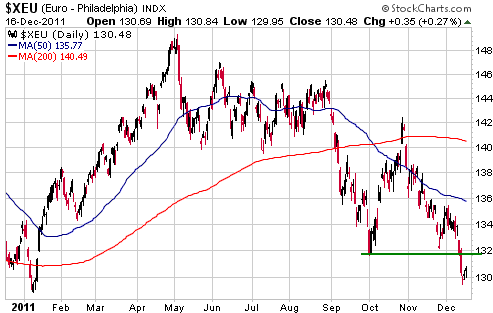
A normal counter-trend bounce in the nearest euro futures contract would take it back to around 132. One of the plausible near-term scenarios is that the euro will rebound to around 132 and then commence a final multi-week plunge to an intermediate-term bottom.
Update
on Stock Selections
Notes: 1) To review the complete list of current TSI stock selections, logon at
http://www.speculative-investor.com/new/market_logon.asp
and then click on "Stock Selections" in the menu. When at the Stock
Selections page, click on a stock's symbol to bring-up an archive of
our comments on the stock in question. 2) The Small Stock Watch List is
located at http://www.speculative-investor.com/new/smallstockwatch.html
 Gold-Ore Resources (TSX: GOZ). Shares: 85M issued, 91M fully diluted. Recent price: C$0.83 Gold-Ore Resources (TSX: GOZ). Shares: 85M issued, 91M fully diluted. Recent price: C$0.83
Trading in GOZ shares was halted on Friday pending news. The news was a merger between GOZ and Astur Gold (TSX: AST). Under the agreed terms of the merger, 2.35 GOZ shares will be exchanged for each AST share.
AST is developing the Salave gold project in Spain, which has a total in-ground resource of about 2M ounces (1.68M in the M&I category plus 0.34M in the Inferred category). The plan is that Salave will be developed into an underground mining operation that produces about 130K ounces per year. Initial production is expected to occur in 2014, but this depends on the company getting all the required permits.
A Preliminary Economic Assessment (PEA) completed in February of this year estimated that the underground mining scenario would have a pre-tax Net Present Value (NPV) of $374M-$391M at a gold price of $1100/oz and that the project's initial capex would be $125M-$150M.
This merger solves a lack-of-growth problem for GOZ and a lack-of-cash problem for AST (GOZ's current cash and expected cash flow should enable Salave to be brought into production with no further shareholder dilution). This should result in the market value of the combined company being materially higher than the sum of the market values of the separate companies.
For GOZ shareholders, the merger adds long-term growth potential but also adds intermediate-term risk. The risk is associated with permitting of the Salave project. The actions that are being taken to mitigate this risk are discussed in the interview with Astur CEO Cary Pinkowsky linked
HERE.
If the market reacts negatively to the merger news when trading resumes on Monday and this negative reaction causes GOZ to fall to the low-C$0.70s, we would treat it as a buying opportunity.

Norton Gold Fields (ASX: NGF). Recent price: A$0.165
Australian junior gold producer NGF is in the TSI Small Stocks Watch List. It is an interesting speculation below A$0.20 and especially at A$0.17 or lower.
Stock prices at Yahoo Finance
Every now and then the closing price reported by Yahoo Finance for a Canadian stock will be
wildly inaccurate. You can determine if a strangely-large price gain or loss reported by Yahoo is genuine by looking at the closing bid-ask spread at Yahoo (the bid-ask will generally be reported correctly even when the closing price is reported incorrectly) or by verifying the price change at another web site (such as stockwatch.com or
stockhouse.com).
Chart Sources
Charts appearing in today's commentary
are courtesy of:
http://stockcharts.com/index.html

|









