|
-- Weekly Market Update for the Week Commencing 20th April 2009
Big Picture
View
Here is a summary of our big picture
view of the markets. Note that our short-term views may differ from our
big picture view.
In nominal dollar terms, the BULL market in US Treasury Bonds
that began in the early 1980s will end by mid-2010. In real (gold)
terms, bonds commenced a secular BEAR market in 2001 that will continue
until 2014-2020. (Last
update: 09 February 2009)
The stock market, as represented by the S&P500 Index, commenced
a secular BEAR market during the first quarter of 2000, where "secular
bear market" is defined as a long-term downward trend in valuations
(P/E ratios, etc.) and gold-denominated prices. This secular trend will bottom sometime between 2014 and 2020. (Last update: 22 October 2007)
A secular BEAR market in the Dollar
began during the final quarter of 2000 and ended in July of 2008. This
secular bear market will be followed by a multi-year period of range
trading. (Last
update: 09 February 2009)
Gold commenced a
secular bull market relative to all fiat currencies, the CRB Index,
bonds and most stock market indices during 1999-2001. This secular trend will peak sometime between 2014 and 2020. (Last update: 22 October 2007)
Commodities,
as represented by the Continuous Commodity Index (CCI), commenced a
secular BULL market in 2001 in nominal dollar terms. The first major
upward leg in this bull market ended during the first half of 2008, but
a long-term peak won't occur until 2014-2020. In real (gold) terms,
commodities commenced a secular BEAR market in 2001 that will continue
until 2014-2020. (Last
update: 09 February 2009)
Copyright
Reminder
The commentaries that appear at TSI
may not be distributed, in full or in part, without our written permission.
In particular, please note that the posting of extracts from TSI commentaries
at other web sites or providing links to TSI commentaries at other web
sites (for example, at discussion boards) without our written permission
is prohibited.
We reserve the right to immediately
terminate the subscription of any TSI subscriber who distributes the TSI
commentaries without our written permission.
Outlook Summary
Market
|
Short-Term
(0-3 month)
|
Intermediate-Term
(3-12 month)
|
Long-Term
(1-5 Year)
|
Gold
|
Neutral
(17-Dec-08)
|
Bullish
(12-May-08)
|
Bullish
|
US$ (Dollar Index)
|
Neutral
(23-Mar-09)
| Neutral
(16-Feb-09)
|
Neutral
(19-Sep-07)
|
Bonds (US T-Bond)
|
Bearish
(06-Apr-09)
|
Bearish
(22-Sep-08)
|
Bearish
|
Stock Market (S&P500)
|
Bullish
(11-Mar-09)
|
Neutral
(02-Feb-09)
|
Bearish
|
Gold Stocks (HUI)
|
Bullish
(12-Jan-09)
|
Bullish
(12-May-08)
|
Bullish
|
| Oil | Bullish
(17-Nov-08)
| Neutral
(22-Sep-08)
| Bullish
|
Industrial Metals (GYX)
| Bullish
(26-Nov-08)
| Neutral
(22-Sep-08)
| Bullish
|
Notes:
1. In those cases where we have been able to identify the commentary in
which the most recent outlook change occurred we've put the date of the
commentary below the current outlook.
2. "Neutral", in the above table, means that we either don't have a
firm opinion or that we think risk and reward are roughly in balance with respect to the timeframe in question.
3. Long-term views are determined almost completely by fundamentals,
intermediate-term views by giving an approximately equal weighting to
fundmental and technical factors, and short-term views almost
completely by technicals.
Creating money out of nothing
Antal Fekete has recently posted another interesting article
dealing with interest rates, depression and deflation. In this latest
piece he reiterates some of the arguments about deflation that we
addressed in our 1st April commentary, but he also argues that the Fed
doesn't create money "out of thin air", as many people believe, because
the new money is collateralised. To be more specific, he argues that
the Federal Reserve banks are only able to create new money to the
extent that they post collateral of equivalent monetary value, which
means that the new money has not actually been created out of nothing.
Like Professor Fekete, we are not fond of the Quantity Theory of Money
(QTM) and the associated Equation of Exchange (M*V = P*Q). As far as
theories go, the Quantity Theory of Money is not particularly useful
because it does a poor job of explaining how changes in the money
supply affect the economy. However, you don't need to be a QTM devotee
to appreciate that banks (the commercial as well as the central
variety) effectively create money "out of thin air" when they make
loans. Here's why.
First, when a bank lends new money into existence the money is loaned
against some form of collateral, but the collateral usually exists
prior to the creation of the new money. For example, when a commercial
bank lends $1M to Fred Jones for the purchase of a new house, the house
exists with or without the loan and the associated new money. But as a
result of the bank's action the money supply is now $1M larger.
Second, a non-bank lender makes a loan by transferring part of the
EXISTING money supply to the borrower, whereas a bank creates NEW money
when it makes a loan. In both cases a repayment obligation is created,
but only the bank's loan results in an expansion of the money supply.
Has the bank not, in effect, created money out of nothing?
Third, the collateral against which a central bank lends money will not
necessarily have any real value because all that's required to balance
the central bank's books is an accounting entry. For example, over the
past seven months the Fed has issued more than one trillion dollars to
various financial corporations in exchange for certain "collateral",
but a detailed breakdown of this so-called collateral has never been
provided. It is reasonable to assume that the collateral includes
securities that are worth less than the amount of new money that was
created to purchase them, and it is quite possible that a portion of
the collateral is essentially worthless. For all intents and purposes
the central bank is above the financial standards that apply to private
companies -- it can be as opaque or as transparent as it wants to be at
any given time.
Fourth, when the Fed monetises government bonds it really receives
nothing in exchange for the new money because the government is a
consumer of wealth, not a producer of wealth, and the government's debt
will never be repaid. If it chose to do so the US government could, for
instance, issue $10T of bonds tomorrow that the Fed purchases with
newly created money, resulting in a more-than-doubling of the economy's
money supply once the new money is spent. This new money will be
'offset' by $10T of bonds on the asset side of the Fed's balance sheet;
but so what? In this hypothetical example the effect on the economy of
the 10 trillion new dollars will be the same as if the money had been
created by an extremely proficient private counterfeiter.
The main difference between the way the Fed operates and the way a
private counterfeiter operates is that the Fed uses double-entry
bookkeeping. To be more specific: whereas a private counterfeiter
simply prints new money and then spends it, for every new dollar the
Fed creates it adds one dollar of "assets" to its balance sheet (the
new dollar goes on the liability side and is balanced by something on
the asset side). As discussed above, however, the assets will not
necessarily have any real value, and in any case the fact that
double-entry bookkeeping is used doesn't invalidate the concept that
new money is being created "out of thin air". Furthermore, a private
counterfeiter could choose to operate the same way as the Fed. Rather
than spend his newly-created money the private counterfeiter could
introduce it into the economy via collateralised loans.
China Update
There are signs of economic recovery emanating from China. Or, to put
it more aptly, policy moves in China are creating the illusion that the
economy is recovering. Chief among these policy moves is the remarkably
successful push to get banks to lend more money. We say "remarkably
successful" because at 4.6T Yuan the amount of Chinese bank lending
during the first quarter of this year was almost four times the amount
during 2008's first quarter. Furthermore, March-2009 set a new
single-month bank lending record.
Are higher debt levels going to generate a sustainable increase in
demand for the products of China's factories? We don't see how.
Another recent policy move of significance is the decision to take
advantage of low commodity prices by stocking-up on industrial
commodities such as iron-ore and base metals. China's decision to
build-up its commodity inventories has given the prices of industrial
commodities a boost and has also caused international freight rates to
rebound, thus creating the impression that the global economy has
turned the corner. The risk, for those betting on a bullish
intermediate-term outcome for industrial commodities, is that China
will soon complete its inventory build-up. During the second half of
this year there will potentially be very little Chinese commodity
demand at the same time as it is becoming clear that the "stimulus"
schemes implemented around the world are doing more harm than good.
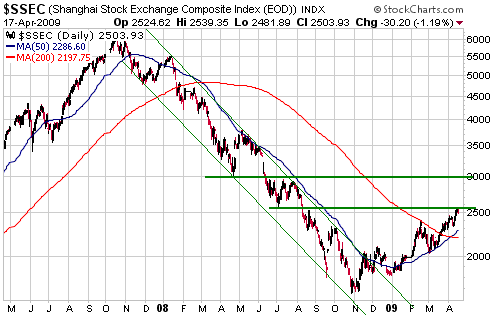
Turning to China's stock market, the Shanghai Stock Exchange Composite
Index (SSEC) has been trending upward in steady fashion since late
October of last year and has gained about 30% since we noted, in the
19th November 2008 Interim Update, that a multi-month tradable rebound
had probably begun. With reference to the following chart, we won't be
surprised if the overall rebound takes the SSEC up to near resistance
at 3000 within the next couple of months, but traders who are long the
Chinese market should, we think, take partial profits now and/or
tighten-up their 'stops'. This is because there is some resistance just
above Friday's closing level and because the downside risk increases as
prices become more extended to the upside, especially if (as we
believe) the rally is the counter-trend variety.
Oil Update
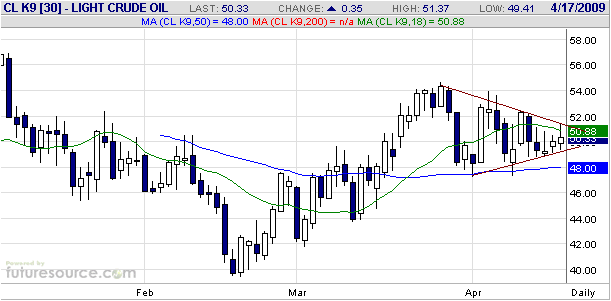
The oil market rallied
from mid February through to late March, at which point it began to
oscillate within a contracting triangle (refer to the following daily
chart of the May oil futures contract for details). More often than
not, triangular chart patterns such as this will be followed by a
continuation of the preceding trend. In oil's case, the direction of
the preceding short-term trend was up.
Our guess is that the oil price will break out to the upside and move
to a new 3-month high within the next few weeks, but a daily close
below $48 in the May futures contract would mean that this guess is
wrong.
The Stock
Market
The senior stock indices
remain well below their 200-day moving averages and therefore still
have significant short-term upside potential. However, the US stock
market and many other markets around the globe have now risen for six
weeks in succession, so it is reasonable to expect that a 1-2 week
'pause for breath' will begin either immediately or following another
upward surge over the coming days.
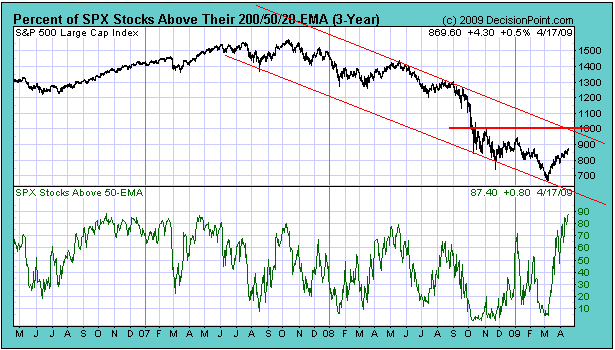
The following decisionpoint.com
chart shows the S&P500 Index and the percentage of S&P500
stocks that are above their 50-day moving averages. The chart shows
that:
a) There is important resistance at 950-1000. Note that the 200-day moving average also lies within this range.
b) The proportion of stocks trading above their 50-day moving averages
is now at its highest level in more than two years. This tells us two
things. First, it tells that the market is 'overbought', which is a
reason to be cautious as far as the next couple of weeks are concerned.
Second, it tells us that the current rally is more broad-based than the
other rallies of the past two years, which is a reason to anticipate
additional upside over the next couple of months.
This week's
important US economic events
| Date |
Description |
| Monday Apr 20 | Leading Economic Indicators
| | Tuesday Apr 21 | No important events scheduled
| | Wednesday Apr 22
| No important events scheduled
| | Thursday Apr 23
| Existing Home Sales
| | Friday Apr 24
| Durable Goods Orders
New Home Sales
|
Gold and
the Dollar
Gold
Gold and Economic Confidence
The gold price relative to the general level of commodity prices (as
represented by the gold/CCI ratio) can be thought of as the real gold
price. In our opinion, few things in the financial world consistently
behave as rationally as the real gold price. As a result, we have had
far more success over the years at predicting the performance of the
real gold price than at predicting the performance of any other market
price. For example, in mid-2008 we correctly anticipated a large rise
in the real gold price and at the beginning of this year we correctly
anticipated a multi-month period of weakness in the real gold price.
Unfortunately, being close to 100% right about the real gold price
during the second half of last year didn't do us any good from a
practical investing/trading perspective because we wrongly thought that
the rise in gold-mining profit margins that would stem from the rise in
the real gold price would support the prices of gold mining equities.
The real gold price (the gold/CCI ratio) is an indicator of economic
confidence in that a rising trend in gold/CCI is usually associated
with declining confidence in the economy and/or the financial system,
while a falling trend in gold/CCI is usually associated with rising
confidence. "Economic confidence" is a fairly vague term, but aside
from the gold/commodity ratio its intermediate-term trend can be
observed in the performances of the yield curve (the differences
between long-term and short-term interest rates) and credit spreads
(the differences between the yields on high-risk and low-risk bonds).
For example, the following chart of the HYG/TLT ratio shows how
high-risk (junk) bonds have performed relative to much lower-risk US
Treasury Bonds. The plunge in this ratio during the second half of last
year was indicative of a massive widening of credit spreads, which was,
in turn, indicative of falling confidence, whereas the ratio's
subsequent rebound tells us that confidence has been gradually
improving over the past few months.
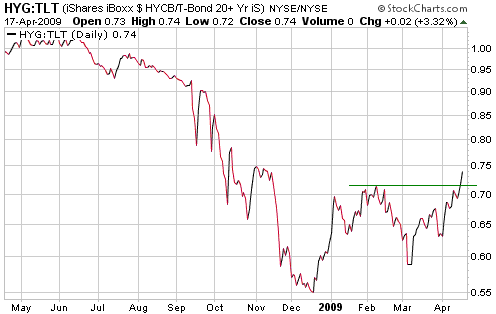
The recent rebound in
economic confidence evidenced by the rise in the HYG/TLT ratio should
have been accompanied by weakness in the gold/CCI ratio, which, of
course, it has.

If our economic
outlook is in the right ballpark then the rebound in economic
confidence and the associated decline in the real gold price could
continue for another 1-2 months, but not for much longer than that.
Furthermore, we perceive more upside potential than downside risk in
the gold/CCI ratio, even in the short-term, because the rise in
confidence that's propelling equity markets and industrial commodities
upward (and gold downward) has fragile underpinnings.
Current Market Situation
The main driver of the recent decline in the gold price has been the
growing belief that the worst is over for the economy and the stock
market. Also of significance, by late February sentiment towards gold
had become overtly optimistic (as revealed by the COT data and the
premiums to net asset values of gold-related mutual funds) and it
recently became apparent that the IMF is going to move forward with its
long-standing plan to sell gold.
The net result of the above-mentioned factors is that the gold price
has pulled back to its 200-day moving average. The market is no longer
'overbought', but although sentiment indicators have become more
supportive they haven't yet reached the levels that would typically
mark the end of a correction. This doesn't mean that the correction is
not over; just that there isn't any sentiment-related evidence that it
is over.
Our view is that the correction could ultimately take the gold price
down to around $800, but not significantly lower than that. In any
case, investors should be focused on value, not on trying to pick the
ultimate bottom. As mentioned in last week's Interim Update: "If
we didn't already have a full position we would be buyers of gold
bullion -- for long-term investment purposes -- in the $850s, and
aggressive buyers in the low-$800s."
Gold Stocks
Current Market Situation
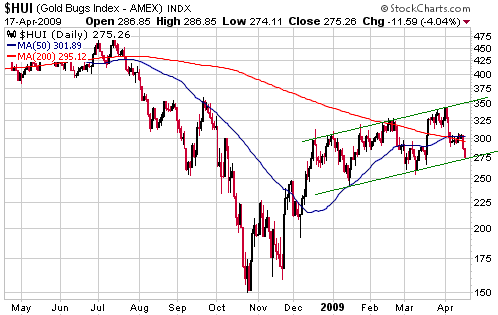
The AMEX Gold BUGS Index (HUI) is now oversold and, as illustrated by
the first of the following charts, has dropped to the bottom of its
multi-month channel. This is a likely place for a correction low to
occur, but there isn't yet any evidence that the correction has ended
or is about to end.
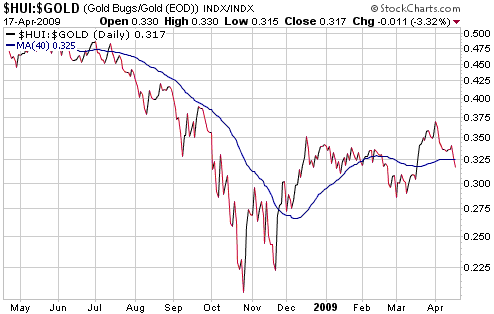
The most important thing missing at this time is a positive divergence
between the gold sector of the stock market and the bullion market. In
particular, weakness in the gold sector over the past two days was
accompanied by weakness in the HUI/gold ratio. The second of the
following charts shows the HUI/gold ratio relative to its 40-day moving
average.
Positive divergences
between the HUI and gold bullion don't always occur near the ends of
downward corrections, but when they do occur -- via the HUI falling at
a slower pace than gold bullion or via gold making a new low while the
HUI makes a higher low -- it increases the probability that a
sustainable bottom is being put in place.
Traders could consider taking a long position now on the assumption
that last week's decline to the channel bottom completed the downward
correction, but a relatively tight stop should be used. For example, a
long position in GDX could be established near Friday's closing price
with the intention of exiting the position if the HUI subsequently
closes below 259. Alternatively, traders that are more risk-averse
could reasonably decide to wait for some evidence of a low, such as a
daily close above 305 by the HUI or the sort of positive divergence
mentioned in the preceding paragraph, before establishing a short-term
position.
As far as our own money management is concerned, we aren't interested
in taking any short-term gold positions at this time. We have
substantial long-term exposure to the gold sector and have begun to
place under-the-market buy orders with the aim of further increasing
this exposure, but if things go according to plan we will build up some
cash by scaling out of non-gold stocks into strength BEFORE we increase
our exposure to the gold sector.
Warrants
Our Great Basin Gold warrants (TSX: GBG.WT) trade was a failure as the
warrants will expire worthless on Monday. However, over the years we've
had considerable success with warrants*. In fact, prior to the GBG.WT
debacle we had completed 12 warrant trades and achieved an average
profit per trade of around 230%.
We can't say for sure, but the bad result on the most recent warrant
trade was probably due to not giving ourselves sufficient time. When we
entered the earlier warrant trades the time to expiry was generally at
least three years and never less than two years, but when we added the
GBG warrants to the TSI List the time to expiry was only 12 months.
This was a mistake we won't make again.
If we are correct to assume that the gold sector commenced a multi-year
advance last October then carefully-selected warrants on gold stocks
should pay-off handsomely over the next 3 years. Unfortunately, there
isn't a lot to choose from at the moment in that most of the
outstanding warrants that we are aware of have less than two years to
expiry and/or are too far out of the money to be of interest (we
usually won't be interested in a warrant if its exercise price is more
than double the current price of the underlying stock, although there
are exceptions) and/or have almost no liquidity and/or are ridiculously
over-priced. Here are a few, shown in alphabetical order, that are
worth monitoring and potentially worth accumulating on weakness over
the coming months:
*ECU Silver Feb-2014 C$0.95 warrants (TSX: ECU.WT, Yahoo Symbol: ECU-WT.TO)
*Endeavour Financial Feb-2014 C$2.50 warrants (TSX: EDV.WT.A, Yahoo Symbol: EDV-WTA.TO)
*Franco Nevada Mar-2012 C$32.00 warrants (TSX: FNV.WT, Yahoo Symbol: FNV-WT.TO)
*Minefinders Corp. Dec-2011 C$5.00 warrants (TSX: MFL.WT, Yahoo Symbol: MFL-WT.TO)
*Silver Wheaton Sep-2013 US$20.00 warrants (TSX: SLW.WT.U, Yahoo Symbol: SLW-WTU.TO)
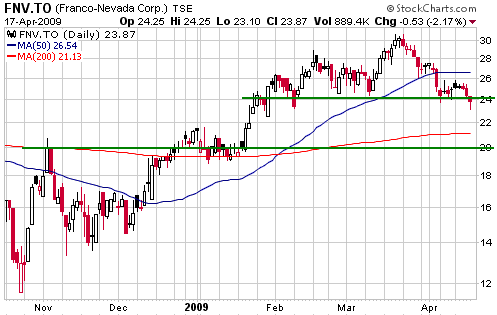
EDV.WT.A is already in the TSI Stocks List. Of the others, the one that
interests us the most at this time is FNV.WT. With reference to the
following chart, FNV (Franco Nevada**) looks like it could drop to
around C$20 within the next few weeks. If so the warrants would
probably drop to C$2.80-C$3.00, in which case we would be buyers.
*The warrants we trade are long-dated call options issued by companies when they do equity financings.
**Franco Nevada is a royalty company that owns both gold and oil
royalties. By the end of this year about 75% of FNV's revenue-producing
royalties are expected to be gold.
Currency Market Update
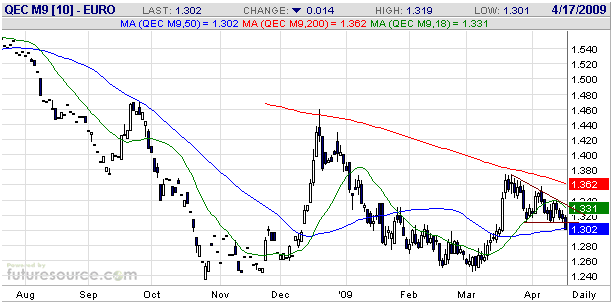
A daily chart of June euro futures is displayed below.
The euro broke below short-term support on Friday, which projects a
drop back to the March low. We suspect that the euro will not only drop
back to the March low, but to new multi-year lows later this year.
However, significant euro weakness (US$ strength) at this time doesn't
mesh with most of our other market views. Additionally, although the
euro broke out to the downside on Friday the Dollar Index remains below
its 50-day moving average. The bottom line is that we have no opinion
on the most likely direction of either the euro or the Dollar Index
over the next few weeks.
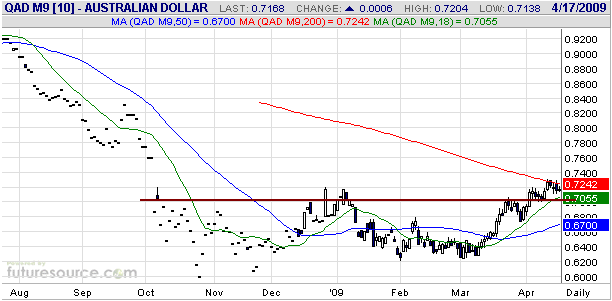
The following daily
chart shows that the A$'s rally from its March low has hesitated at the
200-day moving average, which is normal. We expect the A$ to make
additional gains over the weeks ahead and continue to view 0.75-0.80 as
a reasonable upside target.
Support at 0.70 should limit the extent of any near-term decline. In
fact, this support MUST limit the downside in order for our short-term
positive outlook to remain intact. We would therefore exit any
long-side A$ trading positions if the June contract closes below 0.70.
Update
on Stock Selections
(Note: To review the complete list of current TSI stock selections, logon at http://www.speculative-investor.com/new/market_logon.asp
and then click on "Stock Selections" in the menu. When at the Stock
Selections page, click on a stock's symbol to bring-up an archive of our comments on the stock in question)
 Natural Gas Stocks Natural Gas Stocks
Despite the fact that the natural gas (NG) price is languishing near a
multi-year low, natural gas equities have rebounded strongly from their
early-March lows. The large-cap NG producers are up by an average of
30% over the past six weeks, while many of the smaller producers are up
by 50-100% from their lows. Of course, all of these stocks are still
down a long way from last year's highs.
The strong rebound in NG-related equities has been driven by the
rebound in the broad stock market and, quite likely, the expectation
that the huge reduction in drilling activity will lead to a strong
price recovery late this year (the US natural gas rig count has fallen
to its lowest level in 6 years and is still in a downward trend).
We suspect that the short-term upward trend in the NG sector of the
stock market will remain intact as long as the overall stock market
rebound remains intact. This is partly because additional strength in
the broad stock market should bolster the emerging (but most likely
incorrect) view that a new economic growth phase will begin before
year-end.
In our opinion, traders should look for opportunities over the coming
month or so to scale out of natural gas and other industrial-commodity
stocks on strength and to scale into gold stocks on weakness.
Precision Drilling (NYSE: PDS) is the only NG-related trading position
in the TSI List (PDS appears twice in the TSI List -- once as a trading
position and once as a longer-term investment position). We are now
placing a trailing sell-stop on the trading position. Specifically, we
will exit the trade if PDS closes 10% or more below its closing high
for the move. The current closing high is Friday's US$4.02, so the sell
stop will initially be at US$3.61.
Chart Sources
Charts appearing in today's commentary
are courtesy of:
http://stockcharts.com/index.html
http://www.futuresource.com/
http://www.decisionpoint.com/

|