|
-- Weekly Market Update for the Week Commencing 20th October 2008
Big Picture
View
Here is a summary of our big picture
view of the markets. Note that our short-term views may differ from our
big picture view.
Bonds commenced a secular BEAR market in
June of 2003. (Last
update: 22 August 2005)
The stock market, as represented by the S&P500 Index, commenced
a secular BEAR market during the first quarter of 2000, where "secular
bear market" is defined as a long-term downward trend in valuations
(P/E ratios, etc.) and gold-denominated prices. This secular trend will bottom sometime between 2014 and 2020. (Last update: 22 October 2007)
The Dollar commenced a secular BEAR market during the final quarter of 2000. The
first major downward leg in this bear market ended during the first
quarter of 2005, but a long-term bottom won't occur until 2008-2010. (Last update: 28 March 2005)
Gold commenced a
secular bull market relative to all fiat currencies, the CRB Index,
bonds and most stock market indices during 1999-2001. This secular trend will peak sometime between 2014 and 2020. (Last update: 22 October 2007)
Commodities, as
represented
by the CRB Index, commenced a secular BULL market in 2001. The first
major upward leg in this bull market ended during the second quarter of
2006, but a long-term
peak won't occur until at least 2008-2010. (Last update: 08 January 2007)
Copyright
Reminder
The commentaries that appear at TSI
may not be distributed, in full or in part, without our written permission.
In particular, please note that the posting of extracts from TSI commentaries
at other web sites or providing links to TSI commentaries at other web
sites (for example, at discussion boards) without our written permission
is prohibited.
We reserve the right to immediately
terminate the subscription of any TSI subscriber who distributes the TSI
commentaries without our written permission.
Outlook Summary
Market
|
Short-Term
(0-3 month)
|
Intermediate-Term
(3-12 month)
|
Long-Term
(1-5 Year)
|
Gold
|
Bullish
(30-Jun-08)
|
Bullish
(12-May-08)
|
Bullish
|
US$ (Dollar Index)
|
Neutral
(10-Sep-08)
| Neutral
(22-Sep-08)
|
Neutral
(19-Sep-07)
|
Bonds (US T-Bond)
|
Neutral
(14-Jul-08)
|
Bearish
(22-Sep-08)
|
Bearish
|
Stock Market (S&P500)
|
Bullish
(16-Oct-08)
|
Bullish
(08-Oct-08)
|
Bearish
|
Gold Stocks (HUI)
|
Bullish
(30-Jun-08)
|
Bullish
(12-May-08)
|
Bullish
|
| Oil | Neutral
(03-Sep-08)
| Neutral
(22-Sep-08)
| Bullish
|
Industrial Metals (GYX)
| Neutral
(18-Jun-08)
| Neutral
(22-Sep-08)
| Bullish
|
Notes:
1. In those cases where we have been able to identify the commentary in
which the most recent outlook change occurred we've put the date of the
commentary below the current outlook.
2. "Neutral", in the above table, means that we either don't have a
firm opinion or that we think risk and reward are roughly in balance with respect to the timeframe in question.
3. Long-term views are determined almost completely by fundamentals,
intermediate-term views by giving an approximately equal weighting to
fundmental and technical factors, and short-term views almost
completely by technicals.
Inflation Watch
Until things settle down and
the monetary authorities stop taking extraordinary measures to promote
inflation, we will make "Inflation Watch" part of every Weekly Market
Update.
The anticipated "deflation scare" is here
We have warned a number of times over the past several months that a
"deflation scare" was probably on the cards, with "deflation scare"
being defined by us as a period of accelerating inflation (money supply
growth) combined with rising fear of deflation. Accelerating
money-supply growth can co-exist with rising fear of deflation because
most people wrongly associate falling prices with deflation. Falling
prices are, of course, a natural consequence of deflation, but prices
can fall for reasons that have nothing to do with deflation. In fact,
over the past 70 years there has never been a deflation-related price
decline in the US because during this period the US has never
experienced genuine deflation. There have, however, been several
deflation scares.
Judging by an article published in the Wall Street Journal on 18th
October, a deflation scare has arrived. Here are the opening paragraphs
of this article:
"Policy makers navigating the U.S. through the global credit crisis may have a new concern on the horizon for 2009: deflation.
The risk of deflation --
generally falling prices across the economy, beyond volatile energy and
food costs -- remains slim. But the financial shock and a faltering
economy can set the stage for a deflationary environment.
Federal Reserve officials
view broad-based deflation as unlikely but possible. Federal Reserve
Bank of San Francisco President Janet Yellen said in a speech this week
that the plunge in oil prices along with slackening demand for labor
and goods should "push inflation down to, and possibly even below,
rates that I consider consistent with price stability."
Fed officials generally
consider price stability to be an inflation rate between 1.5% and 2%.
Their preferred measure of core inflation, which excludes food and
energy, stands above 2% now, and is expected to remain above that mark
as price increases from earlier this year advance through the product
pipeline.
The economic slowdown and
declining commodity prices have eased the nation's consumer inflation
rate, which surged to 5.6% over the summer. Annual inflation in the
U.S. is likely to turn negative for at least several months next year,
on declining energy and food prices.
With the unemployment
rate rising rapidly and capital markets in turmoil, "pretty much
everything points toward deflation," said Paul Ashworth, chief U.S.
economist at Capital Economics. "The only thing you can hope is that
the prompt action of policy makers can maybe head this off first.""
The comment from the "chief US economist at Capital Economics" is funny
because it implies that with the financial markets going haywire the
only thing that can save us is more government-sponsored inflation.
Deflation scares always have inflationary consequences -- at least,
they have always had inflationary consequences in the past -- because
most chief economists and the makers of monetary policy seriously
believe that more inflation is the appropriate response to the problems
wrought by earlier inflation. This is why the rate of monetary
inflation invariably ramps up whenever prices embark on a downward
trend, and why the bigger the deflation scare the more bullish the
long-term gold price outlook generally becomes.
Some commentators have posited that the amount of new money being
created by the government and its central bank is tiny compared to the
amount of market value being lost in the equity, real estate and bond
markets. This is true, but irrelevant as far as the long-term inflation
outlook is concerned because changes in market value don't directly
affect the money supply. For example, the rise in the price of a house
from $1M to $2M does not create new money and the fall in the price of
a house from $2M to $1M does not eliminate any money; all that happens
as a result of the up or down move in the house price is a change in
the proportion of the EXISTING money supply that will get transferred
from buyer to seller upon the sale of the house.
If policy makers attempt to offset asset price declines with new money
the end result won't just be inflationary, it will be
hyper-inflationary. Note, though, that we are not expecting
hyper-inflation to occur within the next few years.
Current Monetary Situation
The Fed expanded its balance sheet by an additional $245B last week,
which means that the cumulative increase since 10th September is now
$852B. This equates to a 96% increase in just 5 weeks.
As at 6th October, the date of the most recent broad money-supply data,
the effect on the total money supply of the aforementioned explosion in
reserve bank credit had been significant, but nowhere near as
significant as we would have expected (M2 increased by $160B between
8th September and 6th October). There are, we think, two main reasons
for this. First, part of the increase in Reserve Bank credit has been
associated with the currency swaps that the Fed has arranged with other
central banks. These swaps increase the global supply of US dollars,
but they don't boost the domestic M2 or TMS monetary aggregates.
Second, as at 15th October there were 495 billion dollars sitting in
the US Treasury's "Supplementary Financing Account" at the Fed. As we
understand it, this money has been earmarked for use in various US
Government bailout schemes, such as the scheme to purchase equity in
banks and the scheme to purchase the bad debts of banks. However,
because it hasn't yet been 'injected' into the economy it doesn't yet
figure in the broader money-supply aggregates.
We expect that the money currently residing in the "Supplementary
Financing Account" will be injected into the economy over the coming
weeks/months, thus giving the broader aggregates a hefty boost. Also,
on 27th October the Fed will begin to lend money directly to
non-financial corporations, thus overcoming the 'problem' of banks
accumulating additional reserves but choosing not to increase their
lending.
The Stock
Market
Although the stock market is
still oscillating wildly there is evidence that the financial
environment is slowly becoming less stressed. For example, the large
gap between the 3-month Treasury Bill yield and 3-month LIBOR narrowed
a little last week. Also, the December-2008 3-month eurodollar futures
contract broke out to the upside on Friday, signaling a future
reduction in the short-term borrowing costs of banks.
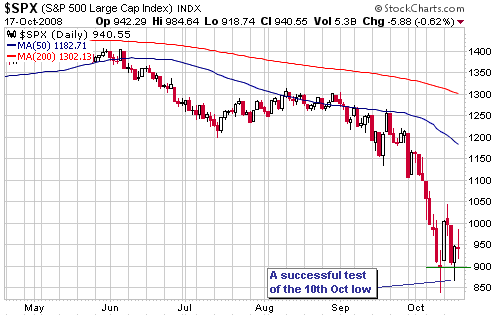
Let's now take a quick look at some charts, beginning with a daily
chart of the S&P500 Index (SPX). Last Thursday (16th October) the
SPX completed a successful test of the 10th October low, although this
might not be the final test of the low.
Our view is that the SPX now has more short-term upside potential than
downside risk, but for this view to remain valid the SPX should not
close below the 899.
Next up is a daily
chart of the Bank Index (BKX). The BKX led to the downside prior to
July of this year but has shown relative strength over the past three
months. This relative strength is evidenced by the fact that while
almost every stock market index in the world collapsed to new
multi-year lows during the first two weeks of October, the BKX held
above its July low. It also held up relatively well during last week's
SPX test of the October low.
The BKX appears to have made a major 'double bottom', although this
double bottom appears to be the result of government manipulation
rather than natural market forces. The US Government has diverted
hundreds of billions of taxpayers' dollars to the banks and has
promised to divert hundreds of billions more, and any sector of the
economy that benefits from government largesse to this extent is bound
to show some short-term strength at the expense of other sectors.
We should endeavour to trade and invest based on the way things are,
not the way they should be. As such, traders could consider averaging
into 'long' positions in one or more of the four major US banks (BAC,
C, JPM, WFC), with initial stops set just below last week's lows.

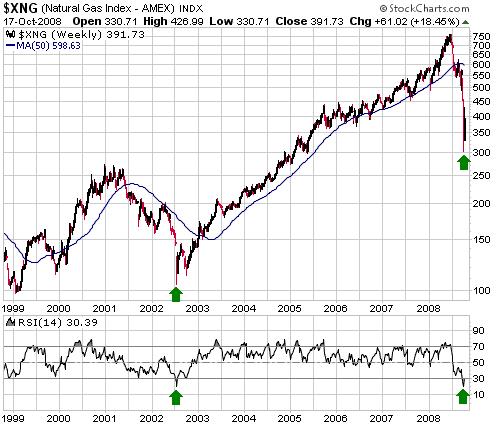
Finally, below is a
weekly chart of the Natural Gas Index (XNG) covering the past 10 years.
At the recent low the XNG was further below its 50-week moving average
than it had ever been and its weekly RSI (shown at the bottom of the
chart) was as oversold as it had been at the major low of July-2002.
Either the October-2008 low will prove to be just as important as the
July-2002 low, or this year's rapid decline will prove to be only the
first leg of a major bear market. We think the former possibility is
the more likely, but even if we are wrong there should still be a
substantial rebound over the next several months.
This week's
important US economic events
| Date |
Description |
Monday Oct 20
| Leading Economic Indicators
| | Tuesday Oct 21 | No important events scheduled
| | Wednesday Oct 22
| No important events scheduled
| | Thursday Oct 23
| No important events scheduled
| | Friday Oct 24
| Existing Home Sales
|
Gold and
the Dollar
Gold
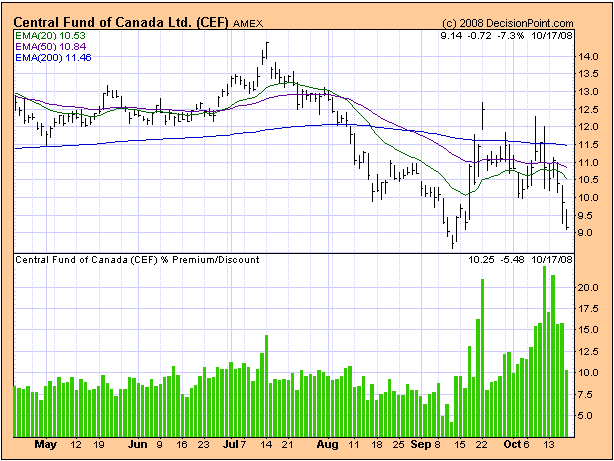
The Central Fund of Canada (AMEX: CEF) holds gold and silver bullion in
approximately equal dollar amounts. It is a closed end fund, which
means that its market price can deviate from its net asset value (NAV).
The extent to which CEF's market price deviates from its NAV is an
indicator of the public's sentiment, with a large premium to NAV
suggesting that the public is very bullish and a small premium, or
discount, suggesting a lack of interest in gold and silver bullion on
the part of the investing public. The public's sentiment is always a
contrary indicator, so a large CEF premium should be considered a
bearish omen.
A chart of CEF and the CEF %premium is displayed below. CEF's premium
to its NAV had not been a reliable short-term indicator of gold price
movements prior to the past few months, but recent peaks and troughs in
the gold price have coincided with peaks and troughs in the CEF
premium. For example, the rise in the CEF premium to 14% marked the
July peak in the gold price, the drop to below 5% in the CEF premium
marked the early-September low in the gold price, and the rise in the
CEF premium to above 20% marked the late September and early October
highs in the gold price. The decline in the gold price from its
early-October peak has been accompanied by a drop in the CEF premium to
around 10%, which is still a bit on the high side.
A drop in the CEF premium to 5% or lower would signal that gold was
close to a short-term bottom. It would also signal a buying opportunity
for CEF.
Note: CEF's premium to NAV is reported daily at http://www.centralfund.com/Nav%20Form.htm
It probably wouldn't
take much additional weakness in the gold price to push the CEF premium
down to 5%. Also, other sentiment indicators, including the Commitments
of Traders report, are quickly approaching the levels that would be
consistent with a price low.
Last Friday's close below $800 warns that gold could be about to test
the support at $725-$735 defined by its September-2008 low and its
May-2006 peak. Sentiment indicators suggest that this support will hold
if tested.
Gold Stocks
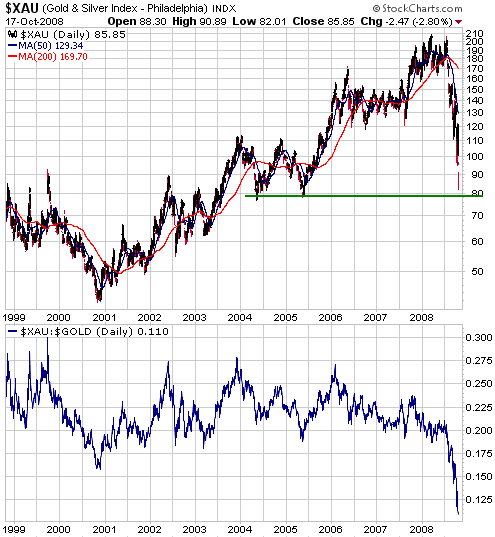
The top section of the following chart shows that the XAU's crash has
taken it back to near long-term support at 78-80. We won't be surprised
to see a test of this support during the coming week.
The bottom section of the chart shows that the XAU is now lower
relative to gold than it has been at any point over the past 10 years.
Relative to gold bullion the XAU is actually a lot cheaper now than it
was at the major bottom of November-2000.
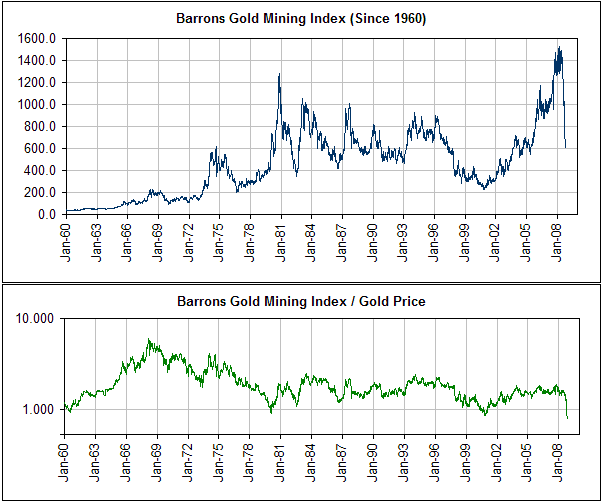
To show how the
current situation stacks up on a longer-term basis we present, below, a
weekly chart showing the Barrons Gold Mining Index (BGMI) and the
BGMI/gold ratio dating back to 1960. There have obviously been other
huge declines in the gold-mining sector over the past 48 years, but the
recent episode stands out. For one, the recent decline is the steepest.
Also, the BGMI/gold ratio is now lower than it has been at any time
since 1960. In other words, the current situation is unprecedented.
The gold sector is
now at its most oversold extreme ever, which doesn't mean that it won't
fall further. In fact, it will likely fall further during the coming
week if gold bullion drops back to test its September low. What it does
mean is that this month's low will probably be the major variety (the
type that sets the stage for a multi-year bull market) and that the
initial rally following the low will be fast.
In last Friday's email alert we said that traders could attempt to play
the potential for a fast gold-sector rebound via GDX call options with
expiry dates of Jan-2009 or later. Such a trade could be averaged into
over the coming days, but should only be attempted by those with plenty
of risk capital.
Speculating using options only ever makes sense if the money being put
at risk is small in comparison with the speculator's cash reserve.
Putting it another way, options trading should only be done using money
that could be written off without blinking an eye if things don't go as
planned.
Currency Market Update
With regard to the following weekly chart of the Dollar Index, note that:
1. Pullbacks during the intermediate-term upward trend of Jan-2005
through to Nov-2005 ended at, or just below, the 20-week moving average
(the blue line on the chart).
2. Rebounds during the intermediate-term downward trend of Nov-2005
through to Mar-2008 ended at, or just above, the 20-week moving average.
3. Pullbacks during the current intermediate-term upward trend have ended near the 20-week moving average.
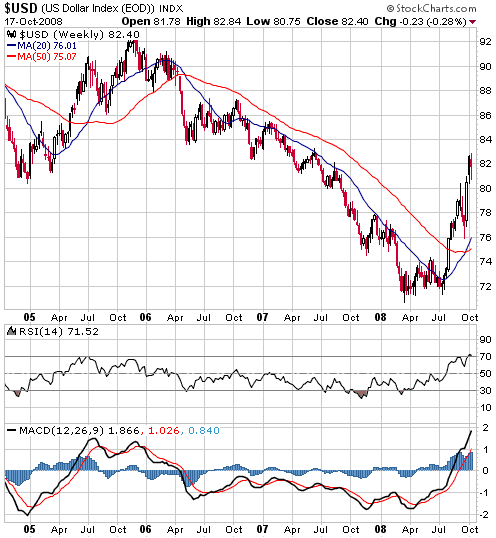
We don't think the
dollar's intermediate-term upward trend is over, but it is overbought
and due for a pullback. A reasonable expectation, based on what has
happened over the past few years, is that the next pullback will take
the Dollar Index down to the vicinity of its 20-week moving average.
Is silver too heavy?
Jim Sinclair (www.jsmineset.com)
recently commented that silver is too heavy to ever again be widely
used as money. By this we think he means that large purchases would
require the transport of such bulky quantities of silver that its use
as money would be impractical. According to Mr. Sinclair, the relative
ease with which a large monetary value of gold can be transported gives
the yellow metal a significant advantage over silver.
In his 16th October discussion at http://silveraxis.com/todayinsilver/,
Tom Szabo explains why he thinks Mr. Sinclair is mistaken. We also
think Mr. Sinclair's logic is flawed on this particular issue, but not
for the reasons given by Mr. Szabo. In our opinion, Messrs. Sinclair
and Szabo are overlooking the most important point with regard to
silver's transportability. The point is that with today's technology
there would seldom be any need to physically transport monetary silver
or gold.
We often read that a monetary system based on gold and/or silver would
not be flexible enough to meet the needs of today's dynamic economy,
but the people who make such claims completely misunderstand the nature
of good money and the relationship between money supply and economic
growth. The fact is that maximising the economy's long-term growth
potential involves making the general medium of exchange (money) as
INFLEXIBLE as possible. To paraphrase Shakespeare, money should be as
constant as the sun. If the money supply were stable then price signals
would always carry accurate information regarding supply/demand
fundamentals, leading to a greater proportion of correct
business/investment decisions and, consequently, stronger long-term
economic growth.
Only a naturally occurring element can be sufficiently
inflexible/stable to be good money, and over the centuries gold and
silver have proven to be the elements best suited to perform the
monetary role. Moreover, never before in world history have gold and
silver been better suited to perform the monetary role than they are
right now. The reason is that current technology makes it possible to
use gold and silver as money without ever having to physically shift
the metal. To be more specific, the metal could remain securely stored
in a vault anywhere in the world, with computers and internet-related
technology used to transfer ownership. As a result, there would never
be a need to carry a bag of gold and silver coins to your local
shopping centre. Instead, you could make purchases using a 'gold card'
or 'silver card' in the same way that you currently use a credit card,
the difference being that a purchase would result in the ownership of a
certain quantity of metal being transferred from yourself to the shop
owner. Similarly, companies could pay salaries by electronically
transferring the ownership of gold or silver to their employees'
accounts.
Having said that, we actually agree with Mr. Sinclair's conclusion that
gold will eventually regain its monetary role while silver will not.
The reason is that for a commodity to adequately perform the role of
money its aboveground supply must dwarf the amount of the commodity
used in industrial applications. This is the case for gold, but is no
longer the case for silver.
Silver bulls claim that the ever-expanding industrial usage of silver
could lead to silver being a better investment than gold over the years
ahead, which is possibly true. However, that's a different issue
altogether. The point is that the more silver is used in industrial
applications, the less chance of it ever again being widely used as
money.
Update
on Stock Selections
(Note: To review the complete list of current TSI stock selections, logon at http://www.speculative-investor.com/new/market_logon.asp
and then click on "Stock Selections" in the menu. When at the Stock
Selections page, click on a stock's symbol to bring-up an archive of our comments on the stock in question)
 Risk Risk
Over the past several months we have suggested focusing on gold stocks
in general and on junior gold stocks in particular (for longer-term
positions, as the juniors are not good trading vehicles). Furthermore,
within the ranks of gold juniors we've suggested focusing on those that
were relatively low risk. Unfortunately, our suggested approach hasn't
worked. Despite sufficient strength in the gold price to lay the
foundation for higher gold-mining profit margins, the gold sector of
the stock market has been hit as hard as, or harder than, any other
sector, and the lower-risk gold juniors have often fared just as poorly
as the higher-risk ones.
But in the face of adversity comes opportunity, and an opportunity
created by the current market environment was described as follows in
the 6th October Weekly Update:
"Due to the fact that the
prices of almost all junior resource stocks have been hammered
regardless of their risk, the opportunity now exists -- and will
probably continue to exist for 3 more months -- to improve the quality
of one's portfolio by shifting out of the most risky juniors and into
those that offer more safety. ...The point is that the market has
downgraded stocks indiscriminately, thus creating an opportunity to
reduce overall portfolio risk without reducing upside potential."
We don't expect any of the junior gold/silver stocks in the TSI Stocks
List to go out of business. If we did we would remove them from the
List. However, some stocks are obviously less risky than others, and
the opportunity to shift from the relatively high-risk to the
relatively low-risk stocks without paying significant safety premiums
still exists.
With the aim of reducing risk we are going to make one specific change
to the TSI Stocks List at this time (as detailed below), but the
general idea is to shift from early-stage explorers to miners that
have, or are close to having, current PROFITABLE production; and
amongst the early-stage explorers to shift from those that are
cash-poor to those that are cash-rich. Stocks that have, or are close
to having, current profitable production are allocated a risk rating of
3 or less (the risk rating is the second last column of the TSI Stocks
List). Cash-rich early-stage explorers include ADM.V, CKG.V, KGN.V and
SBB.V.
ATW.V (ATW Ventures), CGR (Claude Resources) and NSU (Nevsun Resources)
are special situations in that they warrant a relatively high risk
rating (4 or 5) even though they aren't early-stage explorers. ATW has
about $10M of cash and is expected to advance its Burnakura project
into production within the next few months, but we will leave the risk
rating at '4' until there is a clearer indication from the company as
to the project's completion schedule and economics. CGR has about 50K
ounces/year of current production at its Seabee project, but has never
been able to turn a profit from this production. Due to Seabee's
marginal nature we have always considered that the bulk of CGR's upside
potential lay with its early-stage Madsen project. NSU has moved into
the development phase and has plenty of cash, but has high political
and execution risk.
New
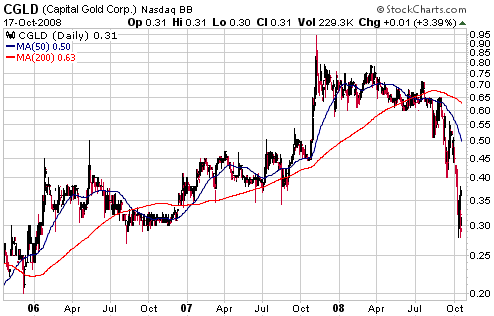
stock Selection: Capital Gold Corporation (OTC: CGLD, TSX: CGC).
Shares: 193M issued, 198M fully diluted. Recent price: US$0.305
The change to the TSI Stocks List referred to above is the removal of
Claude Resources (AMEX: CGR) and the addition of Capital Gold (OTC:
CGLD). It would make no sense to exit CGR near its current
ultra-depressed price unless it was possible to replace it with a stock
that had a more attractive risk/reward ratio.
Thanks to the indiscriminate selling that has occurred in the stock
market over the past few months, the lower-risk CGLD has been hit just
as hard as the higher-risk CGR. This creates the opportunity to
substantially reduce risk without sacrificing much upside potential
(CGLD has a lot less risk than CGR and only slightly less upside
potential).
Both CGR and CGLD have plenty of cash and about 50K ounces/year of
current production. The most important difference is that CGLD's cash
cost of production is about $225/ounce whereas CGR's cash cost is
around $700/ounce. When other costs are factored in, at the current
gold price this means that CGLD's production is very profitable whereas
CGR's production is barely break-even. Other factors in CGLD's favour
are its greater proven gold resource and its greater intermediate-term
growth potential (CGLD's production is expected to be 70K ounces/year
in 2009).
But not everything favours CGLD. For example, while CGLD has good
exploration-related upside it doesn't have anything with as much "blue
sky" as CGR's Madsen project. Also, CGR has an AMEX listing and a
cleaner share structure. CGLD's management is considering an AMEX
listing, but in order to qualify for the AMEX the company would have to
do a reverse split.
Due mainly to CGR's Madsen-related upside we agonised over whether to
make this change to the TSI List. In the end, the deciding factor was
current profitability. The level of speculation amongst junior resource
stocks will probably remain subdued over the coming months, meaning
that the upside potential of the Madsen project will probably remain
under-appreciated. At the same time, it will be difficult for the
market to continue ignoring current profitability and strong earnings
growth.
The CGLD story is quite an unusual one, for all the right reasons. In
an environment where cost overruns and construction delays were the
norm, the company brought its Chanate gold mine in Mexico into
production late last year on time and below budget. Furthermore, the
mine's performance during its first three quarters of operation was
better than Feasibility Study projections. Such positive surprises are
rare because almost every new mine has teething problems.
The Chanate project has a measured-and-indicated resource of 1.7M
ounces, including 832K ounces in the P&P reserve category. A new
resource estimate should be released early next year.
If the gold price averages at least $800/ounce then CGLD should
generate cash flow of at least $30M next year. Assuming a conservative
cash-flow multiple of 8 we therefore arrive at a rough valuation of
$240M for the company. However, from this $240M we must subtract $18M
for the royalties on the Chanate project owned by Royal Gold (RGLD),
leaving us with a royalty-adjusted value of $222M. Based on the fully
diluted share count of 198M, this equates to US$1.12/share.
Chesapeake Gold (TSXV: CKG). Shares: 38M issued, 43.5M fully diluted. Recent price: C$4.11
CKG released its Phase 1 report on the Metates project last Friday. The
report contained less information than we were expecting, but the
information provided was very encouraging. In particular, initial
indications are that the project is economically viable.
The Metates project has a historical (non-NI 43-101 compliant) resource
estimate of 15.7M gold-equivalent (gold + silver) ounces. This
calculation was done by Cambior, a former owner of the project, and
much of CKG's work over the past several months has been directed
towards confirming the drilling results achieved by Cambior with the
aim of coming up with a NI 43-101 compliant resource estimate. CKG has
also been drilling with the aim of expanding the overall resource.
CKG's drilling campaign has been successful to date and should provide
the basis for a very large NI 43-101 compliant resource estimate.
However, the company has not yet advised the likely timing of this
updated estimate.
CKG has more than enough cash to fund its activities over the coming
year and is, we think, a good core holding for long-term gold bulls. It
is suitable for new buying near the current price, but note that care
must be taken when buying/selling because it is a tightly held and
illiquid stock.
Chart Sources
Charts appearing in today's commentary
are courtesy of:
http://stockcharts.com/index.html
http://www.futuresource.com/
http://www.decisionpoint.com/

|