|
-- Weekly Market Update for the Week Commencing 21st June 2010
Big Picture
View
Here is a summary of our big picture
view of the markets. Note that our short-term views may differ from our
big picture view.
In nominal dollar terms, the BULL market in US Treasury Bonds
that began in the early 1980s will end by mid-2010. In real (gold)
terms, bonds commenced a secular BEAR market in 2001 that will continue
until 2014-2020. (Last
update: 09 February 2009)
The stock market, as represented by the S&P500 Index, commenced
a secular BEAR market during the first quarter of 2000, where "secular
bear market" is defined as a long-term downward trend in valuations
(P/E ratios, etc.) and gold-denominated prices. This secular trend will bottom sometime between 2014 and 2020. (Last update: 22 October 2007)
A secular BEAR market in the Dollar
began during the final quarter of 2000 and ended in July of 2008. This
secular bear market will be followed by a multi-year period of range
trading. (Last
update: 09 February 2009)
Gold commenced a
secular bull market relative to all fiat currencies, the CRB Index,
bonds and most stock market indices during 1999-2001. This secular trend will peak sometime between 2014 and 2020. (Last update: 22 October 2007)
Commodities,
as represented by the Continuous Commodity Index (CCI), commenced a
secular BULL market in 2001 in nominal dollar terms. The first major
upward leg in this bull market ended during the first half of 2008, but
a long-term peak won't occur until 2014-2020. In real (gold) terms,
commodities commenced a secular BEAR market in 2001 that will continue
until 2014-2020. (Last
update: 09 February 2009)
Copyright
Reminder
The commentaries that appear at TSI
may not be distributed, in full or in part, without our written permission.
In particular, please note that the posting of extracts from TSI commentaries
at other web sites or providing links to TSI commentaries at other web
sites (for example, at discussion boards) without our written permission
is prohibited.
We reserve the right to immediately
terminate the subscription of any TSI subscriber who distributes the TSI
commentaries without our written permission.
Outlook Summary
Market
|
Short-Term
(0-3 month)
|
Intermediate-Term
(3-12 month)
|
Long-Term
(1-5 Year)
|
Gold
|
Bullish
(21-Jun-10)
|
Bullish
(12-May-08)
|
Bullish
|
US$ (Dollar Index)
|
Neutral
(07-Jun-10)
| Bullish
(02-Nov-09)
|
Neutral
(19-Sep-07)
|
Bonds (US T-Bond)
|
Neutral
(17-May-10)
|
Bearish
(14-Dec-09)
|
Bearish
|
Stock Market (S&P500)
|
Bearish
(16-Jun-10)
|
Bearish
(11-May-09)
|
Bearish
|
Gold Stocks (HUI)
|
Neutral
(07-Jun-10)
|
Neutral
(16-Sep-09)
|
Bullish
|
| Oil | Neutral
(28-Oct-09)
| Bearish
(01-Mar-10)
| Bullish
|
Industrial Metals (GYX)
| Bearish
(21-Sep-09)
| Bearish
(25-May-09)
| Neutral
(11-Jan-10)
|
Notes:
1. In those cases where we have been able to identify the commentary in
which the most recent outlook change occurred we've put the date of the
commentary below the current outlook.
2. "Neutral", in the above table, means that we either don't have a
firm opinion or that we think risk and reward are roughly in balance with respect to the timeframe in question.
3. Long-term views are determined almost completely by fundamentals,
intermediate-term views by giving an approximately equal weighting to
fundamental and technical factors, and short-term views almost
completely by technicals.
Inflation
Money Supply Update
The best web-based presentation of US money supply data is located at http://trueslant.com/michaelpollaro/austrian-money-supply/.
That's where we obtained the following chart, which shows the
year-over-year (YOY) percentage changes for TMS1, TMS2 and M2. Note
that "TMS2" is what we normally refer to as TMS (True Money Supply),
whereas "TMS1" is a narrower definition of money supply that doesn't
count savings deposits.
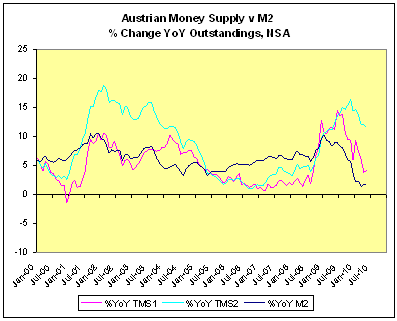
There has been a lot
of figurative hair-pulling over the belief that the US money supply is
falling, but this is only because the focus has generally been on
flawed measures of money supply that include credit instruments in
addition to money. When proper measures are used (reasonable arguments
could be made in favour of either TMS1 or TMS2 in this regard) it
becomes apparent that the US money supply is growing more slowly now
than it was six months ago, but is still growing. Not only that, based
on TMS2 it is still growing at a double-digit pace.
By the way, even if the US money supply were shrinking it would be a
bad idea for the Fed to inject more money into the economy. Creating
money out of nothing always causes problems, even if done in an effort
to counteract monetary deflation. The reason is that the new money
doesn't get spread evenly over the economy; rather, it enters the
economy at discreet points, causes some prices to increase relative to
other prices, and benefits some individuals and economic sectors (the
early receivers of the new money) at the expense of others. It
therefore leads to a greater number of ill-conceived investments, more
resources being wasted, and the transference of wealth from the later
to the earlier users of the new money.
Inflation and Relative Scarcity
Over the long-term almost all parts of the economy are hurt by monetary
inflation (creating a lot of money out of nothing), but over timeframes
of a few years or less there are winners and losers. It is usually
difficult to forecast who will win and who will lose, although one way
of identifying the most and least likely beneficiaries is to look at
relative scarcity. In particular, all else remaining equal the parts of
the economy where there is a lot of excess capacity are less likely to
benefit from inflation than are the parts of the economy where supply
is constrained or that are operating at close to full capacity. This is
a large part of the reason why commodities did not benefit in a big way
from the monetary inflation of the 80s and 90s but were amongst the
main beneficiaries of the past decade's inflation.
The relationship between relative scarcity and monetary inflation goes
a long way towards explaining why counter-cyclical monetary policy
creates far more problems than it solves. When boom turns to bust, the
central bank invariably slams its foot onto the monetary gas pedal in
an effort to support the parts of the economy that are performing the
worst, but these are the parts of the economy where there will usually
be the greatest amount of excess capacity. In other words, the central
bank tries to use inflation to boost the economic sectors that are
amongst the LEAST likely beneficiaries of the inflation. This is why
efforts to 'pump up' the weakest sectors invariably lead to new bubbles
-- and a whole new round of mal-investment -- elsewhere.
In the US economy at this time, excess capacity is most apparent in the
labour market (there is a lot of unemployment and under-employment) and
the property market (the current and potential future supply of
residential and commercial property is weighing heavily on prices). In
response to high unemployment and the weak real estate market the Fed
seems determined to maintain an exceedingly loose monetary policy. But
as discussed above, this cannot possibly help. Take the example of the
labour market. The unusually high level of excess capacity in this
market ensures that it will not be a beneficiary of inflation. Instead,
a likely consequence of the loose monetary policy will be an increase
in the cost of living relative to the cost of labour, meaning a general
decline in real wages and greater hardship for wage earners.
On a related matter, there can be no such thing as a "wage-price
spiral" or any other economy-wide price spiral in the absence of
continuing money-supply growth. If there's a large one-off injection of
new money then some prices will rise in response to the greater supply
of money, and eventually -- probably after a few years -- most prices
will move to a higher level than they would have been in the absence of
the new money. However, higher prices cannot bring about higher prices
in a never-ending loop unless the supply of money continues to ramp up.
We mentioned above that the labour market is more likely to be hurt
than helped by the Fed's easy money. What sector of the economy, then,
is likely to benefit?
Energy (oil, gas, coal, and fossil-fuel alternatives such as uranium,
wind and solar) could benefit, but the only long-term upward trend in
which we have a lot of confidence at this time is in the gold market.
Interesting quote or fact of the week
One
of the reasons that so many people with formal economics training
understand so little about economics is that their understanding comes
from textbooks such as the one written by Paul Samuelson. As recently
as 1989, Samuelson's extremely popular economics textbook contained the
following gem:
"...the Soviet economy is
proof that, contrary to what many skeptics had earlier believed, a
socialist command economy can function and even thrive."
The Stock
Market
At the beginning of this year
we thought that the most likely scenario entailed the US stock market
following the Presidential Cycle model (a model based on the 50-year
average for the 2nd year of the Presidential Cycle). The green line on
the chart displayed below represents this model.
As evidenced by the following chart of the S&P500 Index: so far, so good.
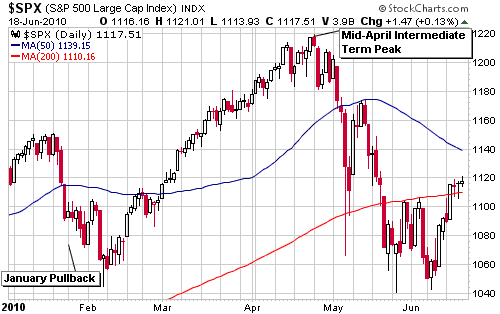
A literal
interpretation of the model would point to a 'choppy' market between
now and mid August (encompassing a rebound peak in mid July) and then a
very weak market from late August through to early October. However,
the model shouldn't be interpreted literally because there are many
paths that the market could take over the months ahead and still end up
at the expected October low.
Our best guess is that the current rebound will peak sometime between
now and mid July at somewhere between 1120 and 1200 (basis the
S&P500).
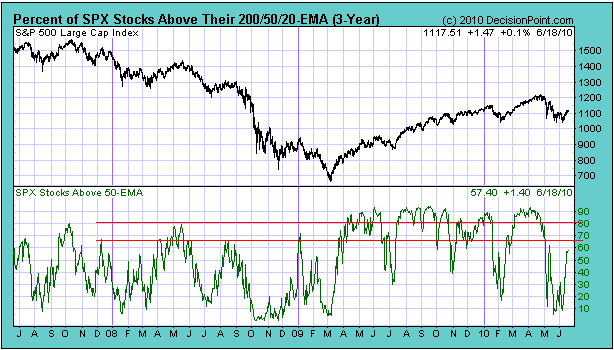
Displayed below is a chart showing the percentage of S&P500 stocks
trading above their respective 50-day moving averages. When the
percentage dropped below 10 last month it was a sign that the market
was sufficiently 'oversold' to enable a strong multi-week rebound. It
is now appropriate to consider how far this indicator could rise before
a rebound peak is in place.
During the intermediate-term advance of 2009-2010, downward corrections
didn't begin until after the S&P500's 50-day MA percentage rose to
at least 90. However, during the intermediate-term decline of 2007-2009
the upward corrections ended after the 50-day MA percentage rose to
between 65% and 80%.
Based on the assumption that an intermediate-term decline is in
progress, we conclude that the current rebound will probably end after
the 50-day moving average percentage rises to the 65-80 range.
This week's
important US economic events
| Date |
Description |
Monday Jun 21
| No important events scheduled
| Tuesday Jun 22
| Existing Home Sales
| | Wednesday Jun 23
| FOMC Announcement
New Home Sales
| | Thursday Jun 24
| Durable Goods Orders
| | Friday Jun 25
| Q1 GDP (revised)
Consumer Sentiment
|
Gold and
the Dollar
Gold and Silver
Current Market Situation
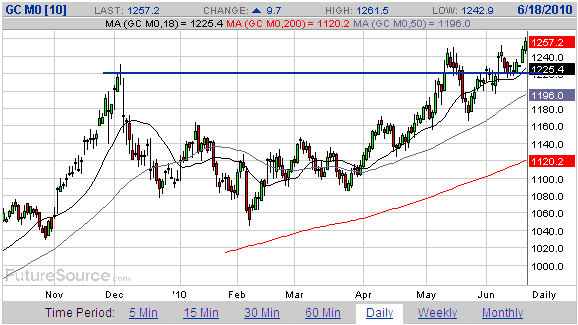
The US$ gold price broke above resistance at $1250 on Friday and is
therefore now in new-high territory. There is no overhead resistance,
but the chart suggests a short-term target of $1340. Sentiment is
strangely quiet, suggesting plenty of scope for additional gains.
If gold's break to a new high is going to fail then it will probably do
so within the next two weeks, meaning that we should soon know whether
Friday's breakout was the start of something or the end of something.
After looking at gold's performance following the other breaks to new
multi-year highs that have occurred over the past decade, we think that
support at $1220 (basis the nearest futures contract) can now be used
as a demarcation level. Specifically, a daily close below $1220 within
the next few weeks would signify a breakout failure.
The over-extended level of the euro-denominated gold price remains our biggest concern with regard to gold's short-term outlook.
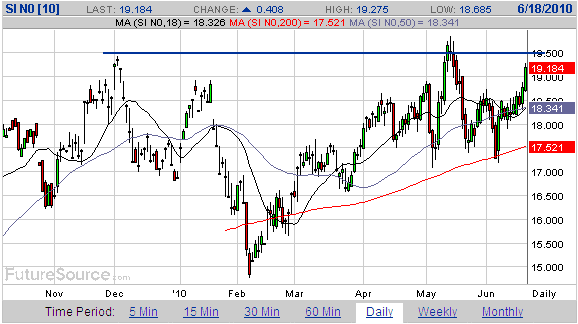
Silver continues to
trade like a large-cap gold stock, meaning that silver's chart
continues to look very much like the HUI's chart. If gold maintains its
short-term upward trend then silver will almost certainly be dragged
behind it to a new multi-year high.
Gold Fund Premiums
When you buy a closed-end gold fund, or any exchange-traded fund for
that matter, you should be mindful of the premium/discount to net asset
value (NAV) at which the fund is trading. The current NAV
premium/discount will generally be reported daily at the fund's web
site.
Gold funds such as GTU, CEF and PHYS sometimes trade at ridiculously
large premiums to their NAVs. For example, the following chart shows
that GTU's premium was above 30% for a while during the first half of
2009. The implication is that someone who bought GTU units in March of
2009 when the fund's premium was above 30% currently has a small LOSS
on their investment even though the price of gold bullion is now about
30% higher.
In our opinion, you should never pay a premium of more than 5% for gold funds or any other exchange-traded funds.
Note that GTU's premium is presently around 3%, which is reasonable. It
would be OK to buy some GTU near its current premium, either as a
long-term investment or as a trade. If buying as a trade you should
plan to exit if gold bullion closes below $1220.

Gold and Silver Stocks
Current Market Situation
The gold-stock indices had good upward moves during the second half of
last week, but there was surprisingly little excitement evident in the
gold sector despite gold bullion's rise to a new all-time high on
Friday. For example, trading volumes were generally lower than average.
It is also worth noting that the HUI remains below the highs of
May-2010, December-2009 and March-2008.
The lack of excitement in the gold sector could be taken as a
significant non-confirmation of gold bullion's rise to a new all-time
high, or it could be viewed from a contrary perspective as bullish. We
don't think the time is right for the gold stock indices to surge to
new all-time highs, but that's exactly what they will do if gold
bullion continues its short-term upward trend.
Below is a chart of Franco Nevada (TSX: FNV), one of the two senior
gold royalty companies. For many years we have used Royal Gold (RGLD),
the other senior gold royalty company, as a leading indicator of the
gold sector, but if the HUI rises to a new all-time high within the
next two months then it will be clear that FNV acted as a leading
indicator.

We think that FNV's
breakout was the 'real thing', but even so it could be near a
short-term peak. A routine 50% pullback would take the price back to
around C$30, after which the next upward leg would get underway.
Silver Stocks
A very good report on mid-tier silver producers can be found HERE.
"Mid-tier", in this case, is loosely defined as having 3M-25M ounces
per year of production. Anyone who invests/speculates in silver mining
stocks should go through the entire 18-page report, but here is the
conclusion:
"After taking all of the
above charts and qualitative factors into account, the three best
overall values among mid-tier silver producers presently appear to be
Fortuna, Silver Standard and First Majestic. We are currently
accumulating a position in Fortuna and will be on the lookout for
buying opportunities in Silver Standard and First Majestic should we
get a further pullback in the markets. With its huge leverage to higher
silver prices, U.S. Silver also offers silver bulls an attractive
speculative punt, but we are unlikely to be buyers until cash
production costs decline below $10 per silver ounce because in our view
the downside risk remains excessive otherwise. Remember, leverage works
in both directions. Purists who want primarily precious metal exposure
in their portfolios should consider Endeavour Silver with the
understanding that purity usually carries a premium. Pan American also
deserves consideration as an all-around solid silver producer although
it too has a few warts (including a less-than-stellar safety record).
In the grand scheme of
things, our report reveals that the mid-tier silver producers are not
screaming buys at current prices especially when we consider that they
do not offer operating leverage to a 30% rise in metal prices from
current levels. Therefore, we believe the key to gains from silver
producers in the short to medium term will be value-conscious
selectivity and market timing."
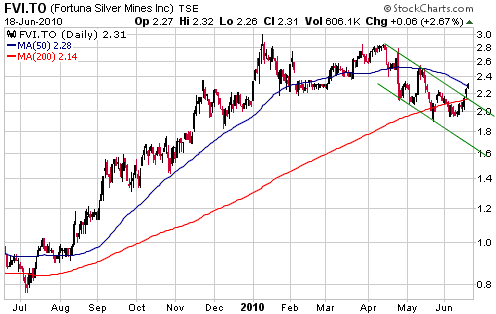
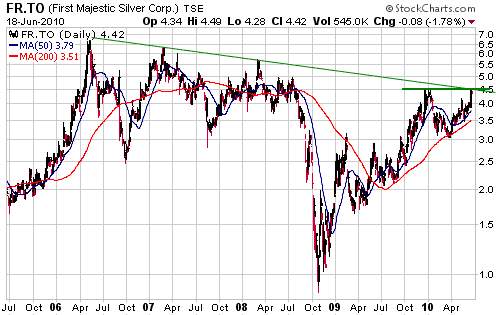
The afore-linked report cites Fortuna (TSX: FVI) and First Majestic
(TSX: FR) as two of the three best overall values among mid-tier silver
producers. We agree, which is why they are the only two mid-tier silver
producers currently in the TSI Stocks List. Sabina (TSX: SBB), an
exploration-stage miner, is the only other silver stock in the TSI List.
Charts of FVI and FR are displayed below. FVI's chart shows that it
broke above the top of a short-term downward-sloping channel last week,
a sign that a correction low is in place. We most recently highlighted
FVI as a candidate for new buying in late April at C$2.15, at which
time we mentioned a valuation-based target of C$3.50. Note that our
target probably won't be reached this year unless silver does much
better in the short-term than we currently expect. FR's chart shows
that it is now testing a confluence of short-term and long-term
resistance at C$4.50. A break above C$4.50 would create an initial
chart-based target of C$6.00, a level at which FR would be fully valued
assuming a silver price in the $18-$21 range.
Silver Standard
Resources (NASDAQ: SSRI) is the other stock cited as being among the
best overall values in the realm of mid-tier silver producers. Prompted
by this report, for the first time in a long time we gave SSRI a close
look. Our conclusion: near the current price it is definitely an
interesting speculation. Furthermore, it is big enough and liquid
enough to be used as a trading vehicle.
SSRI has one project in production and many projects in various stages of development (refer to the map at http://www.silverstandard.com/projects/
for project locations and development stages). The Pirquitas silver
project in Argentina is the one that's currently in production. This
project is expected to produce 7M ounces of silver in 2010 and 8-10M
ounces/year thereafter. Of SSRI's other projects, by far the most
important is Snowfield/Brucejack (SB). The SB project has a massive
near-surface, low-grade, bulk tonnage gold-copper deposit containing
24M ounces of gold in the M&I category and another 14M ounces of
gold in the inferred category. A Preliminary Economic Assessment (PEA)
on just the Snowfield part of the overall project suggested reasonable
economics near current metal prices. The PEA is currently being updated
to incorporate Brucejack and the project's rhenium mineralisation. Due
to the SB project, SSRI actually offers greater leverage to the gold
price than to the silver price.
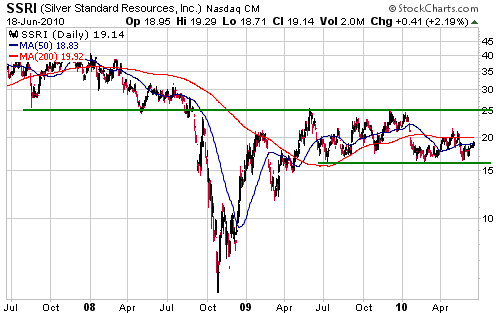
A chart of SSRI is shown below. There is major resistance at US$25, and
a break above this resistance would project a test of the $40 all-time
high reached back in 2007.
SSRI has around 80M shares outstanding, and therefore has a current
market capitalisation of around US$1.5B. At 31st March it had working
capital of $117M and long-term debt of $112M.
We aren't going to add SSRI to the TSI Stocks List at this time because
there will hopefully be a better buying opportunity during
October-November. However, we have begun to accumulate the stock in our
own account with the aim of averaging into a full position over the
next six months.
As an aside, we never
cease to be impressed with the way the stock market periodically falls
into and out-of love with different stocks. SSRI, for example, went
from being a stock market darling during 2005-2007 to being a stock
market outcast over the past 12 months. As far as we can tell, the
change in sentiment wasn't related to a change in the fundamental value
of SSRI's business.
Currency Market Update
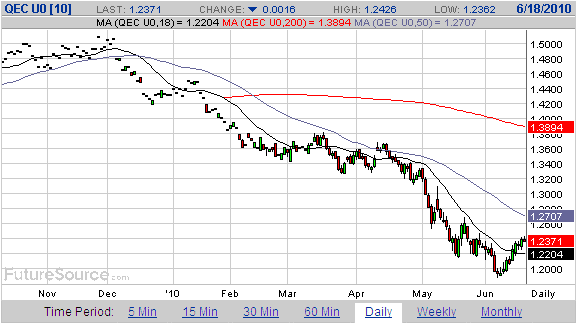
A daily chart of September euro futures is displayed below.
We continue to expect that the euro's rebound will take it up to the
vicinity of its 50-day moving average, but not much more than that. It
could move up to this target over the coming days, or it could pull
back to around 1.22 before resuming its rebound.
Note that we plan to exit the euro call options we recently bought for
our own account if the euro trades above 1.2550 this week.
Suggested Reading
Over the years we've read many books on investment, but very few of
them have had much impact on us. Some of the ones that have had an
impact are noted below.
One thing that the following books have in common is that they contain
very little specific advice on how to be a better investor. They have,
however, helped to shape the way we view the financial markets and the
business of investing.
Note that we have never read any books on "technical analysis".
1. "Fooled By Randomness -- The Hidden Role of Chance in the Markets and in Life" by Nassim Taleb
2. "The Black Swan -- The Impact of the Highly Improbable" by Nassim Taleb
3. "The Education of a Speculator" by Victor Niederhoffer
4. "Practical Speculation" by Victor Niederhoffer
5. "Reminiscences of a Stock Operator" by Edwin Lefevre
6. "Against the Gods -- The Remarkable Story of Risk" by Peter Bernstein
7. "Secrets of Professional Turf Betting" by Robert Bacon
For those looking to develop a basic understanding of economics and the
interaction between politics and economics, we suggest the following:
1. "Meltdown" by Thomas Woods
2. "The Politically Incorrect Guide to Capitalism" by Robert Murphy
3. "The Politically Incorrect Guide to The Great Depression and The New Deal" by Robert Murphy
4. "Economics In One Lesson" by Henry Hazlitt
5. "The Roosevelt Myth" by John Flynn
Update
on Stock Selections
(Notes: 1) To review the complete list of current TSI stock selections, logon at http://www.speculative-investor.com/new/market_logon.asp
and then click on "Stock Selections" in the menu. When at the Stock
Selections page, click on a stock's symbol to bring-up an archive of
our comments on the stock in question. 2) The Small Stock Watch List is
located at http://www.speculative-investor.com/new/smallstockwatch.html)
 Gold-Ore Resources (TSX: GOZ). Shares: 83M issued, 89M fully diluted. Recent price: C$0.51 Gold-Ore Resources (TSX: GOZ). Shares: 83M issued, 89M fully diluted. Recent price: C$0.51
In early May we wrote:
"Of the gold and silver
producers we track, GOZ has by far the lowest market capitalisation per
ounce of annual production. In the current market, 200K-500K oz/yr gold
producers are typically being valued at $2500-$4000 per ounce of
production and sub-200K oz/yr producers are typically being valued at
$2000-$3500 per ounce of production. However, at Friday's closing price
of C$0.45/share the market was valuing GOZ's production at only $850/oz.
In our opinion, the main
reasons for the low valuation are higher-than-expected production costs
and lower-than-expected production growth. Due to its high production
cost GOZ is only generating a small amount of cash despite the high
gold price, while the lack of production growth prevents speculators
from becoming enthusiastic about the stock."
The latest quarterly production results announced by GOZ last Thursday
indicate that some improvement has occurred, in that Q2-2010 production
was about 13% above Q1-2010 production. Full financial results,
including production costs, will be announced within the next 30 days,
but the higher production rate should translate into lower costs.
There is evidence in GOZ's chart that its downward trend is over, although the big test will be resistance at C$0.58-C$0.60.
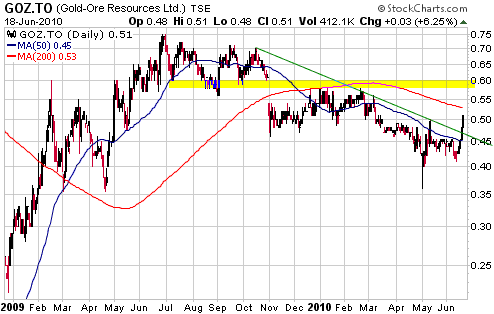
The improvement
indicated by the latest production results combined with the stock's
price action and Friday's upside breakout in the gold price suggests to
us that GOZ is now a good candidate for new buying, especially if it
pulls back to the high-C$0.40s.
Clifton Star Resources (TSXV: CFO). Shares: 28M issued, 38M fully diluted. Recent price: C$4.51
In last week's Interim Update, we wrote: "We
believe that this is an excellent buying opportunity and that the stock
[Clifton Star] is close to its ultimate correction low, but we do have
one concern. The concern is the lack of drilling results over the past
few months. A massive drilling campaign got underway early this year
and we expected that this campaign would yield a steady stream of
drilling results throughout the year, but apart from one uninspiring
press release in April there has been no drilling news from CFO since
February."
A few hours after we wrote about the lack of drilling news, CFO issued
a press release containing some recent drilling results. The results
were not spectacular, but they were solid. The Mineweb article linked HERE provides some information.
Over the next two months we expect to see more press releases with more drilling results.
UNG trade update. Recent price: $8.53
For our UNG (United States Natural Gas Fund) trade we are running a 5%
trailing stop based on daily closing prices. The highest daily closing
price to date is US$8.83, which means that we will automatically exit
if UNG closes below $8.39. Obviously, the stop will rise if UNG closes
above $8.83.
Strange discrepancies between closing prices in the US and Canada
On Friday, Minefinders closed at C$9.80 in Canada. This equates to
about US$9.55 at the current exchange rate, but the closing price of
the stock in the US was US$8.74. We also noticed large discrepancies
between the US and Canadian closing prices for Gammon Gold and Fronteer
Group, with the US$ closing price being much lower in each case than
the US$-equivalent of the closing price in Canada.
We have mentioned at TSI in the past that when these large
discrepancies appear the price in Canada is almost always the correct
price. It seems that games are sometimes played with the closing prices
in the US, with a trade being done at an unrealistically low or high
price right at the closing bell in order to 'paint the tape'. When it
happens, the 'error' will normally be corrected as soon as the US
market re-opens.
Chart Sources
Charts appearing in today's commentary
are courtesy of:
http://stockcharts.com/index.html
http://www.futuresource.com/
http://www.decisionpoint.com/

|









