|
-- Weekly Market Update for the Week Commencing 21st July 2014
Big Picture
View
Here is a summary of our big picture
view of the markets. Note that our short-term views may differ from our
big picture view.
In nominal dollar terms, the BULL market in US Treasury Bonds
that began in the early 1980s ended in 2012. In real (gold)
terms, bonds commenced a secular BEAR market in 2001 that will continue
until 2018-2020. (Last
update: 20 January 2014)
The stock market, as represented by the S&P500 Index,
commenced
a secular BEAR market during the first quarter of 2000, where "secular
bear market" is defined as a long-term downward trend in valuations
(P/E ratios, etc.) and gold-denominated prices. This secular trend will bottom sometime between 2014 and 2020.
(Last update: 22 October 2007)
A secular BEAR market in the Dollar
began during the final quarter of 2000 and ended in July of 2008. This
secular bear market will be followed by a multi-year period of range
trading.
(Last
update: 09 February 2009)
Gold commenced a
secular bull market relative to all fiat currencies, the CRB Index,
bonds and most stock market indices during 1999-2001.
This secular trend will peak sometime between 2014 and 2020.
(Last update: 22 October 2007)
Commodities,
as represented by the Continuous Commodity Index (CCI), commenced a
secular BULL market in 2001 in nominal dollar terms. The first major
upward leg in this bull market ended during the first half of 2008, but
a long-term peak won't occur until 2014-2020. In real (gold) terms,
commodities commenced a secular BEAR market in 2001 that will continue
until 2014-2020.
(Last
update: 09 February 2009)
Copyright
Reminder
The commentaries that appear at TSI
may not be distributed, in full or in part, without our written permission.
In particular, please note that the posting of extracts from TSI commentaries
at other web sites or providing links to TSI commentaries at other web
sites (for example, at discussion boards) without our written permission
is prohibited.
We reserve the right to immediately
terminate the subscription of any TSI subscriber who distributes the TSI
commentaries without our written permission.
Outlook Summary
Market
|
Short-Term
(1-3 month)
|
Intermediate-Term
(6-12 month)
|
Long-Term
(2-5 Year)
|
|
Gold
|
Bullish
(10-Jun-14) |
Bullish
(26-Mar-12) |
Bullish
|
|
US$ (Dollar Index)
|
Neutral
(10-Jul-14) |
Neutral
(10-Jul-14) |
Neutral
(19-Sep-07) |
|
Bonds (US T-Bond)
|
Bullish
(11-Dec-13)
|
Neutral
(18-Jan-12)
|
Bearish |
|
Stock Market
(DJW)
|
Bearish
(07-Apr-14) |
Bearish
(28-Nov-11) |
Bearish
|
|
Gold Stocks
(HUI)
|
Bullish
(10-Jun-14) |
Bullish
(23-Jun-10) |
Bullish
|
|
Oil |
Neutral
(02-Jun-14) |
Neutral
(31-Jan-11) |
Bullish
|
|
Industrial Metals
(GYX)
|
Neutral
(17-Feb-14) |
Bullish
(28-Apr-14) |
Bullish
(28-Apr-14) |
Notes:
1. The date shown below the current outlook is when the most recent outlook change occurred.
2. "Neutral", in the above table, means that we either don't have a
firm opinion or that we think risk and reward are roughly in balance with respect to the timeframe in question.
3. Long-term views are determined almost completely by fundamentals,
intermediate-term views by
fundamentals, sentiment and technicals, and short-term views by sentiment and
technicals.
Setting the stage for the
next collapse
When the central bank pumps money into the
economy and suppresses interest rates it creates incentives to speculate and
invest in ways that would not otherwise be viable. At a superficial level the
central bank's strategy will often seem valid, because the increased speculating
and investing prompted by the monetary stimulus will temporarily boost economic
activity and could lead to lower unemployment. The problem is that the diversion
of resources into projects and other investments that are only justified by the
stream of new money and artificially low interest rates will destroy wealth at
the same time as it is boosting activity. In effect, the central bank's efforts
cause the economy to feast on its seed corn, temporarily creating full bellies
while setting the stage for severe hunger in the future.
We witnessed a classic example of the above-described phenomenon during
2001-2009, when aggressive monetary stimulus introduced by the US Federal
Reserve to mitigate the fallout from the bursting of the NASDAQ bubble and "911"
led to booms in US real estate and real-estate-related industries/investments.
For a few years, the massive diversion of resources into real-estate projects
and debt created the outward appearance of a strong economy, but a reduction in
the rate of money-pumping eventually exposed the wastage and left millions of
people unemployed or under-employed. The point is that the collapse of 2007-2009
would never have happened if the Fed hadn't subjected the economy to a flood of
new money and artificially-low interest rates during 2001-2005.
Rather than learning from prior mistakes, that is, rather than learning from the
fact that the use of monetary stimulus to mitigate the effects of the 2000-2002
collapse led to a more serious collapse during 2007-2009 and a "lost decade" for
the US economy, the 2007-2009 collapse became the justification for the most
aggressive monetary stimulus to date. The damage wrought by previous attempts to
artificially stimulate has resulted in the pace of economic activity remaining
sluggish despite the aggressive monetary accommodation of the past several
years, but it is still not difficult to find examples of the mal-investment that
has set the stage for the next collapse. Here are some of them:
1) The suppression of interest rates has prompted a scramble for yield, which
has pushed yields on higher-risk bonds down relative to yields on lower-risk
bonds. The bonds issued by the governments of Spain and Italy now yield only
slightly more than US Treasury Notes, the yields on investment-grade corporate
bonds are now roughly the same as the yields on equivalent government bonds, and
the yields on junk bonds are generally much lower than normal relative to the
yields on investment-grade corporate bonds. This tells us that monetary
accommodation has greatly increased the general appetite for risky investments,
which is always a prelude to substantial losses.
2) Public companies have been buying back equity at a record pace, despite high
equity valuations. One reason is that although equity valuations are high, debt
is generally priced even higher. Regardless of how expensive a company's stock
happens to be, from a financial-engineering perspective it can make sense for
the company to borrow money to repurchase its own stock as long as the interest
rate on its debt is lower than its earnings yield. Buying back stock boosts
per-share earnings and often increases bonus payments to management, but it does
nothing to expand or improve the underlying business.
3) The number of unprofitable IPOs during the first half of this year was the
highest since the first half of 2000. What a waste.
4) The latest boom has been so obviously reliant on the Fed's easy money that
the real economy's response has been far less vigorous than usual. This at least
partly explains the reticence of corporate America to devote money to capital
expenditure designed to grow the business and, instead, to focus on financial
engineering designed to give per-share earnings a boost. IBM provides us with an
excellent example. As David Stockman points out in a recent
blog post, since 2004 IBM has generated $131B of net income, spent $124B
buying-back its own stock and devoted $45B to capital expenditure. IBM has
therefore been channeling almost all of its earnings into stock buy-backs and
has bought back almost $3 of its own stock for every $1 of capex. Furthermore,
90% of the capex was to cover depreciation and amortisation. No wonder IBM has
just reported declining year-over-year revenue for the 9th quarter in
succession.
If interest rates were at more realistic levels there would be less incentive to
buy back stock and more incentive to invest in ways to increase productivity.
5) Thanks to the combination of government support, low interest rates and a
flood of new money, some large, poorly-run companies are staggering around like
zombies, consuming resources that could have been used more productively.
General Motors is a prime example.
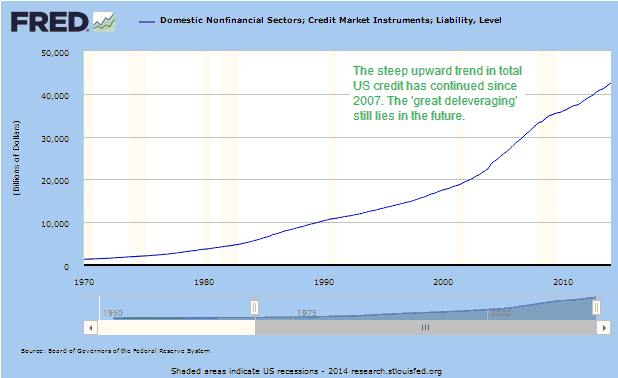
6) On an economy-wide basis there has been no deleveraging in the US. This is
evidenced by the following chart. Instead, the Fed's promotion of leveraged
speculation and the government's deficit-spending maintained the steep upward
trend in economy-wide credit. Consequently, in terms of total debt the US
economy is in a more precarious position today than it was in 2007. It will
therefore not be possible for interest rates to normalise without precipitating
an economic collapse.
7) The abundance of cheap credit prompted hedge funds and private equity firms
to buy more than 200,000 US houses, which in many cases are now being rented to
people who lost their homes when the previous Fed-promoted boom turned to bust.
This has boosted house prices and created the false impression that the
residential real-estate market is immersed in a sustainable recovery, prompting
new (mal-) investments in this market.
8) The strength in auto sales is linked to the ready availability of subprime
credit, which, in turn, is an effect of central-banking largesse, making it
likely that auto sales will tank within the next two years. This will not only
affect the assemblers of cars and the manufacturers of the components that go
into cars, but will also affect all the industries that are involved in the
shipping, storage, selling and financing of new cars.
9) While there is no doubt that the shale oil-and-gas industry would have been a
great success story without the flood of cheap credit engineered by the Fed, the
flood of cheap credit has led to a massive increase in the industry's
debt-to-revenue ratio that has probably made the economics of shale-oil
production look better than is actually the case and made the industry acutely
vulnerable to tighter monetary conditions. Consequently, despite its solid
economic foundation there will probably be many bankruptcies within this
industry over the next few years.
A final point is that just as you never really know who has been swimming naked
until after the tide goes out, you will never be able to identify all the
mal-investments until after the monetary stimulus comes to an end.
The Stock
Market
The US
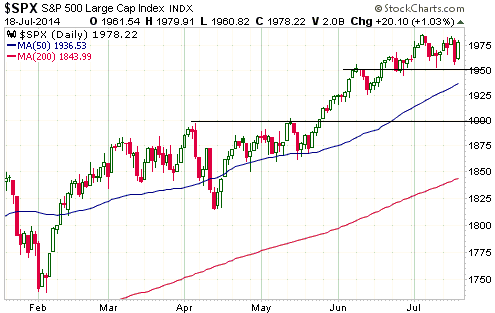
The S&P500 Index (SPX) has essentially traded sideways since 10th June, which,
not coincidentally, was the day that GDXJ confirmed the beginning of a tradable
rally in gold-related investments by breaking above the top of its short-term
channel. It is also worth pointing out that various indicators, most notably
credit spreads and the RUT/SPX ratio, are sending bearish signals, and that the
first half of July is a time of the year when the SPX regularly reverses
direction on a short-term basis. However, the SPX hasn't yet shown any signs of
weakness.
A daily close below 1950 would be a preliminary sign of weakness. It would
suggest that the SPX was at least on its way back to the low-1900s and was
possibly on its way back to its 200-day MA in the mid-1800s. The SPX hasn't
visited its 200-day MA since the final quarter of 2012, so a decline of this
magnitude is overdue regardless of whether or not the cyclical bull market is in
trouble.
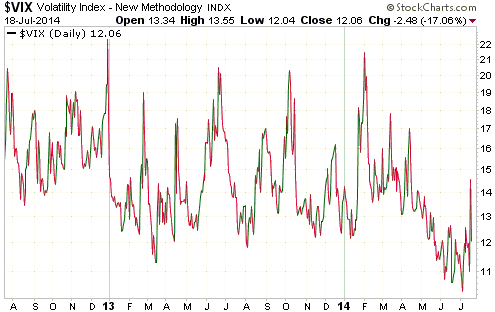
There was a short-lived burst of fear in the stock market last Thursday in
reaction to news that a passenger jet had been shot down in Ukraine. This caused
the Volatility Index (VIX) to break upward from its recent range, but the fear
completely subsided within a few hours and the VIX was unable to sustain its
breakout.
As an aside, we have some VIX August-$15 call options in our account that will
be sold if the VIX spikes up to around 20 within the next four weeks. In the
absence of a near-term volatility surge, these options will expire worthless.
Russia
Due to last week's news it is time to take another look at Russian equities, as
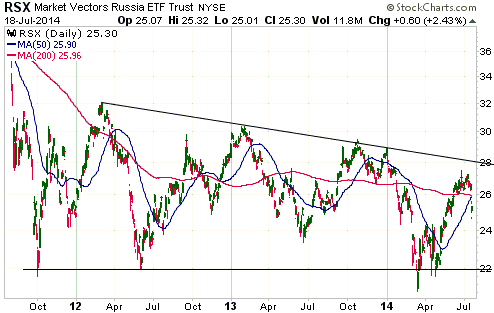
represented on the following daily chart by the Market Vectors Russia ETF (RSX).
The historical record suggests that Russian equities will be good performers
over the coming 12 months if commodity prices trend upward, almost regardless of
political and geopolitical considerations/risks. Our intermediate-term bullish
outlook for commodities therefore piques our interest in owning RSX, especially
since the Russian stock market's average valuation is very low.
RSX plunged last Thursday in reaction to the Ukraine news and only retraced a
small portion of its Thursday losses on Friday. This price action means that a
new opportunity to buy RSX could arrive within the next few weeks.
We'll try to identify the opportunity when it arrives.
This week's
important US economic events
| Date |
Description |
| Monday Jul 21 |
No important events scheduled | | Tuesday
Jul 22 |
CPI
Existing Home Sales
Richmond Fed Mfg Index | | Wednesday
Jul 23 |
No important events scheduled | | Thursday
Jul 24 |
New Home Sales
Kansas Fed Mfg Index
|
| Friday Jul 25 |
Durable Goods Orders |
Gold and
the Dollar
Gold
Goldman's Gold Forecast
Last week, a Goldman Sachs analyst
reiterated his forecast for the gold price to drop to $1050/oz by the end of
this year.
The Goldman Sachs gold-market analysis is much better than the gold-market
analysis of Eric Sprott and many other high-profile gold bulls, because at least
Goldman is looking in the right direction for clues as to what the future holds
in store for gold. Many gold bulls, on the other hand, haven't the foggiest idea
about gold's fundamental drivers.
Goldman's gold forecast has little chance of being correct, though, because it
is predicated on a strengthening US economy and because gold's true fundamentals
are trending in a bullish direction. Of particular importance, we note that:
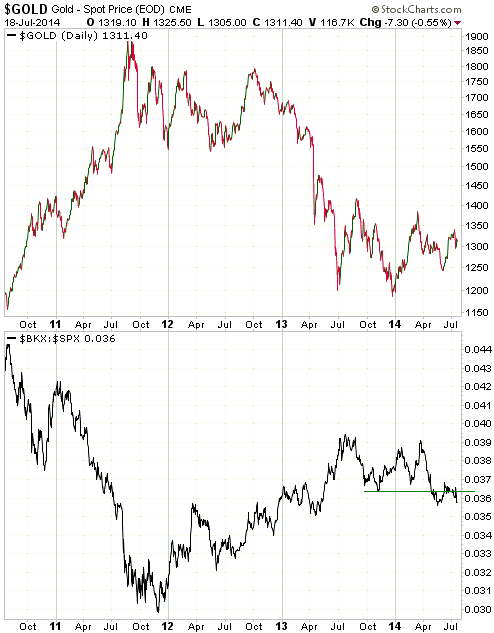
a) The BKX/SPX ratio, a measure of how the banking sector is performing relative
to the broad US stock market, gradually began to turn gold-bullish (meaning:
bank stocks gradually started to weaken relative to the overall market) in
early-July of last year and turned decisively gold-bullish in April of this
year. This influential ratio will remain supportive for gold as long as it is
making lower highs and lower lows.
Here's a daily chart comparing gold and the BKX/SPX ratio over the past four
years.
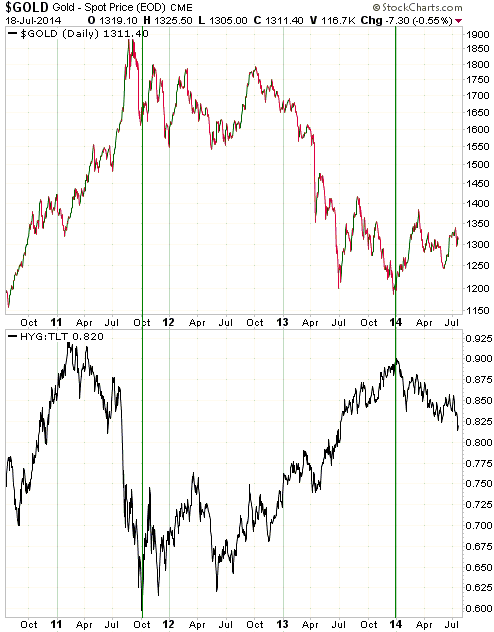
b) The HYG/TLT ratio, a measure of US credit spreads, began to move in gold's
favour (meaning: credit spreads began to widen, causing the HYG/TLT ratio to
decline) at the end of last year and made a new 52-week extreme last week. As is
the case with the BKX/SPX ratio, the HYG/TLT ratio will remain supportive for
gold as long as it is making lower highs and lower lows.
Here's a daily chart comparing gold and the HYG/TLT ratio over the past four
years.
Our guess is that the gold price will end this year in the $1400-$1500 range.
Another geopolitical drama disrupts the gold market
Ukraine is again the source of an increase in international tension due to the
shooting down, either by Russia-backed Ukrainian rebels or the Ukrainian
military, of a Malaysian Airlines passenger plane traveling in Ukrainian
airspace last Thursday. This news caused the gold price to jump $20/oz, which
prompts us to reiterate the following guideline:
All price gains made by gold on the back of international military-risk events
will be given back.
It was therefore never likely that last Thursday's news would result in the
resumption of gold's upward trend. In fact, it's possible that last Thursday's
news has prolonged the correction that got underway following the 11th July
spike to the high-$1340s by causing a premature surge in speculative buying.
The speculative gold buying that often occurs in reaction to news suggesting
heightened geopolitical risk is uninformed. This is because heightened
geopolitical risk is not a fundamental driver of gold's value.
Current Market Situation
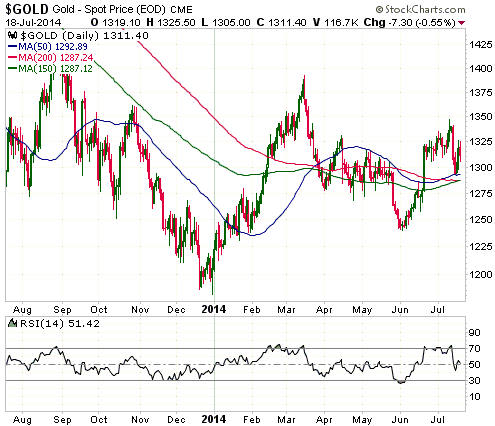
In the 14th July Weekly Update, when discussing the likelihood that the gold
market would 'correct' its recent gains before resuming its advance, we wrote:
"...a substantial correction is unlikely at this time. The 65-week moving
average should now provide strong support, which suggests that gold should
remain above $1310 on a weekly closing basis. The shorter-term moving averages
of importance (the 50-day, 150-day and 200-day moving averages) are now either
into the $1290s or should move into the $1290s within the next three weeks,
which suggests that the $1290s is probably now the worst case for an intra-day
downward spike."
Last week the gold price traded as low as $1292, but ended the week marginally
above $1310. Last week's price action was therefore not out of the ordinary.
Having said that, the fast pace of the decline during the first two days of the
week and the news-related surge on Thursday could lead to a small extension of
the correction in terms of both price and time. Furthermore, the speculative
net-long position in COMEX gold futures hasn't yet fallen by enough to suggest
that the correction is complete.
As mentioned in last week's Interim Update, it is now likely that the $1280s
will be visited before a rise to new multi-month highs gets underway. However,
regardless of anything else we would now view a daily close above the 17th July
intra-day high of $1325.90 as an early warning sign that the correction is over.
Gold Stocks
The gold-mining sector held up quite well in the face of last week's $28 decline
in the gold price. The HUI only lost 1.7% and the GDXJ/GDX ratio is not far
below its high of the past two months.
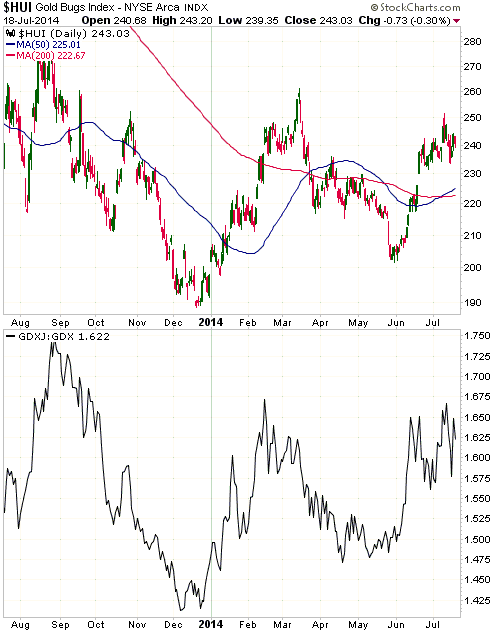
As is the case with gold bullion, the market reaction to the latest Ukraine
drama will potentially extend the gold sector's correction in terms of both
price and time. We still think that moving-average support at around 225 defines
the near-term downside risk for the HUI, but there is now a higher probability
that this support will be tested before the upward trend resumes.
Traders and investors should use near-term price weakness to add to positions in
gold-mining stocks in preparation for another strong 1-2 month rally. Our guess
is that the next tradable rally will begin in early August.
The Currency Market
The euro is very close to breaking out to the downside. This means that it is
now either very close to a short-term bottom or about to breach important
support and project significant additional weakness.
A daily close below 134.9 would constitute a downside breakout and suggest that
the currency was on its way to 130.
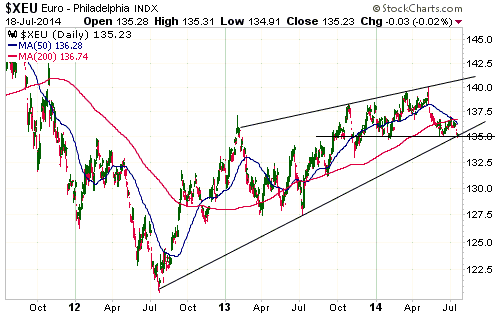
The recent weakness in euro-zone bank stocks is the most important bearish
influence on the euro at this time. If this weakness persists then the euro will
probably breach support, indicating that the decline is more than just a routine
correction within a continuing intermediate-term advance.
In the euro's favour is the fact that speculators have already built-up a large
bearish position in the futures market. However, although the speculative
net-short position in euro futures is near an 18-month high, there is no
theoretical limit to how high it could go. Furthermore, the speculative
net-short position was more than double its current level when concerns about
the euro's prospects were peaking in mid-2012. It is therefore possible that
breaking below support at 134.9-135.0 will set in motion another wave of
speculative selling, especially if the breakdown is accompanied by more threats
of default within the euro-zone's banking industry.
Note that a breakdown in the euro in reaction to heightened fears about the
solvency of Europe's banks would be fundamentally bullish for gold and would
probably lead to a higher US$ gold price, even though it would result in a
higher Dollar Index. However, the gold market's initial knee-jerk reaction could
be to decline along with the euro.
Updates
on Stock Selections
Notes: 1) To review the complete list of current TSI stock selections, logon at
http://www.speculative-investor.com/new/market_logon.asp
and then click on "Stock Selections" in the menu. When at the Stock
Selections page, click on a stock's symbol to bring-up an archive of
our comments on the stock in question. 2) The Small Stock Watch List is
located at http://www.speculative-investor.com/new/smallstockwatch.html
 Company
news/developments for the week ended Friday 18th July 2014: Company
news/developments for the week ended Friday 18th July 2014:
[Note: AISC = All-In Sustaining Cost, FS = Feasibility Study, IRR =
Internal Rate of Return, MD&A = Management Discussion and Analysis,
M&I = Measured and Indicated, NAV = Net Asset Value, NPV(X%) = Net
Present Value using a discount rate of X%, P&P = Proven and
Probable, PEA = Preliminary Economic Assessment, PFS =
Pre-Feasibility Study]
*Almaden Minerals (AAU) has arranged a C$6M financing at
C$1.50/share. This is a reasonable move by the company's management
and was not unexpected (on 19th May we wrote that a small equity
financing would probably be done during the second half of this year
to top-up the treasury).
We estimate that AAU will have about US$15M in the bank when the
aforementioned financing is completed. This should be enough to
fully fund its business for the coming 12 months.
*Asanko Gold (AKG) advised that the budget for building Phase 1 of
the Asanko Gold Mine (Ghana) is $295M. This is almost identical to
the figure contained in the 2012 FS arranged by PMI Gold, the
previous owner of what is now Phase 1 of the Asanko project and what
was previously known as the Obotan project. Phase 1 is expected to
result in gold production of 200K ounces per year beginning in
Q1-2016. Phase 2 will incorporate the Esaase deposit and will
probably enable production to be increased to around 400K
ounces/year.
In addition to confirming that PMI Gold's 2012 estimate for the
Phase 1 capital cost remains valid, AKG's detailed engineering has
also confirmed that other important components of the 2012 FS are
still applicable. Consequently, AKG's Definitive Project Plan for
Phase 1, which is scheduled to be complete in Q4-2014, shouldn't be
materially different from the 2012 FS. This suggests that Phase 1 of
the Asanko mine will be economically robust at $1300/oz.
AKG currently has $150M of undrawn credit and about $230M of cash,
so Phase 1 is fully funded through to production.
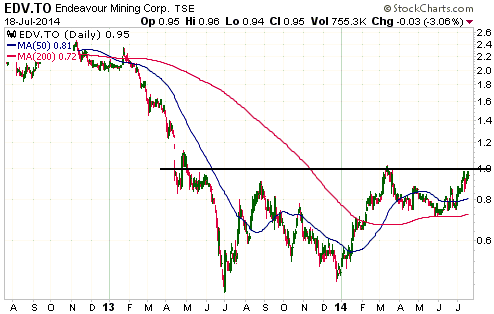
*Endeavour Mining (EDV.TO, EVR.AX) reported gold production of
122.5K ounces during the June quarter. This is well above plan and
makes it likely that the company will exceed the top end of its
400K-440K-oz 2014 production guidance. This is simply an excellent
result.
We suspect that EDV will break above major resistance at C$1.00 (the
top of its long-term base) within the next month.
*Pretium Resources (PVG) has filed a final short-form base-shelf
prospectus with the relevant securities commissions in Canada and
the US that will allow it to offer up to US$600M of new securities
from time to time over the next 2 years. PVG's management is
therefore paving the way for the additional equity financing that
will be needed to build the proposed $750M underground mine at the
Brucejack project.
This news is neither surprising nor significant. However, if PVG
goes ahead and raises the money needed to build the mine it will be
significant. Given that a sale of the project to a senior or
mid-tier gold producer is the preferred exit strategy, it will
indicate that the company has been unable to attract a buyer and has
therefore been forced to 'go it alone'.
List
of candidates for new buying
From within the ranks of TSI stock selections, the best candidates for new
buying at this time are:
1) AAU (last Friday's closing price: US$1.47).
2) EDV.TO in the low-C$0.90s (last Friday's closing price: C$0.95).
3) EVN.AX (last Friday's closing price: A$0.82).
4) RSG.AX (last Friday's closing price: A$0.63).
5) SBB.TO (last Friday's closing price: C$0.81).
Chart Sources
Charts appearing in today's commentary
are courtesy of:
http://stockcharts.com/index.html
http://research.stlouisfed.org/

|









