|
-- Weekly Market Update for the Week Commencing 21st November 2011
Big Picture
View
Here is a summary of our big picture
view of the markets. Note that our short-term views may differ from our
big picture view.
In nominal dollar terms, the BULL market in US Treasury Bonds
that began in the early 1980s ended in December of 2008. In real (gold)
terms, bonds commenced a secular BEAR market in 2001 that will continue
until 2014-2020. (Last
update: 4 April 2011)
The stock market, as represented by the S&P500 Index, commenced
a secular BEAR market during the first quarter of 2000, where "secular
bear market" is defined as a long-term downward trend in valuations
(P/E ratios, etc.) and gold-denominated prices. This secular trend will bottom sometime between 2014 and 2020. (Last update: 22 October 2007)
A secular BEAR market in the Dollar
began during the final quarter of 2000 and ended in July of 2008. This
secular bear market will be followed by a multi-year period of range
trading. (Last
update: 09 February 2009)
Gold commenced a
secular bull market relative to all fiat currencies, the CRB Index,
bonds and most stock market indices during 1999-2001. This secular trend will peak sometime between 2014 and 2020. (Last update: 22 October 2007)
Commodities,
as represented by the Continuous Commodity Index (CCI), commenced a
secular BULL market in 2001 in nominal dollar terms. The first major
upward leg in this bull market ended during the first half of 2008, but
a long-term peak won't occur until 2014-2020. In real (gold) terms,
commodities commenced a secular BEAR market in 2001 that will continue
until 2014-2020. (Last
update: 09 February 2009)
Copyright
Reminder
The commentaries that appear at TSI
may not be distributed, in full or in part, without our written permission.
In particular, please note that the posting of extracts from TSI commentaries
at other web sites or providing links to TSI commentaries at other web
sites (for example, at discussion boards) without our written permission
is prohibited.
We reserve the right to immediately
terminate the subscription of any TSI subscriber who distributes the TSI
commentaries without our written permission.
Outlook Summary
Market
|
Short-Term
(0-3 month)
|
Intermediate-Term
(3-12 month)
|
Long-Term
(1-5 Year)
|
| Gold
|
Neutral
(22-Sep-11)
|
Neutral
(24-Jan-11)
|
Bullish
|
| US$ (Dollar Index)
|
Bullish
(12-Oct-11)
| Bullish
(12-Oct-11)
|
Neutral
(19-Sep-07)
|
| Bonds (US T-Bond)
|
Neutral
(19-Sep-11)
|
Bearish
(24-Aug-11)
|
Bearish
|
| Stock Market (S&P500)
|
Bearish
(17-Oct-11)
|
Neutral
(24-Aug-11)
|
Bearish
|
| Gold Stocks
(HUI)
|
Neutral
(31-Oct-11)
|
Bullish
(23-Jun-10)
|
Bullish
|
| Oil | Neutral
(31-Jan-11) | Neutral
(31-Jan-11)
| Bullish
|
| Industrial Metals
(GYX)
| Bearish
(19-Sep-11)
| Neutral
(29-Aug-11)
| Neutral
(11-Jan-10)
|
Notes:
1. In those cases where we have been able to identify the commentary in
which the most recent outlook change occurred we've put the date of the
commentary below the current outlook.
2. "Neutral", in the above table, means that we either don't have a
firm opinion or that we think risk and reward are roughly in balance with respect to the timeframe in question.
3. Long-term views are determined almost completely by fundamentals,
intermediate-term views by giving an approximately equal weighting to
fundamental and technical factors, and short-term views almost
completely by technicals.
The two prerequisites
for hyperinflation
Relatively rapid inflation of the money supply -- say, a monetary inflation rate averaging 10% per year -- can occur for a long time without the "inflation" becoming "hyper". The reason is that a certain mass psychology must be present to create the condition known as hyperinflation. At the same time, hyperinflation cannot result from psychological factors alone. There must also be rapid growth in the money supply.
To further explain, assume that an economy's money supply has been increasing at around 10% per year for many years, leading to a roughly 8% per year reduction in the purchasing power (pp) of money. (Under normal circumstances the long-term reduction in money pp will be less than the long-term increase in money supply due to the effects of productivity and population increases.) At this point, a critical mass of people comes to believe that the "inflation" will be endless and that money is guaranteed to be worth significantly less in 12 months time than it is today. These people react by becoming much quicker to spend whatever money they get, which has the effect of reducing the pp of money at a faster rate than the money supply is increasing. The accelerated rate at which prices are rising throughout the economy leads to wider recognition of the inflation problem and a more widespread desire to spend money as quickly as possible. In other words, a vicious cycle begins whereby rapid price rises cause people to accelerate their spending, leading to even faster increases in prices, and so on. This is hyperinflation.
The possibility that a change in psychology could accelerate the pace at which money loses pp is why central bankers devote so much time and energy to the management of inflation expectations. However, they need not bother, because the above description of how 'normal' inflation evolves into hyperinflation leaves out a part of the process over which the central bank has full control and without which the general price level could not rocket upward for long. At any time during the inflationary process described above, the central bank could put an end to the price spiral without delving into the nebulous world of psychology. It would simply have to stop the expansion of the money supply.
Consider this: If prices were rising rapidly throughout the economy, a lot more money would be needed for every transaction. Another way of saying this is that the demand for money would be in a steep upward trend. Not the demand for money as a temporary store of purchasing power, but the demand for money as a medium to facilitate exchange.
Now consider what would happen if an upward ramp in money demand were not met by an upward ramp in money supply. It should be clear that a severe shortage of money would soon develop and that the price (purchasing power) of money would rise to bring demand and supply back into balance. That is, the prices of goods and services would fall.
Looking back at historical episodes of hyperinflation we see that when surging prices created an apparent money shortage, the central bank generally responded by increasing the money supply. That is, the central bank continued to feed the inflationary process. It could have stopped the inflation in its tracks at any time by stopping the expansion of the money supply, but for whatever reason it invariably made more sense to those in charge to satisfy the perceived short-term need for more money.
So, not only is substantial growth in the money supply needed to set the stage for hyperinflation, monetary inflation must ramp up with prices in order for an upward price spiral to be sustained beyond the very short-term.
In summary, hyperinflation is not a purely psychological phenomenon. It is also not solely related to changes in the money supply, because there is no telling how much monetary inflation it will take to bring about the frenzied mass shift out of cash that pushes the economy from "inflation" to "hyperinflation". Instead, hyperinflation has psychological and money-supply components. Both are essential.
Interesting Facts
Ten years ago, North Dakota's oil production was 86,000 bpd. Today it is 485,000 bpd. This means that North Dakota now produces more oil than Ecuador, an OPEC country.
The above information came to us by way of The Gartman Letter.
N. Dakota's dramatic increase in oil production is linked to the Bakken rock formation that lies under much of the state. It is estimated that "the Bakken" contains more than 20 billion barrels of recoverable oil. This oil has always been there, but it only became 'economic' over the past several years due to the combination of a higher oil price and new drilling technology.
We remain confident that if not for political interference in one form or another, no rational person would be concerned about "peak oil" (or peak anything).
The Stock
Market
The S&P500 closed right at the important 1216 support level on both Thursday and Friday of last week. However, the NASDAQ100 Index (NDX), which often leads the other senior US stock indices, broke below equivalent support at 2275-2300. This tells us that the odds are in favour of the S&P500 breaking below 1216 in the near future.
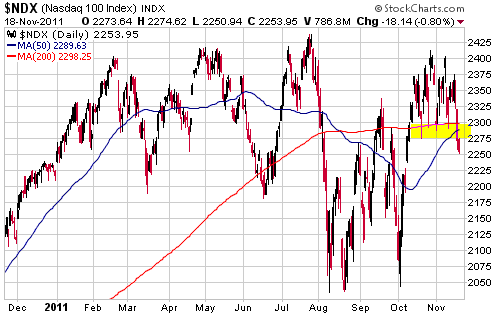
As stated in earlier commentaries, we think that the S&P500 will do no worse in the short-term than drop back to the low-1100s. The low-1100s for the S&P500 is equivalent to 2050-2100 for the NDX. To put it another way, we think that the remaining downside potential is less than 10%.
This has a lot to do with our assessment of market sentiment. To explain, it seems to us that it won't take much additional price weakness from here to push sentiment indicators back to the sorts of extremes that are only seen near important lows. For example, the VIX is currently in the low-30s and would probably move into the 40s if the stock market quickly lost another 5% or so.
At the same time, it's unlikely that the stock market will rally for more than a few days as long as Europe's sovereign debt drama keeps generating a steady stream of bad news.
Due more to the lack of upside potential than the downside risk, our short-term stock market outlook remains "bearish". Our short-term view will automatically shift to "neutral", though, if the S&P500 drops to the 1150s and/or the NDX drops to the 2170s during the first three days of this week.
This week's
important US economic events
| Date |
Description |
| Monday Nov 21 | Existing
Home Sales
| | Tuesday Nov 22 | FOMC
Minutes
Q3 GDP (revised)
| | Wednesday Nov 23 | Durable
Goods Orders
Personal Income and Spending
Consumer Sentiment | | Thursday
Nov 24 | US markets closed for
Thanksgiving
| | Friday Nov 25 | No
important events scheduled
|
Gold and
the Dollar
Gold and Silver
The first of the following daily charts shows that gold has pulled back to short-term support. There is no evidence in this chart that a short-term trend reversal (from up to down) has occurred.
The second of the following daily charts shows that silver has broken out to the downside. It also shows that silver's rebound from its September low did no more than take the price back to the declining 50-day moving average.
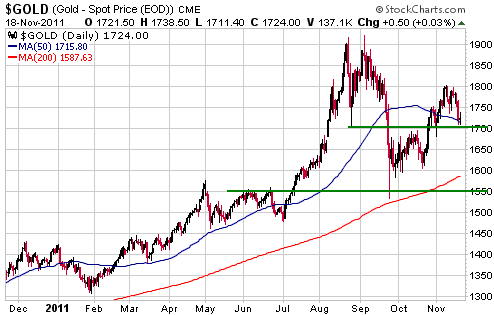
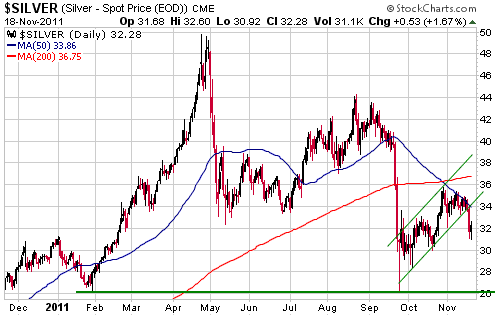
As far as the next few months are concerned, we think that support near the respective September lows defines the maximum downside potential for both gold and silver. A break to significantly lower levels is very unlikely because sentiment in these markets already lies somewhere between indifference and pessimism. To further explain, it's likely that negative sentiment would be almost palpable if the price of either metal dropped back to its September low. This effectively puts a floor under the market, because downward trends are fueled by the conversion of bulls to bears.
Of the two markets, the silver market has a much better chance of testing its September low. Note, though, that even if a test of the September low ($26) is on the cards, there could be an intervening rebound to as high as $34.
Gold Stocks
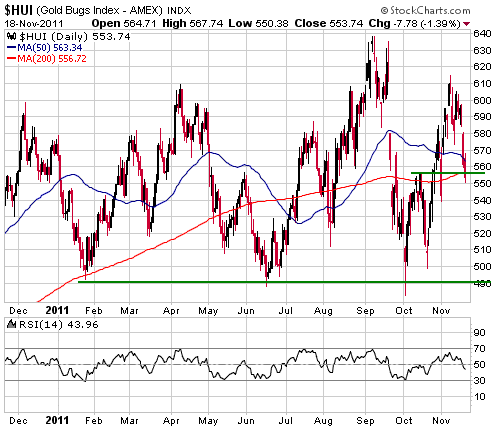
The HUI's rebound from last month's low has been more volatile than the rebounds from the other October lows of the past 10 years. In particular, the October pullback was deeper than it really should have been (based on what happened during earlier post-October-low rallies) and the November pullback has now extended further than it really should have done. The greater-than-expected extension of the November pullback forces us to consider the possibility that the rally from the 4th October 2011 low ended sooner, and with momentum indicators at lower levels, than expected.
The odds still favour a move to new post-October highs prior to the setting of a multi-month peak, but in any case it's important to always take what the market gives you and not insist that the market follow a predetermined path. The reality is that sometimes when you expect a selling opportunity to arise prior to a buying opportunity or a buying opportunity to arise prior to a selling opportunity, the opposite happens.
Last week's price action suggests that we could get another good short-term buying opportunity before we get a good short-term selling opportunity. However, a general (sector-wide) buying opportunity is not currently at hand. While many individual gold mining stocks are at levels where new buying would make sense for speculators wanting to build positions, the HUI is presently in no-man's land from a short-term risk/reward perspective.
Last Friday's marginal breach of support by the HUI could have set the low for the correction that began early this month, but there is no price-related evidence that a low is in place and there is the concern that the silver market has just broken out to the downside. Also, the risk management parameters are not clearly defined right now, meaning that there is no obvious place near the current price to draw a line that would separate a bullish position from a neutral or bearish position.
In last week's Interim Update we said that the chart of GDXJ (the Junior Gold Miners ETF) didn't contain any hints regarding the most likely direction of the next $3 move, but that it did point to a significant risk of a test of the October low within two months. GDXJ's price action over the final two days of last week increased the probability that the October low will be tested in the not-too-distant future.
By the way, GDXJ's October low is only about 10% below last Friday's low, so by suggesting that this low will be tested within the next couple of months we aren't saying that we perceive a lot of additional downside potential.
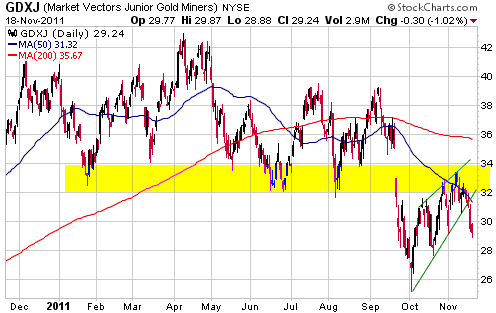
There is a plausible short-term scenario that would allow the HUI to complete a typical post-October-low rebound and GDXJ to test its October low within two months. It involves the HUI rallying to a new multi-week high within the coming fortnight while GDXJ rebounds to a lower high, with both then trending lower into January-2012. But regardless of whether it happens this week or waits until January, our view is that a decline by GDXJ to the vicinity of its October low ($26-$28) would constitute a very good buying opportunity.
Currency Market Update
Over the past two months the Dollar Index has traded as high as 80 and as low as 74.5. It ended last week at around 78.
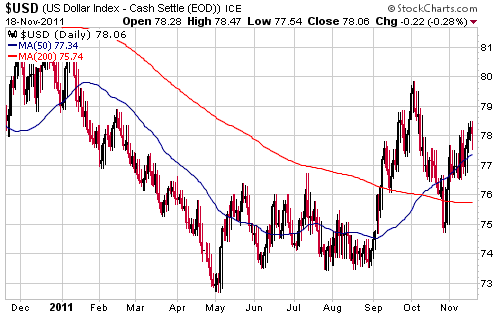
If the Dollar Index breaks out of its 74.5-80.0 range in the near future, the breakout will most likely be to the upside in reaction to a perceived worsening of the euro-zone's debt predicament. The yields on the bonds issued by the governments of Italy and Spain were held in check last week by ECB purchases of these bonds, but the ECB's ability to support the bonds of heavily-indebted euro-zone governments will be very limited as long as it avoids large-scale debt monetisation (the ECB's recent bond purchases were apparently "sterilised", meaning that new money created to effect the purchases was subsequently removed).
One thing that the euro has going for it is the current positioning of traders, as illustrated by the following chart. The chart, which is compliments of the excellent
Sharelynx.com web site, shows that a) there has been a consistent inverse relationship over the past 2.5 years between the euro and the net Commercial position in euro futures (indicated by the blue bars in the bottom section of the chart), and b) the Commercials are currently as 'long' as they were at the early-October-2011 low and almost as 'long' as they were at the June-2010 low.
The Commitments of Traders (COT) situation will not cause the euro's short-term trend to reverse upward, but it does mean that there is now a lot of fuel to drive the euro upward once a trend reversal occurs for some other reason.
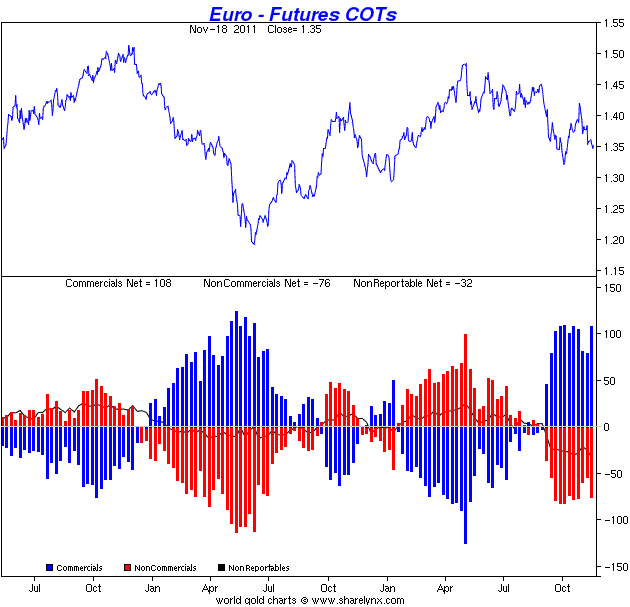
The COT situation tells us that the euro is probably within a few weeks of a short-term bottom, but it doesn't tell us the price level at which the bottom is likely to occur.
Update
on Stock Selections
Notes: 1) To review the complete list of current TSI stock selections, logon at
http://www.speculative-investor.com/new/market_logon.asp
and then click on "Stock Selections" in the menu. When at the Stock
Selections page, click on a stock's symbol to bring-up an archive of
our comments on the stock in question. 2) The Small Stock Watch List is
located at http://www.speculative-investor.com/new/smallstockwatch.html
 Fairborne Energy (TSX: FEL). Shares: 102M issued, 109M fully diluted. Recent price: C$3.05 Fairborne Energy (TSX: FEL). Shares: 102M issued, 109M fully diluted. Recent price: C$3.05
The natural gas market often makes an intermediate-term low during September-October and then rebounds for 2-4 months. For example, the following daily natgas futures chart shows that there was a strong rebound from a September low in 2009 and a modest, but still tradable, rebound from an October low in 2010. The chart also shows that the seasonal rally has not occurred this year.
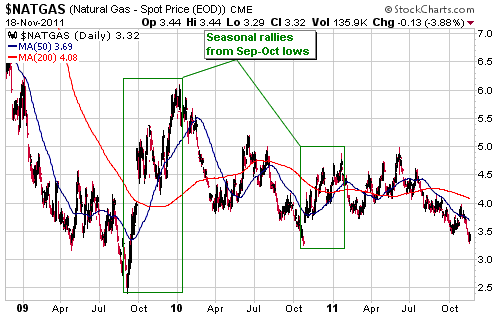
2008 was the only other year of the past 10 that the natgas market made a new 52-week low after October and/or failed to experience at least a 2-month rebound after trending lower into September-October. 2008's price action was way out of the ordinary in many markets due to the Global Financial Crisis.
We don't know why the seasonal rally hasn't materialised this year. The amount of gas in
underground storage is high relative to the 5-year moving average for this time of the year, but storage levels were similarly high when the market was rallying during the final quarters of 2009 and 2010.
It is possible that the seasonal rally has been delayed this year, but will still happen. A colder-than-usual winter in parts of the US and Canada should help in this regard. However, there is a risk that the price will maintain its downward trend over the next few months due to the fact that natgas producers haven't yet reacted to the low price by meaningfully reducing supply.
Although the fundamentals of the natgas market appear to be bearish, these fundamentals are well known and are already factored into the stock prices of leveraged natgas producers such as FEL. This, we think, is creating another opportunity to accumulate these stocks, an earlier opportunity having occurred during the final week of September and the first week of October.
We won't be surprised if another tradable rebound begins within the next couple of weeks.
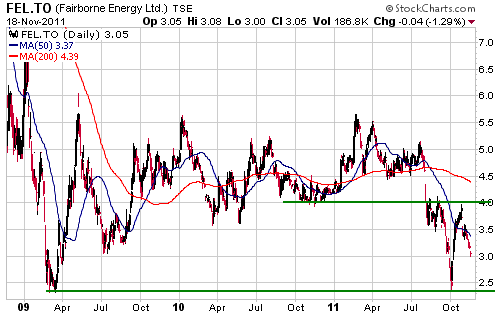
Chart Sources
Charts appearing in today's commentary
are courtesy of:
http://stockcharts.com/index.html

|









