--
Weekly Market Update for the Week Commencing
21st November 2016
Big Picture
View
Here is a summary of our big picture
view of the markets. Note that our short-term views may differ from our
big picture view.
The BULL market in US Treasury Bonds
that began in the early 1980s ended in early-2015, but there will be many years
of topping action in bond prices and bottoming action in bond yields before
major new trends get underway. (Last update: 29 June 2015)
The stock market, as represented by the S&P500 Index,
commenced
a secular BEAR market during the first quarter of 2000, where "secular
bear market" is defined as a long-term downward trend in valuations
(P/E ratios, etc.) and gold-denominated prices. This secular trend will bottom sometime between 2018 and 2020.
(Last update: 29 June 2015)
A secular BEAR market in the
US
Dollar
began during the final quarter of 2000 and ended in July of 2008. This
secular bear market will be followed by a multi-year period of range
trading.
(Last
update: 09 February 2009)
Gold commenced a
secular bull market relative to all fiat currencies, the CRB Index,
bonds and most stock market indices during 1999-2001.
This secular trend will peak sometime between 2018 and 2020.
(Last update: 29 June 2015)
Commodities,
as represented by the CRB Index, commenced a
secular BULL market in 2001 in nominal dollar terms. The first major
upward leg in this bull market ended during the first half of 2008, but
a long-term peak won't occur until 2018-2020.
(Last
update: 29 June 2015)
Copyright
Reminder
The commentaries that appear at TSI
may not be distributed, in full or in part, without our written permission.
In particular, please note that the posting of extracts from TSI commentaries
at other web sites or providing links to TSI commentaries at other web
sites (for example, at discussion boards) without our written permission
is prohibited.
We reserve the right to immediately
terminate the subscription of any TSI subscriber who distributes the TSI
commentaries without our written permission.
Outlook Summary
Market
|
Short-Term
(1-3 month)
|
Intermediate-Term
(6-18 month)
|
Long-Term
(2-5 Year)
|
|
Gold
|
N/A |
Neutral
(21-Nov-16) |
Bullish
|
|
US$ (Dollar Index)
|
N/A |
Neutral
(17-Aug-16) |
Neutral
(19-Sep-07) |
|
US Treasury Bonds (TLT)
|
N/A |
Neutral
(21-Nov-16)
|
Bearish |
|
Stock Market (DJW)
|
N/A |
Neutral
(14-Nov-16) |
Bearish |
|
Gold Stocks
(HUI)
|
N/A |
Neutral
(21-Nov-16) |
Bullish
|
|
Oil |
N/A |
Neutral
(26-Oct-15) |
Bullish
|
|
Industrial Metals
(GYX)
|
N/A |
Neutral
(10-Oct-16) |
Bullish |
Notes:
1. Our short-term expectations are discussed in the commentaries, but except in
special circumstances we won't attempt to assign a "bullish", "bearish" or
"neutral" label to these expectations.
2. The date shown below the current outlook is when the most recent outlook change occurred.
3. "Neutral" means that we think risk and reward are roughly in balance with respect to the timeframe in question.
4. Long-term views are determined almost completely by fundamentals and intermediate-term views
are determined by a combination of fundamentals, sentiment and technicals.
Last week's posts at the TSI Blog
Gold and the Real Interest Rate
Summary of current
thinking/positioning
1) Thinking that new rebounds
for gold and the associated mining indices will soon begin, but continuing
to expect that the overall corrections will extend into Q1-2017.
2)
Expecting that 2017-2018 will be a very bullish period for commodities.
Gradually building up long-term exposure to non-gold commodities while
acknowledging that the early-2016 lows could be tested prior to the start
of the aforementioned bullish period. Looking for opportunities to
establish hedges due to concern about short-term downside risk.
3)
Thinking that government bonds have commenced a long-term bear market, but
that the US Treasury Bond is close to a short-term price bottom.
4)
Positioned for short-term downside in the US stock market via QID
(leveraged NDX bear fund) call options expiring in January, but this
speculation is currently not working.
5) Thinking that the Dollar
Index is close to a 1-2 month top, but that it will move to new multi-year
highs during the first quarter of 2017 and won't reach a major top before
the second quarter of 2017.
6) Maintaining a large cash reserve in
recognition of the downside risk in almost all equities (current cash
percentage is 40%-45%).
The Extremes
A remarkable number of market
prices and indexes reached some type of extreme over the past two weeks.
Perhaps this is what we should expect as the financial/monetary system
becomes increasingly unstable due to the increasingly-aggressive
interventions of central banks. Anyhow, here are some of the recent
extremes:
1) The Copper Market
During the week before last
the copper price completed an extraordinary run of 14 consecutive up-days,
culminating in the daily RSI (a short-term momentum indicator) hitting its
highest level in more than 20 years. Also, the speculative net-long
position in Comex copper futures hit a 12-year high.
2) The
Treasury Market
The daily RSI for the 20+ Year Treasury Fund (TLT)
hit a 9-year low and the daily RSI for the 10-year T-Note yield hit a
9-year high.
3) The NASDAQ
The daily number of NASDAQ stocks
making new 52-week highs was greater than at any time since early-2004.
4) The relative strength of the banking sector
Both the daily
and the weekly RSI for the BKX/SPX ratio hit 20-year highs, as 'investors'
firstly bid up bank stocks on the belief that bank profit margins will
widen in response to rising interest rates and then bid them up some more
on the belief that Trump will repeal "Dodd-Frank".
5) The
Transportation Sector
The daily RSI for the Dow Transportation
Average hit a 20-year high.
6) The Coal Sector
The weekly
RSI for the VanEck Vectors Coal ETF (KOL) reached by far the highest level
in the fund's 8-year history. Note that almost all of the gain happened
prior to Trump's election.
7) The Currency Market
First,
the Mexican Peso made an all-time low relative to the US$. Second, the
Dollar Index has just risen for a very rare 10 trading days in a row (and
counting).
The Long Term
Dollar Bear
The US dollar's multi-decade
downward trend relative to the Swiss Franc (SF) and the euro is a topic
we've been covering 'forever' and last re-visited in the 6th June Weekly
Update. Considering the recent price action, this is a good time for an
update.
Just to recap, relative to the SF (and more recently the
euro) the dollar has made a succession of lower highs and lower lows since
1970. However, there has never been a runaway bull or bear market. Rather,
steady declines lasting 8-10 years have been punctuated by steady advances
lasting 6 years.
Here's the updated chart showing the long-term
decline described above. Note that the chart shows the US dollar's
performance relative to the SF prior to February-2005 and relative to the
euro from February-2005 onwards. Also note that we've drawn a vertical
line in 2011 to mark the end of the dollar's most recent down-cycle, even
though the US$ bottomed against the euro during the first half of 2008.
This was done because the US$ bottomed relative to both gold and the SF
during the third quarter of 2011.
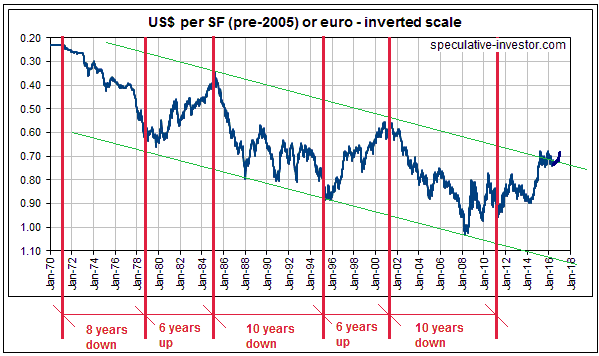
When viewed on such a broad timescale the dollar's cyclical
performance looks straightforward and predictable, but in real time it can
be difficult to figure out the current position in the cycle. For example,
if we measure from the early-2008 low then the dollar's latest 6-year
up-cycle should have ended by mid-2014. Instead, mid-2014 was the start of
a rapid 9-month advance. This is another reason that it makes sense to
consider Q3-2011 to be the starting point of the latest up-cycle.
In our most recent previous update on this long-term cycle (in June of
this year), we wrote:
"Price (position relative to the
long-term channel) and sentiment point to the dollar's latest up-cycle
having ended in March-2015, but based on time the up-cycle could extend
well into next year [2017]. A break above or below the relatively narrow
range of the past 15 months (92.5 to 101) will indicate whether we are
dealing with a continuing up-cycle with as much as a year to go or a new
down-cycle that will probably extend well into the next decade."
The subsequent price action strongly suggests that we are dealing with
a continuing up-cycle. If so, then May-August of 2017 is a reasonable
guess as to the timing of the next long-term US$ peak. The reason is that
July-August of 2011 appears to have marked the beginning of the current
6-year up-cycle and the month of May marked important turning points in
2014 and 2016.
The T-Bond's
intermediate-term risk/reward is no longer bearish
There's a decent chance that the
secular bull market in US government bonds is over. Furthermore, even if
the secular upward trend in T-Bond prices and the associated secular
downward trend in interest rates are not over, there's a good chance that
the T-Bond price will decisively breach its 2016 low before bottoming some
time during 2017. However, it is time to temporarily step away from our
bearish intermediate-term outlook for the T-Bond.
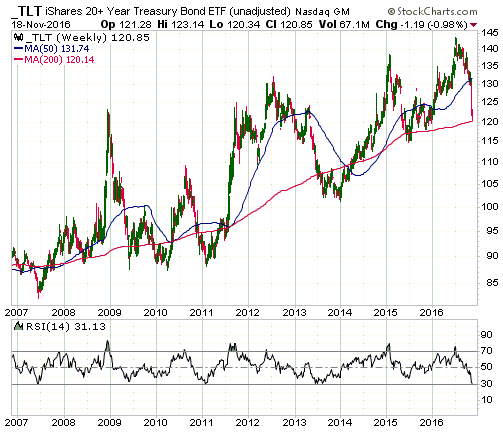
The reason is the
extent to which the price has fallen over the past few months and
especially over the past two weeks. As illustrated by the following weekly
chart, the 20+ Year Treasury ETF (TLT) has reached its 200-week MA (the
red line on our chart) and has registered a weekly RSI (shown at the
bottom of the chart) that's equivalent to the lows of the past 10 years.
There is a risk that the short-term decline will extend to important
lateral support defined by last year's low (115), but even if the
intermediate-term downward trend is set to continue there is a good chance
of a rebound to the 50-week MA (the blue line on our chart) within the
coming two months.
The differences between 1981 and now
Parallels have been drawn in some
quarters between the upcoming start of the Trump presidency and the start
of Reagan's first presidential term in 1981. However, the economic and
financial-market backdrops could hardly be more different, so a very
different outcome is all but guaranteed.
Here is a good summary of
the differences written by fund manager Kevin Duffy of Bearing Asset
Management:
"Reagan inherited a 14 year bear market in stocks
and 34 year bear market in bonds. Government debt/GDP had continually
fallen since WWII. The baby boomers were moving into their productive
years. The IBM PC was just launched. The Soviet empire was on the verge of
collapsing. Trump is inheriting asset bubbles in stocks, bonds, and
commercial real estate. Total debt/GDP is at record highs, rates at
all-time lows (with much of the world's sovereign debt actually dipping
into negative yields not long ago). Boomers are just moving into
retirement which will swamp an entitlement system that was never reined
in. Bonds are probably on the verge of a multi-decade bear market. The
government's interest costs will explode as the political class structured
its debt on the short end of the curve, assuming rates would stay low
forever. Why anyone in his right mind would want to put his name on this
Hindenburg is beyond me. But, heck, the Trump brand has been immune to
economic forces in the past, so why not?"
The Stock Market
A Fourth Reason
Last week we listed three reasons that, despite the high average
valuation and the absence of earnings growth, there could be a 6-12 month
extension of the US stock market's long-term upward trend. There is also a
fourth reason, which is the performance of stock markets in other parts of
the world.
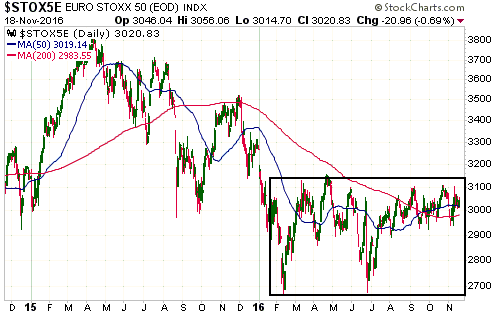
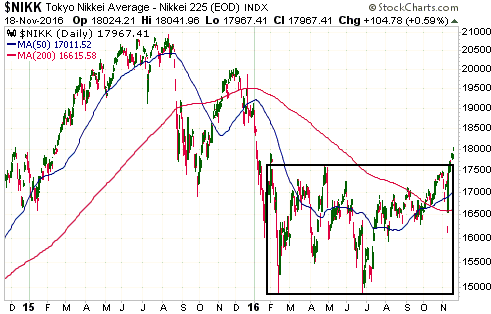
A few times over the past 6 months we wrote that the
best thing going for the US stock market was that while the senior US
stock indices appeared to be stretched to the upside and tracing out major
topping patterns, important stock indices in other parts of the world
offered reasonable value and appeared to be tracing out major basing
patterns. The best examples are the EURO STOXX 50 Index (STOX5E) and
Japan's Nikkei225 Index, charts of which are displayed below. Both of
these indices appear to have completed double bottoms during the first
half of this year.
The US stock market could be supported over the coming 12 months by a
more bullish global trend for equities. This could help the US stock
market make new highs in nominal dollar terms while being weak relative to
other stock markets.
Current Market Situation
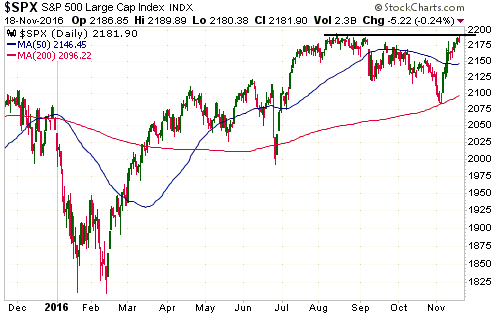
The S&P500 Index (SPX) tested its August-2016 high (and all-time high)
late last week. It is not yet 'overbought' on a short-term basis and is
therefore in a good position to break out to the upside.
The NASDAQ100 Index (NDX), however, is in a very different position.
It continues to trace out a pattern that has the look of an important top.
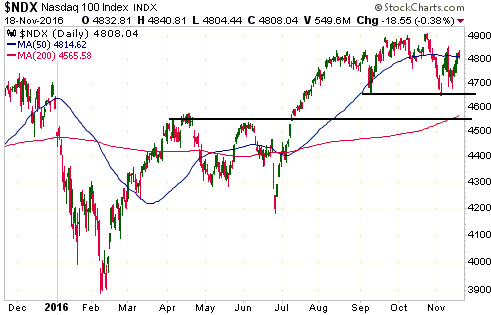
The SPX and the NDX will soon have to move into line with each other,
via either a downward reversal in the SPX or the NDX strengthening enough
to invalidate the 'topping pattern' interpretation of its chart. We are
positioned for the former outcome, although we don't have a strong opinion
on which way this will go.
This week's
significant US economic events
[Notes:
1) The most important events
(to the markets) are shown
in bold. 2) A list of global economic events can be found
HERE]
| Date |
Description |
|
Monday November 21 |
No important events scheduled |
| Tuesday
November 22 |
Existing Home Sales |
|
Wednesday November 23 |
Durable Goods Orders
New
Home Sales
Consumer Sentiment |
|
Thursday November 24 |
US markets closed |
|
Friday November 25 |
No important events scheduled |
Gold and the Dollar
Gold
The Fundamentals
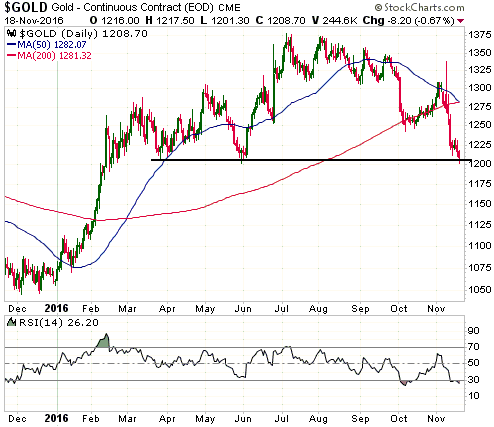
Our expectation since
early-October has been that the US$ gold price would spend most of its time
until year-end in the $1250-$1300 range, with moves outside this range being
short-lived and there being a realistic chance that support in the low-$1200s
would be tested. Prior to the past 1.5 weeks this expectation probably looked
too pessimistic to many of our readers, but it is now starting to look too
optimistic.
It is not looking too optimistic simply because the gold
price has dropped to support in the low-$1200s and has not immediately bounced,
but also because the fundamental backdrop is now as gold-bearish as it has been
in years. Specifically, with last week's upside breakout in the Dollar Index we
now have four of gold's six true fundamental price drivers in bearish territory,
one (the general trend for commodity prices) in neutral territory and only one
(the yield curve) in bullish territory.
As previously noted, for
practical purposes a chart of the bond/dollar ratio (the T-Bond price divided by
the Dollar Index) is a reasonable way to quickly see whether the fundamental
backdrop is becoming more or less bullish for gold. As illustrated below, the
bond/dollar ratio collapsed over the past two weeks and is now below its 2015
low.
It is not appropriate for us to be intermediate-term bullish on gold
under these circumstances.
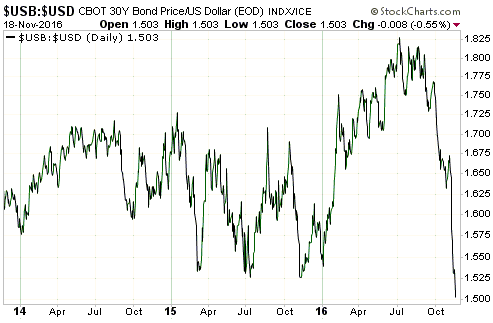
The good news for gold 'longs' is that both the T-Bond and the Dollar Index
are very extended -- to the downside for the T-Bond and to the upside for the
Dollar Index -- on a short-term basis, which makes it likely that the
bond/dollar ratio will soon begin to rebound. Also and as mentioned earlier in
today's report, the relative strength of the banking sector (another of gold's
true fundamentals) is stretched to an extreme, which means that it is acutely
vulnerable to a multi-week corrective move -- in a direction that would be
helpful to gold -- even if it is destined to move higher within the coming
several months. This should enable the gold price to rebound, but it will be
very interesting to see if such a rebound begins before or after a weekly close
below $1200/oz.
Before leaving the fundamental influences on the gold
market we wanted to point out that the December meeting of the Fed probably
won't be important. Almost everyone knows that the Fed is going to implement its
second 0.25% rate hike at this meeting, so a rate hike is fully in the market.
If gold is still in a short-term decline when mid-December rolls around then the
December Fed meeting could coincide with an upward price reversal as it did last
year, but we think there's a better chance of the short-term reversal occurring
this month.
The Price Action and Sentiment
In last week's Interim Update we wrote that the rebound following gold's
test of support in the low-$1200s had been weak to date, so we wouldn't be
surprised if there were additional tests over the days ahead. We also wrote that
an intra-day spike below support wouldn't be a problem, but that a weekly close
below $1200 would be a problem for the intermediate-term bullish case.
Additional doubt has since been cast upon the intermediate-term bullish case by
moves in currencies and interest rates, but despite an obvious upside breakout
by the Dollar Index the US$ gold price has managed to hold above trend-defining
lateral support in the low-$1200s. Also, there was a minor bullish
non-confirmation on Friday due to the gold price making a new multi-month low
while the HUI held above its 14th November low.
The latest COT report (a sentiment indicator) revealed that there was a sizable
post-election decline in the total speculative net-long position in Comex gold
futures, although the decline wasn't as big as it could have been given the
price action. We wouldn't have been surprised if the total speculative net-long
position had dropped to 150K contracts or less, but as at Tuesday 15th November
it was 200K contracts.
This means that gold's COT situation has not
significantly changed. It stopped being a threat a few weeks ago, but it hasn't
yet become supportive.
Considering the extent to which the gold market is
now short-term 'oversold' and the likelihood that some important influences have
moved as far as they are going to move in a gold-bearish direction in the
short-term, we suspect that this month's low will be followed by a rebound into
year-end.
We don't have an opinion on whether this month's low is already
in place. It might have been put in place last Friday. Alternatively, there
could be a spike below $1200 prior to a turnaround.
Silver
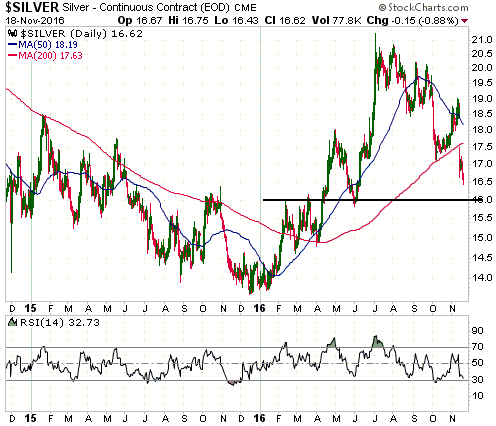
Over the past few months we've had $16.00 in mind as a likely level for a
correction low in the silver price. The silver price came within 43c of this
targeted level on Friday.
We won't be surprised if the silver price
spikes down to $16.00 this week, but a bottom that holds for at least two months
is probably not far away. As is the case with gold, however, silver's final
price low -- which could turn out to be a test of the November-2016 low -- will
probably not occur until the first few months of next year.
Gold Stocks
Current Market
Situation
As mentioned above, there was a bullish non-confirmation
last week with the HUI failing to confirm Friday's drop to new lows in the
bullion market. Actually, although a lower low in the gold price alongside a
higher low in the gold-mining sector is generally viewed as a bullish
non-confirmation, ANY non-confirmation or divergence following a substantial
downward move can be bullish. For example, a huge rally began in January shortly
after the HUI made a new bear-market low and the gold price made a higher low.
Whether or not last week's non-confirmation signaled an imminent turn to the
upside is unknowable at this time.
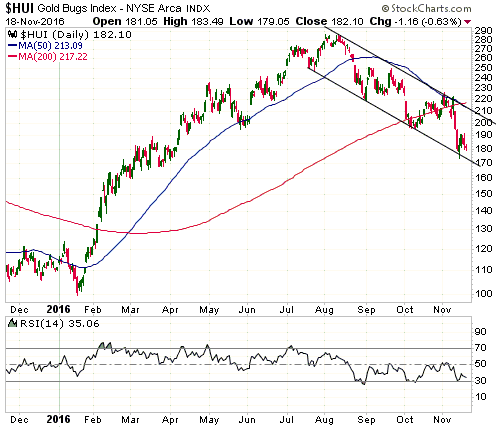
If
a turn to the upside doesn't happen immediately it will probably do so before
the end of November. This is not only because the gold-mining indices are
'oversold', but also because the short-term blow-off moves in T-Bonds and the
US$ (the source of the current downward pressure on gold-related investments)
will soon exhaust themselves.
The rebound that follows the coming
short-term reversal could last a few weeks and could be strong enough to create
the impression that a new intermediate-term upward trend has begun, but the
price action of the past two weeks has increased our conviction that the overall
correction/decline won't end before the first quarter of next year.
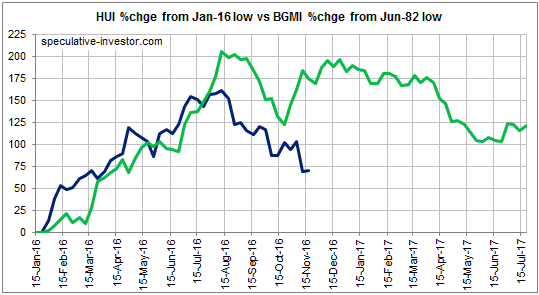
By
the way, the price action of the past two weeks has caused the HUI to deviate in
a big way from the 1982-1983 model we've been tracking. The updated chart is
shown below. Although the HUI has deviated by falling sharply, this could be
viewed as a longer-term positive development in that the 1982-1983 rally was the
bear-market variety.
What to do?
Last week we wrote that
the best approach for most people and the approach that we were using was to
slowly/methodically add to gold-stock exposure on price weakness. There was
plenty of price weakness in high-quality gold-mining stocks over the past
fortnight and we grabbed the chance to make a few buys, but due to the
deteriorating fundamental backdrop for gold we probably won't do any additional
buying within this sector unless a spectacular opportunity presents itself. We
will also be quicker than usual to take profits during rebounds over the coming
two months.
The Currency Market
The Dollar Index
has broken above the top of its 20-month horizontal range, but after rising for
10 days in a row it is extended on a short-term basis and probably close to a
peak that will hold for at least a few weeks.
The US$/euro exchange rate
makes up almost 60% of the Dollar Index. It's therefore interesting that even
though the Dollar Index has broken above the top of its 20-month range, the euro
hasn't yet broken below the bottom of a similar range. Refer to the following
daily chart for details. A sustained downside breakout by the euro is now a high
probability, but it might not happen until next year.
We expect that the
euro will rebound for at least a few weeks from whatever low is put in place
this month.

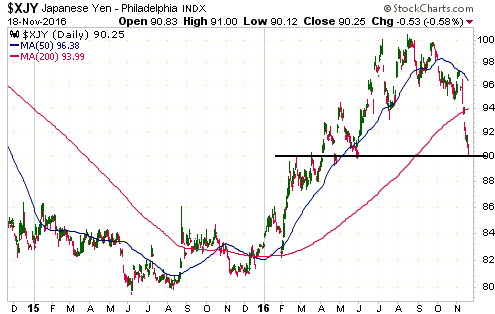
Our
expectation over the past few months has been that the Yen would decline to
89-90 before resuming its long-term advance. The Yen traded as low as 90.1 on
Friday and is probably now very close to an intermediate-term bottom in terms of
both price and time.
Note that since the Dollar Index's performance is
mostly determined by the euro, the Yen will be capable of exceeding its 2016
peak during the first half of 2017 even if the Dollar Index maintains its upward
trend.
Updates
on Stock Selections
Notes: 1) To review the complete list of current TSI stock selections, logon at
http://www.speculative-investor.com/new/market_logon.asp
and then click on "Stock Selections" in the menu. When at the Stock
Selections page, click on a stock's symbol to bring-up an archive of
our comments on the stock in question. 2) The Small Stock Watch List is
located at http://www.speculative-investor.com/new/smallstockwatch.html
 Company
news/developments for the week ending Friday 18th November 2016:
Company
news/developments for the week ending Friday 18th November 2016:
[Note: AISC = All-In Sustaining Cost, FS = Feasibility Study, FY = Financial
Year, IRR = Internal Rate of Return, ISR = In-Situ Recovery, MD&A = Management
Discussion and Analysis, M&I = Measured and Indicated, NAV = Net Asset Value,
NPV(X%) = Net Present Value using a discount rate of X%, P&P = Proven and
Probable, PEA = Preliminary Economic Assessment, PFS = Pre-Feasibility Study]
*Alkane Resources (ALK.AX) had its annual general
meetings of shareholders last week. The
presentation
delivered at the meetings provides a very good overview of the company's
progress and potential. It is mandatory reading for anyone who owns or is
interested in owning ALK shares.
Although it has a significant
gold-production business, the main reason to own ALK is the development-stage
Dubbo Zirconia Project (DZP). A Feasibility-level study completed last year
estimated that the DZP could be developed into a mining operation with a net
present value (NPV), using an 8% discount rate, of US$1.1B (A$1.45B). This
equates to A$2.90 per ALK share, or about 5-times the current stock price.
Furthermore, an updated engineering/economic analysis using a modular
construction process is scheduled to be completed during the first quarter of
2017 and will probably reveal a higher NPV.
The biggest unknowns/risks
are the future prices of the specialty metals that the DZP will produce and the
details of the construction financing. With regard to the latter, if the modular
construction concept is shown to be attractive then ALK will have to raise about
US$500M next year in order to bring the project's first phase into production in
2019.
*Euro Sun Mining (ESM.TO) issued its
quarterly report for the September quarter. The report showed that the company
had working capital of US$6.7M (C$8.9M) at 30th September, which should mean
that ESM is fully funded for at least the next 6 months.
The next
significant news for ESM is likely to be the ratification of its mining licence
by the Romanian government. We expect this to happen early next year. Also, work
on a Feasibility Study for the Rovina Valley gold-copper project is expected to
begin early next year.
*Premier Gold (PG.TO)
issued its quarterly report for the September quarter.
The company's
balance sheet underwent a dramatic change during the quarter, with working
capital rising from C$42M to C$85M, long-term debt rising from C$9M to C$103M,
net debt (long-term debt minus working capital) rising by C$51M and non-current
assets rising by C$155M. The change was primarily due to the purchase of the
Mercedes gold mine (Mexico) for US$123M of cash (funded by a loan and a gold
stream) and US$20M of equity.
The balance sheet is likely to undergo
another big change during the December quarter due to the completion of PG's
transformation from an explorer to a gold producer with two operating mines.
Production is expected to be 70K-80K ounces of gold during the quarter, which
should enable the company to add a lot of cash and/or gold inventory to its
Current Assets.
Of even greater importance, the results of the FS for the
Hardrock (Trans-Canada) project in Ontario were published last week. This
project is a 50/50 JV between PG and Centerra Gold.
Our initial comments
on the FS results were included in last week's Interim Update. We summed them up
with the word "lacklustre", because they showed that the economics are not good
enough near the current gold price to warrant moving the project into the
construction phase. It is worth pointing out, however, that the project is
sufficiently close to the money and 'permittable' to suggest that it will
eventually be developed into an operating mine. This puts the Hardrock project
well ahead of many other undeveloped North American mining projects, including
International Tower Hill's Livengood gold project and Northern Dynasty's Pebble
copper-gold project. The probability that either of these projects ever gets
developed into an operating mine is approximately zero.
The Hardrock FS
is based on an open-pit gold mine that produces an average of 288K ounces/year
over about 14 years. The estimated AISC is only US$600/oz, which means that the
mine would be very profitable at the current gold price if it were in operation
today. The problem is that the estimated initial capital cost is almost US$1B
(US$962M, to be exact). It's the initial capital cost that weighs down the
economics.
At a gold price of US$1250/oz and a USD/CAD exchange rate of
1.3 (implying a local-currency-denominated gold price of C$1625/oz, which is
close to the current price), the project's after-tax NPV(5%) and IRR are
estimated to C$709M and 14.4%, resp. A 14.4% IRR is not bad, but given the risks
involved it is not high enough to justify mine development. At a 15% higher
C$-denominated gold price the IRR rises to about 20%, which would almost
certainly make the project viable. In other words, we think that the project is
currently about 15% out of the money.
Also worth noting is that although
the project is a 50/50 JV, PG's 50% stake is worth more than 50% of the total
NPV. This is because of PG's tax credits and the greater spending obligations of
PG's partner. According to a separate press release, PG's 50% share of the
project has an after-tax NPV(5%) of C$414M and an after-tax IRR of 17.5%.
Based on the above, at the project's current stage of development we think
it's fair to assign a value of about C$200M (a 50% discount to the NPV) to PG's
stake in the Hardrock project. The company has 201M shares, so this equates to
C$1.00/share.
After taking into account the effects on PG's two
gold-producing assets of the recent decline in the gold price and assigning a
value of C$50M to the company's portfolio of exploration-stage assets, we
roughly estimate that at the current gold price PG is worth C$4.00/share.
*UEX Corp. (UEX.TO) published its quarterly report
for the September quarter. The report shows that the company had about C$7M of
working capital at 30th September, which is down from about C$9M at the end of
the preceding quarter. This should be enough to fund the company's uranium
exploration business until mid-2017, but it's reasonable to expect that the next
equity financing will happen during the first few months of 2017.
List
of candidates for new buying
From within the ranks of TSI stock
selections the best candidates for new buying at this time, listed in
alphabetical order, are:
1) AAU (last Friday's closing price: US$1.07)
2) BLK.AX (last Friday's closing price: A$0.54)
3) EVN.AX (last
Friday's closing price: A$1.96)
4) PG.TO (last Friday's closing price:
C$2.28)
Note that the above list is limited to five stocks. It will
sometimes contain less than five, but it will never contain more than five
regardless of how many stocks are attractively priced for new buying.
Chart Sources
Charts appearing in today's commentary
are courtesy of:
http://stockcharts.com/index.html