|
-- Weekly Market Update for the Week Commencing 21st December 2009
Big Picture
View
Here is a summary of our big picture
view of the markets. Note that our short-term views may differ from our
big picture view.
In nominal dollar terms, the BULL market in US Treasury Bonds
that began in the early 1980s will end by mid-2010. In real (gold)
terms, bonds commenced a secular BEAR market in 2001 that will continue
until 2014-2020. (Last
update: 09 February 2009)
The stock market, as represented by the S&P500 Index, commenced
a secular BEAR market during the first quarter of 2000, where "secular
bear market" is defined as a long-term downward trend in valuations
(P/E ratios, etc.) and gold-denominated prices. This secular trend will bottom sometime between 2014 and 2020. (Last update: 22 October 2007)
A secular BEAR market in the Dollar
began during the final quarter of 2000 and ended in July of 2008. This
secular bear market will be followed by a multi-year period of range
trading. (Last
update: 09 February 2009)
Gold commenced a
secular bull market relative to all fiat currencies, the CRB Index,
bonds and most stock market indices during 1999-2001. This secular trend will peak sometime between 2014 and 2020. (Last update: 22 October 2007)
Commodities,
as represented by the Continuous Commodity Index (CCI), commenced a
secular BULL market in 2001 in nominal dollar terms. The first major
upward leg in this bull market ended during the first half of 2008, but
a long-term peak won't occur until 2014-2020. In real (gold) terms,
commodities commenced a secular BEAR market in 2001 that will continue
until 2014-2020. (Last
update: 09 February 2009)
Copyright
Reminder
The commentaries that appear at TSI
may not be distributed, in full or in part, without our written permission.
In particular, please note that the posting of extracts from TSI commentaries
at other web sites or providing links to TSI commentaries at other web
sites (for example, at discussion boards) without our written permission
is prohibited.
We reserve the right to immediately
terminate the subscription of any TSI subscriber who distributes the TSI
commentaries without our written permission.
Outlook Summary
Market
|
Short-Term
(0-3 month)
|
Intermediate-Term
(3-12 month)
|
Long-Term
(1-5 Year)
|
Gold
|
Neutral
(07-Dec-09)
|
Bullish
(12-May-08)
|
Bullish
|
US$ (Dollar Index)
|
Bullish
(23-Nov-09)
| Bullish
(02-Nov-09)
|
Neutral
(19-Sep-07)
|
Bonds (US T-Bond)
|
Neutral
(30-Nov-09)
|
Bearish
(14-Dec-09)
|
Bearish
|
Stock Market (S&P500)
|
Neutral
(07-Dec-09)
|
Bearish
(11-May-09)
|
Bearish
|
Gold Stocks (HUI)
|
Neutral
(09-Nov-09)
|
Neutral
(16-Sep-09)
|
Bullish
|
| Oil | Neutral
(28-Oct-09)
| Neutral
(14-Oct-09)
| Bullish
|
Industrial Metals (GYX)
| Bearish
(21-Sep-09)
| Bearish
(25-May-09)
| Bullish
|
Notes:
1. In those cases where we have been able to identify the commentary in
which the most recent outlook change occurred we've put the date of the
commentary below the current outlook.
2. "Neutral", in the above table, means that we either don't have a
firm opinion or that we think risk and reward are roughly in balance with respect to the timeframe in question.
3. Long-term views are determined almost completely by fundamentals,
intermediate-term views by giving an approximately equal weighting to
fundmental and technical factors, and short-term views almost
completely by technicals.
Vacation Reminder
Just a reminder that we will
be on vacation as of Tuesday 22nd December and that the next TSI
commentary will be the Interim Update scheduled for Thursday 7th
January 2010.
Very best wishes for a joyful Holiday Season and a happy and profitable 2010!
Money Supply Distortions
Popular
money-supply measures such as M2, M3, and MZM have components that are
not actually money. As a result, they are not reliable indicators of
monetary inflation. M1, on the other hand, fails to include significant
components of the economy's money supply, rendering it all but useless
as an indicator of monetary inflation. Our preferred indicator of
monetary inflation is the aggregate known as "True Money Supply" (TMS).
TMS was developed by two well-known "Austrian" economists (Murray
Rothbard and Joseph Salerno), but it should be noted that other
economists of the Austrian School (Frank Shostak, for example) prefer
an aggregate known as "Austrian Money Supply" (AMS). The difference
between AMS and TMS is that TMS includes savings deposits whereas AMS
does not.
Apart from a few minor divergences, over the past 25 years the
year-over-year percentage changes in TMS and AMS have been in synch
with each other. This means that over the past 25 years it hasn't
really mattered, from a practical standpoint, whether an analyst used
TMS or AMS to determine what was happening on the monetary inflation
front. However, users of AMS and TMS are presently arriving at very
different assessments of the monetary inflation backdrop. These
differences are partly due to the differing treatments of savings
deposits (as mentioned above), but mainly due to the treatment of the
US Treasury's Supplementary Financing Program (SFP). As explained at http://www.newyorkfed.org/markets/statement_091708.html, the SFP was introduced as a reserve management tool in September of 2008.
Between mid September and mid November of 2008 the US Treasury put more
than US$500B into the SFP account at the Fed. The program has since
been unwound to the extent that there is now only $15B remaining,
meaning that today's calculation of the total money supply will be
roughly the same regardless of whether or not the SFP is counted as
money. The issue is that the decision to include, or not to include,
the SFP will dramatically affect the year-over-year numbers. For
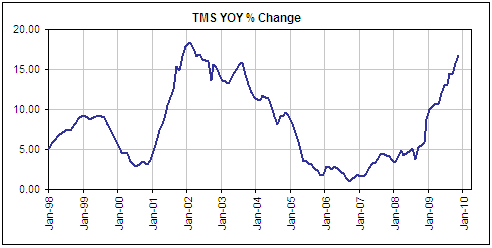
example, our chart (see below) of TMS's year-over-year percentage
change shows that a new multi-year high of more than 16% was reached
last month, but if we had counted the SFP as 'money' then our chart
would show much faster money-supply growth during Q4-2008 and a decline
to a growth rate of around 8% as of November 2009. Moreover, because
AMS is a subset of TMS, the effect of counting or not counting the SFP
as 'money' has an even greater effect on AMS's year-over-year
comparisons than it does on TMS's. Of particular note, analysts who use
AMS as their preferred money-supply measure AND who count the SFP as
money will determine that there was a veritable moon-shot in
money-supply growth during the final quarter of 2008, followed by a
plunge that has just taken the year-over-year growth rate to a
double-digit NEGATIVE number. These analysts will therefore perceive
monetary DEFLATION at this time!
An understanding of the above is important because for the next several
months there will be large differences in the way the monetary
inflation backdrop is portrayed, even within the 'Austrian camp'. One
of the main reasons for these differences will be the distortions
introduced by the SFP.
Base Metals
We greatly
under-estimated this year's upside potential in the prices of the base
metals (copper, nickel, zinc, lead). We thought they would rebound
strongly in parallel with the stock market's post-crash rebound and an
economic 'false dawn', but the rebounds have gone much farther than
expected in terms of both price and time.
We are at a loss to explain the unexpectedly bullish price action,
because the commercial supply/demand situation appears to be downright
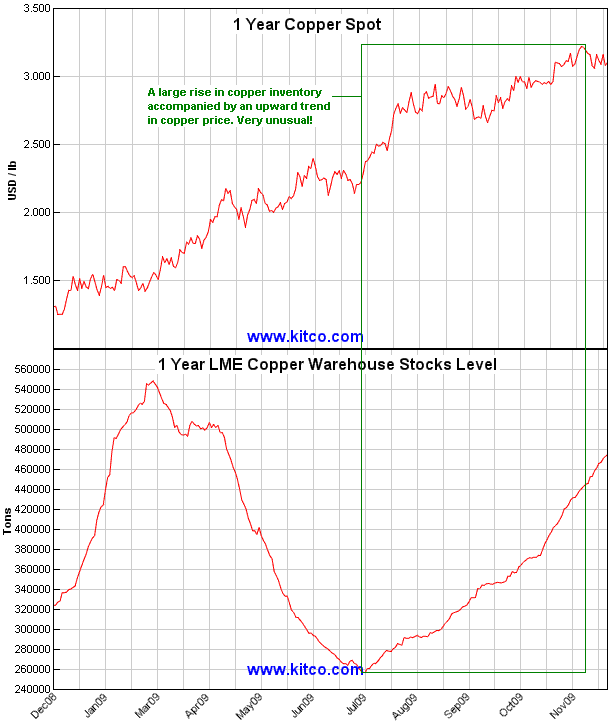
BEARISH. The following chart, for example, shows that the copper price
has maintained its upward trend since July in parallel with a huge rise
in the LME copper inventory (the top section of the chart shows the
price in US$/pound and the bottom section shows the LME inventory in
tons). Also of note is that the Shanghai copper inventory is near a
5-year high. In other words, the copper price has rallied over the past
6 months even though production has clearly been rising -- and rising
strongly -- relative to consumption. It's a similar story across the
base-metal spectrum.
Speculators have obviously been accumulating positions in the base
metals in anticipation of a lot more economic growth and/or currency
depreciation, but apart from pig and goose farmers in China
we don't know who would be dumb enough to place such a bet. We expect
that there will be a lot more currency depreciation over the years
ahead, but we question the logic of playing such an outcome via the
base metals, given that a) there is abundant supply, and b) the base
metals require both currency depreciation and robust nominal growth to
make sustainable real gains. On the other hand, it could be that we are
the 'dumb money' and that the pig-farmers-turned-copper-speculators
know what they are doing.
As mentioned in previous commentaries, we expect that the base metals
will re-visit their 2008-2009 price lows within the next couple of
years. We won't be surprised if prices hold up for a few more months,
though, because the economic rebound is probably not yet complete and
the negative seasonal period -- which, by the way, has had no effect to
date -- will soon end.
The Stock
Market
The number of consecutive
trading days that the S&P500 Index has spent within a narrow
horizontal range is now at 28 and counting. Since 9th November the
S&P500 has not closed lower than 1087 or higher than 1111. The
absence of volatility, combined with the sideways price action and low
volume, indicates a lack of enthusiasm on the parts of both the bullish
and the bearish camps.
We suspect that the breakout from the current range will point the way
for the ensuing 2-4 weeks. For example, if the S&P500 breaks out to
the upside within the next few days then it will probably rally into
the first half of January. However, the direction of the breakout
won't, by itself, tell us much about what's likely to happen beyond the
ensuing few weeks. In isolation, it won't signal the start of a major
market move.
Other indicators will give us a better idea as to whether the eventual
move out of the current narrow range has implications beyond the very
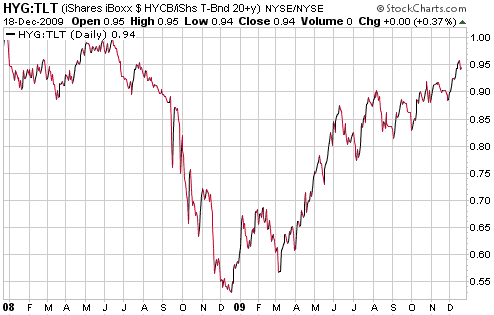
short-term. For example, credit spreads have been contracting since
late last year, and especially since March of this year, telling us
that credit-market confidence has been in an upswing. This upswing in
confidence is reflected by the upward trend in the HYG/TLT ratio, a
chart of which is presented below. A stock market decline that is not
led by or accompanied by a pronounced downward reversal in the HYG/TLT
ratio probably won't get very far.
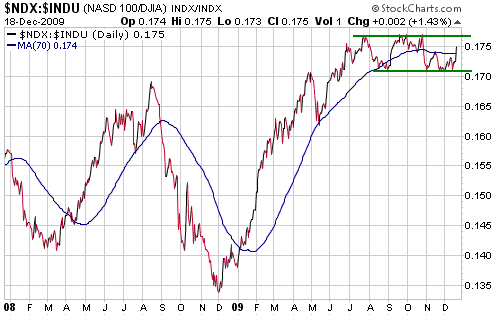
The NDX/Dow ratio is
another example of an indicator that will potentially tell us whether
something important is happening, or is about to happen, in the stock
market. As evidenced by the following chart, NDX/Dow has been
oscillating within a horizontal range since July.
We probably shouldn't get excited about any downturn in the S&P500
Index unless it is accompanied by the NDX/Dow ratio breaking to a new
multi-month low.
This week's
important US economic events
| Date |
Description |
| Monday Dec 21 | No important events scheduled
| Tuesday Dec 22
| Q3 GDP (final)
Existing Home Sales
| | Wednesday Dec 23
| Personal Income and Spending
Consumer Sentiment
New Home Sales
| | Thursday Dec 24
| Durable Goods Orders
| | Friday Dec 25
| Markets closed for Christmas
|
Gold and
the Dollar
Gold
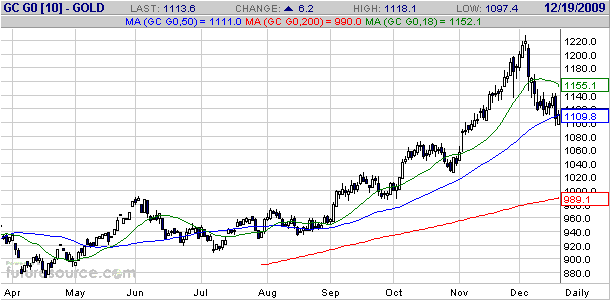
The gold price ended last week at its 50-day moving average, meaning
that it has reached what we considered to be the most likely short-term
downside objective. We won't be surprised if it turns out that last
week's brief dip below $1100 created the price low for the correction,
but significant short-term risk remains.
We would be more
confident that the correction had run its course if the decline from
the 3rd December peak had prompted a 10%-15% reduction in the
speculative net-long position in COMEX gold futures, but the latest
Commitments of Traders (COT) report showed that the speculative
net-long position had fallen by only 1% from its high.
The purpose of a downward correction in a bull market is to shake out
the 'weak hands' prior to the next advance. By the same token,
corrections usually don't end until there has been a meaningful
shakeout of the 'weak-handed longs'. The COT data therefore suggest
that gold's correction is not over.
The COT report is just one part of the sentiment picture and sentiment
is just one part of the overall picture, so it is certainly possible
that gold bottomed near its 50-day moving average last week despite the
lack of movement in the COT data. A 10%-15% contraction in the
speculative net-long position would just have improved the odds of a
sustainable price low.
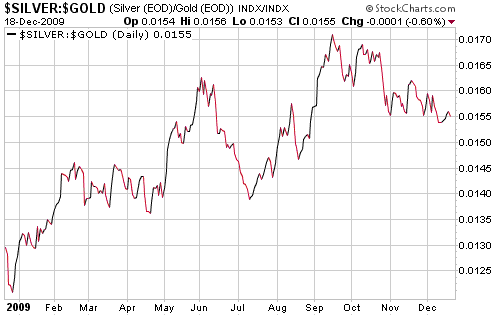
One positive development late last week was silver's ability to hold
above the low of the preceding week. Last week's resilience in the
silver market meant that gold's drop to a new correction low was not
confirmed by the silver/gold ratio. This is just a minor positive
divergence right now considering that the silver/gold ratio has been
drifting lower since mid September (refer to the following chart for
details), but it could evolve into something of importance.
If you had planned to
buy gold as a trade following a pullback to the 50-day moving average
then in our opinion you should go ahead and do so. You could then
manage risk by placing an initial stop just below last week's intra-day
low. For example, plan to exit trading positions entered near the
current price if February gold closes below $1095.
Gold Stocks
Last Thursday's plunge by the HUI to a new low for the move was a
little surprising. We expected it to make new correction lows, but not
as soon as it did.
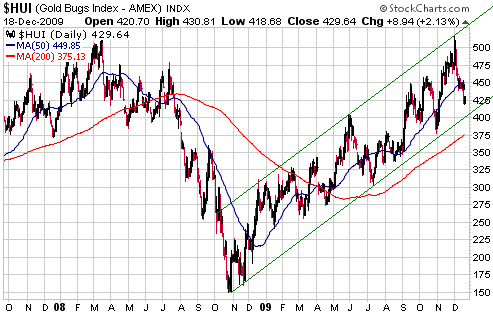
The following daily chart shows the channel that has defined the HUI's
progress since its October-2008 bottom. If the correction that began on
2nd December turns out to be the intermediate-term variety (it probably
will, but a more bullish scenario is still possible), then the channel
bottom will be breached before the correction ends. However, it should
not be breached during the first short-term decline (the current
decline). This means that as far as the next several weeks are
concerned the remaining downside risk is probably limited to about 5%.
Our short-term gold-stock outlook will automatically shift to "bullish"
if the HUI trades below 410 within the next three weeks. A drop to 410
would prompt us to exit our put-option hedges and, quite likely, do
some buying.
On an intermediate-term basis we think the remaining downside risk is
somewhere between 10% and 30%. This is based on the fact that all
intermediate-term HUI corrections during 2000-2007 resulted in
peak-to-trough declines of 25% to 40%.
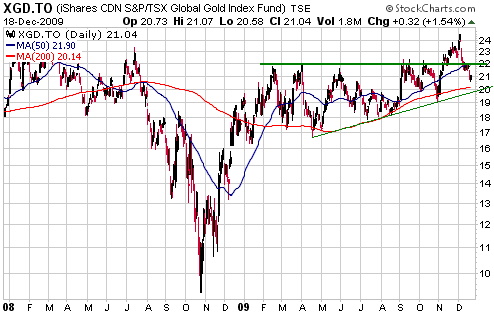
A daily chart of XGD is displayed below. XGD is a proxy for the gold sector in Canadian Dollar terms.
XGD broke out to the upside in November and quickly gained an
additional 10%, but since the beginning of this month it has given back
all of its post-breakout gains and then some. This is obviously not
bullish, but the point we wanted to make is that the XGD is now within
about 5% of an area of strong support defined by a trend-line and the
200-day moving average. With reference to the chart, notice that every
short-term correction since March has bottomed at the 200-day moving
average.
The XGD chart supports the view that the remaining near-term downside risk is about 5%.
Currency Market Update
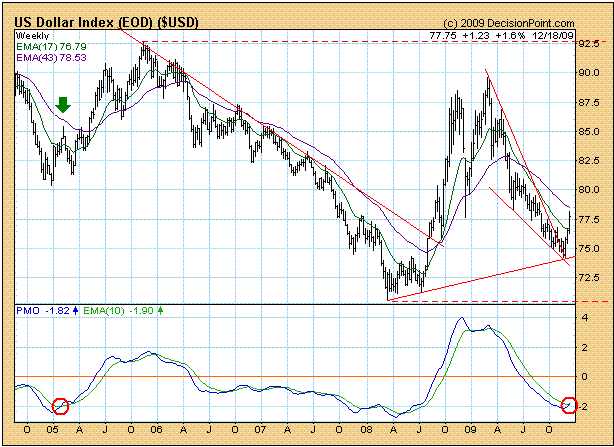
Last week's price action provided us with more evidence that an
intermediate-term bottom is in place for the Dollar Index. For example,
the following weekly DecisionPoint.com chart shows that the Dollar
Index's weekly PMO (Price Momentum Oscillator) has now confirmed the
upward reversal.
However, the dollar's INITIAL rally is probably now close to a peak.
There is considerable resistance at around 78, and the initial rally
from the low has done as much as it should do if the dollar is
following its typical bottoming pattern. As was the case during the
first quarter of 2005 and the first half of 2008, we expect that the
initial rally will be followed by a pullback to 'test' the low. We are
therefore expecting to see the Dollar Index drop back to around 75
during the first quarter of 2010 before commencing the best part of its
intermediate-term advance.
In addition to being
very 'oversold', there are fundamental reasons to anticipate
substantial strength in the US$ relative to the euro (the Dollar Index
is dominated by the USD/EUR exchange rate). For one, despite the best
efforts of the Fed (the US Fed has been doing its best to reduce the
value of the US$), the euro is at least 20% over-valued relative to the
US$ on a purchasing power basis. For another, at some point in the
not-too-distant future the European Monetary Union will have to deal
with the dire fiscal predicaments of its weakest members. This could
entail a more inflationary monetary policy or a change in the
membership.
Update
on Stock Selections
(Note: To review the complete list of current TSI stock selections, logon at http://www.speculative-investor.com/new/market_logon.asp
and then click on "Stock Selections" in the menu. When at the Stock
Selections page, click on a stock's symbol to bring-up an archive of our comments on the stock in question)
 Stops on Natgas Trades Stops on Natgas Trades
Trading positions in US Natural Gas Fund (UNG) and Fairborne Energy
(TSX: FEL) were recently added to the TSI Stocks List with initial sell
stops at US$8.45 and C$4.27, respectively.
We are switching to a 10% trailing stop for UNG, based on daily closing
prices. This means that from here on we will exit the trade if UNG
closes more than 10% below its highest daily closing price. For
example, UNG closed at US$10.62 on Friday, so our stop is now at
US$9.56 (0.9*10.62). If UNG were to close at $11.00 on Monday then our
stop would increase to $9.90.
We will leave our FEL stop at C$4.27 for now, but will switch to a 10% trailing stop after the stock closes above C$5.20.
Pediment Gold (TSX: PEZ). Shares: 47M issued, 53M fully diluted. Recent price: C$1.35
PEZ reported the initial NI 43-101 resource estimate for its La
Colorada gold project on Friday. The project has 0.6M ounces in the
M&I category and another 0.6M ounces in the Inferred category.
Across its two projects (San Antonio + La Colorada) PEZ now has a total
resource of 2.8M ounces, 2.1M of which are in the M&I category.
This means that the company is presently being valued by the stock
market at around US$21 per ounce of in-ground gold, or at only
US$15/ounce if PEZ's $16M of cash is taken into account. This
relatively low valuation creates the potential for significant
additional gains in the stock price.
As stated in the 2nd December Interim Update, we think PEZ is suitable
for new buying at around C$1.30. Some profit-taking would be
appropriate at around C$2.00.
Chart Sources
Charts appearing in today's commentary
are courtesy of:
http://stockcharts.com/index.html
http://www.futuresource.com/
http://www.decisionpoint.com/

|