|
-- Weekly Market Update for the Week Commencing 22nd August 2011
Big Picture
View
Here is a summary of our big picture
view of the markets. Note that our short-term views may differ from our
big picture view.
In nominal dollar terms, the BULL market in US Treasury Bonds
that began in the early 1980s ended in December of 2008. In real (gold)
terms, bonds commenced a secular BEAR market in 2001 that will continue
until 2014-2020. (Last
update: 4 April 2011)
The stock market, as represented by the S&P500 Index, commenced
a secular BEAR market during the first quarter of 2000, where "secular
bear market" is defined as a long-term downward trend in valuations
(P/E ratios, etc.) and gold-denominated prices. This secular trend will bottom sometime between 2014 and 2020. (Last update: 22 October 2007)
A secular BEAR market in the Dollar
began during the final quarter of 2000 and ended in July of 2008. This
secular bear market will be followed by a multi-year period of range
trading. (Last
update: 09 February 2009)
Gold commenced a
secular bull market relative to all fiat currencies, the CRB Index,
bonds and most stock market indices during 1999-2001. This secular trend will peak sometime between 2014 and 2020. (Last update: 22 October 2007)
Commodities,
as represented by the Continuous Commodity Index (CCI), commenced a
secular BULL market in 2001 in nominal dollar terms. The first major
upward leg in this bull market ended during the first half of 2008, but
a long-term peak won't occur until 2014-2020. In real (gold) terms,
commodities commenced a secular BEAR market in 2001 that will continue
until 2014-2020. (Last
update: 09 February 2009)
Copyright
Reminder
The commentaries that appear at TSI
may not be distributed, in full or in part, without our written permission.
In particular, please note that the posting of extracts from TSI commentaries
at other web sites or providing links to TSI commentaries at other web
sites (for example, at discussion boards) without our written permission
is prohibited.
We reserve the right to immediately
terminate the subscription of any TSI subscriber who distributes the TSI
commentaries without our written permission.
Outlook Summary
Market
|
Short-Term
(0-3 month)
|
Intermediate-Term
(3-12 month)
|
Long-Term
(1-5 Year)
|
| Gold
|
Neutral
(19-Apr-11) |
Neutral
(24-Jan-11)
|
Bullish
|
| US$ (Dollar Index)
|
Neutral
(10-Aug-11)
| Neutral
(10-Aug-11)
|
Neutral
(19-Sep-07)
|
| Bonds (US T-Bond)
|
Neutral
(22-Aug-11)
|
Neutral
(22-Aug-11)
|
Bearish
|
| Stock Market (S&P500)
|
Neutral
(08-Aug-11)
|
Bearish
(11-Oct-10)
|
Bearish
|
| Gold Stocks
(HUI)
|
Neutral
(13-Jul-11) |
Bullish
(23-Jun-10)
|
Bullish
|
| Oil | Neutral
(31-Jan-11) | Neutral
(31-Jan-11)
| Bullish
|
| Industrial Metals
(GYX)
| Bearish
(03-Jan-11)
| Bearish
(25-May-09)
| Neutral
(11-Jan-10)
|
Notes:
1. In those cases where we have been able to identify the commentary in
which the most recent outlook change occurred we've put the date of the
commentary below the current outlook.
2. "Neutral", in the above table, means that we either don't have a
firm opinion or that we think risk and reward are roughly in balance with respect to the timeframe in question.
3. Long-term views are determined almost completely by fundamentals,
intermediate-term views by giving an approximately equal weighting to
fundamental and technical factors, and short-term views almost
completely by technicals.
T-Bond Update
From the 15th August Weekly Update:
"When we combine the likely reduction in the perceived need for a safe haven with sentiment indicators, the T-Bond's recent near-vertical price advance and the closeness of long-term resistance defined by the December-2008 peak, we conclude that we should be short- and intermediate-term bearish on T-Bonds.
Acknowledging that our bias is to be too bearish on T-Bonds, we are going to place a 'stop' on our bearish outlook. Specifically, if the nearest T-Bond futures contract closes above its 9th August intra-day high (140 in the September futures), we will shift back to "neutral"."
With the September T-Bond futures contract having closed above 140 last Friday, we are now back to "neutral" on both a short- and intermediate-term basis. We still believe that the T-Bond is close to an important peak in terms of time, but the risk for the bears is that even a 2-3 week extension of the upside blow-off could result in meaningful additional gains.
It is possible that we will be prompted by the market action to make another quick change over the days ahead. For example, if the T-Bond were to immediately reverse downward and drop by enough to mark last week's up-side breakout as a 'fakeout', then we would most likely resume a bearish stance for the reasons outlined in our 15th August commentary.
On a related matter, we continue to avoid bearish T-Bond speculations. We will not lose any money betting against the T-Bond while it is trending upward, and we will not make any money betting against the T-Bond during the initial phase of its coming bear market. There are better uses for our trading capital.
The Stock
Market
Presidential Cycle Update
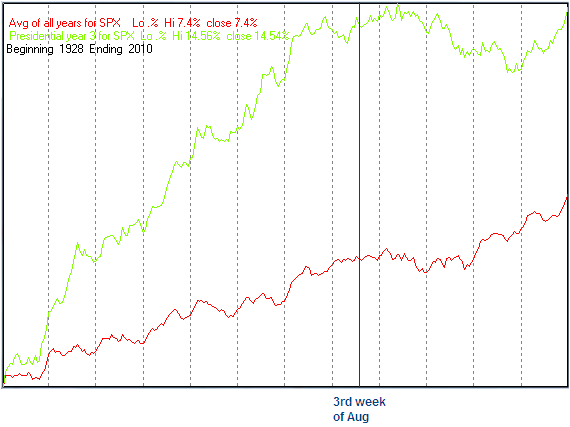
From time to time over the course of this year we've discussed how the US stock market was performing against a model based on the average performance of the S&P500 Index during the third year of the US Presidential Cycle (the "Presidential Cycle Model"). During the 3rd year of the Presidential Cycle the S&P500 has been up 89% of the time with an average gain of 14.9%. Furthermore, the S&P500 hasn't had a down year during the 3rd year of the Presidential Cycle since 1939.
At the beginning of the year we noted that the Presidential Cycle would exert a positive influence, but our view at the time was that the price-boosting efforts of the incumbents (the fundamental reason for the generally bullish third year) would probably be overwhelmed by other fundamentals.
The green line on the following chart shows the average performance of the S&P500 during the 3rd year of the Presidential Cycle. The red line shows the average of all years. We've drawn a vertical blue line to mark the current position.
Clearly, over the past 3.5 months the stock market has diverged in a big way from the Presidential Cycle Model. As things currently stand, it looks like 2011 will mark the first time since 1939 that the third year of the Cycle has been a down year.
It won't be a surprise if the Presidential Cycle Model doesn't work this time, because the fundamental basis for the Cycle no longer exists. By way of further explanation, the Cycle is based on the desire of the incumbent president to get any 'belt tightening' out of the way during the first half of his 4-year term and to then become fiscally accommodative during the second half. The goal, of course, is to have a 'vibrant' economy just prior to the election. However, this time around there was no 'belt tightening' during the first half and there appears to be no capacity to become more fiscally accommodative as the 2012 election approaches.
Current Market Situation
We said that it was reasonable to expect the senior US stock indices to test their 9th August lows, almost regardless of which intermediate-term scenario was playing out. The sharp decline that occurred over the final two trading days of last week has brought the indices back to the vicinity of the lows hit earlier this month, but we aren't sure that this is the anticipated test. The reason is that insufficient time has elapsed since the low. The test of a crash low will typically occur 4-8 weeks after the low, but the US stock market reached its intra-day low for the move only 9 trading days ago.
If the stock indices reverse upward this week from near their 9th August lows (1100 for the S&P500), it will be unclear if a test has occurred (and was successful) or is still to come. In other words, the waters will be muddied. Alternatively, if the indices plunge well below their 9th August lows over the days ahead then we will assume that we haven't yet seen the end of the market's INITIAL decline and that whatever new low is made during the second half of August will have to be tested 4-8 weeks later.
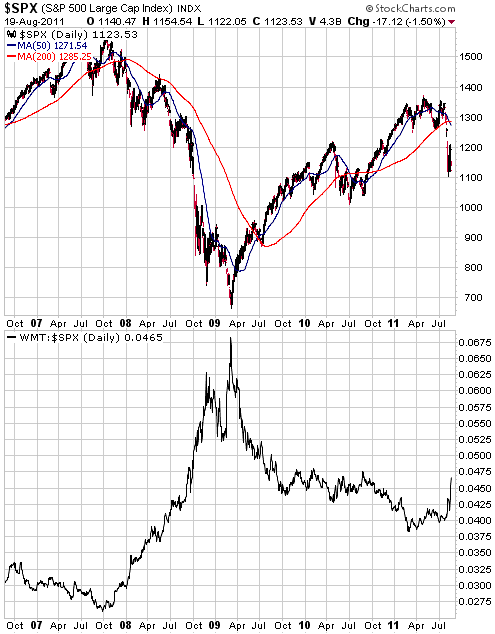
We first showed the following chart comparison at TSI about three years ago. We haven't shown it recently, because it hasn't been relevant. However, recent market action makes it relevant.
The comparison is between the S&P500 Index (SPX) and the WMT/SPX ratio (the stock price of Wal-Mart relative to the price of the average large-cap US stock). The idea behind the chart is that WMT is the type of stock to which investors gravitate when they are becoming more risk averse, so the WMT/SPX ratio should begin trending upward during the early stages of a cyclical bear market.
Notice that there has recently been a pronounced upward reversal in the WMT/SPX ratio -- the first such reversal since the March-2009 stock market bottom.
The O&G (Oil and Gas) Services Stocks
In the 4th July Weekly Update we wrote:
"Regardless of whether or not a much higher natural gas price will be needed for shale gas (and oil) production to live up to the lofty expectations that have prevailed over much of the past three years, the drilling services industry could have a bright future. The reason is that the demand for drilling services should experience strong growth over the years ahead if the natural gas price enters a new bull market (a major upward trend in the natural gas price would lead to additional drilling activity) OR is kept at a low level by increasing production from shale deposits (more production requires more drilling). On an industry-wide basis the risk for drilling services companies isn't that the natural gas price will stay low due to increasing supply, it's that the demand for natural gas will fall due to a global economic slump. This risk would be mitigated for equity investors if the stock market declined to the point where a global slowdown was discounted in current prices.
Further to the above, it will make sense to build-up exposure to the stocks of drilling services companies -- perhaps via an ETF such as OIH -- if their prices decline to the point where significant growth is no longer priced in. This probably means a reduction of at least 20% in the price of the average drilling services stock from its current level. There's a good chance that the drilling services sector will achieve significant growth over the years ahead, but an equity investor can only profit from the growth that isn't already factored in."
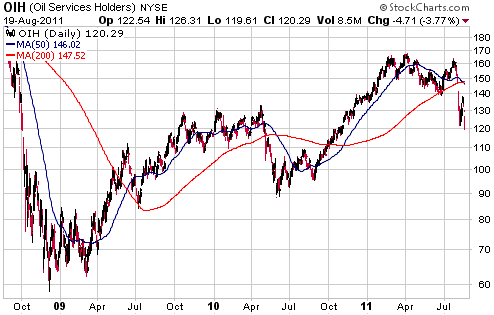
During the period since we wrote the above, the average drilling services stock has fallen by at least 20% and OIH (the Oil Services Holders ETF) is down by around 20%. A daily chart of OIH is displayed below. We don't think that the stock market has declined to the point where a global slowdown is fully discounted in current prices, but risk has certainly been lowered by the recent market action (note: actual downside risk and the general perception of downside risk move in opposite directions, in that falling prices simultaneously reduce downside risk and make people more worried about the market's potential downside).
Aside from the gold sector, drilling services is one of the few stock market sectors that interest us at this time. This is definitely not the time to be buying aggressively, but the price of the average drilling services stock is now low enough to START the scaling-in process.
This week's
important US economic events
| Date |
Description |
| Monday Aug 22 | No important events
scheduled
| | Tuesday
Aug 23 | New Home Sales | | Wednesday
Aug 24 | Durable Goods Orders | | Thursday
Aug 25 | No important events
scheduled
| | Friday
Aug 26 | Q2 GDP (revised)
Consumer Sentiment
Ben Bernanke speech
|
Gold and
the Dollar
Gold and Silver
The gold market has 'gone parabolic' over the past few weeks. This type of price action usually only happens near the END of an upward trend, but there is no telling exactly where the end will be. Having come this far, it's possible that the end will be the next big round number ($2,000/oz). The $2,000 level for gold could act like a magnet in the same way that the $50 level acted like a magnet for silver earlier this year.
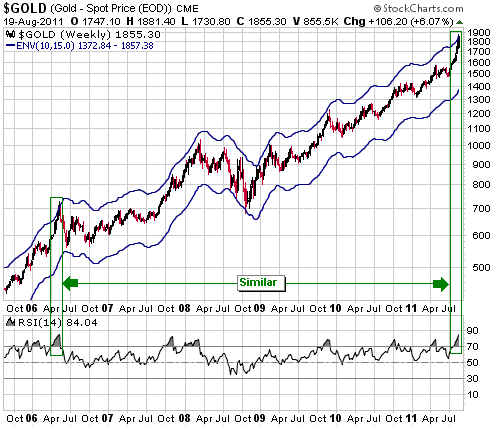
The US$ gold price rose every day last week. More significantly, it has now risen 7 weeks in a row and ended last week slightly above the top of the moving average envelope shown on the following weekly chart.
As noted on the following chart, current price action looks similar to the action leading up to the May-2006 intermediate-term peak. That peak was preceded by 9 consecutive up-weeks.
There is obviously no guarantee that the current rise will continue for another two weeks to match the 2006 upside blow-off, or that the current rise will end after two more weeks if it does continue. However, the downside risk is increasing as rapidly as the price. If gold surges to $2,000/oz over the coming fortnight then the odds will be heavily in favour of the next correction being the intermediate-term variety. An intermediate-term correction is one that lasts at least 6 months and takes the price down to the 200-day moving average or lower.
Every time a commodity futures market 'goes parabolic', two things are bound to happen:
1. The futures exchange will hike margin requirements.
2. The bulls on the commodity will express shock and horror that the futures exchange could do such a thing.
So, get ready for margin hikes and for some gold bulls to cry "foul".
Interestingly, gold and T-Bonds have been positively correlated over the past month. Both have benefited from stock market turmoil and both are likely to decline once the stock market temporarily stabilises. In addition to benefiting from the 'flight to safety' that has obviously been occurring in the financial markets, we suspect that gold has also benefited from speculators piling into what's working.
The following chart shows the US$ silver price and the silver/gold ratio.
Silver moved to a new multi-month high on Friday. The silver/gold ratio also strengthened on Friday, but remains near its lows of the past six months.
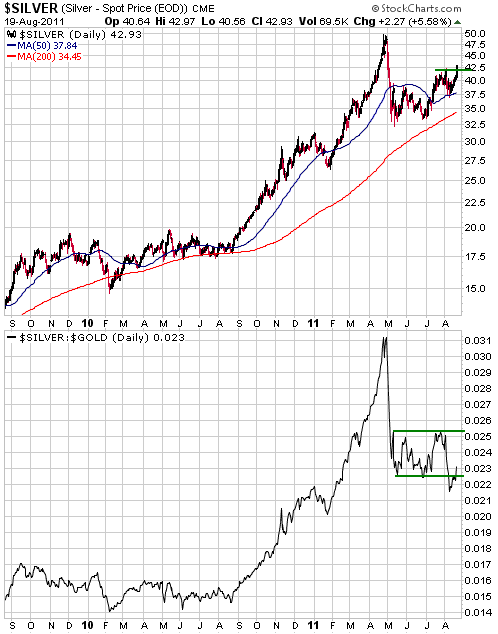
Last Friday's breakout suggests that silver could test its late-April high within the next few weeks, but whether it does or not will greatly depend on gold's ability to sustain its upside blow-off for a while longer. If silver does manage to rise far enough to test its April high, then the similarities with the 2006 precious metals peak will be enhanced. This is because the 2006 peak encompassed the following sequence:
1. A spectacular upside blow-off in the silver market
2. A plunge in the silver price along with a routine pullback in the gold price
3. A sharp rise to new multi-year highs in the gold market, along with silver rising by just enough to test its earlier high and the silver/gold ratio making a much lower high.
The bearish divergence between gold and the silver/gold ratio is more pronounced today than it was when gold was nearing its peak in 2006. However, divergences never matter...until they do.
The bottom line: Gold's upside blow-off has pulled silver out of its range of the past few months, but silver's risk/reward hasn't significantly changed. The risk of a large gold correction has increased and will become greater still if gold's upside blow-off continues for another couple of weeks.
Gold Stocks
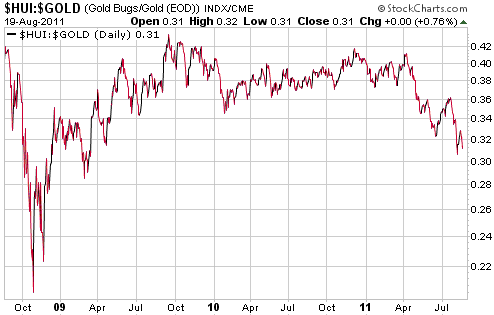
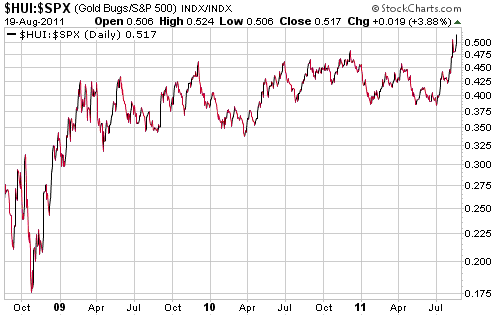
Gold stocks continue to be pulled upward by gold bullion and pushed downward by the broad stock market. The result is reflected by the following two charts, the first of which shows that the HUI/gold ratio is near a 2-year low and the second of which shows that the HUI/SPX ratio ended last week at a multi-year high (an all-time high, actually).
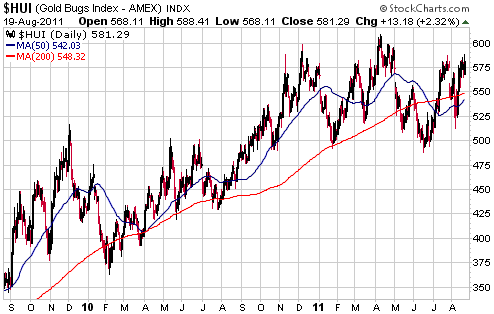
The HUI continues to probe resistance in the 580s. Unlike gold bullion, it is not 'overbought'.
A normal pullback would take the HUI back to its moving averages in the 540s. Such a pullback would constitute a short-term buying opportunity, although many individual gold stocks are already at levels where new buying would be appropriate.
Currency Market Update
Nobody wants a strong currency
The world of policy-making is dominated by Mercantilism and Keynesianism.
Under the Mercantilist way of thinking, the greater the level of goods exports relative to goods imports, the better. Or, looking at it from another angle, from the perspective of a Mercantilist a good policy is one that maximises the amount of money flowing into the country by maximising the amount of goods flowing out of the country.
Under the Keynesian way of thinking, spending drives the economy and recessions happen when mysterious forces -- sometimes called "animal spirits" -- cause spending to fall by too much. A great example of the Keynesian way of thinking is Paul Krugman's recent claim that the global economy would be shifted onto a sustainable upward trajectory if the governments of the world began preparing for an alien invasion that never happens. The idea that an economy can be helped by consuming a huge amount of resources in a totally wasteful manner is consistent with Keynesian economic theory.
It's not surprising, then, that a strong currency is anathema to most policy-makers. Currency strength will make life more difficult for goods exporters in the short-term, which is the only term that matters to most politicians, and persistent currency strength will tend to promote saving. In the real world, saving is the cornerstone of economic progress; but in the upside-down world of the Keynesian, more saving is bad because it means less immediate spending.
Due to the theories that guide their thinking, policy-makers will often panic if their currency achieves large gains against the currencies of their trading partners. For example, Swiss policy-makers recently began to show signs of panic in response to the Swiss Franc's performance relative to the euro. As illustrated by the following chart, the euro, which had been weakening steadily against the Swiss Franc for more than two years, commenced an accelerated decline at the end of June. At its low point earlier this month, the euro had lost about one quarter of its value against the Swiss Franc (SF) in only 4 months.
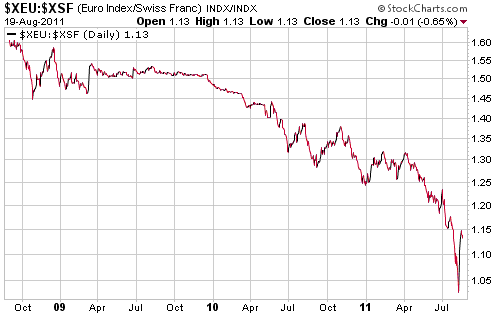
In response to the performance depicted above, some Swiss policy-makers and influential business leaders have recommended that the Swiss National Bank (SNB) immediately set a lower limit of 1.10 for the euro/SF rate and then gradually increase this limit over time. In other words, the suggestion has been made that the SNB do whatever it takes to firstly prevent the SF from strengthening any further and secondly reverse the SF's long-term upward trend.
We have some sympathy for Swiss exporters. It must be difficult to remain competitive when the currency in which your exports are priced weakens relentlessly against the currency in which most of your costs are denominated. However, any short-term solution that involves depressing the relative value of the SF is likely to have dire long-term consequences. The reason is that the only effective way to change the SF's trend is to greatly increase the supply of this currency.
The SF's value relative to the euro will fall if the SF supply is boosted to a sufficient extent, but the monetary inflation will promote widespread mal-investment and sow the seeds of an eventual economic bust. It could even sow the seeds of hyperinflation. The reason is that for the SNB to ensure relative weakness in the SF it will have to consistently inflate at a faster rate than the ECB, and the ECB could end up inflating rapidly as it desperately attempts to hold Europe's monetary union together by bailing out banks and other bondholders.
The world's monetary system appears to have degenerated to the point where there are no good options, meaning that economic hardship lies along every possible path. However, policy-makers could minimise the hardship by not entering, or withdrawing, from the 'race to the bottom' in which most currencies are presently engaged. This would be the best way to protect the savings that will be needed to fuel sustainable economic growth in the future.
We advise against holding your breath while waiting for the current gaggle of policy-makers to do the right thing.
Current Market Situation
The Swiss are discussing plans to reverse their currency's upward trend, but it's quite possible that a major reversal has already occurred. Given that the SF is very over-valued on a purchasing power basis and that it recently experienced a spectacular upside blow-off amidst almost universal bullishness (Market Vane's bullish consensus for the SF got as high as 98%), the ingredients of a major trend reversal were certainly in place earlier this month. The rapid decline of the past two weeks suggests that the reversal has occurred.
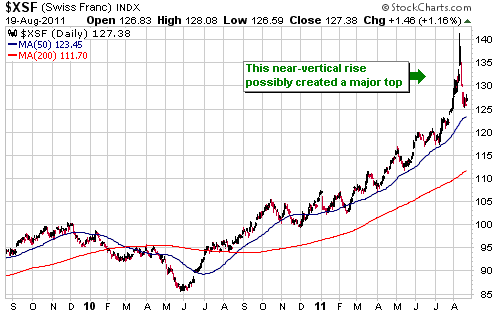
Despite the fact that there have been large moves in some currencies over the past month, the Dollar Index has remained within its narrow trading range. It would take a daily close below 73.5 or above 76.5 to break the dollar out of its range.
Update
on Stock Selections
Notes: 1) To review the complete list of current TSI stock selections, logon at
http://www.speculative-investor.com/new/market_logon.asp
and then click on "Stock Selections" in the menu. When at the Stock
Selections page, click on a stock's symbol to bring-up an archive of
our comments on the stock in question. 2) The Small Stock Watch List is
located at http://www.speculative-investor.com/new/smallstockwatch.html
 Lowered Expectations Lowered Expectations
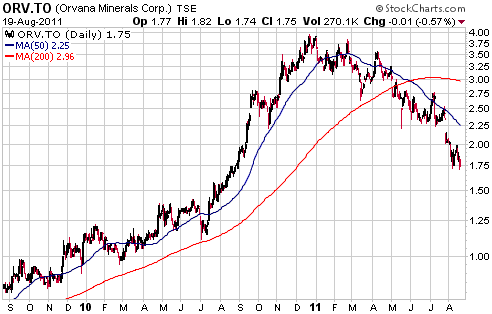
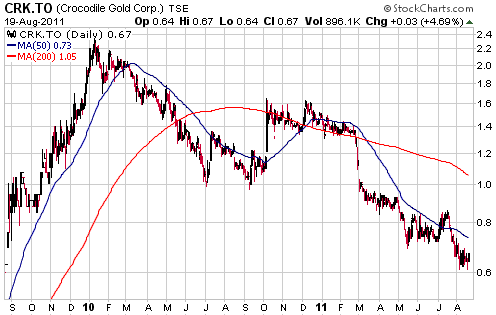
Crocodile Gold (TSX: CRK) and Orvana Minerals (TSX: ORV) are junior gold producers that look very under-valued at their current prices, but both companies have recently lowered their production forecasts for the next 2-3 quarters. Regardless of how under-valued a stock appears to be, its price usually won't make substantial short-term gains if the underlying company is failing to meet its own sales forecasts.
A few months ago we thought that ORV stood a good chance of ending this year at a production run-rate of around 120K ounces/year, but a recent press release from the company indicated that it is now expected to take until April of next year to achieve a run rate of only 75K ounces/year. This is due to 'teething problems' at ORV's two new mines. Such problems often occur during the first few quarters after a mine is brought into production, but due to the operational experience of ORV's managers we had hoped that in this case the transition to full production would be smooth. Our hopes have been dashed.
ORV is a hold or a buy at its current price of C$1.75, but as a result of mine startup issues the stock's upward progress is likely to be slower than previously anticipated.
CRK now forecasts 2011 production of 77K-82K ounces, which is about 10K less than expectations that had already been lowered as a result of the record-high rainfall during the first few months of this year.
The Cosmo underground mine, CRK's most important asset, is scheduled to come on line late this year. This asset should facilitate a large increase in production next year, but at this stage the stock market is not prepared to give the company any credit for future growth. Given the operational performance over the past 12 months, that's understandable.
For new buying within the ranks of junior gold producers, at this time we prefer several other TSI stock selections to CRK. Our preferences are: DRA.AX, GOZ.TO, GSS, JAG, ORV.TO and
RSG.AX.
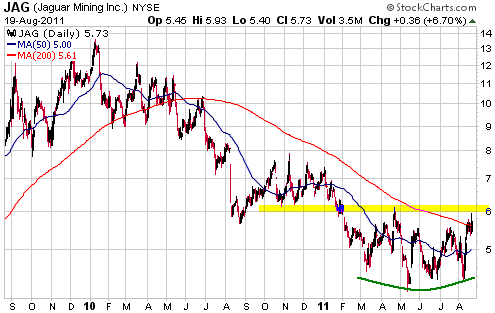
Jaguar Mining (NYSE and TSX: JAG). Shares: 84M issued, 88M fully diluted. Recent price: US$5.73
Evidence has emerged over the past two quarters that JAG's gold mining operations have turned around. This hasn't yet been reflected in the performance of the company's stock, although the chart pattern (see below) has the look of a rounded base that is almost complete. A daily close above US$6.20 would indicate that the basing was complete.
The ideal place for new buying is the price-area near the 50-day moving average (currently, just above US$5.00), but the stock probably won't pull back that far. Depending on present exposure, it may be appropriate to do some buying in the US$5.60-$5.80 range.
New speculative idea: Dacha Strategic Metals (TSXV: DSM). Shares: 77M issued, 100M fully diluted. Recent price: C$0.82
DSM is a rare earth metals play, but it doesn't mine rare earth metals and it doesn't explore for them; instead, it maintains a metals inventory at a warehouse. It is therefore probably the purest stock-market play on the prices of rare earth metals.
In March of this year when it was trading at C$0.35-C$0.40, we took an initial position in DSM for our own account and considered mentioning the stock as a speculative opportunity at TSI. We subsequently kicked ourselves for not mentioning it, because it traded as high as C$1.20 in July before commencing a significant correction. In our defense, there was no way we could have foreseen in March that DSM's net asset value was about to rocket upward due to incredibly fast gains in the market value of the company's inventory.
DSM's risk/reward is possibly just as good today, with the stock at around C$0.80, as it was during the first half of March when it was trading at C$0.35-$0.40. The reason is that the company's net asset value (NAV) was around C$0.50/share during the first half of March versus about C$1.90/share now. That is, the discount to NAV is greater today than it was back then.
The risk is that the prices of rare earth metals will plunge, but this risk is mitigated by the large discount at which the stock trades. In effect, DSM's stock price is currently discounting a 50% decline in the prices of the metals that the company holds. The potential reward revolves around further increases in the market value of the company's metals inventory and/or the stock price moving closer to the per-share NAV.
Speculators looking for exposure to rare earth metals should consider scaling into DSM on weakness over the months ahead.
Clifton Star Resources (TSXV:
CFO)
It looks like CFO's trading halt won't be lifted for at least two more weeks. We hope that the company will issue a press release this week to allay the fears of shareholders.
Chart Sources
Charts appearing in today's commentary
are courtesy of:
http://stockcharts.com/index.html

|









