|
-- Weekly Market Update for the Week Commencing 22nd October 2012
Big Picture
View
Here is a summary of our big picture
view of the markets. Note that our short-term views may differ from our
big picture view.
In nominal dollar terms, the BULL market in US Treasury Bonds
that began in the early 1980s will end by 2013. In real (gold)
terms, bonds commenced a secular BEAR market in 2001 that will continue
until 2014-2020. (Last
update: 23 January 2012)
The stock market, as represented by the S&P500 Index,
commenced
a secular BEAR market during the first quarter of 2000, where "secular
bear market" is defined as a long-term downward trend in valuations
(P/E ratios, etc.) and gold-denominated prices. This secular trend will bottom sometime between 2014 and 2020.
(Last update: 22 October 2007)
A secular BEAR market in the Dollar
began during the final quarter of 2000 and ended in July of 2008. This
secular bear market will be followed by a multi-year period of range
trading.
(Last
update: 09 February 2009)
Gold commenced a
secular bull market relative to all fiat currencies, the CRB Index,
bonds and most stock market indices during 1999-2001.
This secular trend will peak sometime between 2014 and 2020.
(Last update: 22 October 2007)
Commodities,
as represented by the Continuous Commodity Index (CCI), commenced a
secular BULL market in 2001 in nominal dollar terms. The first major
upward leg in this bull market ended during the first half of 2008, but
a long-term peak won't occur until 2014-2020. In real (gold) terms,
commodities commenced a secular BEAR market in 2001 that will continue
until 2014-2020.
(Last
update: 09 February 2009)
Copyright
Reminder
The commentaries that appear at TSI
may not be distributed, in full or in part, without our written permission.
In particular, please note that the posting of extracts from TSI commentaries
at other web sites or providing links to TSI commentaries at other web
sites (for example, at discussion boards) without our written permission
is prohibited.
We reserve the right to immediately
terminate the subscription of any TSI subscriber who distributes the TSI
commentaries without our written permission.
Outlook Summary
Market
|
Short-Term
(1-3 month)
|
Intermediate-Term
(6-12 month)
|
Long-Term
(2-5 Year)
|
|
Gold
|
Bullish
(17-Oct-12)
|
Bullish
(26-Mar-12)
|
Bullish
|
|
US$ (Dollar Index)
|
Neutral
(17-Sep-12)
|
Neutral
(09-Jan-12)
|
Neutral
(19-Sep-07)
|
|
Bonds (US T-Bond)
|
Bearish
(02-Jul-12)
|
Neutral
(18-Jan-12)
|
Bearish |
|
Stock Market
(DJW)
|
Bearish
(30-Jul-12)
|
Bearish
(28-Nov-11)
|
Bearish
|
|
Gold Stocks
(HUI)
|
Bullish
(22-Oct-12)
|
Bullish
(23-Jun-10)
|
Bullish
|
|
Oil |
Neutral
(30-Jul-12)
|
Neutral
(31-Jan-11)
|
Bullish
|
|
Industrial Metals
(GYX)
|
Neutral
(30-Jul-12)
|
Neutral
(29-Aug-11)
|
Neutral
(11-Jan-10)
|
Notes:
1. In those cases where we have been able to identify the commentary in
which the most recent outlook change occurred we've put the date of the
commentary below the current outlook.
2. "Neutral", in the above table, means that we either don't have a
firm opinion or that we think risk and reward are roughly in balance with respect to the timeframe in question.
3. Long-term views are determined almost completely by fundamentals,
intermediate-term views by
fundamentals, sentiment and technicals, and short-term views by sentiment and
technicals.
Important Note: No Interim
Update this week
We will be taking a break this week and as a
result there will be no Interim Update on Thursday 25th October. The next TSI
commentary will therefore be the Weekly Update on Sunday 28th October.
Interesting Quote
Thanks to "Austrian economics" aficionado
Ed Bugos for bringing the following Ludwig von Mises quote to our attention:
"The problem is not the allocation of known scarce resources to
satisfy known wants of known consumers based on a known
lowest cost method of production for each known good and/or service.
These 'knowns' are not given, but are the elements that must and can only be
discovered through a market process."
These two simple sentences encapsulate why central planning of the economy has
never worked and never will work. It doesn't matter how knowledgeable and
well-intentioned the planners and how much data they have, they will never have
the right information because the right information is the market prices that
can only exist in the absence of central planning.
Inflation and Inflation
Expectations
QE3 Update
We noted in recent commentaries that although the Fed had announced on 13th
September that it would be monetising (buying with money created out of nothing)
$40B per month of mortgage-backed securities (MBS), the first few weeks of this
new balance-sheet-expansion program had been characterised by a total absence of
balance-sheet expansion. It was beginning to look like a different type of hoax.
Every QE program is a hoax to the extent that it is sold to the public as a way
of promoting economic growth (what it really does is surreptitiously transfer
wealth and reduce the economy's long-term growth potential), but it was
beginning to seem as if the latest QE program wasn't a QE program at all. The
Fed didn't appear to be actually monetising anything. However, the appearance
was deceiving.
Mike Pollaro, money-supply expert and the proprietor of
The Contrarian Take, wrote
to us to point out that there will often be a delay of at least one month
between the Fed's purchase of securities and that purchase being settled. Of
particular relevance, the purchase will only become part of the Fed's balance
sheet after it gets settled. This means that purchases of MBS made by the Fed
during the second half of September wouldn't normally become part of the Fed's
balance sheet until at least the second half of October. Mystery solved,
provided that we soon see evidence of balance-sheet expansion in the
H.4.1 report
published by the Fed every Thursday.
The latest H.4.1 report reveals the first hard evidence of the Fed's new
monetary inflation program. Specifically, it reveals a $22B expansion of the
Fed's balance sheet due to a $27B increase in MBS partially offset by decreases
in other items.
So, the QE3 announcement wasn't just hot air. A new monetary inflation program
has begun in earnest.
Inflation Expectations Update
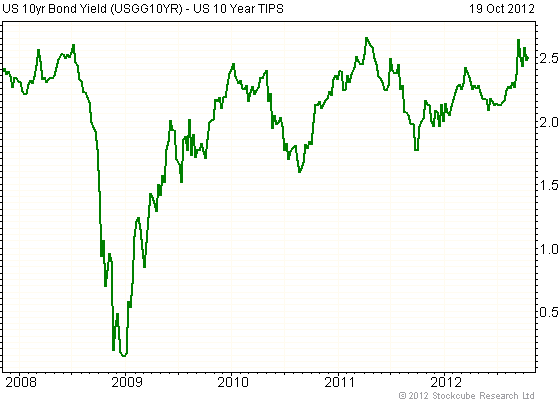
The difference between the yield on a 10-year T-Note and the yield on a 10-year
TIPS (Treasury Inflation Protected Security) indicates the amount of "price
inflation" that the market expects the US government to admit to over the years
ahead. We refer to it as the "Expected CPI".
The following Fullermoney.com chart
shows that the Expected CPI moved sharply higher in anticipation of and in
immediate reaction to "QE3", but has since pulled back. Either "inflation
expectations" have just made another intermediate-term peak with the Expected
CPI at around 2.7%, or a major upside breakout will soon happen.
Whether or not the Expected CPI makes an upside breakout over the next few weeks
or commences an intermediate-term decline will very likely be determined by the
stock market. If the stock market has peaked then so, in all likelihood, has the
Expected CPI, but if the stock market can maintain an upward bias for a few more
months then we could get the long-awaited upside breakout in the Expected CPI
and a consequential large decline in the T-Bond price.
The Stock
Market
The NASDAQ100 Index (NDX) is in a different
position to the S&P500 Index (SPX). Whereas the SPX has held above support
during the post-QE3-announcement stock market decline, the NDX closed at its
lowest level in more than two months on Friday and has done enough to hint that
an intermediate-term peak was put in place in September.
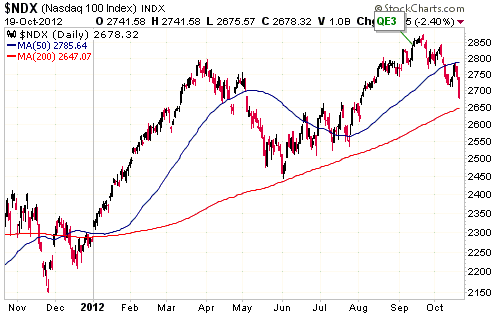
The evidence of a top in the NDX is not close to being conclusive, though,
because this index tends to be the most volatile of the senior US stock indices.
We note, for example, that most short-term NDX corrections result in a decisive
break below the 50-day moving average. The fact that the NDX has fallen well
below its 50-day moving average therefore doesn't tell us anything other than
the index is now 'oversold' on a short-term basis.
Regardless of whether or not the NDX made an intermediate-term peak last month,
it is probably not far from a low that will hold for at least a few weeks. If an
intermediate-term peak is in place, the next rally will end at or below the
September high. A subsequent break below this month's low would then clearly
signal that an intermediate-term downward trend was underway.
While we are very cognisant of the risk that a large stock market decline could
begin at any time and will probably begin within the next few months, we hasten
to point out that with only one exception none of our risk-aversion indicators
are pointing to trouble ahead. The one exception is the RUT/SPX ratio, which, as
recently discussed, continues to make lower highs.
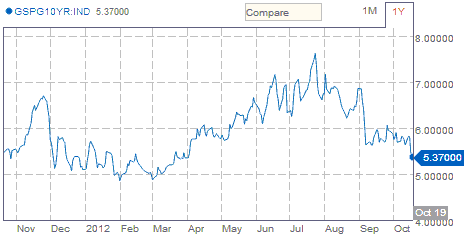
One risk-aversion indicator that we are paying especially close attention to at
this time is the yield on the Spanish Government 10-year Bond. As illustrated by
the following chart, this yield has been trending lower since July and is now in
the bottom quartile of its 12-month range. This suggests that 'the market'
expects further mitigation of the EZ government debt predicament. Even when
equity indices fell sharply last Friday the yield on the 10-year Spanish
Government bond was only up by 2 basis points (0.02%). Over the course of last
week the yield fell by 40 basis points (0.4%), bringing about a significant
contraction in the spread between the yields on Spanish and German government
bonds.
A large stock market decline is unlikely to begin while Spanish government bond
yields are trending downward.
This week's
important US economic events
| Date |
Description |
| Monday Oct 22 |
No important events scheduled
| | Tuesday Oct 23 |
Richmond Fed Mfg Index | | Wednesday
Oct 24 |
FOMC Announcement
New Home Sales | | Thursday
Oct 25 |
Durable Goods Orders
Pending Home Sales Index
|
| Friday Oct 26 |
Q3 GDP (revised)
Consumer Sentiment
|
Gold and
the Dollar
Gold and Silver
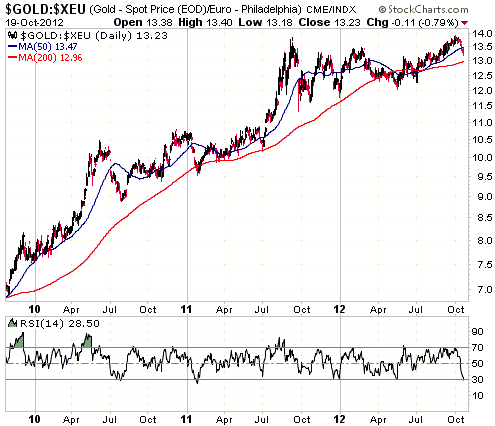
Below is a daily chart of the euro-denominated gold price (gold/euro). At the
bottom of the chart is the RSI(14), a momentum indicator.
The 200-day moving average became a likely target for gold/euro after the price
broke decisively below the 50-day moving average. At the close of trading on
Friday gold/euro was only 2% above its 200-day moving average, which suggests
that it only has about 2% of additional downside potential. Note that if the
euro-US$ exchange rate remains the same, a decline by gold/euro to its 200-day
moving average would coincide with a decline by the US$ gold price to $1685.
Gold/euro's daily RSI supports the idea that a short-term bottom is near, in
that this indicator was close to a 3-year low at the end of last week.
Like most QE beneficiaries, the silver market has been in 'correction mode'
since the day after the "QE3" announcement. The reason should be obvious from a
glance at the following chart. In case it isn't, the reason is that there was a
big run-up in the silver price prior to the announcement.
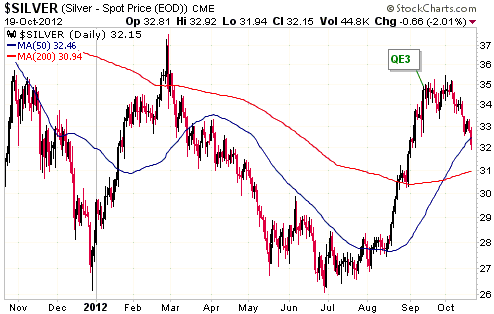
After a correction got underway in the silver market the $30-$32 range became a
likely target for a correction low. The top of this range was reached last
Friday. In our opinion, the bottom of the range defines the maximum short-term
downside potential.
Gold Stocks
Last Friday was a good day for the gold sector, even though the HUI ended the
day only marginally higher. It was a good day because the flat performance
occurred in parallel with a $20 fall in the gold price and a weak general stock
market. Also, the HUI briefly traded at a new multi-week low before reversing
course.
The top section of the following chart shows the HUI and the bottom section of
the chart shows the HUI/gold ratio. Notice that Friday's intra-day low for the
HUI was within 1% of the 50-day MA. This means that the second of the two
conditions for a correction low has, for all intents and purposes, now been
satisfied (the first condition, which had previously been satisfied, was a
decline in the daily RSI to 40-50). Notice as well that the HUI/gold ratio
didn't make a new low for the move late last week. Due to the fact that gold
bullion did make a new low for the move, this constitutes a bullish divergence.
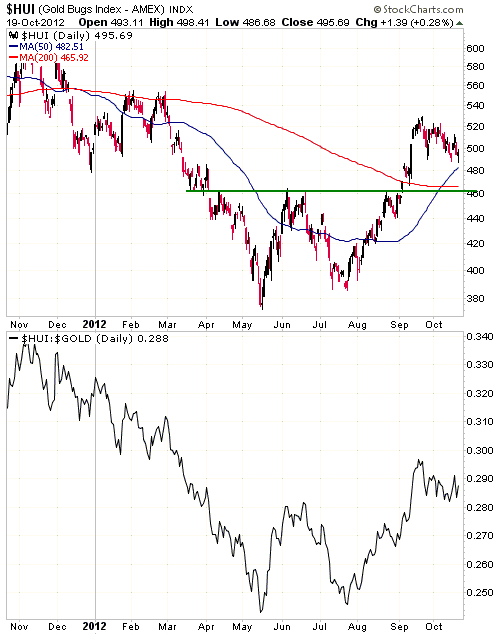
It's still the case that the price action hasn't definitively signaled a bottom,
but last week's action provided evidence that the HUI is not going to trade a
lot lower before the correction comes to an end. Our short-term HUI outlook has
therefore shifted from "neutral" to "bullish".
A likely reason for Friday's resilience in the gold-mining sector in the face of
weakness in the broad stock market and the bullion market was news that a
company controlled by Eike Batista, Brazil's richest person, had offered to buy
both Galway Resources (TSXV: GWY) and Calvista Gold (TSX: CVZ) at hefty
premiums. Batista is buying these companies to obtain ownership of
exploration-stage gold projects in Colombia.
Batista's GWY+CVZ purchase follows on the heels of the recent purchase of
gold-mining assets by Carlos Slim, Mexico's and the world's richest person. It
therefore starts to establish a pattern. It seems that while a famous US
billionaire remains oblivious to the damage being done to money and the
consequent importance of having substantial exposure to gold, some of his
counterparts in Latin America are interested in not only growing their exposure
to gold but also in growing their exposure to gold via the companies that
produce and explore for gold.
Currency Market Update
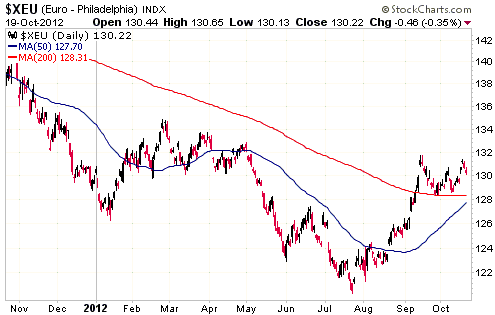
The euro has essentially been trading sideways for a bit more than one month.
This multi-week period of sideways movement looks more like a consolidation
within a short-term upward trend than a topping pattern. In other words, the
euro rally that began in July doesn't appear to be complete.
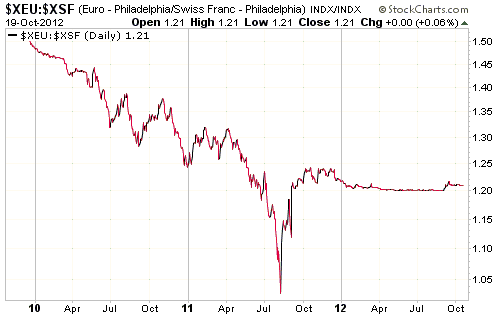
In August of last year the Swiss National Bank drew a line at 1.20. It stated
that no matter what happened to the euro, the euro/SF exchange rate was not
going to fall below 1.20. To those who believe that a central bank cannot
override market forces, the following chart of the euro/SF exchange rate is
definitive evidence that you are wrong. Unfortunately, central banks can and
regularly do override market forces, with numerous dire consequences.
Update
on Stock Selections
Notes: 1) To review the complete list of current TSI stock selections, logon at
http://www.speculative-investor.com/new/market_logon.asp
and then click on "Stock Selections" in the menu. When at the Stock
Selections page, click on a stock's symbol to bring-up an archive of
our comments on the stock in question. 2) The Small Stock Watch List is
located at http://www.speculative-investor.com/new/smallstockwatch.html
 Company
news/developments for the week ended Friday 19th October 2012: Company
news/developments for the week ended Friday 19th October 2012:
*Clifton Star Resources (CFO.V) posted its MD&A and financial
results for the year ended 30th June 2012. There didn't appear to be
any new information in these documents.
There are two important events coming up for CFO. The first is the
expected receipt of a $22.5M loan from Osisko by the end of
November. The second is the completion of the Duparquet project's
Preliminary Economic Assessment (PEA). The results of the PEA are
expected to be published in January.
*Energy Fuels (EFR.TO), the owner/operator of the only
conventional uranium mill in the US and the biggest US-based
producer of uranium, advised that it was scaling back its annual
rate of U3O8 production from around 1.4M pounds to 1.0-1.1M pounds.
This action became necessary due to the decline in the uranium
price.
As we've mentioned in the past, EFR offers huge leverage to the
uranium price. This characteristic will serve the company (and its
shareholders) well when uranium eventually enters a new bull market,
but isn't helpful during periods when the uranium price is in a
relentless downward trend.
The outlook for uranium is likely to become increasingly bullish
over the next 12 months, mainly due to the scheduled termination of
the "Megatons to Megawatts" program at the end of 2013. In one fell
swoop, this will remove about 20M pounds per year of uranium supply
-- about 10% of global supply -- from the market. Until recently
there was a chance that this could have been offset by the expansion
of BHP's huge Olympic Dam mine in South Australia, but this
expansion plan has been shelved. A global recession could lead to a
reduction in demand, but even taking the potential demand reduction
into account the uranium market appears to be heading for a large
supply deficit during 2014-2015. The question is: when will the
market begin to discount this looming deficit? It certainly won't
wait until the end of 2013 to begin doing so.
Our view is that patient speculators should gradually build-up
uranium-mining exposure during periods when prices are depressed.
Periods like the present. Relatively low-risk diversified exposure
can be obtained via URA. Higher-risk/higher-reward exposure can be
obtained via EFR.TO and UEX.TO.
*Golden Star Resources (GSS) reported drilling results that point
to expansion potential for its Wassa Mine in Ghana. While it's
important for the company to define new resources to create growth
and replace the ounces that are mined, we own GSS due to the cash
flow that could/should be generated by its existing operations and
the substantial under-valuation of the stock based on this expected
cash flow.
*Keegan Resources (KGN) has raised a chunk of money via what it
describes as a strategic alliance and financing. The money is coming
from Highland Park, an investment company. Highland Park and some
other investors have agreed to purchase 9.4M KGN shares at
C$3.44/share, with each new share coming with a 2-year C$4.00
warrant. The financing therefore adds about 19M shares to the
company's fully diluted share count to raise a total of around C$70M
-- $32M now and an additional $38M when the warrants are exercised.
Considering that KGN already had more than $180M of cash there was
no need to do another equity financing, especially at such a low
price (the low financing price reduces KGN's per-share value). It
seems that the main reason for the financing was to bring some good
people on board. As stated in KGN's press release:
"The key investors in Highland Park include the original founders
and former executives of Toronto based LionOre Mining International
Limited ("LionOre"). LionOre was acquired in 2007 for US$6.3 billion
by Norilsk Nickel. Highland Park was also involved in the
development and strategic direction of Mantra Resources into a
leading uranium explorer and developer prior to its acquisition by
ARMZ Uranium Holding Co. in 2011.
In conjunction with the Highland Park investment, Keegan is pleased
to announce the appointments of Mr. Peter Breese as President and
Chief Executive Officer and Mr. Tony Devlin as Chief Operating
Officer of the Company to occur concurrently with completion of the
placement. Mr. Breese will also be appointed as a Director of
Keegan. Along with Mr. Breese and Mr. Devlin comes a
multidisciplinary technical team that has the expertise necessary to
execute on all aspects of the project. The Board understands that
the appointment of a CEO and a COO with strong records of success in
project development and operations management, as well as extensive
experience in Africa, is an important and timely step for the
Company as it evolves from an explorer into a significant near-term
gold producer. Shawn Wallace, co-founder, Chairman and acting CEO,
will continue to play a key role with Keegan as Chairman of the
Board and as a Director."
And:
"Peter Breese has over 25 years executive, operational and
project management experience in the global mining industry in the
base and precious metals sectors. Peter is currently a Director of
TSX listed Coalspur Mines Limited. He has held a number of senior
executive positions including CEO of Mantra Resources, CEO of
Norilsk Nickel International, COO of LionOre, as well as senior
management and board positions with Impala Platinum Holdings (South
Africa), Mimosa Mining Company (Zimbabwe), Zimasco (Zimbabwe) and
BCL (Botswana).
Tony Devlin has over 30 years executive, operational and project
management experience in Africa. Most recently Tony was Managing
Director ("MD") of Mantra Tanzania. Prior to that he was MD of
Williamson Diamonds in Tanzania and also held a number of executive
management positions with Anglo American including CEO of Zimbabwe
Alloys (Zimbabwe)."
When an equity financing is priced well below the current market
price the market price will normally plunge to the financing price,
but KGN's market price rose in response to the latest financing
news. This is due to the new management and investors that came on
board as part of the financing.
KGN is now in an even better position to bring the 5M-ounce Esaase
gold project into production. We are still hoping for and expecting
a takeover bid for KGN prior to Esaase entering the mine
construction phase, but it's good that the company is not dependent
upon such a bid.
*Orvana Minerals (ORV.TO) reported its production results for the
quarter and financial year ended September-2012 and its production
guidance for the 2013 financial year. ORV operates the EVBC gold
mine in Spain and the UMZ copper/gold mine in Bolivia.
ORV missed its own forecasts for the September quarter, mainly due
to problems at EVBC that have apparently (according to management)
been resolved. The problems at EVBC resulted in gold production at
that mine being only 10.5K ounces during the latest quarter. 15K
ounces had been forecast. Total production across both operations
amounted to 15.2K ounces of gold plus 4.1M pounds of copper. Average
costs were about $850/oz for gold and $2.00/pound for copper.
Although the latest quarter's production was below expectations, the
company probably generated at least $11M of cash and should
therefore have been able to continue the turnaround (from weakness
to strength) of its balance sheet.
FY 2013 (1st Oct 2012 through to 30th Sep 2013) guidance is for 75K
ounces of gold plus 18M pounds of copper. If this guidance is
achieved and metal prices say roughly where they are today, ORV will
likely generate at least $65M of cash over the 12-month period. This
level of annual cash flow would justify a stock price well north of
C$3.00, which is why we continue to be interested in ORV despite the
risks. The main risk is the location of the UMZ operation (Bolivia).
There is also the risk that guidance will not be achieved.
*Pinetree Capital (PNP.TO) reported that its Net Asset Value (NAV)
was C$1.91/share as at 30th September. Based on what has happened
since then, the current NAV is probably C$1.80-C$1.85. This compares
to Friday's closing price of C$1.10.
*Pretium Resources (PVG.TO) reported the final set of drilling
results for this year's program. As usual, the latest results
included some spectacular intercepts. We now await the updated
resource estimate scheduled for December-January.
*Ramelius Resources (RMS.AX) issued a production update. First,
the company reported that its Wattle Dam project had been fully
depleted a few months ahead of schedule. This is good news because
it amounts to the same amount of gold being produced over a shorter
time and at a lower cost. RMS estimates that it will save about $4M
due to the earlier-than-expected completion of mining at Wattle Dam.
Second, the company advised that the ramp-up of production at its Mt
Magnet mine was happening more slowly than previously forecast, but
not a lot more slowly. Gold production during the just-completed
quarter was 12.2K ounces, which is at the bottom of the 12k-14K
range previously forecast. Gold production during the December
quarter is expected to be 15K ounces, which is 2K-3K ounces less
than we were anticipating based on the company's earlier forecast.
Total production during the final quarter of this calendar year
should be around 22K ounces (15K from Mt Magnet plus 7K from Wattle
Dam) and next year's production should be around 100K ounces (almost
all from Mt Magnet).
We continue to believe that RMS is one of the best buys in the gold
sector near A$0.40/share.
*Rio Novo Gold (RN.TO) reported bulk sampling results from the
exploration-stage Toldafria project in Colombia. Details can be
found here: http://media3.marketwire.com/docs/Toldafria_exploration_update.pdf.
Due to the nuggety nature of the gold at Toldafria, a more accurate
assessment of the resource can be obtained by bulk sampling than by
drilling.
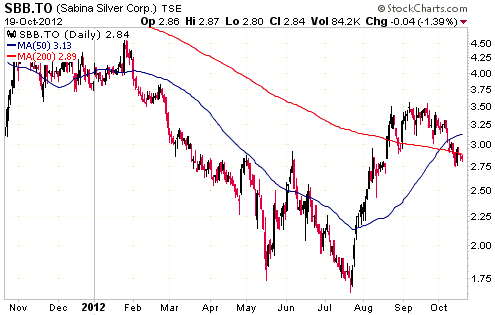
*Sabina Gold and Silver (SBB.TO) reported what will probably turn
out to be its penultimate set of drilling results for this year. Its
camps have been closed for the winter and won't re-open until next
March, but some assay results are still pending.
As usual, the latest batch of drilling results contained some
excellent gold intercepts. The two best were 16.54g/t over 25.45m
and 6.36 g/t Au over 28.50m.
The next important milestone for this company will be the completion
of a new resource estimate. This is expected to happen in January.
After being a candidate for partial selling in September, SBB has
now pulled back far enough and for long enough to create a new
buying opportunity. New buying would be appropriate in the C$2.80s
or lower. At this stage the C$4.00-C$4.50 range looks like a
realistic short-term upside target based on the stock's chart (see
below) and valuation.
*UEX Corp. (UEX.TO) announced the discovery of a new zone of
high-grade uranium mineralisation next to the currently defined
resource at its Shea Creek project in the Athabasca Basin. UEX owns
49% of the Shea Creek project. The remaining 51% is owned by Areva,
the project operator.
The main deposit at Shea Creek is called Kianna and the discovery
announced last week is called Kianna East. The discovery holes had
intercepts of 16.0m grading 3.59% U3O8 and 18.1m grading 3.70% U3O8.
These wide high-grade drill intercepts suggest that the Kianna East
discovery is significant, but the continuing slide in the uranium
price and the resultant lack of enthusiasm for uranium mining
equities meant that there was almost no stock-market reaction to the
news.
Jaguar
Mining (NYSE and TSX: JAG). Shares: 84M issued, 88M fully diluted. Recent price:
US$1.18
JAG's stock price is currently about 100% above its July low, but its enterprise
value (EV) is only up by about 20% over the same period. The reason is the
company's large debt relative to its market cap. To further explain, when the
stock price was bottoming at US$0.60 in July the company had a market cap of
only $50M and net debt of about $230M, giving it an EV of $280M. With the market
cap since doubling to around $100M and the debt load remaining the same at about
$230M, the EV is now $330M -- 18% higher than it was at the July bottom. This
reflects the leverage that the shares of a highly indebted company can provide
to a change in the performance of the underlying business. In JAG's case the
market perceived sufficient improvement in the prospects of the underlying
business to raise the EV by about 20%, but this was enough to increase the stock
price by 100%. Of course, leverage works both ways, which is why the stock fell
so far over the first 7 months of the year and why it was still a very risky
proposition at the July low.
The stock is still risky, but the risk/reward looks better now than it has in a
long time. The four reasons are:
1) The $150-$200/oz increase in the gold price since its May-July bottom has
reduced the risk side of the equation by giving JAG's profit margin a
significant boost. Due to the increase in the gold price, JAG's operations
should be generating more cash than they were a few months ago even if the
company's cost-reduction program is behind schedule.
2) As well as providing a much-needed boost to current cash flow, the increase
in the gold price has boosted our valuation. Specifically, in the 20th August
Weekly Update we came up with a back-of-the-envelope valuation of $3.50/share
based on a gold price of $1500/oz. Doing the same calculation using a $1700/oz
gold price results in a valuation of about $4.50/share.
3) The company has new senior management with more credibility.
4) Since the July bottom, the EVs of most gold miners with more than 100K
ounces/year of current production and healthy balance sheets have had much
larger gains than JAG's EV. Consequently, JAG's value has improved relative to
its counterparts with healthy balance sheets.
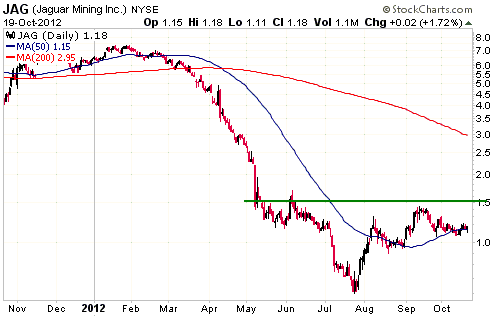
Although it isn't an important factor, it is also worth noting that the stock
chart (see below) looks 'constructive'. It looks like the stock price is
completing the final stage of a basing pattern.
Due to JAG's weak balance sheet the risk is still high. The risk is that the
company will soon run out of cash and be forced to issue another 30M-50M new
shares at a low price per share, or that management will decide to do a large
equity financing as a precautionary measure to make sure that there is no danger
of the company running out of cash anytime soon.
In the absence of new information about how the company's operations are
performing and whether an equity financing will be necessary, we think the
risk/reward is very attractive below $1.20/share. New information from the
company should become available sometime between now and mid-November, at which
point we will either be more or less comfortable owning JAG shares. The question
is whether to do some buying now or wait for the information. The problem with
waiting is that if JAG's cost-reduction program is on track and a large equity
financing will not be needed, those who wait will probably end up paying a much
higher price. This is the sort of trade-off that investors and speculators are
often faced with.
We like the idea of doing some buying now and then re-assessing after the
company issues new information, but we aren't risk averse.
Chart Sources
Charts appearing in today's commentary
are courtesy of:
http://stockcharts.com/index.html
http://www.bloomberg.com/
http://www.fullermoney.com/

|









