|
-- Weekly Market Update for the Week Commencing 23rd February 2015
Big Picture
View
Here is a summary of our big picture
view of the markets. Note that our short-term views may differ from our
big picture view.
In nominal dollar terms, the BULL market in US Treasury Bonds
that began in the early 1980s ended in 2012. In real (gold)
terms, bonds commenced a secular BEAR market in 2001 that will continue
until 2018-2020. (Last
update: 20 January 2014)
The stock market, as represented by the S&P500 Index,
commenced
a secular BEAR market during the first quarter of 2000, where "secular
bear market" is defined as a long-term downward trend in valuations
(P/E ratios, etc.) and gold-denominated prices. This secular trend will bottom sometime between 2014 and 2020.
(Last update: 22 October 2007)
A secular BEAR market in the Dollar
began during the final quarter of 2000 and ended in July of 2008. This
secular bear market will be followed by a multi-year period of range
trading.
(Last
update: 09 February 2009)
Gold commenced a
secular bull market relative to all fiat currencies, the CRB Index,
bonds and most stock market indices during 1999-2001.
This secular trend will peak sometime between 2014 and 2020.
(Last update: 22 October 2007)
Commodities,
as represented by the Continuous Commodity Index (CCI), commenced a
secular BULL market in 2001 in nominal dollar terms. The first major
upward leg in this bull market ended during the first half of 2008, but
a long-term peak won't occur until 2014-2020. In real (gold) terms,
commodities commenced a secular BEAR market in 2001 that will continue
until 2014-2020.
(Last
update: 09 February 2009)
Copyright
Reminder
The commentaries that appear at TSI
may not be distributed, in full or in part, without our written permission.
In particular, please note that the posting of extracts from TSI commentaries
at other web sites or providing links to TSI commentaries at other web
sites (for example, at discussion boards) without our written permission
is prohibited.
We reserve the right to immediately
terminate the subscription of any TSI subscriber who distributes the TSI
commentaries without our written permission.
Outlook Summary
Market
|
Short-Term
(1-3 month)
|
Intermediate-Term
(6-18 month)
|
Long-Term
(2-5 Year)
|
|
Gold
|
N/A |
Bullish
(26-Mar-12) |
Bullish
|
|
US$ (Dollar Index)
|
N/A |
Bearish
(26-Jan-15) |
Neutral
(19-Sep-07) |
|
US Treasury Bonds (TLT)
|
N/A |
Neutral
(18-Jan-12)
|
Bearish |
|
Stock Market
(DJW)
|
N/A |
Bearish
(28-Nov-11) |
Bearish
|
|
Gold Stocks
(HUI)
|
N/A |
Bullish
(23-Jun-10) |
Bullish
|
|
Oil |
N/A |
Bullish
(17-Dec-14) |
Bullish
|
|
Industrial Metals
(GYX)
|
N/A |
Neutral
(15-Sep-14) |
Bullish
(28-Apr-14) |
Notes:
1. Our short-term expectations are discussed in the commentaries, but except in
special circumstances we won't attempt to assign a "bullish", "bearish" or
"neutral" label to these expectations.
2. The date shown below the current outlook is when the most recent outlook change occurred.
3. "Neutral" means that we think risk and reward are roughly in balance with respect to the timeframe in question.
4. Long-term views are determined almost completely by fundamentals and intermediate-term views
are determined by a combination of fundamentals, sentiment and technicals.
Last
week's posts at the TSI Blog
Why the next stock market collapse won't be a "black swan"
How the Fed's QE creates money Revisiting
the global boom/bust indicator
Gold tends to fare relatively poorly during the
booms, which are periods when confidence in central banks and the economy rises
at the same time as mal-investment is setting the stage for a future period of
great hardship, and fare relatively well during the busts, which are periods
when the investing mistakes of the past come to the fore. Be aware, though, that
the word "relatively" is critical to understanding gold's relationship to the
boom/bust cycle, because the relationship often doesn't apply to gold's
performance in US$ terms.
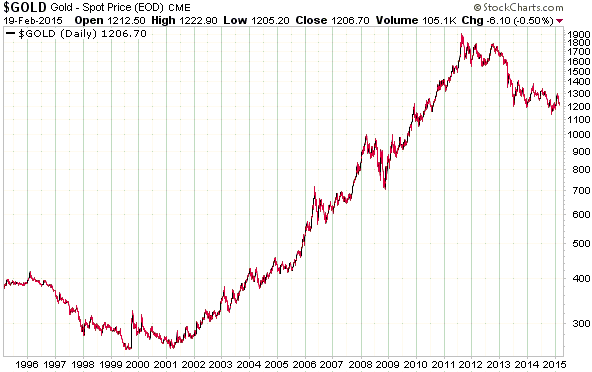
To show what we mean we'll begin with a chart of the US$ gold price covering the
past 20 years. There were booms and busts during this period that are not
evident on this chart. In particular, 2001-2011 contained huge booms and busts,
and yet the gold price trended steadily upward throughout. How could this be?
Armed with the 20/20 vision called hindsight, analysts who did not expect the
large 2001-2011 rise in the US$ gold price and who were completely baffled by it
while it was happening eventually came up with explanations/rationalisations for
it. Some of the most popular explanations involved identifying other things that
trended relentlessly upward during the 2001-2011 period and assuming that the
rise in this other 'thing' caused the rise in the gold price.
For one example, prior to the past two years it was possible to create a chart
that demonstrated a strong positive correlation between the gold price and the
US federal-debt/GDP ratio, provided that you started your chart in the
early-2000s (starting the chart much earlier would reveal that there was
actually no consistent relationship between gold and the debt-GDP ratio*). For a
second example, prior to the past two years it was also possible to create a
chart that demonstrated a strong positive correlation between the gold price and
the US Monetary Base, again provided that you started your chart in the
early-2000s (as is the case with the supposed relationship between the gold
price and the debt/GDP ratio, the relationship between gold and the US Monetary
Base disappears when a longer-term view is taken**). For a third example, some
analysts belatedly linked the 2001-2011 upward trend and subsequent downward
reversal in the gold price to the goings-on in the "emerging" economies. This
explanation is a top contender for our "grasping at straws" award, since, unlike
the linking of gold to the debt/GDP ratio or the Monetary Base, it has
absolutely no logical basis. Not only that, but the net buying of gold by India,
China and Russia, the three most important "emerging" markets, was greater when
the gold price was trending downward during 2012-2014 than when the gold price
was trending upward during 2009-2011.
As intimated in our opening paragraph, the overarching driver of the gold price
(the boom/bust cycle) only becomes clear when gold's RELATIVE performance is
viewed. More specifically, understanding why gold did what it did over a long
period requires looking at how it performed relative to industrial metals.
The fact is that the gold market is generally weak relative to the industrial
metals markets during the boom phase of the inflation-fueled,
central-bank-sponsored boom/bust cycle and strong relative to the industrial
metals markets during the bust phase of the cycle. In other words, the gold/GYX
ratio (gold relative to the Industrial Metals Index) tends to fall during the
booms and rise during the busts. This is due to gold’s historical role as a
store of purchasing power and a hedge against uncertainty.
By shading the bust periods in grey, we’ve indicated the global booms and busts
on the following chart of the gold/GYX ratio. During the 20-year period covered
by this chart there were four busts: the multiple crises of 1997-1998 (the Asian
financial crisis, the Russian debt default and the LTCM blowup), the recession
of 2001-2002 that followed the bursting of the NASDAQ bubble, the global
financial crisis and "great recession" of 2007-2009, and the euro-zone sovereign
debt and banking crisis of 2011-2012. On a relative basis gold was clearly very
strong during the busts and generally drifted lower during the intervening
periods when confidence was rising.
Note that monetary-inflation-fueled booms tend to fall apart more quickly than
they build up, which is why the rising trends in the gold/GYX ratio tend to be
shorter and steeper than the falling trends.
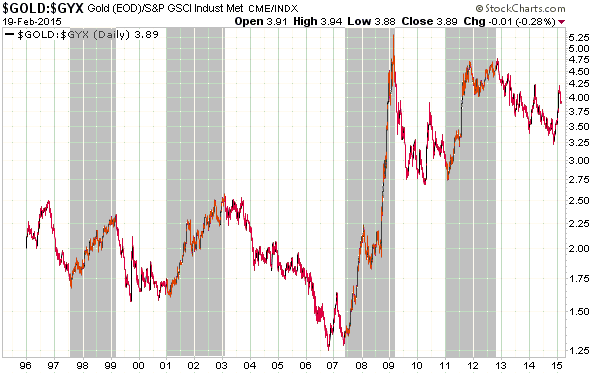
When gold/GYX made a new multi-year low last October it indicated that the
global boom was going to extend into 2015, which it has certainly done. However,
gold/GYX's sharp rise from its November-2014 low to its January-2015 high could
be an early warning that the boom is on its last legs.
Gold/GYX has pulled back far enough from its January peak that a solid break
above that peak would now be a clear signal that the boom has ended or is about
to end.
*Refer to
http://tsi-blog.com/2014/09/does-the-debtgdp-ratio-drive-the-gold-price/ for
additional information
**Refer to
http://tsi-blog.com/2014/10/does-the-monetary-base-drive-the-gold-price/ for
additional informationThe Stock
Market
The US
Current Market Situation
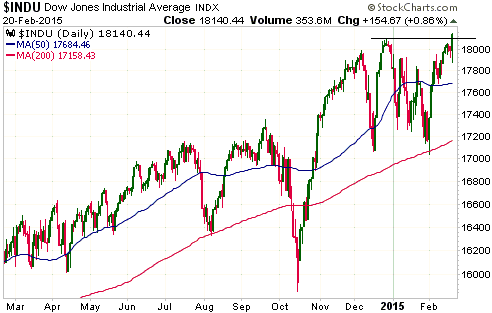
A week ago we wrote that although the breakout hadn't been confirmed by all of
the important US stock indices, it was fair to say that the US stock market had
broken out to the upside and in so doing marked the choppy December-January
price action as a consolidation within an upward trend. Over the ensuing week
the breakout was confirmed by more indices. The following daily charts of the
Russell2000 Index and the Dow Industrials Index are examples.

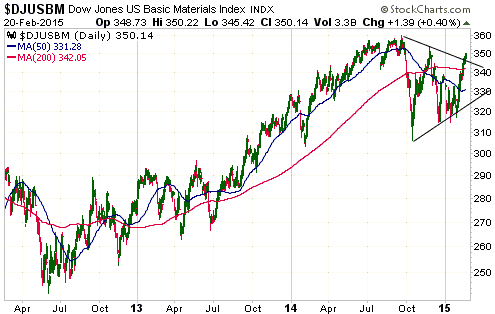
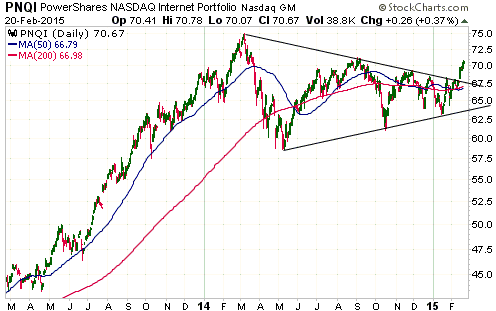
Also, it's worth mentioning that although they haven't exceeded last year's
highs, the Dow Jones Basic Materials Index (DJUSBM) and the PowerShares NASDAQ
Internet ETF (PNQI) broke upward from triangular price patterns last week.
However, there are still some significant non-confirmations among the indices.
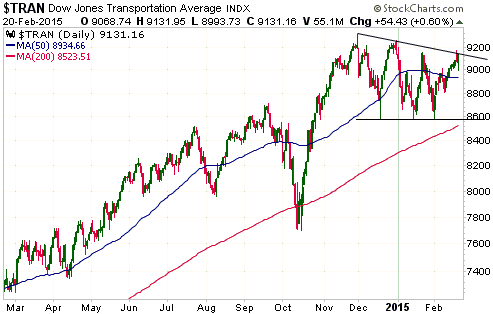
For example, the following chart shows that the Dow Transportation Average
remains below last year's peak and below a declining short-term trend-line. For
what it's worth (not much), the failure of the Dow Transports to confirm last
Friday's upside breakout in the Dow Industrials is a bearish non-confirmation
under "Dow Theory".
A more interesting example of non-confirmation is provided by the chart of the
NYSE Composite Index (NYA) displayed below. The NYA ended last week at lateral
resistance defined by 2014's double top.
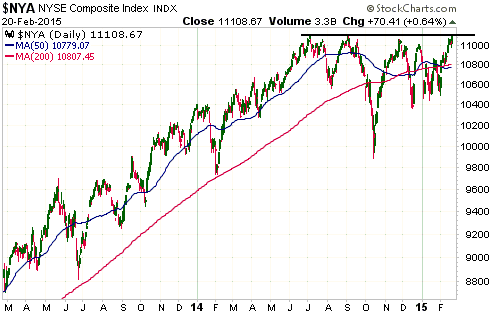
As stated last week, the most probable scenario involves an upside breakout that
fails within a few weeks. This would be similar to how the NYA peaked in 2000
and how several US stock indices peaked in 2007. But as also stated last week,
there is more to be lost than gained by 'jumping the gun' and betting on a
breakout failure before it happens.
The return to 5000
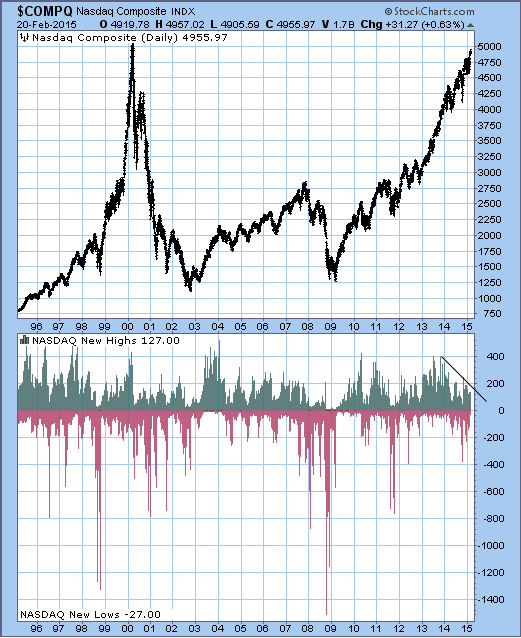
The top section of the following chart shows that the NASDAQ Composite Index
(NAS) has almost made it back to the 'magical' 5000 level, which is where its
spectacular blow-off culminated in March of 2000. It's reasonable to expect that
5000 will act as both a magnet and a ceiling over the weeks immediately ahead,
meaning that the market will be drawn to 5000 but will probably be unable to
make a solid break above it.
The bottom section of the same chart reveals that the NASDAQ's rally has been
getting progressively narrower over the past year or so. Whereas a new
multi-year high by the NAS in late-2013 coincided with 400 individual NASDAQ
stocks making new 12-month highs, last Friday's new multi-year high by the NAS
coincided with only 127 individual NASDAQ stocks making new highs. This is a
bearish divergence, although it is obviously a divergence that is capable of
continuing for a long time.
Japan
EWJ (Japan iShares) has broken out above major resistance at $12.00-$12.20.
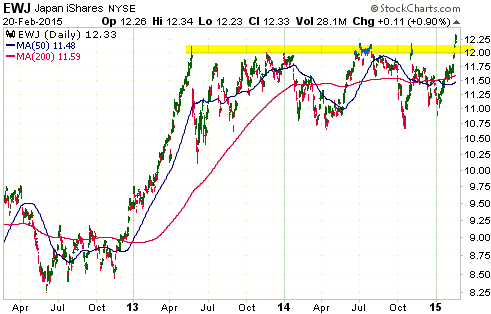
A long position in EWJ is half of our 'Japanese pair trade', the other half
being a long position in the Yen (FXY). At least one half of this pair trade is
likely to work very well, with the profits on the winning half being much
greater than the losses on the losing half.
It's not too late to get involved in this trade. The reason is that although EWJ
is short-term 'overbought' and therefore vulnerable to consolidation/correction
over the weeks immediately ahead, it has the potential to make sizable gains
over the next several months. Furthermore, FXY is 'oversold' over all
timeframes.
This week's
significant US economic events
(The most important events are shown
in bold)
| Date |
Description |
| Monday Feb 23 |
Existing Home Sales
Dallas Fed Mfg Survey | | Tuesday
Feb 24 |
Case-Shiller Home Price Index
Consumer Confidence
Richmond Fed Mfg Index | | Wednesday
Feb 25 |
New Home Sales | | Thursday
Feb 26 |
CPI
Durable Goods Orders
Kansas City Fed Mfg Index
|
| Friday Feb 27 |
Q4-2014 GDP (revised)
Chicago PMI
Consumer Sentiment
Pending Home Sales Index |
Gold and
the Dollar
Gold
When gold spiked above US$1300/oz in January we said that it was probably close
to a multi-week high in US$ terms and a multi-month high in non-US$ terms. In
US$ terms it was sufficiently 'overbought' on a short-term basis to set the
stage for a significant correction, with $1250 being a likely initial target for
the correction even if the upward spike continued to as high as $1350. In
non-US$ terms the gold market was stretched to the upside on an
intermediate-term basis, thus paving the way for a lengthy correction. In fact,
by one reliable measure (re-visited below) it was as stretched to the upside as
it ever gets. The correction of the past 4 weeks has therefore not come as a
surprise.
It will never be possible to know, in advance, how far a correction will extend.
It will not even be possible to know, in advance, that a pullback or rebound is
a correction to an existing trend as opposed to the first leg of a new trend in
the opposite direction. We can (and usually do) make guesses regarding the
extent of a correction based on support levels and historically-typical
retracement amounts, but the reality is that corrections continue until they
have done what they need to do. In the case of a downward correction, what they
generally need to do is push momentum indicators back to neutral or moderately
'oversold' levels and eradicate speculative enthusiasm. In this way the
correction sets the stage for the next leg higher (in the case of an upward
trend) or lower (in the case of a downward trend).
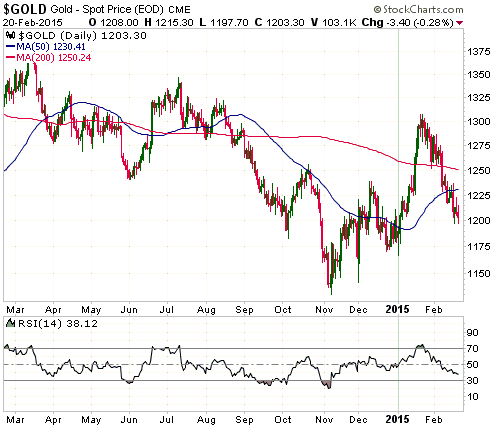
With regard to the US$ gold price, the correction of the past 4 weeks has done
almost as much as it needed to do. In particular, the RSI (a momentum indicator)
included at the bottom of the following daily chart has fallen from above 70 to
below 40 and the total speculative net-long position in COMEX gold futures has
fallen by 62K contracts from its late-January peak.
In our 2015 Yearly Forecast and again in the 11th February Interim Update we
said that the US$ gold price would probably drop to test its November-2014
bottom if the US stock indices broke above last year's highs. Owners of
gold-related investments should therefore be prepared for a test of last year's
low. That being said, it's unlikely that such a test will happen over the next
few weeks. Our expectation, based on current gold-market sentiment and our views
on other markets, is that the US$ gold price will make a short-term bottom
within the next two weeks (probably early-March) at well above last year's low
and then rally for a few weeks. If this multi-week rally happens it will likely
result in a lower high for the year in the gold price and higher highs for the
year in the gold-mining indices.
Keep in mind that the fundamental backdrop for gold-mining stocks is currently
more bullish than the fundamental backdrop for gold bullion.
In the case of the non-US$ gold price, the correction is probably more than half
over in terms of price and a lot less than half over in terms of time. We'll try
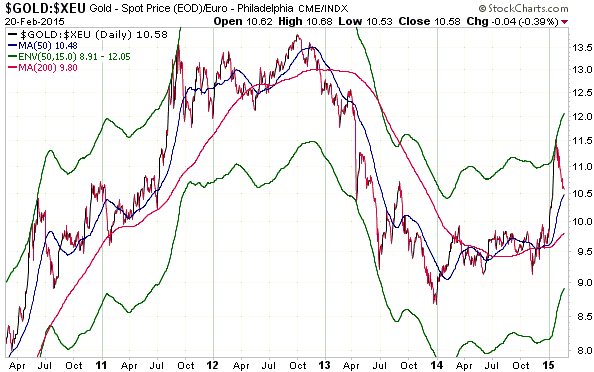
to explain why with the help of the following chart. The chart shows the
euro-denominated gold price (gold/euro), the 50-day and 200-day MAs for
gold/euro, and a 15% envelope around gold/euro's 50-day MA. This MA envelope has
always limited intermediate-term gold/euro rallies in the past, even during the
strong bull-market years of 2009-2011.
Based on the historical record, anyone who was expecting gold/euro to make large
additional short-term gains after it hit the top of the aforementioned MA
envelope in late January was kidding themselves. Unless it was going to be
different this time, the rise to the top of the envelope indicated that a
correction lasting at least a few months would soon begin.
In the past, the corrections that have followed surges by gold/euro to the top
of its 50/15 MA envelope have always continued until the 200-day MA was reached.
We don't know of a good reason why it will be different this time, so we expect
a return by gold/euro to its 200-day MA prior to the start of a rally to new
multi-year highs. The 200-day MA is rising, so the longer it takes for the price
to get to the MA the higher the price will be when the intersection occurs. Our
guess is that the intersection will occur at least two months from now with the
price above 1000 euros.
Gold Stocks
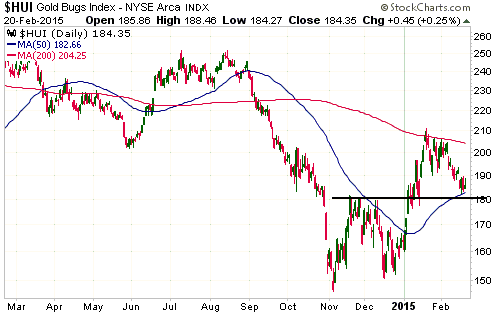
Despite the US$ gold price having fallen by around $100 from its January peak,
the HUI has managed to hold above lateral support at 180 and its 50-day MA. To
maintain its potential to reach new highs for the year during the next
multi-week gold rally, the HUI must continue to hold above 180 on a daily
closing basis.
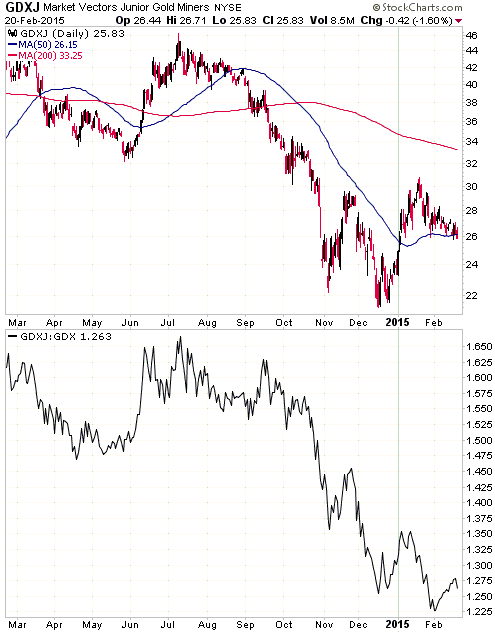
Although it has strengthened a little in relative terms since the beginning of
this month, GDXJ, a proxy for the junior end of the gold-mining universe, has
continued to trend downward relative to GDX (a proxy for the stocks of
larger-scale gold miners) since the November-2014 bottom. Although we didn't
anticipate this relative weakness, we can explain it by pointing out that the
more speculative stocks will often underperform early and outperform late in an
intermediate-term rally.
Unlike the HUI, which held above its 50-day MA last week, GDXJ ended the week
below its 50-day MA.
As noted above, whereas the next multi-week rally in gold bullion will probably
be within the context of an on-going correction, we expect that the next
multi-week rally in the gold-mining sector will result in new highs for the
year. If it pans out this way then the 2014-2015 bottoming process will start to
look very much like the 2000-2001 bottoming process.
The Currency Market
Greece
Last Friday the Greek government did a deal with the rest of the euro-zone (EZ)
that effectively gave the parties an additional 4 months to re-negotiate the
terms of the Greek government's on-going 'financial rescue'. In a televised
statement on Saturday, Greek Prime Minister Alexis Tsipras essentially declared
victory. He said: "Yesterday we took a decisive step, leaving austerity, the
bailouts and the troika behind."
This is strange, because from our perspective the new Greek government has not
yet won a single concession. Instead, it seems to be going along with the
"extend and pretend" strategy that it railed against prior to being elected and
during its first couple of weeks in power.
In any case, the financial positions of Greece's government and banking system
no longer appear to be urgent issues. The so-called bailout money will continue
to flow while negotiations proceed over the coming four months.
Current Market Situation
Last Friday's news about the Greek government's temporary deal doesn't change
anything. We can't rule out the possibility that there will be a marginal new
low in the euro and high in the Dollar Index within the next couple of weeks,
but multi-month moves upward in the euro and downward in the Dollar Index will
probably soon begin. These moves will initially be powered by the covering of
the massive speculative short position in the euro futures market, but the
primary fundamental driver will be strength in European equities relative to US
equities.
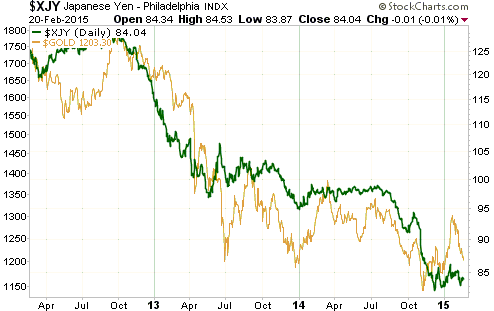
The Yen is in a similar position to the euro. It hasn't yet done enough to
signal an upward trend reversal, which means that we can't rule out the
possibility that it will make a marginal new low in the near future, but a
tradable rally should soon begin. Due to the fact that the Yen has been trading
with the US$ gold price over the past few years (see the chart below for
details), there's a good chance that the coming short-term bottom in the gold
price will coincide with a turnaround in the Yen.
Updates
on Stock Selections
Notes: 1) To review the complete list of current TSI stock selections, logon at
http://www.speculative-investor.com/new/market_logon.asp
and then click on "Stock Selections" in the menu. When at the Stock
Selections page, click on a stock's symbol to bring-up an archive of
our comments on the stock in question. 2) The Small Stock Watch List is
located at http://www.speculative-investor.com/new/smallstockwatch.html
 Company
news/developments for the week ended Friday 20th February 2015: Company
news/developments for the week ended Friday 20th February 2015:
[Note: AISC = All-In Sustaining Cost, FS = Feasibility Study, IRR = Internal
Rate of Return, MD&A = Management Discussion and Analysis, M&I = Measured and
Indicated, NAV = Net Asset Value, NPV(X%) = Net Present Value using a discount
rate of X%, P&P = Proven and Probable, PEA = Preliminary Economic Assessment,
PFS = Pre-Feasibility Study]
*Endeavour Mining (EDV.TO, EVR.AX) provided updated information on
the economics of the Hounde gold project in Burkina Faso. Based on the FS
completed in November of 2013, the Hounde project would be economically viable,
but not robust, at a gold price of $1300/oz. However, according to the updated
information provided last week, exploration success has resulted in a 34%
increase in the project's gold reserves, which, in turn, has greatly improved
the economics. The project is now estimated to be more profitable at $1200/oz
than it was previously estimated to be at $1300/oz, which is obviously very good
news.
At $1200/oz, Hounde is now estimated to have an IRR and NPV(5%) of 28% and
US$302M, respectively. The initial capital cost is expected to be US$325M.
Based on the figures reported last week and the earlier receipt of a mining
permit, it clearly makes sense for EDV to move the Hounde project into the
construction phase if, and only if, it can arrange reasonable-cost financing.
Separately, EDV announced a net increase of 400K ounces in its company-wide
reserves over the course of 2014. The net increase stems from 850K ounces of new
reserves less 450K ounces of mining depletion.
*Energy Fuels (EFR.TO, UUUU) advised that it has purchased 50% of
the exploration-stage Wate uranium project in northern Arizona. The Wate
project's uranium deposit is similar to the deposits at the Pinenut and Canyon
mines operated by EFR. It is anticipated that future production from the Wate
Project would be processed at EFR's White Mesa uranium mill in Utah, which is
currently the only operating uranium mill in the U.S.
The purchase price is $250K to be paid immediately followed by $500K over the
next two years. The acquisition is therefore not financially significant for EFR.
*Evolution Mining (EVN.AX): When EVN issued very good quarterly
production results last month, we wrote that we wouldn't know the extent to
which these production results had boosted the company's balance sheet until we
saw the Half Year report. The Half Year report was published last week.
EVN reported a record net profit of A$43M, or about A$0.06/share, for the half
year ended 31st December 2014. Importantly, there was significant free cash-flow
generation during the period, with the company's net debt position (long-term
debt minus working capital) falling by $23M. Net debt is now only A$93M, which
is an easily-manageable amount for a profitable 440K-oz/yr gold producer. Also,
a 1c/share dividend will be paid to shareholders registered at 27 February.
Due to the increase in the A$-denominated gold price, EVN's profit during the
first half of this year (the second half of the company's financial year) should
comfortably exceed the record achieved during the preceding half. Moreover, EVN
should generate enough cash over the next few quarters to completely pay off its
debt, although we doubt that EVN's management will want or allow the balance
sheet to become debt free. It's more likely that with the company now strongly
cash-flow positive and its balance sheet in good shape, EVN will go on the
acquisition trail. This could be good or bad news for shareholders, depending on
the asset purchased and the purchase price. Assuming the price was right, it
seems to us that the 260K-oz/yr Cowal gold mine in New South Wales, which has
just been put up for sale by Barrick Gold, would be a reasonable addition to
EVN's portfolio.
We continue to expect that EVN will trade north of A$1.50/share before this year
is over.
*Golden Star Resources (GSS) published its financial results for
Q4-2014 and for the past 12 months.
Despite an improved production performance during the final quarter of last
year, the company's balance sheet has continued to deteriorate. There is now a
working capital deficit of US$32M and net debt of $148M. The net debt figure
includes $78M of convertible debentures* and is up from $126M at 30th September
2014.
GSS does not appear to be in immediate danger of going broke, but the
combination of its balance sheet and its cost structure makes it too risky for
new buying at the current gold price. New buying probably won't be appropriate
until there is a sustained move in the gold price to more than $1300/oz and/or
the company receives a large-enough injection of new capital to enable the
development of underground operations at Wassa and Prestea. It is estimated that
these underground operations could reduce the AISC to around $750/oz, enabling
GSS to become cash-flow positive at a much lower gold price.
At current stock and metal prices it makes a lot more sense to own EDV.TO than
to own GSS. This is because EDV has just as much upside potential as GSS and a
lot less risk. Consequently, if you own GSS and do not own EDV, we think that it
would be a good idea to sell GSS and buy EDV.
*GSS's balance sheet shows a liability of only $47M for
the convertible debentures. This is the calculated market value of these
debentures, but the full amount of the liability (the amount that will have to
be paid when the debentures mature in 2017) is $78M.
*Ramelius Resources (RMS.AX) published its Half Year report for
the period ending 31st December 2014. The report reflected a return to
profitability and strengthening of the balance sheet.
Importantly, RMS now has working capital of A$21M and long-term debt of only
A$1M. This means that the company is well-positioned to fund the new small-scale
mines that it plans to develop over the next several months.
Also, RMS announced that it has forward sold 47K ounces of gold for delivery
over the next 2 years at an average price of A$1582/oz. This was a reasonable
move, as the hedging only covers about 20% of the company's expected production
over the period (meaning: there is still plenty of exposure to future upside in
the gold price) and was done with the A$-denominated gold price near a 2-year
high. Assuming current cost levels, the hedging locks in a healthy profit margin
for 47K ounces of future production.
*Timmins Gold (TGD) has agreed to buy Newstrike Capital (NES.V) in
an all-stock deal in order to obtain NES's exploration-stage Ana Paula gold
project in Guerrero, Mexico. Assuming the deal is approved by the shareholders
of both companies, each NES share will be exchanged for 0.9 TGD shares. This
will result in the combined company being 63%-owned by former TGD shareholders
and 37%-owned by former NES shareholders.
We'll state up front that this latest TGD acquisition is more sensible than its
December-2014 purchase of the exploration-stage Caballo Blanco gold project in
Veracruz, Mexico. How could it not be, given that the Caballo Blanco purchase
involved paying $26M for a deposit that has almost zero chance of ever being
developed into a mine due to the virtual impossibility of getting all necessary
permits and approvals. In other words, the Caballo Blanco purchase involved
paying $26M for something with zero value. Although it is in a far-from-ideal
location from a political/drug-cartel/security perspective*, the Ana Paula
project probably can be permitted and does have significant value.
A PEA completed last September indicates that for a capital cost of US$164M Ana
Paula could be developed into an open-pit 116K-oz/yr gold mine with an AISC of
only $567/oz. At a gold price of $1300/oz, the after-tax NPV(5%) and the IRR are
estimated to be $232M and 32.8%, respectively. Moreover, at a gold price of
$1200/oz the figures are $185M and 28.1%, which suggests that the project would
be economically viable at the current gold price. The M&I resource is 1.86M
ounces.
At US$1.00 per TGD share, which was roughly the price at the time the deal was
announced, the acquisition values the Ana Paula project at around US$105M. This
is moderately expensive assuming a gold price of $1200/oz, but would be a
reasonable price to pay assuming a gold price of $1300/oz. That is, TGD appears
to be over-paying considering the current gold price. However, TGD's management
believes that the Ana Paula project's economics can be improved.
Associated with the NES acquisition, TGD will raise US$8M by issuing 8M new
shares at US$1.00/share to current substantial shareholders in the company and
other accredited investors. The price at which these relatively knowledgeable
investors are buying shares is almost 20% above the current market price.
*The risk of
living/working in Guerrero state is highlighted by the
2014 mass
kidnapping and murder of students and the
recent kidnapping
of 12 people from near the mine being built by Torex Gold.
List of candidates for new buying
From within the ranks of TSI stock selections the best candidates
for new buying at this time, listed in alphabetical order, are:
1) AAU (last Friday's closing price: US$1.10).
2) AKG (last Friday's closing price: US$1.55).
3) EDV.TO (last Friday's closing price: C$0.58).
4) EVN.AX following a pullback to the low-A$0.80s (last Friday's
closing price: A$0.90).
5) TGD (last Friday's closing price: US$0.84).
Note that the above list is limited to five stocks. It will
sometimes contain less than five, but it will never contain more
than five regardless of how many stocks are attractively priced for
new buying.
Chart Sources
Charts appearing in today's commentary
are courtesy of:
http://stockcharts.com/index.html

|









