|
-- Weekly Market Update for the Week Commencing 23rd June 2014
Big Picture
View
Here is a summary of our big picture
view of the markets. Note that our short-term views may differ from our
big picture view.
In nominal dollar terms, the BULL market in US Treasury Bonds
that began in the early 1980s ended in 2012. In real (gold)
terms, bonds commenced a secular BEAR market in 2001 that will continue
until 2018-2020. (Last
update: 20 January 2014)
The stock market, as represented by the S&P500 Index,
commenced
a secular BEAR market during the first quarter of 2000, where "secular
bear market" is defined as a long-term downward trend in valuations
(P/E ratios, etc.) and gold-denominated prices. This secular trend will bottom sometime between 2014 and 2020.
(Last update: 22 October 2007)
A secular BEAR market in the Dollar
began during the final quarter of 2000 and ended in July of 2008. This
secular bear market will be followed by a multi-year period of range
trading.
(Last
update: 09 February 2009)
Gold commenced a
secular bull market relative to all fiat currencies, the CRB Index,
bonds and most stock market indices during 1999-2001.
This secular trend will peak sometime between 2014 and 2020.
(Last update: 22 October 2007)
Commodities,
as represented by the Continuous Commodity Index (CCI), commenced a
secular BULL market in 2001 in nominal dollar terms. The first major
upward leg in this bull market ended during the first half of 2008, but
a long-term peak won't occur until 2014-2020. In real (gold) terms,
commodities commenced a secular BEAR market in 2001 that will continue
until 2014-2020.
(Last
update: 09 February 2009)
Copyright
Reminder
The commentaries that appear at TSI
may not be distributed, in full or in part, without our written permission.
In particular, please note that the posting of extracts from TSI commentaries
at other web sites or providing links to TSI commentaries at other web
sites (for example, at discussion boards) without our written permission
is prohibited.
We reserve the right to immediately
terminate the subscription of any TSI subscriber who distributes the TSI
commentaries without our written permission.
Outlook Summary
Market
|
Short-Term
(1-3 month)
|
Intermediate-Term
(6-12 month)
|
Long-Term
(2-5 Year)
|
|
Gold
|
Bullish
(10-Jun-14) |
Bullish
(26-Mar-12) |
Bullish
|
|
US$ (Dollar Index)
|
Bearish
(16-Apr-14) |
Bearish
(27-Jan-14) |
Neutral
(19-Sep-07) |
|
Bonds (US T-Bond)
|
Bullish
(11-Dec-13)
|
Neutral
(18-Jan-12)
|
Bearish |
|
Stock Market
(DJW)
|
Bearish
(07-Apr-14) |
Bearish
(28-Nov-11) |
Bearish
|
|
Gold Stocks
(HUI)
|
Bullish
(10-Jun-14) |
Bullish
(23-Jun-10) |
Bullish
|
|
Oil |
Neutral
(02-Jun-14) |
Neutral
(31-Jan-11) |
Bullish
|
|
Industrial Metals
(GYX)
|
Neutral
(17-Feb-14) |
Bullish
(28-Apr-14) |
Bullish
(28-Apr-14) |
Notes:
1. The date shown below the current outlook is when the most recent outlook change occurred.
2. "Neutral", in the above table, means that we either don't have a
firm opinion or that we think risk and reward are roughly in balance with respect to the timeframe in question.
3. Long-term views are determined almost completely by fundamentals,
intermediate-term views by
fundamentals, sentiment and technicals, and short-term views by sentiment and
technicals.
US money pumping by decade
and Fed chairman
A large increase in the money supply will
always lead to large increases in prices somewhere in the economy. However,
monetary inflation affects different prices in different ways at different
times, so the pertinent question is: which prices? The answer to this question
is important from the perspective of almost everyone and is always obvious with
the benefit of hindsight, but it is often difficult to determine ahead of time.
Also, depending on which prices are affected the inflation will sometimes be
widely perceived as a problem and at other times be widely perceived as a
benefit or a non-issue.
Due to the dramatic differences in the general perception of inflation that stem
from the specific details of inflation-related price rises, in the US there has
been no correlation over the past several decades between the amount of monetary
inflation and the extent to which "inflation" is perceived as a problem. As
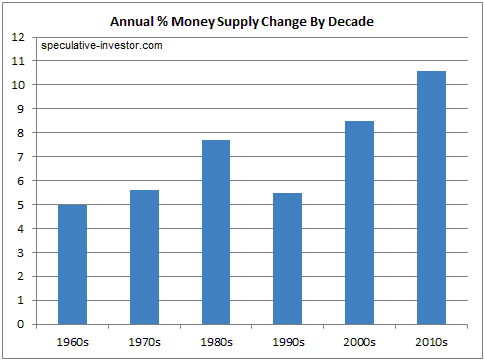
evidence we present the following bar chart showing the compound annual growth
in the US True Money Supply (TMS) during each decade since the 1960s. Of
particular interest, the 1970s is widely considered to be a decade when
"inflation" was out of control, but our chart shows that the money supply grew
at a much faster average pace during the supposedly 'disinflationary' 1980s than
during the 1970s. Also, during the first 4 years and 5 months of the current
decade the US money supply grew almost twice as fast as it did during the 1970s,
and yet very few people perceive a US inflation problem at this time.
The lack of correlation between the amount of monetary inflation and the general
perception of "inflation" leads to a lack of correlation between the general
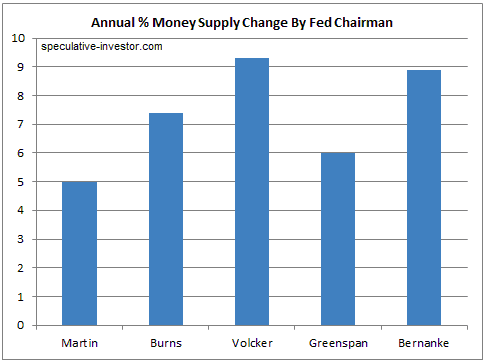
perception of a Fed Chairman's performance and his/her actual performance. Paul
Volcker is the best example. Volcker is generally considered to have been a
hard-nosed inflation-fighter, but based on annual rate of growth in the money
supply he currently holds the record as the most inflationary Fed Chairman of
the past 60 years. Ben Bernanke is in second place, followed by Arthur Burns
(Fed chief during most of the 1970s), Alan Greenspan, and then William McChesney
Martin (Fed chief during the 1950s and 1960s). Refer to the following bar chart
for specific details.
Note: The chart omits George Miller, who was Fed Chairman for only 17 months
during 1978-1979, and Janet Yellen, who only recently took over from Ben
Bernanke.
On a related matter, Volcker is widely regarded as a hard-nosed inflation
fighter simply because a commodity-price collapse got underway within 6 months
of his August-1979 appointment as Fed Chairman. However, thanks to the steep
decline in the money-supply growth rate that began in late-1977 and the fact
that the US had spent the 6 months prior to August-1979 in monetary deflation, a
commodity price collapse was 'baked into the cake' when Volcker took the helm of
the Fed. Whoever was appointed Fed Chairman in August 1979 would now have the
credit for having ended the "great inflation" of the 1970s, almost regardless of
what actions they took.
Finally, it's actually a problem that the rapid money-supply growth of the past
5 years has not yet led to general concern about "inflation". It all but
guarantees that the Fed will continue to react to economic and/or stock-market
weakness by pumping up the money supply, especially since the new Fed Chair
clearly believes that the central bank can create jobs and economy-wide
prosperity by adjusting monetary levers and the price of credit. The likely
result will be an economic bust within the next few years that dwarfs what
happened during 2007-2009.
T-Bond Update
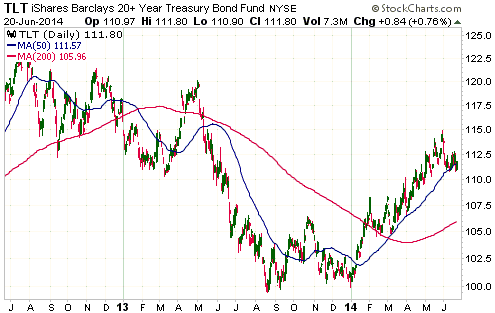
TLT, an ETF proxy for long-dated US Treasury
securities, is probably close to completing a routine short-term correction
within an on-going upward trend.
Our view that TLT's recent pullback to the vicinity of its 50-day MA will be
followed by a rise to new highs for the year is supported by a very bullish
sentiment mismatch in the Treasury futures market. We are referring to the fact
that despite the bullish price action of the past six months, speculators, as a
group, continue to bet heavily on falling 10-year T-Note prices (rising 10-year
interest rates).
 The Stock
Market
The US
Perhaps we are clutching at straws to justify the maintenance of a bearish
outlook in the face of a continuing upward trend, but we think the following
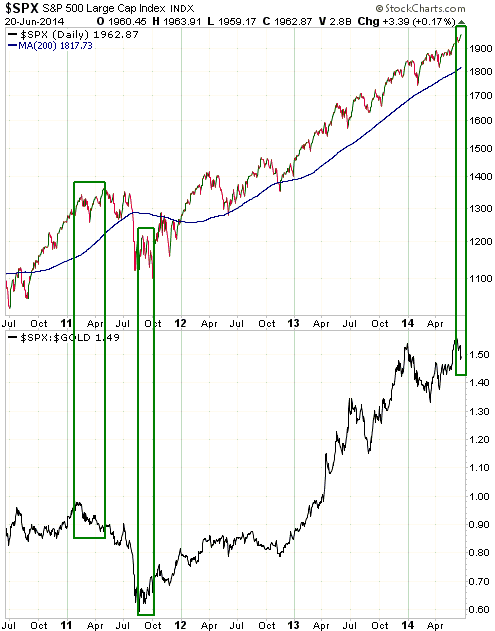
chart comparison of the SPX (S&P500 Index) and the SPX/gold ratio is another
reason to anticipate a top of at least intermediate-term significance.
The chart's message is that divergences between the SPX and the SPX/gold ratio
are important. For example, when the SPX/gold ratio began to trend downward in
early-2011 while the SPX continued along its upward path it was a sign that the
SPX's next meaningful multi-month move would be to the downside, and when the
SPX/gold ratio began to trend upward in August of 2011 while the SPX remained
weak it was a sign that the SPX's next meaningful multi-month move would be to
the upside.
There is currently no evidence in the SPX's price action that its upward trend
is about to end. However, the SPX/gold ratio reversed downward two weeks ago
after making only a marginal new high for the year. Provided that the downward
reversal in the SPX/gold ratio 'sticks', this suggests to us that the SPX's next
meaningful multi-month move will be to the downside.
Japan
Although Japan's Nikkei225 Index is still lower than it was at the beginning of
the year, it has stubbornly refused to break down and has recently been stronger
than expected. As things currently stand, the Nikkei's so-called "Death Cross"
in early-April marked the low for the year.
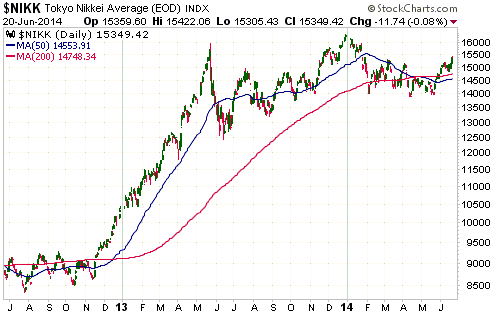
The Nikkei is short-term 'overbought' and probably won't make much additional
headway before pulling back, but if it remains at or above its 50-day MA during
any 'corrective' activity over the next few weeks then the sideways trading of
the past year will start to look more like a mid-trend consolidation than a
topping pattern.
This week's
important US economic events
| Date |
Description |
| Monday Jun 23 |
Existing Home Sales | | Tuesday
Jun 24 |
Case-Shiller Home Price Index
New Home Sales
Consumer Confidence
Richmond Fed Mfg Index | | Wednesday
Jun 25 |
Durable Goods Orders
Q1 GDP (revised) | | Thursday
Jun 26 |
Personal Income and Spending
Kansas City Fed Mfg Index
|
| Friday Jun 27 |
Consumer Sentiment |
Gold and
the Dollar
Gold
Current Market Situation
The gold price broke out to the upside last Thursday, signaling an end to the
correction that began in March. The upward reversal was not surprising, but its
exact timing was unpredictable.
The gold market is likely to test resistance at $1400 within the next two months
and could trade as high as $1500 before year-end, but we have no opinion on what
it will do over the next two weeks. The RSI shown at the bottom of the following
daily chart reveals that the market is now short-term 'overbought', but this
only means that a 1-2 week consolidation would not be out of the ordinary. It
doesn't mean that the price won't continue to move higher. For example, the gold
price continued to move higher for about three weeks after the daily RSI reached
a similar 'overbought' level in February.
What we can say is that the 50-day and 200-day moving averages, which are
currently in the $1285-$1290 range, should act as a price floor if a pullback
begins in the near future.
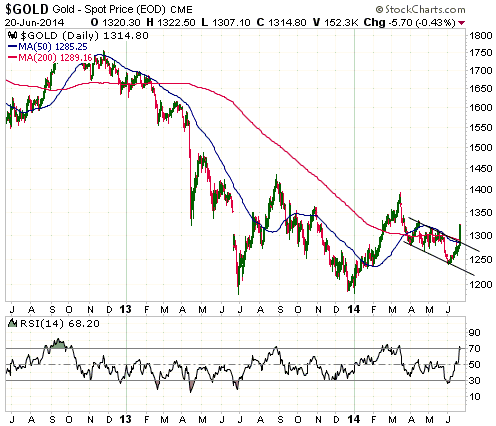
By the way, while the historical record indicated that the so-called "Golden
Cross" (the 50-day MA crossing from below to above the 200-day MA) that occurred
in March would probably mark a short-term price high and that the so-called
"Death Cross" (the 50-day MA crossing from above to below the 200-day MA) that
occurred at the end of May would probably mark a short-term price low, the next
Golden Cross -- which is likely to occur within the coming month -- will have no
predictive value.
The reason for the gold reversal
Despite much press coverage putting last week's sharp rise in the gold price
down to increasing Iraq-related tensions and/or the Fed's confirmation that
official US interest rates would not be raised for a long time, neither
explanation rings true. First, increasing tension in Iraq would affect the oil
market more than the gold market and would also affect the equity and bond
markets, but there were no signs of heightened concerns about Iraq in any of
these markets. Second, the Fed's plan to keep its targeted interest rate near
zero for the foreseeable future is not news. Everyone was already aware of this.
It could be argued that by emphasising her devotion to hopelessly flawed
Keynesian ideas at a press conference last Wednesday, Janet Yellen gave a gentle
downward push to confidence in the Fed. Given that gold's perceived value is the
reciprocal of confidence in the Fed, this could have helped to 'get the gold
ball rolling'. However, last Thursday's surge in the gold price had been
telegraphed well in advance by the performance of the gold-mining sector, so we
don't think it makes sense to attribute the rise to any particular piece of
recent news.
We think the upward reversal can be adequately explained by the combination of
fundamental drivers and a bullish mismatch between sentiment and price action
(sentiment had become far more bearish than warranted by the price action). As
stated in the 9th June Weekly Update: "It seems that almost every 'technical
analyst' on the planet is calling for gold and the gold-mining indices to make
new lows within the next few months. The long-term bulls expect a final decline
to marginal new lows prior to the start of a multi-year upward trend, whereas
the long-term bears expect a decline to well below last year's lows as part of a
continuing bear market. Enough strength over the weeks ahead to confirm that the
March-June decline was a correction to a new upward trend rather than the
continuation of the 2011-2013 downward trend would therefore catch the maximum
number of chart-huggers and price-followers off guard. This doesn't mean that
gold is about to reverse course and prove the majority wrong, but it does mean
that there is plenty of sentiment-related fuel to propel the price upward. As
discussed in previous commentaries, there is also now plenty of
fundamentals-related fuel for a gold rally..."
Silver
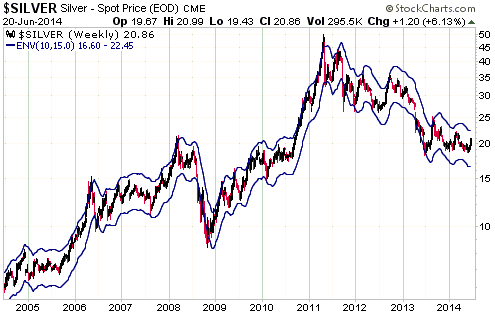
The silver market also broke out to the upside last week. The breakout is not
clearly evident on the following 10-year weekly chart, but it is obvious on
short-term daily charts.
Except for those periods when the silver market is either crashing or immersed
in a manic upside blow-off, the significant swings in the silver price are
usually limited by a 15% envelope around its 10-week moving average. This
envelope is represented by the blue lines on the following chart. An implication
is that the silver price is likely to rise to $22.50-$23.00 within the next
several weeks, but is unlikely to make a sustained move above $23 in the
short-term.
The view that silver's short-term upside potential is limited to about 10% is
consistent with the fact that the silver/gold ratio is now very 'overbought' on
a short-term basis (while remaining 'oversold' on a long-term basis).
Gold Stocks
The decline from the March-2014 peak was deeper and longer than originally
expected (we originally thought that the HUI's decline would not go beyond the
220s), but there was never much doubt that it would turn out to be a correction.
To put it another way, there was never a realistic chance that it would prove to
be a continuation of the 2011-2013 bear market.
The positive divergence between the GDXJ/GDX ratio and the HUI from mid-April
through to mid-May was the first evidence that the correction was nearing its
conclusion. More evidence came on 10th June, when the outperformance of the
junior end of the gold sector, as indicated by the GDXJ/GDX ratio, went from
interesting to dramatic. The 10th June price action prompted us to send out an
email alert in which we noted the increasing weight of evidence that a
short-term bullish scenario was developing and upgraded our short-term outlooks
for both gold and gold stocks to "bullish".
There will necessarily remain a smidgen of doubt until after prices make new
highs for the year, but as a result of last week's market action it's now a
near-certainty that a) the decline from the March high was corrective in nature
and b) a rally to a new high for the year is in progress. Of greater interest,
however, is that last week's price action generated additional evidence that a
new cyclical bull market commenced in December. The evidence to which we are
referring is illustrated by the following weekly charts.
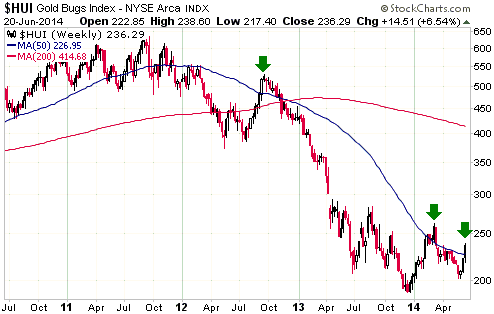
The first weekly chart shows the HUI relative to its 50-week MA. The HUI has
just achieved a weekly close above its 50-week MA, which is not in itself a
reliable bullish signal. After all, the HUI also achieved a weekly close above
its 50-week MA in September of 2012, shortly before it embarked on a huge
multi-quarter decline. In this case it is bullish, though, because by closing
above its 50-week MA in March of this year and again last week the rise from the
December-2013 bottom has differentiated itself from the counter-trend rally that
unfolded during 2012.
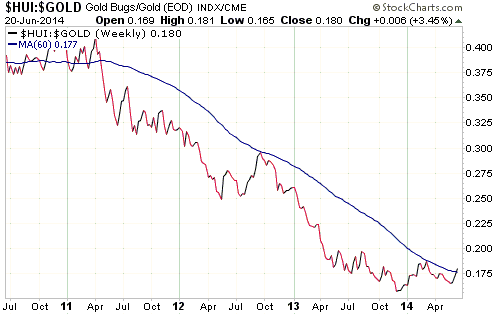
The second weekly chart shows the HUI/gold ratio relative to its 60-week MA. By
ending last week above its 60-week MA the HUI/gold ratio has done something it
hasn't done since early-2011. This is another clear sign that the advance from
the December-2013 bottom is different from any of the rallies that occurred over
the preceding two years. It is a sign that we are dealing with a new bull
market, not a bear-market rebound.
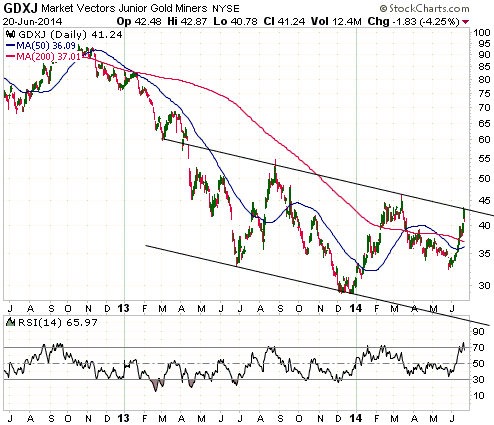
The junior end of the gold-mining sector, represented by GDXJ, has led to the
upside and the downside. Over the past few weeks it has led to the upside, but
by the close of trading last Thursday it was short-term 'overbought' and at
intermediate-term resistance. It would therefore be normal if GDXJ were to
consolidate before resuming its advance, but it's unlikely that anything more
than a 1-2 week top is in place.
Quarterly changes to indexes and index trackers such as GDXJ had big effects on
many junior gold and silver mining stocks last week. These effects included some
big-percentage high-volume moves last Friday. Last Friday's moves are likely to
be at least partially retraced on Monday, after which normal trading should
resume.
The Currency Market
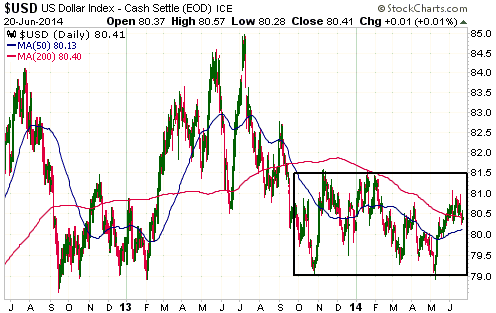
Over the past 9 months the Dollar Index has oscillated between 79.0 and 81.5. A
break through either the top or the bottom of this range would likely be
followed by a tradable multi-month move in the direction of the breakout. We are
expecting a downward breakout.
Over the past three weeks the Dollar Index has traded in a very narrow range
near its 200-day MA. Unfortunately, there is nothing in this price action to
suggest whether the next move of consequence will be to the upside or the
downside.
The performance of the Dollar Index is mostly determined by the performance of
the US$/euro exchange rate. Not surprisingly, therefore, the euro's recent
trading has been as non-committal as that of the Dollar Index.
That being said, we are encouraged to maintain our short-term bearish outlook
for the Dollar Index by two developments. First, last week's upside breakouts in
the gold and silver markets could be signaling future weakness in the US$.
Second, the speculative net-short position in euro futures just hit its highest
level since May of last year. The last time speculators were as bearish on the
euro as they are right now, the euro was close to an important bottom.
Updates
on Stock Selections
Notes: 1) To review the complete list of current TSI stock selections, logon at
http://www.speculative-investor.com/new/market_logon.asp
and then click on "Stock Selections" in the menu. When at the Stock
Selections page, click on a stock's symbol to bring-up an archive of
our comments on the stock in question. 2) The Small Stock Watch List is
located at http://www.speculative-investor.com/new/smallstockwatch.html
 Company
news/developments for the week ended Friday 20th June 2014: Company
news/developments for the week ended Friday 20th June 2014:
[Note: AISC = All-In Sustaining Cost, FS = Feasibility Study, IRR =
Internal Rate of Return, MD&A = Management Discussion and Analysis,
M&I = Measured and Indicated, NAV = Net Asset Value, NPV(X%) = Net
Present Value using a discount rate of X%, P&P = Proven and
Probable, PEA = Preliminary Economic Assessment, PFS =
Pre-Feasibility Study]
*Asanko Gold (AKG) updated the market on its progress. Detailed
engineering and early works programs are proceeding on schedule,
with ground breaking at the plant site for Phase 1 of the Asanko
gold mine development expected to happen in August. An updated
capital cost estimate is in the final stages, a preliminary mine
plan is expected to be ready in July and a final mine plan is
expected to be complete within the ensuing two months.
The detailed mine plan and the updated capital cost estimate will be
combined with an updated resource estimate into a Definitive Project
Plan, which is scheduled to be completed in Q4 2014.
*Energy Fuels (EFR.TO, UUUU) obtained a Wyoming-based gold-copper
project, known as the Copper King (CK) project, when it bought
Strathmore Minerals last year. This non-core project has a low-grade
resource comprising roughly 1M ounces of gold and 300M pounds of
copper.
The CK project has been transferred into a new company called CK
Mining Corp. in exchange for some cash and 50% of the shares of CK
Mining. The remaining interest in CK Mining will be held by a
private investor group with extensive experience in developing gold
projects and building mining companies.
This deal seems like a reasonable way for EFR to obtain value from
an asset that is presently being assigned no value.
*Evolution Mining (EVN.AX) announced during the week before last
that it had entered into a farm-in and JV agreement with Emmerson
Resources (ERM.AX) over the Tennant Creek gold-copper project in
Australia's Northern Territory. EVN can earn 65% of the project,
which is very prospective and has a current high-grade resource of
900K ounces, by spending $15M within 3 years, and can increase its
stake to 75% by spending an additional $10M. As part of the deal,
EVN will pay $1.9M for a 13% stake in ERM and issue 2.5M EVN shares
to ERM.
We suspect that this could turn out to be a good deal for both EVN
and ERM, although it has minimal financial significance for EVN at
this time.
*Pilot Gold (PLG.TO) reported results from four more holes drilled
at the TV Tower project in Turkey. These results were from the K2
porphyry target, which is 1.5km from the Valley porphyry target.
Recall that the Valley target generated a very good gold-copper
intercept (0.99 grams/tonne gold and 0.39% copper over 153.1 metres
starting from near the surface) during the week before last.
The latest drilling results were only mildly interesting. The
reported grades were too low to be economic, but the grades and
widths were sufficient to suggest that more exploration is
warranted.
*Pretium Resources (PVG) reported the results of the updated FS
for its Brucejack high-grade gold project in BC, Canada. The
proposed underground gold mine would have average annual production
of 404K ounces at a very low AISC of $448/oz over an 18-year life.
The initial capital cost is estimated to be $747M.
The calculations of project economics shown in the FS were based on
gold prices of $800/oz, $1100/oz and $1400/oz. To facilitate
comparisons with the calculated economics of the development-stage
projects of other gold miners, most of which are based on gold
prices in the $1250-$1350 range, we scaled the figures in the
Brucejack FS to estimate the economics at $1300/oz.
At $1300/oz, the project is estimated to have a post-tax NPV(5%) of
US$2B and an IRR of 35%. The FS therefore shows that the project is
economically robust near the current gold price. Taking into account
PVG's current market cap of US$820M and the estimated initial capex
of around $750M, the FS also shows that PVG offers good value near
today's price of US$7.52/share (in this case, good value is
evidenced by the sum of the market cap and the estimated capex being
less than the calculated post-tax NPV).
In summary, the FS is positive. However, it does nothing to resolve
the Strathcona-generated controversy over the resource estimation
methodology because the FS is based on the assumption that the
Snowden resource estimate is correct. If Strathcona's concerns
regarding the resource estimate are valid then the FS published last
week is meaningless.
We suspect that the resource estimate put together by Snowden and
used in the FS is close to the mark, but we have no way of knowing
and no reason to be confident given that experienced geologists have
differing views on this matter or have expressed uncertainty. Of
importance to us as speculators/investors, the uncertainty regarding
the validity of the resource estimate probably means that PVG will
have to build the mine itself. That is, there is unlikely to be a
takeover prior to production.
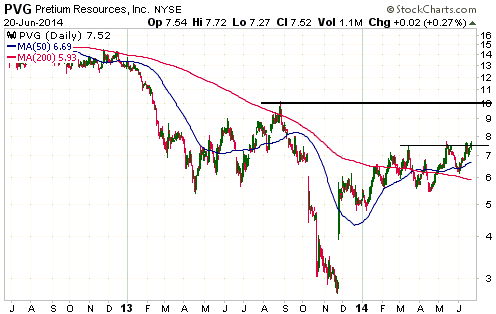
Due to the value of the Brucejack deposit indicated by the FS, we
think that PVG would be a buy if it pulled back to around US$6.50.
At that price there wouldn't be much downside risk, because there is
little doubt that the project has the potential to be developed into
a profitable gold mine at the current gold price. The
doubt/disagreement revolves around whether it should be developed
into a 400K-oz-year operation using bulk mining or a much smaller
operation using selective mining. However, due to the uncertainty
regarding the appropriate mining method and the low probability of a
takeover bid, we would be sellers at US$9.50-$10.00.
List
of candidates for new buying
From within the ranks of TSI stock selections, the best candidates for new
buying at this time are:
1) AAU at around US$1.40 (last Friday's closing price: US$1.47).
2) EDV.TO (last Friday's closing price: C$0.80).
3) EVN.AX (last Friday's closing price: A$0.75).
4) TGM.V in the low-C$0.40s (last Friday's closing price: C$0.43).
Chart Sources
Charts appearing in today's commentary
are courtesy of:
http://stockcharts.com/index.html

|









