|
-- Weekly Market Update for the Week Commencing 23rd November 2009
Big Picture
View
Here is a summary of our big picture
view of the markets. Note that our short-term views may differ from our
big picture view.
In nominal dollar terms, the BULL market in US Treasury Bonds
that began in the early 1980s will end by mid-2010. In real (gold)
terms, bonds commenced a secular BEAR market in 2001 that will continue
until 2014-2020. (Last
update: 09 February 2009)
The stock market, as represented by the S&P500 Index, commenced
a secular BEAR market during the first quarter of 2000, where "secular
bear market" is defined as a long-term downward trend in valuations
(P/E ratios, etc.) and gold-denominated prices. This secular trend will bottom sometime between 2014 and 2020. (Last update: 22 October 2007)
A secular BEAR market in the Dollar
began during the final quarter of 2000 and ended in July of 2008. This
secular bear market will be followed by a multi-year period of range
trading. (Last
update: 09 February 2009)
Gold commenced a
secular bull market relative to all fiat currencies, the CRB Index,
bonds and most stock market indices during 1999-2001. This secular trend will peak sometime between 2014 and 2020. (Last update: 22 October 2007)
Commodities,
as represented by the Continuous Commodity Index (CCI), commenced a
secular BULL market in 2001 in nominal dollar terms. The first major
upward leg in this bull market ended during the first half of 2008, but
a long-term peak won't occur until 2014-2020. In real (gold) terms,
commodities commenced a secular BEAR market in 2001 that will continue
until 2014-2020. (Last
update: 09 February 2009)
Copyright
Reminder
The commentaries that appear at TSI
may not be distributed, in full or in part, without our written permission.
In particular, please note that the posting of extracts from TSI commentaries
at other web sites or providing links to TSI commentaries at other web
sites (for example, at discussion boards) without our written permission
is prohibited.
We reserve the right to immediately
terminate the subscription of any TSI subscriber who distributes the TSI
commentaries without our written permission.
Outlook Summary
Market
|
Short-Term
(0-3 month)
|
Intermediate-Term
(3-12 month)
|
Long-Term
(1-5 Year)
|
Gold
|
Bullish
(02-Sep-09)
|
Bullish
(12-May-08)
|
Bullish
|
US$ (Dollar Index)
|
Bullish
(23-Nov-09)
| Bullish
(02-Nov-09)
|
Neutral
(19-Sep-07)
|
Bonds (US T-Bond)
|
Bullish
(16-Nov-09)
|
Neutral
(09-Sep-09)
|
Bearish
|
Stock Market (S&P500)
|
Bearish
(21-Sep-09)
|
Bearish
(11-May-09)
|
Bearish
|
Gold Stocks (HUI)
|
Neutral
(09-Nov-09)
|
Neutral
(16-Sep-09)
|
Bullish
|
| Oil | Neutral
(28-Oct-09)
| Neutral
(14-Oct-09)
| Bullish
|
Industrial Metals (GYX)
| Bearish
(21-Sep-09)
| Bearish
(25-May-09)
| Bullish
|
Notes:
1. In those cases where we have been able to identify the commentary in
which the most recent outlook change occurred we've put the date of the
commentary below the current outlook.
2. "Neutral", in the above table, means that we either don't have a
firm opinion or that we think risk and reward are roughly in balance with respect to the timeframe in question.
3. Long-term views are determined almost completely by fundamentals,
intermediate-term views by giving an approximately equal weighting to
fundmental and technical factors, and short-term views almost
completely by technicals.
Copper
With reference to the
following chart-based comparison of the copper price and the LME copper
inventory, we draw your attention to the fact that the upward trends in
LME inventory that began in mid-2006, mid-2007 and mid-2008 were
accompanied by downward trends in the copper price. This is the
relationship we would expect to see between stockpiles and prices given
that the copper market tends to live from hand to mouth (today's
production feeds tomorrow's consumption).
We now draw your attention to the fact that the aforementioned
relationship has completely broken down since the middle of this year
in that a strong upward trend in the copper price has occurred
alongside a strong upward trend in the LME copper inventory.
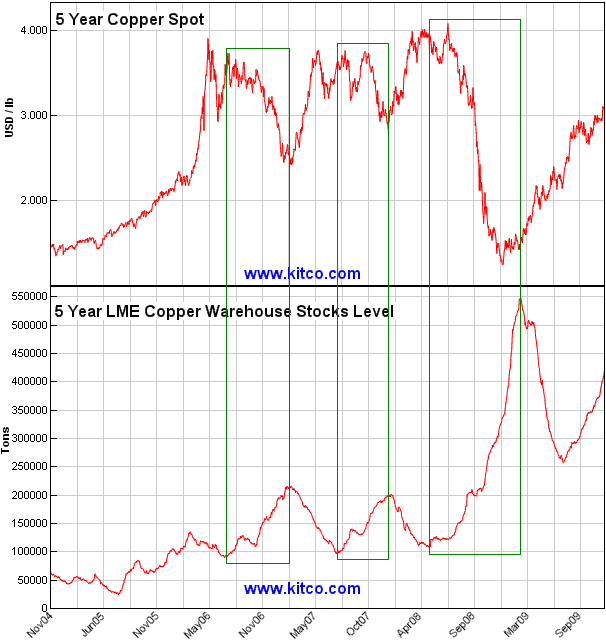
Our guess is that the
discrepancy of the past few months (a rising price in parallel with
rising inventory) results from speculators buying copper in
anticipation of a strong global economic rebound at the same time as
the industrial consumption of copper is falling relative to production.
We expect that the speculators will be proven wrong and that the copper
price will drop back to near its December-2008 low of around
US$1.50/pound within the next 18 months.
Are we betting on such a bearish outcome at this time?
No. With the Baltic Dry Index (BDI) having just rebounded to a new high
for the year and with China's stock market in a short-term upward
trend, we don't think this is the right time to be placing such a bet.
The Stock
Market
Supporting the case for a lengthy topping process
Fed rate hikes have preceded every major decline in the US stock market
over the past 80 years. This doesn't mean that every Fed rate-hiking
campaign has been followed by a major stock market decline, because
that certainly isn't the case. Rather, it implies that while a Fed
rate-hiking campaign will not necessarily bring about a major stock
market decline, it could, under the current system, be a prerequisite
for such an event. To put it another way, it implies that the
probability of a major stock market decline getting started will be
very low if monetary policy is either accommodative or becoming
increasingly accommodative.
Before going any further, two clarifications are in order. First, once
a major stock market decline begins it will usually run its course
regardless of the Fed's attempts to prop-up prices. The point is that
no major stock market decline has ever STARTED -- at least, not over
the past 80 years -- while the Fed has been cutting interest rates or
maintaining interest rates at a low level. Second, we are not
suggesting that the stock market would trend upward indefinitely in the
absence of Fed attempts to tighten monetary policy. Fed rate-hiking
campaigns are invariably reactions to signs of an inflation problem, so
it is probably more accurate to say that no major stock market decline
since the late-1920s ever started until some time after the signs of an
inflation problem became so blatant that even the Fed could see them.
Today's official interest rate is effectively zero and the Fed has
promised to keep it that way for a considerable period. It seems that
the Fed's plan is to maintain an ultra-easy monetary policy until
employment begins to pick up, but the reality is that it will only be
possible for the Fed to maintain its current stance until an inflation
problem becomes undeniable. During the 1970s and early 1980s, for
example, the Fed was forced by blatant evidence of an inflation problem
to aggressively hike its official interest rate target in parallel with
high-and-rising unemployment and a very weak economy.
The idea we are working around to is that the next major stock market
decline probably won't start until some time after the Fed begins to
hike its interest rate target, which won't happen until after the
evidence of an inflation problem becomes obvious to all.
The above statement meshes with our view that the most likely
intermediate-term stock market scenario involves the S&P500 Index
peaking near its current level, and then, rather than immediately
embarking on another major decline, spending up to 12 months
oscillating within about 10% of its peak before beginning to trend
downward. As well as being consistent with the monetary backdrop, this
scenario is in line with the 1937-1942 and 1980-1982 stock market
models discussed in previous commentaries.
The counter-argument is that the monetary backdrop doesn't matter
because the current stock market rally is only a counter-trend move
within the context of the major decline that began in 2007. According
to this view of the financial world, the 2009 stock market rally is
akin to the first of the counter-trend rebounds that occurred within
the major decline of 1929-1932.
We are in full agreement with the idea that the current stock market
rally is the counter-trend variety, but the monetary backdrop is always
extremely important and today's monetary backdrop is diametrically
opposite to that of 1930. This actually makes the long-term outlook for
the US economy worse today than it was in 1930, but, at the same time,
it means that equity prices are unlikely to collapse the way they did
during 1930-1932. Also, the longer the current rally lasts the more
implausible the 1930 comparison will become (from a stock market
perspective). The reason is that although today's rally has done no
more than the 1930 rebound in terms of retracement percentage, it has
already lasted almost 3 months longer if measured by the Dow
Industrials Index and almost 7 months longer if measured by the
NASDAQ100 Index.
Most "fundamental analysis" is trend-following in disguise
We've noticed that many commentators on the financial markets look at
the price action and then spin a "fundamental" story that matches the
price trend. This, however, is a pointless exercise, because for
fundamental analysis to have any value it must be independent of price
action. After all, the main investment-related purpose of fundamental
analysis is to identify discrepancies between price and value or
between perception and reality.
Current Market Situation
In last week's Interim Update we mentioned the bearish divergence that
has occurred over the past month between indicators of the stock
market's internals (the Advance-Decline Line, for instance) and the
senior stock indices. Symptomatic of this divergence is the relatively
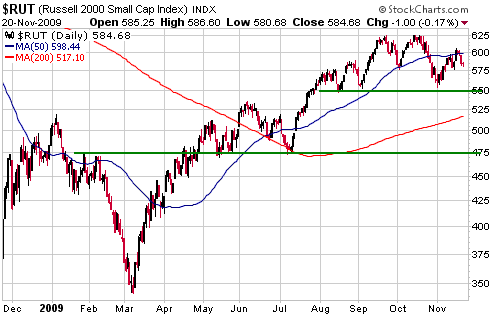
poor performance of the Russell2000 (R2000) Index since mid September.
The R2000 Index is made up of 2000 small-cap stocks.
The following chart shows that the R2000 moved well below its 50-day
moving average during the second half of October. It then did no more
than rebound to this moving average during the November rally that
pushed the senior stock indices to marginal new highs for the year.
The R2000 has support at 550 and at 475. In our opinion, the lower of
these support levels defines the maximum downside risk over the coming
few months.
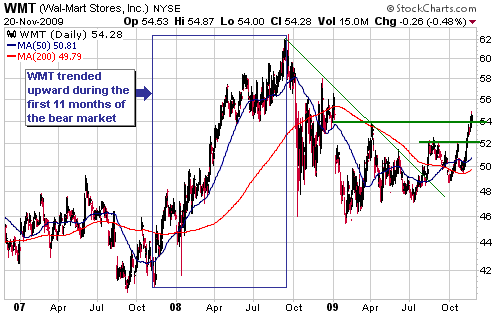
Investors treated
WalMart (WMT) as a safe haven during the first 11 months of the
2007-2009 stock market decline, causing it to trend upward while the
broad market trended downward. Interestingly, and ominously if it is a
sign of increasing risk aversion, WMT has again begun to do well on
both a relative and absolute basis.
We take WMT's recent strength as another piece of evidence that the broad stock market is close to a top.
This week's
important US economic events
| Date |
Description |
Monday Nov 23
| Existing Home Sales
| | Tuesday Nov 24 | Q3 GDP (revised)
Consumer Confidence
S&P Case-Shiller Home Price Index
| | Wednesday Nov 25
| Durable Goods Orders
Personal Income and Spending
New Home Sales
Consumer Sentiment
| | Thursday Nov 26
| US markets closed for Thanksgiving Day
| | Friday Nov 27
| No important events scheduled
|
Gold and
the Dollar
Gold
Current Market Situation
Either gold has entered blow-off mode (not likely, but possible) or it
will soon begin to 'correct'. A normal short-term correction would take
the gold price down to $1050-$1070.
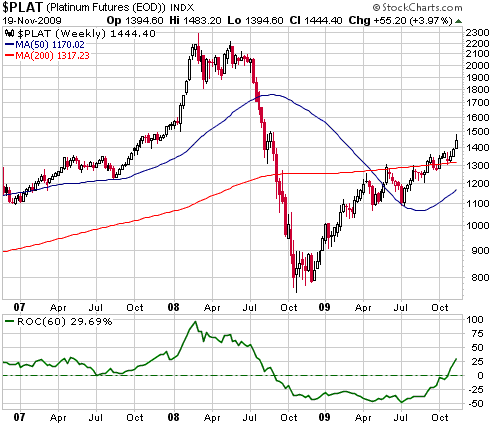
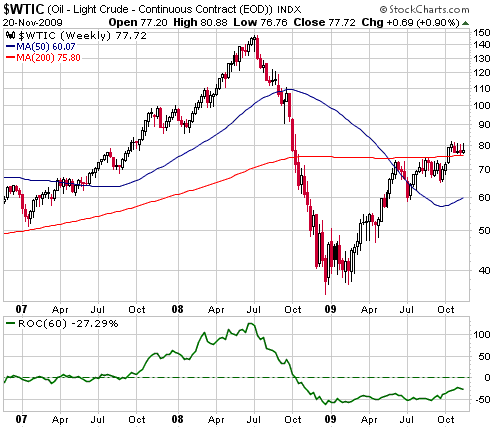
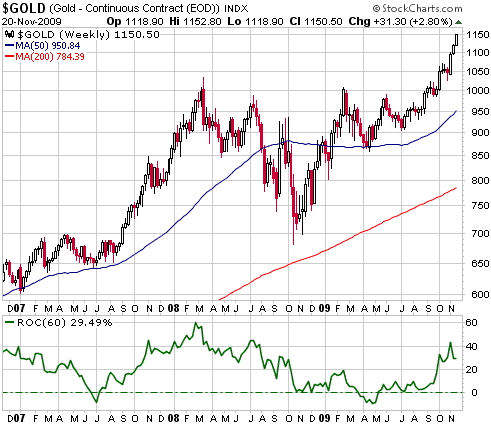
We are presenting the following weekly charts to counter the
increasingly popular idea that gold has entered 'bubble territory'. At
the bottom of each chart is a 60-week rate-of-change (ROC) indicator.
The first chart shows that when platinum was peaking in early 2008 its
60-week ROC was 100%, meaning that it had doubled over the preceding 60
weeks.
The second chart
shows that when oil was peaking in mid-2008 its 60-week ROC was around
120%, meaning that it had more than doubled over the preceding 60 weeks.
The third and final
chart shows that gold's 60-week ROC is presently around 30%, and that
gold broke out to the upside from a lengthy basing pattern only 7 weeks
ago. It looks 'overbought' on a short-term basis, but does not appear
to be remotely close to 'bubble territory'. By way of comparison, when
gold was peaking in 1974 its 60-week ROC was above 150%, and when it
reached its ultimate peak in January of 1980 its 60-week ROC was in
excess of 200%.
Quick note regarding "tungsten gold bars"
A story
about gold bars being filled with tungsten has been doing the rounds.
We think that this story should be filed under "unadulterated hogwash".
There are very good reasons to be bullish on gold. We wish that some
gold bulls would stop giving the rest of us a bad name by spreading
ridiculous rumours.
Gold Stocks
The Big Picture
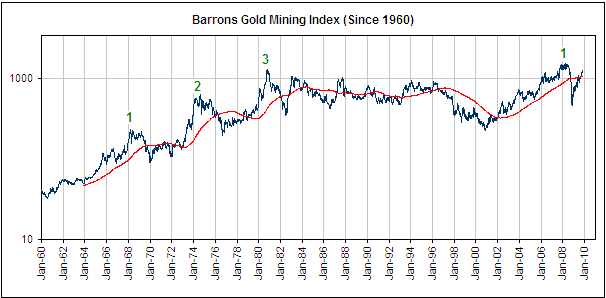
Below is the long-term weekly chart of the Barrons Gold Mining Index (BGMI) that we show from time to time.
One plausible 'big picture' scenario is that the gold sector's current
long-term bull market, which began in November of 2000, is following a
similar pattern to the bull market that extended from the early-1960s
through to 1980. If so, the current bull market will have three major
upward legs and we are now in the early part of the bull market's
second major upward leg (roughly at the equivalent of 1971).
The comparison with
the previous long-term bull market is one reason not to expect a
spectacular upside blow-off over the months ahead. To be at the point
where a greatly accelerated advance gets underway we would have to be
nearing the end of the bull market's third (final) major upward leg.
Another reason to believe that the gold sector's bull market has many
years to run, and is therefore not yet close to the point where
dramatic upward acceleration will occur, relates to the broad stock
market's valuation. As explained in the past, long-term gold bull
markets tend to go hand-in-hand with long-term equity bear markets,
where a long-term equity bear market is defined as a 1-2 decade period
during which equity valuations (not necessarily nominal prices) trend
downward. Previous long-term equity bear markets have continued until
the average price/earnings ratio has dropped to single digits and the
average dividend yield has moved above 5%. Given that today's
valuations are more like those found near the tops of long-term bull
markets than near the bottoms of long-term bear markets, this suggests
that the current equity bear market -- and, by extension, the current
gold bull market -- is not remotely close to its end.
Current Market Situation
The HUI's advance from last year's low has been by far the strongest
intermediate-term advance of its 9-year bull market. The main reason
for the uncommon strength is that gold stocks were pushed down to
absurdly low levels relative to gold bullion during last year's panic.
The gold sector's crash created one of the biggest discrepancies we've
ever seen between the price and the "fundamentals", setting the stage
for the huge rebound that has since occurred.
As noted in recent TSI commentaries, there's a significant risk that
the HUI is now close to an intermediate-term peak. However, gold stocks
are generally still under-valued relative to gold bullion and the
recent price action suggests that there is the potential for the
overall advance to extend into the first quarter of next year. Also,
although it is certainly extended to the upside the HUI is not quite as
'overbought' as it was at the early-June or mid-September highs (to
become as 'overbought' as it was at the aforementioned highs the HUI
would have to surge to the low-500s this week).
What we hope and expect will happen is that a multi-week pullback will
begin very soon (if it didn't already begin last week). We are hoping
for such an outcome, despite having substantial exposure to junior gold
stocks, because a pullback at this time would give us more clues as to
what we can reasonably expect over the months ahead. In particular, a
pullback to, say, the HUI's 50-day moving average (now at 433 and
rising at the rate of about 8 points per week) and then a rise above
the November high would suggest to us that the overall rally was going
to last until at least March of 2010.
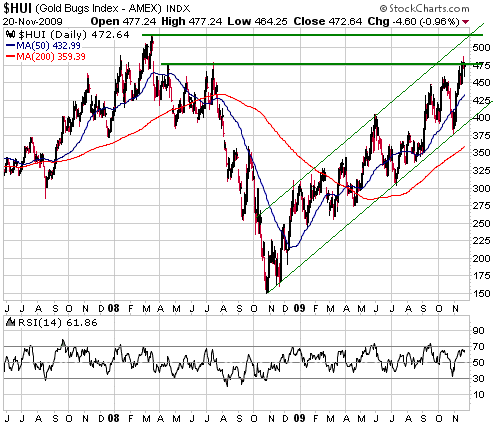
The following daily chart shows that the HUI is now challenging
resistance at 475-480. Just above that lies the resistance defined by
the all-time high of March-2008. It really would be extraordinary if
the HUI returned to its all-time high within 14 months of its
October-2008 crash low.
Currency Market Update
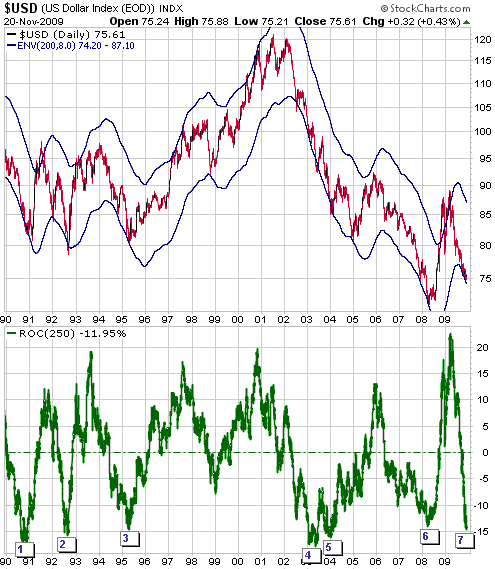
The top section of the following chart shows the Dollar Index and a
moving-average (MA) envelope (the envelope is determined by the Dollar
Index's 200-day moving average +/- 8%), while the bottom section shows
the Dollar Index's 250-day rate of change (ROC). This chart's purpose
is to show that a) including the past week, there have only been 7
occasions since 1990 when the 250-day ROC was around -15%, and b) on 5
of the 6 earlier occasions when the Dollar Index found itself in a
similar position, a tradable multi-month rally ensued. The lone
exception was early-2003, when the Dollar Index could only manage a
short bounce before resuming its downward trend.
The next chart shows
that the Dollar Index remains within the downward-sloping channel that
began to form in June. It also shows that the dollar's downward
momentum peaked in June and has been gradually diminishing ever since
(as indicated by rising trends for the RSI and the MACD shown at the
bottom of the chart).
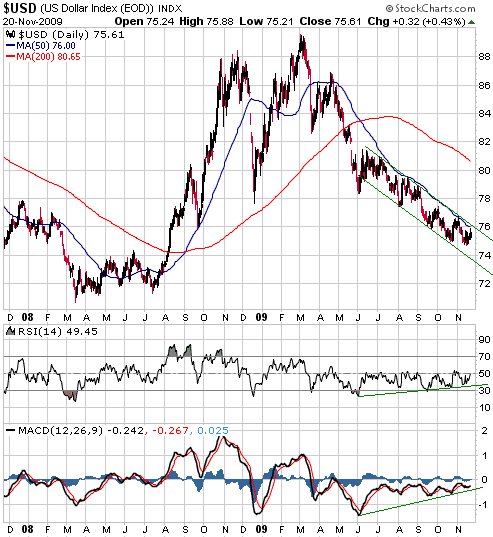
To signal that a low
is in place the Dollar Index would have to break decisively above its
channel top. A daily close above 77 would do it.
Although the price action hasn't yet confirmed a low, the potential for
a sizeable US$ rebound clearly exists. At the same time, the declining
downward momentum and the proximity to major support at 71-74 suggests
limited additional short-term downside risk. We have therefore upgraded
our short-term US$ outlook to "bullish".
If the Dollar Index has bottomed then its most likely path over the
coming months will encompass a rally lasting a few weeks followed by a
decline to test the bottom during the first quarter of next year. Such
a currency-market outcome would pave the way for a short-term pullback
in the gold price followed by a rally to new highs.
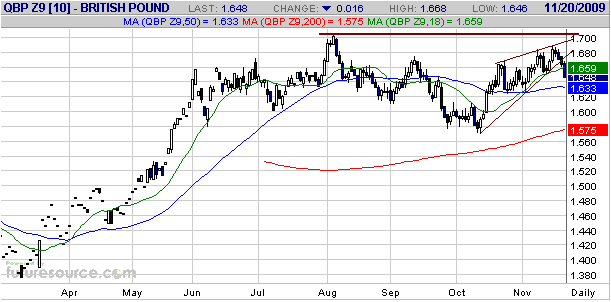
The following daily chart shows that the December British Pound has
just reversed lower after rebounding to 'test' its early-August peak.
Due to its relatively bearish fundamentals, it would make sense for the
Pound to be the first major currency to reach an intermediate-term peak
during this year's broad-based shift away from the US$. That is, the
Pound's price action makes sense if the Dollar Index is in the process
of bottoming on an intermediate-term basis. By extension, a surprising
(to us) rise to a new 52-week high by the Pound would suggest that the
Dollar Index is not as close as we think to an intermediate-term bottom.
Update
on Stock Selections
(Note: To review the complete list of current TSI stock selections, logon at http://www.speculative-investor.com/new/market_logon.asp
and then click on "Stock Selections" in the menu. When at the Stock
Selections page, click on a stock's symbol to bring-up an archive of our comments on the stock in question)
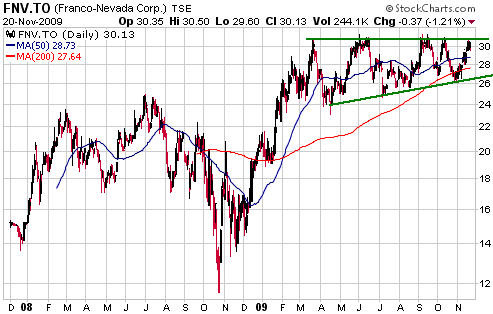
 The
following chart shows the 8-month (and counting) consolidation pattern
of Franco Nevada (TSX: FNV). It's hard to argue that gold-related
investments are in 'bubble territory' when one of the two premier gold
royalty stocks has a chart pattern such as this. The
following chart shows the 8-month (and counting) consolidation pattern
of Franco Nevada (TSX: FNV). It's hard to argue that gold-related
investments are in 'bubble territory' when one of the two premier gold
royalty stocks has a chart pattern such as this.
FNV has resistance at
C$31 and support at C$27. The FNV warrants (TSX: FNV.WT) are 'buyable'
whenever the stock drops to near support.
New Gold (AMEX: NGD, TSX: NGD). Shares: 387M issued, 471M fully diluted. Recent price: US$3.62
It was announced on Thursday that a Mexican court had nullified the
Environmental Impact Statement (EIS) relating to NGD's Cerro San Pedro
(CSP) gold/silver mine, leading to the Mexican environmental
enforcement agency ordering the suspension of mining at CSP. This 'out
of the blue' bad news naturally caused NGD's stock price to tank.
Specifically, the stock price fell from US$4.35 to US$3.42 during the
hours following the news, before recovering a little to end the week at
US$3.62.
The nullification of the EIS is the latest in a series of attempts by a
small group of non-locals to disrupt the CSP mine. These attempts began
years ago, during the project's construction phase.
NGD is taking the necessary legal actions to address this situation and
will almost definitely be able to resume mining in the future, but we
have no way of estimating how far in the future. Things could be
favourably resolved in a week, or it could drag on for months.
Prior to last week's unexpected development we said that NGD had become
fully valued and that a drop to the low-US$3 area would be required to
justify new/additional investment. In other words, even without the CSP
uncertainty we would not be looking to buy the stock at its current
price.
There were good opportunities to sell NGD shares over the past few
weeks and there may be a good opportunity to buy them in the
not-too-distant future, ideally following a sector-wide correction and
some information as to when the CSP issue will be resolved. In the mean
time, the appropriate thing to do is...nothing.
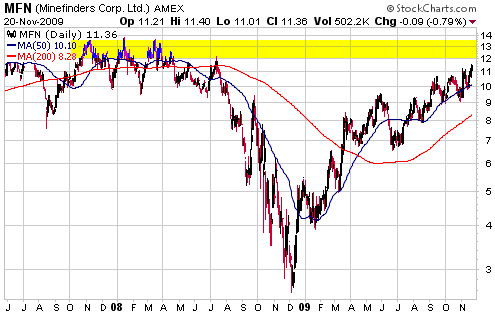
Minefinders Corp. (AMEX: MFN). Shares: 65M issued, 81M fully diluted. Recent price: US$11.36
The following chart shows that junior gold/silver producer MFN has
substantial resistance at US$12-$13.50. It would, we think, also be
fully valued in the aforementioned range.
We suggest making a partial exit from MFN near the current price and a
complete exit above US$13. We will remove MFN from the TSI Stocks List
if it trades above US$13.00 between now and year-end.
Chart Sources
Charts appearing in today's commentary
are courtesy of:
http://stockcharts.com/index.html
http://www.futuresource.com/
http://www.kitco.com/

|