|
-- Weekly Market Update for the Week Commencing 24th February 2014
Big Picture
View
Here is a summary of our big picture
view of the markets. Note that our short-term views may differ from our
big picture view.
In nominal dollar terms, the BULL market in US Treasury Bonds
that began in the early 1980s ended in 2012. In real (gold)
terms, bonds commenced a secular BEAR market in 2001 that will continue
until 2018-2020. (Last
update: 20 January 2014)
The stock market, as represented by the S&P500 Index,
commenced
a secular BEAR market during the first quarter of 2000, where "secular
bear market" is defined as a long-term downward trend in valuations
(P/E ratios, etc.) and gold-denominated prices. This secular trend will bottom sometime between 2014 and 2020.
(Last update: 22 October 2007)
A secular BEAR market in the Dollar
began during the final quarter of 2000 and ended in July of 2008. This
secular bear market will be followed by a multi-year period of range
trading.
(Last
update: 09 February 2009)
Gold commenced a
secular bull market relative to all fiat currencies, the CRB Index,
bonds and most stock market indices during 1999-2001.
This secular trend will peak sometime between 2014 and 2020.
(Last update: 22 October 2007)
Commodities,
as represented by the Continuous Commodity Index (CCI), commenced a
secular BULL market in 2001 in nominal dollar terms. The first major
upward leg in this bull market ended during the first half of 2008, but
a long-term peak won't occur until 2014-2020. In real (gold) terms,
commodities commenced a secular BEAR market in 2001 that will continue
until 2014-2020.
(Last
update: 09 February 2009)
Copyright
Reminder
The commentaries that appear at TSI
may not be distributed, in full or in part, without our written permission.
In particular, please note that the posting of extracts from TSI commentaries
at other web sites or providing links to TSI commentaries at other web
sites (for example, at discussion boards) without our written permission
is prohibited.
We reserve the right to immediately
terminate the subscription of any TSI subscriber who distributes the TSI
commentaries without our written permission.
Outlook Summary
Market
|
Short-Term
(1-3 month)
|
Intermediate-Term
(6-12 month)
|
Long-Term
(2-5 Year)
|
|
Gold
|
Bullish
(13-Jan-14) |
Bullish
(26-Mar-12) |
Bullish
|
|
US$ (Dollar Index)
|
Neutral
(13-Jan-14) |
Bearish
(27-Jan-14) |
Neutral
(19-Sep-07) |
|
Bonds (US T-Bond)
|
Bullish
(11-Dec-13)
|
Neutral
(18-Jan-12)
|
Bearish |
|
Stock Market
(DJW)
|
Bearish
(13-Jan-14)
|
Bearish
(28-Nov-11) |
Bearish
|
|
Gold Stocks
(HUI)
|
Neutral
(17-Feb-14) |
Bullish
(23-Jun-10) |
Bullish
|
|
Oil |
Neutral
(30-Jul-12) |
Neutral
(31-Jan-11) |
Bullish
|
|
Industrial Metals
(GYX)
|
Neutral
(17-Feb-14) |
Neutral
(06-Jan-14) |
Neutral
(11-Jan-10) |
Notes:
1. In those cases where we have been able to identify the commentary in
which the most recent outlook change occurred we've put the date of the
commentary below the current outlook.
2. "Neutral", in the above table, means that we either don't have a
firm opinion or that we think risk and reward are roughly in balance with respect to the timeframe in question.
3. Long-term views are determined almost completely by fundamentals,
intermediate-term views by
fundamentals, sentiment and technicals, and short-term views by sentiment and
technicals.
Monetary Inflation Update
The US
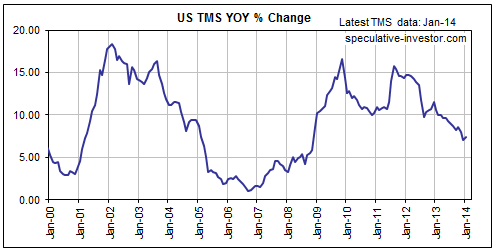
The January-2014 money-supply data reflect an uptick in the year-over-year (YOY)
growth rate in US True Money Supply (TMS). However, the US monetary inflation
rate remains near a 5-year low and in danger of dropping to a level that would
precipitate the next economic bust.
Note that a severe economic bust has been made inevitable by the rapid monetary
inflation of the past few years. The only question relates to timing. Will it
begin this year or will it be postponed until next year?
A premature end to the Fed's "tapering" would potentially postpone the start of
the coming 'bust' until next year.
Other Countries
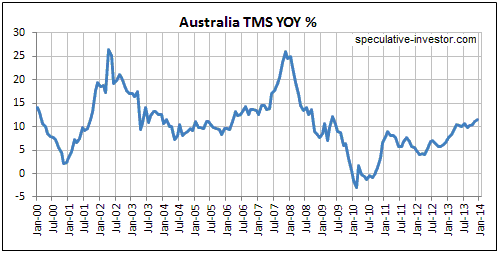
Monetary conditions in Australia are currently much easier than monetary
conditions in the US, as evidenced by the fact that the YOY growth in A$ TMS
recently hit a new 4-year high of 11.6%. In the short term this should help
A$-denominated assets and, therefore, the A$, but it adds to the currency's
long-term downside potential.
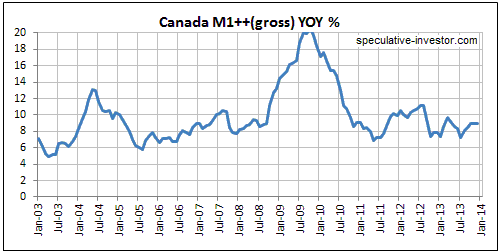
Since experiencing a huge rise and then a huge fall during 2008-2011, Canada's
money-supply growth rate has oscillated in a narrow range around 9%/year. It is
presently in the middle of this range.
The Bank of Canada is therefore now 'easier' than the US Fed and 'tighter' than
the Reserve Bank of Australia.
In order to address an obvious "price inflation" problem and to stem the
weakness in its currency, Brazil's central bank has been attempting to 'tighten
the monetary reins' over the past couple of years. However, the following chart
indicates that this monetary tightening has not been effective where it counts.
The chart shows that Brazil's YOY TMS growth rate remains above 15%, which
guarantees that the country's inflation problem will get worse over the next few
years.

The Stock
Market
The US Market
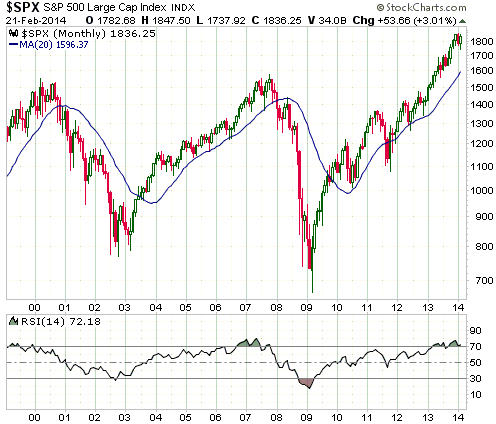
The S&P500 Index (SPX) hasn't had consecutive down months since the first half
of 2012. That is, it is coming up to two years since the SPX last closed lower
for two months in a row. This is a long time, but it is not unprecedented. In
fact, the lead-up to the mid-2007 peak was similar, in that prior to the monthly
declines of June and July-2007 the SPX had gone two years without experiencing
consecutive months with lower closes.
Once the SPX achieves consecutive monthly declines, the 20-month MA (the blue
line on the following monthly chart) becomes a high-probability short-term
target. Currently, that implies a short-term target -- which would likely be
reached in March -- of around 1600 if the SPX were to end the month of February
lower than where it ended the month of January. The chance of this happening was
reduced, but not eliminated, by last week's extension of the rebound from the
early-February low.
The SPX will have to decline by at least 3% over the course of this week to end
the month of February below the January close of 1783 and project a further
decline to around 1600. Alternatively, ending the week between 1783 and 1850
would 'muddy the waters', and ending the week above 1850 would confirm that the
cyclical bull market was intact.
Emerging Markets
EEM, a proxy for "emerging market" equities, has rebounded from its
early-February low to its 50-day MA. Furthermore, the 50-day MA happens to be
just below important lateral resistance and the 200-day MA. The upshot is that
EEM's recent rally has, to date, done as much as a routine counter-trend rebound
should do.
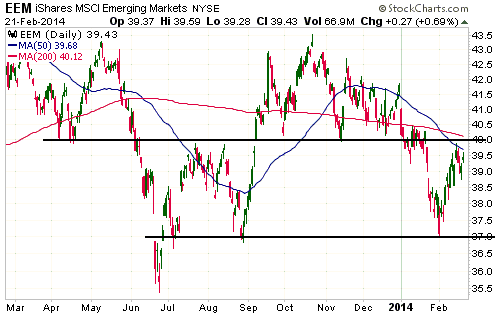
This is a good place to bet against EEM, either directly or by purchasing EEV (a
fund that is designed to have daily percentage moves that are roughly twice the
opposite of EEM's daily percentage moves). That's partly because the risk
management parameters are clear and should ensure that any loss will be small.
For TSI record purposes, a short-term trading position in EEV will be exited at
a loss if EEM achieves two daily closes above $40.20.
The potential exists for a sharp decline in EEM to the low-$30s. That's the
reason for our short-term bearish speculation. On a longer-term basis, the trend
that entails relative weakness in the emerging markets is now very old and is
probably going to end within the next several months. It seems that almost
everyone is now bearish on the emerging markets. While such a sentiment backdrop
doesn't preclude a final washout, it sets the stage for the emerging markets to
become leaders to the upside during the next global equity-market advance.
This week's
important US economic events
| Date |
Description |
| Monday Feb 24 |
Dallas Fed Mfg Survey | | Tuesday
Feb 25 |
Case-Shiller Home Price Index
Consumer Confidence
Richmond Fed Mfg Index | | Wednesday
Feb 26 |
New Home Sales | | Thursday
Feb 27 |
Durable Goods Orders
Kansas City Fed Mfg Index
|
| Friday Feb 28 |
Q4 GDP (revised)
Chicago PMI
Consumer Sentiment
Pending Home Sales |
Gold and
the Dollar
Gold
Most gold bulls will be right for the wrong reasons
An interesting aspect of the gold market is that most analysis is off track,
with the reasons put forward for being bullish generally being further off-track
than the reasons put forward for being bearish. That's despite gold bulls having
the long-term price trend and fundamentals in their favour. The problem is that
most gold bulls pay scant attention to the real fundamental price drivers and
focus on things that don't matter. A good example is the current focus on the
possible reduction in annual gold production stemming from the combination of
rising costs and last year's decline in the gold price.
The idea that a potential decline in annual gold production is an important
reason for being bullish on gold is so far off track and reflects such a basic
misunderstanding of price formation in the gold market that any analyst who
promotes this idea should be ignored. As we've explained many times, the
gold-mining industry adds a tiny percentage (about 1.5%) to the total supply of
gold each year. This means that if the mining industry's annual production were
to fall by 10%, the effect on the total supply of gold over the course of a year
-- and, since supply and demand are always equal, the effect on the total demand
for gold over the course of a year -- would be about 0.15%. This is trivial.
Note that gold is the only commodity for which changes in current production
will never have a significant effect on the price trend, although we hasten to
add that for the same reason (the high level of the existing above-ground supply
relative to new mine supply) the effect of annual production changes are also
generally small enough to be ignored when analysing silver's prospects.
Another example of the bad analysis that permeates the ranks of gold bulls is
the idea that gold demand can be determined by adding up the flows of gold
between different parts of the market. Such flows include the transfer of gold
from coin dealers to the general public, the transfer of gold from outside to
inside China, the transfer of gold from bullion ETFs to other holders, and the
transfer of gold from commercial traders to jewellery buyers in India. For every
buyer there must always be a seller, so adding up the quantity of gold bought
during a period will generally tell you nothing about why the gold price did
what it did in the past or what the gold price will likely do in the future.
The fact is that the total demand for gold will always be equal to the total
supply of gold, which will always be equal to the total aboveground gold
inventory. The demand for gold was equal to the total aboveground gold inventory
when the price was peaking at $1920 in 2011 and it was equal to the total
aboveground gold inventory when the price was bottoming at $1180 last year.
What, then, determines the price?
The price is not determined by the volume bought/sold; at the most basic level,
it is determined by the relative desires of buyers and sellers to change their
current positioning. If buyers are more motivated than sellers, the price will
rise. If sellers are more motivated than buyers, the price will fall. Both a
price rise and a price fall could occur on either rising or falling volume.
Consequently, what gold-market analysts should do is concentrate on the factors
that influence the motivation to hold gold. This generally means concentrating
on macro-economic factors such as real interest rates, credit spreads, the yield
curve, inflation expectations, and the health of the banking sector. Strangely,
gold bears are often better at this than gold bulls. The gold bears are
currently not interpreting the economic backdrop correctly (most of them wrongly
believe that a real recovery is underway), but at least they are looking for
clues in the right places.
If you are bullish on gold you are almost certainly going to be right over the
next few years, regardless of how spurious your reasoning happens to be. Being
bullish for the right reasons will only matter when the long-term bull market is
near its end.
Current Market Situation
Last week's gold-market action was uneventful, but an important fundamental
driver of gold's intermediate-term price trend became slightly more bullish. The
fundamental driver to which we are referring is the relative strength of the
banking sector, as measured by the BKX/SPX ratio.
Relative strength in the banking sector, as indicated by a rising trend in the
BKX/SPX ratio, points to increasing confidence in the financial system. Since
gold benefits from falling confidence in the financial system, it isn't
surprising that the BKX/SPX ratio and gold have been inversely correlated over
the past several years. The relationship is clearly evident on the following
chart.
Gold began to turn upward and the BKX/SPX ratio began to turn downward last
June-July. The BKX/SPX ratio is now close to breaking out to the downside, a
development that would provide additional confirmation of a major trend change
in the gold market.
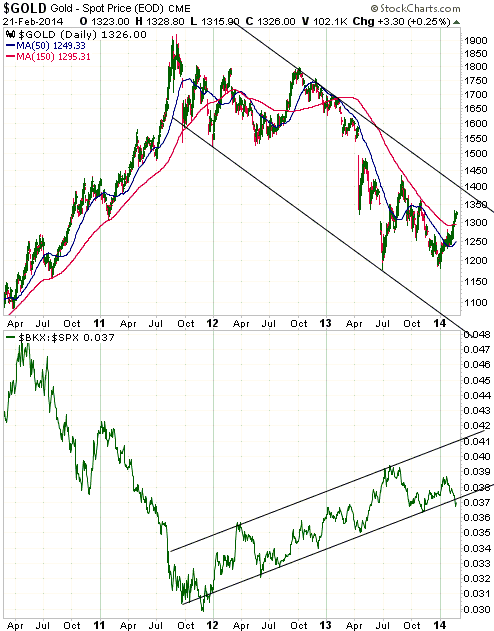
Gold is 'overbought', but not by enough to create significant downside risk.
However, if it rises to around $1350 without first experiencing a multi-week
consolidation then the short-term downside risk will be as high as the remaining
short-term upside potential. Our short-term outlook will therefore shift from
"bullish" to "neutral" if gold trades in the $1340s this week.
Gold Stocks
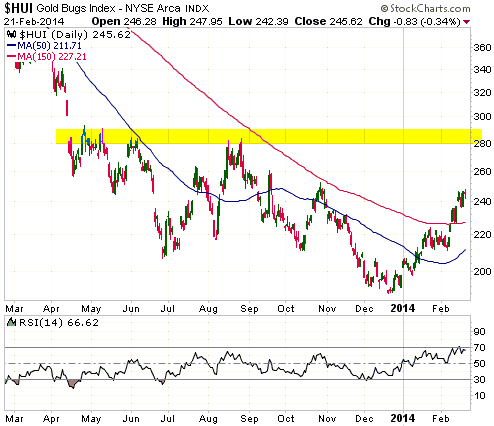
There isn't enough evidence yet to tell whether the HUI has commenced a
multi-week correction or is just pausing briefly before resuming its advance.
There is resistance in the 250s, so if the advance immediately resumes then this
would be a likely place for it to stop. There is more substantial resistance at
280-290 (the shaded area on the following daily chart). This resistance will
almost certainly be tested and will probably be breached by mid-year, but we
will be surprised if it is tested prior to a multi-week correction.
The confirmation of a major trend reversal in the gold-mining sector will happen
in stages. The next stage will be sufficient strength to differentiate the
current rally from the intermediate-term rebound that occurred during the second
and third quarters of 2012, there having already been more than enough strength
to differentiate the current rally from the short-term rebounds that occurred in
2013.
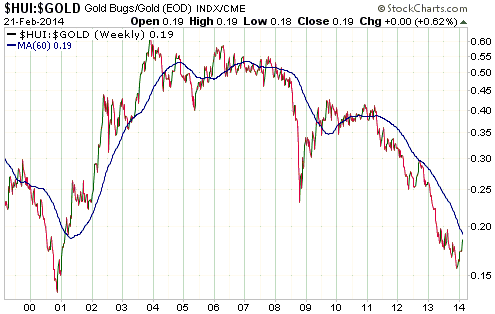
The following weekly chart of the HUI/gold ratio helps to explain one way that
the current rally can -- and probably will -- differentiate itself from the
intermediate-term rebound of 2012. Notice that on a weekly closing basis the HUI/gold
ratio remained below its 60-week MA (the blue line on the chart) throughout the
2011-2013 bear market, with the 2012 rebound ending right at this moving
average. A solid break by the HUI/gold ratio above its 60-week MA would
therefore be important additional confirmation that a major trend reversal
happened in December of 2013.
During the second half of last year a commonly-cited reason to remain bearish on
gold-mining stocks was that the large decline in the gold price would force
producers to substantially reduce their reported gold reserves and take huge
impairment charges. This argument was 50% right and, at the same time, 100%
wrong. The substantial reserve reductions and huge impairment charges have
happened as predicted, but the upward trend in the gold-mining sector that began
in December remains intact.
Although the stock market is often wrong, it is usually capable of discounting
the bleeding obvious. By the time the gold price completed its 2-3 month crash
in late-June of 2013, the stock market had fully discounted the reserve and
asset write-downs that have only been made official over the past few weeks. In
fact, by the end of June-2013 the stock market had discounted the worst case
scenario and then some. The gold-mining sector's bear market didn't end until
December-2013, but in price terms it was more than 95% complete by June-2013.
The second half of last year was largely characterised by people getting more
negative in anticipation of developments that the market had fully discounted
months earlier.
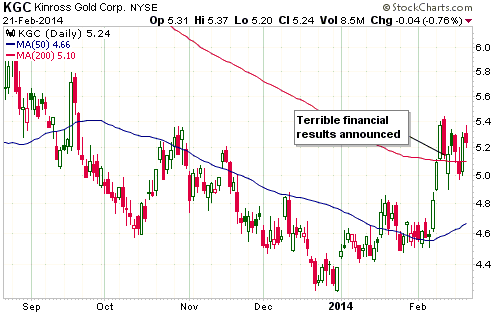
The recent performance of Kinross Gold (KGC) offers up a good example of what we
are talking about. After the close of trading on 12th February, KGC reported
terrible financial results for the final quarter of 2013 and the whole of 2013.
It wasn't just the large reserve/asset write-down that made the results
terrible. Of greater importance, the company had net cash consumption of about
$320M during the final quarter of last year. So, how did the stock-market react
to this news?
KGC had ended the 12th February trading session at US$5.15. On 13th December the
stock price quickly dropped to $4.90 in a knee-jerk reaction to the financial
results, but then recovered to end the day at US$5.15. In other words, on a
daily closing basis the terrible results caused no decline in the stock price.
The stock has since chopped back and forth near its 200-day MA (refer to the
daily chart below) and ended last week at US$5.24.
Price action such as this is typical of a bull market.
Currency Market Update
The US$ and the euro continue to do very little relative to each other, although
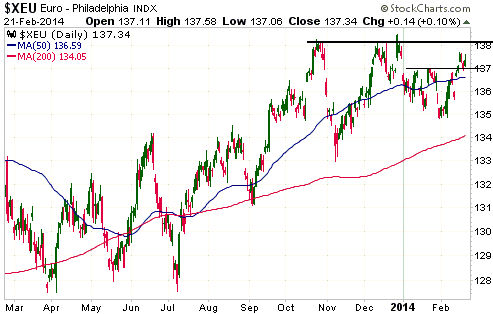
last week the euro did manage to break above minor resistance at 137. More
important resistance lies at 138.
A break above 138 would create a chart-based target of 143, which looks like a
realistic target to us. However, we suspect that the euro will 'chop around' in
the 136-138 range for a few more weeks before breaking out to the upside.
With respect to the coming several months we favour the euro over the US$
because we expect that a) relative stock market performance will be the factor
that decides which of the two senior currencies is the stronger, and b) European
equities will be propelled upward relative to US equities over the next several
months due to their much lower valuations.
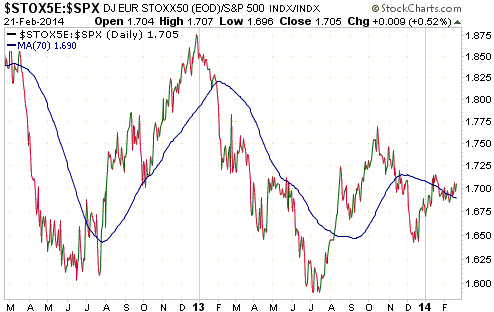
The STOX5E/SPX ratio (the EURO STOXX50 Index divided by the S&P500 Index) is how
we are measuring the performance of European equities relative to US equities.
The following chart shows that this ratio clearly moved in the euro's favour
during July-October of last year, but has since been non-committal. A move above
the January high would signal that European equities had resumed their upward
trend relative to US equities.
Updates
on Stock Selections
Notes: 1) To review the complete list of current TSI stock selections, logon at
http://www.speculative-investor.com/new/market_logon.asp
and then click on "Stock Selections" in the menu. When at the Stock
Selections page, click on a stock's symbol to bring-up an archive of
our comments on the stock in question. 2) The Small Stock Watch List is
located at http://www.speculative-investor.com/new/smallstockwatch.html
 Company
news/developments for the week ended Friday 21st February 2014: Company
news/developments for the week ended Friday 21st February 2014:
[Note: AISC = All-In Sustaining Cost, FS = Feasibility Study, IRR =
Internal Rate of Return, MD&A = Management Discussion and Analysis,
M&I = Measured and Indicated, NAV = Net Asset Value, NPV(X%) = Net
Present Value using a discount rate of X%, P&P = Proven and
Probable, PEA = Preliminary Economic Assessment, PFS =
Pre-Feasibility Study]
*Dragon Mining (DRA.AX) held a shareholders meeting on 7th
February to consider the request of Eurogold, DRA's largest
shareholder, to remove three existing directors (including the
chairman and the managing director) and appoint two new directors.
The changes requested by Eurogold were approved, which means that
Eurogold now has control of the Board. We don't know if this is good
news, bad news or irrelevant news, because Eurogold has not outlined
its strategy.
We plan to remove DRA from the TSI List within the coming three
months. Due to the steadily improving market for gold bullion and
gold-mining stocks, there's a good chance that we will be able to do
so at well above the current price.
*Evolution Mining (EVN.AX) issued its half-year financial results.
During the 6-month period ending 31st December 2013, EVN produced
214K ounces of gold at an AISC of A$1070/oz (US$970/oz), generated a
net profit of A$35.4M (A$0.05/share), and modestly strengthened its
balance sheet. This is a decent result considering the market
environment.
A 1c/share dividend will be paid to shareholders on the books at 4th
March 2014.
Unless its management does something stupid (a definite risk), the
improving gold-market environment should pave the way for EVN to
generate much greater profits and substantial free cash flow during
2014.
*Golden Star Resources (GSS) reported its financial results for
2013 and for Q4-2013. It also reiterated its 2014 guidance.
On 13th January, we wrote:
"Last year's [final quarter] cash cost was around $1100/oz, which
implies a total production cost of at least $1400/oz and explains
why GSS continues to be cash-flow negative at the current gold
price. The amount of cash consumed by GSS during the final quarter
of last year won't be known until the company releases its financial
statements on 20th February, but we estimate that its financial
position deteriorated by about $10M during the quarter. It still has
a healthy cash reserve, but it will need a meaningful recovery in
the gold price within the next few quarters."
The information published last week tells us that GSS's financial
position* actually deteriorated by $21M during the final quarter of
last year. We were therefore too optimistic. The company's cash was
roughly unchanged from 30th September through to 31st December, but
this was only because an additional $17M was drawn against the
Ecobank credit facility.
Regarding GSS's prospects, the following excerpt from our 13th
January commentary still applies:
"2014 guidance is for reduced production at a lower cost, meaning
that the company's management is opting for quality over quantity.
Specifically, the company expects to produce about 300K ounces of
gold at a cash cost of around $1,000/oz. This means that if the
guidance is achieved, the gold price will have to average $1,350/oz
or more for GSS to be genuinely profitable. An average gold price of
at least $1,350/oz is likely (our guess is that gold will average
about $1,500/oz during 2014).
Due to its substantial leverage to changes in the gold price and the
fact that its survival is not in question at this time, GSS could
become an excellent candidate for new buying AFTER the gold price
breaks above $1,300/oz."
We didn't highlight GSS as a good candidate for new buying
immediately after gold broke above $1300, the reason being that the
stock was short-term 'overbought' and at resistance. In fact, we
noted a week ago that GSS had just moved into a price range
(US$0.80-$1.00) in which some selling could be appropriate. However,
GSS probably would be a buy if it were to pull back to the
low-US$0.60s.
*When determining the change in financial position from
one period to the next we exclude all accounting adjustments to
asset and liability values. In GSS's case, we didn't include a large
write-down in asset value due to the lower gold price and in the
future we will not include any increase in asset value stemming from
a higher gold price. We also add back any money spent on genuine
growth projects, where a genuine growth project is one that will
lead to an increase in the company's total sales. In GSS's case
there are no genuine growth projects, because the company's sales
are expected to be stable or slightly lower over the next couple of
years. We are, in effect, determining the total amount of cash
consumed or generated by the company accounting for ALL expenditure
except the expenditure that results in genuine growth.
*Lydian International (LYD.TO) announced that its underwritten
C$1.00/share equity financing closed as planned on 18th February and
that the underwriters had exercised their overallotment option in
full. This means that the company raised about C$17M.
The exercising of the overallotment option indicates that there is
strong demand for LYD in the low-C$1 area.
*Premier Gold (PG.TO) reported some good results from four holes
drilled at its exploration-stage Cove gold project in Nevada.
Highlights were 13.22 g/t Au over 10.3m and 28.05 g/t Au over 4.5m.
This project is at an early stage of development and currently has a
high-grade 420K-oz resource.
At today's gold price, PG's market cap is more than fully justified
by its 7M-oz Hardrock deposit in Ontario and its $60M of working
capital. The company is not reliant on exploration success at its
Cove project in Nevada or at its Rahill-Bonanza project in Ontario,
but these earlier-stage projects have delivered some interesting
results to date.
*Pretium Resources (PVG): In the 10th Feb Weekly Update, we wrote:
"...[PVG] is almost certainly being held back by anticipation of
an equity financing, which opens up the possibility of a rapid
increase in the stock price if PVG's management either raises
additional money without issuing more shares (there are multiple
ways that this could be done, including via the immediate mining of
the ultra-rich Cleopatra Vein) or issues new shares at well above
the current market price." PVG was C$6.77 at the time.
The widely anticipated financing was announced after the close of
trading last Thursday. Assuming that the overallotment option is
exercised, PVG will raise C$26M by issuing 3.18M flow-through shares
at an average price of C$8.18 per share. This is about 20% higher
than the price at which the stock was trading when we wrote the
above comment and more than 50% higher than the price at which many
short-sellers would have expected the company to issue new shares
when the short positions were established.
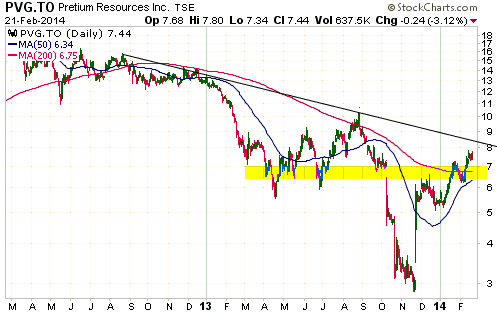
PVG's stock price fell about 3% last Friday in reaction to the
financing news, which is neither here nor there. With the financing
news now out of the way, the stock is likely to hold at or above
support at C$6.50-$7.00 during any sector-wide correction over the
weeks ahead. There is also the potential for a short-covering-fueled
surge to trend-line resistance at around C$8.50 or the important
lateral resistance that lies at C$9-$10.
*Ramelius Resources (RMS.AX) issued its half-year financial
results.
RMS's financial results for the 6-month period ending 31st December
were poor, but no worse than expected. Due to last November's
failure of the ball-mill motor at its Mt Magnet gold mine, a
bottom-line loss and a cash drain were inevitable. However, the
company's balance sheet is still in reasonable shape.
We are concerned that there is a management deficiency at RMS that
will lead to more ill-conceived investment choices, such as, in our
opinion, last year's decision to proceed with the acquisition of the
early-stage Vivien project at a cost of $10M, and cause 'one-off'
operational problems such as the aforementioned motor failure to
become routine. However, as a marginal producer with about 100K
ounces/year of current production, RMS's stock price has the
potential to gain a lot of ground quickly in response to additional
strength in the bullion market.
List
of candidates for new buying
From within the ranks of TSI stock selections, the best candidates for new
buying at this time are:
1) LYD.TO in the low-C$1 area (last Friday's closing price: C$1.08).
2) SBB.TO in the low-C$0.90s (last Friday's closing price: A$0.97).
List
of candidates for profit-taking
Refer to the profit-taking suggestions outlined in the 17th February Weekly
Update. There are no changes.
Chart Sources
Charts appearing in today's commentary
are courtesy of:
http://stockcharts.com/index.html

|









