|
-- Weekly Market Update for the Week Commencing 27th April 2009
Big Picture
View
Here is a summary of our big picture
view of the markets. Note that our short-term views may differ from our
big picture view.
In nominal dollar terms, the BULL market in US Treasury Bonds
that began in the early 1980s will end by mid-2010. In real (gold)
terms, bonds commenced a secular BEAR market in 2001 that will continue
until 2014-2020. (Last
update: 09 February 2009)
The stock market, as represented by the S&P500 Index, commenced
a secular BEAR market during the first quarter of 2000, where "secular
bear market" is defined as a long-term downward trend in valuations
(P/E ratios, etc.) and gold-denominated prices. This secular trend will bottom sometime between 2014 and 2020. (Last update: 22 October 2007)
A secular BEAR market in the Dollar
began during the final quarter of 2000 and ended in July of 2008. This
secular bear market will be followed by a multi-year period of range
trading. (Last
update: 09 February 2009)
Gold commenced a
secular bull market relative to all fiat currencies, the CRB Index,
bonds and most stock market indices during 1999-2001. This secular trend will peak sometime between 2014 and 2020. (Last update: 22 October 2007)
Commodities,
as represented by the Continuous Commodity Index (CCI), commenced a
secular BULL market in 2001 in nominal dollar terms. The first major
upward leg in this bull market ended during the first half of 2008, but
a long-term peak won't occur until 2014-2020. In real (gold) terms,
commodities commenced a secular BEAR market in 2001 that will continue
until 2014-2020. (Last
update: 09 February 2009)
Copyright
Reminder
The commentaries that appear at TSI
may not be distributed, in full or in part, without our written permission.
In particular, please note that the posting of extracts from TSI commentaries
at other web sites or providing links to TSI commentaries at other web
sites (for example, at discussion boards) without our written permission
is prohibited.
We reserve the right to immediately
terminate the subscription of any TSI subscriber who distributes the TSI
commentaries without our written permission.
Outlook Summary
Market
|
Short-Term
(0-3 month)
|
Intermediate-Term
(3-12 month)
|
Long-Term
(1-5 Year)
|
Gold
|
Bullish
(27-Apr-09)
|
Bullish
(12-May-08)
|
Bullish
|
US$ (Dollar Index)
|
Neutral
(23-Mar-09)
| Neutral
(16-Feb-09)
|
Neutral
(19-Sep-07)
|
Bonds (US T-Bond)
|
Bearish
(06-Apr-09)
|
Bearish
(22-Sep-08)
|
Bearish
|
Stock Market (S&P500)
|
Neutral
(27-Apr-09)
|
Neutral
(02-Feb-09)
|
Bearish
|
Gold Stocks (HUI)
|
Bullish
(12-Jan-09)
|
Bullish
(12-May-08)
|
Bullish
|
| Oil | Bullish
(17-Nov-08)
| Neutral
(22-Sep-08)
| Bullish
|
Industrial Metals (GYX)
| Neutral
(27-Apr-09)
| Neutral
(22-Sep-08)
| Bullish
|
Notes:
1. In those cases where we have been able to identify the commentary in
which the most recent outlook change occurred we've put the date of the
commentary below the current outlook.
2. "Neutral", in the above table, means that we either don't have a
firm opinion or that we think risk and reward are roughly in balance with respect to the timeframe in question.
3. Long-term views are determined almost completely by fundamentals,
intermediate-term views by giving an approximately equal weighting to
fundmental and technical factors, and short-term views almost
completely by technicals.
Inflation Update
The Effects of Inflation
The effects of monetary inflation are three-fold. First, it brings
about an unwarranted transfer of purchasing power (resources) to the
creator of the new money and/or the first user of the new money.
Another name for this unwarranted transfer is theft. Second, it has a
NON-UNIFORM effect on prices, leading to mal-investment and the wastage
of resources. The huge amount of savings and resources squandered in
real-estate investments over the past several years exemplifies the
havoc that can result from monetary inflation and why its effects
cannot simply be counteracted at some later time by "withdrawing
liquidity". Third, it EVENTUALLY results in a broad-based increase in
the prices of everyday goods and services.
Almost everyone focuses on the third of these effects, but the greatest
injustices and economic problems result from the first two. The
"Keynesians" and the "Monetarists", for instance, are generally unaware
of the first two effects. In their fatally flawed views of the economic
world, monetary inflation either doesn't matter at all or doesn't
matter unless/until it causes the CPI to rise.
Based on traditional lead times, the substantial monetary inflation
that has occurred over the past seven months probably won't start to
become evident in the prices of everyday goods and services until 2010.
Furthermore and as mentioned in previous TSI commentaries, the CPI will
probably trend downward throughout 2009. This will make the
deflationists look right for the next few quarters even though they
will be wrong. They will be wrong because even while prices decline,
the inflation will be taking a heavy toll on the economy by
facilitating the transfer of resources to the government and to failed
businesses. The Keynesians argue that the monetary inflation won't be a
problem because the economy will remain weak due to "insufficient
aggregate demand", but they fail to realise that "insufficient
aggregate demand" doesn't cause anything* and that monetary inflation
is one of the main reasons why the economy is destined to remain weak.
We are far more bearish on economic growth and employment than the
mainstream economists who are predicting deflation, and yet we expect
an upward trend in the general price level to begin within 12 months.
Our expectation is not outlandish because economic weakness will not
prevent a currency from losing its purchasing power in response to
substantial growth in its supply. In fact, it's the other way round.
The less stuff that gets produced by the economy the greater will be
the eventual decline in the currency's purchasing power stemming from
monetary inflation. Or, to put it another way, real economic growth
puts downward, not upward, pressure on the general price level, so
during periods when the economy is weak there will be greater potential
for increasing currency supply to bring about higher prices (after the
usual 'confusing' lag, of course). During 1933-1940, for example, the
unemployment rate was stuck in the 14%-20% range and yet prices trended
upward in response to a moderate increase in the money supply (the US
Government/Fed couldn't increase the money supply at will during this
period due to the remaining vestiges of the Gold Standard). Prices also
trended upward in parallel with high unemployment during the 1970s,
again due to growth in the money supply.
The effects of monetary inflation will work their way through the
economy over the next few years, but the theft is happening right now.
We suggest that the deflationists stop going on about how the amount of
money created 'out of thin air' is small compared to the declines in
asset and debt prices (and thus encouraging the Fed to counterfeit
money at an even faster pace), and start emphasising the problems
inherent in the inflation.
*Aggregate demand
will never be "insufficient" until everyone has everything they want,
which means it will never be insufficient. What Keynesian economists
refer to as "insufficient aggregate demand" is the increased tendency
to save, and the corresponding reduced tendency to spend, after savings
have been obliterated on a grand scale due to the mal-investments
prompted by the preceding inflation-fueled boom. A fall in prices is
one of the ways the economy heals itself in the aftermath of an
inflation-fueled boom. Generating more inflation prevents the healing
process from occurring.
Current Situation
Either through luck or skillful manipulation, the Fed has managed to
bring about a sizeable increase in the US money supply over the past
seven months while preventing the money supply growth rate from
spiraling out of control. At the beginning of this year there appeared
to be a significant risk that the monetary situation would spiral out
of control, but things have since settled down. For example, US M2
money supply is down by around $100B over the past four weeks and is
almost flat over the past 11 weeks, causing the year-over-year M2
growth rate to drop back from 10% to 8% (we haven't re-calculated TMS,
but the TMS and M2 growth rates have tracked each other closely over
the past several months).
The year-over-year growth rate in the money supply is likely to resume
its upward trend over the coming months, though, because the Fed is
likely to ramp-up the rate at which it monetises bonds. In fact, such a
ramp-up appears to be underway in that the Fed monetised (purchased
with newly created money) $75B of mortgage-backed securities and $14B
of Treasury Bonds during the week ended 22nd April.
Interest Rates, the Business Cycle, and the Gold/Commodity Ratio
The natural interest rate (IR) is solely a reflection of the collective
preference of consumers for present goods over future goods, also known
as the time preference of consumers. To further explain, when there is
a general desire to spend more today and save less for the future it
means that the time preference of consumers is high, which, in turn, is
reflected by a higher interest rate. Conversely, when there is a
general desire to save more for the future and consume less today it
means that consumers have a low time preference, which, in turn, is
reflected by a lower interest rate.
When money is sound, such as when gold is the general medium of
exchange, the observed interest rate will be the same as the natural
interest rate. Under such a monetary system a higher level of savings
will result in lower interest rates, and vice versa. In other words,
under a sound monetary system the interest rate transmits accurate
information about the level of real savings within the economy. This
information then becomes a useful input into business plans. However,
under a monetary system such as the one we currently have -- a monetary
system that encompasses the systematic manipulation of interest rates
and the large-scale creation of money 'out of thin air' by the banking
industry (led by the central bank) -- the observed interest rate no
longer matches the natural interest rate. Rather, interest rates today
are primarily reflections of central bank monetary policy and inflation
expectations. For example, when the central bank injects new money into
the economy or reduces the observed interest rate by some other means
it creates the impression that there has been an increase in savings,
when, in fact, no such increase has occurred. Consequently, the
investments that are based on this interest rate reduction will have an
uncommonly high risk of failure.
It should be apparent to astute observers that mal-investment has been
occurring on an ever-increasing scale over recent decades, leading to a
slowdown in the long-term rate of economic progress. The underlying
cause is our current monetary system.
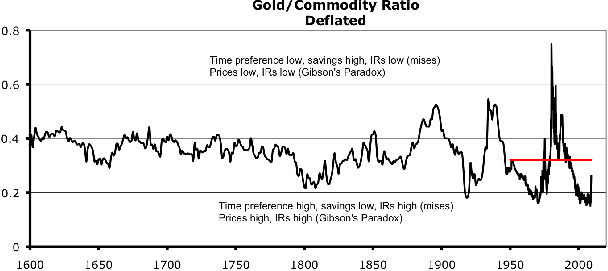
We will now move along to the main purpose of this discussion, which is
to introduce the very insightful analysis of Peter Wright (PW). In the
below-linked articles PW draws on the work of Ludwig von Mises to show
that even though the observed interest rate has been divorced from the
natural interest rate, we can still observe changes in the collective
time preference of consumers (changes in the desire to consume today
relative to the desire to save for the future) in the gold/commodity
(g/c) ratio. Specifically, he shows that periods of high consumption
(high time preference, strong desire to spend) -- periods such as the
1920s, the 1960s, the 1990s, and 2003-2007 -- tend to be associated
with a low g/c ratio, and that periods of low consumption (low time
preference, strong desire to save) -- periods such as the 1930s, the
1970s, and right now -- tend to be associated with a high g/c ratio.
Actually, he uses a deflated g/c ratio in his analysis rather than the
nominal g/c ratio because the costs imposed on the overall economy by
today's fiat monetary system caused gold's purchasing power to enter a
long-term upward trend a few decades ago. As an aside and as discussed
in the 6th April Weekly Update, the cost of today's monetary system is
also reflected in the long-term decline in the productivity of debt
(the long-term upward trend in the total quantity of debt relative to
net national income).
Links to the articles are included below, as is a copy of PW's chart of
the deflated g/c ratio. Note: if you only have time to read one of
these articles then you should read the third one (part iii) because it
includes summaries of the first two.
http://www.freemensch.com/2009/03/mises-money-gold-and-gibsons-paradox-part-i.html
http://www.freemensch.com/2009/03/mises-money-gold-and-gibsons-paradox-part-ii.html
http://www.freemensch.com/2009/03/mises-money-gold-and-gibsons-paradox-part-iii.html
Here are some excerpts from the above-linked articles:
"... if entrepreneurial
advances are misdirected into destructive arenas the advance of
civilization will slow, halt or reverse. The g/c ratio will begin to
increase as wealth is directed to and concentrated in the hands of the
non-productive. That fiat (as opposed to gold) money permits the
redirection of progress to destructive arenas is self evident. Wars,
big government, corrosive IP laws and intrusive regulation and wealth
distribution all are made possible on a scale unimaginable under gold
as money. This is the cost of fiat money. So I will make two explicit
assumptions. First that the institution of fiat money slows the advance
of civilization. Second, that this impediment to advancing civilization
appears as an increase in the purchasing power of gold that can be
observed and quantified."
"The depression period of
1875-1895 is observed as a rising g/c ratio. As would be expected
during a period when people are trying to increase their savings. The
boom period until the end of the 1920s is also observed as a period of
high time preference. The great depression as a time of low time
preference. The 1950s and 1960s as a boom period with high time
preference. Then the mini depression of the 1970s with people
expressing low time preference as they try to rebuild savings. Finally
the long boom of the 1990s ending with high time preference. Few would
dispute that we have recently witnessed a time of conspicuous urgent
consumption. Under a gold standard this high time preference would have
been expressed as a high IR. In fact, as we know, administered rates
were very low."
"With a too-low interest
rate devoid of information about savings, now institutionalized,
borrowing and investing can proceed in all sorts of lines that are
destined to eventually fail because all the wrong things have been made
(multiple examples of this are apparent at present). As the boom turns
to bust the bankers can create money at an even faster rate exactly
BECAUSE the time preference of society declines. This we see right now
in Early 2009. This of course is just a potted version of the Austrian
Business Cycle Theory."
"...under a fiat standard
the observed interest rate is merely a direct reflection of peoples
inflation expectations and not much more. ...When people try to save or
time preference declines (which is saying the same thing) then under a
fiat standard, bankers, fearing falling prices, will be motivated to
create new money. Just at a time when they are not constrained by the
need to retain confidence in the currency. For instance we now hear
daily talk of "quantitative easing" which would have been unimaginable
in its effects only a few months ago. However the new money WILL show
up in increasing prices later, thus increasing inflation expectations.
Since IRs are now merely a reflection of inflation expectations they
also increase after a delay."
Finally, here are two conclusions that can be drawn from PW's analysis and the current position of the g/c ratio:
1. The increased desire to save has caused the deflated g/c ratio to
reverse upward, but it is still low by historical standards. In other
words, there is huge scope for gold to make additional gains relative
to other commodities over the years ahead. In fact, by the time this
cycle is complete the gold price could reach heights relative to the
prices of other commodities that are unimaginable today.
2. As people desperately try to increase their savings the central
bankers of the world will intensify their efforts to destroy the value
of these savings, leading to rising inflation expectations and higher
interest rates during 2010 and beyond.
Base Metals Update
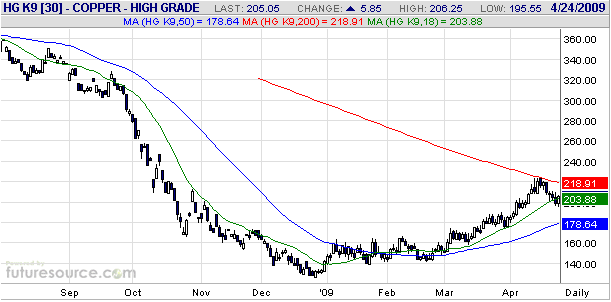
The following daily
futures chart shows that the copper price reversed lower during the
week before last after rising to its 200-day moving average. Over
recent years the copper market has consistently reached
intermediate-term price peaks during the month of May (there were
intermediate-term peaks during May of 2006, 2007 and 2008), so it won't
surprise us if copper makes a new high for the year next month.
However, the multi-month rebound in this market has been driven by
three factors that are likely to disappear in the not-too-distant
future (by July at the latest). These factors are: 1) expectations that
the global economy will return to its growth path later this year; 2)
the stock market rebound; and 3) re-stocking by China.
Due to the effects of production cut-backs, inflation and increased
infra-structure spending, we expect the copper price and the Industrial
Metals Index (GYX) to hold above last December's lows during the next
downturn. However, the bulk of the short-term upside potential has
probably now been wrung out of the industrial metals sector. We are
therefore downgrading our short-term outlook from "bullish" to
"neutral". All else remaining equal, moderate additional price gains
over the coming month or two would prompt a further downgrade (to
"bearish").
The Stock
Market
Current Market Situation
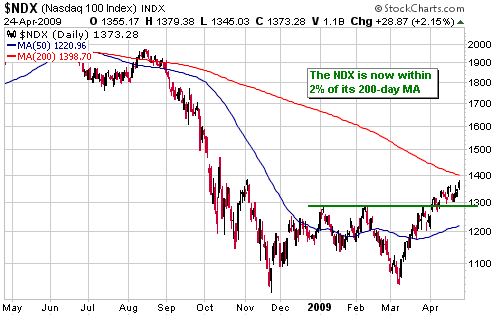
With reference to the following chart, the NASDAQ100 Index (NDX) moved
to a new 5-month high and to within 2% of its 200-day moving average on
Friday. At the same time and as discussed later in today's report,
there are signs that gold and gold stocks have resumed their
intermediate-term advances. The combination of these factors suggests
that the short-term downside risk in the broad stock market is now at
least as high as the additional short-term upside potential. We have
therefore downgraded our short-term stock market outlook from "bullish"
to "neutral".
Natural Gas Stocks
We have recently witnessed the extraordinary situation of natural gas
stocks rallying while the natural gas price regularly makes new 5-year
lows. This divergence between the stocks and the commodity has pushed
the AMEX Natural Gas Index (XNG) to a 15-year high (and perhaps to an
all-time high) relative to the price of natural gas. We are currently
benefiting from this extraordinary divergence, but we know it can't
continue for much longer. Either the natural gas price will soon begin
to trend upward or the stocks of natural gas producers will give back a
substantial chunk of their recent gains.
The relative positions of the XNG/natgas ratio and the natgas price are
illustrated by the following chart. Notice that all previous extremes
in the XNG/natgas ratio over the past 15 years led to rallies in the
natgas price.
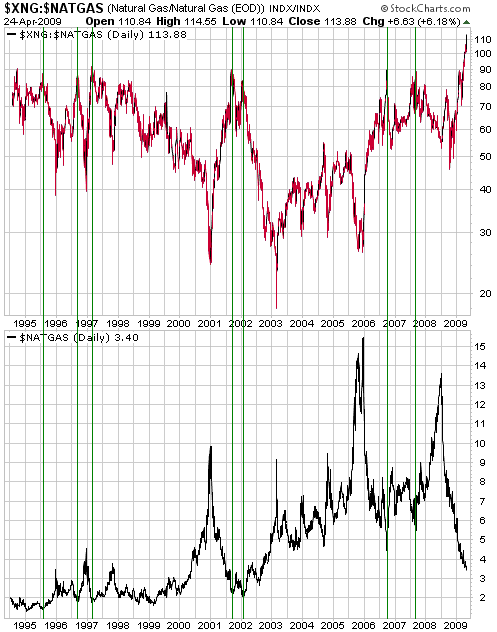
The implications of the above are:
1. The natgas price will probably begin to rebound in the near future
2. Natgas equities are currently very expensive relative to the underlying commodity
3. Natgas (the commodity) will almost certainly outperform the stocks of natgas producers over the next few months
In our own accounts we have begun to scale out of natgas equities.
Basically, we boosted our exposure to natgas equities in late February
and the first half of March, and we are now scaling out of what we
bought at that time with the aim of getting back to where we were at
the beginning of the year. We may buy some UNG (the US Natural Gas
Fund) to obtain direct exposure to the commodity, but haven't done so
yet. We plan to maintain a core position in natgas producers, primarily
via the Canadian 'gassy' trusts, in line with our long-term bullish
view.
In the TSI Stocks List we have long-term positions in the 'gassy'
trusts, Precision Drilling (PDS) and Fairborne Energy (TSX: FEL), and a
trading position in PDS. For the trading position we will continue to
run a 10% trailing stop, effective on a daily closing basis. On Friday
PDS closed at US$4.69, a new high for the move. Our sell stop has
therefore increased to US$4.22 (we will exit if PDS closes at or below
US$4.22).
This week's
important US economic events
| Date |
Description |
| Monday Apr 27 | No important events scheduled
| | Tuesday Apr 28 | Consumer Confidence
Case-Shiller Home Price Index
| | Wednesday Apr 29
| FOMC Monetary Policy Statement
| | Thursday Apr 30
| Personal Income and Spending
Employment Cost Index
Chicago PMI
| | Friday May 01
| Factory Orders
ISM Index
|
Gold and
the Dollar
Currency Market Update
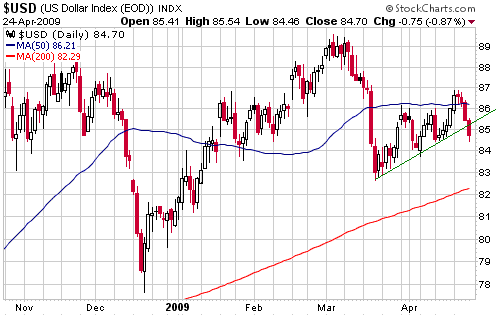
The Dollar Index failed to sustain last Monday's mini upside breakout
and, in fact, broke below a short-term trend-line on Friday (refer to
the following daily chart for details). We seriously doubt that this is
the beginning of a large decline in the Dollar Index, mainly because we
can see no good reason for substantial relative strength in the euro;
however, a pullback by the Dollar Index to the low-80s has been a
reasonable expectation for some time and remains so.
Coming up with
reasons to explain short-term price fluctuations in any market is
generally a futile endeavour because these fluctuations are subject to
considerable randomness, but if we were forced to pinpoint a reason for
the dollar's recent swoon we'd go with the revelation that Bank of
America (BOA) Chairman Ken Lewis was coerced by Fed Chairman Ben
Bernanke and Treasury Secretary Hank Paulson into proceeding with the
takeover of Merrill Lynch last December. To be more specific, Ken Lewis
has claimed that Bernanke, via Paulson, threatened to have the board
and the senior management of BOA removed unless the Merrill takeover
was consummated. According to Lewis, this threat was prompted by the
misgivings about the takeover deal that he expressed in a meeting with
Bernanke and Paulson in mid December. In this meeting Lewis apparently
intimated that BOA might back away from the deal because it had come to
light that Merrill was in far worse shape than previously believed.
Additional information on this topic can be found in this Forbes article and in Mish's commentary.
There is undoubtedly much investigating and testifying to come, but if
it turns out that Lewis is telling the truth then he, Paulson and
Bernanke have broken the law. Bernanke's direct involvement in this
mess has market-moving potential because he is the person in charge of
managing inflation expectations.
Gold
General optimism about gold's prospects, as measured by the COT data
and the premiums to net asset value of CEF and GTU, has not yet reduced
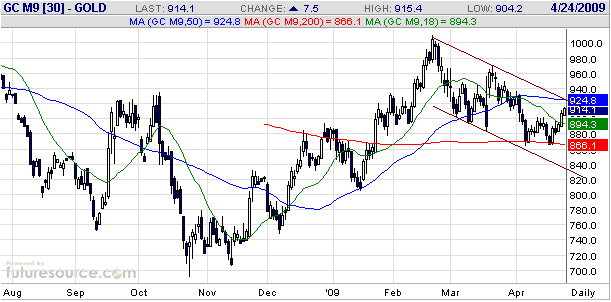
enough to indicate that a correction low is in place. Also, the
following daily chart shows that June gold remains within the confines
of a downward-sloping channel and below its 50-day moving average. That
being said, the gold market did enough during the final two days of
last week to suggest that its correction is over. In particular, it
achieved consecutive daily closes above minor resistance at $900 and
its 18-day moving average.
In response to the price action and despite the lack of sentiment
support, we've upgraded our short-term gold view from "neutral" to
"bullish".
Note that if June gold were to move below $890 on a daily closing basis
it would negate last week's bullish price action. Short-term traders
could therefore consider going 'long' near the current price (or,
ideally, following a pullback over the coming 1-2 days) and placing a
closing stop at around $890. That is, plan to exit short-term positions
if June gold CLOSES below $890. Investors should simply accumulate on
pullbacks and otherwise hold in anticipation of much higher nominal and
real gold prices over the years ahead.
More often than not
over recent months gold has ignored the US dollar's performance in the
foreign exchange market, but during the final two days of last week
gold definitely got a boost from a fall in the Dollar Index. The
reason, we think, is that last week's US$ decline was prompted by the
Fed Chief's possible involvement in a scandal rather than by a revival
of global growth expectations. Gold was also helped late last week by
news that China has been steadily increasing its official gold reserves
over the past six years.
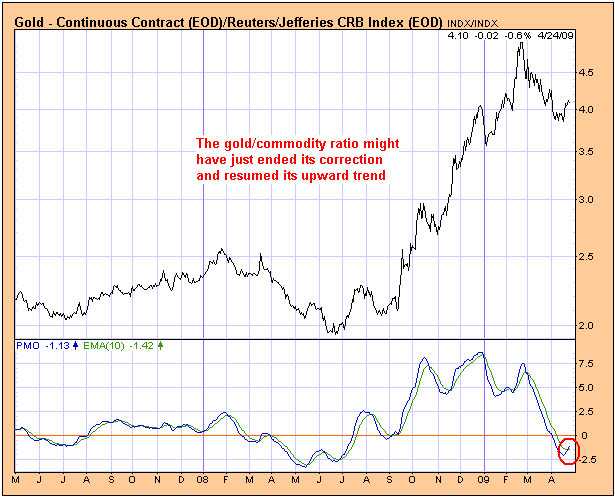
We discussed the gold/commodity ratio in some detail above and also in
the 20th April Weekly Update (in the 20th April commentary we
specifically referred to the gold/CCI ratio, which we also called the
"real gold price"). The current position of this extremely important
ratio is charted below, in this case using the CRB Index to represent
the general level of commodity prices. Note that Decisionpoint.com's
Price Momentum Oscillator (PMO) for the gold/CRB ratio is displayed in
the bottom section of the chart.
We won't be surprised if gold/CRB makes a slightly lower low during May
or June, but for all intents and purposes this ratio's correction
appears to be over.
Gold Stocks
Current Market Situation
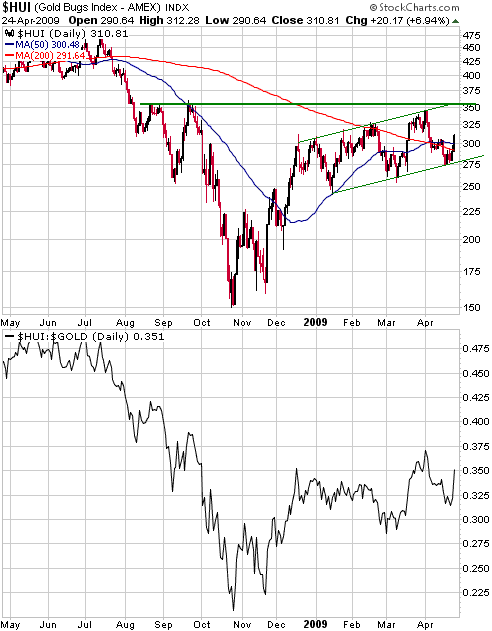
A chart showing the HUI and the HUI/gold ratio is displayed below.
The gold sector was strong enough during the final two days of last
week to push the HUI above resistance at 305. Furthermore, the strength
was confirmed by a surge in the HUI/gold ratio. This means that a
correction low is most likely in place.
The next resistance of importance lies in the 350s. It is defined by
the rebound peaks of August-September last year as well as by the
rising channel top. This resistance will eventually be breached -- it's
a question of when, not if.
The HUI is not
'overbought' on even a short-term basis, but there's a good chance that
the rapid advance of the past two days will be followed by a 1-2 day
pullback. Traders should take advantage of any pullback early this week
and place initial sell stops just below the lows of the past fortnight.
By far the best value in the gold/silver sector can be found amongst
the small exploration-stage juniors, but the stocks with the best
short-term risk/reward ratios are the juniors that offer significant
current production, current cash flow, solid balance sheets, and
reasonable stock market liquidity. Some examples from the TSI Stocks
List are (in alphabetical order): First Majestic Silver (TSX: FR),
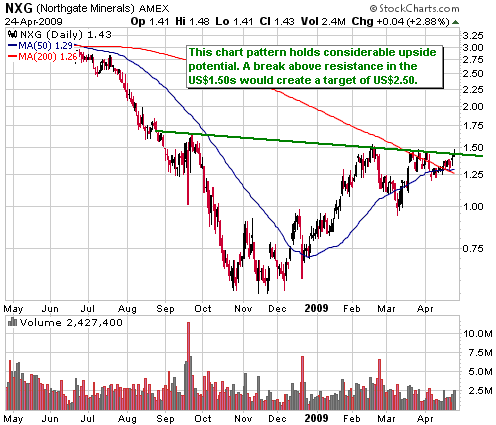
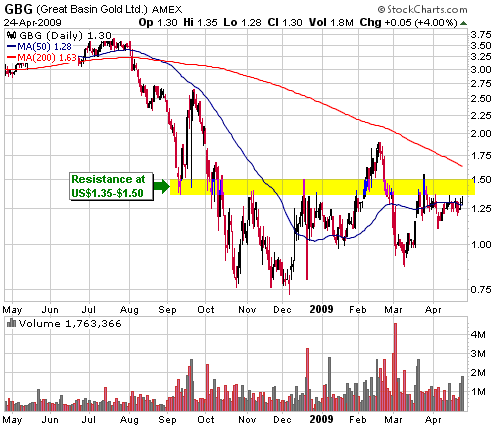
Great Basin Gold (AMEX: GBG), New Gold (AMEX: NGD), and Northgate
Minerals (AMEX: NXG) (note that GBG isn't yet cash flow positive, but
it has the other attributes and its valuation is low). Charts of NXG
and GBG are presented below.
Gold Stock Cycles
During 2000-2006 there was a very strong tendency for the gold sector
to make intermediate-term turning points during October-November and
during May. The October-November period has continued to provide
important turning points in the gold sector, but the May cycle appears
to be losing its influence. For example, in 2007 and 2008 there was
neither an important high nor an important low during May.
Although the May cycle hasn't operated over the past two years, IF the
gold sector rises at a rapid pace over the next few weeks it will
potentially set the stage for an intermediate-term May peak.
Update
on Stock Selections
(Note: To review the complete list of current TSI stock selections, logon at http://www.speculative-investor.com/new/market_logon.asp
and then click on "Stock Selections" in the menu. When at the Stock
Selections page, click on a stock's symbol to bring-up an archive of our comments on the stock in question)
Chart Sources
Charts appearing in today's commentary
are courtesy of:
http://stockcharts.com/index.html
http://www.futuresource.com/
http://www.decisionpoint.com/

|









