|
-- Weekly Market Update for the Week Commencing 24th June 2013
Big Picture
View
Here is a summary of our big picture
view of the markets. Note that our short-term views may differ from our
big picture view.
In nominal dollar terms, the BULL market in US Treasury Bonds
that began in the early 1980s will end by 2013. In real (gold)
terms, bonds commenced a secular BEAR market in 2001 that will continue
until 2014-2020. (Last
update: 23 January 2012)
The stock market, as represented by the S&P500 Index,
commenced
a secular BEAR market during the first quarter of 2000, where "secular
bear market" is defined as a long-term downward trend in valuations
(P/E ratios, etc.) and gold-denominated prices. This secular trend will bottom sometime between 2014 and 2020.
(Last update: 22 October 2007)
A secular BEAR market in the Dollar
began during the final quarter of 2000 and ended in July of 2008. This
secular bear market will be followed by a multi-year period of range
trading.
(Last
update: 09 February 2009)
Gold commenced a
secular bull market relative to all fiat currencies, the CRB Index,
bonds and most stock market indices during 1999-2001.
This secular trend will peak sometime between 2014 and 2020.
(Last update: 22 October 2007)
Commodities,
as represented by the Continuous Commodity Index (CCI), commenced a
secular BULL market in 2001 in nominal dollar terms. The first major
upward leg in this bull market ended during the first half of 2008, but
a long-term peak won't occur until 2014-2020. In real (gold) terms,
commodities commenced a secular BEAR market in 2001 that will continue
until 2014-2020.
(Last
update: 09 February 2009)
Copyright
Reminder
The commentaries that appear at TSI
may not be distributed, in full or in part, without our written permission.
In particular, please note that the posting of extracts from TSI commentaries
at other web sites or providing links to TSI commentaries at other web
sites (for example, at discussion boards) without our written permission
is prohibited.
We reserve the right to immediately
terminate the subscription of any TSI subscriber who distributes the TSI
commentaries without our written permission.
Outlook Summary
Market
|
Short-Term
(1-3 month)
|
Intermediate-Term
(6-12 month)
|
Long-Term
(2-5 Year)
|
|
Gold
|
Bullish
(17-Oct-12)
|
Bullish
(26-Mar-12)
|
Bullish
|
|
US$ (Dollar Index)
|
Neutral
(24-Dec-12)
|
Bullish
(01-May-13)
|
Neutral
(19-Sep-07)
|
|
Bonds (US T-Bond)
|
Bullish
(24-Jun-13)
|
Neutral
(18-Jan-12)
|
Bearish |
|
Stock Market
(DJW)
|
Neutral
(06-May-13)
|
Bearish
(28-Nov-11)
|
Bearish
|
|
Gold Stocks
(HUI)
|
Bullish
(24-Dec-12)
|
Bullish
(23-Jun-10)
|
Bullish
|
|
Oil |
Neutral
(30-Jul-12)
|
Neutral
(31-Jan-11)
|
Bullish
|
|
Industrial Metals
(GYX)
|
Neutral
(30-Jul-12)
|
Neutral
(29-Aug-11)
|
Neutral
(11-Jan-10)
|
Notes:
1. In those cases where we have been able to identify the commentary in
which the most recent outlook change occurred we've put the date of the
commentary below the current outlook.
2. "Neutral", in the above table, means that we either don't have a
firm opinion or that we think risk and reward are roughly in balance with respect to the timeframe in question.
3. Long-term views are determined almost completely by fundamentals,
intermediate-term views by
fundamentals, sentiment and technicals, and short-term views by sentiment and
technicals.
Our history of being early
We have a history of being too early to
adopt a new long-term view on each of the major financial markets that we
analyse. Here are some examples:
1) We were at least 2 years too early in turning long-term bearish on the US
stock market and US dollar in the late-1990s.
2) We were at least 2 years too early in turning long-term bullish on gold and
commodities in the late-1990s.
3) We were 6-12 months too early in turning long-term bearish on China's stock
market and the China growth story in 2007.
4) We were 6-12 months too early in upgrading our long-term US$ outlook (from
bearish to neutral) in 2007.
5) We were several months too early in coming to the conclusion that oil was
close to a long-term peak in real terms in 2008.
6) We were about a year early in downgrading our long-term industrial-metals
outlook in 2010.
One implication of our record of being too early in getting positioned for a
major trend change is that at those rare times when our long-term outlook
changes you should probably file the information away for at least 12 months.
Another implication is that we are far more likely to downgrade our long-term
gold market outlook well in advance of the ultimate price top than to stay
long-term bullish beyond the ultimate price top.
China Credit Crunch
Recent sharp rises in interbank lending rates in
China indicate that a credit crunch of sorts is happening within China's banking
industry. As is often the case when prices suddenly make large moves in a
bearish direction, this short-term interest-rate surge in China has prompted
"end of the world" type commentary at Zero Hedge and a few other web sites.
However, China's sudden 'credit crunch' probably isn't important.
Before getting to the reasons behind our claim that this isn't a development of
major global significance, we'll point out that the increase in China's
interbank lending rates has certainly been impressive. For example, as noted in
a
20th June Bloomberg article: "The seven-day repurchase rate rose 2.70
percentage points to 10.77 percent in Shanghai, according to a daily fixing
announced by the National Interbank Funding Center. That was the highest in data
going back to March 2003. The one-day rate rose by an unprecedented 527 basis
points to an all-time high of 12.85 percent, a separate fixing showed. An
intra-day gauge of the one-day rate touched a record 30 percent."
We now turn to the reasons why the current 'credit crunch' isn't a big deal.
The first reason is that the short-term credit shortage has been deliberately
manufactured by the PBOC (People's Bank of China, China's central bank) and
could be ended by the PBOC any time it chooses.
The second reason is that on an economy-wide basis the supplies of credit and
money continue to grow rapidly. For example, China's M2 money supply grew by
almost 16% over the past 12 months. This means that while the PBOC temporarily
'turns the screws' on some banks, the overall economy continues to be flooded
with more credit and more money. This, in turn, means that a credit and money
deluge, as opposed to a credit and money shortage, remains one of the biggest
threats to China's economy.
The third reason is that the so-called 'credit crunch' is dwarfed by China's
mal-investment and "price inflation" problems that we've highlighted for many
years. Since 2007 we've described China as an economic disaster waiting to
happen, thanks largely to the massive mal-investment resulting from
relentlessly-fast growth in the money supply and the fact that a lot of
property, infrastructure and other capital investment is done with minimal
consideration for, or in defiance of, long-term economic merits. It would
probably now be more appropriate to describe China as an economic disaster in
the process of happening, albeit in slow motion.
Of course, just because an event isn't fundamentally important doesn't mean that
it won't have a significant short-term effect on market prices. While market
prices always fall into line with fundamentals over the long term, short-term
price changes are often dominated by sentiment. It is therefore possible that
news of China's 'credit crunch' contributed to last week's extreme weakness in
the gold market. After all, if you have been hoodwinked into believing that the
goings-on in China are a cornerstone of gold's bull market and you have some
logical consistency, then news of credit tightening in China should cause you to
become more bearish on gold.
T-Bond Update
In a world where central banks have
eliminated the most important information contained in the default-free interest
rate (a change in interest rates is supposed to reflect a change in the
economy-wide desire to spend in the present, with interest rates falling as the
savings rate rises and interest rates rising as the savings rate declines),
changes in inflation expectations tend to dominate changes in long-term bond
yields. The way it is supposed to happen and the way it has invariably happened
up until this year is that a significant reduction in inflation expectations
causes long-term interest rates to fall and bond prices to rise. As discussed
last week, the strangest aspect of the recent sharp decline in the T-Bond price
and the associated sharp rise in the T-Bond yield is that it happened in
parallel with a PLUNGE in inflation expectations.
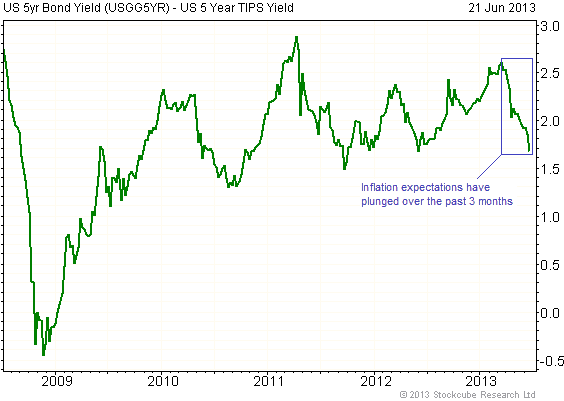
We usually show what has happened to inflation expectations by displaying a
chart of the 10-year Expected CPI, which we define as the yield on the 10-year
T-Note minus the yield on the 10-year TIPS. For the sake of variety, however,
today we are showing a chart of the 5-year Expected CPI (the yield on the 5-year
T-Note minus the yield on the 5-year TIPS). The message is the same: inflation
expectations have plunged over the past three months.
By using our imagination we can come up with explanations for why the T-Bond has
recently sold-off sharply in parallel with a sharp decline in inflation
expectations. We have also read others' explanations for the unusual behaviour.
However, none of these explanations holds up under close scrutiny. At this time
the T-Bond's short-term performance is a quandary.
Regardless of why the T-Bond market has done what it has done, there's a good
chance that it is now close to a short-term bottom in terms of both price and
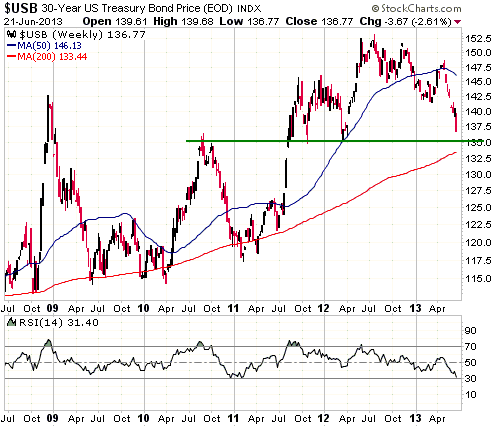
time. Judging by the following weekly chart, it could even be close to an
intermediate-term bottom. The chart shows that the T-Bond is now within 1% of
intermediate-term support at 135 and that the T-Bond's weekly RSI is at its lows
of the past 5 years.
Previous intermediate-term bottoms over the past 5 years were put in place after
the T-Bond spiked below its 200-week moving average (the red line on the
following chart), which suggests that there could be as much as five points of
additional downside between now and the next important reversal. However, the
short-term risk/reward is now skewed towards reward. Our short-term T-Bond view
is therefore now "bullish".
The Stock
Market
Where secular valuation trends begin and
end
The following chart shows the S&P500's P/E ratio since 1900.
No secular equity bear market since 1900 ended until after the S&P500's P/E
ratio hit the horizontal green line drawn on this chart. We don't see a good
reason to believe that this time will be different.
The S&P500's P/E ratio has been in a downward trend since 2000, but it still has
a long way to go to reach the sort of valuation at which secular bear markets
end.
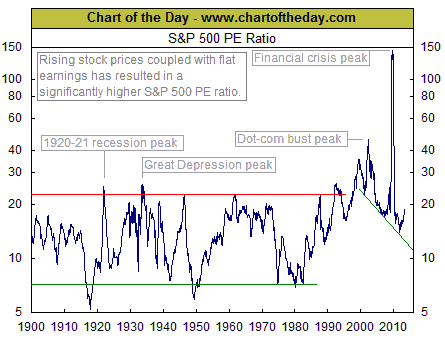
Chart Source:
http://www.chartoftheday.com/20130619.htm?T
Current Market Situation
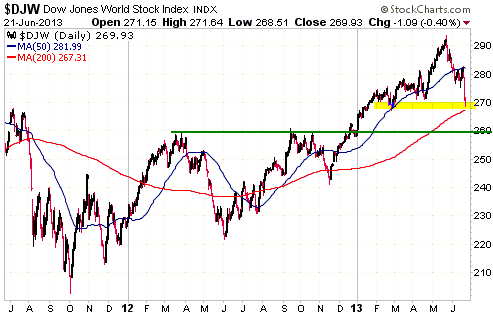
Last week the Dow Jones World Index (DJW) tested support defined by its
February-April lows and almost reached its 200-day MA (the red line on the
following daily chart). A spike below the 200-day MA to intermediate-term
support at 260 looks distinctly possible within the next two weeks, but
regardless of the longer-term outlook the index is probably not far from a
short-term bottom.
This week's
important US economic events
| Date |
Description |
| Monday Jun 24 |
Dallas Fed Mfg Survey | | Tuesday
Jun 25 |
Durable Goods Orders
Case-Shiller Home Price Index
New Home Sales
Consumer Confidence
Richmond Fed Mfg Index | | Wednesday
Jun 27 |
Q1 GDP (revised) | | Thursday
Jun 28 |
Personal Income and Spending
Pending Homes Sales Index
Kansas Fed Mfg Index
|
| Friday Jun 29 |
Chicago PMI
Consumer Sentiment |
Gold and
the Dollar
Gold
More thoughts on paper versus physical
Many gold market pundits spend far too much time analysing flows between
different parts of the market. As explained in previous TSI commentaries, these
flows generally provide no information about why the gold price did what it did
in the past or, more relevantly, what the gold price is likely to do in the
future. Many gold market pundits also spend far too much time looking at price
differences between gold in its various forms. Regardless of whether gold is in
a bull or a bear market, there will sometimes be significant differences between
the widely-recognised "spot price" and the per-ounce prices of various items
manufactured from gold. As far as gold's investment merits and major price trend
are concerned, these differences are generally neither here nor there. There is,
however, one price difference that would be important if it ever arose.
The only price difference of importance would be 400-oz gold bars in the major
gold markets (primarily London and New York) trading at sizeable and sustained
price premiums to gold futures; or, to put it another way, gold futures
contracts trading at sizeable and sustained discounts to 400-oz gold bars in the
major/liquid markets.
This price difference has not arisen at any time to date, but if it did arise it
would probably be the result of -- and therefore signal -- a plunge of
confidence in paper claims to gold that would have serious ramifications beyond
the gold market. In this case, the driver of the price difference would be
increasing demand for physical gold at the expense of paper gold. It could also
be the result of an attempt to manipulate the gold price downward by
aggressively short-selling gold futures contracts. In this case the price driver
would be increasing supply of paper gold.
We emphasise that the only price difference between 'paper gold' and physical
gold that would really matter has not appeared to date. We also emphasise that
this price difference would definitely appear IF there were either a plunge in
confidence in paper gold or aggressive selling of paper gold (on a large-enough
scale to be effective beyond the very short-term) with the primary goal of
artificially lowering the gold price.
The only price difference that really matters might never appear. This is
because the futures market could continue to function correctly, allowing
speculators to speculate on future price movements and allowing commercials
(bullion banks, producers, wholesalers) to hedge their exposure to the physical.
Fortunately, the continuation of gold's long-term bull market does not depend in
any way on the emergence of such an intra-market price difference.
Current Market Situation
Based on sentiment and fundamentals, we expect the next major advance in the
gold (and silver) market to begin from this year's low. Prior to last week we
thought it was an even-money bet as to whether this year's low was already in
place or would be put in place during October-November (a time-window when major
turning points tend to happen). By eliminating the first possibility, last
week's price action decisively shifted the odds in favour of a major
October-November low.
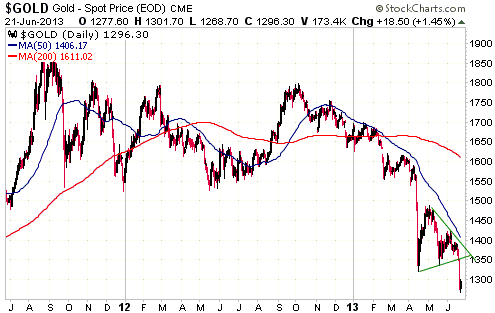
Turning to gold's daily price chart (see below), last week's breach of the April
low creates a measured objective of around $1200. Unfortunately, that doesn't
mean much. We will be surprised if gold trades much lower than last Friday's
intra-day low ($1268) at any time over the next few weeks, but the gold market
has lately been making a habit of surprising us.
It's strange, but we are becoming increasingly optimistic. Perhaps it's because
every fundamentals-based gold-bearish argument we read is flimsy. As is always
the case, though, after the price of an investment has fallen a long way the
public will believe almost any bearish argument, no matter how nonsensical.
Gold Stocks
Current Market Situation
Prior to last week we thought that the two most likely gold-stock scenarios
could be described as follows:
a) The May-2013 low was the ultimate low of the major correction (or cyclical
bear market) that began in September of 2011. According to this scenario a new
cyclical bull market was in its embryonic stage.
b) The May-2013 low was significant, but not the ultimate low of the cyclical
bear market. According to this scenario the most likely timing for the ultimate
low was October-November of this year.
The first of these scenarios was ruled out by last week's price action. The
second scenario is very much still in play, although we would not have predicted
last week's breakdown even if we had known for certain that the ultimate low was
destined to occur during October-November. Even under the second scenario it
would have been reasonable to expect a more substantial rebound prior to a
breakdown.
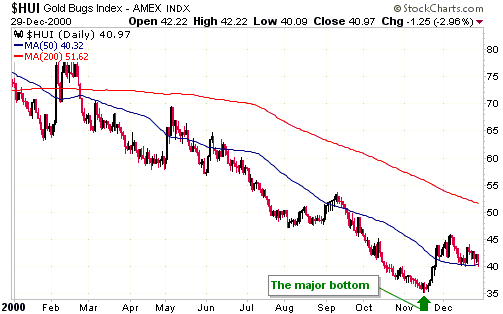
With the absence of a strong rebound throughout this year to date, 2013 is
unfolding similarly to 2000.
The first of the following daily charts shows the HUI's performance during 2000.
A bull market began in November of that year. The second of the following charts
shows the HUI's performance over the past 12 months.
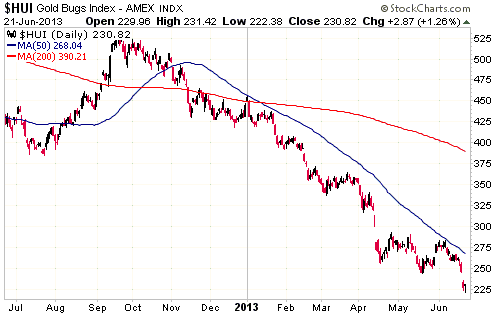
If the HUI didn't reach an interim low last Friday, it will probably do so early
this week.
Index and ETF adjustments cause large high-volume price declines
In the 17th June Weekly Update we mentioned the TSI stocks that would
potentially be driven downward on Friday 21st June due to changes in S&P/TSX
indices and GDXJ holdings. The two TSI stocks that ended up being most affected
by the selling of index trackers were RMS.AX, which dropped by as much as 20% in
Australian trading last Friday on massive volume, and EDV.TO, which fell 14% in
Canadian trading last Friday on the highest volume in at least 5 years. Two non-TSI
stocks affected in the same way by index/ETF changes were Lake Shore Gold (LSG.TO)
and Aucana Corporation (AUN.TO), which fell 37% and 19%, respectively, last
Friday.
Currency Market Update
From mid-February until about two weeks ago the Dollar Index was positively
correlated with global equities. This was anomalous behaviour in the context of
how the relationship between the currency and stock markets had operated for
many years. However, last week's market action, with a sharp rebound in the
Dollar Index coinciding with significant declines in most stock markets around
the world, suggests that the more typical inverse relationship between equities
and the US$ is in the process of being re-established.
A week ago we thought that the Dollar Index was likely to rebound by about 2
points, regardless of whether or not the overall decline from the May-2013 high
was complete. The Dollar did gain a couple of points last week and, as a
consequence, is no longer short-term 'oversold'. It also isn't 'overbought' and
there is nothing in the chart to indicate the most likely direction of the next
2-point move.
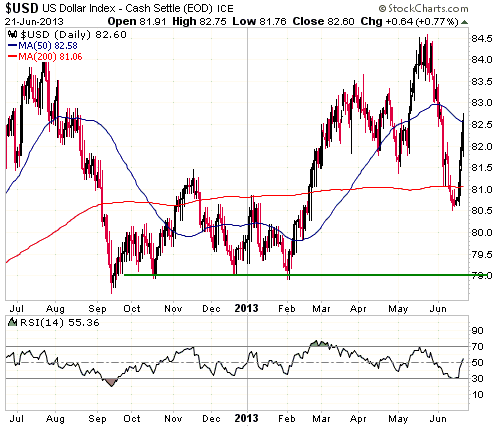
We are tempted to downgrade our short-term Dollar Index outlook to "bearish" on
the basis that a) a pullback to test support at 79-80 has a
better-than-even-money chance of happening at some point over the next several
weeks, and b) there is a small chance that support at 79 will be breached if the
EZ's banking system holds together for at least a few more months. We are
resisting this temptation, though, because we aren't confident that the EZ's
banking system will hold together for at least a few more months.
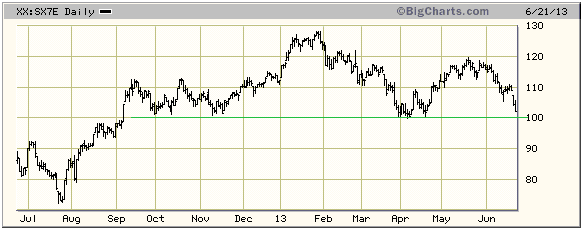
All it would take to signal the start of the next banking crisis in Europe would
be a solid break by the EURO STOXX Banks Index (SX7E) below support at 100. This
support is only 2% below last Friday's close.
Update
on Stock Selections
Notes: 1) To review the complete list of current TSI stock selections, logon at
http://www.speculative-investor.com/new/market_logon.asp
and then click on "Stock Selections" in the menu. When at the Stock
Selections page, click on a stock's symbol to bring-up an archive of
our comments on the stock in question. 2) The Small Stock Watch List is
located at http://www.speculative-investor.com/new/smallstockwatch.html
 Company
news/developments for the week ended Friday 21st June 2013: Company
news/developments for the week ended Friday 21st June 2013:
[Note: FS = Feasibility Study, IRR = Internal Rate of Return, MD&A =
Management Discussion and Analysis, M&I = Measured and Indicated,
NAV = Net Asset Value, NPV(X%) = Net Present Value using a discount
rate of X%, P&P = Proven and Probable, PEA = Preliminary Economic
Assessment, PFS = Pre-Feasibility Study]
*Asanko Gold (AKG) advised that work is underway on the FS for the
5M-oz Esaase gold project, Ghana. The plan is for the FS to be
complete, $150M of mine financing to be arranged and all necessary
permits to be in place by early next year. The longer-term plan is
for Esaase to be producing gold at the rate of 200K-ounces/year by
the end of 2015.
AKG also advised that it has identified opportunities to expand
production and reduce costs and thus improve on the project
economics contained in the May-2013 PFS. The implication is that
although the project economics outlined in the PFS were good, those
outlined in the upcoming FS will be better. We'll see.
As a result of last week's sector-wide decline, AKG is now trading
at around cash value. That is, the company's market cap is now
roughly the same as its net cash, meaning that the stock market is
assigning zero value to the Esaase project. The Esaase project is
worth a lot more than zero.
*Batero Gold (BAT.V) issued a press release last Tuesday.
Following a lengthy and uninteresting discussion about relatively
unimportant soil/rock-chip samples and a planned drilling program,
the press release mentions that the PEA for the La Cumbre deposit
(by far the most important upcoming milestone for BAT) would be
complete during Q3-2013. The strange thing is that in a 14th May
press release the company confirmed that it was on schedule to
deliver the PEA during the second quarter of 2013. So, in the space
of a month the completion of the PEA has been delayed by at least
one month. Not good.
*Clifton Star Resources (CFO.V) reported a very good intercept
from its on-going drilling program at the Duparquet project
(Quebec). We are referring to Hole BD13-22, which intersected 34.0
meters grading 5.64 g/t Au. The hole was drilled within one of the
proposed pits (that is, within the bounds of the existing resource)
and therefore probably won't expand the project's overall resource,
but it adds to the confidence level.
CFO plans to announce an updated resource estimate within the next
two weeks that will include the results of all drilling completed up
to 6th May. This resource estimate will then form part of the
in-progress PFS.
*Golden Star Resources (GSS) published its latest operational
update, which is the news we've been waiting for since the company's
previous operational update early last month. The previous
operational update announced the failure of a pit wall at GSS's
Bogoso/Prestea mine (Ghana), resulting in 2013 production guidance
falling from 335K ounces to 300K ounces. The previous update also
reported very high "cash costs" at Bogoso/Prestea, introducing the
possibility that this operation would be placed on
care-and-maintenance and, therefore, that 2013 production would fall
to around 200K ounces.
According to the new operational update, production will continue at
the Bogoso/Prestea mine. Costs will remain high over the next three
quarters, but a revised mine plan indicates that costs will be 30%
lower by mid-2014. In the mean-time, the company expects that the
Wassa mine will generate enough cash to offset the Bogoso mine's
cash drain.
With production continuing at Bogoso, GSS has kept its 2013 guidance
at around 300K ounces. That is, there hasn't been a reduction in
guidance beyond the reduction from 335K to 300K ounces advised last
month. Despite the reduced production, the per-ounce "cash cost"
guidance is being maintained at the original 2013 level of
$1050-$1150. This was made possible by various cost savings outlined
in last week's press release.
In addition to finding enough savings to maintain its "cash cost"
guidance, GSS has reduced its planned 2013 spending on sustaining
capital, development capital and exploration. This should ensure
that the company has enough cash to survive the next 6-12 months
even if the gold price drops a bit lower.
On the whole, this latest news from GSS is neither good nor bad.
It's good that the company has found a way to keep its Bogoso mine
in production, but keeping Bogoso in production increases the risk
for the overall company because this mine will be a drain on cash
reserves for the next three quarters or until the gold price moves
back above $1600/oz.
*Pretium Resources (PVG) provided an update on the progress and
schedule of its Bulk Sample Program. Excavation of the bulk sample
is scheduled to commence this week and is expected to be complete in
late July or early August. The underground drilling being done in
support of the bulk sample testing is scheduled to be complete by
mid-August. The report by the third party consultant (Strathcona
Minerals Services) responsible for overseeing the bulk sample data
collection and analysis is expected to be available during the final
quarter of this year.
*Ramelius Resources (RMS.AX) traded 30.5M shares on Friday 21st
June. This compares to average daily trading volume of about 1.4M
shares. Friday's massive volume was almost certainly related to
RMS's 21st June deletion from GDXJ, which we warned about in the
17th June Weekly Update.
Due to its recent price plunge, RMS now has a negative enterprise
value. In other words, the company is now being valued at less than
its net cash.
In lousy market environments it occasionally happens that
exploration-stage gold miners trade below their cash in the bank,
but it is extremely rare for a gold miner with 3M ounces of
in-ground resources and 80K ounces/year of current gold production
in the world's best mining region (Western Australia) to trade below
cash value.
We bought some more RMS shares at A$0.10 on Friday.
Two
changes to TSI Stocks List
In last week's Interim Update we discussed three stocks that would be added to
the TSI List if certain price levels were reached -- Lydian International (LYD.TO)
and Premier Gold (PG.TO) as (potentially) long-term positions and Rio Alto
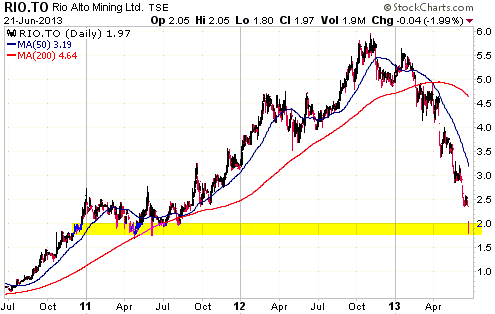
Mining (RIO.TO) as a short-term trade. Of these, only RIO fell far enough to
reach our stipulated buy level of "low-C$2", although the other two came close.
RIO was at C$2.40 when we wrote the Interim Update, but traded as low as C$1.80
on Friday and ended the week at C$1.97. It has been added to the TSI List at
C$2.00 as a short-term trading position.
The main short-term risk with RIO is that its all-in gold production cost is
only about $50/oz below the current gold price. This means that if gold were to
extend last week's decline, the stock price could be hit again. On the plus
side, the stock price should quickly recoup some of its recent losses when the
gold price rebounds and there's a high probability that RIO will announce good
quarterly production results next month.
We are buying in anticipation of a rebound to the C$3.00-C$3.50 range within the
coming two months, at which point we would exit.
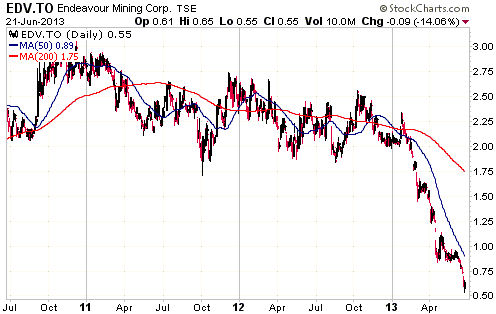
The other change to the TSI Stocks List is the addition of a short-term trading
position in Endeavour Mining (EDV.TO). The TSI List already contains long-term
exposure to EDV, but the short-term risk/reward is now extremely attractive as a
result of last week's price action.
As is the case with RIO, there is a potential stock-specific short-term catalyst
for an EDV price rebound. We are referring to the gold hedges that EDV still
holds as a result of its takeovers of Adamus and Avion. Based on the most recent
financial statements, EDV has a total of 114K ounces of gold committed via
forward sales and call options. It also has 27K ounces of gold bullion, leaving
a net hedging position of 87K ounces.
At the current gold price the value of this hedging position would be about $26M
higher than the value included in the 31st March financial statements. This
opens up the possibility that EDV will report a significant boost to its balance
sheet when the next set of financial statements is issued in early-August.
Ideally, EDV's management will take advantage of the current weakness in the
gold market to close out the remaining hedges.
We have added a short-term trading position in EDV at Friday's closing price of
C$0.55. The goal is to exit this position following a rebound to around C$1.00.
We will add long-term positions in LYD.TO and PG.TO if these stocks trade at
C$1.05 and C$1.80, respectively, within the next two weeks.
Chart Sources
Charts appearing in today's commentary
are courtesy of:
http://stockcharts.com/index.html
http://bigcharts.marketwatch.com/
http://www.fullermoney.com/

|









