-- Weekly Market Update for the Week Commencing 24th August 2015
Big Picture
View
Here is a summary of our big picture
view of the markets. Note that our short-term views may differ from our
big picture view.
The BULL market in US Treasury Bonds that began in the early 1980s ended in early-2015, but there will be many years of topping action in bond prices and bottoming action in bond yields before major new trends get underway. (Last update: 29 June 2015)
The stock market, as represented by the S&P500 Index, commenced a secular BEAR market during the first quarter of 2000, where "secular bear market" is defined as a long-term downward trend in valuations (P/E ratios, etc.) and gold-denominated prices. This secular trend will bottom sometime between 2018 and 2020. (Last update: 29 June 2015)
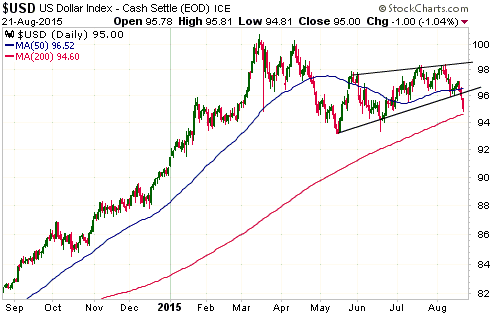
A secular BEAR market in the US Dollar began during the final quarter of 2000 and ended in July of 2008. This secular bear market will be followed by a multi-year period of range trading. (Last update: 09 February 2009)
Gold commenced a secular bull market relative to all fiat currencies, the CRB Index, bonds and most stock market indices during 1999-2001. This secular trend will peak sometime between 2018 and 2020. (Last update: 29 June 2015)
Commodities,
as represented by the CRB Index, commenced a
secular BULL market in 2001 in nominal dollar terms. The first major
upward leg in this bull market ended during the first half of 2008, but
a long-term peak won't occur until 2018-2020.
(Last
update: 29 June 2015)
Copyright
Reminder
The commentaries that appear at TSI
may not be distributed, in full or in part, without our written permission.
In particular, please note that the posting of extracts from TSI commentaries
at other web sites or providing links to TSI commentaries at other web
sites (for example, at discussion boards) without our written permission
is prohibited.
We reserve the right to immediately
terminate the subscription of any TSI subscriber who distributes the TSI
commentaries without our written permission.
Outlook Summary
|
Market |
Short-Term (1-3 month) |
Intermediate-Term (6-18 month) |
Long-Term (2-5 Year) |
| Gold | N/A |
Bullish (26-Mar-12) |
Bullish |
| US$ (Dollar Index) | N/A |
Neutral (22-Jun-15) |
Neutral (19-Sep-07) |
| US Treasury Bonds (TLT) | N/A |
Neutral (18-Jan-12) |
Bearish |
| Stock Market (DJW) | N/A |
Bearish (28-Nov-11) |
Bearish |
| Gold Stocks (HUI) | N/A |
Bullish (23-Jun-10) |
Bullish |
| Oil | N/A |
Bullish (17-Dec-14) |
Bullish |
| Industrial Metals (GYX) | N/A |
Bullish (22-Jun-15) |
Bullish (28-Apr-14) |
4. Long-term views are determined almost completely by fundamentals and intermediate-term views
are determined by a combination of fundamentals, sentiment and technicals.
Last week's posts at the TSI Blog
Basic Gold Market
Facts
Everything is obvious with the benefit of hindsight
The meaning of the 6-year low in GLD’s bullion inventory
The 7-Year Cycle
In the 27th July 2015 Weekly
Update we discussed the 7-year cycle as it relates to the US stock market.
Purely by coincidence or not, beginning in 1966 the S&P500's performance at
7-year intervals (1966, 1973, 1980, 1987, 1994, 2001, 2008) has usually been
well-below-average and/or contained an abnormally-large peak-to-trough decline.
Our aim was to consider what, if anything, this cycle suggested was in store for
S&P500 over the remainder of the year. The main reason for revisiting the topic
in today's report is to take a broader view of the cycle.
Taking a broader view of the 7-year cycle is something we first did more than
two years ago in the 3rd April 2013 Interim Update. Here's what we wrote back
then, including the embarrassing final sentence:
"We don't put a lot of emphasis on cycles, but we also don't completely
ignore them. In looking backwards and forwards from the 1987 stock market crash,
we recently noticed a 7-year cycle of major turning points and/or financial
crises. We aren't claiming that this is an important new discovery, as we are
sure that many other people will have previously identified the same cycle.
The cycle begins in 1966, which is when the secular bull market in US equities
that started in the 1940s peaked in real terms.
The 7-year anniversary of the 1966 stock market peak occurred in 1973, which is
when the US stock market successfully tested its 1966 nominal peak and embarked
on a huge 2-year decline. 1973 also ushered in the first oil crisis and one of
the worst recessions of the past 100 years.
7 years later, in 1980, some of the biggest trends of the preceding 10-15 years,
most notably the long-term bull markets in gold and commodities, came to an end.
The next occurrence of the 7-year cycle was 1987, the year of a spectacular
global stock market crash.
Rather than a single dramatic event or turning point, there were a few
developments at the 1994 cycle anniversary that when taken together can aptly be
described as "major". Specifically, in 1994 there was a) an economic/currency
crisis in Mexico that affected markets around the world, b) the Orange County
bankruptcy in the US, c) the biggest decline of the past 20 years in the US
Treasury Bond market, and d) a stock market correction in the US that resulted
in the most bearish sentiment (as measured by Investors Intelligence) of the
past 30 years.
The last two anniversaries of the 7-year cycle were the fateful years of 2001
and 2008. All of our readers will remember that 2001 was the year of the most
important terrorist attack ever on US soil and a dramatic stock market collapse,
and that 2008 was the year of a global financial crisis and one of the worst
stock market declines in history.
The 7-year cycle next comes into play in 2015. One possibility is that 2015 will
be marked by another global financial crisis and a major peak in the gold
market."
In 2015 there's probably not going to be a global financial crisis, although
localised economic/financial crises are underway or brewing in various parts of
the world (for example, Greece, Ukraine, Brazil and China) and a mini-crisis
could be developing in the US high-yield bond market. In addition, there will
obviously be nothing like a major peak in the US$ gold price this year, but
based on the current state of affairs there's a good chance of a major
gold-market turn from down to up. There's also a good chance that the
combination of dramatic price declines and extraordinarily negative sentiment
has set the scene for major turning points (from down to up) in commodity prices
and inflation expectations. And lastly, there remains a realistic possibility
that 2015 will usher-in the ultimate high for the cyclical bull market in US
equities.
Commodities
Overview
As a bull market nears its end, extremely-high price forecasts not only become
prevalent, they also become generally accepted as reasonable. At least, they
don't get laughed at. Almost regardless of how high they are they have a ring of
plausibility because they are based on extrapolations of trends that have been
in progress for a long time -- trends that everyone has become accustomed to. By
the same token, extremely-low price forecasts gain in popularity and become
generally accepted as reasonable as a bear market nears its end. Again, this is
because the forecasts are based on extrapolations of trends to which everyone
has become accustomed. This is relevant because extreme-low commodity price
forecasts are now being bandied about and hardly anyone is batting an eyelid.
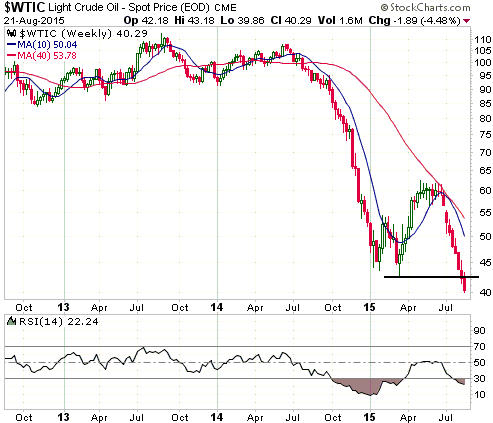
Oil is the best example. With the oil price having just breached its March-2015
bottom in the low-$40s, sub-$30 price forecasts are common and sub-$20 price
forecasts are being taken seriously. Furthermore, fundamental analysts and
technical analysts are generally in agreement that the oil price has nowhere to
go from here except down. The 'fundamentalists' think that the market will be
weighed down by excess supply for a long time to come, whereas the technicians
are placing rulers on charts and measuring the distance that the price will have
to fall to complete the patterns they perceive. If only markets were that
simple!
Oil
We thought that oil was tracing out a bottoming pattern during the first half of
this year that was along the lines of either the 1986 bottom (more likely) or
the 2009 bottom (less likely). If this view of the oil world had been correct
then the decline from the Q2 high should have gone no further than the March low
(a successful test of the March low would have been consistent with the 1986
bottoming pattern). However, the following weekly chart shows that the oil price
has just broken decisively below its March-2015 low.
On a short-term basis the price action can no longer be compared to the 1986
bottoming pattern, but we continue to like the comparison between the 1980-1986
oil bear market and the 2008-2015 oil bear market.
The similarities between these two periods are most clearly evident when prices
are adjusted for "inflation" (US$ depreciation) using the method we
first
outlined in December-2010. To illustrate what we mean, here's a monthly
chart of the inflation-adjusted oil price with the two bear markets indicated.
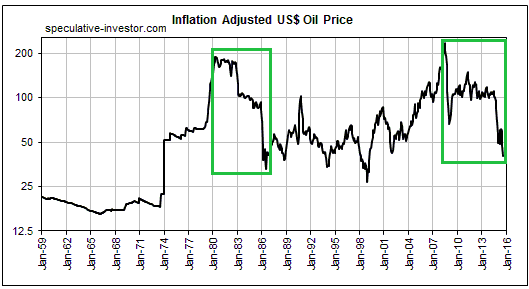
For the 2008-2015 bear market to match the 1980-1986 bear market in terms of the
inflation-adjusted peak-to-trough decline, the price would have to fall to
around $33 in current-dollar terms. However, the current bear market has already
exceeded the earlier one in terms of momentum (the weekly RSI bottomed at around
15 in 1986 and 10 this year) and duration.
Copper
A couple of weeks ago copper's Commitments of Traders (COT) situation became
consistent with a short-term price bottom, but the price has overshot as it did
in December-January. The price decline has continued, although momentum has
waned and the copper market was resilient in the face of a stock market plunge
during the final two days of last week.
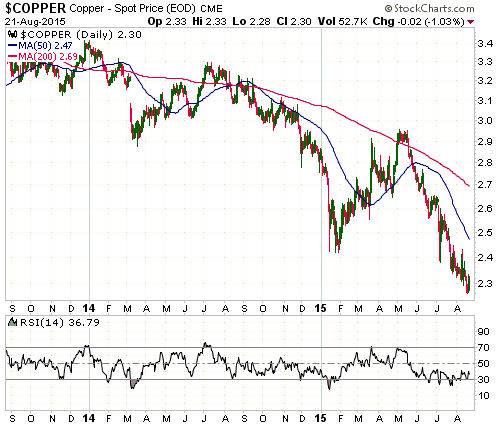
The setup is in place for a short-term bottom and at least a 2-4 month rally in
the copper price, but additional weakness in the stock market and an associated
reduction in economic growth expectations over the coming month could delay the
start of a tradable rebound.
Another consideration is that there is a tendency for gold to lead copper by at
least two months at important price bottoms. At this stage it looks like the US$
gold price bottomed on 24th July, which, based on how price lows have formed
over the past 15 years, suggests that the copper price won't bottom-out until at
least the second half of September.
The Stock Market
The US
Current Market Situation
The S&P500 Index (SPX) finally closed below its March low on Thursday 20th
August. It then confirmed the breakout by accelerating downward on Friday and
ending the week at its lowest level of the year.
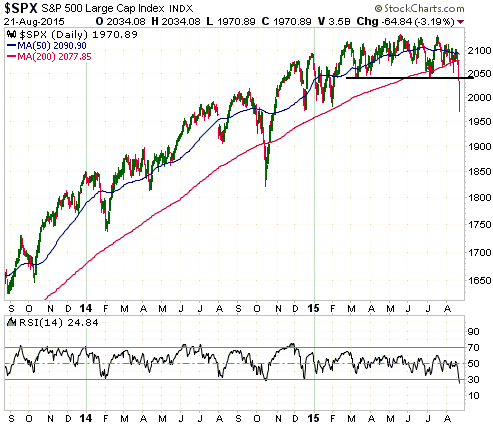
We've been anticipating a 10%-20% decline in the SPX that would bottom by
mid-October at the latest. Such a decline could be either the first leg of a
cyclical bear market or the first meaningful correction since 2011 in an
on-going cyclical bull market. Our guess is that it would be the former, but
from a practical speculation standpoint it doesn't matter at this time.
As well as being consistent with sentiment, bearish divergences in the market
action and the proclivity for the well-known 7-year cycle to usher-in
larger-than-usual peak-to-trough declines, a significant downturn during
July-October is consistent with a much less well-known cycle. This less
well-known cycle was described as follows in the 20th July Weekly Update:
"The US stock market has made an important mid-July peak at 8-9 year
intervals beginning in 1990. Prior to last week there didn't appear to be a
realistic chance of a mid-July peak this year, but the nearly-straight-up move
over the past several days has brought the 8-9 year mid-July cycle into play.
For it to remain in play the SPX should start to roll over by the end of this
week, although it could make a new high during the first half of the week in
reaction to not-as-bad-as-feared earnings news and a further abating of Greece's
crisis (Greek banks will apparently re-open on Monday 20th July).
Here are SPX charts illustrating the cycle noted above. The charts show the
mid-July peaks of 1990, 1998 and 2007. In both 1990 and 1998 the mid-July peak
was followed by a 20% decline to a low in the second week of October, whereas in
2007 the decline from the mid-July peak bottomed in mid-August and was 'only'
about 11%."
The SPX was at 2126 at the time and began to roll over soon after, thus keeping
the price action in line with the 8-9 year mid-July cycle.
The Dow Industrials Index is already down by 10% from its high and has therefore
already achieved the minimum expected decline. However, the SPX is far more
important to most market professionals, because it is the dominant US stock
index for futures trading and performance benchmarking.
At the end of last week the SPX was down by 7.7% from its high. To extend the
decline to 10% it will have to fall to around 1920.
Each person has to manage their own money as they see fit, but here's our very
short-term plan:
1) We will take profits on half of our stock-market put options (we have
January-2016 QQQ puts) this week if there is significant additional downside. In
particular, we intend to exit half of our puts on Monday 24th August if there is
sufficient immediate follow-through to take the SPX down to around 1920. In this
case we will look for an opportunity to replace the exited puts with some new
put options following a rebound in early September.
2) We intend to take no action (that is, we will retain our full put-option
position) if the market begins to rebound immediately and doesn't trade
significantly below last week's low during the course of this week. This is a
possibility because the market is now very 'oversold' on a short-term basis. In
this case we will wait for the better put-selling opportunity that will likely
arise by early-October.
The US stock market versus gold
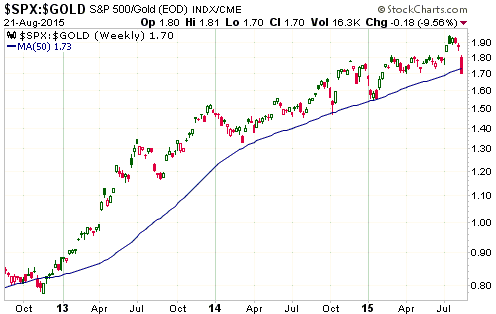
Of even greater significance than last week's SPX break below the March low is
the SPX/gold ratio's weekly close below its 50-week MA. As illustrated below,
SPX/gold hasn't ended a week below its 50-week MA since Q4-2012. This tells us
that the recent reversal could have longer-term importance.
China
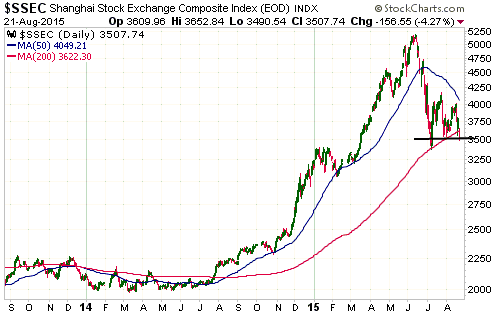
It will be interesting to see what happens to the Shanghai Stock Exchange
Composite Index (SSEC) this week. This is because a) China's government has
drawn a line in the sand at 3500, meaning that it is determined to prevent the
SSEC from breaking below 3500, b) the SSEC ended last week at this arbitrary
line in the sand, and c) Asian stock markets will be under pressure on Monday in
response to the sharp declines in US and European stock markets last Friday.
There's no doubt that China's government has sufficient monetary firepower to
prevent a break below 3500, but as was recently the case with the Yuan/US$
exchange rate it could decide to let market forces prevail to a minor extent and
to start defending a lower level.
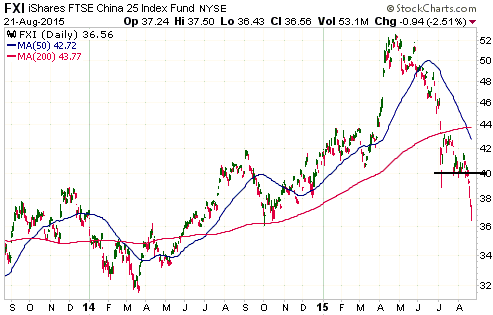
FXI is an ETF that holds large-cap Chinese stocks that trade in Hong Kong. It is
not being propped-up by China's government, which is why it has broken well
below the equivalent of the SSEC's 3500 line in the sand.
FXI has now retraced the entire 2014-2015 surge.
This week's
significant US economic events
[Notes:
1) The most important events
(to the markets) are shown
in bold. 2) A list of global economic events can be found
HERE]
| Date | Description |
| Monday Aug 24 | No important events scheduled |
| Tuesday Aug 25 |
Case-Shiller Home Price
Index New Home Sales Consumer Confidence |
| Wednesday Aug 26 | Durable Goods Orders |
| Thursday Aug 27 |
Q2 GDP (revised) Pending Home Sales |
| Friday Aug 28 |
Personal Income and Spending Consumer Sentiment |
Gold and the Dollar

 Company
news/developments for the week ended Friday 21st August 2015:List
of candidates for new buying
Company
news/developments for the week ended Friday 21st August 2015:List
of candidates for new buying