|
-- Weekly Market Update for the Week Commencing 24th September 2012
Big Picture
View
Here is a summary of our big picture
view of the markets. Note that our short-term views may differ from our
big picture view.
In nominal dollar terms, the BULL market in US Treasury Bonds
that began in the early 1980s will end by 2013. In real (gold)
terms, bonds commenced a secular BEAR market in 2001 that will continue
until 2014-2020. (Last
update: 23 January 2012)
The stock market, as represented by the S&P500 Index,
commenced
a secular BEAR market during the first quarter of 2000, where "secular
bear market" is defined as a long-term downward trend in valuations
(P/E ratios, etc.) and gold-denominated prices. This secular trend will bottom sometime between 2014 and 2020.
(Last update: 22 October 2007)
A secular BEAR market in the Dollar
began during the final quarter of 2000 and ended in July of 2008. This
secular bear market will be followed by a multi-year period of range
trading.
(Last
update: 09 February 2009)
Gold commenced a
secular bull market relative to all fiat currencies, the CRB Index,
bonds and most stock market indices during 1999-2001.
This secular trend will peak sometime between 2014 and 2020.
(Last update: 22 October 2007)
Commodities,
as represented by the Continuous Commodity Index (CCI), commenced a
secular BULL market in 2001 in nominal dollar terms. The first major
upward leg in this bull market ended during the first half of 2008, but
a long-term peak won't occur until 2014-2020. In real (gold) terms,
commodities commenced a secular BEAR market in 2001 that will continue
until 2014-2020.
(Last
update: 09 February 2009)
Copyright
Reminder
The commentaries that appear at TSI
may not be distributed, in full or in part, without our written permission.
In particular, please note that the posting of extracts from TSI commentaries
at other web sites or providing links to TSI commentaries at other web
sites (for example, at discussion boards) without our written permission
is prohibited.
We reserve the right to immediately
terminate the subscription of any TSI subscriber who distributes the TSI
commentaries without our written permission.
Outlook Summary
Market
|
Short-Term
(1-3 month)
|
Intermediate-Term
(6-12 month)
|
Long-Term
(2-5 Year)
|
|
Gold
|
Neutral
(10-Sep-12)
|
Bullish
(26-Mar-12)
|
Bullish
|
|
US$ (Dollar Index)
|
Neutral
(17-Sep-12)
|
Neutral
(09-Jan-12)
|
Neutral
(19-Sep-07)
|
|
Bonds (US T-Bond)
|
Bearish
(02-Jul-12)
|
Neutral
(18-Jan-12)
|
Bearish |
|
Stock Market
(DJW)
|
Bearish
(30-Jul-12)
|
Bearish
(28-Nov-11)
|
Bearish
|
|
Gold Stocks
(HUI)
|
Neutral
(17-Sep-12)
|
Bullish
(23-Jun-10)
|
Bullish
|
|
Oil |
Neutral
(30-Jul-12)
|
Neutral
(31-Jan-11)
|
Bullish
|
|
Industrial Metals
(GYX)
|
Neutral
(30-Jul-12)
|
Neutral
(29-Aug-11)
|
Neutral
(11-Jan-10)
|
Notes:
1. In those cases where we have been able to identify the commentary in
which the most recent outlook change occurred we've put the date of the
commentary below the current outlook.
2. "Neutral", in the above table, means that we either don't have a
firm opinion or that we think risk and reward are roughly in balance with respect to the timeframe in question.
3. Long-term views are determined almost completely by fundamentals,
intermediate-term views by
fundamentals, sentiment and technicals, and short-term views by sentiment and
technicals.
The Fed is the great
enabler
We've speculated in TSI commentaries that
unwavering devotion to bad economic theory (a type of stupidity) is the most
likely reason for the Fed's introduction of a new inflation program at this
time. There are other plausible explanations, but in general terms it boils down
to this: the Fed is either stupid, or evil, or stupid and evil. There is no
fourth possibility that makes any sense. It is either evil enough to inflate the
currency in an effort to help banks (or the re-election chances of Obama*) even
though it knows that doing so will harm the overall economy; or it is stupid
enough to believe that the economy can be helped by creating money out of
nothing and distorting the price signals upon which an efficient market relies;
or it is evil enough and stupid enough to believe that it can transfer wealth to
the banks and simultaneously create a net benefit for the overall economy. We'll
go with evil and stupid. The timing of the new policy was probably determined by
the deteriorating employment situation, but the Fed may well be trying to kill
multiple birds with a single stone. In any case, regardless of the reasoning
behind the Fed's latest policy move, the Fed exists primarily to enable growth
in the government and secondarily to enable growth in the banking industry.
Growth in government is enabled because a government with a captive central bank
will never run short of money, irrespective of how big its deficits become and
how far into debt it goes. Growth in the banking industry is enabled because the
central bank's unlimited power to create new bank reserves means that banks need
never run short of reserves, irrespective of how reckless they are in their
lending and borrowing.
It is clear from the following chart that the Fed has succeeded in its primary
objective. The chart shows spending by the US federal government as a percentage
of GDP from 1880 through to 2012. In 1880 the federal government spent about 3%
of GDP. In 1913, the year the Federal Reserve came into existence, the federal
government also spent about 3% of GDP. In other words, as a percentage of GDP
there was no growth in the US federal government during the 33 years prior to
the inauguration of the Federal Reserve. An ultra-long-term upward trend then
began. Ignoring the war-related spikes during the late-1910s and the first half
of the 1940s, there has been steady growth in the US federal government from
1913 through to the present. Currently, US federal government spending equates
to about 24% of GDP. This means that since the birth of the Federal Reserve the
cumulative increase in the size of the US federal government is about 700%
greater than the cumulative increase in US GDP.
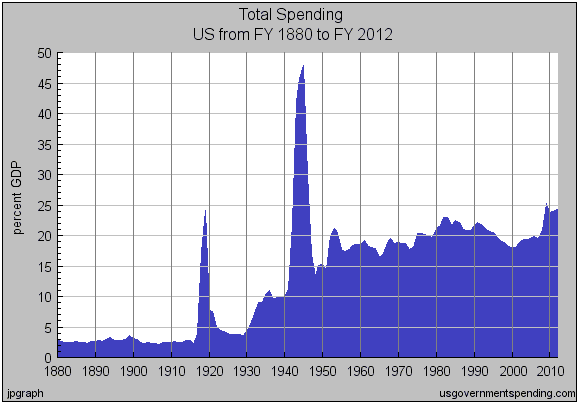
Chart Source:
www.usgovernmentspending.com
Would a Republican victory in this year's US Presidential election reverse the
upward trend in the size of the federal government? If history is a guide, the
answer is no. In fact, over the past thirty years the size of the US federal
government, as indicated by federal government spending as a percentage of GDP,
increased by more during Republican administrations than during Democratic
administrations. The Republicans often talk a good game (they pay lip service to
smaller government), but in practice they are usually just as bad as or worse
than their Democratic counterparts. One of the main reasons is that the
Republicans are generally in favour of boosting the amount of money spent on the
military. An increase in military spending is always politically easy to
accomplish because most Americans are proud of their armed forces, but of the
main areas of US government spending the most unproductive is the military. We
are certainly not in favour of government spending on public works programs in
an effort to create jobs, but it would be much better for the government to
spend money building a bridge in the US than blowing up a bridge in the Middle
East.
So, a Romney-Ryan victory in November would probably change the composition of
the federal budget, but believing that it would result in a smaller government
is an example of the triumph of hope over experience. Regardless of who wins in
November, it's a good bet that the US federal government will be a bigger part
of the economy four years from now than it is today. And as always, the
government growth will be enabled by the Federal Reserve.
The extent of the Fed's success in achieving its secondary objective (enabling
growth in the banking industry) is less easy to establish. This is because the
big banks periodically go way too far and blow themselves up. The Fed then bails
them out, either immediately and directly via the injection of new money or
gradually and indirectly by manipulating the yield curve and altering
regulations, but the periodic blow-ups mean that there hasn't been a consistent
ultra-long-term upward trend in the banking industry relative to the overall
economy. The US financial sector's performance has been lumpy, although it has
still managed to grow from about 3.5% of GDP at the introduction of the Fed to
about 8% of GDP today.
The bottom line is that we can speculate about why the Fed introduced a new
inflation program at this particular time, but in the grand scheme of things it
doesn't matter. A specific policy move by the Fed will generally be a reaction
to recent economic data and short-term considerations, but the Fed doesn't exist
for the purpose of fine-tuning the economy (although the current Fed chairman
and governors may well be politically naive enough and economically illiterate
enough to believe that it does). It is a tool that facilitates the growth of the
government and the banking industry.
*In last week's Interim Update we outlined our reasons for
thinking that the Fed did not act with the aim of boosting Obama's re-election
chances. We also said that in the unlikely event that it did act for this
reason, the move could backfire. An informal Facebook survey conducted by the
Federal Reserve Bank of San Francisco underlines the possibility that the Fed's
move could hinder rather than help the Obama campaign. As noted in a
WSJ blog entry on 17th September, the Facebook survey indicated an
overwhelmingly negative public response to QE3.
The Stock
Market
We've made no secret of our view that "Dow
Theory" non-confirmations, meaning failures of either the Dow Transportation
Index (TRAN) or the Dow Industrials Index to confirm a new high or low in the
other index, have no predictive value. Sometimes these non-confirmations turn
out to be correct, but a blind guess will also turn out to be correct some of
the time. That being said, the TRAN's recent weakness relative to the Dow
Industrials Index is worthy of comment. This isn't the sort of garden-variety
non-confirmation or divergence that happens a few times every year.
What we currently have is a Dow Industrials Index that recently made a new high
for the year and is still very close to its high, and a Dow Transportation Index
(TRAN) that has just fallen back to near its low for the year. Here is a daily
chart of TRAN:
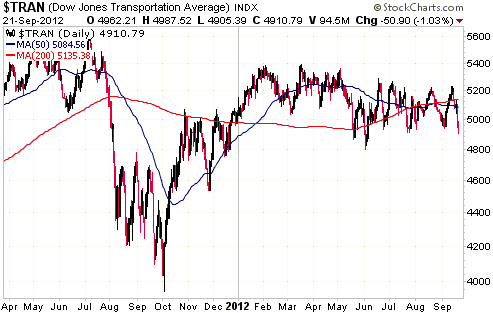
The current divergence is unusually extreme. It doesn't guarantee that the
immediate future will be bearish (such guarantees don't exist), but it is one of
many reasons to be alert to the possibility that the latest QE-inspired rally
will be much shorter than the earlier versions.
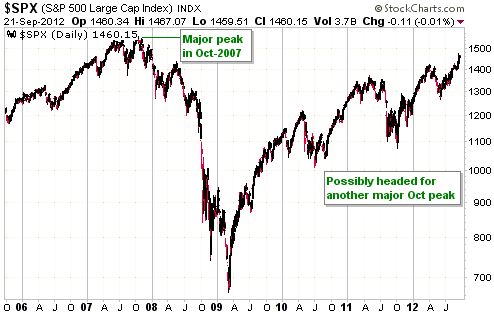
Moving on, October is famous for being a month of stock market crashes and major
stock market bottoms. There is not going to be a crash or a major stock market
bottom in October of 2012. Less famously, October has occasionally ushered-in a
major stock market high. The most notable October high occurred in 2007. More
specifically, the all-time high for the Dow Industrials Index and a successful
test of the March-2000 all-time high in the S&P500 Index occurred in the second
week of October-2007.
There is a realistic possibility of a major high in October of 2012.
By the way, even if the S&P500 Index makes a major high in October of 2012 there
will be almost no chance of the ensuing 12 months being anywhere near as bearish
as the 12-month period following the October-2007 major high. The monetary
backdrop is too different for the stock market outcomes to be similar. There is,
however, risk of a peak-to-trough decline of as much as 30%.
This week's
important US economic events
| Date |
Description |
| Monday Sep 24 |
Dallas Fed Mfg Survey
| | Tuesday Sep 25 |
Case-Shiller Home Price Index
Consumer Confidence | | Wednesday Sep
26 |
New Home Sales | | Thursday
Sep 27 |
Durable Goods Orders
Q2 GDP (revised)
Pending Home Sales
|
| Friday Sep 28 |
Personal Income and Spending
Chicago PMI
Consumer Sentiment
|
Gold and
the Dollar
Gold
Current Market Situation
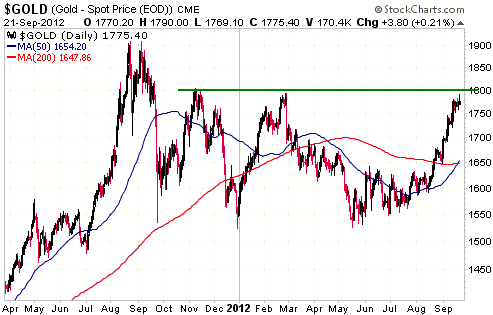
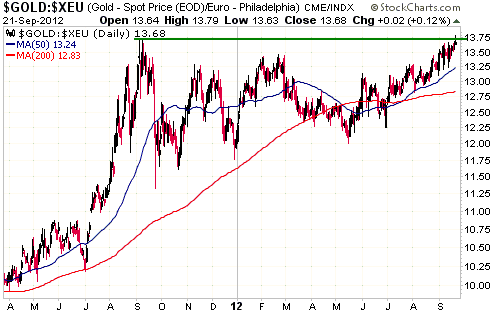
The following two daily charts reveal the immediate obstacle facing the gold
market: lateral resistance. The price area around a former high or low is a
natural place for people to sell on the way up and buy on the way down. The
first of the following charts shows that the US$ gold price almost reached
intermediate-term resistance at $1800 last Friday, while the second chart shows
that the euro gold price is butting up against major resistance defined by last
year's all-time high.
Not surprisingly, sentiment is a lot more optimistic now than it was a couple of
months ago. The higher level of optimism is most clearly evidenced by the total
speculative net-long position in COMEX gold futures, which has risen to 250K
contracts. This is only 5 contracts below the high for the year reached at the
end of February.
A few months ago the sentiment backdrop was completely 'out of whack' with the
price action and the fundamentals, in that sentiment had become
disproportionately pessimistic. It was a signal to do some buying. The current
sentiment backdrop is not out of whack with either the price action or the
fundamentals. It therefore doesn't constitute a signal to sell, although
depending on personal financial considerations it could be appropriate to trim
exposure. This is because there is scope for a short-term downward correction of
as much as $120.
The next short-term buying opportunity in the gold market will occur when the
price meets up with its 50-day MA. It's a similar story in the silver market.
Inability to pull the trigger
In the financial markets the times when you will get the best deals are the most
difficult times to act. For example, the best times to buy coincide with times
when almost everyone is bearish, making it emotionally difficult to "pull the
buy trigger". However, to avoid becoming the financial-market equivalent of
road-kill you will have to learn to overcome the emotions that prevent the
average person from buying when the buying is good and selling when the selling
is good. Using a scale-in/scale-out approach helps because by definition it
circumvents the need to go all-in or all-out at any single time, but putting
this approach to good effect still requires suppressing the instincts that make
people want to stay within the perceived safety of the herd.
Let's now consider the specific cases of gold and silver. There were a few
opportunities to buy gold at around $1550 and silver at $26-$27 over the past 12
months, but each time these opportunities cropped up there was naturally a lot
of pessimism in the market. Even longstanding gold bulls were warning about
additional price weakness. For example, in late September of last year Marc
Faber warned that gold, which was trading in the $1520-$1550 range at the time,
could fall to the $1100s. For another example, in the 11th June 2012 edition of
Barrons Magazine Felix Zulauf said: "I also continue to recommend buying gold
if it breaks below $1500. That could lead to a quick shakeout into the $1300s,
but gold will offer protection in coming years..." We imagine that a lot of
the prospective gold investors who read Zulauf's comment in June would have
focused on the "quick shakeout into the $1300s" part and ignored the "offer
protection in coming years" part. As it turned out, gold never traded below
$1500 before commencing a new upward trend. In our opinion, it will never again
trade below $1500. This means that those who stayed completely out of the market
waiting for the chance to buy in the $1300s or lower now have a difficult
question to answer: Do I 'bite the bullet' and buy with the gold price in the
high-$1700s, or stay out and hope for another chance to buy in the mid-$1500s?
Before attempting to answer the above question they should ask themselves this
question: If I didn't buy in the mid-$1500s the last time around, why would I
buy if another opportunity to do so presented itself in the future? Everything
looks rosy for the gold market right now and people who own gold are feeling
much more comfortable thanks to the recent $200/oz gain in the price and the
inflationary policies just introduced by the ECB and the Fed, but the sentiment
backdrop would be totally different if the gold price were to return to the
mid-$1500s. Stop and think about how the financial world would look if gold had
just fallen back to near its 2012 low. Quite likely, events would be unfolding
in such a way that it seemed to most people as if the central banks were losing
the fight against deflation. The Dollar Index and the T-Bond would be rallying
strongly; the stock market would be very weak and looking like it was headed for
a crash; copper and oil prices would be tanking; and articles warning of large
additional declines in gold and silver prices would be all over the press. Would
you be a buyer of gold under those conditions?
Fortunately, biting the bullet and buying in the high-$1700s or staying out and
hoping for another chance to buy in the mid-$1500s are not the only options. It
is possible that gold will drop back to the mid-$1500s during the first half of
next year, but it's a possibility that now has a very low probability. There
will, however, very likely be a better opportunity to buy in the future than
exists in the present. We will attempt to identify the opportunity in real time.
Our main point is that you have to be able to do most of your buying when things
look bad and most of your selling when things look good. If you can't, your
long-term return on investment will be poor.
Gold Stocks
The HUI fell a few points on Thursday and rose a few points on Friday, leaving
it within half a point of where it was when we wrote last week's Interim Update.
Therefore, nothing has changed since our previous comment. By some short-term
measures the HUI remains as 'overbought' as it has been at any time over the
past 10 years.
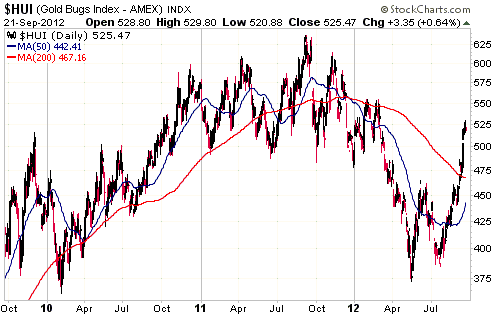
The way the story is unfolding it looks like October will be a 'corrective'
month for the gold sector and that November is the earliest time for an
intermediate-term peak. An intermediate-term peak in November meshes with the
second of our two HUI scenarios. The first scenario is thought to have the
higher probability and involves the HUI's intermediate-term advance continuing
until at least May of next year. Under both of these scenarios, a correction
that takes the HUI back to the vicinity of its 50-day moving average is likely
during October.
Currency Market Update
The Canadian Dollar (C$) doesn't have as much downside risk as the Australian
Dollar (A$), but there is certainly enough downside risk in the C$ to concern
anyone with substantial exposure to this currency. As is the case with the A$,
the C$'s downside risk is unlikely to materialise until after the global stock
market commences its next intermediate-term decline.
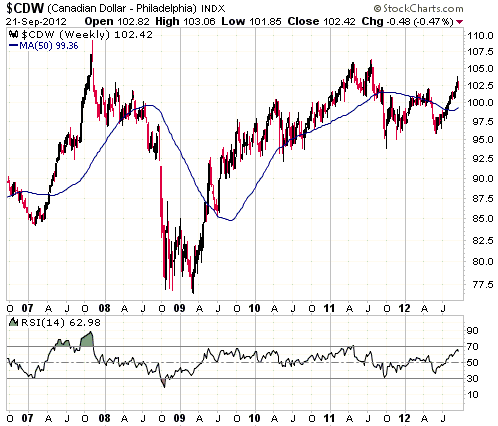
The following weekly chart shows that the C$ made a major peak in November of
2007. This was about four weeks after the stock market's major peak. The chart
also shows that the C$ is not as 'overbought' now as it was in October-November
of 2007. This is clearly evident from the price action (there was an upside
blow-off into the November-2007 top) and the RSI displayed at the bottom of the
chart. This suggests to us that if an intermediate-term decline were to commence
from near the current level it would be limited to 10%-15%. However, the
downside potential would naturally increase if the C$ were to move sharply
higher over the weeks ahead.
Update
on Stock Selections
Notes: 1) To review the complete list of current TSI stock selections, logon at
http://www.speculative-investor.com/new/market_logon.asp
and then click on "Stock Selections" in the menu. When at the Stock
Selections page, click on a stock's symbol to bring-up an archive of
our comments on the stock in question. 2) The Small Stock Watch List is
located at http://www.speculative-investor.com/new/smallstockwatch.html
 Company
news/developments for the week ended 21st September 2012: Company
news/developments for the week ended 21st September 2012:
*Clifton Star (CFO.V) and a microcap gold miner called Xmet (XME.V)
announced a deal that will result in CFO's Duquesne property (200K
Indicated gold ounces plus 280K Inferred gold ounces) being
transferred to XME in exchange for a 20% stake in XME. This deal and
a separate deal involving Brionor Resources will allow all of the
Duquesne district NI 43-101-compliant gold resources to be
consolidated under XME's ownership.
The Duquesne property is about 5 kms from the main Duparquet project
being developed by CFO and was considered to be a non-core asset.
That's why the deal was done. It makes sense, although it doesn't
materially affect CFO's valuation at this time.
*Endeavour Mining (EDV.TO, EVR.AX) announced that it had settled a $200M
damages claim brought against it by Gold Reserve. The claim dates
back to 2008, when EDV was a merchant banking company. The details
of the claim are unimportant, as it was never likely to get anywhere
and has now been fully and finally settled at a cost to EDV of only
$1.5M.
*International Tower Hill Mines (THM) announced a role change for Don
Ewigleben, the company's Chairman. Mr. Ewigleben is now the CEO,
replacing interim CEO Jeff Pontius.
Mr. Ewigleben appears to be well qualified for the role. In
particular, we note that he has a lot of experience permitting and
operating gold mining projects in Alaska (THM's Livengood project is
in Alaska), and that his history with the Livengood project dates
back to 2003 when the project was owned by Anglogold and he was part
of Anglogold's senior management.
THM also reported that it had closed the final $5M tranche of its
$30M equity financing. The final $5M was done at roughly the same
share price (C$2.60/share) as the initial $25M.
THM is beginning to trade more lightly and will probably soon break
out to the upside.
*Pretium Resources (PVG) reported another set of excellent drilling
results from its Brucejack high-grade project.
The stock market is temporarily immune to good drilling results from
PVG. This is partly because positive drilling news has become a
routine event for this company, but mainly because of the
surprisingly low resource re-estimate published early this month.
Many investors and potential investors are probably thinking:
"What's the use of good drilling results if these results lead to a
smaller estimated in-ground resource?" PVG's senior management
attempted to address the concerns that naturally arose in response
to the reduced resource estimate via last week's conference call and
webcast, but it's possible that the stock will be held back by
investor scepticism until the next resource estimate is published in
December or January. The next estimate will almost certainly be
significantly higher than the previous one.
*It was reported on Friday 21st September that Coralbrook Ltd., the major
shareholder of Rio Novo Gold (RN.TO), had purchased an additional
4.3% of the company (4.9M shares) in a private transaction, bringing
Coralbrook's stake in RN to 49.88%. The purchase price of
C$0.245/share was about 30% above the market price at the time. This
transaction indicates that RN's major shareholder is bullish and is
prepared to take advantage of the company's depressed stock price.
RN shares are a good speculation in the low-C$0.20s.
*Sabina Gold and Silver (SBB.TO) reported another round of drilling
results that generally confirmed what was already known. The only
significant new information was the identification of a shallow zone
of gold mineralisation (the "Wing Zone") between the proposed Umwelt
and Llama pits. The discovery hole intersected 12.68-g/t gold over
15.45m beginning 52m below the surface.
Short-term
selling opportunities
Despite the strong rally in the gold sector, none of the TSI gold and silver
stocks are 'sells' based on valuation. However, if, like us, you have a large
core position in the gold mining sector and made a sizeable addition to your
exposure when prices were much lower during April-July, then you should now be
taking some money off the table. With valuations still quite low, decisions
regarding what and how much to sell should be based on personal money-management
considerations. For example, if you had a medium-sized position in a stock two
months ago and the stock's price is now 100% higher, then your position in the
stock might now warrant some trimming regardless of the fact that you remain
bullish.
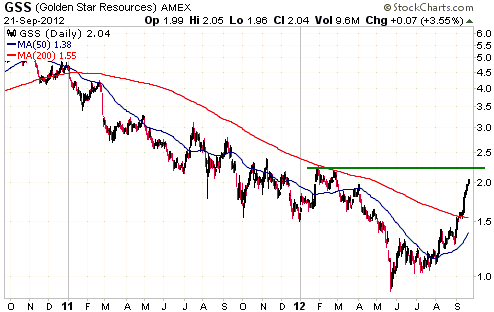
GSS has gained 100% over the past couple of months and, depending on personal
financial considerations, could be a good candidate for trimming. The stock
remains very under-valued (for reasons that are well known) and has the
potential to double again over the next 9 months, but the downside risk is much
greater now than it was two months ago. It is short-term 'overbought' and has
significant lateral resistance in the US$2.20s.
SBB.TO has also gained 100% over the past two months, although it has been
consolidating near its 5-month high over the past few weeks and is no longer
'overbought' (an 'overbought' condition can be alleviated by a pullback or a
period of sideways trading). For what it's worth, the chart suggests that a move
up to resistance at C$4.00 could soon occur.
Like GSS, SBB.TO still has a lot of valuation-related upside potential. However,
the large percentage rise in the stock price since the July low means that it
could be a good candidate for a partial sale, either near the current price or
following a rise to around C$4.
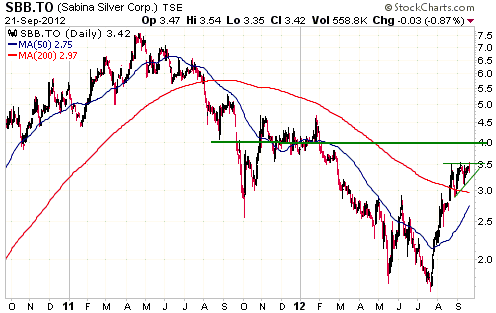
Chart Sources
Charts appearing in today's commentary
are courtesy of:
http://stockcharts.com/index.html

|









