|
-- Weekly Market Update for the Week Commencing 25th July 2011
Big Picture
View
Here is a summary of our big picture
view of the markets. Note that our short-term views may differ from our
big picture view.
In nominal dollar terms, the BULL market in US Treasury Bonds
that began in the early 1980s ended in December of 2008. In real (gold)
terms, bonds commenced a secular BEAR market in 2001 that will continue
until 2014-2020. (Last
update: 4 April 2011)
The stock market, as represented by the S&P500 Index, commenced
a secular BEAR market during the first quarter of 2000, where "secular
bear market" is defined as a long-term downward trend in valuations
(P/E ratios, etc.) and gold-denominated prices. This secular trend will bottom sometime between 2014 and 2020. (Last update: 22 October 2007)
A secular BEAR market in the Dollar
began during the final quarter of 2000 and ended in July of 2008. This
secular bear market will be followed by a multi-year period of range
trading. (Last
update: 09 February 2009)
Gold commenced a
secular bull market relative to all fiat currencies, the CRB Index,
bonds and most stock market indices during 1999-2001. This secular trend will peak sometime between 2014 and 2020. (Last update: 22 October 2007)
Commodities,
as represented by the Continuous Commodity Index (CCI), commenced a
secular BULL market in 2001 in nominal dollar terms. The first major
upward leg in this bull market ended during the first half of 2008, but
a long-term peak won't occur until 2014-2020. In real (gold) terms,
commodities commenced a secular BEAR market in 2001 that will continue
until 2014-2020. (Last
update: 09 February 2009)
Copyright
Reminder
The commentaries that appear at TSI
may not be distributed, in full or in part, without our written permission.
In particular, please note that the posting of extracts from TSI commentaries
at other web sites or providing links to TSI commentaries at other web
sites (for example, at discussion boards) without our written permission
is prohibited.
We reserve the right to immediately
terminate the subscription of any TSI subscriber who distributes the TSI
commentaries without our written permission.
Outlook Summary
Market
|
Short-Term
(0-3 month)
|
Intermediate-Term
(3-12 month)
|
Long-Term
(1-5 Year)
|
Gold
|
Neutral
(19-Apr-11)
|
Neutral
(24-Jan-11)
|
Bullish
|
US$ (Dollar Index)
|
Neutral
(07-Mar-11)
| Bullish
(02-May-11)
|
Neutral
(19-Sep-07)
|
Bonds (US T-Bond)
|
Neutral
(20-Sep-10)
|
Bearish
(21-Mar-11)
|
Bearish
|
Stock Market (S&P500)
|
Bearish
(04-Jul-11)
|
Bearish
(11-Oct-10)
|
Bearish
|
Gold Stocks (HUI)
|
Neutral
(13-Jul-11)
|
Bullish
(23-Jun-10)
|
Bullish
|
| Oil | Neutral
(31-Jan-11)
| Neutral
(31-Jan-11)
| Bullish
|
Industrial Metals (GYX)
| Bearish
(03-Jan-11)
| Bearish
(25-May-09)
| Neutral
(11-Jan-10)
|
Notes:
1. In those cases where we have been able to identify the commentary in
which the most recent outlook change occurred we've put the date of the
commentary below the current outlook.
2. "Neutral", in the above table, means that we either don't have a
firm opinion or that we think risk and reward are roughly in balance with respect to the timeframe in question.
3. Long-term views are determined almost completely by fundamentals,
intermediate-term views by giving an approximately equal weighting to
fundamental and technical factors, and short-term views almost
completely by technicals.
Why do people lend to the US government at 0% interest?
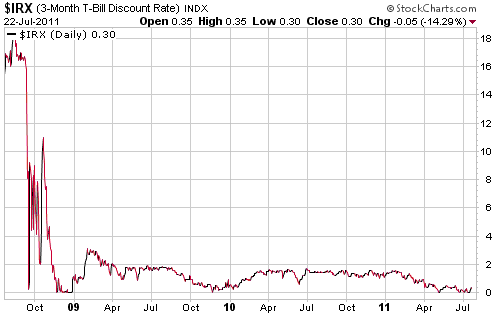
The following chart shows
that since November of 2008 the yield on the 3-month Treasury Bill has
never exceeded 0.3% (the chart's scale shows the yield multiplied by
10, so "2" on the chart means 0.2%) and that the yield has dropped to
0% on a few occasions. In fact, the T-Bill traded at a 0% yield over
the past three weeks and ended last week at a yield of only 0.03%. This
prompts the question: at a time when the US dollar is clearly losing
purchasing power, why would anyone lend money to the US government for
three months in exchange for a guaranteed nominal return on investment
of zero?
The answer is that if you have a lot of US$ cash, parking the cash in
T-Bills is the most efficient way to achieve a guaranteed return OF
your investment.
Consider that there is a lot of uncertainty regarding the true
financial positions of many large banks and that proper accounting
would possibly reveal that some of the most well-known banks are
insolvent. Also consider that FDIC insurance only covers $250K per
depositor per bank, and that a lot of money-market funds have invested
in the debt of banks that could possibly be insolvent. With these
considerations in mind, if you have hundreds of millions, or billions,
of dollars in cash and your only goal is to place this cash where it is
certain to be available at par when you need it, lending the cash to
the US government at zero% could seem like the best option.
When will the Chinese and Japanese governments dump their T-Bonds?
Thanks
to the release of Treasury International Capital (TIC) reports covering
the months of March, April and May, we now know that the devastating
earthquake of early-March 2011 did not interrupt the Japanese
government's accumulation of US government debt. Moreover, there was
never a good reason to expect that it would. As we stated in the 21st
March Weekly Update: "There
are good reasons to be bearish on T-Bonds, but potential T-Bond
liquidation by the government of Japan is definitely not one of them.
...If anything, an effect of the recent natural disaster in Japan will
be increased demand for treasuries on the part of the Japanese
government due to this government's misguided belief -- a belief that
it shares with the governments of almost all countries -- that a weaker
currency helps the economy. Therefore, the direct actions of the
Japanese government are likely to be either neutral or bullish for US
government bonds."
It's important to understand that the policies of the Japanese
government are dictated by false beliefs, one of which is that the
Japanese economy would be hurt by a stronger Yen. We should therefore
not expect the Japanese government to take any actions that would
directly contribute to Yen strength, especially at times when the
Japanese economy is weak or is expected to weaken.
The policies of the Chinese government are dictated by similar false
beliefs. Consequently, it is reasonable to assume that the governments
of Japan and China will be net buyers of US Treasury debt until one of
the following occurs:
a) The currency of the government in question (the Yen or the Yuan)
becomes chronically weak relative to the US$. After all, there would be
no need for a government to go out of its way to weaken a currency that
was already in a long-term decline.
b) Problems related to monetary inflation begin to dominate all other policy considerations.
Japan appears to be a long way from having a chronically weak currency
or being in the situation where "inflation" is widely viewed as 'public
enemy no. 1', but the same can't be said about China. There's a
distinct possibility that China's "inflation" problem has almost grown
to the point where policymakers believe that a stronger currency is
more of a positive than a negative. If so, then we are probably nearing
the time when China switches from being a net buyer to being a net
seller of US Treasury debt.
When China's government begins to scale-back its exposure to the US
government's debt, all else remaining equal the price of the debt will
be pressured downward (US interest rates will be pressured upward).
However, we continue to believe that a large decline in the T-Bond
market will only occur in response to a large rise in US inflation
expectations stemming from the profligate spending and
debt-monetisation of the US government and Federal Reserve. In other
words, we think that domestic institutions pose the only major threat
to the T-Bond market.
The definition of money (from the foremost authority)
Here is how Ludwig von Mises defined money in his book "Human Action":
1) The most commonly used medium or media of exchange in a market society.
2) A community's most marketable economic good, which people seek
primarily for the purpose of later exchanging units of it for the goods
or services they prefer.
3) The circulating media most readily accepted in payment for goods, services and outstanding debts.
Notice the use of the phrases "most commonly used", "most marketable"
and "most readily accepted". The word "most", here, is what
distinguishes money from other media of exchange. For example, one
person could agree to purchase another person's house using airline
tickets, which means that airline tickets would be acting as a medium
of exchange in this transaction. However, it would not be correct to
say that airline tickets are money, since they are clearly not the most
commonly used -- or even a popular -- medium of exchange.
The Stock
Market
These days we generally
operate on a long-only basis. There's always a bull market somewhere,
so rather than trying to find a bear market in which to go short we
focus on finding a bull market in which to go long and stay long. This
is a good strategy in a world where central banks have issued ironclad
guarantees that money will be worth less in the future than it is in
the present.
However, bull markets periodically get over-extended and then
experience large 'corrections', thus exposing the long-only approach to
the risk of a large draw-down. Furthermore, bull markets eventually
end, but in real time it is often difficult to tell the difference
between a gut-wrenching intermediate-term correction in a continuing
bull market and the start of a new bear market. In other words, there's
always a risk that the bull market ends and we don't get the memo.
The main way that we mitigate these risks is by increasing our cash
reserve as the market ramps upward, and doing so most aggressively when
the slope of the upward trend becomes almost vertical. On occasion, we
also use put options to mitigate risk. Put options bought for this
purpose can be likened to home fire insurance, except that in this case
we are insuring against a portfolio disaster.
The above explains why we won't be betting on a decline in the US stock
market, even though we are short- and intermediate-term bearish on this
market. But for those who are inclined to make such bets, this looks
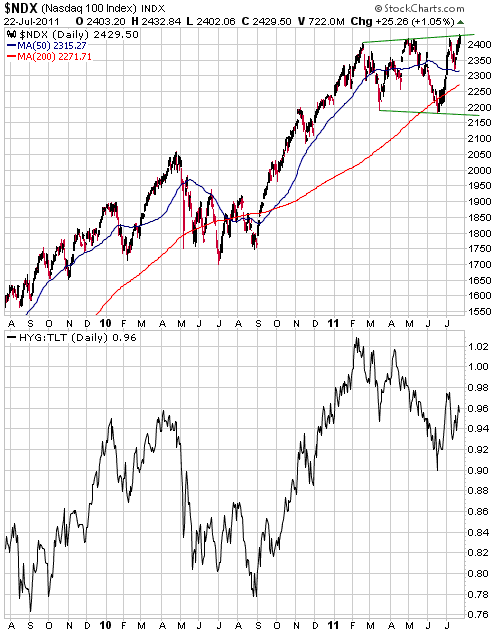
like a reasonable time to establish an initial position. The following
chart illustrates the reason. The chart reveals that the NASDAQ100
Index has just reached the top of its 6-month range while the HYG/TLT
ratio (an indicator of risk tolerance in the credit market) remains
well below its February high. We therefore have a significant bearish
divergence on our hands, combined with a market that is 'overbought'
and at resistance.
This week's
important US economic events
| Date |
Description |
Monday Jul 25
| No important events scheduled
| | Tuesday Jul 26 | Case-Shiller Home Price Index
Consumer Confidence
New Home Sales
| | Wednesday Jul 27
| Durable Goods Orders
Fed's Beige Book
| | Thursday Jul 28
| Pending Home Sales
| | Friday Jul 29
| Employment Cost Index
Q2 GDP (prelim)
Chicago PMI
Consumer Sentiment
|
Gold and
the Dollar
Gold
Over the four trading days since completing a remarkable run of 10
consecutive up-days, the gold futures market has consolidated near its
high. Sentiment is no longer supportive, in that the total speculative
net-long position in COMEX gold futures has moved up to near its
year-to-date high and Market Vane's bullish percentage for gold has
moved well into the 80s; however, no market ever reversed course simply
because sentiment became optimistic. Overtly optimistic sentiment
creates downside risk, but in this case the sentiment indicators are
consistent with the price action. The best way to put it is that
sentiment is neither a positive nor a negative at this time.
As noted in last week's Interim Update, to get more information about
gold's short-term outlook we will need to see how market sentiment
reacts to a pullback to the vicinity of the 50-day moving average
(currently in the $1530s).
A pullback to the vicinity of the 50-day moving average could begin immediately, although a study done by InstitutionalAdvisors.com's
Ross Clark (the best technical analyst we know of) suggests that gold
could continue higher for about three more weeks before embarking on
such a pullback. Ross has determined that there were only six prior
occasions over the past four decades when gold broke to a new high for
the year in July. The typical rally extension following these prior
July breakouts points to a mid-August peak, after which there would be
decline to the 50-day moving average or lower. Note, though, that if
the current market only matched the shortest rally following a prior
July breakout, a peak would be reached this week.
Silver
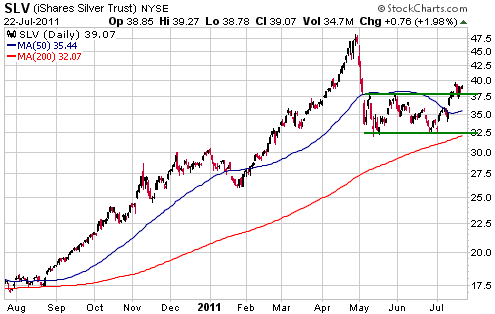
A daily chart of the Silver ETF (SLV) is displayed below. SLV tracks
the silver price very closely, although the price of SLV shares is now
about $1 lower than the spot silver price due to cumulative silver
storage costs since the ETF's inauguration.
In early July it looked, to us, like silver and gold would rebound to
the tops of their 2-month ranges over the ensuing several weeks. This
implied a move up to the $1550s for gold and $39 for silver ($38 for
SLV). Both have done better than expected, with gold rising to a new
all-time high and silver moving as much as $2 above the top of its
former consolidation range before pulling back.
As illustrated below, SLV ended last week about $1 above the top of its
former range. The breakout from the multi-month trading range doesn't
mean that the overall correction is over, but this breakout combined
with gold's price action suggests a near-term upside target of $42-$43
for SLV.
Also as illustrated below, SLV's rising 200-day moving average has now
almost reached its May low. Consequently, SLV will be able to drop back
to its 200-day moving average at some point over the next couple of
months -- and thus achieve the MINIMUM objective for an
intermediate-term correction -- without trading below its May low.
It remains likely
that silver will test its 200-day moving average before its overall
correction comes to an end. Also, there is still a risk that the silver
price will fall as far as the low-$20s at some point over the next few
months, although due to gold's recent move to a new all-time high this
is now a very low-probability risk.
Gold Stocks
With reference to the following daily chart, the Market Vectors Gold
Miners ETF (GDX) 'double-topped' in December and April. It hit a new
6-month low in late June, at which point it was very 'oversold' in both
dollar terms and gold terms. As expected, the subsequent rebound has
been strong. Sufficiently strong, in fact, that GDX is now 'overbought'.
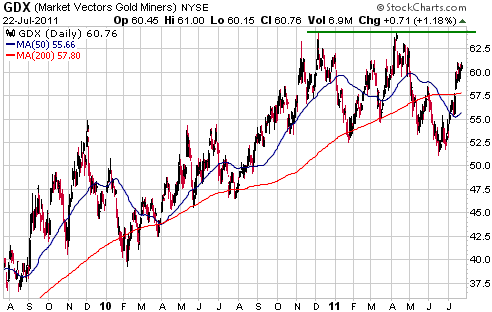
If the June low turns
out to be the ultimate correction low then we've just witnessed the
mildest intermediate-term gold-sector correction of the past 10 years.
So, either it's different this time or there is more work to do on the
downside during September-November.
"It's different this time" is rightly considered to be a dangerous
phrase, but the reality is that sometimes it is different. Furthermore,
there is a good reason why the gold-sector correction that began last
December could have ended without sector proxies such as GDX and the
HUI achieving the minimum downside targets based on earlier
corrections. The reason is that for the first time in gold's current
long-term bull market, the gold price has made a new high for the year
in July. Putting it another way, gold bullion doing something different
has potentially 'paved the way' for the gold sector of the stock market
to do something different.
As things current stand, GDX's recent rally could be a rebound within
an unfinished intermediate-term correction or the first leg of a new
intermediate-term advance. If it's the former then the price will make
a new low within the next three months, but if it's the latter then the
next decline should stop near the 50-day moving average. Either way,
GDX at $60-$64 constitutes a short-term selling opportunity.
Currency Market Update
Last week's big news was that Europe's political and monetary
leadership had cobbled together another rescue operation designed to
prevent the Greek government from defaulting on its debt, although the
latest rescue operation does incorporate a "selective default". In this
case, a selective default is a change in the terms of outstanding
bonds, with some short- and mid-term bonds being converted to the
long-term variety. It is hoped that by stretching-out the Greek
government's obligations and injecting 109 billion euros of new money,
the crisis will end.
The Greek government's financial position is no better today than it
was a week ago, but it seems that the risk of a direct near-term
default has been eliminated. Moreover, Europe's leadership has
demonstrated a commitment to throw whatever amount of new money is
needed at the sovereign debt problem to prevent the monetary union from
breaking apart. So, although nothing of significance was done last week
to improve the financial positions of the "PIIGS", the markets have
been led to believe that there is no limit to what will be done to
mitigate short-term pain and 'keep the game going'.
The whole concept behind the latest euro-zone rescue package is
completely wrong, because it amounts to another massive intervention by
central planners. It is being sold to the public as a means to a
stronger Greek economy and more job opportunities for Greek citizens,
but by propping up bad investments it will actually go a long way
towards ensuring that a genuine economic recovery will not occur.
What's bad for the economy, though, isn't necessarily bad for the stock
market. The stock market often benefits from monetary inflation, so
last week's reaffirmation of the central planners' commitment to throw
a lot more good money after bad gave the stock markets of the world a
hefty boost. And these days, what is good for equities is bad for the
US$. At least, it is clear that traders have become conditioned to sell
the US dollar in response to stock market strength. Consequently, even
though last week's Greek bondholder bailout was fundamentally bearish
for the euro (because it will result in greater euro supply), it
prompted a euro rally and a US$ decline.
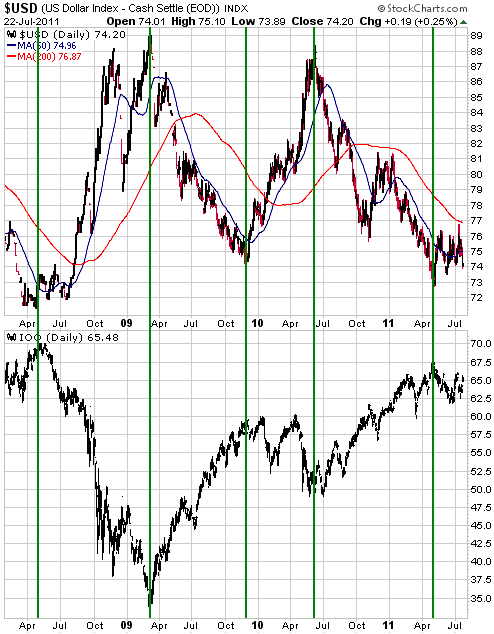
The above-mentioned relationship between the equity and currency
markets is the main reason we are bullish on the Dollar Index with
respect to the coming 6 months. As illustrated by the following chart,
the Dollar Index has consistently trended in the opposite direction to
IOO (S&P Global100 iShares, a proxy for global equities). This
relationship sometimes doesn't work on a short-term basis, but over the
past 3.5 years it has always worked on an intermediate-term basis.
Does this mean that if we are too bearish on the stock market then we are probably too bullish on the US$?
Yes.
Update
on Stock Selections
(Notes: 1) To review the complete list of current TSI stock selections, logon at http://www.speculative-investor.com/new/market_logon.asp
and then click on "Stock Selections" in the menu. When at the Stock
Selections page, click on a stock's symbol to bring-up an archive of
our comments on the stock in question. 2) The Small Stock Watch List is
located at http://www.speculative-investor.com/new/smallstockwatch.html)
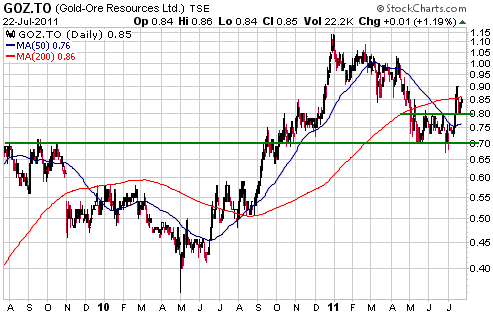
 Gold-Ore Resources (TSX: GOZ). Shares: 85M issued, 91M fully diluted. Recent price: C$0.85 Gold-Ore Resources (TSX: GOZ). Shares: 85M issued, 91M fully diluted. Recent price: C$0.85
We most recently suggested buying shares of GOZ, a junior gold producer
with a mine in Sweden, at C$0.75-C$0.80 in May. Near last week's
closing price of C$0.85, they are still good candidates for new buying.
Assuming no growth in production and no improvement in operating costs,
we estimate that at the current gold price GOZ should generate at least
$18M/year of cash. Applying an 8 multiple to this cash flow implies a
valuation of around $1.60/share. With growth in production beyond the
current 45K-oz/yr rate, the valuation would increase.
Chart Sources
Charts appearing in today's commentary
are courtesy of:
http://stockcharts.com/index.html

|