|
-- Weekly Market Update for the Week Commencing 26th February 2007
Big Picture
View
Here is a summary of our big picture
view of the markets. Note that our short-term views may differ from our
big picture view.
Bonds commenced a secular BEAR market in
June of 2003. (Last
update: 22 August 2005)
The stock market, as represented by the S&P500 Index, commenced a secular BEAR market during the first quarter of 2000. The rally
that
began in October of 2002 will end during the first half of 2007. The ultimate bottom of
the secular bear market won't occur until the next decade. (Last update: 02 October 2006)
The Dollar commenced a secular BEAR market during the final quarter of 2000. The
first major downward leg in this bear market ended during the first
quarter of 2005, but a long-term bottom won't occur until 2008-2010. (Last update: 28 March 2005)
Gold commenced a
secular bull market relative to all fiat currencies, the CRB Index,
bonds and most stock market indices during 1999-2001. The first major
upward leg in this secular bull market ended in December of 2003, but a
long-term peak won't occur until at least 2008-2010. (Last update: 13
February 2006)
Commodities, as
represented
by the CRB Index, commenced a secular BULL market in 2001. The first
major upward leg in this bull market ended during the second quarter of
2006, but a long-term
peak won't occur until at least 2008-2010. (Last update: 08 January 2007)
Copyright
Reminder
The commentaries that appear at TSI
may not be distributed, in full or in part, without our written permission.
In particular, please note that the posting of extracts from TSI commentaries
at other web sites or providing links to TSI commentaries at other web
sites (for example, at discussion boards) without our written permission
is prohibited.
We reserve the right to immediately
terminate the subscription of any TSI subscriber who distributes the TSI
commentaries without our written permission.
Outlook Summary
Market
|
Short-Term
(0-3 month)
|
Intermediate-Term
(3-12 month)
|
Long-Term
(1-5 Year)
|
Gold
|
Bullish
(04-Oct-06)
|
Bullish
(29-Jan-07)
|
Bullish
|
US$ (Dollar Index)
|
Bearish
(14-Feb-07)
| Bullish
(31-May-04)
|
Bearish
|
Bonds (US T-Bond)
|
Bullish
(14-Feb-07)
|
Neutral
(23-Aug-06)
|
Bearish
|
Stock Market (S&P500)
|
Neutral
(13-Dec-06)
|
Bearish
(02-Jan-07)
|
Bearish
|
Gold Stocks (HUI)
|
Bullish
(04-Oct-06)
|
Bullish
(29-Jan-07)
|
Bullish
|
| Oil | Bullish
(04-Oct-06)
| Neutral
(25-Sep-06)
| Bullish
|
Industrial Metals (GYX)
| Neutral
(15-Jan-07)
| Bearish
(25-Sep-06)
| Bullish
|
Notes:
1. In those cases where we have been able to identify the commentary in
which the most recent outlook change occurred we've put the date of the
commentary below the current outlook.
2. "Neutral", in the above table, means that we either don't have a
firm opinion on which way the market will move or that we expect the
market to be trendless during the timeframe in question.
3. Long-term views are determined almost completely by fundamentals,
intermediate-term views by giving an approximately equal weighting to
fundmental and technical factors, and short-term views almost
completely by technicals.
Sometimes it actually is different
...there
has been the odd occasion throughout history when, due to a major
structural change, it actually was different. ...a critical mass of
people came to realise that a knock-on effect of the changing nature of
money would be unrestrained growth in the money supply, making bonds
inherently riskier than stocks over the long haul.
The "it's different this time" argument will routinely be dragged out
in the latter stages of a long-term bull market to justify valuations
that simply can't be justified by traditional methods. In the end,
however, valuations always revert to their long-term average. In fact,
once valuations reach a major peak and reverse course they invariably
keep shrinking until they have moved well below their long-term
average, at which point a new version of the "it's different this time"
argument will typically surface to explain why valuations are doomed to
remain low. As a result, investors who buy into the idea that "this
time it's different" tend to end up in the poor house.
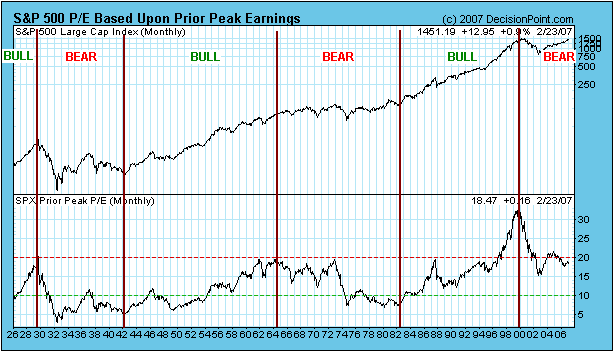
The valuation cycle -- from under-valued to over-valued and back again
-- is clearly evident on the following long-term chart of the
S&P500's P/E ratio. The secular bull markets for the S&P500 are
the 10-25 year periods on the chart when valuations (P/E ratios, etc.)
expanded and the S&P500's secular bear markets are the 10-25 year
periods on the chart when valuations contracted.
Having said all that,
there has been the odd occasion throughout history when, due to a major
structural change, it actually was different. For example, in his book
"Against the Gods -- the Remarkable Story of Risk" Peter Bernstein
explains that prior to 1959 the US stock market's average dividend
yield was almost always greater than the yield on long-dated US
Government bonds. Furthermore, a drop in the average dividend yield to
below the bond yield had traditionally been a reliable indication that
stocks were very over-valued and that a substantial stock market
correction lay in the not-too-distant future. As a result, many prudent
investors would automatically reduce their exposure to the stock market
whenever dividend yields dropped below bond yields. However, in 1959
the US stock market's average dividend yield fell below the Treasury
bond yield and stayed there. Those prudent investors who exited the
stock market in 1959 and began to wait for the S&P500's dividend
yield to move back above the bond yield -- something it had always done
in the past -- prior to re-building their equity portfolios, are still
waiting.
The conventional wisdom in 1959 was that stocks should, and invariably
did, yield more than bonds because they were riskier, but this age-old
relationship was turned on its head by inflation. As an asset class
stocks will be riskier than bonds -- and generally yield more than
bonds -- in a world where the currency maintains its purchasing power
over the long-term. However, in a world where the currency is almost
guaranteed to lose its purchasing power at the rate of more than 3% per
year there will be a strong tendency for equity yields to be lower than
bond yields. The reason is that as prices rise throughout the economy
the nominal earnings, and hence the nominal dividend payments, of most
companies will also rise. A typical bond, on the other hand, will
continue to provide the same nominal income regardless of how much the
currency devalues.
Now, inflation didn't suddenly emerge in 1959. There was, instead, a
multi-decade transition from a stable currency to one that consistently
loses its purchasing power. This transition began in 1913 with the
creation of the Federal Reserve, took a quantum leap in 1934 with the
elimination of US citizens' right to convert their dollars into gold at
a fixed rate, and ended in 1971 with the severing of the last remaining
official link between the US$ and gold. 1959 just happened to be the
year when a critical mass of people came to realise that a knock-on
effect of the changing nature of money would be unrestrained growth in
the money supply, making bonds inherently riskier than stocks over the
long haul.
The above-mentioned change in the nature of money also altered other
traditional relationships. For example, gold went from being a hedge
against deflation to being a hedge against the loss of confidence in
the official currency caused by inflation. Despite this there are still
plenty of people who buy gold as a hedge against deflation because they
have looked at gold's long-term historical record but have failed to
account for the major structural changes that have taken place within
the monetary system. In doing so they have, over the past several
years, proven that in the investment world it is possible for two
wrongs to make a right (they were wrong to expect deflation and wrong
to expect that gold would do well if genuine deflation did actually
occur, but they ended up in the right place anyway because they bought
gold).
Additionally, the stock market's long-term valuation cycle is clearly
still in effect, but the fact that valuations at the end of the most
recent secular bull market were more than 50% above those at earlier
secular peaks is most likely a consequence of the greater amount of
inflation (money supply growth) made possible by changes to the
monetary system.
Summing up, "it's different this time" is usually a dangerous notion to
enter an investor's mind. However, there are rare occasions when
relationships that have held without fail for generations suddenly stop
working due to major structural changes; and for this reason it can
also be dangerous to blindly assume that just because things happened
in a particular way in the past they will necessarily happen that way
in the future.
You really have to
understand WHY things happened the way they did in the past before
coming to any conclusions about the future.
Natural Gas Update
...the
short-term supply glut that has persisted over the past 14 months and
that caused such extreme price weakness has made the long-term outlook
more bullish...
With reference to the following chart showing the quantity of natural
gas (NG) in underground storage in the US relative to the 5-year range,
there has been a dramatic change in the NG supply picture over the past
four weeks. To be specific, thanks to the unseasonably cold weather in
the US over the past month the amount of NG in storage has gone from
well above the top of the 5-year range to not far above the middle of
the 5-year range. This means that the short-term supply glut that put
huge downward pressure on the NG price over the past 14 months has, for
all intents and purposes, been eliminated.

The cold spell did continue, thus increasing the probability that the ultimate price low was already in place.
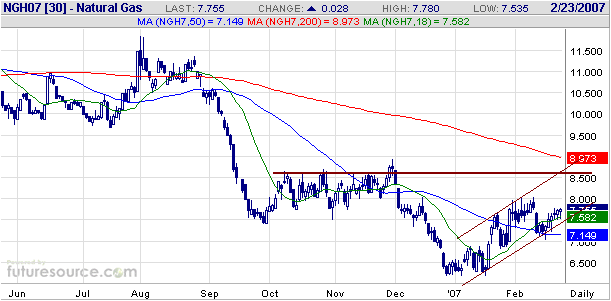
With reference to the following chart of March NG futures, there is a
range of lateral resistance from $8.00 up to around $8.60. The top of
this range also happens to coincide with the top of the short-term
price channel and probably defines the maximum upside potential as far
as the coming several weeks are concerned. At the other end of the
scale, the improvement in the short-term supply situation probably
means that the nearest futures contract won't trade any lower than the
mid-$6 area during any pullback that happens over the next several
weeks.
There are massive undeveloped reserves of NG in the world, but these
reserves are generally in the wrong places (Russia, Central Asia and
the Middle East) as far as the world's biggest NG consumer is
concerned. In order to make it economically feasible to build the
infra-structure needed to convert NG to liquid form, transport it half
way around the world in specially-designed ships and then convert it
back to gas form once it reaches its destination, the NG price will
have to move to a much higher level and stay there.
The Stock
Market
Current Market Situation
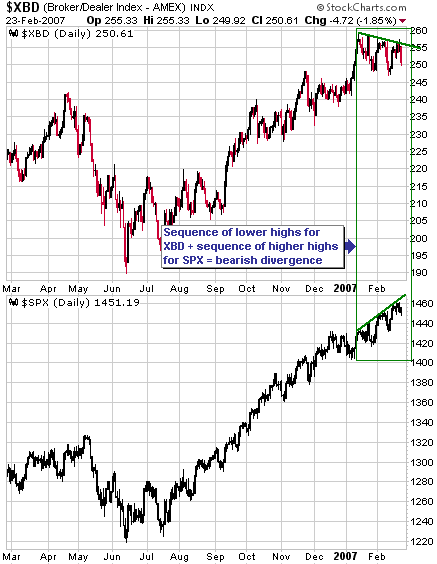
There are two significant bearish divergences 'on the go' at the moment
in the US stock market. The first of these is the failure of the
NASDAQ100 Index (NDX) to confirm the new highs by the other senior
stock indices. The other is illustrated below and is the failure of the
AMEX Broker/Dealer Index (XBD) to exceed its early-January peak. If
things are really as bullish as they superficially seem to be then why
has there been a sequence of declining peaks in the XBD over the past 6
weeks?
We have two
short-term scenarios in mind for the US stock market, one being that
the NDX and the XBD will soon confirm the new 52-week highs recently
achieved by most other indices and the other being that the overall
market will turn down prior to the aforementioned confirmations. In the
first of these scenarios the overall upward trend would be expected to
continue until at least May, whereas in the second scenario an
intermediate-term peak would be close at hand.
Sub-Prime Carnage
...the
current assessment of the financial markets is that the trouble in
'sub-prime land' will NOT have a substantial adverse effect on the
overall US economy.
The following two charts show the spectacular rises and equally
spectacular falls in the stock prices of two of the largest companies
that specialise in sub-prime lending to US homebuyers. If there's
anyone who truly believes that the stock market efficiently discounts
the underlying fundamentals, well, they should take a look at these
charts.
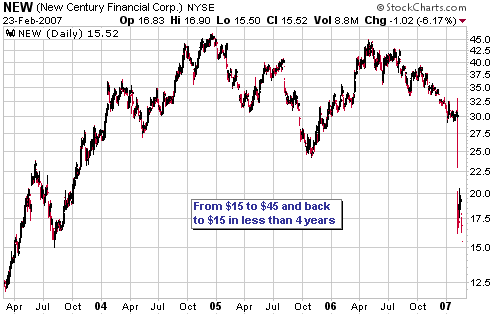
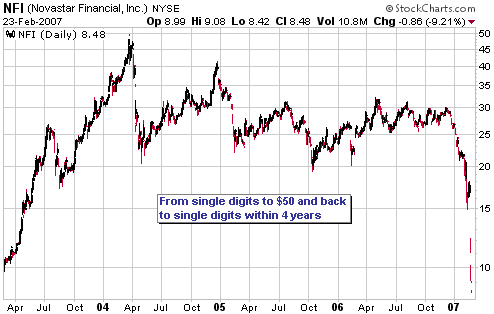
After a long period
of complacency the stock market has obviously now gone a long way
towards discounting the effects, on sub-prime lenders, of the
burgeoning quantity of sub-prime mortgages that are in default.
Based on a desire to
improve short-term earnings growth that overrode normal risk management
considerations, these lenders made loans that could aptly be described
as absurd. In fact, in plenty of cases they granted mortgages for 100%,
or even more than 100%, of home value without obtaining any evidence
that the borrowers had the financial means to meet the loan repayments.
It is therefore not surprising that these loans are now going bad at a
rapid rate. The timing of the collapse was difficult to foresee because
what's happening in the world of sub-prime financing now could just as
easily have happened two years ago or could potentially have been
postponed for another year or so, but it was always a matter of when,
rather than if, these companies were going to get into deep trouble.
What is perhaps a surprise is that the carnage in the sub-prime lending
market has not yet had much effect elsewhere. In particular, the stocks
of the major commercial banks and investment banks have generally
maintained their upward trends, yield and credit spreads have generally
remained narrow, and the senior stock indices are close to 52-week
highs. Clearly, the current assessment of the financial markets is that
the trouble in 'sub-prime land' will NOT have a substantial adverse
effect on the overall US economy.
In the past the markets haven't always been right about such things.
For example, the Asian debt crisis of 1997-1998 brewed for about 12
months before signs of fear began to appear in the US financial
markets. The current crisis, however, is home grown and very well
known, so if there were a good chance of it spreading through the
economy then the markets should have already begun to anticipate such
an outcome.
This week's
important US economic events
| Date |
Description |
Monday Feb 26
| No significant events scheduled
|
Tuesday Feb 27
| Durable Goods Orders
Existing Home Sales
Consumer Confidence
| | Wednesday Feb 28
| Q4 GDP (prelim)
Chicago PMI
New Home Sales
| | Thursday Mar 01
| ISM Index
Personal Income and Spending
Construction Spending
| | Friday Mar 02
| No significant events scheduled
|
Gold and
the Dollar
Currency Market Update
...we
consider the COT situation to be one of many indicators of market
sentiment. ...short-term price extremes (a high for the US$ and lows
for the dollar's main fiat currency counterparts) are already in place.
Today we will take a look at the Commitments of Traders (COT) data for
the Swiss Franc, but before we do it's worth making some general
comments regarding the usefulness -- or lack thereof -- of the weekly
COT reports put out by the CFTC (Commodity Futures Trading Commission).
We don't think there's any point doing in-depth analysis of the COT
data. Like just about everyone else involved in the markets we look at
this data, but the mere fact that just about everyone looks at it
immediately reduces its usefulness (in the financial markets you are
never going to gain an advantage by looking at the same stuff that
everyone else looks at). This, however, is not the only reason to
minimise the importance of the COT data.
Also of significance is that the main pieces of information that can be
extracted from the COT data are the net positions of the speculators
and the commercials, but there are no lasting benchmarks as far as
these net positions are concerned. For example, in the gold futures
market the large speculators are always on the right side of the
long-term price trend, but when the speculative position reaches an
extreme (an extreme net-long position in a long-term bull market or an
extreme net-short position in a long-term bear market) there will
invariably be a reaction against the prevailing price trend as
speculators take profits. The problem for someone using the COT data in
their decision-making process stems from the fact that there is no way
of knowing, in advance, what will constitute an extreme. What
constituted an extreme speculative net-long position in the gold market
three years ago, for instance, did not come close to the extreme
reached over the past year, and the extreme reached over the past year
will almost certainly be dwarfed by the extremes that will be reached
over the coming three years.
Something else worth considering, particularly in relation to gold, is
that the ETFs created over the past few years have attracted some of
the speculative demand that would otherwise have been directed towards
the futures market. The trend is for more alternatives to be provided
to speculators and this trend further reduces the significance of the
COT data.
Finally, a comment last year by Frank Veneroso caught our attention.
When outlining his reasons for being bearish on the base metals Mr
Veneroso happened to mention that speculators in copper futures were
disguising themselves as commercials in order to paint a false picture
of the copper market's structure. He didn't go into the mechanics of
how this was being done, but we doubt that he would have made the
comment unless he was privy to substantiating evidence; and we suspect
that the mechanics wouldn't be very difficult to manage. It would, we
believe, be possible for speculators to execute their buy/sell orders
via entities defined by the CFTC as "commercial", making it look as
though positions were being accumulated by commercial traders rather
than speculators. Our point is: if this has been going on in the copper
market then it has probably also been going on in other markets, even
further reducing the usefulness of the COT data.
Further to the above, we consider the COT situation to be one of many
indicators of market sentiment. We view it as a small piece of a large
puzzle and don't see a good reason to assign it greater importance than
other sentiment indicators such as put/call ratios, sentiment surveys
and the various Rydex ratios.
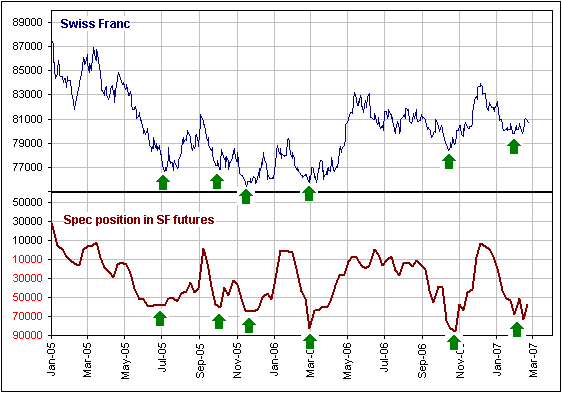
We'll now take a look at what, if anything, the COT data is saying about the Swiss Franc's short-term prospects.
The following chart compares the Swiss Franc (the SF/US$ exchange rate)
with the net position of speculators in Swiss Franc futures over the
past two years. The arrows on the chart mark the times when the
speculative net-short position in SF futures moved above 60,000
contracts.
Notice that whenever speculators have become excessively bearish on the
SF, as indicated by the speculative net-short position rising above
60,000 contracts, a Swiss Franc rally lasting at least 1-2 months has
ensued. The current COT situation is therefore consistent with our view
that a 1-2 month rally got underway during the past couple of weeks.
Also notice, though, that over the past two years the speculative
net-short position in SF futures has been reaching progressively higher
extremes prior to the start of each SF rally, the implication being
that if this pattern continues then the speculative net-short position
will have to rise to at least 90000 before the SF commences a decent
rally. This is a risk, but the market action suggests that short-term
price extremes (a high for the US$ and lows for the dollar's main fiat
currency counterparts) are already in place.
Gold and Gold Stocks
The following chart shows that the AMEX Gold BUGS Index (HUI) spiked up
to test its early-December high on Friday but ended the session almost
2% below this resistance level. The chart also shows that the gold
price ended the week comfortably above its early December high.
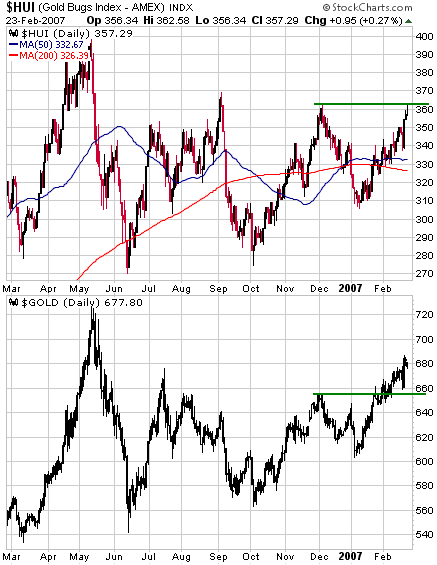
When new multi-month
highs in gold bullion are not accompanied by new multi-month highs in
the gold stock indices it is a bearish divergence because the stocks
usually lead. However, divergences between the stocks and the metal are
not always reliable. For example, when the HUI surged to new
multi-month highs in early September in parallel with a lower high in
the bullion it was interpreted by many analysts (but not us) as a
bullish divergence. But as you can tell from the chart, this so-called
bullish divergence was followed by sharp multi-week declines in both
the stocks and the metal.
Our guess is that if short-term peaks are not already in place for gold
and the gold stock indices then they will be put in place within the
next week or so. However, we expect that any pullback over the coming
few weeks will be followed by a move to new multi-month highs.
A reason to anticipate additional gains prior to more sustainable peaks
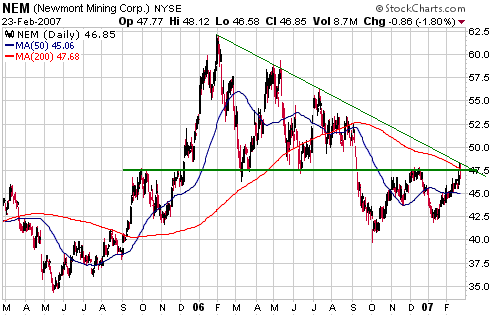
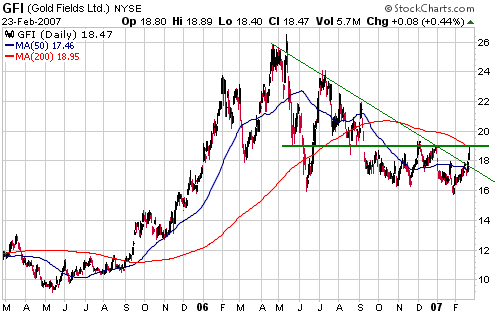
being put in place is encapsulated by the charts of Newmont Mining
(NEM) and Gold Fields Ltd (GFI) included below. Both of these stocks
tested resistance late last week -- GFI has lateral resistance at $19
and NEM has a confluence of resistance at $47.50-$48.00 -- and then
pulled back, but both are clearly a long way from being overbought and
appear to be completing basing patterns rather than topping patterns.
From a longer-term investment perspective we much prefer GFI to NEM. In
fact, at current prices GFI is the only major gold stock in which we'd
be interested in making a long-term investment.
GFI's price has been held back over the past few months by the purchase
of the South Deep mine, but we think this purchase will eventually be
viewed by the market as a huge plus because the company has added an
operational mine with almost 30M ounces of P&P reserves to its
stable at a cost of only US$100 per reserve ounce. If the market is not
valuing this asset at more than $200/ounce in two years time then we
will eat our hat.
NEM, on the other hand, offers less in the way of long-term value but
does appear to offer reasonable upside potential as far as the coming
three months are concerned. In particular, a decline in the company's
production during 2007 has already been fully discounted by the market
whereas we don't think the boost to earnings that will come from the
expiry of its copper hedges -- the last of the disastrous hedges expire
this month -- has yet been factored in.
Update
on Stock Selections
(Note: To review the complete list of current TSI stock selections, logon at http://www.speculative-investor.com/new/market_logon.asp
and then click on "Stock Selections" in the menu. When at the Stock
Selections page, click on a stock's symbol to bring-up an archive of our comments on the stock in question)
 Gryphon Gold (TSX: GGN). Shares: 47M issued, 57M fully diluted. Recent price: C$0.84 Gryphon Gold (TSX: GGN). Shares: 47M issued, 57M fully diluted. Recent price: C$0.84
14 members of the TSI Stocks List (AAU, CGR, GQM, GRS, HL, MFN, MRB,
SBB, MAW, SXR, USU, CML, CUU, and IRC) ended last week at, or near,
52-week highs. At the same time, however, a few of our stocks were
languishing near 52-week lows.
GGN is one of the stocks languishing near its 52-week low. It hasn't,
as yet, recovered from last November's bad news relating to an error in
resource estimation made by one of the company's consultants. As a
result of that bad news, GGN's management lost some credibility and the
investment world lost interest in the stock.
The stock market's reaction to bad news can sometimes create
opportunities to purchase assets at well below their true worth. This,
we think, is the current situation with GGN. Specifically, our
back-of-the-envelope valuation for GGN's Nevada-based Borealis gold
project is US$75M, calculated by assigning a value of US$50/oz to the
project's 1.2M-ounce measured-and-indicated resource and a value of
US$25/oz to the project's 0.6M-ounce inferred resource. This is
approximately double GGN's current market capitalisation and is
probably close to where the stock would now be trading if not for the
stigma associated with last November's disappointment.
GGN has a 72-hole drilling program planned for 2007 to upgrade and
expand the Graben sulphide deposit's resource (the Graben deposit is
part of the Borealis project and currently has a total resource of 875K
ounces) as well as explore for new gold deposits within two
newly-identified gold-bearing systems within 5km of the Graben deposit.
This drilling program is fully funded by the company's cash on hand (we
estimate that GGN presently has about US$8M in the bank) and has the
potential to provide a stream of market-moving news over the next
several months.
In addition, an updated resource estimate for the Graben deposit is
scheduled to be completed during March and could also be market-moving.
This updated estimate is being done by AMEC and will take into account
the results of drilling since March of 2006.
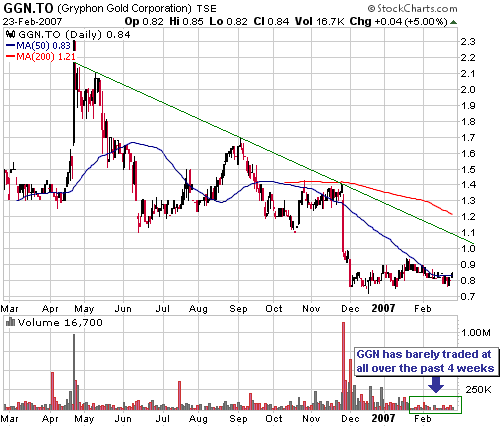
With reference to the following chart, GGN has been drifting lower over
the past month on almost no volume. The lack of volume makes it
difficult to buy the stock in any real quantity, but investors who are
prepared to sit patiently with bids near current levels might be
rewarded as existing shareholders become frustrated with the lack of
stock-price action and 'throw in the towel'. The probability of getting
a buy order filled will improve if the gold sector experiences a
correction during March as presently appears likely.
Although it is very much in the micro-cap category, we don't think
there's a lot of downside risk in GGN near its current price because
the company's in-the-ground gold ounces already sell at a large
discount -- meaning that expectations are low -- and these ounces are
in a safe geographical location (Nevada). The worst case might be that
an investment in GGN proves to be 'dead money' for many more months,
but note that if we are right to expect sector-wide strength to persist
until at least May then speculation sufficient to lift very
under-valued micro-caps to much higher levels could easily occur within
the coming three months.
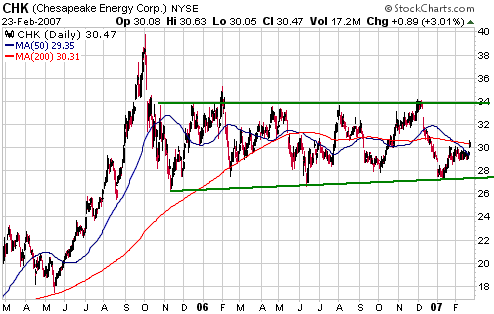
Chesapeake Energy (NYSE: CHK)
The Chesapeake Energy April-2007 $32.50 call options (CHKDZ) are in the TSI Stocks List.
Good news on the earnings front broke CHK upward from a multi-week
consolidation pattern on Friday and additional gains are likely over
the coming weeks. However, we doubt that there will be sufficient
strength in the oil-and-gas sector of the stock market to enable CHK to
breakout to the upside from its 17-month price range (see chart below)
prior to the expiration of our options.
For those who
currently hold the CHK April call options our suggestion is to exit
into strength over the next 3 weeks, whereas those who hold CHK call
options expiring in July or later could consider maintaining a position
in anticipation of sector-wide strength persisting until May.
Chart Sources
Charts appearing in today's commentary
are courtesy of:
http://stockcharts.com/index.html
http://www.futuresource.com/
http://www.decisionpoint.com/

|