|
-- Weekly Market Update for the Week Commencing 26th April 2010
Big Picture
View
Here is a summary of our big picture
view of the markets. Note that our short-term views may differ from our
big picture view.
In nominal dollar terms, the BULL market in US Treasury Bonds
that began in the early 1980s will end by mid-2010. In real (gold)
terms, bonds commenced a secular BEAR market in 2001 that will continue
until 2014-2020. (Last
update: 09 February 2009)
The stock market, as represented by the S&P500 Index, commenced
a secular BEAR market during the first quarter of 2000, where "secular
bear market" is defined as a long-term downward trend in valuations
(P/E ratios, etc.) and gold-denominated prices. This secular trend will bottom sometime between 2014 and 2020. (Last update: 22 October 2007)
A secular BEAR market in the Dollar
began during the final quarter of 2000 and ended in July of 2008. This
secular bear market will be followed by a multi-year period of range
trading. (Last
update: 09 February 2009)
Gold commenced a
secular bull market relative to all fiat currencies, the CRB Index,
bonds and most stock market indices during 1999-2001. This secular trend will peak sometime between 2014 and 2020. (Last update: 22 October 2007)
Commodities,
as represented by the Continuous Commodity Index (CCI), commenced a
secular BULL market in 2001 in nominal dollar terms. The first major
upward leg in this bull market ended during the first half of 2008, but
a long-term peak won't occur until 2014-2020. In real (gold) terms,
commodities commenced a secular BEAR market in 2001 that will continue
until 2014-2020. (Last
update: 09 February 2009)
Copyright
Reminder
The commentaries that appear at TSI
may not be distributed, in full or in part, without our written permission.
In particular, please note that the posting of extracts from TSI commentaries
at other web sites or providing links to TSI commentaries at other web
sites (for example, at discussion boards) without our written permission
is prohibited.
We reserve the right to immediately
terminate the subscription of any TSI subscriber who distributes the TSI
commentaries without our written permission.
Outlook Summary
Market
|
Short-Term
(0-3 month)
|
Intermediate-Term
(3-12 month)
|
Long-Term
(1-5 Year)
|
Gold
|
Bullish
(12-Apr-10)
|
Bullish
(12-May-08)
|
Bullish
|
US$ (Dollar Index)
|
Neutral
(20-Jan-10)
| Bullish
(02-Nov-09)
|
Neutral
(19-Sep-07)
|
Bonds (US T-Bond)
|
Bearish
(05-Apr-10)
|
Bearish
(14-Dec-09)
|
Bearish
|
Stock Market (S&P500)
|
Bearish
(08-Mar-10)
|
Bearish
(11-May-09)
|
Bearish
|
Gold Stocks (HUI)
|
Neutral
(19-Apr-10)
|
Neutral
(16-Sep-09)
|
Bullish
|
| Oil | Neutral
(28-Oct-09)
| Bearish
(01-Mar-10)
| Bullish
|
Industrial Metals (GYX)
| Bearish
(21-Sep-09)
| Bearish
(25-May-09)
| Neutral
(11-Jan-10)
|
Notes:
1. In those cases where we have been able to identify the commentary in
which the most recent outlook change occurred we've put the date of the
commentary below the current outlook.
2. "Neutral", in the above table, means that we either don't have a
firm opinion or that we think risk and reward are roughly in balance with respect to the timeframe in question.
3. Long-term views are determined almost completely by fundamentals,
intermediate-term views by giving an approximately equal weighting to
fundmental and technical factors, and short-term views almost
completely by technicals.
Natural Gas Update
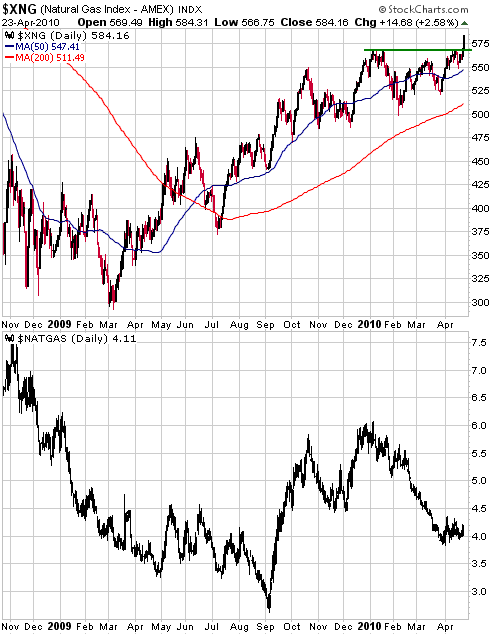
The AMEX Natural Gas Index
(XNG) broke above resistance to a new 52-week high on Friday. This
creates a short-term chart-based target of 625-650.
The recent price action has added to one of the most extraordinary
divergences we have ever seen between a commodity and the stocks of
companies that produce the commodity. The divergence is illustrated by
the following chart comparison of the XNG and the natural gas price.
Note that since November of 2008 the XNG has gained 80% while the
natgas price has fallen 35%.
There are some good reasons why natural gas equities have generally
performed a lot better than the commodity over the past 18 months, the
most important of which are:
1. Most natgas producers also produce oil, and the oil price has trended upward
2. The stock market's post-crash rebound has been strong enough to lift almost all equities
3. New drilling technology makes it possible for natgas producers to be profitable at a lower commodity price
4. Most natgas producers hedge part of their production
But even taking these reasons into account, the extent of the divergence is impressive and unusual.
As previously
advised, we think it makes sense to scale out of natural gas stocks
into strength with the aim of being down to a minimum position by the
end of May.
Grains - biding our time
Corn,
soybeans and wheat, collectively known as "the grains", stand out in
the commodity world for NOT having benefited from speculative demand
over the past year. With the 'hot money' having largely ignored this
group until now, the downside risk in "the grains" is probably a lot
lower than it is for speculative favourites such as oil, the base
metals and the PGMs. At least, the risk of a sharp price decline in
response to the next market-wide plunge in confidence appears to be a
lot lower for the grains than for most other important commodities. At
the same time, there is the potential for bullish speculators to
eventually find their way to the grain markets, as they did during
2007-2008, and/or for grain prices to be boosted by the realisation
that supply will be less plentiful than currently anticipated.
The relatively small downside risk combined with the potential for
either a speculation-related or a supply-related boost has piqued our
interest in being 'long' the grains via an agriculture fund such as
DBA. We aren't going to do anything yet, though, because the price
action isn't right.
Mainly for interest's sake we have included, below, a long-term chart
of the GKX/gold ratio (the GSCI Agriculture Index divided by the gold
price). This chart shows that agricultural commodities have been in a
bear market relative to gold since 1998. We expect that this major bear
market will continue for at least a few more years, but on an
intermediate-term basis the ratio appears to be over-extended to the
downside. In other words, the potential exists for a multi-month
counter-trend rebound in agricultural commodities relative to gold.

The Stock
Market
The US stock market ended
last week at a new 52-week high, so there is no evidence, yet, that a
peak is in place. However, it would be an understatement to say that
the market is 'overbought' and at risk of experiencing a sharp decline.
The Dow Industrials Index has now risen for 8 weeks in a row and on 10
of the past 11 weeks, while the S&P500 Index has risen on 9 of the
past 11 weeks. Furthermore, over the past 11 weeks none of the senior
US stock indices have experienced a draw-down of more than 2%.
As discussed in recent commentaries, the new 52-week highs made by the
US stock market over the past several weeks have not been confirmed by
some other important markets. Those of a bearish bent should be focused
on the markets that are now rolling over after making lower highs,
examples being Brazil, Hong Kong and China. These markets led to the
upside during 2008-2009 and now appear to be leading to the downside.
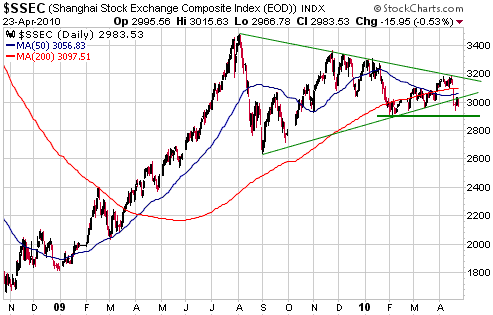
The following chart shows that the Shanghai Stock Exchange Composite
Index (SSEC) broke below trend-line support last week. More important
lateral support lies at around 2900.
This week's
important US economic events
| Date |
Description |
Monday Apr 26
| No important events scheduled
| | Tuesday Apr 27 | Consumer Confidence
S&P Case-Shiller Home Price Index
| | Wednesday Apr 28
| FOMC Meeting Announcement
| | Thursday Apr 29
| No important events scheduled
| | Friday Apr 30
| Q1 GDP (prelim)
Consumer Sentiment
Employment Cost Index
Chicago PMI
|
Gold and
the Dollar
Gold
The June gold futures contract ended last week about $10 below
short-term resistance in the low-$1160s. Breaking above this resistance
would probably be followed in fairly quick time by a test of the
December-2009 peak at around $1220.
It could be significant that the Fed is due to issue its next monetary
policy statement this Wednesday. Considering the large amount of
speculation going on in the financial markets at this time, the gold
price could promptly move up to the $1200s if Bernanke and his gaggle
of money manipulators are silly enough to again state their intention
to hold the overnight interest rate near zero for an extended period.
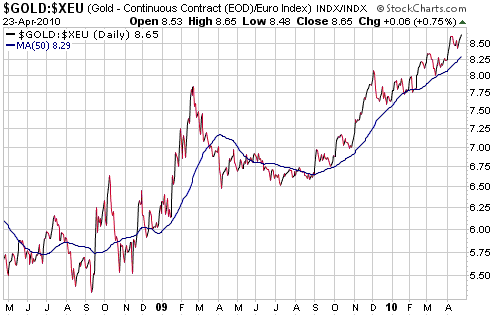
The following chart shows that the euro-denominated gold price
(gold/euro) continues to rise in 'stair-step' fashion and ended last
week at a new all-time high. As previously noted, the benefit of the
doubt should be given to the short-term bullish case as long as
pullbacks in gold/euro end at, or above, the 50-day moving average. In
other words, it would take a solid break below the 50-day moving
average to signal an end to the upward trend.
Also, acceleration in gold/euro's rate of advance could be viewed as a
warning of an impending trend reversal on both a short and intermediate
term basis. For example, if gold/euro were to move more than 15% above
its 50-day moving average we would interpret it as a sign that the
market was within a few weeks of an intermediate-term peak.
There is no point
expressing gold's long-term upside potential in US$ terms -- or, for
that matter, in terms of any other fiat currency -- because who knows
what a dollar will buy in a few years time. For example, a rise in the
gold price to $5000/ounce over the next 5 years wouldn't constitute a
good return if the price of a loaf of bread rose to $100 over the same
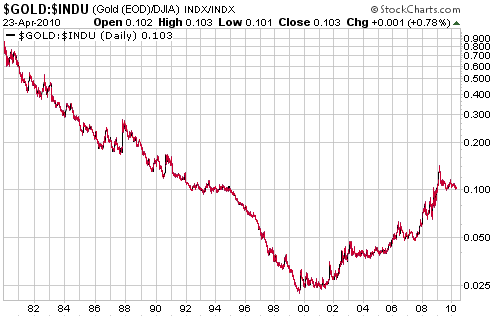
period. In our opinion, the most logical way to view gold's
long-term potential is in terms of the Dow Industrials Index. This is
because: a) the Dow will adjust to changes in the purchasing power of
the US$, b) the history of the gold/Dow ratio is long enough to
indicate a likely range for an extreme high, and c) the gold/Dow ratio
trends inversely to overall stock market valuation over the long-term.
The following chart shows that the gold price would have to increase by
a factor of 10 from here, relative to the Dow, to match its 1980 high.
A similar increase would be required to take gold/Dow back to its 1932
high.
Gold Stocks
Current Market Situation
The HUI's 'choppy' price action continues. The most important levels of nearby support and resistance now lie at 420 and 470.
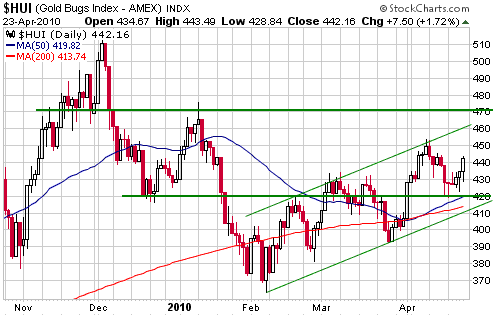
We are hoping that
the HUI strengthens sufficiently over the next few weeks to make a new
multi-month high during May, because such an outcome would be the best
fit with our short-term expectations for other markets and because a
May high would give us information as to what to expect from the gold
sector over the ensuing six months (a May high would be consistent with
a decline to an ultimate correction low during October-November).
However, we are not betting on any particular short-term outcome.
The importance of stock promotion
The managers of some public companies ignore the performance of their
company's stock on the basis that if the business does well then the
stock price will take care of itself. This is actually the best
approach for the managers of large and profitable companies, because
such companies will already be well known within the investment
community and will not have to sell equity in order to remain in
business. A company such as Newmont Mining, for instance, would gain
nothing from stock promotion, so its managers should focus all their
attention on improving the underlying business. However, stock
promotion will be a critical activity for the senior management of any
company that has to regularly issue shares to pay its expenses, which
is the case for almost all exploration/development-stage mining
companies. For such companies, the ability of the management to
effectively promote the stock can have a large bearing on fundamental
value. The reason, in a nutshell, is that the higher the stock price
the lesser the number of shares that will have to be issued to finance
the business and the greater the per-share value will become over time.
Effective stock promotion won't turn a bad story into a good one, but
at any point in time there will always be many small companies with
good stories vying for the attentions of analysts and investors.
Therefore, one of the most important roles of the CEO of a small
company reliant on equity financing is to ensure that his company's
story gets out to the potential buyers of the shares and to the people
who influence the buying of others. We are mystified as to why so many
managers of junior resource companies fail to understand this.
Currency Market Update
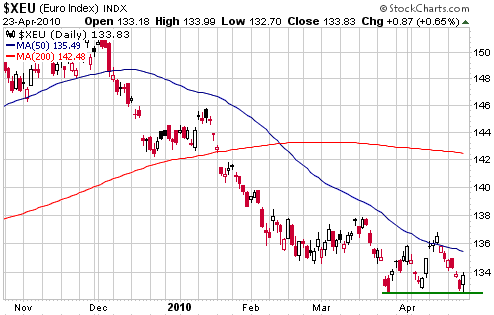
After Thursday's market action we began to wonder how many times the
currency market could react to the same old news about the Greek
government's debt problem. The market pushed the euro back to its March
low on Thursday in response to 'news' that Greece's debt/deficit
problem was worse than the government had been letting on, which really
shouldn't have been news at all. Then, on Friday, the market pushed the
euro upward in response to 'news' that the government of Greece was
officially requesting the loan package that had previously been cobbled
together.
Europe's monetary union has a problem that cannot be solved by propping
up members that are now, for all intents and purposes, bankrupt. The
most sensible course of action would be for the government of Greece to
default on its debt, scale back its involvement in the country's
economy and cut taxes. This course of action would pave the way for a
sustainable recovery in Greece's economy and would not impose
additional costs on the taxpayers of other countries, but it does not
appear to be under consideration. The least sensible course of action
would be for the government of Greece to increase taxes and replace its
existing debt with new debt provided by other governments. This is
currently the chosen course of action and is being promoted as a
bailout for the Greek economy and Greek taxpayers, even though it all
but eliminates the possibility of a sustainable economic recovery and
only benefits the institutions that were silly enough to buy Greek
government bonds. It is clear that the "no bondholder left behind"
policy remains dominant.
We continue to believe that the euro will move much lower relative to
the US$ over the next 12 months. This view was initially predicated on
the likelihood of the US$ being boosted by another wave of
de-leveraging once the global stock market rebound petered out, but of
almost equal importance now is the growing realisation that Europe's
monetary union will not remain intact. The debt-related problems of US
state governments and the US federal government are just as severe a
those being faced in Europe, but an important difference is that the US
federal government has UNLIMITED access to new money. This unlimited
access to new money will eventually destroy the US$, but over the next
year or two it will give the US government the ability to maintain the
illusion of solvency.
Having said that, price action and sentiment still point to a short-term euro rebound.
Update
on Stock Selections
(Notes: 1) To review the complete list of current TSI stock selections, logon at http://www.speculative-investor.com/new/market_logon.asp
and then click on "Stock Selections" in the menu. When at the Stock
Selections page, click on a stock's symbol to bring-up an archive of
our comments on the stock in question. 2) The Small Stock Watch List is
located at http://www.speculative-investor.com/new/smallstockwatch.html)
 Andina Minerals (TSXV: ADM). Shares: 105M issued, 118M fully diluted. Recent price: C$1.09 Andina Minerals (TSXV: ADM). Shares: 105M issued, 118M fully diluted. Recent price: C$1.09
Over the next few weeks we plan to remove some gold/silver stocks from
the TSI List in order to free up space for new stocks with better
risk/reward ratios. The candidates for removal will be those
stocks/companies that have performed the worst over the past year or
that have relatively high valuations.
ADM has been one of our worst performers over the past year, but we
have no intention of removing it from the List. In fact, at current
prices we think ADM is one of the most obvious candidates for new
buying for PATIENT and risk-tolerant speculators. This is because it
controls a large in-ground gold resource in a politically secure
country (Chile), and because it has a strong balance sheet (about $40M
of cash and no debt). The risk is that its deposit will prove to be
uneconomic at today's metal prices, but at the current stock price a
lot of risk is already factored in. We say that because ADM's M&I
gold resource (at a 0.5 g/t cut-off)* is presently being valued by the
stock market at only $17/ounce (or $11/ounce if we deduct the value of
the company's cash).
Patience will be required, though, because over the next several months
the company will be re-engineering the project to account for the
inability to achieve an adequate gold recovery using the earlier mine
plan. This means that there probably won't be any significant new
developments for quite a while. To be more specific, apart from issuing
some non-market-moving drilling results within the next couple of
months, the company will probably be quiet on the news front until the
Preliminary Economic Assessment (PEA) is ready for publication early
next year.
It was news that the previous mine plan would not be viable that caused
the stock price to plunge at the end of February. As we noted at the
time:
"...after a stock plunges
in response to bad company-specific news (or news that is generally
perceived to be bad), the initial reaction low is normally not the
ultimate low. There are no 'hard and fast' rules, but more often than
not the initial low will be followed by a rebound and then a decline to
a new low. It is likely that ADM's initial low was put in place on
Friday or will be put in place early this week, after which there will
be a rebound and then a decline that tests or breaches the initial low."
When we wrote the above the stock had just plunged to the mid-$1.30s
and we guessed that the ultimate low would be in the low-$1.20s, but it
turned out that the initial news-related decline took the price down to
around $1.15. As illustrated by the following chart, the stock then
accomplished the obligatory rebound from the initial low and has since
dropped to a new low for the move. Prior to Friday's sidestep the stock
had fallen for seven days in succession.
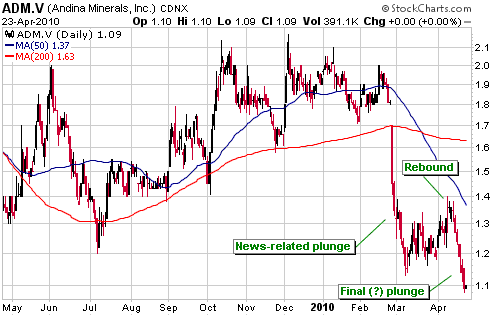
ADM is probably now
at, or very close to, its ultimate news-related low, although stocks
such as this can make big moves in response to relatively small changes
in buying/selling pressure and can therefore overshoot by wide margins
to both the upside and the downside.
*Using a 0.5 g/t
cut-off the M&I gold resource is around 7M ounces. Using a 0.3 g/t
cut-off the M&I resource increases to 9.8M ounces.
Orsu Metals (TSX: OSU). Shares: 158M issued, 214M fully diluted. Recent price: C$0.25
OSU's cash shortage has been solved via an equity financing that raised
$28M. This financing has reduced the stock's risk because the company
should now be fully funded for at least the next two years, but it has
also reduced the upside potential because it resulted in an increase of
more than 200% in the total number of outstanding shares.
It is also worth noting that Kyrgyzstan, the location of OSU's most
important asset, is politically unstable at this time (refer to http://www.reuters.com/article/idAFLDE63M14S20100423?rpc=44 for more info).
Even with the massive stock dilution and the resultant reduction in
value per share, OSU still has considerable upside potential. However,
there are many other junior gold/silver stocks with just as much upside
potential and with assets in politically secure regions. We have
therefore decided to remove OSU from the TSI List and record a huge
loss of around 96%.
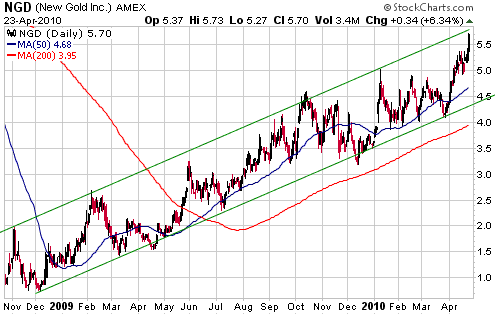
New Gold (AMEX: NGD, TSX: NGD). Shares: 387M issued, 471M fully diluted. Recent price: US$5.70
We have suggested buying NGD at many different prices over the years.
For example, our original entry was at US$1.11 way back in 2003 (via
Metallica Resources) and we most recently highlighted the stock as a
trading buy in the US$4.20s last month in anticipation of a move up to
around US$6.
NGD hasn't quite made it to the aforementioned short-term target of $6,
but it is not far away and the following chart shows that it is nearing
its channel top. More importantly, NGD is now expensive compared to
many other gold stocks. For example, NGD's 2010 production is currently
being valued by the stock market at $6500/ounce, versus only
$2300/ounce for the production of Northgate Minerals (NXG).
We have therefore decided to remove NGD from the TSI List. Based on our
original entry price, the profit on this long-term speculation was 414%.
If we return NGD to the List in the future it will most likely be as a short-term trading position.
On a related matter,
it is important to understand that our assessment of a stock's
valuation is dynamic, the reason being that the fundamentals are
continually changing. It is therefore possible for a stock to be fully
valued at $5/share at one point in time and to subsequently be
under-valued at $10/share (due to positive changes in the
fundamentals). By the same token, it is possible for a stock to be
under-valued at $10/share at one point in time and to subsequently be
fully valued at $5/share.
In NGD's case, back in April of 2008 we explained why we thought the
stock was worth $9/share. Since that time the gold price has gained
about 20%, but the stock now appears to be over-valued -- at least
relative to other gold stocks -- at $5.70/share. There have been some
positive developments in the mean time, but there has also been a large
increase in the share count and the write-down to almost zero of an
asset (the Amapari gold mine) that was once thought to be very valuable.
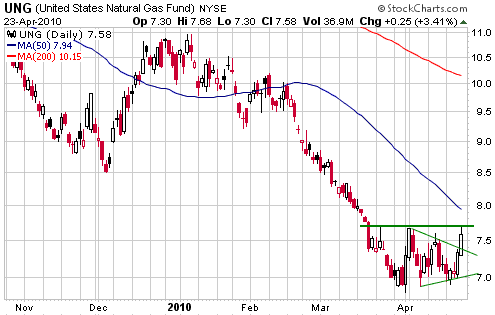
US Natgas Fund (NYSE: UNG). Recent price: US$7.58
UNG needs to close above resistance at $7.70 to provide additional evidence that a bottom is in place.
When we added the
short-term UNG trading position to the TSI List in early April we said
that the initial 'stop' would be a daily close below $6.79. We will
leave this initial stop in place until UNG closes above $7.70, at which
point we will switch to a 5% trailing stop based on daily closing
prices.
Chart Sources
Charts appearing in today's commentary
are courtesy of:
http://stockcharts.com/index.html

|