|
-- Weekly Market Update for the Week Commencing 26th May 2014
Big Picture
View
Here is a summary of our big picture
view of the markets. Note that our short-term views may differ from our
big picture view.
In nominal dollar terms, the BULL market in US Treasury Bonds
that began in the early 1980s ended in 2012. In real (gold)
terms, bonds commenced a secular BEAR market in 2001 that will continue
until 2018-2020. (Last
update: 20 January 2014)
The stock market, as represented by the S&P500 Index,
commenced
a secular BEAR market during the first quarter of 2000, where "secular
bear market" is defined as a long-term downward trend in valuations
(P/E ratios, etc.) and gold-denominated prices. This secular trend will bottom sometime between 2014 and 2020.
(Last update: 22 October 2007)
A secular BEAR market in the Dollar
began during the final quarter of 2000 and ended in July of 2008. This
secular bear market will be followed by a multi-year period of range
trading.
(Last
update: 09 February 2009)
Gold commenced a
secular bull market relative to all fiat currencies, the CRB Index,
bonds and most stock market indices during 1999-2001.
This secular trend will peak sometime between 2014 and 2020.
(Last update: 22 October 2007)
Commodities,
as represented by the Continuous Commodity Index (CCI), commenced a
secular BULL market in 2001 in nominal dollar terms. The first major
upward leg in this bull market ended during the first half of 2008, but
a long-term peak won't occur until 2014-2020. In real (gold) terms,
commodities commenced a secular BEAR market in 2001 that will continue
until 2014-2020.
(Last
update: 09 February 2009)
Copyright
Reminder
The commentaries that appear at TSI
may not be distributed, in full or in part, without our written permission.
In particular, please note that the posting of extracts from TSI commentaries
at other web sites or providing links to TSI commentaries at other web
sites (for example, at discussion boards) without our written permission
is prohibited.
We reserve the right to immediately
terminate the subscription of any TSI subscriber who distributes the TSI
commentaries without our written permission.
Outlook Summary
Market
|
Short-Term
(1-3 month)
|
Intermediate-Term
(6-12 month)
|
Long-Term
(2-5 Year)
|
|
Gold
|
Bullish
(26-Mar-14) |
Bullish
(26-Mar-12) |
Bullish
|
|
US$ (Dollar Index)
|
Bearish
(16-Apr-14) |
Bearish
(27-Jan-14) |
Neutral
(19-Sep-07) |
|
Bonds (US T-Bond)
|
Bullish
(11-Dec-13)
|
Neutral
(18-Jan-12)
|
Bearish |
|
Stock Market
(DJW)
|
Bearish
(07-Apr-14) |
Bearish
(28-Nov-11) |
Bearish
|
|
Gold Stocks
(HUI)
|
Bullish
(03-Mar-14) |
Bullish
(23-Jun-10) |
Bullish
|
|
Oil |
Bearish
(12-Mar-14) |
Neutral
(31-Jan-11) |
Bullish
|
|
Industrial Metals
(GYX)
|
Neutral
(17-Feb-14) |
Bullish
(28-Apr-14) |
Bullish
(28-Apr-14) |
Notes:
1. The date shown below the current outlook is when the most recent outlook change occurred.
2. "Neutral", in the above table, means that we either don't have a
firm opinion or that we think risk and reward are roughly in balance with respect to the timeframe in question.
3. Long-term views are determined almost completely by fundamentals,
intermediate-term views by
fundamentals, sentiment and technicals, and short-term views by sentiment and
technicals.
Important Note: No Interim
Update this week
We will be taking a break this week, so
there will be no Interim Update. The next commentary will be the Weekly Update
scheduled for Sunday 1st June, although we will issue an email alert during the
intervening period if the market action is sufficiently dramatic or unexpected.
Monetary inflation in
Japan
The Fed's QE directly boosts the money supply,
but, as far as we can tell, the Bank of Japan's (BOJ's) QE only boosts the
reserves of financial institutions. Consequently, whereas the Fed can create
whatever amount of monetary inflation it desires, the BOJ relies on financial
institutions expanding credit in response to reserve injections. This means that
the BOJ's QE only boosts the country's money supply to the extent that Japanese
financial institutions respond to reserve injections by monetising assets and
expanding their loan books. Due to the general unwillingness or inability of
financial institutions to take such actions, Japan's monetary inflation rate has
remained relatively low despite the QE programs implemented by the BOJ over the
past 15 years.
The QE program introduced by the BOJ early last year is by far the biggest to
date and has had a greater effect than its predecessors on Japan's money supply.
However, Japan still has the lowest monetary inflation rate in the developed
world. For example, the 3.5% year-over-year rate of increase in Yen supply
compares to year-over-year rates of supply increase of around 8% for the US$ and
the C$, 11.7% for the A$ and 5.6% for the euro. Furthermore, the strong
seasonality of changes in Yen supply has not been affected by the massive QE
program introduced last year, and the latest figures suggest that Japan's
monetary inflation rate, having risen from its long-term average of 2% to
slightly more than 4% at the end of last year in an initial reaction to the
latest round of QE, is now on the decline.
The seasonality mentioned in the preceding paragraph is evident on the following
chart of the 3-month rate of change in Japan's M2 money supply. The pattern that
repeats almost every year involves a January peak, a pullback into a March low,
a rise to another (usually higher) peak in May, and then a decline to the low
for the year in September or October. The most consistent aspects of this
pattern are the May high and the September-October low.
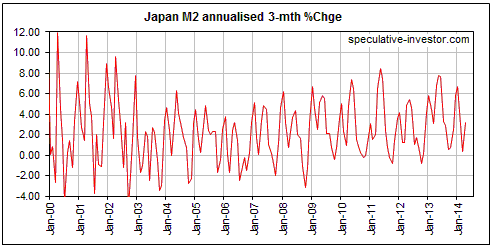
Due to the latest QE program, the May-2013 seasonal peak was the second-highest
of the past 10 years and the September-2013 bottom was higher than any of the
September-October bottoms of the preceding 10 years. However, signs have emerged
that the upward shift in the pattern was temporary, in that the annualised
3-month rate-of-change in Japan's M2 just achieved its lowest April reading
since 2008 and its lowest March reading since 2004.
What's a Japanese central banker to do?
The Stock
Market
The US
The S&P500 Index closed above 1900 for the first time ever last Friday. At the
same time, the number of individual NYSE-traded common stocks that made 52-week
highs was only 81. To put this number into perspective, when the SPX makes a new
52-week high it is normal for the quantity of individual new 52-week highs among
NYSE-traded common stocks to be at least 300. In a healthy market it would be
more than 400. Last Friday's tally of 81 was actually in the bottom quintile of
the 2-year range.
Some of the sectors that had been relatively weak since early-March have
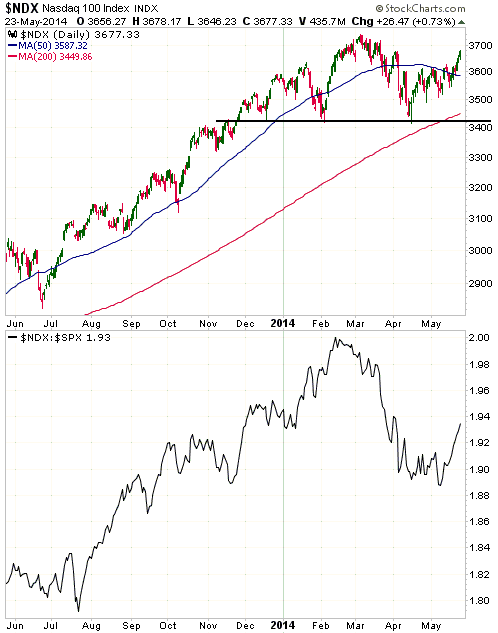
recently rebounded. For example, the following chart shows that the NASDAQ100
Index (NDX), after holding important support at 3400 in April, was strong last
week in both nominal terms (the top half of the chart) and relative terms (the
bottom half of the chart). This rebound is not surprising and doesn't change the
overall picture. It doesn't change the overall picture because we now have
another marginal new high in the SPX that was not confirmed by numerous other
indexes and indicators, including the NDX and the NDX/SPX ratio. Note, however,
that the overall picture would be altered by a weekly NDX close at a new high
for the year. Such an event, which is certainly not expected, would open up the
possibility of a 2-3 month upside blow-off.
In last week's Interim Update we mentioned that the Volatility Index (VIX) had
dropped to near its low of the past few years. It fell a little more last Friday
and is now at its lowest level in many years.
The current situation is about as good as it gets for establishing bearish
positions. This is not just because of the extended price action, the
over-bullish sentiment, the high average valuation and the numerous bearish
divergences/non-confirmations, but also because the NDX's rebound to slightly
below its March high means that managing risk is relatively straightforward.
Bearish positions could be established with the plan to make a quick exit if the
NDX closes at a new high for the year.
In previous commentaries we said that we didn't intend to make any formal
recommendations with regard to bearish equity positions, although for
information purposes we said in the 12th May Weekly Update that we had added a
small SSO (ProShares UltraS&P500 ETF) put-option position to our own account. We
also said that we might double our exposure to these puts in response to some
additional near-term stock market strength, but that the overall position size
would remain small. Again for information purposes only, we advise that we
haven't added to our SSO put-option position but late last week we purchased
some VIX August-2014 $15 call options with the aim of profiting from a
short-term volatility spike.
We still have no intention of making any formal equity-bearish trading
recommendations, and, as previously noted, will only be taking a small bearish
position for our own account. We do, however, expect to achieve a sizeable gain
from weakness in the broad US stock market due to the loose inverse relationship
between the broad stock market and gold-related investments.
Russia
The Russian stock market is the only broad stock market that we are interested
in being 'long' at this time, with the Market Vectors Russia ETF (RSX) being our
preferred vehicle. A couple of weeks ago we suggested taking an initial position
in RSX with the aim of averaging into a full position on weakness over six
months.
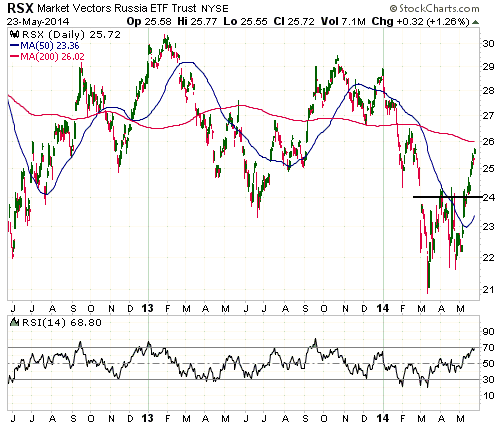
The following daily chart shows that RSX has moved sharply higher since breaking
above lateral resistance at $24. It is now extended to the upside on a
short-term basis and will soon hit resistance defined by its 200-day MA, which
means that now is not the time to be buying. A new buying opportunity could,
however, be created by a pullback to former resistance (now support) at around
$24.
This week's
important US economic events
| Date |
Description |
| Monday May 26 |
US markets closed for Memorial Day | | Tuesday
May 27 |
Durable Goods Orders
Case-Shiller Home Price Index
Consumer Confidence
Dallas Fed Mfg Survey
Richmond Fed Mfg Index | | Wednesday
May 28 |
No important events scheduled | | Thursday
May 29 |
Q1 GDP (revised)
Pending Home Sales Index
|
| Friday May 30 |
Chicago PMI
Consumer Sentiment
Personal Income and Spending |
Gold and
the Dollar
Gold
Gold and India
It's a good bet that later this year India's newly elected government will
remove, or substantially relax, the gold import restrictions that were brought
in last year by the previous government in a misguided effort to 'fix' what
policymakers saw as a current-account-deficit problem. In fact, a
step was taken in that direction last week when the Reserve Bank of India
allowed seven private jewellery exporters -- companies that had been barred from
importing gold since July 2013 -- to resume imports. We hope that these import
restrictions are soon eliminated because doing so would benefit many people in
India by reducing the premium they pay when buying gold, but either way it won't
make much difference to the price at which gold trades in major financial
centres such as New York and London. The fact is that although India has
traditionally been a large and steady importer of gold, changes in Indian gold
demand have never had a significant effect on gold's price trend.
The reason that changes in Indian gold demand have never been important drivers
of gold's price trend is similar to the reason that changes in annual gold
production don't have much effect on the gold price. It's because the amount of
the change is invariably small compared to the global demand for gold. Note that
at any given time the global demand for gold equals the global supply of gold,
which is probably now around 170,000 tonnes. As explained in numerous TSI
commentaries over the years, significant changes in the desire to hold the
aboveground gold supply are primarily influenced by the ebbing and flowing of
confidence in the world's most important currencies (at this time, the US$ and
the euro).
The annual amount of gold imported by India has oscillated between 700 tonnes
and 1000 tonnes since 1997. It was around 1,000 tonnes last year in response to
an import surge during the first half of the year followed by greatly reduced
imports during the second half as the government's import-restricting rules took
effect. Despite the on-going restrictions, India is expected to import around
1,000 tonnes of gold again this year, with illegal imports (smuggling) mostly
counteracting the large decline in legal imports.
Removing the import restrictions would give a hefty boost to legal imports and
substantially reduce the amount of gold smuggling, with the net effect probably
being small and almost certainly being no more than 20%. A 20% change either way
amounts to a 200-tonne difference over the course of a year, which is a
veritable drop in the gold-market ocean.
If India were to suddenly quadruple its annual gold imports or suddenly switch
from being a 1,000-tonne/year importer to a 2,000-tonne/year exporter it could
have a meaningful effect on the global gold price, but that's not the type of
change we are going to get. The type of change in Indian gold imports that has a
realistic chance of happening in response to changes in the Indian government's
import restrictions won't affect gold's price trend.
Manipulation-centric commentary gets sillier by the week
All the financial markets, including the gold market, are manipulated --
sometimes to the upside, sometimes to the downside. This has always been the
case and always will be the case. Get used to it. The biggest manipulators and
the only manipulators that permanently damage the integrity of the market are
governments and central banks. Calling for governments and their agents to
become more involved in the markets in order to put a stop to manipulation is
therefore completely wrongheaded.
The latest manipulation story being promoted by ZeroHedge can be found
HERE. Because the ZeroHedge writer wants to propagate the idea that the gold
market is always manipulated downward he has cherry-picked an example from
mid-2012 that supposedly supports his agenda, despite the fact that the period
under investigation covered 9 years beginning in 2004. When looking at the
complete picture a
plausible argument could be made that the bulk of the gold-market
manipulation was to the upside. Also, as pointed out by
Dan Norcini, you only need to take a slightly wider-angle view of the 2012
market action to see that the manipulation evidence now being trumpeted as a
"smoking gun" had no effect beyond a single-day blip.
As far as we can tell, over the intermediate-term timeframes that interest us
neither upward nor downward manipulation of the gold price has been effective.
The Fundamentals
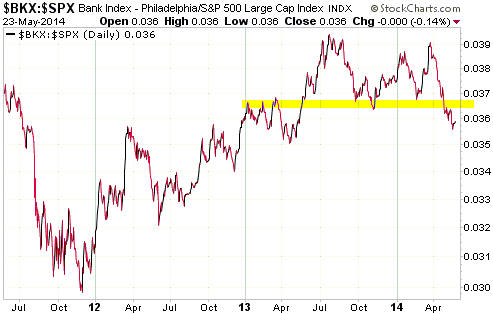
One of the most important gold-market fundamentals over the past several years
has been the profitability of and the general confidence in the US banking
industry, as indicated by the BKX/SPX ratio. A rising BKX/SPX ratio indicates
rising confidence in the major US banks, which is bearish for gold, and a
falling BKX/SPX ratio indicates falling confidence in the major US banks, which
is bullish for gold.
The BKX/SPX ratio peaked in July of last year at around the time that gold was
bottoming. It then made a slightly lower peak in March of this year before
reversing course and breaking out to the downside in April.
The performance of the BKX/SPX ratio is one reason why it is very unlikely that
gold will drop below, or even seriously challenge, its June-2013 price bottom.
Current Market Situation
The US$ gold price continues to move sideways within a very narrow range.
There's a high probability that the next $100+ move will be to the upside, but
although it's not the most likely scenario there is a realistic chance that gold
will quickly drop to the $1250s before commencing a substantial rally.
Silver
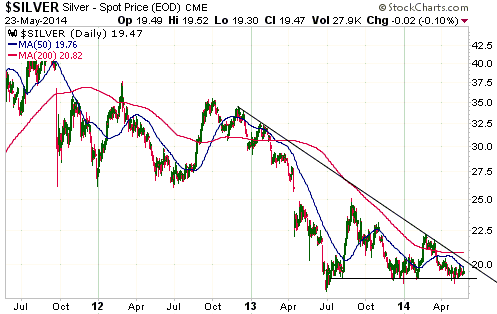
The silver market's price action has recently been almost as uneventful as that
of the gold market, the US stock market and the Dollar Index. However, it will
be difficult for the boredom to continue for more than two more weeks because
the silver price has worked its way into a corner. A breakout in one direction
or the other will have to soon occur. We are obviously anticipating a break to
the upside.
Platinum
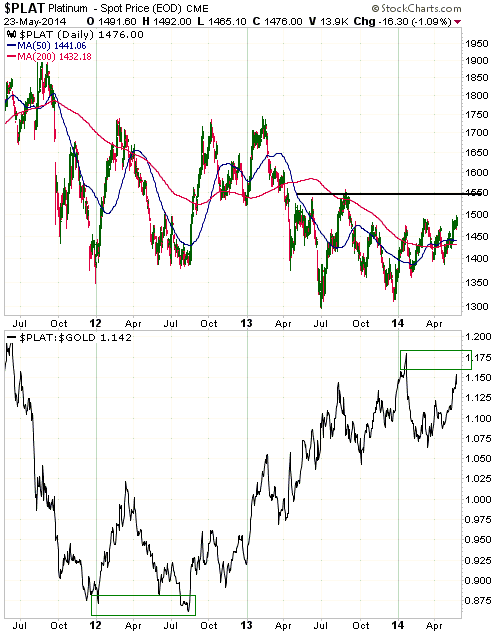
The top section of the following daily chart shows the US$ platinum price. The
price action reflected by this chart suggests to us that the platinum market has
completed its short-term correction and is on its way up to test
intermediate-term resistance at $1550. Once through $1550 the target would be
$1750.
Platinum resistance at $1550 is equivalent to gold resistance at $1425.
The bottom section of the same chart shows the platinum/gold ratio. In the 17th
February 2014 Weekly Update, we wrote:
"The platinum/gold ratio has broken out to the downside, suggesting that
platinum peaked relative to gold early this year. We won't be surprised if the
early-2014 peak in the platinum/gold ratio is tested later this year in similar
fashion to this ratio's August-2012 test of its late-2011 bottom, but our guess
at this early stage is that an important trend reversal is in the works."
The recent strength in platinum relative to gold is setting the stage for the
early-2014 peak in the ratio to be tested as part of what we think is a major
topping pattern. Since gold is more of a counter-cyclical speculation than
platinum, the most likely period for the platinum/gold ratio to test its 2014
peak is the period between now and when the S&P500 Index falls far enough to
make it clear that an intermediate-term stock-market decline is underway.
Gold Stocks
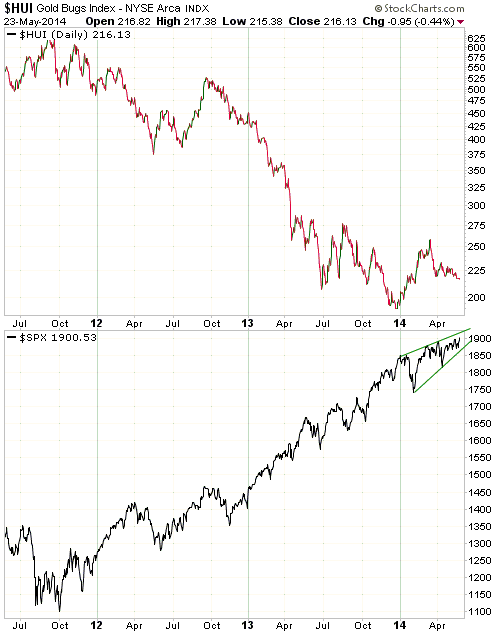
The HUI has closed at 216-217 on each of the past six trading days and at
216-222 on each of the past 13 trading days. This lack of volatility is unusual,
but is consistent with the recent lack of volatility throughout the financial
world.
The following chart illustrates the loose inverse relationship of the past few
years between the gold-mining sector (represented by the HUI) and the broad
stock market (represented by the SPX). Although the SPX has continued to trend
upward, it lost upside momentum at the end of last year. Our view is that the
end of last year was when the HUI made a major low.
Everything is taking longer than expected, but all the markets still appear to
be on the right (from our perspective) track. The right track involves a HUI
rally to around 300 within the next two months, with or without a preceding
spike down to support at 210.
The Currency Market
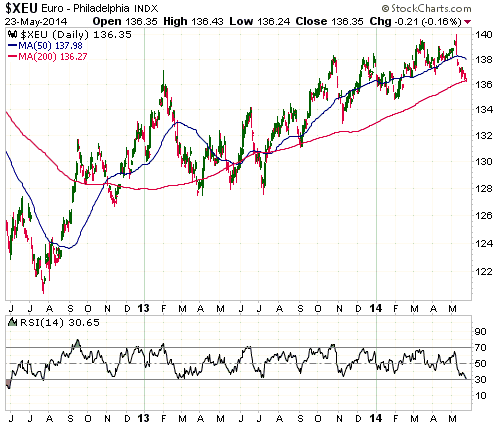
The Dollar Index has rebounded and the euro has pulled back over the past two
weeks. These moves have now gone as far as they should go IF (as we believe)
they are corrections to continuing trends (up for the euro, down for the Dollar
Index).
The following chart shows that the euro ended last week near its 200-day MA.
Furthermore, the RSI at the bottom of the chart shows that the decline of the
past two weeks has resulted in the euro becoming 'oversold' on a short-term
basis. This means that a reversal should soon happen IF the recent decline was
corrective.
Updates
on Stock Selections
Notes: 1) To review the complete list of current TSI stock selections, logon at
http://www.speculative-investor.com/new/market_logon.asp
and then click on "Stock Selections" in the menu. When at the Stock
Selections page, click on a stock's symbol to bring-up an archive of
our comments on the stock in question. 2) The Small Stock Watch List is
located at http://www.speculative-investor.com/new/smallstockwatch.html
 Company
news/developments for the week ended Friday 23rd May 2014: Company
news/developments for the week ended Friday 23rd May 2014:
[Note: AISC = All-In Sustaining Cost, FS = Feasibility Study, IRR =
Internal Rate of Return, MD&A = Management Discussion and Analysis,
M&I = Measured and Indicated, NAV = Net Asset Value, NPV(X%) = Net
Present Value using a discount rate of X%, P&P = Proven and
Probable, PEA = Preliminary Economic Assessment, PFS =
Pre-Feasibility Study]
*Endeavour Mining (EDV.TO) received 2.5M shares of Legend Gold (LGN.V)
as part payment for an early-stage non-core project in Mali. EDV now
has 7.3M LGN shares and will have almost 10M when the final payment
is made. EDV's investment in LGN is currently not financially
significant, although it could eventually be significant if LGN's
exploration is successful.
Final
thoughts (for now) on the proposed Rio Alto (RIO.TO/RIOM) - Sulliden Gold (SUE.TO)
combination
We reiterate that our concerns about the wisdom of this merger -- from the
perspective of RIO shareholders -- has almost nothing to do with the
quality/potential of the asset being acquired by RIO and everything to do with
the price being paid. Considering the way that assets are currently being priced
throughout the gold sector, SUE was an expensive stock prior to RIO's takeover
bid, whereas RIO was very under-valued. Consequently, we don't believe that this
deal would have made sense for RIO shareholders even if there were no premium
involved (RIO's offer was pitched at a 43% premium to the market).
In simple terms, RIO, a company with more than 200K-220K ounces/year of current
low-cost gold production, is trading almost half of itself for an asset that
could, if all goes well (that is, if no major obstacles are encountered) and
with the expenditure of another $150M, add 90K ounces/year of production in 2
years' time. Another way to look at the situation is that the chance (not the
guarantee) of increasing production by less than 50% is costing RIO a doubling
of its share count combined with a $150M reduction in its working capital.
Our assessment of the deal is based largely on the September-2012 FS for the
Shahuindo project. If an updated FS were to indicate a much higher rate of
production and better economics for Shahuindo, then our current assessment of
the deal is definitely too pessimistic and could be completely wrong. However,
we suspect that if it were possible to demonstrate much better economics for
Shahuindo then the promotion-savvy senior management of SUE would have already
done so.
Fortunately, the market views the deal far more favourably than we do. That's
why RIO is only down by 8% from its pre-announcement level, which is a normal
decline by the stock of the acquiring company.
As mentioned in our initial reaction to the deal in last week's Interim Update,
in our own account we are maintaining a larger-than-average position in RIO for
now. Our plan, at this stage, is that the RIO position will be exited when the
gold-mining sector next becomes extended to the upside on a short-term (1-3
month) basis.
Review
of price action for individual stocks
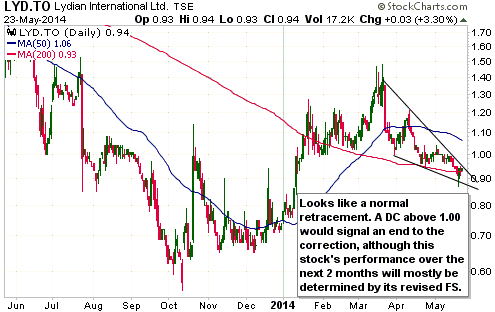
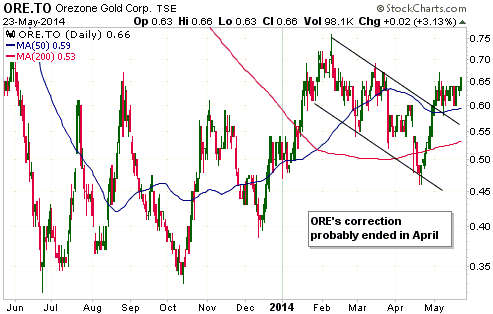
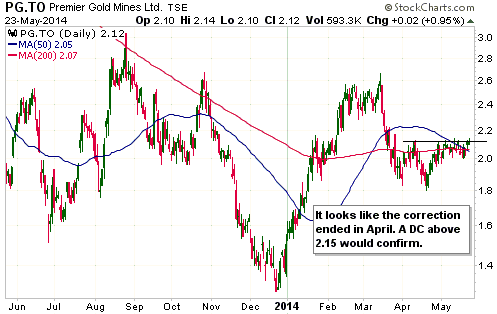
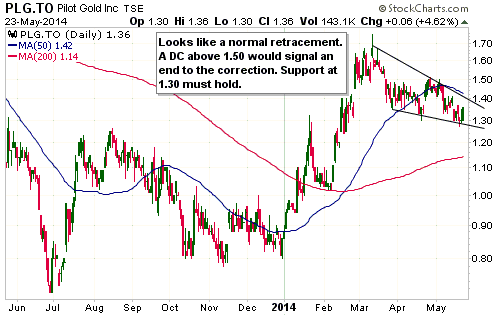
In general, the stocks of gold-mining companies that need a much higher gold
price to either be profitable (in the case of producers) or have an
economically-viable development-stage project (in the case of explorers) have
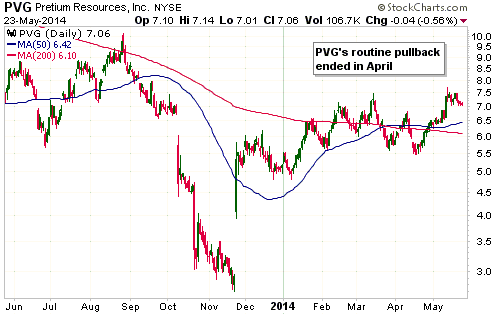
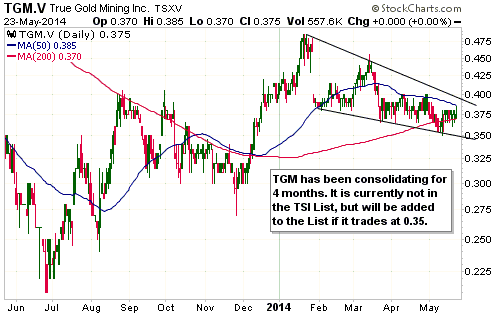
recently been very weak. GSS, CFO.V, RMS.AX and SBB.TO are examples from the TSI
List. However, the stocks of companies that have economically-viable businesses
at the current gold price have generally held up well and appear to be
completing, or in a few cases to have already completed, routine corrections.
Here are charts showing examples from the TSI Stocks List:
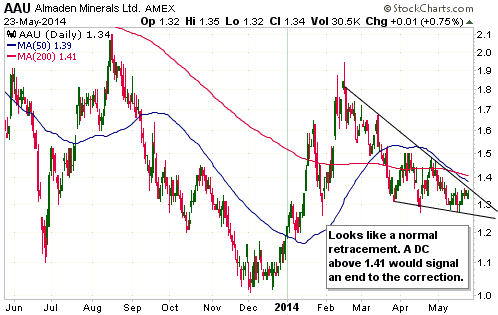
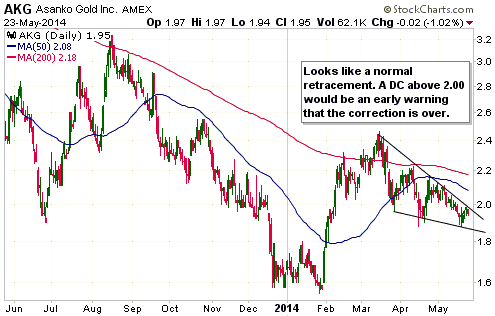
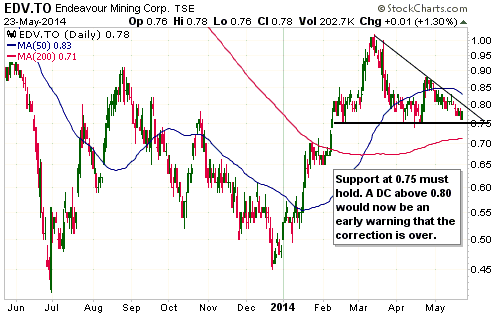
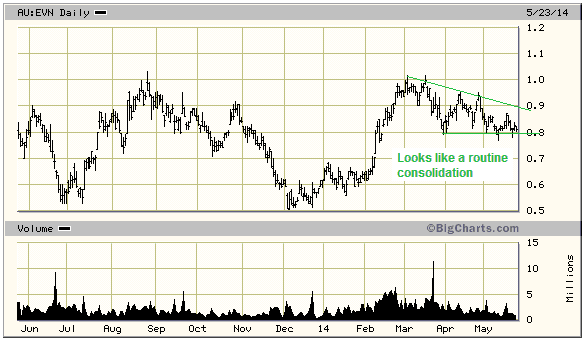
List
of candidates for new buying
From within the ranks of TSI stock selections, the best candidates for new
buying at this time are:
1) EDV.TO (last Friday's closing price: C$0.78).
2) EVN.AX (last Friday's closing price: A$0.81).
3) PLG.TO (last Friday's closing price: C$1.36).
Chart Sources
Charts appearing in today's commentary
are courtesy of:
http://stockcharts.com/index.html
http://bigcharts.marketwatch.com/

|









