|
-- Weekly Market Update for the Week Commencing 26th November 2007
Big Picture
View
Here is a summary of our big picture
view of the markets. Note that our short-term views may differ from our
big picture view.
Bonds commenced a secular BEAR market in
June of 2003. (Last
update: 22 August 2005)
The stock market, as represented by the S&P500 Index, commenced
a secular BEAR market during the first quarter of 2000, where "secular
bear market" is defined as a long-term downward trend in valuations
(P/E ratios, etc.) and gold-denominated prices. This secular trend will bottom sometime between 2014 and 2020. (Last update: 22 October 2007)
The Dollar commenced a secular BEAR market during the final quarter of 2000. The
first major downward leg in this bear market ended during the first
quarter of 2005, but a long-term bottom won't occur until 2008-2010. (Last update: 28 March 2005)
Gold commenced a
secular bull market relative to all fiat currencies, the CRB Index,
bonds and most stock market indices during 1999-2001. This secular trend will peak sometime between 2014 and 2020. (Last update: 22 October 2007)
Commodities, as
represented
by the CRB Index, commenced a secular BULL market in 2001. The first
major upward leg in this bull market ended during the second quarter of
2006, but a long-term
peak won't occur until at least 2008-2010. (Last update: 08 January 2007)
Copyright
Reminder
The commentaries that appear at TSI
may not be distributed, in full or in part, without our written permission.
In particular, please note that the posting of extracts from TSI commentaries
at other web sites or providing links to TSI commentaries at other web
sites (for example, at discussion boards) without our written permission
is prohibited.
We reserve the right to immediately
terminate the subscription of any TSI subscriber who distributes the TSI
commentaries without our written permission.
Outlook Summary
Market
|
Short-Term
(0-3 month)
|
Intermediate-Term
(3-12 month)
|
Long-Term
(1-5 Year)
|
Gold
|
Bullish
(19-Nov-07)
|
Bullish
(12-Nov-07)
|
Bullish
|
US$ (Dollar Index)
|
Bullish
(11-Jun-07)
| Bullish
(31-May-04)
|
Neutral
(19-Sep-07)
|
Bonds (US T-Bond)
|
Neutral
(20-Nov-07)
|
Neutral
(23-Jul-07)
|
Bearish
|
Stock Market (S&P500)
|
Neutral
(20-Nov-07)
|
Neutral
(26-Mar-07)
|
Bearish
|
Gold Stocks (HUI)
|
Bullish
(19-Nov-07)
|
Bullish
(12-Nov-07)
|
Bullish
|
| Oil | Bearish
(23-July-07)
| Bearish
(22-Oct-07)
| Bullish
|
Industrial Metals (GYX)
| Bearish
(11-Jun-07)
| Bearish
(09-July-07)
| Bullish
|
Notes:
1. In those cases where we have been able to identify the commentary in
which the most recent outlook change occurred we've put the date of the
commentary below the current outlook.
2. "Neutral", in the above table, means that we either don't have a
firm opinion or that we think risk and reward are roughly in balance with respect to the timeframe in question.
3. Long-term views are determined almost completely by fundamentals,
intermediate-term views by giving an approximately equal weighting to
fundmental and technical factors, and short-term views almost
completely by technicals.
Industrial Metals
In Dollar Terms
China continues to grow rapidly and consume a lot of metal in the
process, but increased Chinese demand was never likely to fully offset
the effects on metal prices of reduced Western-World demand stemming
from the downturn in the US housing market and the debt-crisis-induced
reduction in liquidity. There are three reasons for this: First,
expectations of continued strong Chinese demand were already factored
into current metal prices. Second, the severity of the downturn in the
US housing market was NOT factored into current metal prices (an
average house uses 200-300 pounds of copper and the annual rate of new
housing starts in the US gas dropped from 2.1M to 1.1M over the past 20
months). Third, it would be strange, indeed, if China's growth rate
were to accelerate at a time when its major export markets were slowing
down and its own government was taking steps to cool-off the rampant
speculation underway in the stock and property markets.
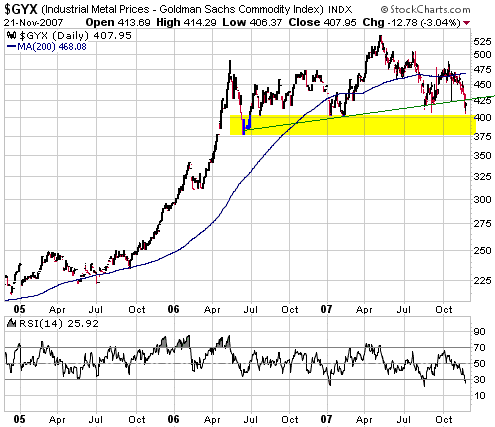
It does not surprise us, therefore, that the pattern revealed by the
following chart of the Industrial Metals Index (GYX) has the look of a
major top. The Index is very oversold on a short-term basis so lateral
support in the 375-400 range will probably hold for now. In fact, we
are expecting a counter-trend rebound -- a rebound that could
complete the "right shoulder" of the major topping pattern evident on
our chart -- to occur during the first few months of next year. But if
we make the reasonable assumption that the current trends in housing
and liquidity won't come to an end in the near future then it is also
reasonable to assume that the cyclical bear market in the industrial
metals sector has a considerable way to go.
We have been short- and intermediate-term bearish on the industrial
metals since June-July and remain so, although in all likelihood we
will soon upgrade our short-term outlook in anticipation of seasonal
strength during the first half of next year.
In Gold Terms
The yield-spread (the zero-risk long-term interest rate versus the
zero-risk short-term interest rate) can widen in response to rising
inflation expectations, but over the past ten years the lengthy periods
of widening have been primarily driven by the combination of
contracting financial-market liquidity* and increasing risk aversion.
On the other hand, lengthy periods of yield-spread narrowing, such as
the period that began during the third quarter of 2003 and ended late
last year, have been indicative of expanding liquidity as speculators
became increasingly eager to "borrow short" in order to purchase
relatively high-risk assets and debt.
Given what we know about gold's historical role as money and the fact
that the amount of gold held for monetary/investment purposes dwarfs
the amount of gold consumed each year in commercial/industrial
applications, the above brief description of what drives
intermediate-term trends in the yield-spread suggests that gold should
fare well relative to the industrial metals when the yield-spread is in
a widening trend and poorly relative to the industrial metals when the
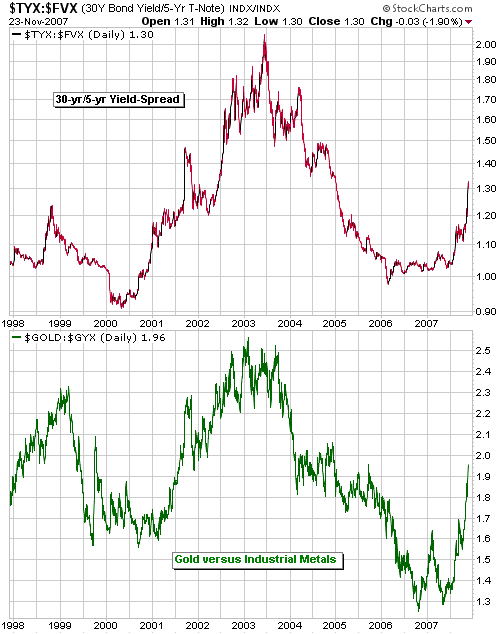
yield-spread is narrowing. The following chart comparison of the
gold/GYX ratio and the US yield-spread (in this case, the 30-year yield
divided by the 5-year yield) shows that what should have happened has,
indeed, happened.
The trend towards a wider yield-spread will naturally be interrupted by
occasional corrections, but the problems in the credit markets and the
associated contraction in liquidity aren't likely to end anytime soon.
We therefore think that the yield-spread is presently about 1 year into
a 2-4 year period of widening, which, if so, implies that the upward
trend in gold relative to the industrial metals will continue for
another 1-3 years.
*Note
that a contraction in liquidity is not the same as a contraction in the
money supply or a fall in the rate of money-supply growth. "Liquidity"
relates to the ease with which investments can be traded in size, with
a highly liquid financial environment being characterised by the
ability to buy and sell large quantities of relatively high-risk
investments without disrupting the market.
Bonds
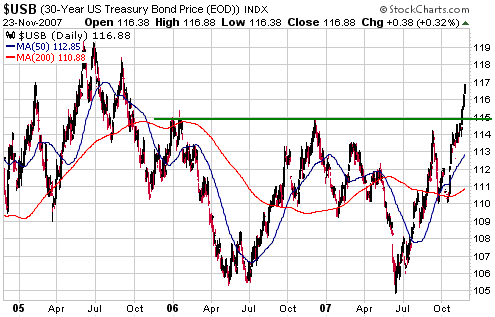
The
price action in the bond market remains bullish, as evidenced by the
break above resistance shown on the following daily chart of the T-Bond
price. However, we downgraded our short-term bond market outlook from
"bullish" to "neutral" last Tuesday because we don't think the upside
potential from here is materially greater than the downside risk.
Treasury Bonds have caught a flight-to-safety bid in response to the
problems with lower quality debt and the downturn in the stock market,
but with the stock market probably not far from a short-term bottom we
suspect that the bond market is within three weeks of a short-term
peak.
The Stock
Market
Current US Market Situation
Most of the sentiment indicators we follow are back to the pessimistic
extremes reached in mid August, which also means that market sentiment
is now as pessimistic as it has been at any time since April of 2003.
This is quite remarkable given that the S&P500 Index hit an
all-time high early last month and is still within 8% of its high.
The sentiment backdrop is therefore consistent with the idea that a
short-term bottom is either already in place or will be put in place
within the next few weeks.
Our guess is that the market will drop to lower levels before a
sustained advance gets underway, mainly because there was a significant
widening of credit spreads over the past week. We doubt that a rally
worth trading will get underway in the stock market until after some
semblance of stability returns to the credit markets, although the
bottom of the current decline is unlikely to be far below last week's
low.
The current price weakness and depressed sentiment is setting the stage
for a strong stock market during the first few months of next year, but
the jury is still out as to whether the next rally will be another
upward leg in a continuing cyclical bull market or a counter-trend
rebound within a new cyclical bear market. We are presently leaning
towards the latter.
Hong Kong
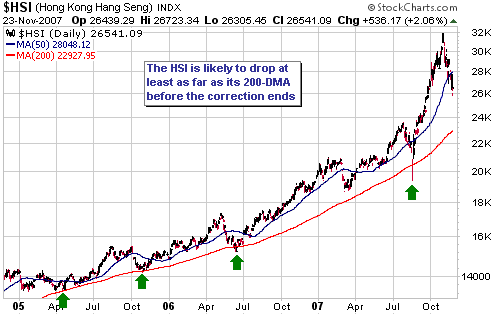
Hong Kong's Hang Seng Index (HSI) has pulled back sharply over the past
few weeks, but a correction low is probably not yet in place. As
evidenced by the following chart, at last week's low the HSI was still
about 13% above its 200-day moving average and none of the previous
corrections over the past three years ended until after this moving
average was reached.
Putting it another way: despite its recent sharp decline the HSI is still too high for this to be a low-risk buying point.
Longer-Term Outlook
A lot of investors, even experienced ones, believe that broad exposure
to the stock market will always yield good returns in the long run
regardless of when the exposure is purchased. It is strange that this
belief is so widespread considering that even a cursory examination of
the stock market's long-term performance will reveal it to be
completely wrongheaded.
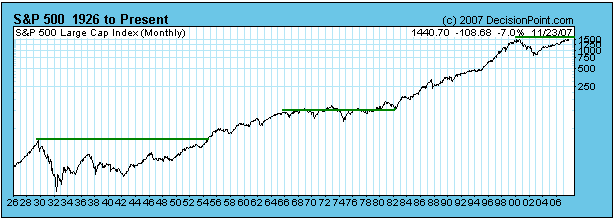
The reality is that if you make a long-term commitment to the
S&P500 Index during those periods when valuations are extremely
high then you are guaranteeing yourself poor returns over the ensuing
10-20 years. That this is so can be quickly explained with the aid of
the following chart. The salient points are:
a) Someone who bought the S&P500 near its 1929 peak was not back to 'break-even' until 1955 (26 years later).
b) Between 1966 and 1982 the S&P500 achieved a nominal gain of
approximately ZERO. Moreover, this was a period of high inflation and,
as a result, the S&P500's REAL return over this 16-year period was
a LOSS of more than 70%.
c) Over the most recent 10-year period the total return on the
S&P500 Index has been less than the total return on 3-month
T-Bills, but, again, this has been a high inflation period so the
lousiness of the performance in nominal terms pales in comparison to
the lousiness of the REAL performance.
Valuations are
currently a lot more attractive than they were at the 2000 peak, but
not much better than they were at the 1966 and 1929 peaks. In fact,
valuations are still high enough to guarantee that someone who buys the
S&P500 now will achieve lousy real returns over the coming decade.
Still, just because poor real returns are all but set in stone as far
as the next 10 years are concerned doesn't mean that the market's
performance over the next 1-2 years will be sub-par. Valuations are
unattractive on a market-wide basis, but if the general willingness of
market participants to take-on risk begins to increase -- as occurred
during 2003-2006 and for about 18 months following the 1998 financial
crisis -- then the S&P500 could achieve good returns over the
intermediate term.
We are open to the possibility that 'investors' will put the
mortgage-related turmoil of 2007 behind them, thus allowing 2008 and
perhaps even 2009 to be good years for the broad stock market. However,
this is not the most likely outcome. As noted in the "Industrial
Metals" section of today's report, "the problems in the credit markets and the associated contraction in liquidity aren't likely to end anytime soon".
We are therefore looking forward to a reasonably strong stock market
during the first quarter of next year, but at this stage we would not
bank on the rally continuing much beyond that.
This week's
important US economic events
| Date |
Description |
Monday Nov 26
| No important events scheduled
|
Tuesday Nov 27
| Consumer Confidence
| | Wednesday Nov 28
| Existing Home Sales
Durable Goods Orders
Fed's Beige Book
| | Thursday Nov 29
| Q3 GDP (revised)
New Home Sales
| | Friday Nov 30
| Personal Income and Expenditure
Chicago PMI
Construction Spending
|
Gold and
the Dollar
Gold
Below is a daily chart of the December gold futures contract. Gold
gained enough ground last Friday to suggest that a short-term bottom
was put in place in the low-770s at the beginning of the week, but the
odds favour a test of last week's low before the correction comes to an
end.
A near-term bullish scenario would entail the gold price pulling back
to successfully test last week's low while the gold-stock indices made
higher lows.
Gold Stocks
With the exception of gold's poor performance relative to oil -- an
exception that we expect will be eliminated over the next few months --
the financial backdrop is currently very supportive for the shares of
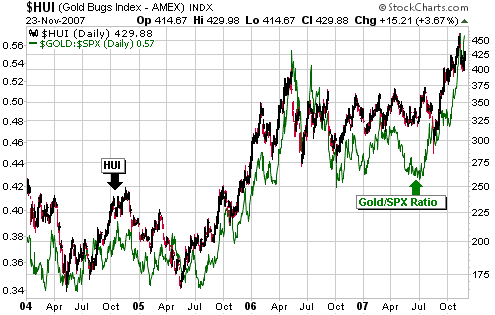
gold-mining companies. For example, the following chart shows that the
HUI (AMEX Gold BUGS Index) tends to move with the gold/SPX ratio (the
gold price divided by the S&P500) and suggests that if gold builds
on its recent upside breakout relative to the S&P500 Index then the
HUI should remain in an intermediate-term upward trend.
Our main concern
continues to revolve around what will happen to gold and gold stocks
during the first few months of a US$ rally. The US dollar's exchange
value does not play a dominant part in our intermediate- and long-term
analyses of the gold market, but a lot of speculators own gold-related
investments (gold futures, physical bullion, gold ETFs and gold-mining
shares) primarily because they expect the US$ to continue its decline
against the euro. This leaves the gold market acutely vulnerable to a
reversal of fortune in the currency market.
We suspect that a reversal of fortune in the currency market would
create only a 2-3 month problem for gold-related investments as long as
most other factors remained 'gold bullish', but investors in gold, and
especially investors in gold stocks, could experience considerable pain
during this 2-3 month period. For example, during June-July of 2002 the
financial backdrop was just as 'gold bullish' as it is today and yet
the HUI suffered a peak-to-trough decline of around 40%.
Here are some of the other nagging concerns we have, expressed in the form of questions that need answers:
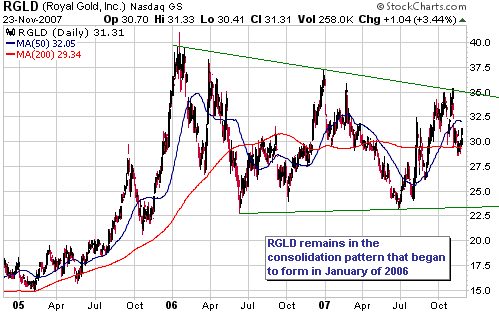
1. Royal Gold (RGLD) is the purest play on gold amongst the large and
mid-size gold stocks, so why has it not only failed to make a new high
but also failed to break a sequence of declining tops dating back to
January of 2006?
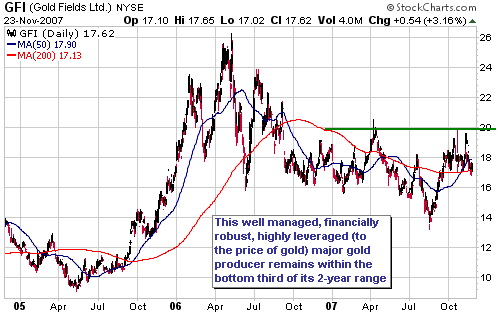
2. Why did the stocks
that offer the most leverage to gold generally performed relatively
poorly during the August-November rally? Note that we are not just
referring to the lacklustre performances of many exploration-stage gold
stocks, but also to the fact that Gold Fields Ltd (GFI) has done
surprisingly little over the past few months. Within the group of large
gold producers that are not being weighed down by company-specific
problems, GFI offers the most leverage to gold; and yet, the following
chart shows that it is languishing in the bottom third of its 2-year
price range.
3. With zinc clearly
mired in a cyclical bear market why was Agnico Eagle (AEM), a primary
ZINC producer with a gold byproduct, one of the leaders to the upside
during the August-November GOLD rally?
4. Why did the HUI close below the peak of its preceding upward leg
(its May-2006 peak) last Monday -- something it has never done during
any of the other major upward legs in its long-term bull market?
The above questions could quickly be made irrelevant by price action.
For example, questions 1 and 3 would no longer apply if RGLD and GFI
were to break above resistance at $35 and $20, respectively, and
question 4 would be meaningless if the HUI were to re-confirm its
upward trend by closing above 463 (this month's intra-day peak). As
things currently stand, though, the questions are relevant.
We continue to emphasise the risks and our concerns because we get the
impression that many of the people who are heavily exposed to gold are
operating on the belief that this market is presently a one-way bet.
It's not.
Our expectation is that the upward trends in gold and gold stocks will
resume following the completion of a fairly normal correction, but at
the same time we are constantly on the lookout for developments that
could turn a normal correction into a large one. Unfortunately, prices
tend to move so quickly in the markets these days that selling after
evidence emerges that things have changed for the worse will often
result in selling near a short-term bottom. This means that
precautionary steps need to be taken when prices are relatively high.
The current situation provides a good opportunity for investors to take
some precautionary steps because the HUI has rebounded to within 4% of
its all-time closing high (448) and to within 8% of its all-time
intra-day high (463). These steps could include: a) doing some selling
near current levels with the aim of buying back if the HUI subsequently
re-confirms its upward trend by closing above 463, and/or b) buying
some March-2008 GDX put options with the plan to immediately sell them
if the HUI closes above 463.
Moving from short-term risks and concerns to something more positive,
there were three significant bullish developments last week. First was
the fact that although the HUI closed slightly below support defined by
its May-2006 peak on Monday there was absolutely no follow-through to
the downside. As things currently stand, therefore, it can be said that
a successful test of intermediate-term support has occurred. Second was
the strength in gold equities relative to Asian equities. For example,
the HUI ended the week with a gain of 4% while the Hong Kong stock
market lost 4% over the course of the week. This was potentially
significant because the short-term downward trends in the Asian stock
markets are probably not over. And third was Friday's move by gold
bullion above its May-2006 highs in C$ and A$ terms. This third bullish
development is probably the most significant and could be why many of
the exploration-stage gold stocks finally caught bids on Friday.
The bottom line is that the short-term outlook remains bullish, but
this is a reasonable time to obtain some insurance 'just in case'. As
stated above, the insurance could be eliminated as soon as the HUI
re-confirmed its upward trend by closing above 463.
As noted in an
earlier commentary, if a major upward leg is underway then it should
result in the HUI moving up to at least the low-600s, meaning that a
lot of profit potential will remain following re-confirmation of the
upward trend.
Currency Market Update
Current Market Situation
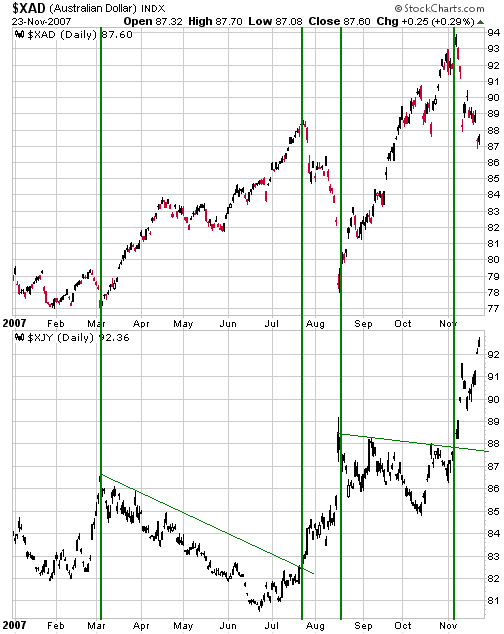
The following chart comparison of the Australian Dollar and the Yen shows that:
a) The A$ rallied from March through to July while the Yen trended
lower, but when the Yen broke its downward trend during the third week
of July the A$ plunged
b) Between the third week of August and the first week of November the A$ trended relentlessly upward while the Yen consolidated
c) When the Yen's consolidation ended via an upside breakout in early November, the A$ plunged
As explained in previous commentaries, the inverse correlation between
the A$ and the Yen comes about because A$-denominated investments have
been major beneficiaries of the Yen carry trade. To be more specific, a
very popular trade has been to borrow Yen (sell Yen short, in effect)
in order to fund the purchases of investments priced in Australian
dollars. Due to interest rate differentials this trade makes sense as
long as the Yen is trending downward or is moving sideways, but losses
are incurred whenever the Yen rallies and these losses cause
carry-traders to close-out their positions.
Our view is that the Yen is on its way to the high 90s. If this view is
accurate then significant additional short-term weakness lies in store
for the A$.
We continue to
anticipate a strong rebound in the US$ against the euro. The euro is
becoming increasingly over-valued relative to the US$ on a purchasing
power basis and optimism about the European currency remains near an
extreme. However, the main catalyst for a substantial rally in USD/EUR
may be the realisation that the debt crisis' effects on European
economic growth, banks and monetary policy will be similar to its
effects in the US. In particular, the markets seem to believe that the
ECB will leave its targeted interest rate unchanged over the next
several months, but we think this is very unlikely. In our opinion the
ECB will soon commence a rate-cutting campaign, prompting a loud
collective "oops!" from the speculators that have built up huge long
positions in the euro.
An interesting way to hedge against a strong US$ rebound
As discussed in last week's Interim Update and a number of earlier
commentaries, there has been a strong inverse correlation this year
between the oil price and the Dollar Index. This means that the next
rally in the US$ should be accompanied by a downward trend in the oil
price. Given that there is almost always a strong inverse correlation
between the airline sector of the stock market and the oil price, this
also means that when the US$ eventually rallies the airline stocks
should also rally. Therefore, those who have substantial exposure to
stocks that are being driven upward in the short-term in response to
weakness in the US$ -- gold stocks, for instance -- could purchase
airline stocks or call options* on airline stocks as hedges against the
likely adverse effects on their portfolios of a US$ rally.
We are bullish on the airline sector because we think the oil market is
close to an intermediate-term peak. Oil is currently priced at a very
high level relative to almost everything, including gold, but the debt
crisis and associated liquidity contraction should eventually take its
toll on oil in the way that it is already taking its toll on the
industrial metals. This could occur with or without a US$ rally; it's
just that the way the markets have been trading over the past several
months the initial phase of the next significant downturn in the oil
market is likely to coincide with a US$ rebound.
Many airline stocks traded at new lows for the month early last week,
which might have resulted in traders being stopped out of their
positions (it would depend on how closely the stops were placed to the
early-November lows). If you were stopped out then you could consider
re-establishing long positions, either immediately or following a sign
of strength such as a daily close above 42 by the AMEX Airline Index
(XAL).
*Note: we wouldn't buy call options that expired before March of 2008.
Update
on Stock Selections
(Note: To review the complete list of current TSI stock selections, logon at http://www.speculative-investor.com/new/market_logon.asp
and then click on "Stock Selections" in the menu. When at the Stock
Selections page, click on a stock's symbol to bring-up an archive of our comments on the stock in question)
Chart Sources
Charts appearing in today's commentary
are courtesy of:
http://stockcharts.com/index.html
http://www.futuresource.com/
http://www.decisionpoint.com/

|