|
-- Weekly Market Update for the Week Commencing 27th May 2013
Big Picture
View
Here is a summary of our big picture
view of the markets. Note that our short-term views may differ from our
big picture view.
In nominal dollar terms, the BULL market in US Treasury Bonds
that began in the early 1980s will end by 2013. In real (gold)
terms, bonds commenced a secular BEAR market in 2001 that will continue
until 2014-2020. (Last
update: 23 January 2012)
The stock market, as represented by the S&P500 Index,
commenced
a secular BEAR market during the first quarter of 2000, where "secular
bear market" is defined as a long-term downward trend in valuations
(P/E ratios, etc.) and gold-denominated prices. This secular trend will bottom sometime between 2014 and 2020.
(Last update: 22 October 2007)
A secular BEAR market in the Dollar
began during the final quarter of 2000 and ended in July of 2008. This
secular bear market will be followed by a multi-year period of range
trading.
(Last
update: 09 February 2009)
Gold commenced a
secular bull market relative to all fiat currencies, the CRB Index,
bonds and most stock market indices during 1999-2001.
This secular trend will peak sometime between 2014 and 2020.
(Last update: 22 October 2007)
Commodities,
as represented by the Continuous Commodity Index (CCI), commenced a
secular BULL market in 2001 in nominal dollar terms. The first major
upward leg in this bull market ended during the first half of 2008, but
a long-term peak won't occur until 2014-2020. In real (gold) terms,
commodities commenced a secular BEAR market in 2001 that will continue
until 2014-2020.
(Last
update: 09 February 2009)
Copyright
Reminder
The commentaries that appear at TSI
may not be distributed, in full or in part, without our written permission.
In particular, please note that the posting of extracts from TSI commentaries
at other web sites or providing links to TSI commentaries at other web
sites (for example, at discussion boards) without our written permission
is prohibited.
We reserve the right to immediately
terminate the subscription of any TSI subscriber who distributes the TSI
commentaries without our written permission.
Outlook Summary
Market
|
Short-Term
(1-3 month)
|
Intermediate-Term
(6-12 month)
|
Long-Term
(2-5 Year)
|
|
Gold
|
Bullish
(17-Oct-12)
|
Bullish
(26-Mar-12)
|
Bullish
|
|
US$ (Dollar Index)
|
Neutral
(24-Dec-12)
|
Bullish
(01-May-13)
|
Neutral
(19-Sep-07)
|
|
Bonds (US T-Bond)
|
Neutral
(12-Nov-12)
|
Neutral
(18-Jan-12)
|
Bearish |
|
Stock Market
(DJW)
|
Neutral
(06-May-13)
|
Bearish
(28-Nov-11)
|
Bearish
|
|
Gold Stocks
(HUI)
|
Bullish
(24-Dec-12)
|
Bullish
(23-Jun-10)
|
Bullish
|
|
Oil |
Neutral
(30-Jul-12)
|
Neutral
(31-Jan-11)
|
Bullish
|
|
Industrial Metals
(GYX)
|
Neutral
(30-Jul-12)
|
Neutral
(29-Aug-11)
|
Neutral
(11-Jan-10)
|
Notes:
1. In those cases where we have been able to identify the commentary in
which the most recent outlook change occurred we've put the date of the
commentary below the current outlook.
2. "Neutral", in the above table, means that we either don't have a
firm opinion or that we think risk and reward are roughly in balance with respect to the timeframe in question.
3. Long-term views are determined almost completely by fundamentals,
intermediate-term views by
fundamentals, sentiment and technicals, and short-term views by sentiment and
technicals.
Why trade deficits are
irrelevant
Like most of the government statistics that
treat economies containing millions of individuals as if they were amorphous
masses, international trade balances are not meaningful. In particular, it is
neither good nor bad for a country to have a trade deficit; it simply doesn't
matter either way.
To understand why, it must first be understood that countries don't trade with
each other. Individuals trade with each other. As is the case with almost all
economic issues, it is therefore of vital importance to reduce the trade
deficit/surplus issue to the individual level.
If you live in the Western world you probably run a trade deficit with Wal-Mart
or some other large supermarket chain. Is this a problem for you? Obviously not,
otherwise you wouldn't do it. Is it anyone's business except your own? Clearly,
the answer is no. But what if the most convenient branch of your favourite
supermarket were located on the other side of a political border? Would the
trade between you and the supermarket then become an economic problem or someone
else's business? Clearly, the answer again is no.
If you live in the Western world you probably also run a trade deficit with
individuals and companies located in China. Is this a problem for you? Obviously
not, otherwise you wouldn't do it. Should your government do something to make
it less economically viable for you to trade with people in China?
Now consider the hypothetical example of two traders (a buyer and a seller) of
widgets operating slightly to the US side of the US-Canada border. The seller
takes a couple of steps to the left and is now operating in Canada. The trading
continues exactly as before, but now, according to government statistics, the
trading contributes to the US trade deficit and is therefore deemed to be
problematic.
Our hypothetical example of the two widget traders helps make the general point
that political borders are not natural economic barriers.
To help make the same point, assume that a line is drawn on a map around one
area (Area A) and that a second line is drawn on the same map around a separate
area (Area B). Then assume that due to the voluntary transactions between the
people living in these two areas, Area A ends up with a trade deficit. What
would this fact tell us about the economic merits of the trade between the two
areas? The answer is: nothing. If a trade is entered into voluntarily then both
parties to the trade believe that they end up better-off as a result. One party
to any trade sees more value in the goods exchanged than in the money exchanged,
and the other party sees more value in the money exchanged than in the goods
exchanged. If not, the trade wouldn't happen.
To drive home the point, now assume that the above-mentioned lines on the map
are re-positioned such that the same total area is covered, but part of what was
originally in Area A is now in Area B and part of what was originally in Area B
is now in Area A. Nothing has changed with regard to the trading being done by
people throughout the combination of the two areas, but due to the
re-positioning of the lines the trade between Area A and Area B is now perfectly
in balance. The re-positioning of the arbitrary lines on our map did not result
in a change to the wealth or living standard of a single person, but
policy-makers are now content because there is no longer a "trade imbalance" to
worry about.
This brings us to the real problem with economic statistics such as the
international trade balance. The real problem isn't that these statistics
provide no useful information, it's that governments and central banks implement
policies in an effort to 'manage' them. The calculation of an international
trade deficit/surplus therefore turns out to be more than just a harmless prank,
because whenever a government agency interferes with the voluntary trading of
individuals it impedes economic progress.
The Stock
Market
Japan
After a market has been moving steadily and relentlessly higher for many months,
an increase in volatility can be a sign that the market is nearing an important
top. We got that sign in spades in the Japanese stock market last week. As
illustrated by the following daily chart, Japan's Nikkei225 Index traded through
a 2000-point (13%) range over the final two days of last week.
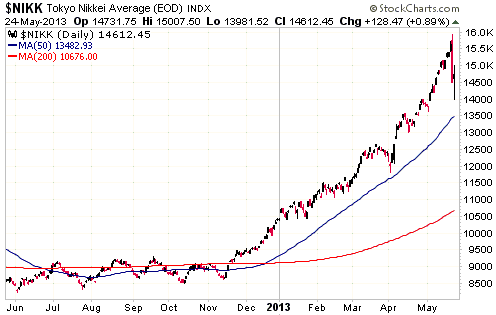
The Nikkei's price action over the past few months creates the potential for a
crash, but as per the "crash pattern" discussion from last week's Interim Update
there is very little chance of a crash occurring immediately even if it is
destined to occur eventually. If the Nikkei is setting up for a genuine crash,
then what we are now seeing is the initial decline from the peak. In this case
it's probable that the initial decline either bottomed at 14000 last Friday or
will bottom this week in the 13000-14000 range, after which there should be a
multi-week rebound that retraces at least half of the initial decline. A
secondary decline that takes out the low of the initial decline could then lead
to a panicked liquidation (a price crash).
For your information, we own DXJ (Wisdom Tree Japan Fund) put options expiring
in August. Our plan is that if the Nikkei plunges to around 13000 this week then
we will exit at least half of this put-option position with the aim of
re-purchasing following a multi-week rebound. If there isn't significant
additional weakness in the Nikkei over the days immediately ahead then we will
retain our existing put options and probably add to the position following a
multi-week rebound.
The US
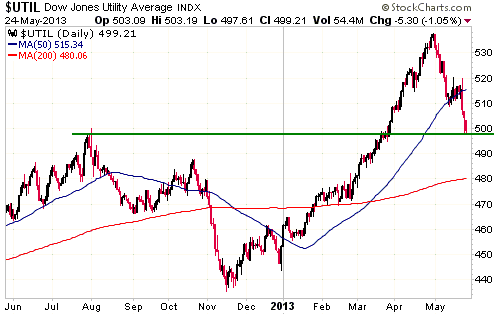
A daily chart of the Dow Jones Utility Index (UTIL) is displayed below.
People who bought a basket of Utility stocks late last month with the aim of
locking in a 4%/year dividend yield find themselves down by 6% in just 4 weeks.
They have discovered that a moderate dividend yield for an equity index doesn't
provide much in the way of safety after the price has 'gone parabolic',
especially when the components of the index have an average price/earnings ratio
of around 25. As a general rule, a stock with a price/earnings ratio of more
than 20 should never be viewed as safe or defensive, regardless of what the
underlying business happens to be.
UTIL ended last week at an obvious support level and is probably close to a
short-term bottom. We won't be surprised if it makes a marginal new high during
the second half of this year (as per the 2007 topping pattern), but we suspect
that the April-2013 top will turn out to be close to the ultimate top.
This week's
important US economic events
| Date |
Description |
| Monday May 27 |
US markets closed for Memorial Day | | Tuesday
May 28 |
Case-Shiller Home Price Index
Consumer Confidence
Richmond Fed Mfg Index
Dallas Fed Mfg Survey | | Wednesday
May 29 |
No important events scheduled | | Thursday
May 30 |
Q1 GDP (revised)
Pending Homes Sales Index
|
| Friday May 31 |
Personal Income and Spending
Chicago PMI
Consumer Sentiment |
Gold and
the Dollar
Gold and Silver
It currently looks like gold and silver successfully tested their April lows on
Monday 20th May, with gold making a slightly higher low and silver spiking below
its April low before reversing course. Gold needs to close above $1400/oz in the
near future to confirm that a successful test of the April low has, indeed,
taken place.
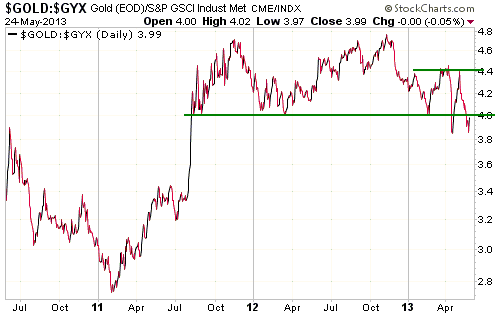
In addition to testing its April low in US$ terms last week, the following chart
shows that gold also tested its April low in GYX (Industrial Metals Index)
terms.
The gold/GYX ratio is an indicator of economic confidence. It trends downward
when economic confidence is on the rise and trends upward when economic
confidence is waning. Note, though, that the general perception of the US
economy's prospects will not necessarily be the primary driver of this economic
indicator. For example, gold/GYX rose sharply during 2011 and also trended
higher during March-August of 2012 in response to escalating worries about the
euro-zone's economic prospects.
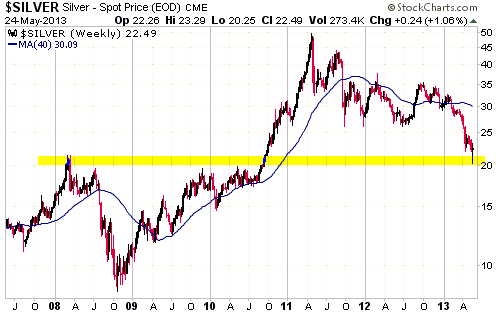
The following weekly chart shows that last week's downward spike in the silver
price not only tested the April-2013 low, but also tested major lateral support
dating back to 2008.
During April-August of 2011 a few TSI readers cancelled their subscriptions
because we were too bearish on silver. During the April-2011 moon-shot in the
silver price we warned that a spectacular price decline was coming, and then,
after a top had been signaled, we warned that the overall corrective process was
likely to last at least 18 months due to the rare sentiment extreme that had
been achieved in April-2011. However, it turned out that we were actually too
bullish! We weren't surprised that silver's correction from its 2011 peak lasted
two years, but although we warned that it could happen we certainly didn't
anticipate the break below $26 and the subsequent plunge to $20.
Sentiment in the silver market is now 180 degrees from where it was in April of
2011, so we are now warning that a large price advance is coming. That being
said, silver's initial rise from the bottom won't be anywhere near as fast as
its initial decline from the peak. Major advances in both gold and silver tend
to gradually build momentum over time.
Lastly, everyone involved in the gold and silver markets should be cognisant of
the possibility that the overall bottoming process in the precious metals will
extend into the final quarter of this year. In fact, a rounded bottom in the
precious metals that takes at least 6 months to unfold would be consistent with
what we consider to be the most likely stock market scenario.
Gold Stocks
Current Market Situation
The gold-mining sector began last week on a positive note in response to what
appeared -- and still appears -- to be a successful test of the April low in the
gold and silver markets, but there was no follow-through to the upside over the
remainder of the week. As a result, we lack evidence that a multi-month low is
in place for gold-stock indices such as the HUI (see chart below).
This is the month when important turning points often happen in the gold-mining
sector, but this month continues for one more week. We could therefore get a
spike to a new low for the year this week and still get a traditional May
extreme (in this case, an extreme low).
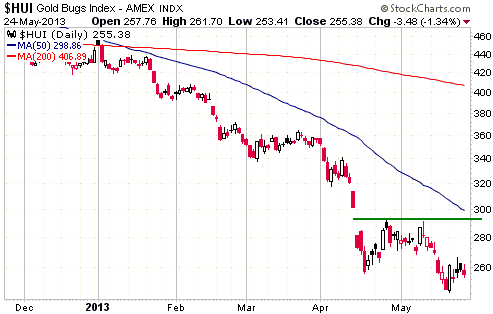
As things currently stand, the two most likely times for a major bottom in the
gold-mining sector are May of 2013 (that is, now) and October-November of 2013.
If the latter, there will most likely be a 1-3 month rebound and then a decline
to the ultimate low.
Be aware that once a major bottom is in place in the gold-mining sector, the
initial multi-month advance is likely to be fast (the equities are different to
the metals). For example, the only two lows of the past 13 years that are
comparable to the low that will be put in place in 2013 are those of
October-2008 and November-2000. The HUI doubled within three months following
the 2008 low and 6 months following the 2000 low. So, don't be thinking that
it's going to take forever to make up the lost ground.
Gold stocks that made higher lows
The gold-stock indices and ETFs briefly traded below their April lows during
May, but some individual gold stocks made higher lows in May. Almost all gold
stocks have very low valuations right now, but the ones that held above their
April lows during the May sell-off are exhibiting relative strength. These
stocks have a decent chance of out-performing once a meaningful sector-wide
rally gets underway.
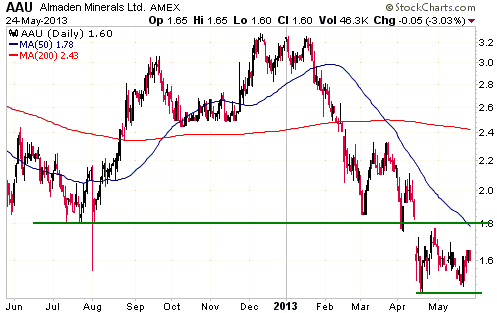
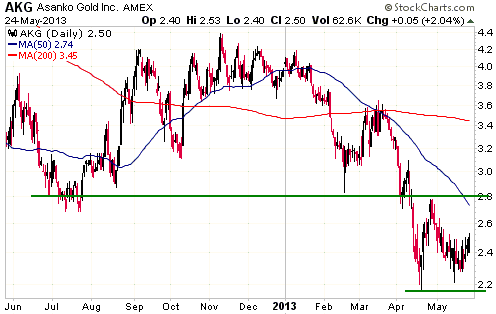
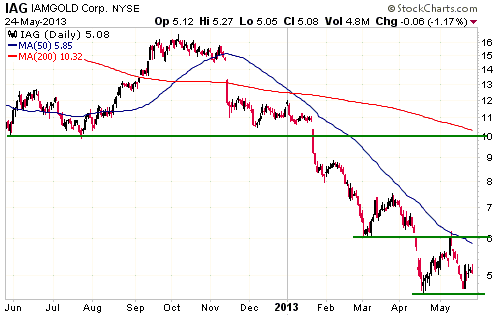
Here are charts of some of the gold stocks that made higher lows in May:
a) Almaden Minerals (AAU). A low for this stock would be confirmed by a decisive
move above US$1.80.
b) Asanko Gold (AKG). A low for this stock would be confirmed by a decisive move
above US$2.80.
c) IAMGOLD (IAG). A break above resistance at US$6.00 would suggest short-term
upside potential to US$7.50-$9.00.
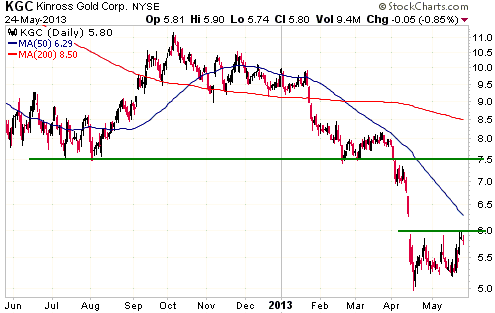
d) Kinross Gold (KGC). A break above resistance at US$6.00 would suggest
short-term upside potential to US$7.50.
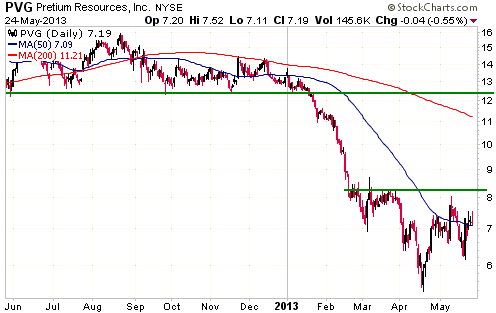
e) Pretium Resource (PVG). For this stock, the May low was well above the April
low and the pattern of the past three months now looks like a base capable of
supporting a rally to US$11-$12. Short-term resistance lies at US$8.00.
Why gold mining companies shouldn't hoard their gold production
There's a line of thought that instead of converting all of their production
into money (US dollars, etc.), gold producers should keep a significant portion
of their cash in gold. This could be achieved by simply holding onto some of the
gold they extract from the ground. The thinking is that gold is a safer store of
purchasing power than any fiat currency, so why not use it for working capital
rather than relying on the paper spewed forth by central banks?
Although we have some sympathy with this line of thinking, our view is that it
generally doesn't make sense for gold producers to hold gold bullion on their
balance sheets in lieu of money. The main reason is that while gold is the
liquid asset with the best long-term record as a store of purchasing power, its
purchasing power often undergoes large swings over short periods. For example,
gold's purchasing power has fallen by more than 30% since August of 2011. Over
the next 12 months it could easily gain 30% or more, but it could also suffer
another significant decline.
A gold miner that denominated a large part of its cash reserve in gold bullion
could therefore end up doing very well or very poorly during any given year. In
effect, the miner would be using its cash reserve to speculate on short-term
changes in the real price of gold, which is not a sensible way to use cash
reserves.
In our opinion, if a gold producer
has cash that it will likely need within the next two years to cover its
expenses, then most of this cash should be denominated in the currency in which
most of its expenses are denominated, with no concern for yield. Excess cash
that a gold producer is unlikely to need within the next two years should be
returned to shareholders, who could then, if they so desired, use the cash to
buy gold.
The secondary reason that it generally doesn't make sense for gold producers to
hoard gold bullion is that the senior managers of gold-mining companies are
notoriously poor market timers. For example, they were big-league hedgers of
their production when gold was bottoming during 1999-2001 and had sworn-off
hedging by the time that gold was making a multi-year peak in 2011. For another
example, they tend to be aggressive acquirers of assets (projects and companies)
when valuations are high and to have no interest in buying when valuations are
low. Consequently, it's reasonable to expect that their eagerness to hoard gold
would rise and fall with the gold price, resulting in most of the hoarding being
done at the least opportune times.
Currency Market Update
Even if the US$ is destined to move much higher over the coming year, the
Commitments of Traders (COT) data and other sentiment indicators are saying that
a multi-month US$ correction/consolidation could soon begin. Of particular note,
there are now large speculative net-short positions in euro futures, Yen
futures, A$ futures, C$ futures and British Pound futures. To put it another
way, speculators are now betting heavily that the US$ will rise against all
other major currencies over the next few months. Such unanimity of opinion
within the speculating community paves the way for something different to
happen.
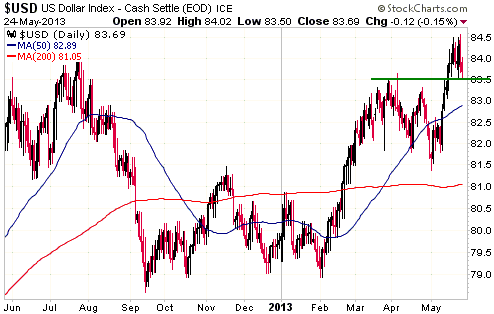
The lopsided sentiment creates the potential for significant counter-trend moves
in the major currencies (down for the US$, up for the others), but it doesn't
mean that short-term extremes are already in place. There is a realistic
possibility, for example, that the Dollar Index will surge to 85-86 before a
multi-month correction gets underway.
Update
on Stock Selections
Notes: 1) To review the complete list of current TSI stock selections, logon at
http://www.speculative-investor.com/new/market_logon.asp
and then click on "Stock Selections" in the menu. When at the Stock
Selections page, click on a stock's symbol to bring-up an archive of
our comments on the stock in question. 2) The Small Stock Watch List is
located at http://www.speculative-investor.com/new/smallstockwatch.html
 Company
news/developments for the week ended Friday 24th May 2013: Company
news/developments for the week ended Friday 24th May 2013:
[Note: FS = Feasibility Study, IRR = Internal Rate of Return, MD&A =
Management Discussion and Analysis, M&I = Measured and Indicated,
NAV = Net Asset Value, NPV(X%) = Net Present Value using a discount
rate of X%, P&P = Proven and Probable, PEA = Preliminary Economic
Assessment, PFS = Pre-Feasibility Study]
*Americas Bullion Royalty (AMB.TO) announced that it has vended 17
mineral exploration properties into Wolfpack Gold (WFP.V) in
exchange for 6M Wolfpack shares (12% of the company) and a royalty
on each of the properties. WFP listed on the TSXV last week via a
reverse takeover of Tigris Uranium.
The WFP stake owned by AMB could eventually have significant value,
but it will obviously depend on what WFP's exploration team
discovers.
*Clifton Star (CFO.V) published its MD&A and financial statements
for the March quarter. The financial statements showed that the
company had net cash of around $5M at 31st March. This should be
enough to cover its expenses over the remainder of the 2013 calendar
year.
According to the MD&A, there has been no further progress in the
on-going negotiations with Osisko regarding a $22.5M loan that, in
the opinion of CFO's management, Osisko is legally obligated to
provide to CFO. Legal counsel has apparently been retained by CFO to
assist in the negotiations.
*Energy Fuels (EFR.TO), a junior uranium producer, announced that
it has agreed to acquire Strathmore Minerals (STM.TO), a junior
uranium explorer. Assuming that the deal gets past the normal
hurdles such as shareholder approvals, EFR will issue 1.47 of its
very under-valued shares for each of STM's very under-valued shares,
resulting in STM shareholders owning 21% of the combined company.
The offer constitutes a 31% premium for STM based on the 20-day
volume-weighted average price of each stock.
The market seemed to like this deal, but we view it as neutral for
EFR. On the positive side of the ledger, the assets being acquired
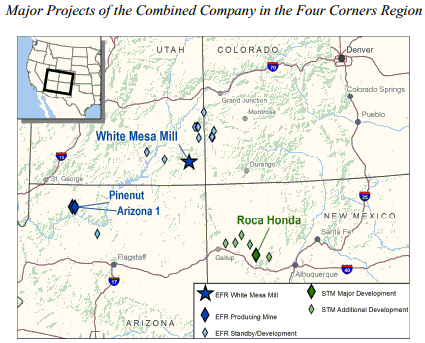
fit neatly into EFR's portfolio. Of particular note, STM's 28M-pound
Roca Hondo project, an advanced-stage relatively-high-grade uranium
project in New Mexico, is situated close enough to EFR's White Mesa
mill that ore from Roca Hondo could -- once a mine is permitted and
built -- be milled at White Mesa. Refer to the following map for
details. This would almost certainly improve the economics of both
Roca Hondo and White Mesa.
Also on the positive side of the ledger, adding the STM assets into
the mix gives EFR even greater leverage to an eventual rally in the
uranium price.
On the negative side of the ledger, the assets being acquired by EFR
consume cash at this stage of their development. This wouldn't be a
problem if uranium was in a bull market, but cash has premium value
under the market conditions that prevail today.
*Sabina Gold and Silver (SBB.TO) reported some very good
intercepts from the on-going drilling program at its Back River gold
project (Nunavut, Canada). The results from 25 holes were reported,
with highlights including 15.20 g/t Au over 20.90m, 19.86 g/t Au
over 16.65m, 11.56 g/t Au over 32.40m, 11.85 g/t Au over 14.35m and
8.27 g/t Au over 29.40m.
These holes were drilled with the purpose of converting Inferred
resources to M&I resources within one of the existing (planned)
pits. In this regard they were almost certainly successful, but they
probably won't increase the overall size of the resource.
Unless SBB makes a major discovery in its exploratory drilling
outside the currently-proposed pits (a realistic possibility, but
not something we are betting on), the next big news will most likely
be the publishing of the Back River PFS results in September.
*UEX Corp (UEX.TO) announced an equity financing after the close
of trading on Friday. The company will be issuing 6.35M shares at
C$0.50/share to raise about $3.2M.
The financing is fairly small and doesn't materially affect the
stock's per-share value. However, we have no idea why UEX is doing
an equity financing with the stock price at such a low level when it
already has more than enough cash in the bank to fund its business
over the coming 12 months.
Chart Sources
Charts appearing in today's commentary
are courtesy of:
http://stockcharts.com/index.html

|









