-- Weekly Market Update for the Week Commencing 27th June 2016
Big Picture
View
Here is a summary of our big picture
view of the markets. Note that our short-term views may differ from our
big picture view.
The BULL market in US Treasury Bonds that began in the early 1980s ended in early-2015, but there will be many years of topping action in bond prices and bottoming action in bond yields before major new trends get underway. (Last update: 29 June 2015)
The stock market, as represented by the S&P500 Index, commenced a secular BEAR market during the first quarter of 2000, where "secular bear market" is defined as a long-term downward trend in valuations (P/E ratios, etc.) and gold-denominated prices. This secular trend will bottom sometime between 2018 and 2020. (Last update: 29 June 2015)
A secular BEAR market in the US Dollar began during the final quarter of 2000 and ended in July of 2008. This secular bear market will be followed by a multi-year period of range trading. (Last update: 09 February 2009)
Gold commenced a secular bull market relative to all fiat currencies, the CRB Index, bonds and most stock market indices during 1999-2001. This secular trend will peak sometime between 2018 and 2020. (Last update: 29 June 2015)
Commodities,
as represented by the CRB Index, commenced a
secular BULL market in 2001 in nominal dollar terms. The first major
upward leg in this bull market ended during the first half of 2008, but
a long-term peak won't occur until 2018-2020.
(Last
update: 29 June 2015)
Copyright
Reminder
The commentaries that appear at TSI
may not be distributed, in full or in part, without our written permission.
In particular, please note that the posting of extracts from TSI commentaries
at other web sites or providing links to TSI commentaries at other web
sites (for example, at discussion boards) without our written permission
is prohibited.
We reserve the right to immediately
terminate the subscription of any TSI subscriber who distributes the TSI
commentaries without our written permission.
Outlook Summary
|
Market |
Short-Term (1-3 month) |
Intermediate-Term (6-18 month) |
Long-Term (2-5 Year) |
| Gold | N/A |
Neutral (27-Jun-16) |
Bullish |
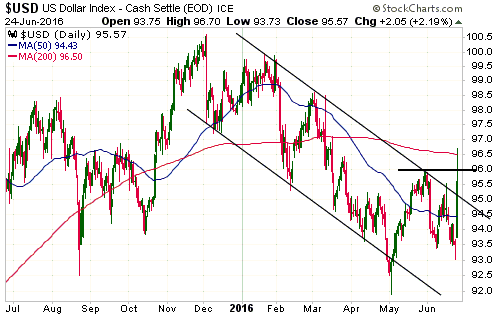
| US$ (Dollar Index) | N/A |
Bullish (29-Feb-16) |
Neutral (19-Sep-07) |
| US Treasury Bonds (TLT) | N/A |
Bearish (19-Oct-15) |
Bearish |
| Stock Market (DJW) | N/A |
Bearish (30-Dec-15) |
Bearish |
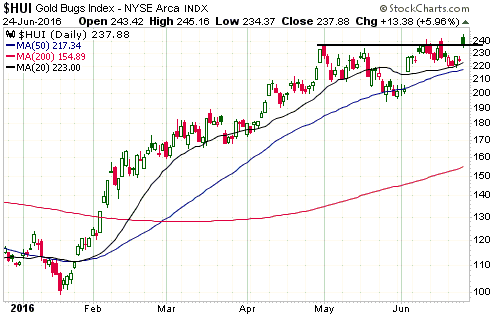
| Gold Stocks (HUI) | N/A |
Neutral (04-May-16) |
Bullish |
| Oil | N/A |
Neutral (26-Oct-15) |
Bullish |
| Industrial Metals (GYX) | N/A |
Neutral (09-Nov-15) |
Bullish (28-Apr-14) |
4. Long-term views are determined almost completely by fundamentals and intermediate-term views
are determined by a combination of fundamentals, sentiment and technicals.
Last week's posts at the TSI Blog
Central bankers believe that they can provide free lunches
The evidence
be damned!
Summary of current
thinking/positioning
1) Concerned about short-term
downside risk in gold, silver and the associated mining stocks, but
comfortable maintaining substantial 'core' exposure in anticipation of
large additional gains over the next two years.
2) Maintaining
relatively small exposure to non-gold commodity-related stocks and
positioned for short-term weakness via XME put options, but getting more
bullish about intermediate-term prospects. Looking for a near-term
opportunity to exit the XME puts.
3) Thinking that the US stock
market has commenced a significant decline and betting (via QID call
options) on additional short-term weakness, although less aggressively now
than a week ago due to having sold some QID calls on Friday 24th June.
4) Thinking that industrial commodities (oil, copper, platinum, etc.)
and the main commodity currencies (A$, C$) made long-term bottoms during
Q1-2016, but that the bottoms could be tested during the second half of
this year as part of a basing process.
5) Thinking that the days
around the 23rd-24th June "Brexit" event will turn out to be a pivot point
for the currency, gold and bond markets (a top for gold, the Yen and the
'safe haven' government bonds).
6) Anticipating a tradable decline
in the T-Bond.
7) Maintaining an unusually-large cash reserve of
around 50% in recognition of the downside risk in almost all equities.
Apres Brexit le
deluge*
Here is the opening of an
article posted at The Telegraph last Thursday:
"Voters in
France, Italy and the Netherlands are demanding their own votes on
European Union membership and the euro, as the continent faces a
"contagion" of referendums.
EU leaders fear a string of copycat
polls could tear the organisation apart, as leaders come under pressure to
emulate David Cameron and hold votes."
This is what the EU
leadership has been most afraid of -- that giving British citizens the
chance to vote on EU membership would 'get the ball rolling'. With Britain
now having opted to leave the EU the pressure to hold similar polls in
other European countries will be even greater.
We can't quantify
the odds, but there appears to be a non-trivial risk of Europe's economic
and monetary unions unravelling within the next two years. In other words,
rather than being a culmination, "Brexit" could be the start of a trend. A
positive trend, we would add.
*A
modification of the
French
expression attributed to Marquise de Pompadour.
Flooding the
system with liquidity
In the email sent to subscribers
last Friday we mentioned that central banks were bound to flood the
financial system with 'liquidity' in response to the "Brexit" result. We
said that this would add to the long-term damage that the idiots have
already done, but would support prices in the short-term. This prompts the
questions: why would the financial system suddenly need additional
'liquidity' and how would the central banks go about providing it?
The answer to the first question is that with one possible exception
(discussed below), the financial system would NOT need additional
'liquidity'. Prices would simply adjust and the world would go on.
However, central bankers wrongly believe that it is their job to stabilise
the financial markets and also wrongly believe that stabilisation can be
achieved by pumping additional money into the banks and other financial
institutions. Two wrongs do not make a right.
Price signals are
only useful if they reflect reality and when central bankers intervene in
markets they prevent this from happening, so the entire concept behind the
intervention is wrong. However, central bankers do not trust and do not
understand markets, so they do what they can in a counter-productive
effort to make the situation better. They don't know what they are doing
but they feel they have to be seen to be doing something, so they do the
only thing they know how to do: create new money via some form of asset
monetisation. This often has the effect of boosting some prices,
especially the prices of stocks and bonds.
The one possible
exception is that due to the way today's global monetary system works, a
sudden increase in risk aversion can lead to a short-lived surge in the
demand for US dollars. This can create a temporary shortage of dollars
OUTSIDE the US that, if not for intervention, could lead to a large, rapid
and disruptive increase in the US dollar's exchange rate. To prevent this
from happening the Fed engages in currency swaps with other central banks.
For example, the Fed provides US dollars to the ECB, the BOE and the BOJ
in exchange for euros, Pounds and Yen, respectively. These swaps are
subsequently reversed after the short-term US$ demand surge has abated.
At this stage we don't know exactly what, if anything, the central
banks did in response to Friday's developments. It's highly probable that
the Fed did some currency swaps with the BOE and the ECB, but it's
possible that no other liquidity-providing measures were undertaken.
We should know more of the details by the end of this week.
Time to take another
stab at a bearish T-Bond speculation
Last week we gave four reasons
to believe that an important top for long-dated US government bonds was
not far away and that the coming decline could be worth trading. We also
wrote: "The risk is that even if our view is correct in terms of time,
the combination of the Brexit vote and stock-market weakness could bring
about a trend-ending blow-off to the upside in 'safe haven' investments."
Friday's price action in T-Bond futures (see chart below) qualifies as
a blow-off, although whether it was the trend-ending kind is not yet
known. In particular, if the stock market follows through to the downside
over the coming 1-2 weeks there could be a surge to another new high in
the T-Bond price.
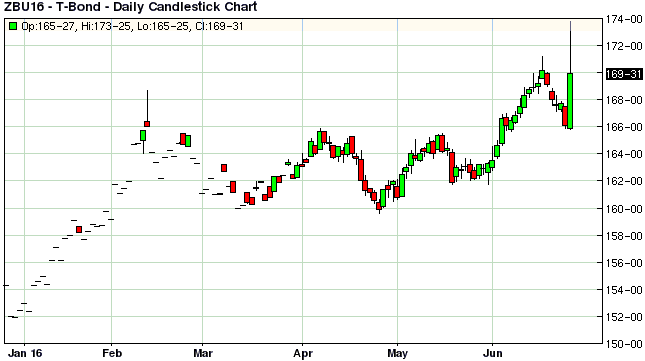
Due to the realistic possibility of some additional panic over the
days ahead a bearish T-Bond speculation is still risky, but now that we've
had at least part of the trend-ending blow-off in safe-haven investments
the risk involved in such a speculation is lesser and the potential reward
is greater. We have therefore added the TBT September-2016 $35 call option
to the TSI List at Friday's closing price of US$1.11.
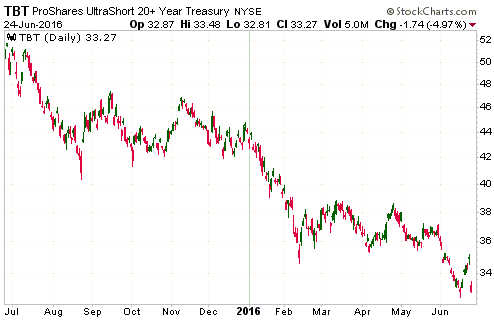
Here is a
chart of TBT. For this trade to work well we don't need a major decline in
the T-Bond, all we need is a 5%-8% decline within the coming 2.5 months.
Commodities
Uranium price to double
by 2018?
"Uranium
prices set to double by 2018" is the title of an article that appeared
at Mineweb early last week. The gist of the article is that while a large
increase in uranium demand is 'baked into the cake' due to the number of
nuclear power plants under construction and in the planning stages in
Asia, negative sentiment has prevented this coming demand surge from being
reflected in the uranium price.
The problem with the argument put
forward in the above-linked article is that the uranium price is
determined by producers and consumers of the commodity that are well aware
of the supply/demand fundamentals. To put it another way, this is not a
market that is currently dominated by poorly-informed members of the
general public.
We won't be surprised if the uranium price doubles
over the next two years. After all, the oil price managed to double in the
space of only four months after bottoming in February of this year.
However, the reason won't be the discovery that a lot of reactors are
being built in China, because this information is already well known by
the dominant participants in the market.
At major commodity-price
bottoms it takes only a small upward shift in demand relative to supply to
reverse the price trend. In the uranium market the shift could happen at
any time, especially given that most of the world's uranium production is
unprofitable at the current spot price, but we long ago gave up on trying
to 'nail down' the timing.
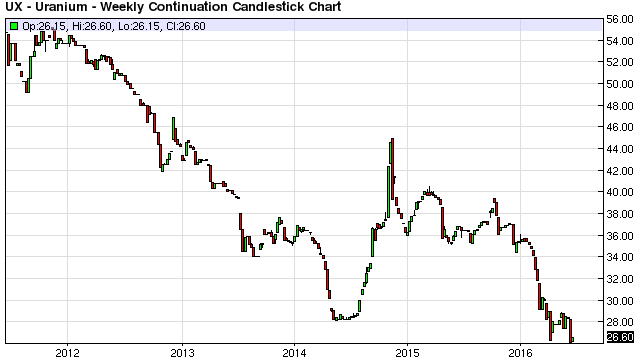
As evidenced by the fact that the
uranium price made a new 5-year low within the past two weeks (refer to
the following weekly chart for details), what we do know is that the shift
hasn't happened yet.
In the stock market, traders periodically anticipate a turnaround in
the uranium price. There is, for example, evidence in the following chart
of the Global X Uranium ETF that traders of uranium-mining equities made
their latest attempt to anticipate a uranium-price turnaround over the
past five months. They were undoubtedly emboldened by the rallies in oil
and other commodities, but, as illustrated above, the uranium price has
not yet begun to validate the optimism of the stock traders.
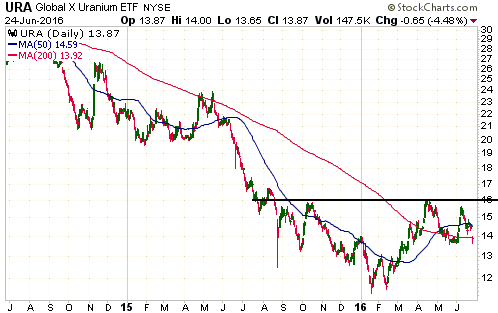
URA's current chart pattern suggests that a long-term base is forming
(the price pattern over the past 12 months is a potential
head-and-shoulders bottom). In other words, URA's chart pattern looks
constructive. Traders of uranium-mining equities have not shown themselves
to be adept at predicting the inevitable/eventual turnaround in the
uranium price in the past, but perhaps this time they will be correct.
We'll wait and see before adding to our uranium exposure.
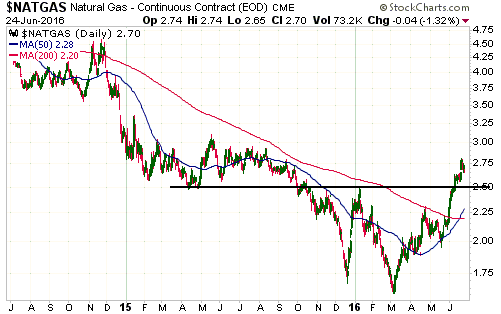
Natural Gas (NG) has signaled a multi-year trend reversal
NG's seasonal pattern contains a high in mid-June followed by a low in
early-September. The seasonal pattern has not been a reliable predictor
over the past few years, but there are signs that it is being followed
this year. Of particular relevance, there was a sharp rise into the
time-window when a seasonal high was due.
On a longer-term basis,
the fact that NG was able to achieve a weekly close above resistance at
US$2.50 is bullish. It warns that a multi-year reversal from down to up
probably occurred during the first quarter of this year. If so, the
seasonal low due in August-September should be comfortably above the March
low.
The Stock Market
The US
Current Market Situation
We
concluded last week's discussion of the US stock market as follows:
"The bottom line is that while the US stock market moved in the
right direction (from our perspective) last week, it hasn't yet signaled
that something more than a routine pullback is underway. What needs to
happen is a daily TRAN close below 7500, a daily NDX close below 4300 and
a daily SPX close below 2040."
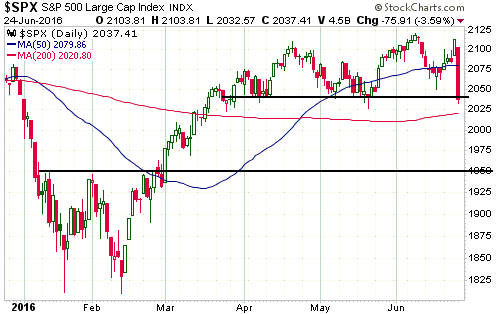
Thanks to Friday's drama, the
SPX has just closed below support at 2040. This means that it has just
achieved its lowest daily (and weekly) close since March. The next support
of consequence lies at 1950.
Also, the NDX has just closed below support at 4300. The next support
of consequence is defined by the January-February lows in the 3900-4000
range.
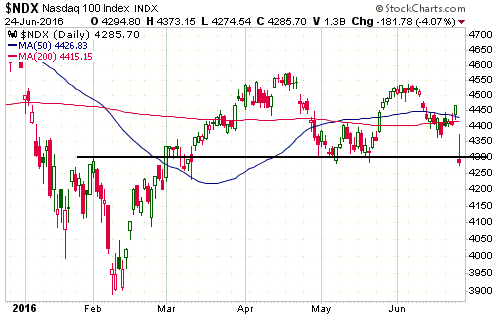
It should be noted that last Friday's breaches of SPX and NDX support
were marginal and happened as part of an emotional reaction to news that
is not fundamentally bearish for the US stock market. However, Friday's
breach of TRAN support was decisive.
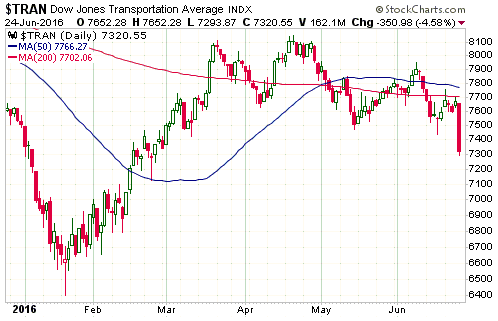
TRAN has been the leading US stock index over the past 18 months, so
its clear-cut downside breakout is potentially significant. At the same
time, our favourite measures of market breadth are more bullish now than
they were just prior to the starts of substantial declines last August and
December. Also, the fact that Friday's downside breakouts happened in
response to news that was not in any way bearish makes their
sustainability more questionable than would otherwise be the case.
There could be some follow-through to the downside over the next couple of
days, but there could also be an immediate rebound. If there is an
immediate rebound it's likely that it would be followed by a decline to
below last week's low.
Whether or not the market rebounds or
continues to decline over the next few days, we expect that a short-term
bottom will be in place within two weeks. What happens thereafter will
largely depend on the level at which the short-term bottom is formed.
Update on short-term bearish speculations
At the end of last week the TSI List contained a QID (leveraged NDX
bear fund) July-2016 $35 call option at a small (by option standards) loss
and a QID October-2016 $40 call option at a small profit. In the email we
sent to subscribers following last Friday's Brexit news we wrote that the
actions we took in response to the news would depend on the magnitudes of
the price moves in the US markets, but that we were planning to exit the
July QID call options and retain the October QID calls. This was for both
our own account and the TSI List.
Due to the closeness of the
expiry date we have removed the QID July call option using the middle of
Friday's closing bid-offer spread (US$0.60) for record purposes and -- as
mentioned in the email -- have retained the October calls. Also, if there
is significant additional downside in the US stock market within the
coming two weeks we will probably exit the October calls with the aim of
re-positioning following a rally.
Europe and the UK
In response to the Brexit news, European equities in euro terms
generally fell much further than UK equities in Pound terms. However,
that's only because the Pound was much weaker than the euro. When we
measure performance in terms of the same currency, that is, when we
compare apples with apples, it's interesting to discover that European
equities plunged by almost the same percentage amount as UK equities last
Friday.
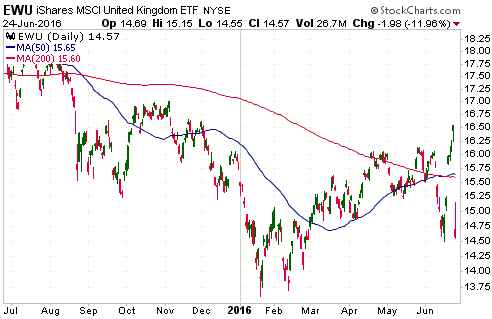
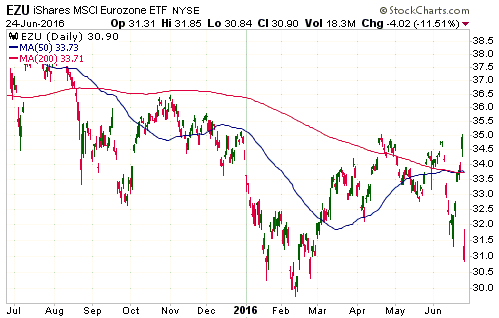
Specifically, the following charts show that UK equities in
US$ terms (EWU) and euro-zone equities in US$ terms (EZU) both plunged by
about 12% on Friday. The magnitude of the market reaction is indicative of
the magnitude of the surprise at the result of Britain's referendum.
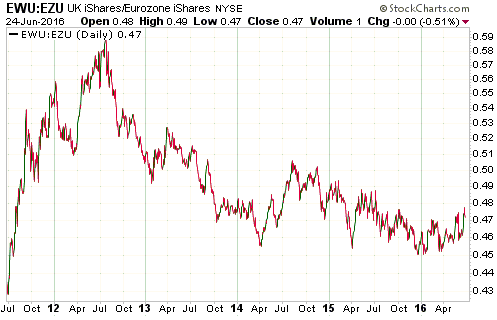
The next chart shows that in terms of a common currency (the US$), UK
equities were much weaker than European equities from mid-2012 (around the
time that the village idiot who runs the ECB promised to do whatever it
takes to maintain Europe's monetary union) through to April of 2014. Over
the past two years the relative performance has stabilised and has
possibly begun to shift in the UK's favour.
This chart confirms
that the relative performance trend was not affected by last week's
dramatic news.
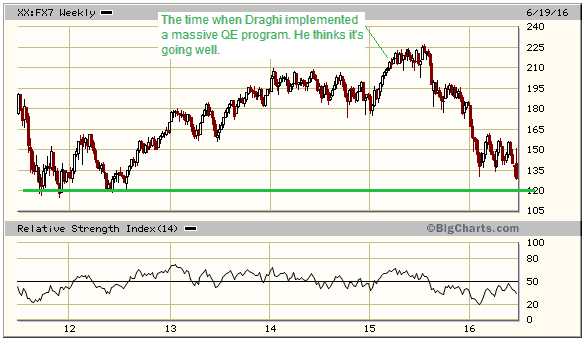
Lastly, it's worth pointing out that the Europe 600 Banks Index (FX7)
plunged 14% last Friday to a new 3-year low. It is now within 7% of the
lows reached during the darkest days of the 2011-2012 euro-zone debt
crisis, which could be viewed as a plus because it means that there is now
only 7% between the current level and a major support level.
Unfortunately, abject failure only encourages central bankers to do more
of the same.
This week's
significant US economic events
[Notes:
1) The most important events
(to the markets) are shown
in bold. 2) A list of global economic events can be found
HERE]
| Date | Description |
| Monday June 27 | Trade Balance |
| Tuesday June 28 |
Q1 GDP (revised) Case-Shiller Home Price Index Consumer Confidence |
| Wednesday June 29 |
Personal Income and Spending Pending Home Sales Index |
| Thursday June 30 | Chicago PMI |
| Friday July 01 |
Motor Vehicle Sales ISM Mfg Index Construction Spending |
Gold and the Dollar
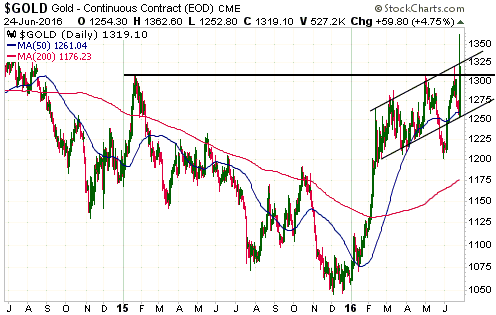
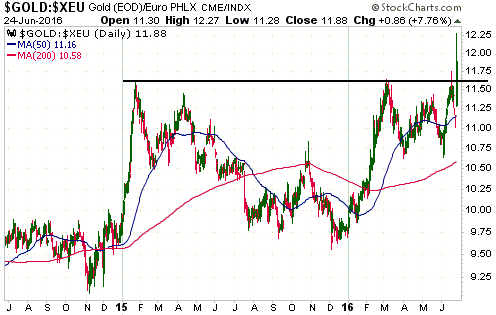
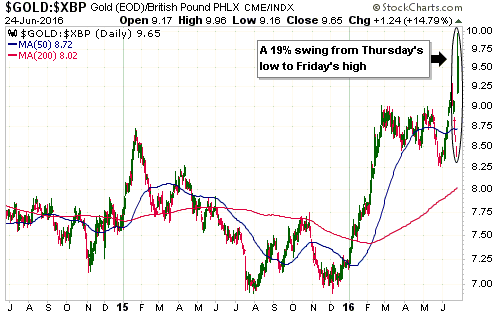
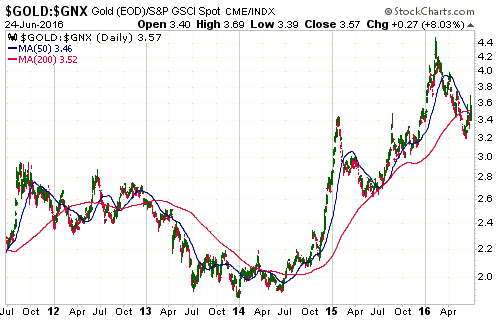

 Company
news/developments for the week ending Friday 24th June 2016:
Company
news/developments for the week ending Friday 24th June 2016: