|
-- Weekly Market Update for the Week Commencing 27th August 2012
Big Picture
View
Here is a summary of our big picture
view of the markets. Note that our short-term views may differ from our
big picture view.
In nominal dollar terms, the BULL market in US Treasury Bonds
that began in the early 1980s will end by 2013. In real (gold)
terms, bonds commenced a secular BEAR market in 2001 that will continue
until 2014-2020. (Last
update: 23 January 2012)
The stock market, as represented by the S&P500 Index,
commenced
a secular BEAR market during the first quarter of 2000, where "secular
bear market" is defined as a long-term downward trend in valuations
(P/E ratios, etc.) and gold-denominated prices. This secular trend will bottom sometime between 2014 and 2020.
(Last update: 22 October 2007)
A secular BEAR market in the Dollar
began during the final quarter of 2000 and ended in July of 2008. This
secular bear market will be followed by a multi-year period of range
trading.
(Last
update: 09 February 2009)
Gold commenced a
secular bull market relative to all fiat currencies, the CRB Index,
bonds and most stock market indices during 1999-2001.
This secular trend will peak sometime between 2014 and 2020.
(Last update: 22 October 2007)
Commodities,
as represented by the Continuous Commodity Index (CCI), commenced a
secular BULL market in 2001 in nominal dollar terms. The first major
upward leg in this bull market ended during the first half of 2008, but
a long-term peak won't occur until 2014-2020. In real (gold) terms,
commodities commenced a secular BEAR market in 2001 that will continue
until 2014-2020.
(Last
update: 09 February 2009)
Copyright
Reminder
The commentaries that appear at TSI
may not be distributed, in full or in part, without our written permission.
In particular, please note that the posting of extracts from TSI commentaries
at other web sites or providing links to TSI commentaries at other web
sites (for example, at discussion boards) without our written permission
is prohibited.
We reserve the right to immediately
terminate the subscription of any TSI subscriber who distributes the TSI
commentaries without our written permission.
Outlook Summary
Market
|
Short-Term
(1-3 month)
|
Intermediate-Term
(6-12 month)
|
Long-Term
(2-5 Year)
|
|
Gold
|
Bullish
(26-Mar-12)
|
Bullish
(26-Mar-12)
|
Bullish
|
|
US$ (Dollar Index)
|
Neutral
(28-May-12)
|
Neutral
(09-Jan-12)
|
Neutral
(19-Sep-07)
|
|
Bonds (US T-Bond)
|
Bearish
(02-Jul-12)
|
Neutral
(18-Jan-12)
|
Bearish |
|
Stock Market
(DJW)
|
Bearish
(30-Jul-12)
|
Bearish
(28-Nov-11)
|
Bearish
|
|
Gold Stocks
(HUI)
|
Bullish
(26-Mar-12)
|
Bullish
(23-Jun-10)
|
Bullish
|
|
Oil |
Neutral
(30-Jul-12)
|
Neutral
(31-Jan-11)
|
Bullish
|
|
Industrial Metals
(GYX)
|
Neutral
(30-Jul-12)
|
Neutral
(29-Aug-11)
|
Neutral
(11-Jan-10)
|
Notes:
1. In those cases where we have been able to identify the commentary in
which the most recent outlook change occurred we've put the date of the
commentary below the current outlook.
2. "Neutral", in the above table, means that we either don't have a
firm opinion or that we think risk and reward are roughly in balance with respect to the timeframe in question.
3. Long-term views are determined almost completely by fundamentals,
intermediate-term views by
fundamentals, sentiment and technicals, and short-term views by sentiment and
technicals.TSI's
Principles of Technical Analysis (TA)
Our views on TA are not mainstream. In fact,
many of our TA-related beliefs are so non-mainstream as to be controversial.
Below is a collection of these beliefs. The collection is not comprehensive, but
it should provide readers with an overview of how we think historical price
action can and can't be used.
Note that there is significant repetition in the following list, in that a
similar meaning is sometimes conveyed in separate points using different words.
Also, we are not stating that our beliefs are the 'be all and end all' of TA and
should be adopted by everyone. For example, if you are able to make good use of
a TA method that we believe to be useless, then there is probably no reason why
our opinion should prompt you to make a change.
1) Clues about future price action can sometimes be gleaned from charts, but
charts tell you a lot about what has happened and very little about what is
going to happen.
2) All of the useful information that can be gleaned from a chart is available
without drawing a single line or calculating a single Fibonacci ratio. For
example, you can tell whether a price has trended upward or downward just by
'eyeballing' the chart. You can also tell, just by looking at the chart, if a
market is extended to the upside or the downside.
3) You can't gain an advantage in the financial markets by doing something that
could be done by the average nine-year-old, such as drawing lines to connect
dots on a chart. Note: We regularly draw lines on the charts contained in TSI
commentaries, but this is for illustrative purposes only. For example, for TSI
presentation purposes we draw horizontal lines to highlight the previous
peaks/troughs that could influence future trading, angled lines to illustrate
the point that a market has been making lower highs or higher lows, and channel
lines to show that a market has been rising or falling at a consistent pace. We
never draw lines on charts for our own trading/investing.
4) The more lines drawn on a chart, the less useful the chart becomes. The
reason is that the lines obscure the small amount of useful information that can
be gleaned from a chart.
5) The more obvious a chart pattern, the less chance it will be helpful in
figuring out what the future holds in store or the appropriate action (buy,
sell, or do nothing).
6) Markets invariably retrace, which means that they never move upward or
downward in straight lines for long. However, markets are no more likely to
retrace in accordance with "Fibonacci" numbers than with any other series of
similarly spaced numbers.
7) Under normal market conditions, breakouts above resistance and below support
are unreliable buy/sell signals. Manic markets like the one for NASDAQ stocks
during 1998-2000 are exceptions. Under these abnormal market conditions, most
upside breakouts are followed by large gains.
8) False upside breakouts are more reliably bearish than downside breakouts, and
false downside breakouts are more reliably bullish than upside breakouts.
9) More often than not, a "death cross" (the 50-day moving average moving from
above to below the 200-day moving average) will roughly coincide with either a
short-term or an intermediate-term low. In other words, "death crosses" usually
have bullish implications and are therefore misnamed. "Golden crosses" (the
50-day moving average moving from below to above the 200-day moving average) are
neither bullish nor bearish.
10) The trend can't possibly be your friend, because in real time you never know
what the trend is. You only know for certain what it was. Another way of saying
this is that the current trend is always a matter of opinion. That's why, at any
given time, there will be a large contingent of bullish traders who believe that
the trend is their friend and a large contingent of bearish traders who believe
that the trend is their friend.
11) When figuring out where to buy and sell it can be useful to identify lateral
support and resistance levels. For example, part of a money management strategy
could reasonably involve buying pullbacks to support when there is good reason
to believe, based on fundamental analysis, that a bull market is in progress.
More generally, charts can help identify appropriate price levels to buy and
sell for investments that have been selected using fundamental analysis.
12) Charts and momentum indicators can help determine the extent to which a
market is 'overbought' or 'oversold', which, in turn, can help identify
appropriate times to scale in to and out of positions.
13) One way of determining the extent to which a market is 'overbought' or
'oversold' is to check the price relative to its 50-day and 200-day moving
averages. For example, when a market price moves a large percentage above or
below its 50-day moving average it usually means that the market is sufficiently
extended in one direction to enable a significant move in the opposite direction
(note that what constitutes a "large percentage" will be different for different
markets). For another example, downward corrections in bull markets tend to end
slightly below the 200-day moving average.
14) Acceleration usually happens near the end of a trend. This means that if you
are long you should view upward acceleration as a warning signal of an impending
top, not a reason to get more bullish.
15) Long sequences of up days create short-term selling opportunities and long
sequences of up weeks create intermediate-term selling opportunities, especially
if the percentage gain is large in the context of the market in question. It's
the same with long sequences of down days/weeks and buying opportunities. A
"long" sequence is at least five in a row.
16) Charts showing price ratios can be informative, but traditional TA is even
less valid with ratios than with nominal prices. In particular, support and
resistance levels only have meaning with reference to the prices of things that
people actively and directly trade in financial markets.
17) With the exception of upward reversals in extremely 'oversold' markets and
downward reversals in extremely 'overbought' markets, intra-day price reversals
are unreliable indicators of the future.
18) History repeats, but in real time you can never be sure which history is
repeating. Putting it another way, a market's future price action will almost
certainly be very similar to the price action of that market or some other
market at an earlier time, but while it is happening you can never be certain
which historical price action is being duplicated.
19) Elliott Wave analysis explains everything with the benefit of hindsight, but
provides its practitioners with very little in the way of foresight.
Oil Update
The oil price has oscillated within a wide
range since the second quarter of last year. It has just moved into the top half
of this range.
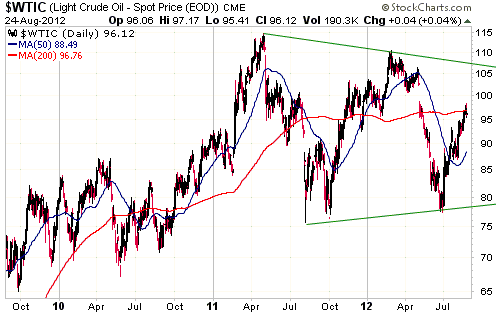
In our opinion, oil's only hope of breaking out of its range to new multi-year
highs within the next 6 months lies with major military conflict or the fear of
major military conflict in the Middle East. In the absence of war in the Middle
East or burgeoning fear of such a development, oil is more likely to drop back
to near the bottom of its range over the months ahead than break above the top
of its range. This is due to the combination of abundant supply (in the absence
of a politically-driven supply shock) and slowing economic growth.
Unfortunately, the risk of war and/or greater political instability in the
Middle East is uncomfortably high.
The oil price could reach new all-time highs within the next few years with or
without a major supply shock, but if it does it will likely be due more to the
depreciation of money than the increasing real value of oil.
The Stock
Market
The US Stock Market
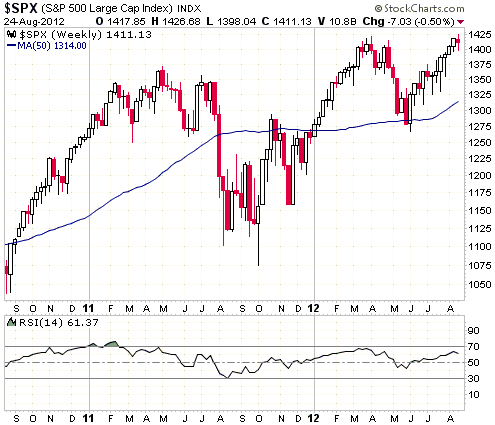
A weekly chart of the S&P500 Index (SPX) is displayed below.
The SPX only needed to decline by a few points on Friday to complete a weekly
reversal from an intermediate-term 'overbought' level, which would have been
preliminary evidence that an important top was in place. Instead, the market
rebounded on Friday. This doesn't mean that an important top is not in place; it
means that there isn't yet any evidence that a top is in place.
It won't surprise us if the senior US stock indices make marginal new multi-year
highs this week. In fact, it will be surprising if the NASDAQ100 Index (NDX)
doesn't make a new multi-year high this week on the back of Apple's victory over
Samsung in a high-profile US patent lawsuit. However, in the absence of the Fed
and/or the ECB implementing new schemes to more rapidly depreciate their
currencies, moves to new nominal price highs at this time will do nothing other
than increase the downside risk.
China's Stock Market
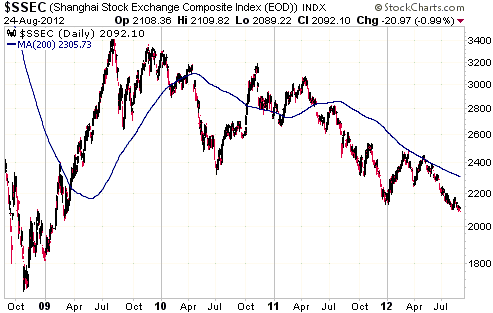
China's stock market, as represented on the following daily chart by the
Shanghai Stock Exchange Composite Index (SSEC), ended last week at its lowest
level since the first quarter of 2009. The miserable performance of China's
stock market is contributing to the bearish outlooks of some analysts, but it
doesn't figure into our bearish outlooks for equities or economic growth.
Thanks largely to the activities of central banks and governments, all stock
markets have some casino-like attributes. China's stock market, however, is
almost solely a type of casino. The performance of this market is determined by
the extent to which the primary focus of the gambling public is on the stock
market, which, in turn, is determined by the extent to which the government
desires a rising stock market. This is one reason that China's economy has
weaker foundations than the much-maligned US economy. The Fed and the government
in the US are making it increasingly difficult to allocate capital efficiently,
but we get the impression that in the majority of cases the US private sector is
still able to overcome the meddling of bureaucrats and politicians. In China,
however, almost all capital allocation is either directly made by the government
or steered by price signals that have been distorted beyond any association with
sustainable consumption patterns or investment returns.
The bottom line is that China's stock market is not an economic indicator, it's
a gambling indicator. Over the past few years, Chinese punters have been
concentrating on other games.
The situation will change if China's government decides, for face-saving
reasons, that an upward-trending stock market is important. That could happen at
any time.
This week's
important US economic events
| Date |
Description |
| Monday Aug 27 |
Dallas Fed Mfg Survey
| | Tuesday Aug 28 |
Richmond Fed Mfg Index
Consumer Confidence
Case-Shiller Home Price Index
| | Wednesday Aug 29 |
Q2 GDP (revised)
Pending Home Sales
Fed's Beige Book | | Thursday
Aug 30 |
Personal Income and Spending
|
| Friday Aug 31 |
Chicago PMI
Consumer Sentiment
Factory Orders
|
Gold and
the Dollar
Gold
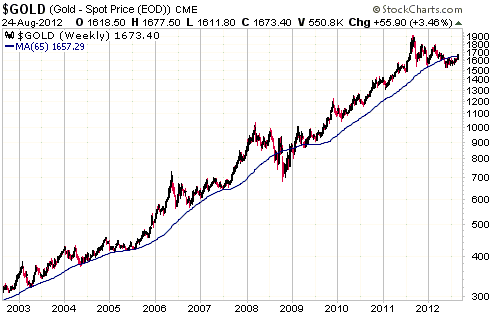
Below is a long-term weekly chart of the US$ gold price. The blue line on the
chart is the 65-week moving average.
All meaningful corrections during the first 7 years of gold's long-term bull
market ended at the 65-week MA. However, the pattern changed in 2008. In 2008
gold broke well below this MA before resuming its long-term advance. There was
also a decisive breach of the MA this year. This is simply a sign that
volatility has begun to increase. As the gold bull market ages we are likely to
see sharper rises and sharper declines.
Last Friday gold achieved its first weekly close above the 65-week MA since
April. This isn't proof that the correction is over, because the gap between the
current price and the MA is small. But as discussed in last week's Interim
Update, you only get "proof" of an important upward trend reversal after it
becomes far more costly to buy.
Anticipation is starting to build regarding what Fed chief Bernanke and ECB
chief Draghi will say at the end of this week at the Fed's annual retreat In
Jackson Hole, Wyoming. Bernanke is scheduled to speak on Friday 31st August and
Draghi is scheduled to speak on Saturday 1st September.
Our opinion regarding the likelihood of more QE anytime soon remains the same:
we think it is very unlikely. However, that doesn't mean that Bernanke won't
'throw a few bones' to the markets in his Jackson Hole speech. Reiterating that
the Fed stands ready and willing to provide greater monetary accommodation
(meaning: create more havoc in the economy by distorting price signals) if
deemed necessary is a bone that will likely be thrown even if there is no
intention to do anything in the near future. This is the sort of statement that
can always be made because it is just a statement of the bleeding obvious. The
fact is that the Fed is ALWAYS ready and willing to pump more money into the
economy if the halfwits who have been granted the power to manipulate money and
interest rates deem it necessary. This is actually the single biggest threat
facing the US economy, but that's a separate issue.
The point we want to make today is that the higher gold moves in the days
leading up to Bernanke's Jackson Hole speech, the greater the potential for a
sharp sell-off if/when no specifics regarding a new inflation-promoting program
are offered. At the end of the week before last gold was trading in the
low-$1600s and there clearly wasn't much QE anticipation built into the price,
but it will be a different story if gold moves well above $1700 during the days
leading up to "Jackson Hole".
A sharp rise in the gold price during the days leading up to Bernanke's 31st
August speech would significantly increase the short-term downside risk and
should therefore be viewed as a short-term selling opportunity.
What about if Bernanke surprises us by making it clear (strongly hinting) that a
new inflation program will soon be introduced? In that case gold will do better
over the next few weeks than we currently expect, which isn't a problem.
Something else worth considering is the possibility that a specific promise or
very clear hint of a new inflation program will come from the ECB rather than
the Fed. For example, if the ECB confirms that it will buy whatever amount of
Spanish, Italian and Portuguese government bonds it needs to buy to keep the
yields on these bonds below certain levels and IF the German government supports
this yield-capping scheme, the short-term effects on the markets would probably
be similar to the Fed announcing a new QE program. Such a development is
unlikely in the near future because opposition from Germany will be a stumbling
block, but it is less unlikely than another round of QE from the Fed.
Gold Stocks
The HUI is testing resistance defined by its June peak. It has just risen for
five days in a row, but it is only a little 'overbought'. This is because the
overall gain achieved over the course of the five consecutive up-days was a
fairly modest 4.8%.
The odds are in favour of the HUI breaking above resistance this week.
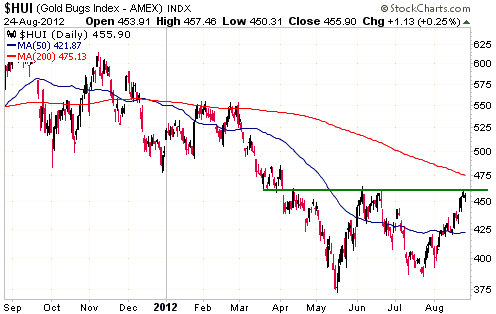
We don't think there's much short-term downside risk to worry about at the HUI's
current price, but, as is the case in the bullion market, risk will increase if
the price moves sharply higher this week in anticipation of a new inflation
program being announced at the Fed's Jackson Hole get-together. Consequently, if
the HUI moves up to the high-400s over the days ahead it should be viewed as a
short-term selling opportunity.
Currency Market Update
Regardless of what has been happening in Australia, over the past several years
the A$ has trended up and down with global equities (as represented by the DJW).
Most recently, this has entailed a sharp decline to a low in early June followed
by a rebound. The relationship is illustrated below.
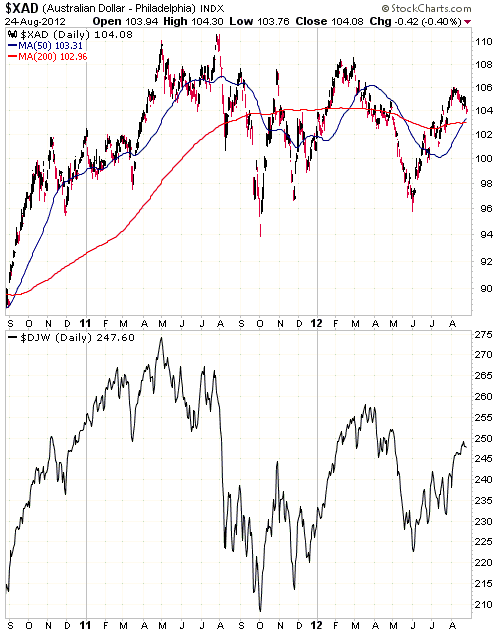
A large stock market decline could begin immediately or there could be 2-3 more
months of topping action before it begins. Either way, there's a high
probability that a large A$ decline will go hand-in-hand with the next large
stock market decline.
As we've mentioned in the past, we are always 'long' the A$ due to the cash and
investments we hold in Australia. We sometimes hedge this exposure by purchasing
FXA put options during periods when the A$'s downside risk looks substantial,
although we are presently unhedged despite the apparent risk. We will possibly
buy some FXA puts if the A$ moves up to around 1.08 within the next few weeks,
but this time around it's more likely that we will indirectly hedge our A$
exposure via VIX call options and/or SPX put options.
Update
on Stock Selections
Notes: 1) To review the complete list of current TSI stock selections, logon at
http://www.speculative-investor.com/new/market_logon.asp
and then click on "Stock Selections" in the menu. When at the Stock
Selections page, click on a stock's symbol to bring-up an archive of
our comments on the stock in question. 2) The Small Stock Watch List is
located at http://www.speculative-investor.com/new/smallstockwatch.html
 Company
news/developments for the week ended Friday 24th August 2012: Company
news/developments for the week ended Friday 24th August 2012:
*Clifton Star (CFO.V) announced that it had employed three engineering
firms to complete the Preliminary Economic Assessment (PEA) for its
Duparquet gold project in Quebec. InnovExplo, a Mining Consulting
Firm from Val-d'Or, will update the resource estimation and will
design the mining sequence for the open pit operations. InnovExplo
will also be responsible for the integration of all other aspects of
the report as the lead author. Bateman Australia Pty Ltd will design
the metallurgical treatment circuit and mill, and also provide a
comparative study on the capex/opex of the alternative BIOX and
Albion processes. Stavibel Engineering Services, a subsidiary of
SNC-Lavalin, will study all the environmental and social aspects of
the project. The PEA is expected to be completed at the end of 2012,
with results published in January of 2013. This is in line with the
tentative schedule previously advised by the company.
CFO also announced that Dr. David Dreisinger will join the company
as Vice President Metallurgy on a part time consulting basis. Dr.
Dreisinger is a Professor and Chairholder (Industrial Research Chair
in Hydrometallurgy) at the University of British Columbia and
consults to the metallurgical industry worldwide through Dreisinger
Consulting Inc.
*Energy Fuels (EFR.TO) announced that it has bought-out its 50/50 joint
venture partner in a small exploration-stage uranium project in
Utah. The total cost to EFR in cash and shares will be about $2M. In
exchange for this payment EFR will add about 1.4M pounds of uranium
and 9M pounds of vanadium to its in-ground resource. This move by
EFR to consolidate ownership of the project is reasonable, but not
financially significant at this time.
*International Tower Hill Mines (THM) reported results from 45
geotechnical and condemnation drill holes. Although there were a few
interesting intercepts, the results generally aren't significant.
The purpose of this type of drilling isn't to expand the existing
deposit or find new deposits, it is to determine the appropriate
location of mining infrastructure.
*Orvana Minerals (ORV.TO) reported production results for the month of
July for its EVBC mine in Spain and its UMZ mine in Bolivia. Total
production for the month comprised 5.9K ounces of gold and 1.7M
pounds of copper. These results are on plan (the plan for the
current quarter is for production of 19.1K ounces of gold and about
5M pounds of copper).
*Pretium Resources (PVG) has completed the small equity financing
announced two weeks ago. Gross proceeds of $20.7M were raised by
issuing flow-through shares at C$18.00/share (a roughly 20% premium
to the current market price).
*Prodigy Gold (PDG.V) announced a large increase in the estimated gold
resource at its Magino project and a confusing alteration to the
Magino project's engineering schedule (the insertion of a PFS into
the schedule, implying that the FS will be completed many months
later than previously advised). This news was discussed in last
week's Interim Update. Later in the week PDG issued its MD&A
(Management Discussion and Analysis) and financial report for the
June quarter. The MD&A didn't include the aforementioned engineering
schedule alteration and reconfirmed the overall plan to commence
mine construction in 2014 and production in 2015. The financial
report showed that PDG had about $50M of working capital as at 30th
June, which should be more than enough to fund its activities over
the next 12 months.
Endeavour
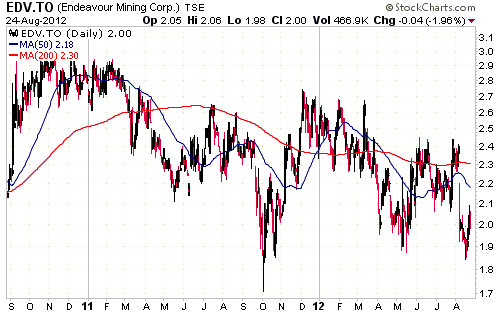
Mining (TSX: EDV, ASX: EVR). Shares: 254M issued, 289M fully diluted. Recent
price: C$2.00
EDV's stock price plunged a couple of weeks ago in reaction to news that the
company had agreed to buy Avion Gold (AVR.TO) in an all-stock deal. We aren't
keen on the deal, because at the current gold price it adds more risk than
potential reward. However, it's important to put things in perspective. This is
not a Tye Burt (former Kinross CEO) style asset purchase that wipes out a lot of
shareholder value in one fell swoop due to an absurdly high price, it is the
purchase of a relatively risky asset at a fairly low price.
The continued downward pressure on EDV shares due to the AVR takeover news
combined with the recent gains in other gold mining stocks has led to EDV
becoming one of the gold sector's best candidates for new buying.
GDXJ
Trading Position
The plan with our GDXJ trading position has been to take profits at around $26
by October, but it will make sense to take profits at a lower level if the price
surges in the days leading up to the Fed's Jackson Hole meeting. For TSI record
purposes, the position will therefore be exited if the price rises to $23.90
this week.
Note that we aren't forecasting a rise to $23.90 this week. We are saying that
if it does happen we will view it as a short-term profit-taking opportunity.
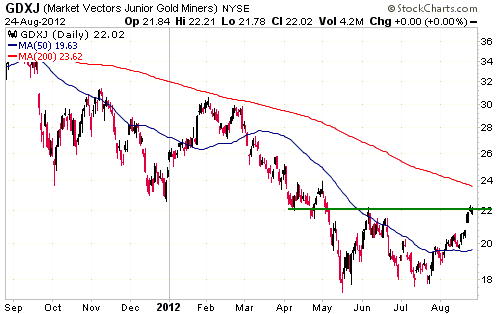
Chart Sources
Charts appearing in today's commentary
are courtesy of:
http://stockcharts.com/index.html

|









