|
-- Weekly Market Update for the Week Commencing
27th October 2014
Big Picture
View
Here is a summary of our big picture
view of the markets. Note that our short-term views may differ from our
big picture view.
In nominal dollar terms, the BULL market in US Treasury Bonds
that began in the early 1980s ended in 2012. In real (gold)
terms, bonds commenced a secular BEAR market in 2001 that will continue
until 2018-2020. (Last
update: 20 January 2014)
The stock market, as represented by the S&P500 Index,
commenced
a secular BEAR market during the first quarter of 2000, where "secular
bear market" is defined as a long-term downward trend in valuations
(P/E ratios, etc.) and gold-denominated prices. This secular trend will bottom sometime between 2014 and 2020.
(Last update: 22 October 2007)
A secular BEAR market in the Dollar
began during the final quarter of 2000 and ended in July of 2008. This
secular bear market will be followed by a multi-year period of range
trading.
(Last
update: 09 February 2009)
Gold commenced a
secular bull market relative to all fiat currencies, the CRB Index,
bonds and most stock market indices during 1999-2001.
This secular trend will peak sometime between 2014 and 2020.
(Last update: 22 October 2007)
Commodities,
as represented by the Continuous Commodity Index (CCI), commenced a
secular BULL market in 2001 in nominal dollar terms. The first major
upward leg in this bull market ended during the first half of 2008, but
a long-term peak won't occur until 2014-2020. In real (gold) terms,
commodities commenced a secular BEAR market in 2001 that will continue
until 2014-2020.
(Last
update: 09 February 2009)
Copyright
Reminder
The commentaries that appear at TSI
may not be distributed, in full or in part, without our written permission.
In particular, please note that the posting of extracts from TSI commentaries
at other web sites or providing links to TSI commentaries at other web
sites (for example, at discussion boards) without our written permission
is prohibited.
We reserve the right to immediately
terminate the subscription of any TSI subscriber who distributes the TSI
commentaries without our written permission.
Outlook Summary
Market
|
Short-Term
(1-3 month)
|
Intermediate-Term
(6-18 month)
|
Long-Term
(2-5 Year)
|
|
Gold
|
N/A |
Bullish
(26-Mar-12) |
Bullish
|
|
US$ (Dollar Index)
|
N/A |
Neutral
(29-Sep-14) |
Neutral
(19-Sep-07) |
|
US Treasury Bonds (TLT)
|
N/A |
Neutral
(18-Jan-12)
|
Bearish |
|
Stock Market
(DJW)
|
N/A |
Bearish
(28-Nov-11) |
Bearish
|
|
Gold Stocks
(HUI)
|
N/A |
Bullish
(23-Jun-10) |
Bullish
|
|
Oil |
N/A |
Neutral
(31-Jan-11) |
Bullish
|
|
Industrial Metals
(GYX)
|
N/A |
Neutral
(15-Sep-14) |
Bullish
(28-Apr-14) |
Notes:
1. Our short-term expectations are discussed in the commentaries, but except in
special circumstances we won't attempt to assign a "bullish", "bearish" or
"neutral" label to these expectations.
2. The date shown below the current outlook is when the most recent outlook change occurred.
3. "Neutral" means that we think risk and reward are roughly in balance with respect to the timeframe in question.
4. Long-term views are determined almost completely by fundamentals and intermediate-term views
are determined by a combination of fundamentals, sentiment and technicals.
Natural
Gas and the Grains
Although they weren't added to the TSI List and are therefore
not being formally tracked at TSI, over the past two months we noted
that natural gas and the grains (via JJG) were suitable for
long-side trades. It's time to check on how these commodities are
faring.
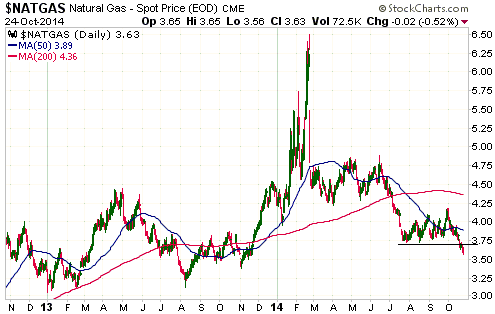
Our last comment on natural gas (NG) was in the 8th September Weekly
Update, at which time we wrote:
"If the NG market is going to continue following its seasonal
pattern, then a seasonal low should be in place by the end of this
week. Therefore, anyone interested in trading the seasonal pattern
by averaging into a natgas position during August-September weakness
should place an initial sell stop just below whatever low is in
place at the end of this week."
$3.81 was the price when the above comment was published and $3.72
ended up being the price that NG needed to remain above to avoid
invalidating the seasonal pattern on which the trading idea was
based.
NG managed to rally to $4.18 in early October before reversing
course. It closed below $3.72 on Monday 20th October, thus deviating
by enough from the seasonal pattern to invalidate our trading idea.
We continue to be bullish on NG's intermediate-term and long-term
prospects, but this commodity's short-term prospects have been
muddied by the recent price action.
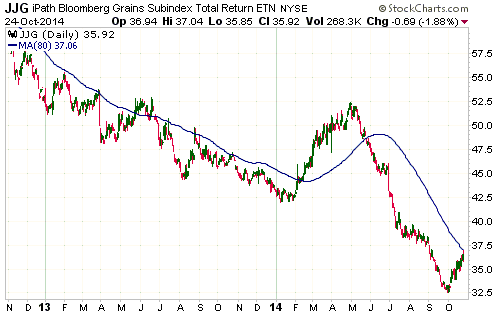
Our last comment on the Grains Total Return ETN (JJG) was in the 22nd September
Weekly Update, when JJG was trading at $33.79. This was our conclusion:
"As a result of the continuing sell-off in and the current extreme relative
cheapness of the grains, a good opportunity to buy JJG for an intermediate-term
trade is now at hand. At this time we don't intend to add JJG to the TSI List,
but we will probably soon start averaging into a position in our own account."
JJG bottomed at $32.58 about one week later and then reversed course. At the end
of last week it was up by around 10% from its low.
We continue to be bullish on JJG's intermediate-term prospects, but would hold
off on new buying for now. The reason is that the September low of around $32.50
will probably be tested prior to the start of a substantial rally. Given that
three of the most important JJG lows of the past six years have occurred during
December-January, we suspect that the next buying opportunity will emerge about
two months from now.
Note that a multi-week pullback followed by a break above the 80-day MA (the
blue line on the following chart) would confirm a trend reversal in JJG.
The T-Bond is to the stock market
as gold is to the industrial metals
The three charts presented below tell an
interesting story. The theme of the story is: preliminary evidence of a
long-term trend change has emerged.
The first chart is the least interesting and least informative of the three, but
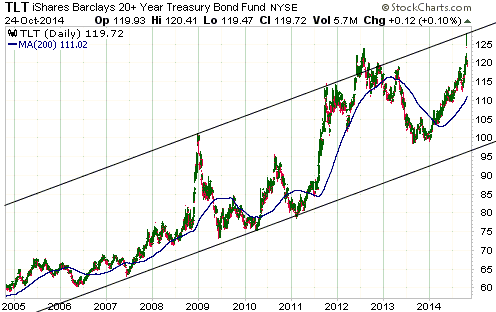
is worthy of inclusion nonetheless. It shows that the iShares 20+ Year Treasury
Bond ETF (TLT) rallied strongly since the beginning of this year and spiked to
an all-time high (in dividend-adjusted terms) on Wednesday 15th October.
At its recent high TLT was very 'overbought'. Sufficiently 'overbought', in
fact, to have put in place a multi-month price top (as we noted in the 15th
October Interim Update). However, for the reasons outlined below we do not
believe that the time is ripe for a bearish speculation in the US Treasury
market.
The first reason we have no interest in betting against the Treasury market is
sentiment. Despite this year's strong upward trend in the prices of long-dated
US Treasury securities, the 'dumb money' remains stubbornly bearish on these
securities.
The second reason is relative valuation, in that even though the 10-year T-Note
does not yield enough to provide a real return, its return looks attractive
compared to the returns and the risks associated with credit-market
alternatives. In particular, how could anyone in their right mind be bearish on
US$-denominated 10-year bonds issued by the US government yielding 2.2% when the
euro-denominated 10-year bonds issued by the governments of Germany, France and
Spain are yielding 0.9%, 1.3% and 2.2%, respectively, and the Yen-denominated
10-year bonds issued by the government of Japan are yielding 0.5%?
The third reason is also relative valuation, but in this case relative to the US
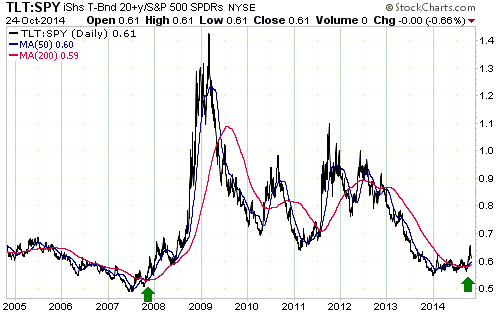
stock market. Although TLT is extended to the upside in nominal dollar terms,
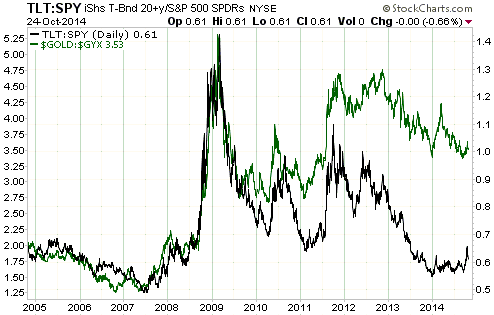
the following chart of the TLT/SPY ratio suggests that relative to the stock
market it has just begun to turn higher from near a 10-year low. Given that TLT
is near the top of its long-term channel in dollar terms and offers a paltry
yield, this chart says more about the stock market's unattractiveness than the
bond market's attractiveness.
Also worth highlighting is that the TLT/SPY ratio's 50-day MA has just crossed
from below to above its 200-day MA, which is exactly what it did near the
beginning of the 2007-2009 equity bear market. This chart can therefore be taken
as preliminary evidence that the US stock market has just commenced a multi-year
decline.
Our final chart compares the TLT/SPY ratio with the gold/GYX ratio (gold
relative to the Industrial Metals Index). Considering the superficial
differences in these ratios, the closeness with which they have tracked each
other over the past 10 years is remarkable.
The strong positive correlation between TLT/SPY and gold/GYX is not a fluke. It
can be explained by the fact that during periods of declining economic
confidence and/or market liquidity, the investment demand for T-Bonds rises
relative to the investment demand for equities and, at the same time, the desire
to own gold for safety/store-of-value purposes increases relative to the
consumption demand for industrial metals. The opposite happens during periods of
rising economic confidence and/or market liquidity. That's why this discussion
is titled: "The T-Bond is to the stock market as gold is to industrial metals".
Interestingly, but not surprisingly considering the long-term relationship, the
recent small upturn in the TLT/SPY ratio has been accompanied by a small upturn
in the gold/GYX ratio. This, again, is what happened near the beginning of the
2007-2009 equity bear market.
The upshot is that while it is far too soon to make any definitive statements,
some indicators that should be reversing course near the beginning of an equity
bear market appear to be doing so.The Stock
Market
Current situation for the US stock market
We think that the short-term US stock market situation can be described as
follows:
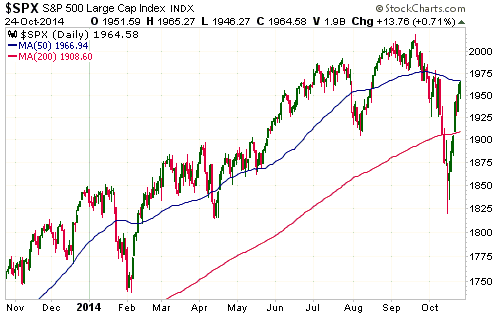
1. The INITIAL decline from the S&P500's 18th September peak ended at 1820 on
15th October at an 'oversold' extreme. That an initial bottom was in place was
signaled the following day by a collapse in the number of individual NYSE and
NASDAQ stocks making new 52-week lows, as mentioned at the time in a
TSI blog post.
2. The rebound from the 15th October bottom was likely to retrace 50%-100% of
the initial decline, suggesting a rebound target of anywhere from 1920 to the
low-2000s.
3. As at the end of last week the rebound was still in progress.
4. The rebound could end at any time, especially given that last Friday's high
was within 2 points of the 50-day MA. However, we guess that it will continue
into early-November with an intervening multi-day pullback this week.
5. The rebound will likely be followed by a sharp decline to test the 15th
October low, but a major decline is unlikely over the months immediately ahead.
There is evidence that a 1-2 year cyclical bear market has begun. If so, there
probably won't be a major decline over the next few months. Instead, the market
is likely to gradually roll over via a series of lower highs and lower lows. The
reason is that after a bullish trend has remained in place for more than three
years it takes a lot of time for a critical mass of market participants to come
to the realisation that the long-term trend has changed. For example, this
general realisation, or point of recognition, didn't occur until 9-11 months
after the major stock-market peaks of January-1973 and October-2007.
At this time there is still a realistic possibility that the S&P500 is
experiencing nothing more than a short-term bull-market correction (its first
since 2012) and that some other stock indices, such as the Russell2000 (RUT),
are experiencing intermediate-term bull-market corrections. However, even if
this is the case there is a good chance that the 15th October low will be tested
prior to the resumption of the long-term upward trend.
Casey Research's stock market crash alert
Casey Research issued a stock market crash alert early last week. We think that
the probability of a crash happening within the next few months is very low, but
we were intrigued by one of the bearish speculations suggested in Casey's crash
alert. We are referring to the suggestion to buy put options on the Regional
Banking ETF (KRE).
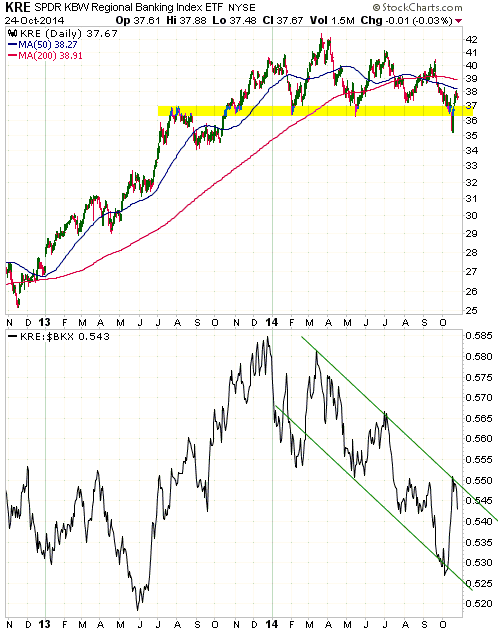
This suggestion interests us for two reasons. First, on a relative-strength
basis the regional banking sector of the stock market has moved in the same
direction as credit spreads over the past 12 months, which suggests that it is
acutely vulnerable to evidence of economic weakness. Second, the chart shows a
potential top in the making and a rebound to resistance. Furthermore, the
rebound to resistance occurred in both nominal terms, with KRE moving up to near
its 50-day MA, and relative terms, with the KRE/BKX ratio moving up to its
channel top. Refer to the following chart for details.
It could be appropriate for option traders to average into KRE put options
(either January-2015 $35 puts or March-2015 $33 puts) over the next two weeks.
SSO (Ultra S&P500 Fund) Put Options
With regard to the exposure to SSO put options in our own account, we have
decided to focus on the January-2015 $100 puts for now because the January-2016
puts are too expensive and illiquid. We purchased an initial position in these
put options last Wednesday and plan to add to the position into market (S&P500)
strength over the next two weeks.
For longer-term exposure to the market's downside potential our current plan,
which is subject to change based on price action, is to average into unleveraged
actively-managed bear funds (BEARX and HDGE) over several months.
This week's
significant US economic events
(The most important events are shown
in bold)
| Date |
Description |
| Monday Oct 27 |
Pending Homes Sales Index
Dallas Fed Mfg Survey | | Tuesday
Oct 28 |
Durable Goods Orders
Case-Shiller Home Price Index
Consumer Confidence
Richmond Fed Mfg Index | | Wednesday
Oct 29 |
FOMC Announcement | | Thursday
Oct 30 |
Q3 GDP
|
| Friday Oct 31 |
Personal Income and Spending
Chicago PMI
Employment Cost Index
Consumer Sentiment |
Gold and
the Dollar
Gold
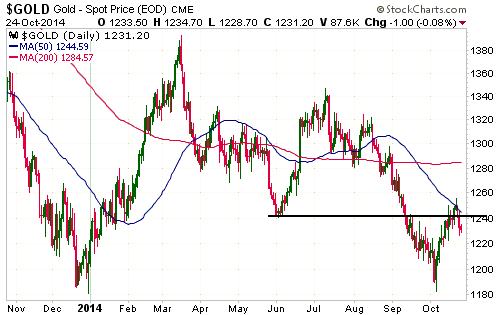
Gold broke above lateral resistance in the low-$1240s during the first half of
last week, but the fact that the breakout wasn't confirmed by silver and the
gold-mining indices indicated that it probably wouldn't be sustained. It wasn't.
It seems that the market cares more about resistance defined by the 50-day MA
than resistance defined by the June low, as the US$ gold price reversed downward
as soon as it reached this moving average.
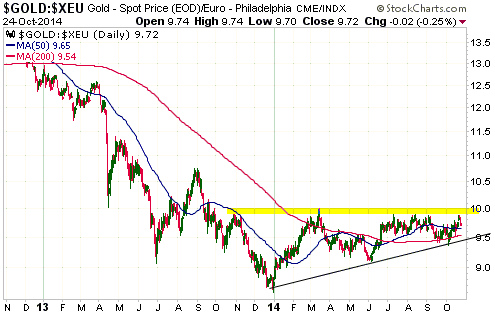
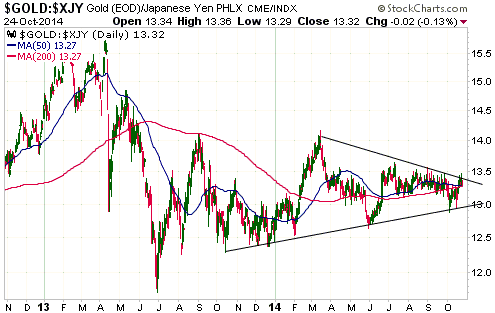
The US$ gold price is in a position where it could gain 5% without significantly
altering the longer-term chart pattern. However, a gain of only a few percent in
the euro- and Yen-denominated gold prices would result in potentially important
upside breakouts. In the case of the euro-denominated gold price, it would
result in the completion of a major basing pattern. In the case of the
Yen-denominated gold price, it would result in an upside breakout from a
12-month consolidation pattern. The relevant charts are displayed below.
Gold Stocks
Current Market Situation
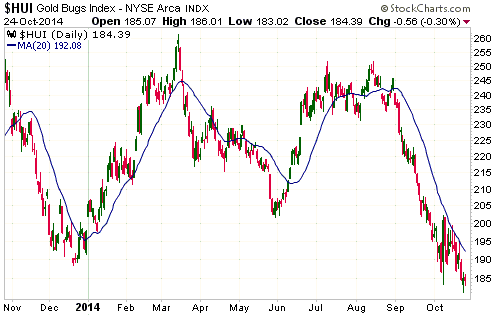
The HUI has now fallen for 8 weeks in a row, with the last 3 weekly declines
being small. The major low that occurred 14 years ago (November-2000) was put in
place via the HUI declining on 9 out of the prior 10 weeks, with the last 4
weekly declines being small. The following weekly charts show the HUI's current
situation and what happened during 2000-2002.
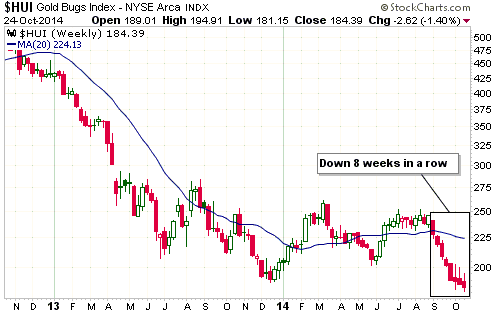
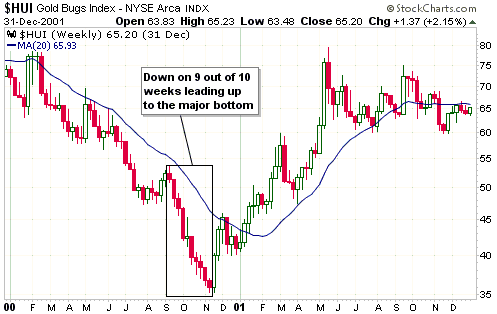
A literal comparison with the final decline to the 2000 bottom suggests that
there will be an upward reversal, signaling the start of a strong
intermediate-term rally, during the first week of November (next week). However,
a literal comparison might not be valid.
The main point we want to make in today's report is that the gold-mining sector
is now so depressed that a trend reversal will be easy to identify soon after it
happens (probably within one week of the event, definitely within two weeks of
the event). For example, a daily close by the HUI above its 20-day MA (the blue
line on the following chart), which is something that should happen within a few
days of the bottom, would now be an early warning that an important trend change
had occurred.
Individual gold stocks will bottom at different times, and regardless of what we
think is going to happen on a sector-wide basis we are always on the lookout for
short-term buying and selling opportunities in the stocks we own/follow.
However, those who trade gold-stock ETFs should probably wait for a daily close
above the 20-day MA before establishing or adding to long positions.
The current bout of tax-loss selling will end this week, removing one source of
pressure on the gold-mining sector in general and the junior gold stocks in
particular. There will be another bout of tax-loss selling in December, but the
effect it has will be determined by what happens to prices during the
intervening period.
Kinross Gold (KGC) versus Gold Fields Ltd. (GFI)
We've previously written that KGC and GFI offered the best value among the
senior gold producers, with GFI being the better intermediate-term speculation,
despite having the slightly higher valuation and the weaker balance sheet, by
virtue of its much lower country risk. (Note: The bulk of KGC's value is
associated with mining assets located in Russia and Mauritania (West Africa),
whereas almost half of GFI's production comes from Australia with the remainder
spread across Latin America, Ghana and South Africa.) However, KGC's
underperformance has been so dramatic over the course of this year, and
especially over the past four months, that the additional risk associated with
the locations of its assets appears to have been more than fully discounted.
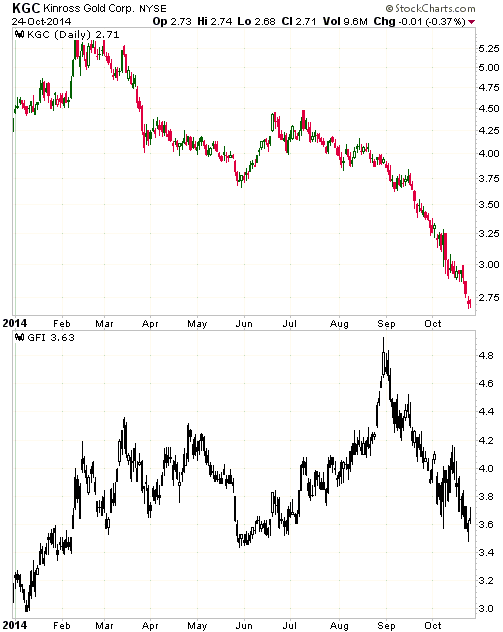
The following chart compares the year-to-date performances of the two stocks. It
shows that GFI is up by about 20% since the start of the year and is at roughly
the same price now as it was 4 months ago, whereas KGC is down by about 36%
since the start of the year with all of the loss coming over the past 4 months.
As a result of these relative performances, the stock market is now valuing
KGC's gold production by about 35% less than GFI's gold production.
KGC has a production-cost advantage of almost 10% over GFI, but both companies
have low-enough production costs to be modestly profitable and cash-flow
positive at the current gold price.
So, despite having lower production costs and a stronger balance sheet, by one
important measure KGC is now being valued at 35% less than GFI, which, itself,
appears to offer good value in absolute terms and relative to other senior gold
producers. As noted above, it's therefore possible that the stock market has
gone too far in its attempts to account for the comparatively high-risk
locations of KGC's assets.
The Currency Market
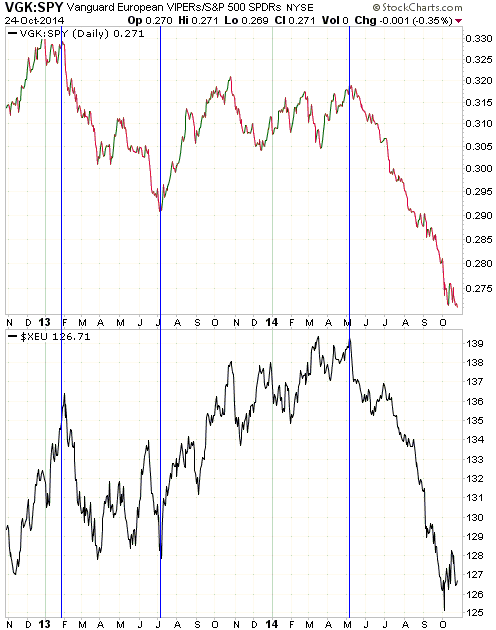
The following chart shows the close relationship between the VGK/SPY ratio
(European equities relative to US equities) and the euro. The VGK/SPY ratio
closed at a marginal new low for the year last Friday, which suggests that we
could still be one more new low in the euro and one more new high in the Dollar
Index away from multi-month extremes. If there is going to be a trend-ending
move to a marginal new low in the euro and new high in the Dollar Index, the
next two weeks is the most likely time for it to happen.
The near-term potential for new euro and Dollar Index extremes would be
eliminated by a daily close below 128.5 in the euro and/or a daily close below
85 in the Dollar Index.
Updates
on Stock Selections
Notes: 1) To review the complete list of current TSI stock selections, logon at
http://www.speculative-investor.com/new/market_logon.asp
and then click on "Stock Selections" in the menu. When at the Stock
Selections page, click on a stock's symbol to bring-up an archive of
our comments on the stock in question. 2) The Small Stock Watch List is
located at http://www.speculative-investor.com/new/smallstockwatch.html
 Company
news/developments for the week ended Friday 24th October 2014: Company
news/developments for the week ended Friday 24th October 2014:
[Note: AISC = All-In Sustaining Cost, FS = Feasibility Study, IRR = Internal
Rate of Return, MD&A = Management Discussion and Analysis, M&I = Measured and
Indicated, NAV = Net Asset Value, NPV(X%) = Net Present Value using a discount
rate of X%, P&P = Proven and Probable, PEA = Preliminary Economic Assessment,
PFS = Pre-Feasibility Study]
*Almaden Minerals (AAU) announced that it will be spinning out its
royalty and early-stage exploration assets into a new company ("spinco"), with
AAU retaining the Tuligtic gold-silver project in Mexico. The shares of Spinco
will be distributed to existing AAU shareholders at the rate of 0.6 for 1.
Therefore, a holder of 1000 shares of AAU pre-spinout will have 1000 shares of
AAU plus 600 shares of Spinco post-spinout.
Spinco will initially hold a 2% Net Smelter Return ("NSR") royalty on the
Tuligtic project in Mexico, a 1.5% NSR on the Caballo Blanco gold deposit in
Mexico (a development project currently operated by Goldgroup Mining), a 2% NSR
on the Elk gold deposit in Canada (an advanced exploration project currently
operated by Gold Mountain Mining Corp., a portfolio of 21 additional NSR
royalties on exploration projects in Mexico, Canada and the United States, a
100% interest in the El Cobre copper-gold porphyry exploration project in Mexico
and the Willow copper-gold porphyry exploration project in Nevada, a portfolio
of 20 other exploration projects, and sufficient working capital to satisfy
stock exchange requirements.
This is a smart move by AAU's management, for three reasons. First, it forces
the market to value the assets that are going into Spinco (as far as we can
tell, these assets are currently not being assigned any value as part of AAU).
Second, it will enable AAU to focus exclusively on its flagship project. Third,
it will pave the way for an eventual purchase of AAU by a mid-tier gold or
silver mining company.
*Pilot Gold (PLG.TO) reported that it has discovered another
gold-copper porphyry deposit, called the Columbaz Target, at its TV Tower
project in Turkey. The discovery hole returned 0.60 g/t Au and 0.11% Cu over
357.7m.
PLG has now discovered five separate deposits at TV Tower: a deep and relatively
high-grade gold-silver-copper zone at the KCD Target, a near-surface zone of
silver-only mineralization that partially overlies the high-grade
gold-silver-copper zone at the KCD Target, and three gold-rich porphyry
deposits. The project clearly has district-scale potential.
*Pretium Resources (PVG) published the remaining assay results
from infill surface drilling in the Valley of the Kings deposit at the Brucejack
gold project. The purpose of the drilling was to a) confirm the grade and
continuity of Indicated and Inferred gold mineralization in an area defined by
the 2013 resource estimate block model, and b) confirm the continuity of gold
mineralization below the area defined by the 2013 resource estimate. The program
achieved its goals.
One of PVG's next steps along the development path is an underground infill
drilling program to support the Brucejack Project mine plan. This program will
begin early next year.
*True Gold Mining (TGM.V) reported the results of a PEA that
considered the addition of the heap-leachable portion of the North Kao deposit
to the current mine plan for the development-stage Karma gold project in Burkina
Faso. According to this PEA, at a $1250/oz gold price the NPV(5%) of the Karma
project could be increased by around $60M via additional capital expenditure of
only $18M. The PEA therefore suggests that the North Kao deposit can add
substantial value to TGM.
The PEA published last week assumed that North Kao would be mined following
completion of the current mine plan. TGM had to make this assumption for
regulatory reasons, but this is almost certainly not the way it will end up
happening. It's far more likely that North Kao will be mined as part of, rather
than at the end of, the current schedule, but before TGM can officially assess
the economics of proceeding in this way it must first convert North Kao's
Inferred Resources to the M&I category via an infill drilling program.
List of candidates for new buying
From within the ranks of TSI stock selections the best candidates
for new buying at this time, listed in alphabetical order, are:
1) AAU (last Friday's closing price: US$1.17).
2) EDV.TO (last Friday's closing price: C$0.59).
3) EVN.AX (last Friday's closing price: A$0.64).
4) PVG (last Friday's closing price: US$5.18).
5) TGD (last Friday's closing price: US$1.26).
Note that the above list is limited to five stocks. It will
sometimes contain less than five, but it will never contain more
than five regardless of how many stocks are attractively priced for
new buying.
Chart Sources
Charts appearing in today's commentary
are courtesy of:
http://stockcharts.com/index.html

|









