|
-- Weekly Market Update for the Week Commencing 28th May 2012
Big Picture
View
Here is a summary of our big picture
view of the markets. Note that our short-term views may differ from our
big picture view.
In nominal dollar terms, the BULL market in US Treasury Bonds
that began in the early 1980s will end by 2013. In real (gold)
terms, bonds commenced a secular BEAR market in 2001 that will continue
until 2014-2020. (Last
update: 23 January 2012)
The stock market, as represented by the S&P500 Index, commenced
a secular BEAR market during the first quarter of 2000, where "secular
bear market" is defined as a long-term downward trend in valuations
(P/E ratios, etc.) and gold-denominated prices. This secular trend will bottom sometime between 2014 and 2020. (Last update: 22 October 2007)
A secular BEAR market in the Dollar
began during the final quarter of 2000 and ended in July of 2008. This
secular bear market will be followed by a multi-year period of range
trading. (Last
update: 09 February 2009)
Gold commenced a
secular bull market relative to all fiat currencies, the CRB Index,
bonds and most stock market indices during 1999-2001. This secular trend will peak sometime between 2014 and 2020. (Last update: 22 October 2007)
Commodities,
as represented by the Continuous Commodity Index (CCI), commenced a
secular BULL market in 2001 in nominal dollar terms. The first major
upward leg in this bull market ended during the first half of 2008, but
a long-term peak won't occur until 2014-2020. In real (gold) terms,
commodities commenced a secular BEAR market in 2001 that will continue
until 2014-2020. (Last
update: 09 February 2009)
Copyright
Reminder
The commentaries that appear at TSI
may not be distributed, in full or in part, without our written permission.
In particular, please note that the posting of extracts from TSI commentaries
at other web sites or providing links to TSI commentaries at other web
sites (for example, at discussion boards) without our written permission
is prohibited.
We reserve the right to immediately
terminate the subscription of any TSI subscriber who distributes the TSI
commentaries without our written permission.
Outlook Summary
Market
|
Short-Term
(0-3 month)
|
Intermediate-Term
(3-12 month)
|
Long-Term
(1-5 Year)
|
| Gold
|
Bullish
(26-Mar-12)
|
Bullish
(26-Mar-12)
|
Bullish
|
| US$ (Dollar Index)
|
Neutral
(28-May-12)
| Neutral
(09-Jan-12)
|
Neutral
(19-Sep-07)
|
| Bonds (US T-Bond)
|
Neutral
(11-Apr-12)
|
Neutral
(18-Jan-12)
|
Bearish
|
| Stock Market
(DJW)
|
Neutral
(25-Apr-12)
|
Bearish
(28-Nov-11)
|
Bearish
|
| Gold Stocks
(HUI)
|
Bullish
(26-Mar-12)
|
Bullish
(23-Jun-10)
|
Bullish
|
| Oil | Neutral
(31-Jan-11) | Neutral
(31-Jan-11)
| Bullish
|
| Industrial Metals
(GYX)
| Neutral
(22-Nov-11)
| Neutral
(29-Aug-11)
| Neutral
(11-Jan-10)
|
Notes:
1. In those cases where we have been able to identify the commentary in
which the most recent outlook change occurred we've put the date of the
commentary below the current outlook.
2. "Neutral", in the above table, means that we either don't have a
firm opinion or that we think risk and reward are roughly in balance with respect to the timeframe in question.
3. Long-term views are determined almost completely by fundamentals,
intermediate-term views by giving an approximately equal weighting to
fundamental and technical factors, and short-term views almost
completely by technicals.
Gold isn't money, but it
is a currency
Gold enthusiasts sometimes claim that although gold is no longer a currency, it is still money. However, they have it backwards. Gold is no longer money, but it is still a currency. In fact, it could be argued that it is one of the two most important global currencies.
To understand why gold is not money today and why gold is a currency, the definitions of money and currency must first be understood. A currency is anything that passes from person to person and is commonly acceptable as a medium of exchange, whereas money is the general (the most commonly used) medium of exchange. To put it another way, money is the currency most readily accepted in payment for goods, services and outstanding debts within an economy. Clearly, there is no economy today in which gold is the general medium of exchange (money). Just as clearly, gold is regularly used throughout the world as a currency.
It is sometimes said that money must be a store of value (purchasing-power). This is true up to a point, although it is more correct to say that in a free market a currency won't become money, or won't continue to be money, if it is a poor store of value. However, an ability to store (retain) value is not a unique characteristic of money, because many non-monetary things can be effective stores of value. The only unique characteristic of money is its role as the most widely used medium of exchange.
China's unreported
purchases of US government debt
In June of last year the governments of the US and China made a deal that enables China's government to purchase US government debt securities directly from the Treasury, thus sidestepping Wall Street firms and the normal reporting processes. Here are excerpts from the
Reuters article
that broke the story:
"China can now bypass Wall Street when buying U.S. government debt and go straight to the U.S. Treasury, in what is the Treasury's first-ever direct relationship with a foreign government, according to documents viewed by Reuters.
The relationship means the People's Bank of China buys U.S. debt using a different method than any other central bank in the world.
The other central banks, including the Bank of Japan, which has a large appetite for Treasuries, place orders for U.S. debt with major Wall Street banks designated by the government as primary dealers. Those dealers then bid on their behalf at Treasury auctions.
China, which holds $1.17 trillion in U.S. Treasuries, still buys some Treasuries through primary dealers, but since June 2011, that route hasn't been necessary.
The documents viewed by Reuters show the U.S. Treasury Department has given the People's Bank of China a direct computer link to its auction system, which the Chinese first used to buy two-year notes in late June 2011.
China can now participate in auctions without placing bids through primary dealers. If it wants to sell, however, it still has to go through the market."
"...The privilege may help China obtain U.S. debt for a better price by keeping Wall Street's knowledge of its orders to a minimum.
Primary dealers are not allowed to charge customers money to bid on their behalf at Treasury auctions, so China isn't saving money by cutting out commission fees.
Instead, China is preserving the value of specific information about its bidding habits. By bidding directly, China prevents Wall Street banks from trying to exploit its huge presence in a given auction by driving up the price."
An implication of this new debt-purchasing arrangement between China and the US is that data on China's current Treasury holdings presented in articles, blogs and newsletters over the past 10 months has almost certainly understated the true situation, perhaps greatly so. The reason is that all of China's sales of Treasury debt still go through Primary Dealers and still get reported/accounted-for in the normal way, whereas some (quite likely most) purchases are now made directly with the Treasury and do not get publicly reported.
The Stock
Market
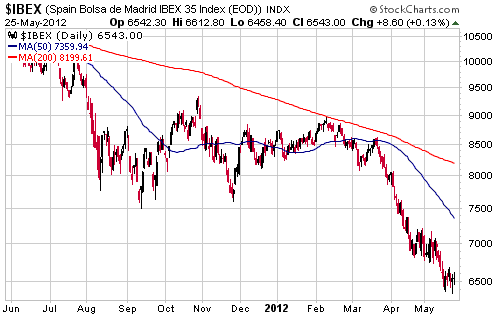
Spain's situation seems to get more desperate by the day, but Spain's stock market (as represented by the IBEX Index) stopped making new lows during the week before last. We can't draw any reasonable conclusions at this early stage about the sustainability of the recent low.
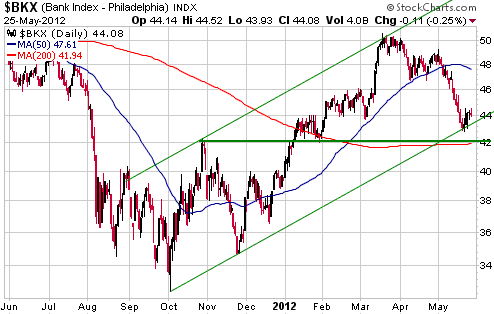
US bank stocks, as represented by the BKX, fell sharply during the first three weeks of May, but the decline hasn't yet been large enough to confirm that an intermediate-term top was put in place in March. Our guess is that an intermediate-term top is in place, but the BKX would have to break below 42 to validate this guess.
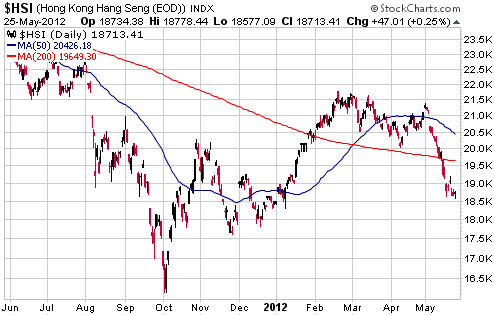
Hong Kong's Hang Seng Index (HSI) has fallen far enough to indicate that an intermediate-term top was put in place earlier this year, but, like most stock indices, the HSI is sufficiently 'oversold' to enable a rebound to begin in the near future.
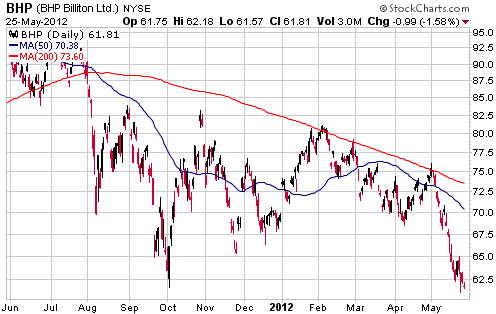
As the world's largest diversified mining company with no major company-specific negatives, BHP can be viewed as a proxy for the mining sector of the stock market. BHP is currently testing its October-2011 low, which means that it is close to a 2-year low.
The mining sector is very 'oversold' on a short-term basis and will probably soon rebound, but we don't like this sector's intermediate-term risk/reward.
This week's
important US economic events
| Date |
Description |
| Monday May 28 | US
markets closed for Memorial Day
| | Tuesday May 29 | Case-Shiller
Home Price Index
Consumer Confidence
Dallas Fed Manufacturing Survey
| | Wednesday May 30 | Pending
Home Sales | | Thursday
May 31 |
Q2 GDP (revised)
Chicago PMI
|
| Friday Jun 01 | Monthly
Employment Report
ISM Index
Motor Vehicle Sales
Personal Income and Spending
Construction Spending
|
Gold and
the Dollar
Gold
GLD's bullion stash versus the gold price
SPDR Gold Shares (GLD) is by far the largest and most heavily traded of the Exchange Traded Funds that hold physical gold bullion. Each GLD share originally (at the November-2004 commencement of the fund) represented exactly 0.1 ounces of gold bullion stored in a vault, but the amount of gold bullion represented by a GLD share very slowly reduces over time due to gold storage costs. As a result, each GLD share now represents 0.097 ounces of physical gold. That's why the market price of GLD is now slightly less than the spot price of one-tenth of a gold ounce.
Gold bullion flows in to and out of GLD's vault to keep the price of a GLD share in line with the current market price of gold. Specifically, if GLD's share price moves above its net asset value (NAV) the fund will purchase, by issuing new GLD shares, sufficient additional gold to bring the NAV back into line with the price, and if GLD's price moves below its NAV then the fund will sell gold from its vault and repurchase shares to achieve the same objective. Or, to put it more simply, GLD keeps its
share price in line with the gold price by issuing shares for gold if its price rises relative to gold and issuing gold for shares if its price falls relative to gold.
This means that falling or rising demand for GLD shares will not automatically lead to a change in the amount of physical gold held by GLD's bullion custodian. To get a change in GLD's gold holdings, the price of GLD must rise or fall relative to the price of gold. For example, if a 10% plunge in the price of GLD is exactly matched by a 10% plunge in the price of gold then there will be no need for GLD to adjust the amount of gold it has in storage. But if a 10% plunge in the GLD price is accompanied by only a 7% plunge in the gold price, then GLD will have to sell some of its gold and repurchase some of its shares.
Due to the relationship between the gold price, the GLD price and GLD's bullion holdings outlined above, we wondered if changes in GLD's bullion holdings reliably predicted changes in the gold price. We therefore created the following chart comparing the gold price with the total amount of gold bullion (measured in tonnes) held by
GLD.
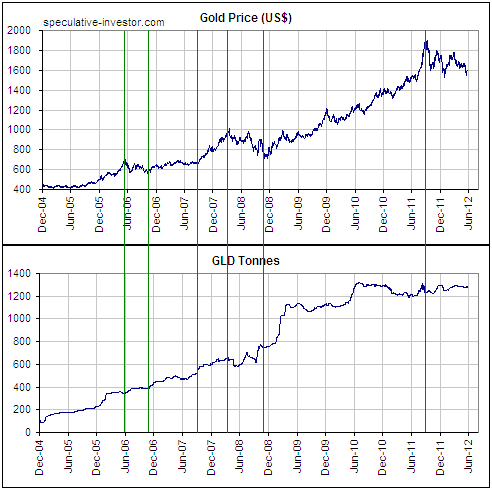
What we found is that there has not been a consistent relationship between significant changes in GLD's gold holdings and the ensuing intermediate-term price trend in the gold market. We note, in particular, that the amount of gold bullion held by GLD rose at a steady pace from GLD's introduction in late 2004 through to late 2008. Although there was increased volatility in GLD's holdings during the 2008 financial crisis, accumulation essentially continued at the same steady pace. There was a sharp increase in GLD's holdings during the first half of 2009, which coincided with large-scale buying of GLD shares by some high-profile hedge funds (most importantly, funds managed by John Paulson). However, gold had clearly begun a new intermediate-term upward trend prior to this surge in GLD demand. Since mid 2009 the amount of gold held by GLD has generally oscillated within a narrow horizontal range, apart from a mini-surge during the second quarter of 2010. Furthermore, you would need to use a lot of imagination to relate gold's 2011 price run-up and subsequent intermediate-term correction to changes in GLD's gold holdings, as the amount of gold held by GLD experienced only minor fluctuations during this period.
A final point is that the amount of gold bullion held by GLD is not substantial in the grand scheme of things, in that the current level of 1270 tonnes is less than 1% of the total aboveground gold supply. Moreover, it's likely that less than half of the gold bullion held by GLD constitutes additional demand for bullion (demand for gold that wouldn't exist in the absence of GLD). For example, big GLD investors such as Paulson, Soros and Einhorn would have purchased their bullion in some other way if GLD didn't exist.
GLD and the funds like it are more of an effect than a cause of a rising gold price, although the cause-effect relationship is self-reinforcing. Increasing investment demand causes the price to rise, which attracts more demand and prompts financial institutions to introduce new ways of participating in the upward price trend, which leads to additional demand, and so on.
Current Market Situation
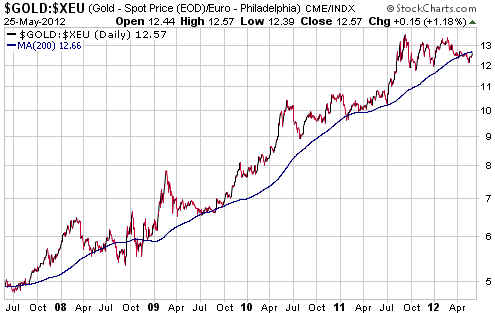
Over the past five years the euro-denominated gold price (gold/euro) has followed a two-step repeating sequence. The first step: move sharply higher. The second step: consolidate for 6-9 months. Each 6-9 month consolidation has involved at least one decline to the 200-day moving average (the blue line on the following chart).
There is currently no evidence that the pattern has changed, in that the most recent consolidation (the one that began last September) has followed a similar path to the previous three. Chances are, it just ended.
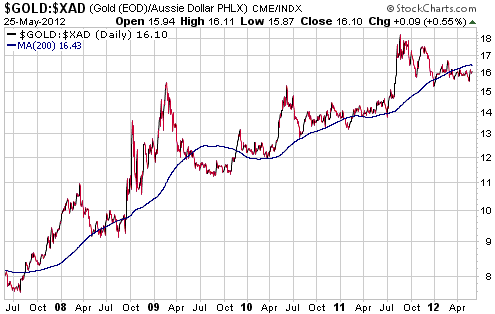
The price of gold has had bigger oscillations in A$ terms than in euro terms. This simply means that the A$ has been more volatile than the euro, since an ounce of gold is always an ounce of gold regardless of which currency it happens to be priced in. But aside from the fact that there has been less consistency in the up-trends and consolidations of gold/A$, the overall price pattern illustrated by the gold/A$ chart displayed below is roughly the same as that illustrated by the gold/euro chart displayed above.
Gold Stocks
Current Market Situation
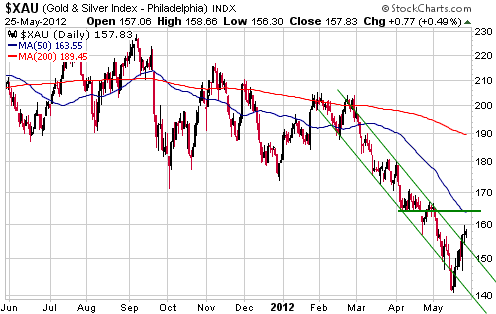
In last week's Interim Update we said that the HUI's initial rebound probably wouldn't get any further than the confluence of resistance at 440. As illustrated below, similar resistance for the XAU lies at 163-165.
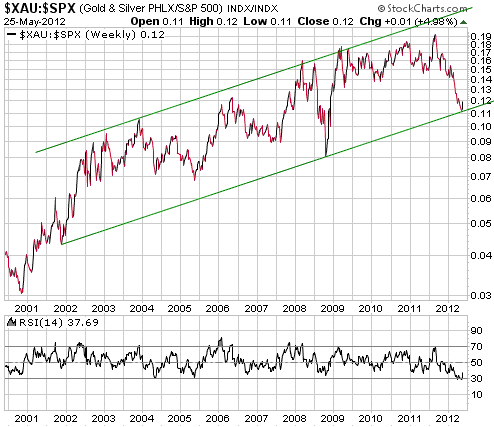
Displayed below is a weekly chart of the XAU/SPX ratio (the gold sector relative to the broad stock market). The chart shows that the XAU/SPX ratio has just turned upward after hitting its long-term channel bottom for only the second time since 2002. The chart also shows that the XAU/SPX's weekly RSI recently hit a 10-year low. A good argument can therefore be made that relative to the broad stock market, the gold sector was recently more 'oversold' than at any other time over the past 10 years.
It isn't every day that you get the chance to buy at the most oversold extreme in 10 years.
After we get confirmation of a bottom we'll lay out some scenarios as to what to expect over the ensuing 6-12 months. As advised in last week's Interim Update, confirmation would come in the form of a higher high following a pullback that lasts somewhere between three days and two weeks.
Great values to prompt more M&A?
Some smart mining analysts and investors expect the great values now existing throughout the gold sector, and especially at the junior end of the gold sector, to bring about a surge in M&A (merger and acquisition) activity as major mining companies snap up the bargains. We doubt it. It would be logical for the majors to take advantage of the great bargains now on offer within the ranks of the juniors, but past performance suggests that they won't.
The past performance we are referring to is the tendency exhibited by the senior managers of large mining companies (the people getting paid the big bucks to make the big decisions) to act like novice investors who get into a buying mood when valuations are high and become paralysed by fear when valuations are low. As far as we can recall, there was no spate of takeovers when gold deposits were in the bargain basement during the final quarter of 2008 and the first quarter of 2009. Rather, most of the takeovers that have involved a major gold mining company buying a junior were done at high valuations. Here are some examples:
1. In October of 2007 NEM paid $1.5B for Miramar Mining in order to obtain the Hope Bay project in Nunavut. Sabina Gold and Silver (SBB.TO), which owns the Back River project and a potentially valuable silver
royalty, is presently being valued by the market at less than one-sixth the amount paid by NEM for Miramar despite a much higher gold price and despite Back River appearing to be a better project than Hope Bay. Perhaps NEM will get interested in making a bid for SBB after the latter's valuation moves into the billions.
2. In February 2011 Newmont agreed to buy Fronteer Gold at a price ($2.3B) that equated to more than $500 per ounce for the latter's in-ground gold. Similar in-ground gold could probably be bought today for less than $100 per ounce, but why pay less than $100 when you can pay more than $500?
3. In August of 2010 Kinross Gold paid a phenomenal $7B to buy 90% of Redback Mining, primarily to obtain the Tasiast project. The value of the assets acquired in this takeover were written down by $3B in February of this year, but are probably still over-valued on Kinross's books.
4. In September of 2010 Goldcorp agreed to buy Andean Resources for about $3.5B in a deal that valued the junior's Argentina-based in-ground gold at more than $1000 per ounce. If it had waited until today it could probably buy the same in-ground gold for less than $100/oz, but it couldn't wait because in September of 2010 Eldorado Gold was also eager to pay more than $1000/oz for Andean.
5. Having missed out on paying an incredibly high price for Andean Resources in late 2010, Eldorado Gold decided to pay way over the top for European Goldfields in December of 2011.
6. In April of 2011 Barrick Gold, a senior gold producer, agreed to pay $7B for a COPPER-producing asset. This purchase was made when the copper price was within a few percent of an all-time high, and prompted us to speculate in a TSI commentary (the 2nd May 2011 Weekly Update) that Barrick had, due to its history of making ill-timed purchases, probably just called the top for the copper market.
The poor timing of takeover bids is undoubtedly one of the reasons that senior gold mining stocks generally underperform gold bullion over long periods of time. The senior miners have to acquire new deposits to replace the ounces they extract from the ground, but they tend to do the bulk of their acquiring when prices are high.
Further to the above, we think that expecting a rally in the juniors to be driven by acquisitive seniors is an example of the triumph of hope over experience. It's more likely that the juniors will rally to much higher prices BEFORE the majors become acquisitive. In other words, high and rising prices will attract the major miners just like they attract the investing public.
If there is going to be a spate of M&A activity in the gold/silver mining sector some time soon, it will probably be led by cashed-up juniors and mid-tiers.
Currency Market Update
Below are two quotes from Jean-Claude Juncker, the prime minister of Luxembourg and the president of the Eurogroup (a group comprising the finance ministers of the euro-zone). The first quote can't be fully understood in the absence of the second.
Quote 1: "I don't envisage, not even for one second, Greece leaving. This is nonsense, this is propaganda."
Quote 2: "When it becomes serious, you have to lie."
The speculative net-short position in euro futures made another all-time high last week and is now roughly double what it was when the euro was bottoming at around 1.20 in May-June of 2010. This net-short position can be considered potential energy. It won't cause the euro's trend to reverse, but it will provide a lot of fuel for the rally that follows an upward reversal.
The following chart suggests that the euro has short-term downside risk to around 1.20. For this risk to materialise, fear of a Greek exit from the euro-zone and uncertainty about what an exit would mean for European monetary union will have to keep building.
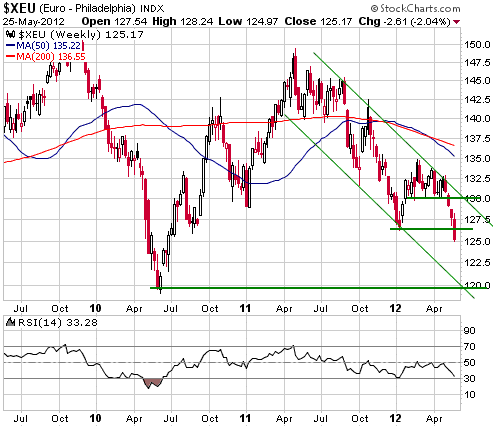
If the above-mentioned fear and uncertainty do continue to build over the weeks immediately ahead then we will probably see simultaneous strength in the Dollar Index and the gold market, with gold rising in US$ terms even as the US$ rises against the euro. This would be similar to what happened in January-February of 2009, April-May of 2010, and during parts of the second and third quarters of last year. In other words, it wouldn't be unprecedented.
Between now and Greece's 17th June election, the currency market will probably be tossed around by the latest Greek polls. If the polls show that the far-left-of-centre Syriza party is gaining the upper hand then currency traders will become more concerned about Greece leaving the euro-zone and will add to their euro 'shorts', whereas short-covering will likely be prompted by signs that Syriza is losing popularity. The
latest polls
reveal some loss of popularity for Syriza, so perhaps there will be some euro short-covering early this week.
It was only 1.5 weeks ago that our short-term US$ outlook shifted to "bearish", but due to the extreme 'fluidity' of the current situation we have shifted it back to "neutral". In this case "neutral" means: almost nothing would surprise us.
Update
on Stock Selections
Notes: 1) To review the complete list of current TSI stock selections, logon at
http://www.speculative-investor.com/new/market_logon.asp
and then click on "Stock Selections" in the menu. When at the Stock
Selections page, click on a stock's symbol to bring-up an archive of
our comments on the stock in question. 2) The Small Stock Watch List is
located at http://www.speculative-investor.com/new/smallstockwatch.html
 Agnico Eagle (AEM) Call Options Agnico Eagle (AEM) Call Options
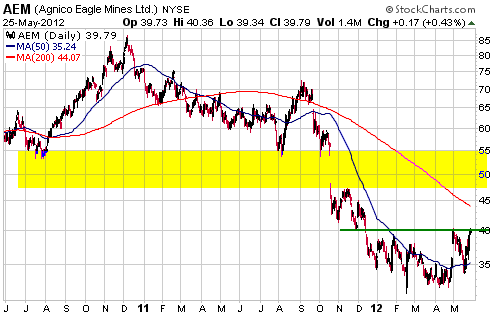
It looks like AEM has almost completed a multi-month basing pattern.
Once it gets above resistance at $40 the obvious target will be the resistance that extends from the high-$40s up to the mid-$50s. Our plan is to take profits on the AEM January-2014 call options in the TSI Stocks List if the stock moves up to around $50 within the next two months.
Clifton Star Resources (TSXV: CFO). Shares: 36M issued, 40M fully diluted. Recent price: C$1.10
In the current environment we would generally direct new buying towards junior gold miners that are cash-flow positive or have a lot of cash on their balance sheets. CFO is one exception to this general rule. CFO has enough cash to fund its business over the next 12 months, but it certainly doesn't qualify as "cash rich". It does, however, have attributes that make it a buy for speculators with high tolerance for risk and volatility.
Last Friday CFO released an updated resource estimate for its Quebec-based Duparquet project. The estimate was done by InnovExplo, an outside consultant.
At 3.4M ounces total (half Indicated, half Inferred), the new resource is lower than we were expecting. However, it involves conservative assumptions and has a high average grade of 1.8-g/t. This resource estimate can, we think, be considered a base case for the Duparquet project. Furthermore, it suggests that there is a good chance of the project being developed into a mine (hopefully by a major or mid-tier miner, not by CFO), although we won't get the first indication of project economics until a Preliminary Economic Assessment is completed in late 2012 or early 2013.
Here's an excerpt from a note sent out by Loewen Ondaatje McCutcheon analyst Michael Fowler in response to CFO's resource update:
"The results show an in-pit resource of 2.4 million ounces at a cut-off grade of 0.6 grams per tonne. This would equate to a resource which potentially could be mined by open pit. In addition an underground resource of 845,000 ounces was estimated at a 2 grams per tonne cut-off. We had been estimating a potentially mineable scenario of between 2.5 to 3 million ounces in a global resource base (which would include resources outside the above potentially mineable parameters) of about 5 million ounces. The estimators did not disclose a global resource, but we feel that it would have been close to that number. Importantly about half of the resource is in the indicated category, which is very positive, as previous estimates had only inferred resources. In our opinion the estimators seemed to have used realistic assumptions. Previous estimates showed a resource of 2.77 million ounces, but they are not directly comparable, since they used different cut-off grades.
The bottom line of this release is that it is positive and can be used as a base for a preliminary economic assessment in the near future. We have a speculative buy on the stock with a $5.96 per share target."
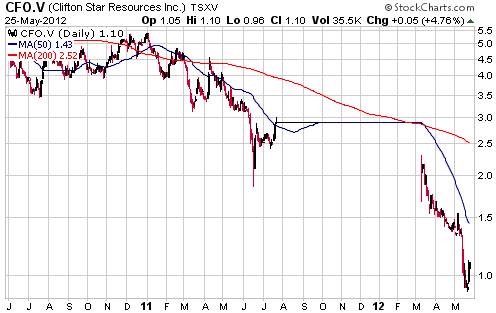
Chart Sources
Charts appearing in today's commentary
are courtesy of:
http://stockcharts.com/index.html

|









